The Income Tax Department is quick to tax profits earned on money gifted within a family. But what happens when those same gifted funds end up in a loss instead of a gain? A recent ruling from the Income Tax Appellate Tribunal, Lucknow Bench, answers this question, and it matters to every household that moves money between spouses for investment.
What Is Clubbing of Income Under Section 64(1)(iv)?
Under Section 64(1)(iv) of the Income Tax Act, 1961, income arising from an asset transferred without adequate consideration to a spouse is added back to the income of the person who made the transfer. If a husband gifts money to his wife and she earns interest, dividends, or capital gains on it, that income is taxed in the husband’s hands, not hers. This clubbing of income rule exists to stop families from splitting income purely to reduce tax, and it is enforced consistently by the Income Tax Department during scrutiny of family investment transfers.
The Case: A Gift, an F&O Trade, and a Tax Dispute
In Vipin Yadav vs. ITO, a husband transferred funds to his wife as a gift. She used the money to trade in equity and futures and options, and the trades resulted in a loss. The taxpayer argued that since profits from gifted funds are taxable in the donor’s hands, losses from the same funds should logically be allowed in the donor’s hands too. The Assessing Officer disagreed, and the matter reached the ITAT.
ITAT’s View: Profit and Loss Cannot Be Treated Differently
The Tribunal examined a core question: can tax law follow the gain but disown the loss arising from the same source? The ITAT held that where income from a gifted asset is liable to be clubbed, a loss from that source cannot be ignored merely because it is a loss. The taxpayer, however, must establish a clear, documented link between the gifted funds and the loss claimed.
A Practical Example
Suppose a husband gifts ₹10 lakh to his wife, who trades it in F&O and incurs a loss of ₹1.5 lakh. Under this clubbing of income and loss principle, that loss may be considered in the husband’s hands rather than the wife’s, provided he can prove the funds traded were the gifted amount. The loss then follows the normal set-off and carry-forward rules for F&O losses.
Tax professionals, including Dr. Haresh Adwani, often note that clubbing disputes turn less on legal principle and more on documentation discipline, since the burden of proving the nexus between a gift and the resulting income or loss always rests with the taxpayer.
Key Takeaways onClubbing of Losses Under Section 64(1)(iv)
At a Glance
Clubbing under Section 64(1)(iv) is not a one-way street that only catches profits.
Losses arising from gifted funds may also be clubbed in the donor’s hands, subject to proof.
A clear trail of the gift deed, bank transfer, and trading statement is essential.
F&O losses, once clubbed, follow standard set-off and carry-forward rules.
Frequently Asked Questions on Clubbing of Losses Under Section 64(1)(iv)
1.Can losses on money gifted to a spouse be clubbed under Section 64(1)(iv)?
Yes. Per the ITAT Lucknow ruling, if income from gifted funds is clubbable, losses from the same source may also be considered in the donor’s hands, subject to proof.
2.What evidence is needed to claim clubbing of a loss?
Taxpayers must show a clear link between the gifted funds and the loss, typically through a gift deed, bank records, and trading statements.
3.Does clubbing of income apply only to F&O and equity losses?
No. Section 64(1)(iv) covers income or loss from any asset gifted to a spouse without adequate consideration, not trading alone.
4.Can clubbed F&O losses still be set off against other income?
Yes, once clubbed, F&O losses follow the normal set-off and carry-forward provisions, including the eight-year carry-forward for non-speculative losses.3.
Conclusion
Clubbing of Losses Under Section 64(1)(iv)
This ruling is a reminder that clubbing of income provisions cut both ways. If gains from gifted funds are taxed in the donor’s hands, fairness and tribunal precedent now demand that losses from the same funds be treated consistently. The real lesson is record-keeping: gift deeds, bank trails, and trading statements can decide whether a clubbing claim succeeds or fails.
Author
CA. Dipesh Gurubakshani. He is a Chartered Accountant with professional experience in audit, direct taxation, and accounting advisory services.
Whether you have already received a credit card income tax notice or want to ensure you never do Adwani and Company is your trusted partner. Led by Dr. Haresh Adwani and a seasoned team of Chartered Accountants, Adwani and Company provides end-to-end income tax compliance, notice response, and financial planning services.
Disclaimer
ITRAdvisor.in is an educational and informational platform focused on tax awareness and compliance updates. Nothing contained herein should be construed as solicitation or advertisement of professional services. Professional services, where applicable, are rendered in accordance with ICAI guidelines. This article is published on ITRAdvisor.in, a tax and compliance knowledge platform.The content has been reviewed for technical accuracy by professionals associated with Adwani & Co LLP
If you have gifted funds to your spouse for investment and are unsure how clubbing of income or loss provisions apply to you, connect with itradvisor.in today for expert guidance.
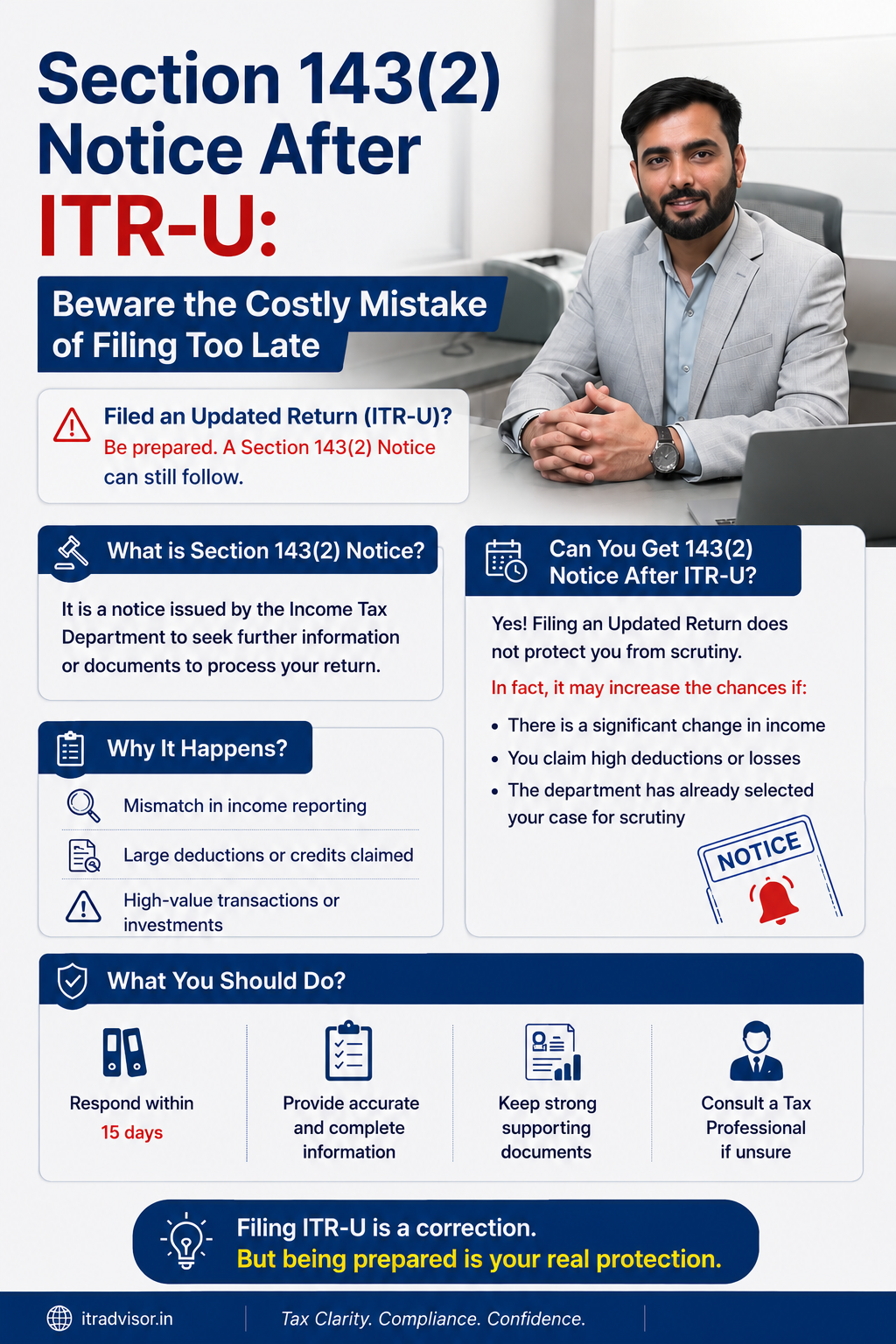
You filed an ITR-U an Updated Return under Section 139(8A) thinking you had corrected your earlier mistake. You breathed easy. Then, a few weeks later, a notice arrived: Section 143(2). Your stomach dropped. If this sounds familiar, you are not alone. Thousands of taxpayers across India are receiving income tax scrutiny notices after filing updated returns, and most of them made one simple but costly mistake they filed too late, or without fully understanding what triggers a 143(2) notice in this context.
What Is Section 143(2) and Why Does It Follow Your ITR-U?
Section 143(2) of the Income Tax Act, 1961 empowers the Assessing Officer (AO) to issue a scrutiny notice when the department believes a return needs closer examination. This is not a penalty it is an invitation to prove that the income you declared is correct and supported by evidence.
When a taxpayer files an ITR-U (Updated Return) under Section 139(8A), the Income Tax Department does not automatically accept the revised figures. In fact, according to the Income Tax Department’s procedural guidelines, updated returns are subject to a higher level of automated and manual scrutiny precisely because they represent a change from the originally filed return.
In plain terms: filing an ITR-U places your return under a magnifying glass. And if the department finds discrepancies in income, deductions, or timing a 143(2) scrutiny notice is almost inevitable.
The Costly Mistake: Filing Your ITR-U Too Late
Section 139(8A) allows a taxpayer to file an updated return within 24 months from the end of the relevant assessment year but each passing year comes with a higher additional tax burden:
When ITR-U is Filed
Additional Tax Payable
Scrutiny Risk Level
Within 12 months from end of AY
25% of additional tax + interest
Moderate
Between 12–24 months from end of AY
50% of additional tax + interest
High
After 24 months (not permitted)
Not allowed under law
Return Invalid
This table tells a clear story: the later you file, the more you pay and the greater the chance of receiving a Section 143(2) notice after filing the ITR-U. The Income Tax Department’s systems are calibrated to flag late updated returns for scrutiny because they often indicate suppression of income in the original filing.
Important Warning
A Section 143(2) notice after filing ITR-U must be responded to within the time specified in the notice typically 15 to 30 days. Failure to respond can lead to ex-parte assessment under Section 144, which can result in a best-judgment assessment with significantly higher tax demand.
Income Tax Notice Time Limit: What the Law Says for 143(2)
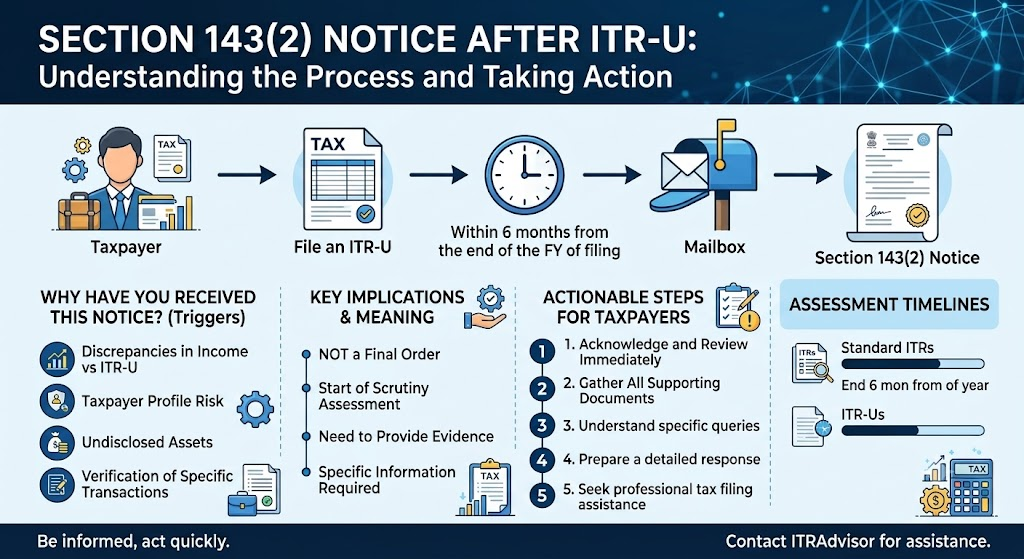
Under the Income Tax Act, the Assessing Officer must issue a Section 143(2) notice within six months from the end of the financial year in which the return was filed. This time limit applies to ITR-U as well. So if you filed your updated return in August 2024 (FY 2024-25), the department has time until 30 September 2025 to issue the 143(2) notice.
This income tax notice time limit is a critical legal protection for taxpayers. If a notice is issued beyond this window, it can be challenged. However, this requires prompt action ideally with professional guidance as courts have strict timelines for such objections.
Read our detailed guide on Income Tax Notice Time Limit to understand exactly when the department’s power to scrutinise expires.
How to Respond to a Section 143(2) Notice After Filing ITR-U
Receiving this notice does not mean you are in trouble — but ignoring it certainly will put you in trouble. Here is the step-by-step response process:
Step 1: Read the Notice Carefully
The notice will specify the assessment year under scrutiny, the issues flagged (income mismatch, deduction claims, etc.), and the deadline to respond. Identify whether the notice relates to your original ITR or the ITR-U specifically.
Step 2: Gather Supporting Documents
Compile Form 16, Form 26AS, AIS (Annual Information Statement), bank statements, investment proofs, and any other documents supporting the income and deductions declared in your updated return. Cross-check your ITR-U with these documents before submitting anything.
Step 3: Respond Through the E-Proceedings Portal
All responses to 143(2) scrutiny notices must be submitted through the Income Tax e-Filing portal (incometax.gov.in) under the ‘Pending Actions’ section. Physical responses are not accepted. Upload all documents clearly labelled and respond to each query point-by-point.
Step 4: Seek Professional Guidance
Income tax scrutiny proceedings can be complex, especially where they involve an updated return. According to Dr. Haresh Adwani, a seasoned tax professional with decades of experience in Indian tax compliance, “taxpayers who respond to 143(2) notices without professional support often provide more information than required, inadvertently opening new lines of inquiry for the Assessing Officer.”
Expert Tip
When responding to a Section 143(2) notice after ITR-U filing, always submit documents that directly address the query nothing more. Over-disclosure is a common mistake that extends scrutiny timelines unnecessarily. Learn more about our Tax Notice Response Service at ITRAdvisor.in.
Can You Avoid a 143(2) Notice After Filing ITR-U?
Not entirely the department has the right to scrutinise any return. But you can reduce the risk significantly by following these practices:
File the ITR-U as early as possible within 12 months of the assessment year end if you can, when the additional tax burden is lower and scrutiny flags are fewer.
Ensure full consistency between the ITR-U and your AIS/Form 26AS. Any mismatch between the two is a primary trigger for income tax scrutiny after an updated return.
Disclose all income correctly partial disclosure in an ITR-U is treated very seriously by the department and can lead to income tax reassessment notice under Section 148 as well.
Keep documentary evidence ready before you file, not after.
Do not use the ITR-U to claim additional refunds the provision is specifically for taxpayers who have under-reported income or missed declaring income, not for claiming higher refunds.
• ITR-U (Updated Return) under Section 139(8A) can be filed within 24 months from the end of the assessment year but later filing means higher tax burden and greater scrutiny risk.
• A Section 143(2) notice after ITR-U is issued when the department needs to verify the accuracy of your updated return.
• The income tax notice time limit for issuing 143(2) is six months from the end of the financial year in which the ITR-U was filed.
• Always respond through the Income Tax e-Filing portal (incometax.gov.in) within the deadline specified in the notice.
• Seek professional guidance before responding over-disclosure can create new problems in scrutiny proceedings.
• Filing ITR-U within 12 months is always preferred to minimise both cost and scrutiny risk.
Frequently Asked Questions (FAQs)
Q1. Can I get a Section 143(2) notice after filing ITR-U even if my return was complete?
Yes. Filing an ITR-U automatically flags your return for enhanced scrutiny. The department issues 143(2) notices based on automated and manual risk parameters, regardless of whether your updated return appears complete.
Q2. What is the income tax notice time limit for Section 143(2) after ITR-U?
The Assessing Officer must issue the 143(2) notice within six months from the end of the financial year in which the updated return was filed. Any notice issued beyond this period can be legally challenged.
Q3. What happens if I do not respond to the income tax scrutiny notice after ITR-U?
Non-response can result in an ex-parte assessment under Section 144, where the AO makes a best-judgment assessment often resulting in a much higher tax demand than what you actually owe.
Q4. Can filing ITR-U trigger an income tax reassessment notice under Section 148 as well?
Yes. If the department believes that income has been under-disclosed even in the ITR-U, they can initiate reassessment proceedings under Section 148. This is why accurate and complete disclosure in the ITR-U is essential.
Q5. Is it better to file ITR-U within 12 months or wait for 24 months?
Always file within 12 months if possible. The additional tax is lower (25% vs 50%), and earlier filing generally attracts less scrutiny compared to returns filed closer to the 24-month deadline.
Conclusion: Don’t Let Timing Become Your Tax Trap
The ITR-U provision was introduced to give taxpayers a second chance — to correct errors and come clean with the Income Tax Department. But this second chance comes with strings attached. A Section 143(2) notice after filing an updated return is not a punishment; it is the department doing its job. What matters is how prepared and professional your response is.
The single most important lesson here: do not delay your ITR-U. The longer you wait, the more you pay, and the greater the scrutiny you face. If you have already received a 143(2) notice, do not panic — but do not delay your response either.
📞 Get Expert Help Today
Confused by a Section 143(2) notice after filing ITR-U? Not sure how to respond without triggering further scrutiny?
Connect with the experts at ITRAdvisor.in today. Our professionals bring deep experience in income tax notice resolution, updated return compliance, and scrutiny proceedings — so you can respond with confidence. Visit: www.itradvisor.in | Expert tax guidance, simplified.
Author
CA. Dipesh Gurubakshani. He is a Chartered Accountant with professional experience in audit, direct taxation, and accounting advisory services.
Whether you have already received a credit card income tax notice or want to ensure you never do Adwani and Company is your trusted partner. Led by Dr. Haresh Adwani and a seasoned team of Chartered Accountants, Adwani and Company provides end-to-end income tax compliance, notice response, and financial planning services.
Disclaimer
ITRAdvisor.in is an educational and informational platform focused on tax awareness and compliance updates. Nothing contained herein should be construed as solicitation or advertisement of professional services. Professional services, where applicable, are rendered in accordance with ICAI guidelines. This article is published on ITRAdvisor.in, a tax and compliance knowledge platform.The content has been reviewed for technical accuracy by professionals associated with Adwani & Co LLP
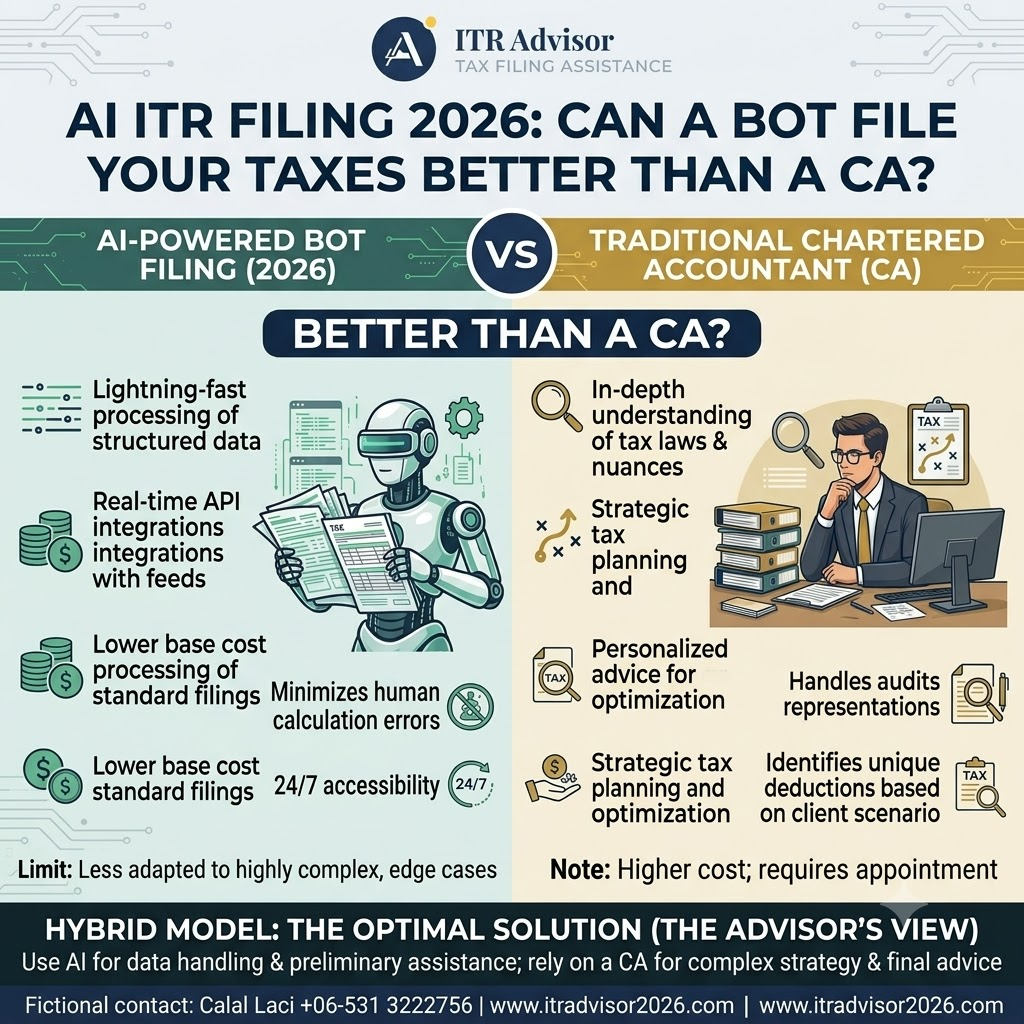
Everyone is asking whether AI can prepare income tax returns. Barely anyone is asking the more important question: who will defend the tax position behind them?
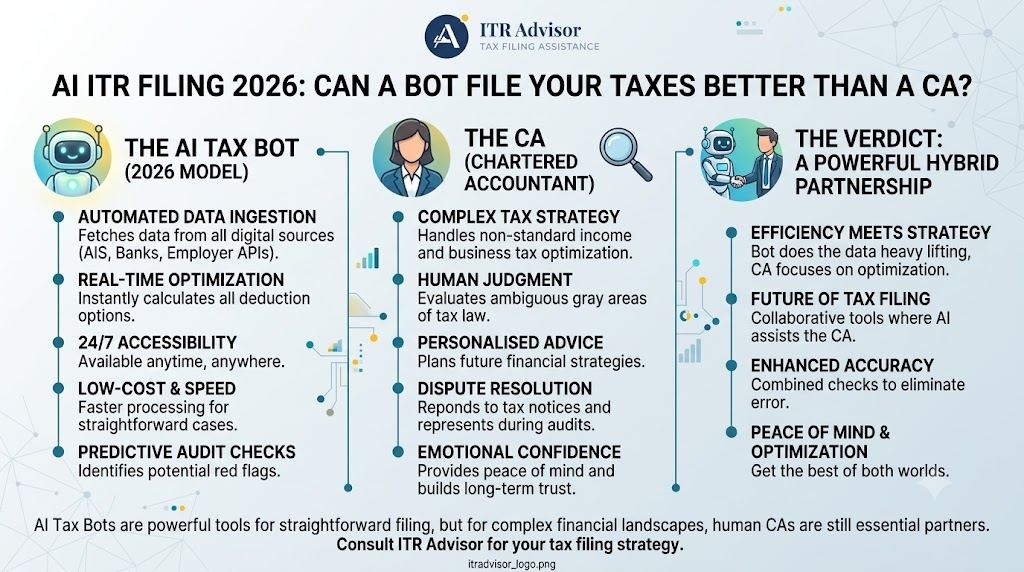
AI ITR filing tools in 2026 are genuinely impressive. They extract data from Form 16 and AIS, pre-populate schedules, flag mismatches with Form 26AS, and generate a draft return faster than any manual process. But here is what they cannot do: determine whether your tax position will hold up if the Income Tax Department sends a notice.
That gap between a technically filed return and a defensible one is exactly what taxpayers need to understand before trusting AI completely with their compliance.
What AI ITR Filing Tools Actually Do Well in 2026
To be fair, AI-assisted tax filing has made meaningful improvements to routine compliance. For straightforward salaried taxpayers with a single employer, Form 16, and standard deductions, AI tools deliver speed and accuracy that was difficult to match manually.
What AI handles reliably in ITR filing 2026:
Auto-fetching pre-filled data from the Income Tax Department’s AIS and Form 26AS
Matching TDS credits with Form 26AS entries to reduce demand notices on mismatch
Suggesting the correct ITR form based on income type — ITR-1, ITR-2, or ITR-4
Computing tax liability under both old and new tax regime and flagging which is lower
Identifying obvious gaps such as a missing TDS entry or an unreported interest income item
Tax risk in India rarely comes from a data extraction error. It comes from reasoning and reasoning is exactly where AI-generated tax returns have a structural gap.
Consider a taxpayer who claims a tax benefit. The numbers are correct. Every document is available. The return passes all system validation checks on the Income Tax Department’s e-filing portal. Yet the questions that matter most remain unanswered:
Questions AI Cannot Answer for Your ITR
→ Is the taxpayer actually eligible for this exemption or deduction?
→ Does a restriction, limitation, or anti-avoidance provision apply?
→ Is there a more advantageous tax position that has not been explored?
→ If the Income Tax Department issues a notice under Section 143(2) or 148, can the position be defended?
These are not rare edge cases. They arise in everyday situations F&O loss set-off against business income, HRA claims without proper rent documentation, deductions under Section 80C with incomplete evidence, or capital gains on equity funds where the holding period is borderline.
The Income Tax Department’s faceless assessment scheme and AI-driven scrutiny systems are specifically designed to catch reasoning inconsistencies not just arithmetic ones. Returns are risk-scored using cross-database matching of ITR data, AIS, GST turnover, MCA filings, and banking transactions. A return that is numerically clean but logically inconsistent across these sources remains a scrutiny risk.
A Real Example: When AI Filed Correctly but Wrongly
Practical Scenario
A freelancer with annual professional receipts of ₹18 lakh used an AI ITR filing tool for AY 2026-27.
The AI correctly:
• Selected ITR-4 (presumptive taxation under Section 44ADA)
• Applied the 50% deemed profit rate declaring ₹9 lakh as income
• Computed tax liability accurately under the new tax regime
What the AI did not evaluate:
• Whether the freelancer had claimed actual expenses exceeding the 50% deemed amount in a prior year, which triggers an obligation to maintain books of account
• Whether certain receipts were from a source that does not qualify under Section 44ADA
Result: The return was filed. But when a scrutiny notice arrived under Section 143(2) querying the presumptive scheme eligibility, there was no documentation trail to support the position. A professional review before filing would have flagged both risks in minutes.
AI ITR Filing 2026 and the Income Tax Notice Risk
As per guidance available through the Income Tax Department’s portal (incometax.gov.in) and CBDT’s risk management framework, cases are increasingly selected for scrutiny based on risk indicators not just mismatches. These indicators include unusual deduction patterns, turnover inconsistencies between ITR and GST returns, and high value transaction disclosures in AIS that do not align with reported income.
In that environment, AI ITR filing 2026 tools create a specific risk: they improve the presentation of a return without improving the underlying defensibility of its positions. A well-formatted, AI-generated return is not automatically a safe return.
This is the reasoning-versus-calculation distinction that tax professionals have been discussing since AI tools entered mainstream compliance and it is the most practically important thing a taxpayer in 2026 needs to understand.
For a detailed breakdown of what triggers income tax notices and how to respond,
What Every Taxpayer Should Remember About AI ITR Filing in 2026
✔ AI ITR filing tools handle data extraction, form selection, and computation well especially for straightforward salaried returns.
✔ The gap is in reasoning: eligibility assessment, deduction defensibility, and position validation.
✔ The Income Tax Department’s faceless assessment and AI-driven risk-scoring evaluate logical consistency not just arithmetic.
✔ Treating an AI-generated ITR as a first draft subject to professional review is the smart approach.
✔ For any non-standard income F&O losses, capital gains, presumptive scheme, foreign income professional review before filing is essential.
Frequently Asked Questions
1. Can AI tools file income tax returns accurately in 2026?
For simple salary-based returns, yes AI tools perform well. For returns involving business income, capital gains, foreign assets, or multiple deduction claims, professional review is strongly recommended before filing.
2. What is the risk of relying only on AI for ITR filing?
The main risk is a reasoning gap AI applies rules mechanically without evaluating whether a specific position is eligible, defensible, or optimal for your situation. This can lead to income tax notices that are difficult to respond to without prior documentation.
3. Does AI ITR filing increase the chance of getting an income tax notice?
Not directly but an AI-filed return that contains an indefensible position is a scrutiny risk regardless of how cleanly it was prepared. The Income Tax Department’s risk-scoring evaluates logical consistency across AIS, GST, and MCA data, not just the arithmetic of the return.
4. Which ITR form should I use for AY 2026-27?
It depends on your income type. ITR-1 is for salaried taxpayers with income up to ₹50 lakh. ITR-2 covers capital gains and multiple properties. ITR-4 applies to presumptive income under Sections 44AD and 44ADA. Read our detailed ITR form selection guide for AY 2026-27 on ITRAdvisor.in.
5. What will be the most valuable tax skill in an AI-driven compliance world?
According to tax professionals including those at Adwani & Co LLP, the highest-value skill will be validating conclusions not just preparing returns. The ability to evaluate whether an AI-generated tax position is legally defensible, commercially reasonable, and consistent with regulatory expectations is what separates a capable tax advisor from a filing service.
Conclusion: AI Is a Tool. Judgment Is the Profession.
AI ITR filing in 2026 is fast, efficient, and accurate on the mechanical layer of compliance. It reduces data entry errors, speeds up return preparation, and makes basic tax filing accessible to a broader audience.
But the most expensive mistakes in taxation are rarely calculation errors. They are reasoning errors wrong eligibility assessments, indefensible deduction claims, and positions that cannot withstand scrutiny. That is where a qualified tax professional still makes the difference that cannot be automated.
The smart approach is not to choose between AI and professional review. It is to use AI for what it does well and ensure a professional reviews what it cannot.
Author
CA. Dipesh Gurubakshani. He is a Chartered Accountant with professional experience in audit, direct taxation, and accounting advisory services.
Whether you have already received a credit card income tax notice or want to ensure you never do Adwani and Company is your trusted partner. Led by Dr. Haresh Adwani and a seasoned team of Chartered Accountants, Adwani and Company provides end-to-end income tax compliance, notice response, and financial planning services.
Get Expert Tax Guidance
If you want to file your ITR accurately and defend it confidently visit ITRAdvisor.in today.
From ITR form selection and tax regime comparison to notice response and professional review, ITRAdvisor.in gives you the tax knowledge you need to stay compliant and avoid costly mistakes
ITRAdvisor.in is an educational and informational platform focused on tax awareness and compliance updates. Nothing contained herein should be construed as solicitation or advertisement of professional services. Professional services, where applicable, are rendered in accordance with ICAI guidelines. This article is published on ITRAdvisor.in, a tax and compliance knowledge platform.
The content has been reviewed for technical accuracy by professionals associated with Adwani & Co LLP.
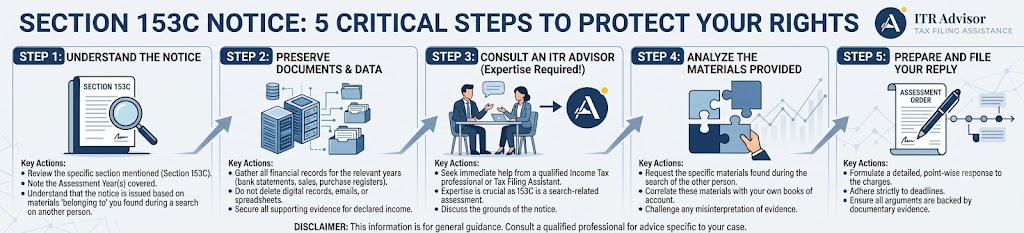
Section 153C Notice : 5 Critical Steps to Protect Your Rights
You didn’t face a search. You didn’t face a seizure. And yet, one morning, a Section 153C income tax notice lands at your door addressed to you as a third party whose documents were found during a raid on someone else. This is where taxpayers make their most expensive mistake: they either panic and overshare, or they ignore the notice entirely. Both approaches can destroy an otherwise defensible position. Here’s everything you need to know and the 5 critical steps that could make all the difference.
What Is a Section 153C Notice in Income Tax? Understanding the Search & Seizure Connection
Section 153C of the Income Tax Act, 1961 is one of the most powerful and misunderstood provisions in Indian taxation. It allows the Income Tax Department to assess a person called a ‘non-searched person’ based on incriminating documents, books of account, or assets belonging to them that were found during a search and seizure operation conducted at another person’s premises under Section 132.
In plain terms: if you are a business partner, family member, client, or associate of someone whose premises were raided, and the department finds papers or digital records belonging to you during that raid, you can receive a Section 153C search and seizure notice even though no search was ever conducted at your own address.
The Income Tax Department, as guided by CBDT circulars available on incometax.gov.in, uses this provision to widen the net of a search operation beyond the original searched person. This makes Section 153C notices particularly dangerous because taxpayers often receive them with no context about what was found, where, or by whom.
Section 153C vs Section 153A: Why the Difference Matters for Your Section 153C Notice
Section 153A applies to the searched person the one whose premises were actually raided. Section 153C applies to a third party someone connected to the searched person. This distinction is not just academic. Under Section 153C, the Assessing Officer of the searched person must first record a satisfaction note establishing that the seized documents ‘belong to’ or ‘pertain to’ the non-searched person, and then transmit those documents and the satisfaction note to the AO having jurisdiction over you. If this satisfaction note is missing, vague, or improperly recorded, your Section 153C notice is legally vulnerable to challenge.
Critical Legal Point
The Supreme Court of India and multiple High Courts have consistently held that a Section 153C notice is invalid if:
• The satisfaction note by the AO of the searched person is absent or defective
• The documents found cannot be shown to ‘belong to’ the non-searched person
• The notice is issued beyond the prescribed time limit under Section 153C Source: CBDT guidelines and landmark rulings including CIT vs. Kabul Chawla (Delhi HC)
Section 153C Time Limit: A Crucial Safeguard That Many Taxpayers Miss
The income tax notice time limit under Section 153C is strictly prescribed. The AO can issue a Section 153C notice for six assessment years immediately preceding the year of search and, in cases of escaped income of ₹50 lakh or more in any year, up to ten assessment years preceding the year of search can be covered.
If a Section 153C notice is issued for years beyond this window, it is barred by limitation and legally challengeable. Always check the date of search and the assessment years covered in your notice. This simple check has helped many taxpayers avoid unnecessary compliance entirely.
5 Critical Steps to Protect Your Rights When You Receive a Section 153C Notice
1: Do Not Panic : But Act Immediately The moment you receive a Section 153C income tax notice, acknowledge its receipt and note the response deadline. Never ignore it non-response can lead to ex-parte assessment and severe adverse orders. Your response window is typically 30 days, but this can vary.
2: Examine the Notice for Procedural Validity Check: (a) Is a satisfaction note recorded by the searched person’s AO? (b) Does the notice specify what documents were found and how they ‘belong to’ you? (c) Is the notice within the Section 153C time limit? Any defect here is a ground for legal challenge before you even address the merits.
3: Gather and Organise Your Financial Records: Compile all books of account, bank statements, ITRs, agreements, and correspondence for the years under scrutiny. Cross-check what the department may have found against what was legitimately disclosed. Unexplained gaps are far more dangerous than disclosed income.
4: File a Detailed, Calibrated Written Reply :Your reply to the Section 153C notice must be factual, legally precise, and free of unnecessary admissions. Address each document or asset the notice references. Raise preliminary objections on jurisdiction and limitation first, then respond on merits — in the same reply if the deadline doesn’t allow separate submissions.
Step 5: Engage a Qualified Tax Professional Immediately: Section 153C proceedings involve complex interplay of search and seizure law, assessment procedure, and evidentiary standards. As tax professionals associated with Adwani & Co LLP led by Dr. Haresh Adwani have noted in practice, the difference between a well-prepared Section 153C reply and a reactive one can run into crores of rupees in tax demand. Do not navigate this alone.
Key Takeaway
Section 153C notice can reach you even if your own premises were never searched
A missing or defective satisfaction note by the searched person’s AO = legally invalid notice
Always verify the Section 153C time limit notices beyond 6/10 assessment years are barred
Section 153C is distinct from Section 153A your rights as a non-searched person differ significantly
A precise, legally grounded reply is non-negotiable never reply without professional guidance Government reference: Income Tax Department guidelines at incometax.gov.in and CBDT search & seizure circulars
Frequently Asked Questions
Q1. What is a Section 153C notice and who can receive it?
A Section 153C notice is issued to a non-searched person whose documents or assets are found during a search at someone else’s premises. You can receive it even if no raid was conducted at your own address.
Q2. Can I challenge a Section 153C notice on procedural grounds?
Yes. If the satisfaction note is absent or defective, or if the notice covers years beyond the Section 153C time limit, you can raise legal objections. Courts have quashed Section 153C notices on these grounds.
Q3. How many years can be covered under a Section 153C income tax search notice?
Typically 6 assessment years preceding the year of search. In cases of escaped income of ₹50 lakh or more, this can extend to 10 assessment years.
Q4. What documents should I collect after receiving a Section 153C notice?
Collect ITRs, bank statements, books of account, contracts, and any financial records for the relevant assessment years. Cross-reference them against what the department may have seized.
Q5. Is Section 153C the same as a scrutiny notice under Section 143(2)?
No. Section 153C arises specifically from search and seizure proceedings under Section 132 and involves much higher legal stakes. A Section 153C reply requires specialised legal and tax expertise — it is far more complex than a routine scrutiny notice
Conclusion:
Receiving a Section 153C income tax notice is not the end of the world but it requires an informed, strategic response from day one. Verify the notice’s procedural validity, check the Section 153C time limit, organise your financial records, and file a calibrated reply that addresses legal objections first and merits second. The Income Tax Department’s search and seizure machinery is powerful, but it operates within legal boundaries boundaries that protect you if you know how to invoke them.
The worst thing you can do after receiving a Section 153C notice is to respond in panic, overshare information, or go silent. The second-worst thing is to face it without experienced guidance.
Author
CA. Dipesh Gurubakshani. He is a Chartered Accountant with professional experience in audit, direct taxation, and accounting advisory services.
Whether you have already received a credit card income tax notice or want to ensure you never do Adwani and Company is your trusted partner. Led by Dr. Haresh Adwani and a seasoned team of Chartered Accountants, Adwani and Company provides end-to-end income tax compliance, notice response, and financial planning services.
Get Expert Tax Guidance
If you want to file your ITR accurately and defend it confidently visit ITRAdvisor.in today.
From ITR form selection and tax regime comparison to notice response and professional review, ITRAdvisor.in gives you the tax knowledge you need to stay compliant and avoid costly mistakes.
→ Understand Income Tax Notices and How to Respond Visit: ITRAdvisor.in
Disclaimer
ITRAdvisor.in is an educational and informational platform focused on tax awareness and compliance updates. Nothing contained herein should be construed as solicitation or advertisement of professional services. Professional services, where applicable, are rendered in accordance with ICAI guidelines. This article is published on ITRAdvisor.in, a tax and compliance knowledge platform.
The content has been reviewed for technical accuracy by professionals associated with Adwani & Co LLP.
Everyone is asking whether AI can prepare income tax returns. Barely anyone is asking the more important question: who will defend the tax position behind them?
AI ITR filing tools in 2026 are genuinely impressive. They extract data from Form 16 and AIS, pre-populate schedules, flag mismatches with Form 26AS, and generate a draft return faster than any manual process. But here is what they cannot do: determine whether your tax position will hold up if the Income Tax Department sends a notice.
That gap between a technically filed return and a defensible one is exactly what taxpayers need to understand before trusting AI completely with their compliance.
What AI ITR Filing Tools Actually Do Well in 2026
To be fair, AI-assisted tax filing has made meaningful improvements to routine compliance. For straightforward salaried taxpayers with a single employer, Form 16, and standard deductions, AI tools deliver speed and accuracy that was difficult to match manually.
What AI handles reliably in ITR filing 2026:
Auto-fetching pre-filled data from the Income Tax Department’s AIS and Form 26AS
Matching TDS credits with Form 26AS entries to reduce demand notices on mismatch
Suggesting the correct ITR form based on income type ITR-1, ITR-2, or ITR-4
Computing tax liability under both old and new tax regime and flagging which is lower
Identifying obvious gaps such as a missing TDS entry or an unreported interest income item
Tax risk in India rarely comes from a data extraction error. It comes from reasoning and reasoning is exactly where AI-generated tax returns have a structural gap.
Consider a taxpayer who claims a tax benefit. The numbers are correct. Every document is available. The return passes all system validation checks on the Income Tax Department’s e-filing portal. Yet the questions that matter most remain unanswered:
Questions AI Cannot Answer for Your ITR
→ Is the taxpayer actually eligible for this exemption or deduction?
→ Does a restriction, limitation, or anti-avoidance provision apply?
→ Is there a more advantageous tax position that has not been explored? → If the Income Tax Department issues a notice under Section 143(2) or 148, can the position be defended?
These are not rare edge cases. They arise in everyday situations F&O loss set-off against business income, HRA claims without proper rent documentation, deductions under Section 80C with incomplete evidence, or capital gains on equity funds where the holding period is borderline.
The Income Tax Department’s faceless assessment scheme and AI-driven scrutiny systems are specifically designed to catch reasoning inconsistencies not just arithmetic ones. Returns are risk-scored using cross-database matching of ITR data, AIS, GST turnover, MCA filings, and banking transactions. A return that is numerically clean but logically inconsistent across these sources remains a scrutiny risk.
A Real Example: When AI Filed Correctly but Wrongly
Practical Scenario
A freelancer with annual professional receipts of ₹18 lakh used an AI ITR filing tool for AY 2026-27.
The AI correctly:
• Selected ITR-4 (presumptive taxation under Section 44ADA)
• Applied the 50% deemed profit rate declaring ₹9 lakh as income
• Computed tax liability accurately under the new tax regime
What the AI did not evaluate:
• Whether the freelancer had claimed actual expenses exceeding the 50% deemed amount in a prior year, which triggers an obligation to maintain books of account
• Whether certain receipts were from a source that does not qualify under Section 44ADA
Result: The return was filed. But when a scrutiny notice arrived under Section 143(2) querying the presumptive scheme eligibility, there was no documentation trail to support the position. A professional review before filing would have flagged both risks in minutes.
AI ITR Filing 2026 and the Income Tax Notice Risk
As per guidance available through the Income Tax Department’s portal (incometax.gov.in) and CBDT’s risk management framework, cases are increasingly selected for scrutiny based on risk indicators — not just mismatches. These indicators include unusual deduction patterns, turnover inconsistencies between ITR and GST returns, and high-value transaction disclosures in AIS that do not align with reported income.
In that environment, AI ITR filing 2026 tools create a specific risk: they improve the presentation of a return without improving the underlying defensibility of its positions. A well-formatted, AI-generated return is not automatically a safe return.
This is the reasoning-versus-calculation distinction that tax professionals have been discussing since AI tools entered mainstream compliance and it is the most practically important thing a taxpayer in 2026 needs to understand.
What Every Taxpayer Should Remember About AI ITR Filing in 2026
✔ AI ITR filing tools handle data extraction, form selection, and computation well especially for straightforward salaried returns.
✔ The gap is in reasoning: eligibility assessment, deduction defensibility, and position validation.
✔ The Income Tax Department’s faceless assessment and AI-driven risk-scoring evaluate logical consistency not just arithmetic.
✔ Treating an AI-generated ITR as a first draft subject to professional review is the smart approach.
✔ For any non-standard income F&O losses, capital gains, presumptive scheme, foreign income professional review before filing is essential.
Frequently Asked Questions
1. Can AI tools file income tax returns accurately in 2026?
For simple salary-based returns, yes AI tools perform well. For returns involving business income, capital gains, foreign assets, or multiple deduction claims, professional review is strongly recommended before filing.
2. What is the risk of relying only on AI for ITR filing?
The main risk is a reasoning gap AI applies rules mechanically without evaluating whether a specific position is eligible, defensible, or optimal for your situation. This can lead to income tax notices that are difficult to respond to without prior documentation.
3. Does AI ITR filing increase the chance of getting an income tax notice?
Not directly, but an AI-filed return that contains an indefensible position is a scrutiny risk regardless of how cleanly it was prepared. The Income Tax Department’s risk-scoring evaluates logical consistency across AIS, GST, and MCA data, not just the arithmetic of the return.
4. Which ITR form should I use for AY 2026-27?
It depends on your income type. ITR-1 is for salaried taxpayers with income up to ₹50 lakh. ITR-2 covers capital gains and multiple properties. ITR-4 applies to presumptive income under Sections 44AD and 44ADA. Read our detailed ITR form selection guide for AY 2026-27 on ITRAdvisor.in.
5. What will be the most valuable tax skill in an AI-driven compliance world?
According to tax professionals including those at Adwani & Co LLP, the highest-value skill will be validating conclusions not just preparing returns. The ability to evaluate whether an AI-generated tax position is legally defensible, commercially reasonable, and consistent with regulatory expectations is what separates a capable tax advisor from a filing service.
Conclusion:
AI ITR filing in 2026 is fast, efficient, and accurate on the mechanical layer of compliance. It reduces data entry errors, speeds up return preparation, and makes basic tax filing accessible to a broader audience.
But the most expensive mistakes in taxation are rarely calculation errors. They are reasoning errors wrong eligibility assessments, indefensible deduction claims, and positions that cannot withstand scrutiny. That is where a qualified tax professional still makes the difference that cannot be automated.
The smart approach is not to choose between AI and professional review. It is to use AI for what it does well and ensure a professional reviews what it cannot.
Author
CA.Dipesh Gurubakshani. He is a Chartered Accountant with professional experience in audit, direct taxation, and accounting advisory services.
Whether you have already received a credit card income tax notice or want to ensure you never do — Adwani and Company is your trusted partner. Led by Dr. Haresh Adwani and a seasoned team of Chartered Accountants, Adwani and Company provides end-to-end income tax compliance, notice response, and financial planning services.
Get Expert Tax Guidance
If you want to file your ITR accurately and defend it confidently visit ITRAdvisor.in today.
From ITR form selection and tax regime comparison to notice response and professional review, ITRAdvisor.in gives you the tax knowledge you need to stay compliant and avoid costly mistakes.
→ Read our ITR Filing Guide for AY 2026-27
→ Explore the Old vs New Tax Regime Comparison 2026
→ Understand Income Tax Notices and How to Respond Visit: ITRAdvisor.in
Disclaimer
ITRAdvisor.in is an educational and informational platform focused on tax awareness and compliance updates. Nothing contained herein should be construed as solicitation or advertisement of professional services. Professional services, where applicable, are rendered in accordance with ICAI guidelines. This article is published on ITRAdvisor.in, a tax and compliance knowledge platform.
The content has been reviewed for technical accuracy by professionals associated with Adwani & Co LLP.
Investment Planning Tax Saving Section 80CELSSCA Advice India Income Tax Act Financial Planning 2026
The investment decision took 60 seconds. Not because the client was reckless but because the right groundwork had already been laid. With a clear picture of his tax liability, eligible deductions, and long-term goals, the answer was obvious. This is what truly smart investment decisions in India look like.
Most Indians make investment decisions backwards. They pick a product a mutual fund, an insurance policy, an FD and then scramble in March wondering if it saves tax. The result? Rushed choices, suboptimal returns, and a tax bill that could have been much smaller.
The truth is that smart investment decisions in India are not about picking the highest yielding instrument. They are about understanding how money, law, and time interact and making a deliberate, informed choice well before the financial year ends. This blog breaks down exactly how to do that, drawing on the principles that guide the advisory work at Adwani and Company,
₹1.5LMax deduction under Section 80C per year
₹1.25LTax-free LTCG on equity per financial year
30%Max tax slab for individuals above ₹15L income
60 sec Time for a confident investment call with the right plan
Why Smart Investment Decisions in India Start with Tax, Not Returns
Here is a question most investors never ask: “How much of this return will I actually keep after tax?” A savings instrument yielding 8% might deliver only 5.6% post-tax if you are in the 30% bracket. Meanwhile, an ELSS fund delivering 12% CAGR combined with the Section 80C deduction could outperform nearly every traditional instrument on an effective basis.
According to guidelines published by the Income Tax Department of India, individuals can claim deductions on a wide range of investments and expenditures under Chapter VI-A of the Income Tax Act, 1961. These deductions directly reduce your taxable income meaning every rupee deducted is a rupee on which you pay zero tax.
The key insight that separates average investors from truly informed ones: smart investment decisions in India treat tax savings as part of the return, not as a bonus on top of it. This mental shift changes everything about how you evaluate an instrument.
The 60-Second Investment Decision: How Prepared Investors Think
A client once walked into the office of Adwani and Company in early February, looking stressed. He had ₹1.5 lakhs to invest before March 31st and had been scrolling through product comparisons for weeks. Within 60 seconds of reviewing his tax profile, Dr. Haresh Adwani identified that the client was in the 30% slab, had no existing 80C investments, and had capital gains from a mutual fund redemption. The recommendation was immediate and precise: ELSS for the current year, with a staggered SIP to begin the next financial year, and a review of capital gains against the ₹1.25 lakh exemption limit.
The decision was fast because the analysis was already done. This is the real lesson: smart investment decisions in India appear effortless when the foundation tax profile, risk appetite, cash flow, and goal mapping is already in place. Preparation is what makes confidence possible.
5-year value (ELSS)~₹2,64,000 + ₹46,800 tax saving = ₹3,10,800 effective
5-year value (FD)~₹1,96,000 post-tax
Advantage of smart investment decision~₹1,14,800 additional wealth created
Smart Investment Decisions in India: Top Tax-Saving Instruments Explained
1. ELSS : Equity Linked Savings Scheme
ELSS funds offer the dual benefit of equity-linked market returns and a deduction under Section 80C up to ₹1.5 lakh per year. With a 3-year lock-in (the shortest among 80C instruments), they are the go-to for investors comfortable with moderate risk. Long-term capital gains above ₹1.25 lakh are taxed at a preferential 12.5%, making ELSS one of the most tax-efficient instruments for smart investment decisions in India.
2. Public Provident Fund (PPF)
For those seeking capital protection, PPF offers an EEE (Exempt-Exempt-Exempt) status meaning the contribution, the interest earned, and the maturity amount are all tax-free. The 15-year lock-in suits long-term goals like retirement. While returns are lower than equity, the tax-free compounding makes the effective yield competitive for debt investors.
3. National Pension System (NPS)
NPS allows an additional deduction of ₹50,000 under Section 80CCD(1B) — over and above the ₹1.5 lakh 80C limit. For a person in the 30% bracket, this alone saves ₹15,600 annually. The new tax regime also allows employers’ NPS contributions as a deduction, making it a compelling instrument for smart investment decisions in India among salaried employees.
4. Health Insurance —:Section 80D
Often overlooked as an “investment,” health insurance premiums are deductible under Section 80D. For individuals below 60, the limit is ₹25,000 (self and family) plus ₹25,000 for parents, rising to ₹50,000 if parents are senior citizens. Dr. Haresh Adwani frequently points out that health insurance is one of the highest-ROI financial decisions an Indian can make — it protects wealth while reducing tax burden simultaneously.
Read our detailed guide on :Section 80GGC Deduction Disallowance: ITAT Rules That Suspicion Is Not Enough, A Guide for Indian Taxpayers
The Role of a Chartered Accountant in Smart Investment Decisions
A great CA does not merely file your returns. A great CA becomes your financial co-pilot helping you see opportunities that spreadsheets and fintech apps can miss. At Adwani and Company, the approach to investment advisory is anchored in both financial analysis and legal precision. Dr. Haresh Adwani’s dual expertise a PhD in Commerce and a formal legal education means that every recommendation considers not just tax efficiency but also legal compliance, documentation requirements, and audit defensibility.
“The biggest tax mistake Indians make is treating investment planning as a year-end activity. True wealth creation starts with a plan made at the beginning of the financial year and revisited every quarter.”
The Ministry of Corporate Affairs (MCA) and the Income Tax Department have increasingly digitised compliance which means discrepancies between your investment records and tax filings are easier to detect than ever. Having a qualified CA review your investment-linked deductions before filing is not optional; it is essential.
How Smart Investment Decisions in India Protect Your Wealth Long-Term
Beyond annual tax saving, smart investment decisions in India create a compounding effect on wealth. Consider this: a 35-year-old who begins tax-optimised investing with ₹3 lakh per year across ELSS, PPF, and NPS, saving approximately ₹93,000 in annual taxes, will have deployed that tax saving as additional capital for 25 years. At a modest 8% annual growth, that recycled tax saving alone compounds to over ₹71 lakh by retirement. This is wealth that would simply not exist without deliberate planning.
Start early in the financial year : April decisions beat March panic
Review your tax slab before choosing instruments : old vs new regime matters
Diversify across 80C, 80CCD, and 80D for maximum deduction coverage
Account for capital gains before adding new equity positions
Involve a qualified CA self-filing misses nuanced deductions regularly
Common Mistakes That Derail Smart Investment Decisions in India
Even informed investors fall into predictable traps. The most common one: choosing the new tax regime without actually calculating whether the old regime (with deductions) delivers a better post-tax outcome. The answer is not universal it depends entirely on the individual’s deduction profile.
Other critical errors include overlooking Form 26AS before filing (which reflects TDS deducted by employers and banks), missing the ₹1.25 lakh LTCG exemption on equity, or failing to declare foreign assets and income as now mandated by the Income Tax Act’s Schedule FA. Adwani and Company regularly helps clients catch these gaps before they become notices from the Department.
A detailed, forward-looking financial review — not just a tax filing exercise — is what separates reactive taxpayers from proactive wealth builders making genuinely smart investment decisions in India. Learn more about our ITR Filing and Compliance Services — accurate, audit-ready returns with zero last-minute stress
Frequently Asked Questions
1.What is the best tax-saving investment option in India for salaried employees in 2026?
For salaried employees in the 30% tax bracket, a combination of ELSS (for 80C), NPS (for the additional ₹50,000 deduction under 80CCD(1B)), and health insurance (80D) typically provides the best post-tax outcome. The choice between old and new tax regimes should be calculated individually — a qualified CA at Adwani and Company can model both scenarios for your specific income profile.
Conclusion:
That client who made his investment decision in 60 seconds was not fortunate. He was prepared. Behind those 60 seconds was a year of structured planning, a clear tax profile, and the guidance of professionals who understood both the numbers and the law. That is the promise of smart investment decisions in India: not speed, but confidence born from clarity.
The Indian tax code, under the Income Tax Act, 1961 and as updated through successive Union Budgets, offers a remarkable range of legal tools to reduce your liability and grow your wealth. But these tools only work when they are used deliberately, early, and in the right combination for your specific financial situation.
Whether you are a salaried professional, a business owner, or an HNI investor, the principles remain the same: understand your tax exposure, choose instruments that serve both financial and tax goals, and work with an expert who can see the full picture. At Adwani and Company, Dr. Haresh Adwani brings a rare combination of academic rigour, legal knowledge, and practical CA experience to every client engagement ensuring that your investment decisions are not just smart, but provably so.
Author
CA Dipesh Gurubakshani is a Chartered Accountant with Adwani & Co LLP, Pune, specialising in income tax audit, direct taxation, and accounting advisory. He supports clients across statutory compliance, financial reporting, and income tax matters with a focus on accuracy, regulatory adherence, and disciplined execution.
Disclaimer: ITRAdvisor.in is an educational and informational platform focused on tax awareness and compliance updates. Nothing contained herein should be construed as solicitation or advertisement of professional services. Professional services, where applicable, are rendered in accordance with ICAI guidelines. This article is published on ITRAdvisor.in, a tax and compliance knowledge platform. The content has been reviewed for technical accuracy by professionals associated with Adwani & Co LLP.
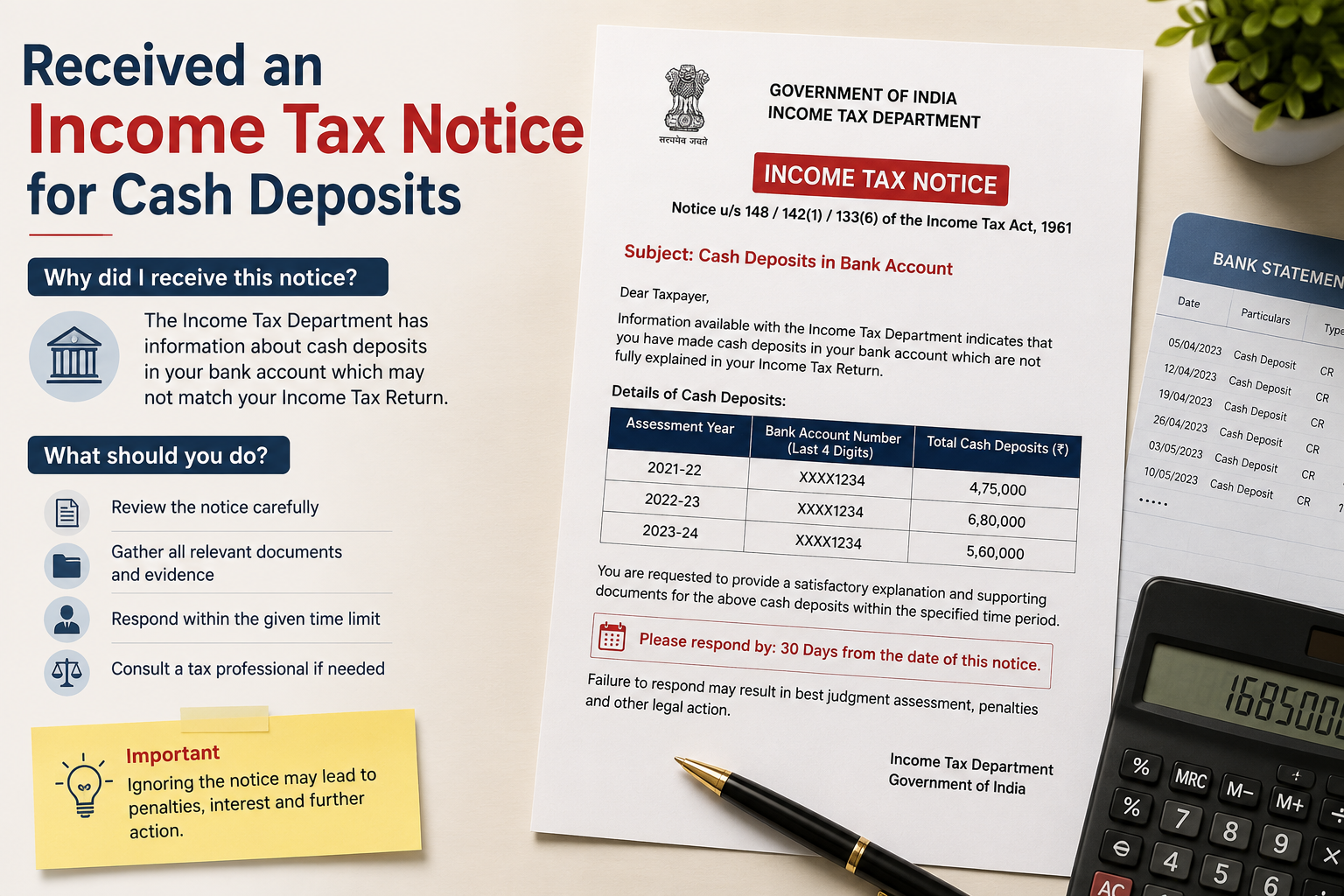
Received an Income Tax Notice for Cash Deposits? Don’t Panic
Have you recently received an Income Tax notice for cash deposits in your bank account?
You’re not alone
Every year, thousands of taxpayers receive notices from the Income Tax Department after depositing substantial amounts of cash in savings accounts, current accounts, or other bank accounts.
In many cases, the deposits are genuine and fully explainable. However, ignoring the notice or providing an incomplete response can lead to scrutiny, reassessment proceedings, additional tax demands, penalties, and prolonged litigation.
This guide explains why you may have received an Income Tax notice for cash deposits, what documents you should collect, how to respond, and how to protect yourself from unnecessary tax disputes in AY 2026-27.
Why Did You Receive an Income Tax Notice for Cash Deposits?
Banks and financial institutions report certain high-value transactions to the Income Tax Department.
The Department uses data analytics, PAN-based reporting, AIS (Annual Information Statement), and other information sources to identify cases where cash deposits appear inconsistent with the income reported in the Income Tax Return (ITR).
Common situations that trigger notices include:
Large cash deposits in savings accounts
Significant cash deposits in current accounts
Cash deposits not matching declared income
Cash deposits during specific monitoring periods
High-value transactions reflected in AIS
Cash deposits where no ITR has been filed
The notice does not automatically mean tax evasion. It simply means the Department requires an explanation.
Common Reasons for Large Cash Deposits
Before responding, identify the actual source of funds.
Legitimate sources may include:
Cash Sales from Business
Businesses dealing in cash may deposit daily collections into bank accounts.
Supporting records should be maintained.
Agricultural Income
Agricultural income may generate substantial cash receipts in certain cases.
Proper evidence should be available.
Withdrawal and Redeployment of Cash
Taxpayers sometimes redeposit cash previously withdrawn from bank accounts.
A clear cash flow trail is important.
Sale of Assets
Cash received from the sale of certain assets may be deposited into a bank account.
Documentation must support the transaction.
Gifts or Family Contributions
In some situations, cash may have been received from family members or relatives.
Proper documentation becomes critical.
Past Savings
Taxpayers may deposit accumulated cash savings.
However, the source and accumulation history should be capable of explanation.
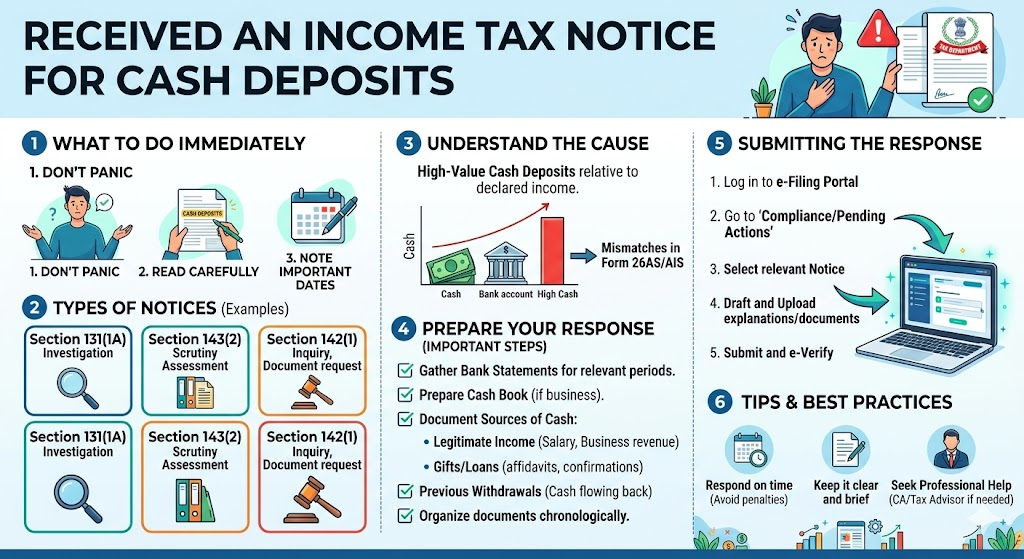
What Types of Notices May Be Issued?
The Income Tax Department may issue different notices depending upon the facts of the case.
Common notices include:
Notice Seeking Information
The Department may ask you to explain the source of cash deposits and provide supporting evidence.
Scrutiny Proceedings
Your return may be selected for detailed examination.
Reassessment Proceedings
In certain circumstances, reassessment proceedings may be initiated if income is believed to have escaped assessment.
Section 148 Notice
A notice under Section 148 may be issued in cases where the Department believes taxable income may not have been properly reported.
A Section 148 notice should never be ignored and requires careful professional review.
What Should You Do Immediately After Receiving the Notice?
Step 1: Read the Notice Carefully
Identify:
Notice section
Assessment year involved
Response deadline
Information requested
Different notices require different responses.
Step 2: Download AIS and Form 26AS
Review:
Reported cash transactions
Bank information
TDS records
Other financial transactions
TDS records
Other financial transactions
Many notices originate from information reflected in AIS.
Step 3: Gather Supporting Documents
Collect documents relevant to the source of cash deposits.
Examples include:
Bank statements
Cash books
Sale agreements
Agricultural records
Income records
Gift documentation
Business books of accounts
The stronger the documentation, the stronger the response.
Step 4: Prepare a Cash Flow Explanation
The Income Tax Department generally expects a logical explanation supported by evidence.
A proper cash flow statement should explain:
Opening cash balance
Cash receipts
Cash utilization
Cash deposits made
This often becomes the most important document in cash deposit cases.
What Happens If You Ignore the Notice?
Ignoring a notice can create serious problems.
Possible consequences include:
Best judgment assessment
Addition of unexplained income
Additional tax liability
Interest charges
Penalty proceedings
Further notices and litigation
Even when the cash deposits are genuine, failure to respond can result in adverse outcomes.
Can Cash Deposits Be Treated as Unexplained Income?
Yes.
If a taxpayer fails to satisfactorily explain the source of cash deposits, the Department may treat the amount as unexplained income under applicable provisions of the Income Tax Act.
This can lead to:
High tax liability
Interest
Penalties
Extended scrutiny
Therefore, documentation and professional representation are extremely important.
Example:
Cash Deposit Notice Successfully Explained
Mr. Sharma received a notice regarding cash deposits of ₹18 lakh in his savings account.
Initially, he was concerned that the Department would treat the entire amount as unexplained income.
Upon review, it was found that:
Part of the deposits represented business receipts
Part represented redeposit of earlier withdrawals
Supporting records were available
A detailed explanation with documentary evidence was submitted.
As a result, the matter was resolved without adverse additions.
This demonstrates the importance of proper representation and documentation.
Common Mistakes Taxpayers Make
Ignoring the Notice
Many taxpayers assume the issue will disappear automatically.
It will not.
Responding Without Reviewing Documents
Incorrect explanations can weaken the case.
Providing Incomplete Information
Half-complete responses often generate additional queries.
Missing Response Deadlines
Delays can adversely affect the outcome.
Not Seeking Professional Advice
Complex cash deposit cases often require technical tax analysis and structured submissions.
How to Avoid Cash Deposit Notices in Future To reduce future risks:
✅ File your ITR on time
✅ Maintain proper books and records
✅ Reconcile cash transactions regularly
✅ Review AIS before filing returns
✅ Maintain supporting evidence for large cash transactions
✅ Ensure reported income matches actual financial activity
Frequently Asked Questions (FAQs)
1. Why did I receive an income tax notice for cash deposits
The notice is generally issued when cash deposits reported by banks appear inconsistent with the income disclosed in your tax records.
2.Does receiving a notice mean I have done something wrong?
No. A notice simply means the Department wants clarification regarding the transaction.
3.Can cash deposits from past savings be explained?
Yes, provided sufficient evidence and a credible explanation are available.
4.What if I received a Section 148 notice for cash deposits?
A Section 148 notice should be reviewed carefully and responded to within the prescribed time limits after evaluating the facts and supporting records.
5.Should I handle the notice myself?
Simple cases may be manageable. However, substantial cash deposits or reassessment proceedings often require professional assistance.
Author
CA Dipesh Gurubakshani is a Chartered Accountant with Adwani & Co LLP, Pune, specialising in income tax audit, direct taxation, and accounting advisory. He supports clients across statutory compliance, financial reporting, and income tax matters with a focus on accuracy, regulatory adherence, and disciplined execution.Received an Income Tax Notice for Cash Deposits? We Can Help.
If you have received:
An income tax notice for cash deposits
A cash transaction notice
A scrutiny notice
A Section 148 notice
A reassessment notice
our experienced tax professionals can help you prepare a strong response supported by proper documentation and legal analysis.
Contact ITR Advisor Today
Don’t ignore the notice. The right response at the right time can make all the difference.
Disclaimer: ITRAdvisor.in is an educational and informational platform focused on tax awareness and compliance updates. Nothing contained herein should be construed as solicitation or advertisement of professional services. Professional services, where applicable, are rendered in accordance with ICAI guidelines. This article is published on ITRAdvisor.in, a tax and compliance knowledge platform. The content has been reviewed for technical accuracy by professionals associated with Adwani & Co LLP.
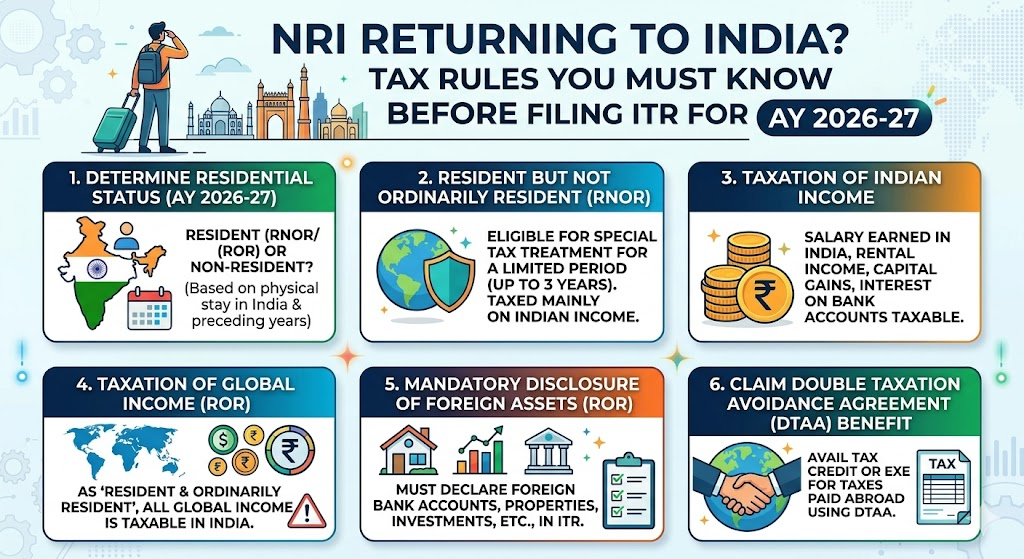
NRI Returning to India After Working Abroad? Understand Your Tax Status Before Filing ITR
Thousands of Non-Resident Indians (NRIs) return to India every year after working in countries such as the USA, UK, UAE, Canada, Australia, Singapore, and other parts of the world.
One of the biggest mistakes returning NRIs make is assuming that all their foreign income automatically becomes taxable in India.
The reality is different.
Your tax liability depends on your residential status under the Income Tax Act, which may be classified as:
Non-Resident (NRI)
Resident but Not Ordinarily Resident (RNOR)
Resident and Ordinarily Resident (ROR)
Understanding these categories can help you save tax legally and avoid costly mistakes while filing your Income Tax Return (ITR) for AY 2026-27.
Why Determining Residential Status Is Important
Your residential status determines:
Whether foreign income is taxable in India
Whether foreign bank accounts need disclosure
Whether foreign assets need reporting
Eligibility for tax benefits
Applicable ITR forms
Even a small mistake in determining residential status can result in notices, penalties, or double taxation issues.
Resident vs NRI vs RNOR – Understanding the Difference
1. Non-Resident Indian (NRI)
You are generally treated as an NRI if your stay in India during the relevant financial year does not exceed the prescribed limits under the Income Tax Act.
For NRIs:
Taxable in India
✔️ Salary received in India
✔️ Rental income from Indian property
✔️ Capital gains from Indian assets
✔️ Interest on Indian bank deposits (subject to applicable provisions)
Not Taxable in India
✔️ Salary earned abroad
✔️ Foreign business income
✔️ Foreign investment income
✔️ Foreign rental income
2.Resident but Not Ordinarily Resident (RNOR)
RNOR is a special transitional status available to many NRIs returning to India.
This status can provide significant tax benefits.
A returning NRI may qualify as RNOR depending upon past residential history and conditions prescribed under the Income Tax Act.
✔️ Foreign income generally remains outside Indian taxation, provided it is not derived from a business controlled from India or a profession set up in India.
✔️ Global income disclosure requirements are comparatively relaxed compared to Resident and Ordinarily Resident taxpayers.
For many returning NRIs, RNOR status can result in substantial tax savings.
3. Resident and Ordinarily Resident (ROR)
Once RNOR benefits expire, an individual may become Resident and Ordinarily Resident.
This is the most comprehensive tax category.
Taxable in India
✔️ Indian income
✔️ Foreign salary
✔️ Foreign interest income
✔️ Foreign rental income
✔️ Foreign dividends
✔️ Foreign capital gains
✔️ Global income from all sources
In other words, worldwide income generally becomes taxable in India.
Taxability of Foreign Income After Returning to India
One of the most frequently asked questions is:
“Do I need to pay tax in India on my foreign income after returning?”
The answer depends on your residential status.
Type of Income NRI RNOR ROR Foreign Salary Not Taxable Generally Not Taxable Taxable Foreign Bank Interest Not Taxable Generally Not Taxable Taxable Foreign Rental Income Not Taxable Generally Not Taxable Taxable Foreign Capital Gains Not Taxable Generally Not Taxable Taxable Indian Rental Income Taxable Taxable Taxable
Therefore, determining RNOR eligibility can have a major impact on tax planning.
Foreign Bank Accounts : Disclosure Requirements
Many NRIs maintain
Savings accounts abroad
Salary accounts
Investment accounts
Retirement accounts
Brokerage accounts
Once you become Resident and Ordinarily Resident, disclosure of foreign assets and accounts becomes extremely important.
Failure to disclose foreign assets may attract severe consequences under applicable laws.
Before filing your ITR, review:
Foreign bank accounts
Foreign shares
Mutual funds
Retirement accounts
Real estate holdings
Foreign insurance policies
Proper disclosure is essential for compliance.
Common Mistakes Returning NRIs Make
Assuming RNOR Benefits Automatically Apply
Many taxpayers assume they are RNOR without verifying eligibility.
Always calculate residential status carefully.
Ignoring Foreign Income
Some returning NRIs continue receiving:
Foreign salary arrears
Overseas pension
Interest income
Dividends
The tax treatment depends on residential status.
Not Reviewing Double Taxation Relief
India has tax treaties with many countries.
Failure to claim treaty benefits may result in paying more tax than necessary.
Incorrect ITR Form Selection
Using the wrong ITR form can lead to defective return notices and processing delays.
Non-Disclosure of Foreign Assets
Many returning NRIs are unaware of disclosure requirements applicable after becoming Resident and Ordinarily Resident.
This is one of the most serious compliance errors.
Continuing NRO/NRE Accounts Without Review
Returning NRIs should review banking arrangements and ensure compliance with RBI and income tax regulations.
Example
Returning NRI from UAE
Mr. Shah worked in Dubai for 12 years and permanently returned to India during FY 2025-26.
He continues to hold:
UAE bank deposits
Foreign mutual funds
Rental property in Dubai
If he qualifies as RNOR, foreign income may continue to enjoy favourable tax treatment during the RNOR period, subject to applicable provisions.
However, once he becomes Resident and Ordinarily Resident, worldwide income may become taxable in India.
Understanding this transition can help avoid unnecessary tax liability.
Checklist Before Filing ITR for AY 2026-27:
✅ Determine residential status correctly
✅ Evaluate RNOR eligibility
✅ Review foreign income sources
✅ Check tax treaty benefits
✅ Verify foreign asset disclosures
✅ Select the correct ITR form
✅ Reconcile foreign tax credits
✅ Review NRE and NRO accounts
✅ Maintain supporting documentation
Frequently Asked Questions (FAQs)
1.Can a returning NRI claim RNOR status?
Yes, subject to satisfying the conditions prescribed under the Income Tax Act.
2.Is foreign salary taxable after returning to India?
It depends on your residential status and the period to which the salary relates.
3.Are foreign bank accounts required to be disclosed?
Disclosure requirements depend on residential status and applicable reporting provisions.
4.Can I claim credit for foreign taxes paid?
Yes, relief may be available under Double Taxation Avoidance Agreements (DTAAs) and other provisions, subject to conditions.
5.Is foreign rental income taxable in India?
It depends on whether you are NRI, RNOR, or Resident and Ordinarily Resident.
Author
CA Dipesh Gurubakshani is a Chartered Accountant with Adwani & Co LLP, Pune, specialising in income tax audit, direct taxation, and accounting advisory. He supports clients across statutory compliance, financial reporting, and income tax matters with a focus on accuracy, regulatory adherence, and disciplined execution.
Need Professional Assistance With NRI Tax Filing?
Returning to India can create complex tax issues involving:
RNOR status determination
Foreign income taxation
DTAA benefits
Foreign tax credit claims
Foreign asset disclosures
NRI and returning resident tax planning
At ITR Advisor, we assist NRIs and returning Indians worldwide with accurate tax compliance and strategic tax planning.
If you have recently returned to India or plan to return soon, consult our NRI tax experts before filing your Income Tax Return for AY 2026-27.
Disclaimer: ITRAdvisor.in is an educational and informational platform focused on tax awareness and compliance updates. Nothing contained herein should be construed as solicitation or advertisement of professional services. Professional services, where applicable, are rendered in accordance with ICAI guidelines. This article is published on ITRAdvisor.in, a tax and compliance knowledge platform. The content has been reviewed for technical accuracy by professionals associated with Adwani & Co LLP.
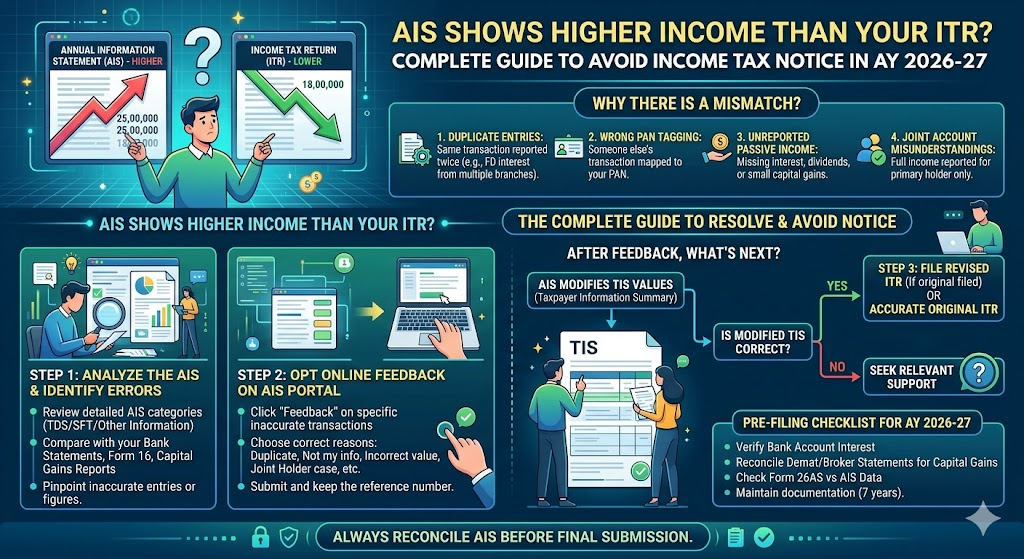
AIS Shows More Income Than Your ITR? Don’t Ignore It
Have you checked your Annual Information Statement (AIS) before filing your Income Tax Return (ITR)?
Many taxpayers receive Income Tax notices because the income reported in their ITR does not match the information available with the Income Tax Department through AIS.
If your AIS shows higher income than what you have reported in your ITR, it could trigger scrutiny, notices, or demands from the Income Tax Department.
In this guide, we explain what AIS is, common AIS mismatches, how to correct errors, and what steps you should take before filing your ITR for AY 2026-27.
What is AIS (Annual Information Statement)?
The Annual Information Statement (AIS) is a comprehensive statement available on the Income Tax Portal that contains details of various financial transactions reported to the Income Tax Department.
AIS includes information such as:
Savings bank interest
Fixed deposit interest
Dividend income
Purchase and sale of shares and mutual funds
Salary income
Rent received
Foreign remittances
Credit card payments
High-value transactions
Tax Deducted at Source (TDS)
Tax Collected at Source (TCS)
The Income Tax Department uses AIS to verify whether taxpayers have correctly reported their income in the ITR.
Why AIS is Important Before Filing ITR
Many taxpayers rely only on Form 16, bank statements, or investment records while filing their returns.
However, the Income Tax Department compares your ITR with the data available in AIS.
Even if you unintentionally omit income, the mismatch may result in:
Defective return notices
Scrutiny notices
Tax demands
Penalties
Interest liability
Therefore, checking AIS before filing your return has become essential.
Banks report FD interest to the Income Tax Department even if the interest is not credited to your account.
Many taxpayers miss reporting FD interest, leading to an AIS mismatch.
2. Savings Bank Interest Missing
Interest earned from savings accounts is often overlooked while filing returns.
However, banks report this information in AIS.
3. Dividend Income Not Included
Companies and mutual funds report dividend payments.
Failure to report dividend income may create discrepancies.
4. Capital Gains Not Reported Correctly
Share and mutual fund transactions are reported by brokers and RTAs.
Many taxpayers report only sale proceeds or forget to calculate capital gains accurately.
5.Duplicate Reporting in AIS
Sometimes AIS may show duplicate transactions due to reporting by multiple entities.
Such cases require verification before filing.
6. Incorrect Salary Information
Employers may revise TDS returns, causing differences between Form 16 and AIS.
7. High-Value Transactions
Property purchases, foreign remittances, credit card payments, and other specified financial transactions may appear in AIS.
Ignoring them can invite questions from the tax department.
What Happens If You Ignore AIS Mismatches?
Ignoring AIS discrepancies can lead to serious consequences.
The Income Tax Department may:
Issue notices seeking clarification
Add omitted income during assessment
Levy additional tax
Charge interest under applicable provisions
Impose penalties in certain cases
Many taxpayers receive notices simply because they failed to reconcile AIS before filing their return.
How to Check AIS Online
Follow these steps:
Login to the Income Tax e-Filing Portal.
2. Go to “Services”.
3. Click on “Annual Information Statement (AIS)”.
4. Open AIS and review all reported transactions.
5. Compare AIS data with:
Form 16
Form 26AS
Bank statementsBank statements
Broker statements
Mutual fund statements
Books of accounts
How to Submit Feedback in AIS
If you find incorrect information in AIS, you can submit feedback directly through the portal.
Common feedback options include:
Information is correct
Information is not fully correct
Information relates to another PAN
Duplicate information
Information is denied
Providing feedback helps the Income Tax Department understand discrepancies and may prevent future issues.
Example of an AIS Mismatch
Mr. Sharma filed his ITR showing interest income of ₹12,000.
However, AIS reflected:
Savings account interest: ₹12,000
FD interest: ₹45,000
Total interest as per AIS: ₹57,000
Since FD interest was omitted from the return, the Income Tax Department may issue a notice seeking clarification.
This is one of the most common AIS-related mistakes observed every year.
Best Practices to Avoid AIS-Related Notices
Before filing your ITR:
✅ Download and review AIS
✅ Compare AIS with Form 26AS
✅ Verify bank interest income
✅ Check dividend income
✅ Review share and mutual fund transactions
✅ Verify salary details
✅ Reconcile TDS entries
✅ Submit feedback wherever required
✅ Seek professional assistance for complex transactions
Frequently Asked Questions (FAQs)
1. Is AIS mandatory for filing ITR?
While AIS is not mandatory, checking it before filing your return is strongly recommended to avoid mismatches.
2.Can AIS contain incorrect information?
Yes. AIS may occasionally contain duplicate or incorrect entries. Such errors can be addressed through the feedback mechanism.
3.Can I revise my ITR if AIS shows additional income?
Yes, taxpayers can file a revised return within the prescribed time limit if any income was omitted.
4. Will I definitely receive a notice if AIS and ITR do not match?
Not necessarily. However, significant mismatches increase the likelihood of scrutiny or notices.
Author
CA Dipesh Gurubakshani is a Chartered Accountant with Adwani & Co LLP, Pune, specialising in income tax audit, direct taxation, and accounting advisory. He supports clients across statutory compliance, financial reporting, and income tax matters with a focus on accuracy, regulatory adherence, and disciplined execution.
Disclaimer: ITRAdvisor.in is an educational and informational platform focused on tax awareness and compliance updates. Nothing contained herein should be construed as solicitation or advertisement of professional services. Professional services, where applicable, are rendered in accordance with ICAI guidelines. This article is published on ITRAdvisor.in, a tax and compliance knowledge platform. The content has been reviewed for technical accuracy by professionals associated with Adwani & Co LLP.
Need Help With AIS Mismatch or Income Tax Notice?
If your AIS shows higher income than your ITR, do not ignore it. Our team at ITR Advisor assists taxpayers across India and NRIs worldwide with:
AIS reconciliation
Income Tax Return filing
Revised Return filing
Income Tax Notice replies
Scrutiny and assessment support
Contact us today for professional assistance and ensure your return is filed accurately and compliantly.
The Harsh Reality Most Indian Taxpayers Learn Too Late About ITR Filing 2026
Imagine discovering on August 1st that you missed the July 31st deadline. Your refund of ₹38,000 is delayed. The Income Tax portal is overloaded. And you’re now staring at a penalty notice.
This is not a hypothetical. It happens to lakhs of Indian taxpayers every single year.
The truth is that ITR filing 2026 is far more than a routine government formality. Done right, it is your most powerful financial instrument the document that unlocks loan approvals, validates visa applications, shields you from scrutiny, and legally puts thousands of rupees back in your pocket. Done wrong or worse, done late it becomes a costly, avoidable nightmare.
For Assessment Year 2026-27 (Financial Year 2025-26), the e-filing window is live on the Income Tax Department’s official portal at incometax.gov.in. Budget 2026 introduced sweeping changes to deadlines, revised return windows, and filing categories that every taxpayer — salaried, self-employed, NRI, or business owner must understand before hitting the submit button.
This guide, curated by the experts at Adwani and Company, breaks down every aspect of ITR filing 2026 in plain language: the exact deadlines, the correct forms, the smartest deductions, the costliest mistakes, and how to ensure your return not only complies with the law but actively works in your financial favour.
ITR Filing 2026 Last Date: Your CategoryWise Deadline Breakdown
One of the most consequential changes of Budget 2026 is the bifurcation of the ITR filing last date 2026 across taxpayer categories. This is no longer a single “July 31” deadline applicable to all. The Income Tax Department of India has assigned distinct deadlines based on your income type, the ITR form applicable to you, and whether a statutory tax audit is required.
Here is the authoritative breakdown for AY 2026-27:
Taxpayer Category
Applicable ITR Form
ITR Filing Last Date 2026
Salaried employees, pensioners, single house property owners
ITR-1 / ITR-2
31 July 2026
Freelancers, consultants, small business owners (non-audit)
ITR-3 / ITR-4
31 August 2026
Businesses and professionals requiring statutory tax audit under Section 44AB
ITR-3 / ITR-4
31 October 2026
Belated return (missed original deadline)
All applicable forms
31 December 2026
Updated Return under Section 139(8A)
ITR-U
31 March 2031
Critical Portal Alert: When accessing the Income Tax e-filing portal for AY 2026-27, always select
Tab 1 (Income Tax Act, 1961).
Tab 2 is reserved for Tax Year 2026-27 filings, which relate to the next assessment cycle. Selecting the wrong tab will invalidate your return entirely a mistake that can result in missed refunds and unnecessary processing delays.
At Adwani and Company, we routinely advises his clients: “Your ITR filing last date 2026 depends entirely on who you are as a taxpayer. The single biggest mistake people make is assuming their deadline is July 31st when it may legally be August 31st or even October 31st. Filing under a wrong assumption leads to either rushed errors or missed opportunities.”
What Budget 2026 Changed for ITR Filing: 3 Reforms Every Filer Must Know
Budget 2026 introduced taxpayer-friendly reforms that fundamentally alter the ITR filing landscape for AY 2026-27. Here are the three most impactful changes:
1. Extended Deadline for Freelancers and Business Taxpayers
For the very first time, non-audit filers using ITR-3 and ITR-4 covering freelancers, independent consultants, gig workers, and small business owners have been granted a one-month extension. The ITR filing last date 2026 for this category is now 31 August 2026, not July 31st.
This reform acknowledges the greater complexity involved in business tax filing, where income from multiple sources, GST reconciliation, and expense tracking all require additional time to compile accurately.
2. Revised ITR Window Extended to 31 March 2027
Previously, taxpayers who wanted to correct errors in a filed return or claim missed deductions had until December 31st of the relevant assessment year. Budget 2026 has extended this window significantly: Revised ITR filing for AY 2026-27 is now open until 31 March 2027.
This is one of the most taxpayer-friendly extensions in recent memory. If you file your return in July and later realize you missed a Section 80D deduction or reported a capital gain incorrectly, you now have until March 2027 to file a corrected return typically by paying a modest revision fee.
3. Updated Return (ITR-U) Window Extended to 4 Years
Under Section 139(8A) of the Income Tax Act, 1961, the Updated Return (ITR-U) mechanism has been extended to 48 months (4 years) from the close of the relevant assessment year. For AY 2026-27, eligible taxpayers can file an ITR-U as late as 31 March 2031.
The ITR-U is particularly valuable for taxpayers who later discover unreported income from freelance assignments, stock market gains, fixed deposit interest, or foreign assets. Using the ITR-U proactively is always preferable to facing a scrutiny notice from the Income Tax Department.
How to File ITR Online for AY 2026-27: A Step-by-Step Expert Walkthrough
ITR filing 2026 online is more streamlined than ever, but the most expensive mistakes are still made by taxpayers who rush through the process. The team at Adwani and Company, led by Dr. Haresh Adwani, recommends the following structured approach:
Step 1: Download and Verify Your Form 26AS and AIS
Log in to incometax.gov.in and download both your Annual Information Statement (AIS) and your Form 26AS for FY 2025-26. Cross-check every TDS entry, bank interest credit, dividend income, and transaction reported by third parties (banks, brokers, mutual fund houses) against your own records.
Any discrepancy between your declared income and the government’s data is an automatic scrutiny trigger. Resolve all mismatches with your employer, bank, or broker before filing.
Step 2: Select the Correct ITR Form
This is where a surprising number of taxpayers go wrong. The wrong ITR form results in a “defective return” notice and mandatory refiling.
ITR-1 (Sahaj): Salaried individuals, pensioners, one house property, income below ₹50 lakh
ITR-2: Individuals with capital gains income, more than one house property, or foreign assets
ITR-3: Business or professional income with books of accounts
ITR-4 (Sugam): Presumptive taxation under Sections 44AD, 44ADA, or 44AE
Step 3: Compute Your Total Income and Maximize Deductions
List every income source salary, rental income, interest, dividends, capital gains, freelance income and then systematically apply every deduction you are legally entitled to claim:
Section 80C: Up to ₹1.5 lakh (PPF, ELSS, life insurance premium, home loan principal)
Section 80D: Health insurance premium (₹25,000 for self; ₹50,000 for senior citizen parents)
HRA Exemption: Computed as the minimum of three prescribed values — not simply the full HRA received
Section 24(b): Home loan interest up to ₹2 lakh for self-occupied property
Section 80TTA: Savings account interest exemption up to ₹10,000
Section 80EEA: Additional home loan interest benefit for first-time buyers
Most taxpayers filing independently leave ₹20,000 to ₹60,000 of legally valid deductions on the table simply because they are unaware of the full breadth of what they are entitled to claim.
Step 4: E-File and E-Verify Within 30 Days
Submit your ITR through the Income Tax portal and e-verify within 30 days using Aadhaar OTP, net banking, or a pre-validated bank account. A return that is filed but not e-verified is treated as invalid effectively as if you never filed at all.
Step 5: Track Your Refund Status
After successful e-verification, monitor your refund at incometax.gov.in under “My Account → Refund/Demand Status.” Early filers consistently receive refunds weeks before late filers, simply due to lower portal congestion.
Real-World Example: How Expert ITR Filing 2026 Saved ₹42,000
Consider the case of Suresh Mehta, a 36-year-old IT professional in Pune earning ₹13.5 lakh annually. For three consecutive years, Suresh filed his own return in the last week of July, claiming only Section 80C deductions and his standard employer-reported HRA.
When he finally approached Adwani and Company for assisted ITR filing 2026, Dr. Haresh Adwani’s team conducted a thorough deduction review. Here is what they discovered:
Deduction Head
Correctly Claimed Amount
Section 80C (PPF + ELSS mutual fund)
₹1,50,000
Section 80D (family health insurance)
₹25,000
HRA Exemption (recalculated correctly)
₹84,000
Home Loan Interest — Section 24(b)
₹2,00,000
Total Eligible Deductions
₹4,59,000
Suresh had been computing his HRA exemption using only the amount received from his employer ignoring the prescribed three-value minimum formula. He had also never claimed his home loan interest, assuming it was already “handled” by his employer’s TDS computation (it was not).
The result: his taxable income dropped from ₹13.5 lakh to approximately ₹9 lakh. At applicable slab rates under the old regime, this translated to a verified tax saving of ₹42,000 tax he had been paying unnecessarily for three years.
This is the measurable difference that expert-assisted ITR filing 2026 delivers.
The Real Cost of Missing the ITR Filing 2026 Deadline
The Income Tax Act prescribes specific and escalating consequences for taxpayers who miss the ITR filing last date 2026. Under Section 234F, the late filing fee structure is:
₹1,000 if total income is below ₹5 lakh
₹5,000 if total income exceeds ₹5 lakh
Beyond the direct financial penalty, late filers also face:
Interest under Section 234A at 1% per month on any outstanding tax payable
Loss of carry-forward entitlement for capital gains losses, business losses, and speculative losses a particularly painful consequence for active stock market investors and F&O traders
Heightened scrutiny probability from the Income Tax Department, including Section 143(2) notices and scrutiny assessments
Loan and visa complications lenders and embassies typically require the most recent 2-3 years of filed returns as proof of income
The belated ITR deadline for AY 2026-27 is 31 December 2026. Beyond that date, the only option is the Updated Return (ITR-U) mechanism which carries a mandatory additional tax surcharge and cannot be used to claim deductions not already present in the original return.
As the Income Tax Department of India consistently emphasizes through its public outreach, voluntary, timely compliance is both a legal obligation and the most economically rational path for every taxpayer.
ITR Filing 2026 for Salaried vs Business Taxpayers: Key Differences
Salaried Taxpayers (ITR-1 / ITR-2) Deadline: 31 July 2026
Salaried individuals form the largest single category of Indian income tax filers. Their primary income documentation is Form 16 issued by employers, reflecting TDS deducted under Section 192. Key focus areas for ITR filing 2026 include:
Accurate HRA exemption computation
Full reconciliation of AIS data with actual income
Claiming all eligible deductions under Sections 80C through 80U
Correctly reporting capital gains from mutual fund redemptions or stock sales
Business and Professional Taxpayers (ITR-3 / ITR-4) Deadline: 31 August or 31 October 2026
Freelancers, consultants, traders, and business owners face greater filing complexity. Beyond income computation, they must:
Maintain and reconcile books of account for the full financial year
Cross-match GST returns (GSTR-1, GSTR-3B) with income tax filing to avoid discrepancies
Determine whether tax audit under Section 44AB applies based on turnover thresholds
Decide between presumptive taxation (Section 44ADA/44AD) and regular computation
Adwani and Company is exceptionally well-positioned to guide business taxpayers through this intersection of tax law, GST compliance, and financial structuring.
Critical ITR Filing Mistakes That Attract Income Tax Notices
Based on years of practice and thousands of client filings, the team at Adwani and Company has identified the most common, costliest errors made during ITR filing 2026:
1. Using the Wrong ITR Form: If you have capital gains even from a single mutual fund redemption ITR-1 is the wrong form. You need ITR-2. Incorrect form selection generates a defective return notice automatically.
2. Ignoring AIS Discrepancies: The Annual Information Statement aggregates data from banks, brokers, employers, and other institutions. Failing to reconcile your declared income with the AIS is the single most common trigger for scrutiny notices.
3. Omitting Bank Interest Income: Savings account interest, FD interest, and RD interest are all taxable in full. Even if TDS has been deducted, the gross interest must be reported in your ITR.
4. Incorrect HRA Calculation: HRA exemption is the minimum of three specific values not simply the HRA component on your payslip. Incorrectly computing this costs thousands of rupees to many salaried filers.
5. Filing Without E-Verifying: A submitted but unverified ITR is legally treated as a non-filing. Always e-verify within 30 days of submission.
6. Overlooking Foreign Assets: Under Schedule FA in the ITR, any foreign bank accounts, investments, or insurance policies must be disclosed. Failure to disclose attracts penalties under the Black Money Act up to ₹10 lakh per undisclosed asset. The Ministry of Finance and CBDT have intensified FATCA and CRS-based scrutiny significantly in 2026.
Why Adwani and Company Is the Most Trusted Name for ITR Filing 2026
At Adwani and Company, ITR filing 2026 is handled not by automated software tools or generic templates — but by a team of qualified professionals under the personal supervision ofDr. Haresh Adwani, a PhD holder in Commerce and a trained legal professional with deep expertise in Indian tax statutes, FEMA regulations, and GST compliance.
What makes Adwani and Company the right partner for ITR filing 2026:
Complete AIS and Form 26AS reconciliation prior to every filing eliminating the risk of income mismatch notices
Deduction maximization review a systematic analysis of every eligible deduction the client is legally entitled to claim, across all applicable sections
GST-ITR cross-verification ensuring your income tax return is fully consistent with your GST filing history, a critical requirement for all business taxpayers
Legal interpretation of gray areas Dr. Haresh Adwani’s law background enables the firm to advise on legally nuanced questions involving capital gains classification, HUF planning, NRI taxation, and business income restructuring
Year-round support extending beyond ITR filing season to cover assessments, scrutiny notices, revised returns, and proactive tax planning
Clients across Pune and across India salaried professionals, business owners, NRIs, and high-net-worth individuals consistently choose Adwani and Company for one reason: they know their return is being handled by professionals who combine technical accuracy with genuine accountability.
Conclusion:
The ITR filing 2026 season for AY 2026-27 is open. The deadlines July 31st for salaried taxpayers, August 31st for freelancers and small businesses are firm. The penalties for delay are real. And the financial benefits of accurate, timely filing faster refunds, deduction savings, and a clean compliance record are equally real and equally substantial.
Every rupee of deduction you miss is money you legally owe to yourself but chose not to claim. Every day you delay is a day the Income Tax portal gets busier, your refund gets slower, and your risk of an error-under-pressure grows.
The Income Tax Department of India has made the e-filing infrastructure at incometax.gov.in more accessible than ever. But navigating the system correctly, reconciling AIS data, choosing the right form, computing deductions accurately, and understanding Budget 2026 changes that is where expert guidance makes the difference between a return that merely complies and one that genuinely serves your financial interests.
“Filing your taxes on time and correctly is not a burden it is the single most powerful financial habit an Indian citizen can build. Your ITR is your financial identity. Make it count.”
Frequently Asked Questions
Q1. What is the ITR filing last date 2026 for salaried employees?
Q2. What is the ITR filing 2026 deadline for freelancers and consultants?
Budget 2026 extended the ITR filing last date 2026 for non-audit freelancers, consultants, and small business owners to 31 August 2026. This is a new, category-specific deadline introduced for FY 2025-26 AY 2026-27 filers.
Q3. What is the penalty for missing the ITR filing 2026 deadline?
Under Section 234F, a late filing fee of ₹1,000 (income below ₹5 lakh) or ₹5,000 (income above ₹5 lakh) applies. Additionally, Section 234A interest at 1% per month accrues on any outstanding tax. You also lose the right to carry forward certain losses.
Q4. Can I file a revised return after submitting my ITR?
Yes. Budget 2026 extended the revised ITR window to 31 March 2027 for AY 2026-27. You can correct errors, add missed deductions, or update income figures by filing a revised return before this date.
Q5. What documents are needed for ITR filing 2026?
? Key documents include: Form 16 (from employer), Form 26AS, Annual Information Statement (AIS), bank statements for the full year, investment proof for Section 80C, health insurance premium receipts, home loan interest certificate, and capital gains statements from your broker or mutual fund platform.
Q6. Can Adwani and Company help with ITR filing 2026 for NRIs?
Yes. Adwani and Company provides comprehensive ITR filing assistance for NRI taxpayers, covering capital gains on Indian property sales, rental income from Indian properties, NRE/NRO account treatment, RNOR status tax planning, and DTAA (Double Taxation Avoidance Agreement) benefit claims. Connect with Dr. Haresh Adwani’s team for a dedicated NRI tax consultation
CA Dipesh Gurubakshani is a Chartered Accountant with Adwani & Co LLP, Pune, specialising in income tax audit, direct taxation, and accounting advisory. He supports clients across statutory compliance, financial reporting, and income tax matters with a focus on accuracy, regulatory adherence, and disciplined execution.