Blog

  • ITR Filing 2026: Smart Strategies to Beat the Deadline, Slash Your Tax Bill & Secure Your Future

    ITR Filing 2026: Smart Strategies to Beat the Deadline, Slash Your Tax Bill & Secure Your Future

    The Harsh Reality Most Indian Taxpayers Learn Too Late About ITR Filing 2026

    Imagine discovering on August 1st that you missed the July 31st deadline. Your refund of ₹38,000 is delayed. The Income Tax portal is overloaded. And you’re now staring at a penalty notice.

    This is not a hypothetical. It happens to lakhs of Indian taxpayers every single year.

    The truth is that ITR filing 2026 is far more than a routine government formality. Done right, it is your most powerful financial instrument the document that unlocks loan approvals, validates visa applications, shields you from scrutiny, and legally puts thousands of rupees back in your pocket. Done wrong or worse, done late it becomes a costly, avoidable nightmare.

    For Assessment Year 2026-27 (Financial Year 2025-26), the e-filing window is live on the Income Tax Department’s official portal at incometax.gov.in. Budget 2026 introduced sweeping changes to deadlines, revised return windows, and filing categories that every taxpayer — salaried, self-employed, NRI, or business owner must understand before hitting the submit button.

    This guide, curated by the experts at Adwani and Company, breaks down every aspect of ITR filing 2026 in plain language: the exact deadlines, the correct forms, the smartest deductions, the costliest mistakes, and how to ensure your return not only complies with the law but actively works in your financial favour.

    Learn more about our Income Tax Filing and Compliance Services


    ITR Filing 2026 Last Date: Your CategoryWise Deadline Breakdown

    One of the most consequential changes of Budget 2026 is the bifurcation of the ITR filing last date 2026 across taxpayer categories. This is no longer a single “July 31” deadline applicable to all. The Income Tax Department of India has assigned distinct deadlines based on your income type, the ITR form applicable to you, and whether a statutory tax audit is required.


    Here is the authoritative breakdown for AY 2026-27:

    Taxpayer CategoryApplicable ITR FormITR Filing Last Date 2026
    Salaried employees, pensioners, single house property ownersITR-1 / ITR-231 July 2026
    Freelancers, consultants, small business owners (non-audit)ITR-3 / ITR-431 August 2026
    Businesses and professionals requiring statutory tax audit under Section 44ABITR-3 / ITR-431 October 2026
    Belated return (missed original deadline)All applicable forms31 December 2026
    Updated Return under Section 139(8A)ITR-U31 March 2031

    Critical Portal Alert: When accessing the Income Tax e-filing portal for AY 2026-27, always select

    Tab 1 (Income Tax Act, 1961).

    Tab 2 is reserved for Tax Year 2026-27 filings, which relate to the next assessment cycle. Selecting the wrong tab will invalidate your return entirely — a mistake that can result in missed refunds and unnecessary processing delays.

    At Adwani and Company, we routinely advises his clients: “Your ITR filing last date 2026 depends entirely on who you are as a taxpayer. The single biggest mistake people make is assuming their deadline is July 31st when it may legally be August 31st or even October 31st. Filing under a wrong assumption leads to either rushed errors or missed opportunities.”


    What Budget 2026 Changed for ITR Filing: 3 Reforms Every Filer Must Know

    Budget 2026 introduced taxpayer-friendly reforms that fundamentally alter the ITR filing landscape for AY 2026-27. Here are the three most impactful changes:

    1. Extended Deadline for Freelancers and Business Taxpayers

    For the very first time, non-audit filers using ITR-3 and ITR-4 covering freelancers, independent consultants, gig workers, and small business owners have been granted a one-month extension. The ITR filing last date 2026 for this category is now 31 August 2026, not July 31st.

    This reform acknowledges the greater complexity involved in business tax filing, where income from multiple sources, GST reconciliation, and expense tracking all require additional time to compile accurately.

    2. Revised ITR Window Extended to 31 March 2027

    Previously, taxpayers who wanted to correct errors in a filed return or claim missed deductions had until December 31st of the relevant assessment year. Budget 2026 has extended this window significantly: Revised ITR filing for AY 2026-27 is now open until 31 March 2027.

    This is one of the most taxpayer-friendly extensions in recent memory. If you file your return in July and later realize you missed a Section 80D deduction or reported a capital gain incorrectly, you now have until March 2027 to file a corrected return typically by paying a modest revision fee.

    3. Updated Return (ITR-U) Window Extended to 4 Years

    Under Section 139(8A) of the Income Tax Act, 1961, the Updated Return (ITR-U) mechanism has been extended to 48 months (4 years) from the close of the relevant assessment year. For AY 2026-27, eligible taxpayers can file an ITR-U as late as 31 March 2031.

    The ITR-U is particularly valuable for taxpayers who later discover unreported income from freelance assignments, stock market gains, fixed deposit interest, or foreign assets. Using the ITR-U proactively is always preferable to facing a scrutiny notice from the Income Tax Department.


    How to File ITR Online for AY 2026-27: A Step-by-Step Expert Walkthrough

    ITR filing 2026 online is more streamlined than ever, but the most expensive mistakes are still made by taxpayers who rush through the process. The team at Adwani and Company, led by Dr. Haresh Adwani, recommends the following structured approach:

    Step 1: Download and Verify Your Form 26AS and AIS

    Log in to incometax.gov.in and download both your Annual Information Statement (AIS) and your Form 26AS for FY 2025-26. Cross-check every TDS entry, bank interest credit, dividend income, and transaction reported by third parties (banks, brokers, mutual fund houses) against your own records.

    Any discrepancy between your declared income and the government’s data is an automatic scrutiny trigger. Resolve all mismatches with your employer, bank, or broker before filing.

    Step 2: Select the Correct ITR Form

    This is where a surprising number of taxpayers go wrong. The wrong ITR form results in a “defective return” notice and mandatory refiling.

    • ITR-1 (Sahaj): Salaried individuals, pensioners, one house property, income below ₹50 lakh
    • ITR-2: Individuals with capital gains income, more than one house property, or foreign assets
    • ITR-3: Business or professional income with books of accounts
    • ITR-4 (Sugam): Presumptive taxation under Sections 44AD, 44ADA, or 44AE

    Step 3: Compute Your Total Income and Maximize Deductions

    List every income source salary, rental income, interest, dividends, capital gains, freelance income and then systematically apply every deduction you are legally entitled to claim:

    • Section 80C: Up to ₹1.5 lakh (PPF, ELSS, life insurance premium, home loan principal)
    • Section 80D: Health insurance premium (₹25,000 for self; ₹50,000 for senior citizen parents)
    • HRA Exemption: Computed as the minimum of three prescribed values — not simply the full HRA received
    • Section 24(b): Home loan interest up to ₹2 lakh for self-occupied property
    • Section 80TTA: Savings account interest exemption up to ₹10,000
    • Section 80EEA: Additional home loan interest benefit for first-time buyers

    Most taxpayers filing independently leave ₹20,000 to ₹60,000 of legally valid deductions on the table simply because they are unaware of the full breadth of what they are entitled to claim.

    Step 4: E-File and E-Verify Within 30 Days

    Submit your ITR through the Income Tax portal and e-verify within 30 days using Aadhaar OTP, net banking, or a pre-validated bank account. A return that is filed but not e-verified is treated as invalid effectively as if you never filed at all.

    Step 5: Track Your Refund Status

    After successful e-verification, monitor your refund at incometax.gov.in under “My Account → Refund/Demand Status.” Early filers consistently receive refunds weeks before late filers, simply due to lower portal congestion.


    Real-World Example: How Expert ITR Filing 2026 Saved ₹42,000

    Consider the case of Suresh Mehta, a 36-year-old IT professional in Pune earning ₹13.5 lakh annually. For three consecutive years, Suresh filed his own return in the last week of July, claiming only Section 80C deductions and his standard employer-reported HRA.

    When he finally approached Adwani and Company for assisted ITR filing 2026, Dr. Haresh Adwani’s team conducted a thorough deduction review. Here is what they discovered:

    Deduction HeadCorrectly Claimed Amount
    Section 80C (PPF + ELSS mutual fund)₹1,50,000
    Section 80D (family health insurance)₹25,000
    HRA Exemption (recalculated correctly)₹84,000
    Home Loan Interest — Section 24(b)₹2,00,000
    Total Eligible Deductions₹4,59,000

    Suresh had been computing his HRA exemption using only the amount received from his employer ignoring the prescribed three-value minimum formula. He had also never claimed his home loan interest, assuming it was already “handled” by his employer’s TDS computation (it was not).

    The result: his taxable income dropped from ₹13.5 lakh to approximately ₹9 lakh. At applicable slab rates under the old regime, this translated to a verified tax saving of ₹42,000 tax he had been paying unnecessarily for three years.

    This is the measurable difference that expert-assisted ITR filing 2026 delivers.

    Learn more about our Deduction Maximization and Tax Planning Advisory


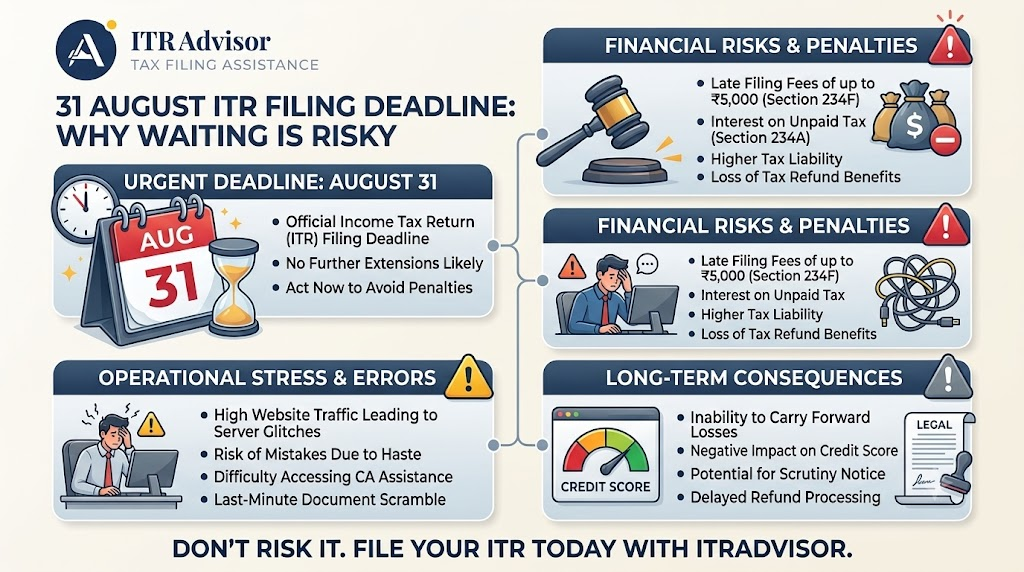
    The Real Cost of Missing the ITR Filing 2026 Deadline

    The Income Tax Act prescribes specific and escalating consequences for taxpayers who miss the ITR filing last date 2026. Under Section 234F, the late filing fee structure is:

    • ₹1,000 if total income is below ₹5 lakh
    • ₹5,000 if total income exceeds ₹5 lakh

    Beyond the direct financial penalty, late filers also face:

    • Interest under Section 234A at 1% per month on any outstanding tax payable
    • Loss of carry-forward entitlement for capital gains losses, business losses, and speculative losses a particularly painful consequence for active stock market investors and F&O traders
    • Heightened scrutiny probability from the Income Tax Department, including Section 143(2) notices and scrutiny assessments
    • Loan and visa complications lenders and embassies typically require the most recent 2-3 years of filed returns as proof of income

    The belated ITR deadline for AY 2026-27 is 31 December 2026. Beyond that date, the only option is the Updated Return (ITR-U) mechanism which carries a mandatory additional tax surcharge and cannot be used to claim deductions not already present in the original return.

    As the Income Tax Department of India consistently emphasizes through its public outreach, voluntary, timely compliance is both a legal obligation and the most economically rational path for every taxpayer.


    ITR Filing 2026 for Salaried vs Business Taxpayers: Key Differences

    Salaried Taxpayers (ITR-1 / ITR-2) Deadline: 31 July 2026

    Salaried individuals form the largest single category of Indian income tax filers. Their primary income documentation is Form 16 issued by employers, reflecting TDS deducted under Section 192. Key focus areas for ITR filing 2026 include:

    • Accurate HRA exemption computation
    • Full reconciliation of AIS data with actual income
    • Claiming all eligible deductions under Sections 80C through 80U
    • Correctly reporting capital gains from mutual fund redemptions or stock sales

    Business and Professional Taxpayers (ITR-3 / ITR-4) Deadline: 31 August or 31 October 2026

    Freelancers, consultants, traders, and business owners face greater filing complexity. Beyond income computation, they must:

    • Maintain and reconcile books of account for the full financial year
    • Cross-match GST returns (GSTR-1, GSTR-3B) with income tax filing to avoid discrepancies
    • Determine whether tax audit under Section 44AB applies based on turnover thresholds
    • Decide between presumptive taxation (Section 44ADA/44AD) and regular computation

    Adwani and Company is exceptionally well-positioned to guide business taxpayers through this intersection of tax law, GST compliance, and financial structuring.


    Critical ITR Filing Mistakes That Attract Income Tax Notices

    Based on years of practice and thousands of client filings, the team at Adwani and Company has identified the most common, costliest errors made during ITR filing 2026:

    1. Using the Wrong ITR Form: If you have capital gains even from a single mutual fund redemption ITR-1 is the wrong form. You need ITR-2. Incorrect form selection generates a defective return notice automatically.

    2. Ignoring AIS Discrepancies: The Annual Information Statement aggregates data from banks, brokers, employers, and other institutions. Failing to reconcile your declared income with the AIS is the single most common trigger for scrutiny notices.

    3. Omitting Bank Interest Income: Savings account interest, FD interest, and RD interest are all taxable in full. Even if TDS has been deducted, the gross interest must be reported in your ITR.

    4. Incorrect HRA Calculation: HRA exemption is the minimum of three specific values not simply the HRA component on your payslip. Incorrectly computing this costs thousands of rupees to many salaried filers.

    5. Filing Without E-Verifying: A submitted but unverified ITR is legally treated as a non-filing. Always e-verify within 30 days of submission.

    6. Overlooking Foreign Assets: Under Schedule FA in the ITR, any foreign bank accounts, investments, or insurance policies must be disclosed. Failure to disclose attracts penalties under the Black Money Act up to ₹10 lakh per undisclosed asset. The Ministry of Finance and CBDT have intensified FATCA and CRS-based scrutiny significantly in 2026.

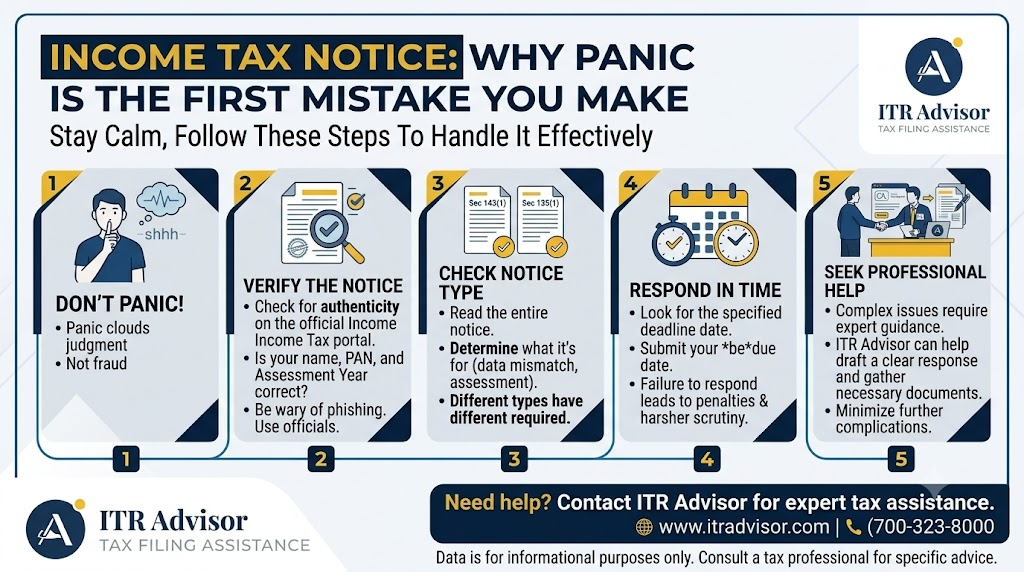
    Read our detailed guide on how to respond on Income Tax notice https://www.adwaniandco.com/blog/income-tax-notice-received


    Why Adwani and Company Is the Most Trusted Name for ITR Filing 2026

    At Adwani and Company, ITR filing 2026 is handled not by automated software tools or generic templates — but by a team of qualified professionals under the personal supervision of Dr. Haresh Adwani, a PhD holder in Commerce and a trained legal professional with deep expertise in Indian tax statutes, FEMA regulations, and GST compliance.

    What makes Adwani and Company the right partner for ITR filing 2026:

    • Complete AIS and Form 26AS reconciliation prior to every filing eliminating the risk of income mismatch notices
    • Deduction maximization review a systematic analysis of every eligible deduction the client is legally entitled to claim, across all applicable sections
    • GST-ITR cross-verification ensuring your income tax return is fully consistent with your GST filing history, a critical requirement for all business taxpayers
    • Legal interpretation of gray areas Dr. Haresh Adwani’s law background enables the firm to advise on legally nuanced questions involving capital gains classification, HUF planning, NRI taxation, and business income restructuring
    • Year-round support extending beyond ITR filing season to cover assessments, scrutiny notices, revised returns, and proactive tax planning

    Clients across Pune and across India salaried professionals, business owners, NRIs, and high-net-worth individuals consistently choose Adwani and Company for one reason: they know their return is being handled by professionals who combine technical accuracy with genuine accountability.


    Conclusion:

    The ITR filing 2026 season for AY 2026-27 is open. The deadlines July 31st for salaried taxpayers, August 31st for freelancers and small businesses are firm. The penalties for delay are real. And the financial benefits of accurate, timely filing faster refunds, deduction savings, and a clean compliance record are equally real and equally substantial.

    Every rupee of deduction you miss is money you legally owe to yourself but chose not to claim. Every day you delay is a day the Income Tax portal gets busier, your refund gets slower, and your risk of an error-under-pressure grows.

    The Income Tax Department of India has made the e-filing infrastructure at incometax.gov.in more accessible than ever. But navigating the system correctly, reconciling AIS data, choosing the right form, computing deductions accurately, and understanding Budget 2026 changes that is where expert guidance makes the difference between a return that merely complies and one that genuinely serves your financial interests.

    “Filing your taxes on time and correctly is not a burden it is the single most powerful financial habit an Indian citizen can build. Your ITR is your financial identity. Make it count.”

    Frequently Asked Questions

    Q1. What is the ITR filing last date 2026 for salaried employees?

    The ITR filing last date 2026 for salaried individuals and pensioners filing ITR-1 or ITR-2 is 31 July 2026, as confirmed by the Central Board of Direct Taxes (CBDT) and the Income Tax Department of India.

    Q2. What is the ITR filing 2026 deadline for freelancers and consultants?

    Budget 2026 extended the ITR filing last date 2026 for non-audit freelancers, consultants, and small business owners to 31 August 2026. This is a new, category-specific deadline introduced for FY 2025-26 AY 2026-27 filers.

    Q3. What is the penalty for missing the ITR filing 2026 deadline?

    Under Section 234F, a late filing fee of ₹1,000 (income below ₹5 lakh) or ₹5,000 (income above ₹5 lakh) applies. Additionally, Section 234A interest at 1% per month accrues on any outstanding tax. You also lose the right to carry forward certain losses.

    Q4. Can I file a revised return after submitting my ITR?

    Yes. Budget 2026 extended the revised ITR window to 31 March 2027 for AY 2026-27. You can correct errors, add missed deductions, or update income figures by filing a revised return before this date.

    Q5. What documents are needed for ITR filing 2026?

    ? Key documents include: Form 16 (from employer), Form 26AS, Annual Information Statement (AIS), bank statements for the full year, investment proof for Section 80C, health insurance premium receipts, home loan interest certificate, and capital gains statements from your broker or mutual fund platform.

    Q6. Can Adwani and Company help with ITR filing 2026 for NRIs?

    Yes. Adwani and Company provides comprehensive ITR filing assistance for NRI taxpayers, covering capital gains on Indian property sales, rental income from Indian properties, NRE/NRO account treatment, RNOR status tax planning, and DTAA (Double Taxation Avoidance Agreement) benefit claims. Connect with Dr. Haresh Adwani’s team for a dedicated NRI tax consultation

    CA Dipesh Gurubakshani  is a Chartered Accountant with Adwani & Co LLP, Pune, specialising in income tax audit, direct taxation, and accounting advisory. He supports clients across statutory compliance, financial reporting, and income tax matters with a focus on accuracy, regulatory adherence, and disciplined execution.

  • The 120-Day Rule That Is Silently Taxing Thousands of NRIs in India :Are You at Risk?

    The 120-Day Rule That Is Silently Taxing Thousands of NRIs in India :Are You at Risk?

    Dr. Haresh Adwani April 2026 14 min read

    Imagine spending decades building your career abroad, sending money home faithfully, and then one day discovering that a brief holiday visit to India has quietly triggered a massive tax liability on your global income. This is not a hypothetical scenario

    It is the harsh reality being faced by thousands of Non-Resident Indians (NRIs) who are completely unaware of the 120-day NRI tax rule in India. One seemingly harmless overstay, and you could find yourself reclassified as a tax resident, with your foreign salary, overseas investments, and global savings suddenly falling within the reach of the Indian Income Tax Department.

    According to Dr. Haresh Adwani, of Adwani and Company a leading Chartered Accountancy firm trusted by NRIs across the globe this rule has become one of the most misunderstood and dangerous provisions in Indian tax law today. “We see clients every year who did not even know the 120-day threshold existed,” he says. “By the time they find out, the damage is already done.” This comprehensive guide breaks down the 120-day NRI residency rule in India, explains how NRI taxation works, and shows you exactly what steps to take to stay protected. You can check on Income Tax India


    What Exactly Is the 120-Day NRI Tax Rule in India?

    Before the Finance Act of 2020, the residency threshold for NRIs was straightforward: if you stayed in India for fewer than 182 days in a financial year (April 1 to March 31), you were classified as a Non-Resident Indian for tax purposes. Under this classification, only your income earned or received in India was taxable. Your overseas salary, foreign bank interest, and global investments were beyond the reach of Indian tax authorities.

    However, the Finance Act 2020 introduced a critical amendment that changed the game entirely for high-income NRIs. Under the revised rules, if your total taxable income from Indian sources exceeds ₹15 lakhs in a financial year, the residency threshold drops significantly from 182 days to just 120 days. In other words, if you earn more than ₹15 lakh from Indian sources (such as rent from Indian property, fixed deposit interest, capital gains on Indian investments, or salary for services rendered in India) and you stay in India for 120 days or more in that financial year, the Income Tax Department can classify you as a Resident but Not Ordinarily Resident (RNOR) and eventually even as a full Resident.

    As the Income Tax Department of India notes under Section 6 of the Income Tax Act, 1961, an individual’s residential status is determined each financial year based on physical presence in India and other prescribed criteria. The 2020 amendment brought this provision into sharper focus for NRIs with substantial Indian income.


    The Three Residential Status Categories Every NRI Must Know

    Understanding the 120-day rule requires understanding how the Indian Income Tax Act classifies individuals into three distinct residential categories:

    1. Non-Resident Indian (NRI)

    An NRI is someone who does not qualify as a resident under the Income Tax Act. As an NRI, you pay taxes only on income that arises, accrues, or is received in India. Your foreign earnings are entirely outside Indian tax jurisdiction. This is the most tax-efficient status for Indians living abroad.

    2. Resident but Not Ordinarily Resident (RNOR)

    This is the middle ground and often where the 120-day NRI tax rule pushes unsuspecting NRIs. An RNOR is treated somewhat like a resident but still enjoys limited tax protection: foreign income is generally not taxable unless it is derived from a business controlled from India or a profession set up in India. You qualify as RNOR if you have been a non-resident for nine out of the ten preceding financial years, or if you have stayed in India for 729 days or fewer during the last seven financial years.

    3. Resident and Ordinarily Resident (ROR)

    This is the most tax heavy classification. As a full resident, your worldwide income salary earned in the UK, interest from US bank accounts, dividends from Canadian stocks all become taxable in India. This is why the 120-day rule can be so financially devastating for NRIs who unknowingly cross this threshold.


    How the 120-Day NRI Residency Rule Works:

    A Practical Example

    Let us take the example of Mr. Rajesh Mehta, a software engineer based in Dubai for the past twelve years. He owns a flat in Mumbai that generates rental income of ₹18 lakhs per year, and he has a fixed deposit in an Indian bank earning additional interest of ₹2 lakhs annually. His total Indian taxable income is ₹20 lakhs well above the ₹15 lakh threshold.

    In Financial Year 2023-24, Rajesh decided to extend his India visit due to a family function and medical check ups. Without realising it, his total stay reached 128 days. He also checks whether he spent 365 days or more in India during the preceding four financial years (FY 2019-20 to FY 2022-23). If he did say, due to COVID-related lockdowns he gets classified as RNOR for FY 2023-24.

    As an RNOR, Rajesh still escapes full global income taxation for now. But if he continues to stay beyond the 182-day mark in subsequent years or fails to meet the RNOR conditions, he could quickly become a full resident and his Dubai salary, overseas savings, and international investments would all become taxable in India. A scenario Dr. Haresh Adwani describes as “a ticking tax time bomb that most NRIs do not even know is ticking.”


    The Deemed Residency Trap: Even Zero Days in India Is Not Safe

    Here is something that shocks most NRIs: you can be classified as a tax resident of India even if you did not step foot in the country during that financial year. This is what is known as the “deemed residency” provision under the Finance Act 2020.

    If you are an Indian citizen whose total taxable Indian income exceeds ₹15 lakhs, and you are not liable to pay income tax in any other country (for example, if you reside in a tax-free jurisdiction like the UAE, Bahrain, or Qatar), then you will be automatically classified as a Resident but Not Ordinarily Resident in India even with zero days of physical presence.

    This provision was specifically designed to close a longstanding loophole where high-earning Indians would move to tax-free countries, maintain their NRI status, and avoid paying taxes both in India and abroad. While the objective is logical, it has caught many well-intentioned NRIs completely off guard.

    Adwani and Company has encountered several such cases where clients living in Dubai or Abu Dhabi with significant Indian rental or investment income were deemed Indian tax residents without ever realising it. According to Dr. Haresh Adwani, “The deemed residency rule is the hidden clause of the 120-day rule. Most NRIs in the Gulf region have never heard of it yet they may already be non-compliant.”


    What Income Is Taxable for NRIs in India?

    As long as you maintain your NRI status, the following types of income earned or received in India are taxable under the Indian Income Tax Act:

    • Salary received in India or for services rendered in India
    • Rental income from properties located in India
    • Capital gains from the sale of Indian assets (property, shares, mutual funds)
    • Interest earned on NRO (Non-Resident Ordinary) accounts — NRE and FCNR account interest remains tax-free
    • Dividends from Indian companies (now taxable in the hands of shareholders)
    • Income from business or profession set up in India
    • Any income received or deemed to be received in India

    Importantly, interest earned on NRE accounts and FCNR deposits continues to be exempt from Indian taxation, even for returning NRIs, until they acquire the status of Resident and Ordinarily Resident. This makes strategic account management a key tool for NRI tax planning something the experts at Adwani and Company can help you navigate effectively.

    Learn more about our NRI Taxation & Compliance Services https://www.adwaniandco.com/services/global-delivery-model


    How to Calculate Your Days in India — And Why Precision Matters

    Day counting sounds simple, but it is far more nuanced than most NRIs assume. The Income Tax Act requires that you count both the day of arrival and the day of departure as days spent in India. This means a visit from July 1 to December 31 which feels like six months is actually 184 days, not 183. A single day’s miscalculation near the 120-day boundary could be the difference between being an NRI and being reclassified.

    Additionally, you need to look back at the four preceding financial years to determine whether your cumulative stay in India has crossed 365 days. Even if you stayed well under 120 days in the current year, a longer stay in earlier years could trigger residency classification when combined with your current year’s visit. This multi-year calculation is something that requires expert guidance, not guesswork.

    Dr. Haresh Adwani recommends that every NRI maintain a detailed travel log flight tickets, boarding passes, hotel receipts, and entry/exit stamps to create a paper trail that can be presented to tax authorities if your residential status is ever questioned.


    Smart Strategies to Stay Safe from the 120-Day NRI Tax Trap

    If your Indian income is approaching or exceeds the ₹15 lakh mark, here are the key strategies that Dr. Haresh Adwani and the team at Adwani and Company recommend:

    1. Monitor Your Days in India in Real Time

    Do not wait until the end of the financial year to count your days. Use a travel tracker and set alerts when you approach the 100-day mark. This gives you a 20-day buffer to plan your departure before crossing the 120 day threshold.

    2. Manage Your Indian Taxable Income Below ₹15 Lakhs

    If your Indian income is close to ₹15 lakhs, consider restructuring it. For instance, investing in NRE fixed deposits rather than NRO deposits, or shifting rental income through tax-efficient vehicles, could help keep your taxable Indian income below the threshold that activates the 120 day rule.

    3. Leverage the Double Tax Avoidance Agreement (DTAA)

    India has signed Double Tax Avoidance Agreements (DTAAs) with over 90 countries. If you are residing in one of these treaty nations, you can submit a Tax Residency Certificate (TRC) from your country of residence to claim DTAA benefits and avoid double taxation. This is especially critical for NRIs who get reclassified as RNOR under the 120-day rule.

    4. Time Your Return to India Strategically

    If you are planning to return to India permanently, consider returning after October 2 of the financial year. This limits your days in India to under 182 during that transition year, potentially allowing you to retain NRI or RNOR status for one more year giving you time to restructure your overseas finances without global tax exposure.

    Read our detailed guide on NRI Return to India Tax Planning https://www.adwaniandco.com/blog/nri-tax-rules-10-critical-questions-before-returning-to-india


    What Changed with the Income Tax Bill 2025 : And How It Affects NRIs from April 2026

    In February 2025, the Central Government introduced the Income Tax Bill 2025, a sweeping overhaul of India’s tax system. While the Bill retains the core NRI residency rules including the 120-day rule it brings significant structural simplifications. The bill consolidates the existing framework from 819 sections into 536 clauses, making compliance somewhat cleaner, but the substantive rules remain unchanged.

    Key takeaways for NRIs under the new bill (effective April 1, 2026): The 120-day rule continues to apply for high-income NRIs with Indian income exceeding ₹15 lakhs. The deemed residency provision remains intact for Indian citizens in tax-free jurisdictions. RNOR status is preserved, ensuring foreign income remains untaxed at that intermediate stage. Enhanced tax recovery provisions mean authorities now have greater powers to recover dues from Indian assets of NRIs who fail to comply.

    Given these strengthened enforcement mechanisms, proactive tax planning for NRIs is not optional it is essential. The professionals at Adwani and Company stay updated with every policy change from the Ministry of Finance, the Income Tax Department, and relevant government portals to ensure their NRI clients remain fully compliant.


    Conclusion

    The 120day NRI tax rule in India is not just a technicality buried in the fine print of the Income Tax Act it is a real and growing tax risk for millions of NRIs worldwide. Whether you are a professional in the Gulf, a businessperson in the UK, or an IT consultant in the United States, if you earn significant income from India and visit home regularly, this rule directly affects your financial future.

    The good news is that with the right planning precise day counting, income structuring, DTAA utilisation, and timely return filing you can legally and effectively protect your wealth from unintended Indian tax exposure. The critical first step is awareness, and the second is action.

    Frequently Asked Questions

    Q1. Who does the 120-day rule apply to?

    The 120-day NRI tax rule applies to Indian citizens or Persons of Indian Origin (PIOs) whose total taxable income from Indian sources exceeds ₹15 lakhs in a given financial year. If you cross both the income threshold (₹15 lakhs) and the stay threshold (120 days or more in India), and have also spent 365 days or more in India in the preceding four years, you may be classified as RNOR.

    Q2. What income counts toward the ₹15 lakh threshold?

    Only income that is sourced from India counts rental income, capital gains from Indian assets, interest on NRO accounts, salary for services rendered in India, and dividends from Indian companies. Interest on NRE accounts and FCNR deposits is exempt and does not count toward the ₹15 lakh threshold.

    Q3. If I am classified as RNOR, will my overseas salary be taxed in India?

    Generally, no. As an RNOR, your foreign income salary earned abroad, interest from foreign banks, dividends from foreign companies is not taxable in India, unless it is derived from a business controlled from India or a profession set up in India. Only your Indian-sourced income is taxable during the RNOR phase.

    Q4. I live in Dubai (a tax-free country). Am I automatically an Indian tax resident?

    Not automatically, but potentially yes. Under the deemed residency provision, if you are an Indian citizen living in a tax-free country like the UAE and your taxable Indian income exceeds ₹15 lakhs, you will be classified as RNOR in India even if you did not visit India at all during that financial year. This is a crucial provision that NRIs in Gulf countries must be aware of.

    Q5. Can I use a DTAA to avoid double taxation as an NRI?

    Yes. India has DTAA agreements with over 90 countries. If you are a tax resident of a treaty nation, you can submit a Tax Residency Certificate (TRC) to claim DTAA benefits and avoid being taxed on the same income in both countries. This is one of the most effective tools for NRI tax optimisation and should be part of every NRI’s tax strategy.
     

    Q6. Does the 120-day rule apply if my Indian income is below ₹15 lakhs?

    No. If your taxable Indian income is below ₹15 lakhs, the old 182-day rule continues to apply. You can stay in India for up to 181 days without triggering residency. The 120 day threshold is triggered only when your Indian income crosses the ₹15 lakh limit.
     

    Q7. Do I need to file an income tax return in India as an NRI?

    Yes, if your annual Indian income before deductions and exemptions exceeds the basic exemption limit of ₹2.5 lakhs, you are required to file an Income Tax Return in India. The deadline is typically July 31 of the assessment year. Even if TDS has already been deducted, filing a return is often beneficial for claiming refunds or availing treaty benefits under the DTAA.
     

    Author

    Dr. Haresh Adwani

    PhD (Commerce) · Adwani & Company, Pune

    Dr. Haresh Adwani is a PhD holder in Commerce with over 20 years of experience in NRI taxation, FEMA compliance, international financial advisory, and tax notice resolution. He is one of Pune’s most trusted NRI tax advisors, specialising in residential status assessment, DTAA planning, and cross-border compliance for professionals returning from the US, UK, UAE, Canada, and Australia.

  • Received a Credit Card Income Tax Notice? Here’s the Ultimate Guide to Protect Yourself in 2025

    Received a Credit Card Income Tax Notice? Here’s the Ultimate Guide to Protect Yourself in 2025

    By Dr. Haresh Adwani | Tax Advisor, itradvisor.in | Updated: May 2026

    If your total credit card payments in a financial year crossed ₹10 lakh, there is a very real possibility that your bank has already reported it to the Income Tax Department. And if that number does not reconcile with your declared income, a credit card income tax notice could be headed your way or may have already arrived.

    This guide, crafted with insights from Dr. Haresh Adwani a distinguished tax advisor and financial strategist — breaks down exactly how these notices are generated, what legal provisions apply, and most importantly, what you must do right now to protect yourself.


    What Is a Credit Card Income Tax Notice and Why Should You Care?

    A credit card income tax notice is an official communication from the Income Tax Department of India asking you to explain the source of funds behind your credit card payments. It is not an accusation of wrongdoing but it is a formal legal demand that requires a structured, documented response.

    The notice is triggered when the department’s automated systems identify a mismatch between what you earn (as declared in your Income Tax Return) and what you spend (as reported by your bank under the Statement of Financial Transactions framework). In simple terms: if your spending story does not match your income story, the tax department wants an explanation.

    According to the Income Tax Department of India (www.incometax.gov.in), the Annual Information Statement (AIS) is a comprehensive financial dossier that includes details of every significant financial transaction including credit card payments made during a financial year.

    The key threshold you must know: any aggregate credit card payment exceeding ₹10 lakh in a single financial year is mandatorily reported. This single data point can become the starting point of an unwanted tax scrutiny.


    How the Income Tax Department Tracks Your Credit Card Spending

    The Statement of Financial Transactions (SFT) Your Bank’s Report Card to the Government

    Under Rule 114E of the Income Tax Rules, 1962, every bank and credit card company is legally required to submit a Statement of Financial Transactions (SFT) to the Income Tax Department. This is not optional — it is a statutory obligation.

    The SFT captures the following information about your credit card usage:

    • Total credit card bill payments during the financial year (if aggregate exceeds ₹10 lakh)
    • Cash payments of ₹1 lakh or more made against credit card dues in a single transaction
    • Any high-value single credit card payment exceeding ₹10 lakh

    Once the SFT is filed, this data is automatically reflected in your Annual Information Statement (AIS), which you can view on the Income Tax e-Filing Portal. When you file your ITR, the system cross-checks these figures with your declared income and if a significant mismatch is found, your profile is flagged for scrutiny.


    Your Annual Information Statement: What the Tax Department Sees About You

    Many taxpayers are unaware of just how comprehensive their AIS is. Log into the Income Tax e-Filing Portal and navigate to the AIS section you will find a detailed record of your financial activity including savings account interest, dividends, property transactions, foreign remittances, stock market trades, mutual fund redemptions, and yes your credit card payments.

    Dr. Haresh Adwani regularly advises clients to review their AIS before filing their ITR every year. “The AIS tells you exactly what story the government has already built about your finances. Your ITR should reconcile with that story not contradict it,” he notes.

    The failure to reconcile these two data points is what triggers most credit card income tax notices in India today.


    The Triggers: What Makes a Credit Card Income Tax Notice Land in Your Inbox?

    1. Payments Significantly Exceeding Declared Income

    The most straightforward trigger. If your declared annual income is ₹7 lakh but your credit card payments total ₹13 lakh, the department’s algorithm flags a ₹6 lakh unexplained gap. This gap — unless satisfactorily explained with documentation — can be treated as unexplained expenditure under Section 69C of the Income Tax Act.

    2. Cash Payments Against Credit Card Bills

    Paying your credit card bill in cash is a significant red flag. The SFT reporting mechanism specifically captures cash payments of ₹1 lakh or more against credit card dues. Cash transactions are inherently difficult to trace, which is why the department treats them with heightened suspicion.

    3. High-Value Individual Purchases

    Even if your overall annual spending is within limits, a single large purchase — say, a ₹5 lakh piece of jewellery, a luxury appliance, or an international business-class flight — can trigger specific scrutiny if not proportionate to your known income.

    4. Inconsistency Across Multiple Financial Instruments

    The Income Tax Department’s Project Insight initiative uses advanced data analytics to cross-reference multiple financial data points simultaneously. If your credit card spending, bank deposits, property registrations, and investment patterns collectively suggest a lifestyle inconsistent with your declared income, the risk of receiving a credit card income tax notice multiplies significantly.


    Quick Reference: Credit Card Payments and Tax Risk

    ScenarioThresholdReporting RequiredTax Risk
    Annual credit card paymentsAbove ₹10 lakhYes (SFT by bank)High — AIS mismatch likely
    Cash payment vs. credit card billAbove ₹1 lakh (single)Yes (SFT)Medium-High — red flag
    No explanation for excess spendAny amount flaggedN/AVery High — Section 69C applies
    Third-party card usage (undocumented)Any amountN/AMedium — burden of proof on taxpayer

    Section 69C of the Income Tax Act: The Law That Can Cost You 78% in Taxes

    This is the provision that gives most taxpayers sleepless nights — and rightly so. Section 69C of the Income Tax Act, 1961 deals with ‘unexplained expenditure.’ If the Assessing Officer finds that you have incurred an expenditure that you cannot satisfactorily explain, and the source of that expenditure is not disclosed in your return, the entire amount can be deemed as income and taxed at a punishing rate.

    How much tax under Section 69C? The income deemed under Section 69C is taxed at a flat rate of 60% under Section 115BBE, plus a 25% surcharge on the tax amount, plus 4% health and education cess. The effective tax rate comes out to approximately 78%. Add interest under Section 234A/234B and penalties under Section 271AAC (up to 10% of the undisclosed income), and you can see why this provision is so feared.


    A Numerical Example to Understand Section 69C Better

    Let us consider a real-world scenario that the team at itradvisor.in frequently encounters:

    ParameterAmount
    Declared Annual Income₹9,00,000
    Total Credit Card Payments (FY)₹17,50,000
    Unexplained Difference₹8,50,000
    Tax @ 60% under Sec 115BBE₹5,10,000
    Surcharge @ 25% of tax₹1,27,500
    Cess @ 4%₹25,500
    Total Tax Demand (approx.)₹6,63,000
    Penalty under Sec 271AAC (10%)₹85,000
    TOTAL LIABILITY (approx.)₹7,48,000

    This example illustrates why a credit card income tax notice is not something to take lightly. On a seemingly routine spending pattern, the potential tax liability can wipe out years of savings.


    The Most Common Real-Life Scenarios That Trigger a Credit Card Income Tax Notice

    Scenario 1: Entire Family Sharing One Credit Card

    This is India’s most common household financial arrangement — a single primary credit card used by the entire family. Your spouse shops online, your parents pay medical bills, your children book their tuition fees all on your card. The result? A total annual payment figure that is completely disproportionate to your personal income. The fix is simple but often neglected: always collect reimbursements via bank transfer (UPI or NEFT), never cash. A ₹500 UPI transfer creates a permanent, timestamped digital record. Cash repayment leaves no trace.

    Scenario 2: Routing Business Expenses Through a Personal Card

    Freelancers, consultants, and small business owners commonly use personal credit cards for client entertainment, travel, software subscriptions, and office supplies. This is perfectly legal — but it creates a documentation nightmare when the department asks you to explain your spending. Maintain a detailed monthly categorisation of every business transaction on your personal card. Ideally, open a separate business credit card. This clean separation is among the top recommendations that Dr. Haresh Adwani makes to self-employed clients.

    Scenario 3: High-Frequency Reward Point Optimisation

    Financially savvy individuals often route every possible payment insurance premiums, utility bills, mutual fund SIPs, rent through credit cards to maximise cashback and reward points. There is absolutely nothing wrong with this strategy. But it can push annual payments well above ₹10 lakh even for moderate earners. The key safeguard: ensure your ITR fully discloses all income streams including interest income, rental income, capital gains, and freelancing earnings so that the total outflow figure is proportionately justified.

    Scenario 4: Friends Swiping and Repaying

    Group travel bookings, shared dinners, joint purchases these are common in urban India. But when a friend swipes your card for ₹1.5 lakh and returns the money in cash two days later, that ₹1.5 lakh becomes part of your reported credit card payments with no corresponding income source on record. The rule is non-negotiable: always insist on digital transfers for reimbursements. The convenience of cash is not worth the documentation risk.

    Scenario 5: High-Value EMI Purchases

    When you buy a ₹1.8 lakh laptop or a ₹3 lakh television on EMI, the entire purchase amount may appear as a single lump-sum in the SFT report even though you are repaying it over 24 months. This single entry can significantly skew the apparent gap between your income and expenditure. Keep purchase invoices, EMI conversion letters, and bank statements as supporting evidence. These documents can instantly clarify the nature of the transaction if a notice arrives.


    7 Powerful Steps to Protect Yourself From a Credit Card Income Tax Notice

    1. Track your annual credit card payments actively. If you are nearing ₹8–9 lakh in a financial year, start maintaining a detailed transaction log immediately.
    2. Review your Annual Information Statement (AIS) on the Income Tax e-Filing Portal before filing your ITR. Reconcile every figure. If anything appears incorrect, raise a dispute on the portal itself the department allows you to flag inaccurate SFT data.
    3. Collect all reimbursements digitally. Bank transfers and UPI payments create an automatic, permanent paper trail. Never accept cash repayments for shared card usage.
    4. Disclose all income sources in your ITR including savings bank interest, fixed deposit interest, rental income, capital gains, and any freelancing revenue. Even small undisclosed income can be the critical gap that makes your credit card spending look suspicious.
    5. Separate business and personal credit cards. If you are a business owner or self-employed professional, this is a compliance imperative, not merely a best practice.
    6. Perform a pre-filing income-vs-expenditure reconciliation. Total your credit card payments, EMIs, rent, and cash withdrawals. If the sum exceeds your declared income, identify the funding source and document it before the department asks.
    7. Consult a qualified tax advisor before filing especially if your annual credit card payments are above ₹10 lakh. A proactive review is far less costly than responding to a scrutiny notice.

    For professional guidance on income tax compliance and credit card tax planning, explore the advisory services available at itradvisor.in — your trusted destination for expert tax and financial advice.


    Already Received a Credit Card Income Tax Notice? Here’s Your Immediate Action Plan

    If the notice has already arrived, do not panic but also do not delay. Here is what you need to do:

    1. Read the notice carefully. Identify under which section it is issued — Section 142(1) (seeking information), Section 148 (reassessment), or another assessment-related provision. Each has a different timeline and response requirement.
    2. Compile all relevant documents immediately: credit card statements, bank statements, UPI transaction histories, purchase invoices, family member declarations (if applicable), and employer or business income certificates.
    3. Prepare a detailed reconciliation statement that maps every major credit card payment to its source of funds. The cleaner and more organised this document, the stronger your case.
    4. Engage a qualified Chartered Accountant with experience in income tax assessment proceedings. A poorly drafted response can escalate a straightforward notice into a full-scale assessment.
    5. Submit the response within the stipulated deadline. Missing the deadline can result in ex-parte assessment — the department proceeding in your absence, which rarely works in the taxpayer’s favour.

    Dr. Haresh Adwani emphasises that most credit card income tax notice cases are resolvable at the first response stage itself, provided the taxpayer has maintained even basic documentation. “The department is not trying to punish honest taxpayers,” he explains. “It is trying to identify undisclosed income. If you can show that your spending is justified, the matter ends there.”

    Learn more about our Income Tax Notice Response Services and how we help taxpayers navigate scrutiny with confidence.

    https://www.adwaniandco.com/blog/section148-notice-how-to-reply


    India’s Financial Surveillance Framework: Understanding the Full Picture


    The credit card income tax notice is just one manifestation of a much broader shift in how the Indian government monitors financial activity. Over the past decade, the Income Tax Department has built a sophisticated, multi-layered data intelligence ecosystem:

    • Project Insight: A data analytics initiative that aggregates and analyses financial data from banks, registrars, market intermediaries, and more to identify tax non-compliance
    • Faceless Assessment Scheme: All tax assessments are now conducted digitally, with no personal interaction making the process data-driven and algorithm-dependent
    • Annual Information Statement (AIS): A comprehensive financial profile accessible to both the taxpayer and the department
    • GST Return Cross-Matching: For business owners, GST turnover declared on the GST Portal (www.gst.gov.in) is routinely cross-checked with ITR income declarations
    • MCA Filings: Directors and shareholders of companies have their financial profiles cross-referenced with MCA data via the Ministry of Corporate Affairs portal (www.mca.gov.in)

    In this environment, financial transparency is no longer optional it is the only viable strategy. The taxpayers who maintain clean, well documented financial records are the ones who sleep soundly when notices arrive.

    Also Read

    https://www.adwaniandco.com/services/taxation-compliance


    Conclusion:

    In today’s digitally surveilled tax environment, every credit card swipe creates a data point. When those data points collectively suggest a mismatch with your declared income, the Income Tax Department’s algorithms will take notice literally.

    A credit card income tax notice is not a verdict of guilt. It is a data-driven question from the government: “Can you explain your spending?” For taxpayers who maintain clean records, reconcile their finances proactively, and declare all sources of income, the answer is straightforward. For those who do not, the consequences as Section 69C demonstrates can be financially devastating.

    The solution is not complicated. Track your credit card payments against your declared income. Collect digital proof for all shared card usage. Review your AIS before filing your ITR. Declare all income. And when in doubt, consult a qualified tax professional before the notice arrives not after.

    Dr. Haresh Adwanileaves us with this: “The cost of organised documentation is a few hours a year. The cost of disorganised finances is years of legal stress and lakhs in tax liability. The choice is yours — and it is an easy one.”


    Frequently Asked Questions

    Q1. What is the SFT limit for credit card payments that triggers reporting to the Income Tax Department?

    Any aggregate credit card payment exceeding ₹10 lakh during a single financial year is mandatorily reported to the Income Tax Department by your bank or card issuer under Rule 114E. Additionally, any cash payment of ₹1 lakh or more made against a credit card bill is also separately reported.

    Q2. Can I get a credit card income tax notice if my income is declared correctly?

    Yes, you can. A notice is triggered by a mismatch between your declared income and your reported credit card payments — not necessarily by undeclared income. If your spending appears disproportionate to your income, the department may seek an explanation even if your returns were filed correctly. This is why income-expenditure reconciliation before filing is critical.

    Q3. What happens under Section 69C if I cannot explain my credit card spending?

    Under Section 69C of the Income Tax Act, 1961, any expenditure that cannot be satisfactorily explained may be deemed as income. This income is then taxed at 60% under Section 115BBE, plus a 25% surcharge and 4% cess — resulting in an effective tax rate of approximately 78%. Penalties under Section 271AAC can add a further 10% of the undisclosed income.

    Q4. Is it illegal for family members to use my credit card?

    It is not illegal, but it creates a documentation challenge. Since the card is issued in your name, all payments are attributed to your financial profile. If the department questions the spending, you must prove that others used the card and reimbursed you. Always ensure reimbursements are made via digital transfers (UPI/NEFT) rather than cash.
     

    Q5. How do I check if my credit card payments have been reported in my AIS?

    Log in to the Income Tax e-Filing Portal (www.incometax.gov.in), go to ‘Services’, then ‘Annual Information Statement (AIS)’. Under the SFT section, you will find details of credit card payments reported against your PAN. Review this before filing your ITR every year.
     

    Q6. Can I dispute incorrect credit card payment data in my AIS?

    Yes. The Income Tax e-Filing Portal allows taxpayers to submit feedback on AIS data. If you believe the reported credit card payment figure is incorrect for example, if it reflects payments made by another cardholder on an add-on card you can raise a dispute directly on the portal, and the information will be sent back to the reporting entity (your bank) for verification.

    Q7. How many years back can the Income Tax Department send a credit card income tax notice?

    Generally, the department can reopen assessments up to 3 years from the end of the relevant assessment year for regular cases. In cases where the escaped income exceeds ₹50 lakh, this period can extend up to 10 years. Maintaining documentation for at least 7 years is a prudent practice.

    Author

    CA.Dipesh Gurubakshani. He is a Chartered Accountant with professional experience in audit, direct taxation, and accounting advisory services.

    Whether you have already received a credit card income tax notice or want to ensure you never do — Adwani and Company is your trusted partner. Led by Dr. Haresh Adwani and a seasoned team of Chartered Accountants, Adwani and Company provides end-to-end income tax compliance, notice response, and financial planning services.

    Visit: www.adwaniandco.com | Call: +91 7620 127 137 | Email: enquiries@adwaniandco.com

  • Old vs New Tax Regime 2025: Stop Guessing, Start Calculating

    Old vs New Tax Regime 2025: Stop Guessing, Start Calculating

    By Dr. Haresh Adwani, PhD (Commerce), Law Graduate, Adwani and Company


    Every April, millions of Indian taxpayers face a question that could determine whether they save ₹50,000 or silently lose it: Should I choose the old vs new tax regime? Most people answer it the wrong way by asking colleagues, following guesswork, or simply doing nothing and letting the default kick in. That ‘nothing’ decision alone costs thousands of taxpayers lakhs of rupees every year.

    The truth is, there is no universally correct answer. Whether the old vs new tax regime works better for you depends entirely on your income level, your deductions, your lifestyle, and your financial discipline. What this guide does is cut through the confusion and give you a clear, number-backed, expert-driven framework to make the right call for your life, not someone else’s.

    With the Income Tax Act, 2025 now fully in effect and the new regime established as the default option, the stakes have never been higher. Let’s break it down completely.


    Understanding the Old vs New Tax Regime : What Actually Changed

    India’s personal income tax system today operates with two distinct parallel structures, each with its own slab rates, deduction rules, and strategic advantages. Every individual taxpayer whether salaried, self-employed, or running a business must choose one at the time of filing returns.

    What is the Old Tax Regime?

    The old tax regime has been the backbone of Indian income taxation for decades. It allows taxpayers to legally reduce their taxable income by claiming a wide range of deductions and exemptions. The Income Tax Department of India permits deductions such as:

    • House Rent Allowance (HRA) under Section 10(13A)
    • Standard Deduction of ₹50,000 for salaried individuals
    • Section 80C deductions up to ₹1.5 lakh (PPF, ELSS, EPF, LIC, home loan principal)
    • Section 80D for health insurance premiums (up to ₹25,000–₹50,000 depending on age)
    • Home loan interest deduction under Section 24(b) up to ₹2 lakh for self-occupied property
    • Leave Travel Allowance (LTA) and other specific exemptions

    The key benefit: these deductions shrink your taxable income before slab rates are applied, meaning your effective tax rate can be significantly lower than what the published rates suggest.

    What is the New Tax Regime?

    Introduced in Budget 2020 and significantly restructured in Budget 2023, the new tax regime offers lower headline slab rates in exchange for giving up most deductions. Under the Income Tax Act, 2025, the new regime is now the default meaning taxpayers who do not actively opt out will be assessed under this regime.

    The new regime is designed to simplify tax compliance, reduce paperwork, and appeal to those who prefer lower rates over complex deduction planning. It still allows the standard deduction of ₹75,000 (revised upward in 2024) and the employer’s NPS contribution under Section 80CCD(2) two benefits that are frequently overlooked.


    Old Tax Regime vs New Tax Regime : Slab Rate Comparison for FY 2025–26

    Income SlabOld Regime RateNew Regime (FY 2025–26)
    Up to ₹3,00,000NilNil
    ₹3,00,001 – ₹7,00,0005%5%
    ₹7,00,001 – ₹10,00,00020%10%
    ₹10,00,001 – ₹12,00,00030%15%
    ₹12,00,001 – ₹15,00,00030%20%
    Above ₹15,00,00030%30%

    On paper, the new regime’s lower rates between ₹7 lakh and ₹15 lakh look very attractive. But slab rates only tell half the story. Your effective tax rate the percentage of income you actually pay after deductions can be dramatically different. This is the calculation that Dr. Haresh Adwani, founder of Adwani and Company, insists every taxpayer must do before making their regime choice.


    Key Deductions You Lose in the New Tax Regime : And Why It Matters for Tax Saving

    Understanding the deduction gap is central to the old vs new tax regime comparison. Here are the most impactful deductions that are not available in the new regime:

    HRA (House Rent Allowance): For salaried employees in metro and Tier-1 cities, HRA exemption often ranges from ₹1 lakh to ₹3 lakh annually. This is one of the most powerful salary components from a tax perspective and it simply does not exist in the new regime.

    Section 80C (₹1.5 lakh limit): Covers PPF, ELSS mutual funds, home loan principal repayment, life insurance premiums, NSC, and children’s tuition fees. For any disciplined investor, this deduction is almost automatic and it saves up to ₹46,800 in taxes at the highest slab.

    Section 80D (Health Insurance): Premiums paid for self and family can be deducted up to ₹25,000 (or ₹50,000 for senior citizens). In the new regime, this benefit disappears entirely.

    Home Loan Interest Section 24(b): Up to ₹2 lakh annually on interest for a self-occupied property. For taxpayers with an ongoing home loan, this single deduction can be decisive in regime selection.

    LTA (Leave Travel Allowance): Tax-exempt travel allowance available in the old regime for domestic travel twice in a four-year block. Not available in the new regime.

    Learn more about our Taxation & Compliance Services — our CA team at Adwani and Company https://www.adwaniandco.com/blog/income-tax-filing-for-salaried-individuals


    Real-World Numerical Example: Old vs New Tax Regime at ₹16 Lakh Income

    Let’s apply real numbers to understand the difference between Old vs New Tax Regime . Consider Priya, a salaried software professional in Pune earning ₹16 lakh gross annually, with HRA, active 80C investments, a health insurance policy, and a home loan.

    ItemOld RegimeNew Regime
    Gross Salary Income₹16,00,000₹16,00,000
    Standard Deduction−₹50,000−₹75,000
    HRA Exemption−₹1,80,000Not Applicable
    Section 80C (PPF + ELSS)−₹1,50,000Not Applicable
    Section 80D (Health Ins.)−₹25,000Not Applicable
    Home Loan Interest (24b)−₹1,20,000Not Applicable
    Net Taxable Income₹10,75,000₹15,25,000
    Approx. Tax (incl. cess)~₹1,45,000~₹2,05,000

    CASESTUDY

    In this case, Priya saves approximately ₹60,000 more by choosing the old regime. This calculation assumes actual deduction claims and is illustrative individual results will vary based on specific figures.

    This is the calculation that most taxpayers never run. As Dr. Haresh Adwani, founder of Adwani and Company, consistently guides clients: the regime that appears more generous at the slab level is frequently more expensive once your actual deductions are factored in.


    Which Income Band Benefits More : A Practical Old vs New Tax Regime Breakdown

    Income Up to ₹12.75 Lakh

    Under the new tax regime for FY 2025–26, taxpayers with income up to ₹12 lakh may have zero tax liability due to the revised Section 87A rebate (up to ₹60,000). Combined with the ₹75,000 standard deduction for salaried individuals, effective tax-free income rises to ₹12.75 lakh. For this income band especially those with minimal investments the new regime is a clear winner. This is one of the most significant improvements the government has introduced, as clearly outlined in the Finance Bill 2025 notified by the Ministry of Finance.

    Income Between ₹12.75 Lakh and ₹18 Lakh

    This is the battleground zone. If you have HRA, 80C investments, and a home loan, the old regime almost certainly wins. If your deductions are limited to just the standard deduction, the new regime may be comparable or marginally better. Running the actual calculation is non-negotiable at this income level.

    Income Above ₹18–20 Lakh

    For higher income brackets, the new regime’s lower slab rates begin to overpower the benefit of deductions but only if your total deductions are below a certain threshold. The break-even point varies depending on your HRA amount and home loan outstanding. Adwani and Company, has observed that even at ₹20 lakh+ income, taxpayers with substantial home loans and maximum 80C investments often fare better in the old regime.


    Critical Mistakes to Avoid When Choosing Your Tax Regime

    Mistake 1: Not Informing Your Employer Before April 1

    The new tax regime is the default. If you want the old regime, you must proactively inform your employer before the start of the financial year. Failure to do so means TDS will be deducted under the new regime throughout the year potentially resulting in either a year-end tax demand or the hassle of claiming a refund.

    Mistake 2: Deciding Based on Slab Rates Alone

    Comparing tax regimes using published slab tables without running your actual income and deductions is like comparing cars by looking only at the price tag. Always calculate your net taxable income under both regimes before deciding.

    tax advisory team offers this comparison service as part of every annual tax planning engagement.

    Mistake 3: Ignoring the NPS Employer Contribution in the New Regime

    Section 80CCD(2) allows a deduction for your employer’s NPS contribution up to 14% of your basic salary even in the new regime (versus 10% for private sector in the old regime). Many employees overlook this during CTC negotiation. Restructuring your salary to maximize this benefit is one of the smartest tax moves available under the new regime, and one that Adwani and Company actively helps clients implement.

    Mistake 4: Forgetting the Business Income Switching Rule

    Taxpayers with business or professional income who file under ITR-3 or ITR-4 face a critical restriction: they can switch from the new regime back to the old regime only once in their lifetime. After reverting to the new regime, they cannot switch back to old. This rule under Section 115BAC is frequently misunderstood and can result in irreversible tax decisions. Salaried individuals have no such restriction they can switch every year freely.

    Mistake 5: Assuming the Same Answer as Last Year Still Applies

    Your income changes. Your deductions change. Interest rates change. The regime that was optimal in FY 2024–25 may not be optimal in FY 2025–26. Annual reassessment ideally before April — is essential. The Income Tax Department’s official calculator at incometax.gov.in is updated for each assessment year and provides a reliable starting point.


    Old vs New Tax Regime for Freelancers and Business Owners

    Self-employed individuals, consultants, and business owners operate under a different set of rules. The ability to claim business expenses rent, travel, depreciation, professional fees, and utilities as deductions against income makes tax planning more nuanced for this group.

    For businesses with turnover up to ₹3 crore, the presumptive taxation scheme under Section 44AD is compatible with the new regime and offers simplicity without the burden of maintaining detailed books purely for deduction purposes. Similarly, professionals with receipts up to ₹75 lakh can opt for Section 44ADA presumptive taxation.

    Importantly, your business structure whether you operate as a proprietorship, LLP (registered under the Ministry of Corporate Affairs), or private limited company significantly affects how income is taxed. The regime choice applies to individual promoters on their personal income; companies and LLPs are taxed under separate corporate rates and are not directly subject to the old vs new regime choice. Read our detailed guide on Company Formation and Tax Structuring for a complete breakdown.


    A 5-Step Framework to Choose the Right Tax Regime Recommended by Dr. Haresh Adwani

    Dr. Haresh Adwani recommends the following structured approach for every individual taxpayer before each financial year begins:

    1. Step 1 : Project your total income: Include salary, rental income, business income, capital gains, and any other sources for the year.
    2. Step 2 : List every deduction you will legitimately claim: HRA, 80C investments, 80D premiums, home loan interest, NPS, LTA, and any other applicable items.
    3. Step 3 : Compute net taxable income under both regimes: Subtract your applicable deductions from gross income under the old regime; subtract only the standard deduction and eligible items under the new regime.
    4. Step 4 : Apply slab rates to each and calculate total tax: Include surcharge (if applicable) and the 4% health and education cess as specified by the Income Tax Department.
    5. Step 5 : Choose the lower outcome and communicate it: Inform your employer before April 1 if you are salaried, or record your regime choice in your ITR filing.

    This entire process, with a CA’s guidance, can be completed in under 30 minutes yet it directly determines how many thousands of rupees stay in your pocket every year.


    Conclusion: Old vs New Tax Regime : Make a Decision, Not a Guess

    The old vs new tax regime debate is not a philosophical discussion it is a mathematical calculation. And yet, year after year, lakhs of Indian taxpayers make this choice on instinct, peer advice, or sheer inertia.

    Your tax planning is deeply personal. The deductions you claim, the salary structure you have, the investments you maintain these are unique to you. The regime that saves your colleague ₹45,000 could cost you ₹70,000, and vice versa. With the Income Tax Act, 2025 and the new default regime now in play, the consequences of an uninformed choice are larger than ever before. The framework is simple: project your income, list your deductions, calculate tax under both regimes, and choose the lower number. Do this before April 1 every year, communicate it to your employer, and revisit it annually as your income and life situation evolve

    1: Which is better old vs new tax regime for a ₹10 lakh salary?

    At ₹10 lakh gross salary, the answer depends on your deductions. If you claim HRA, 80C, and 80D, the old regime typically results in lower tax. If your deductions are minimal, the new regime’s lower rates may be beneficial. Always calculate both before deciding one size does not fit all.

    2: Can I switch between old and new tax regime every year?

    Yes, if you are a salaried employee. You can switch your regime preference every financial year by informing your employer or selecting the regime at the time of ITR filing. Taxpayers with business or professional income, however, can switch from the new regime to the old regime only once after reverting to the new regime, they cannot switch back.

    3: Is HRA exempt in the new tax regime?

    No. House Rent Allowance exemption under Section 10(13A) is not available in the new tax regime. For employees renting homes in metro cities where HRA forms a significant part of CTC, this is often the single biggest reason the old regime turns out cheaper.

    4: What deductions are actually allowed in the new tax regime?

    The new regime permits the standard deduction of ₹75,000 for salaried employees, employer NPS contributions under Section 80CCD(2) up to 14% of basic salary, and a few other specific allowances like transport and conveyance. Most other major deductions 80C, 80D, HRA, LTA, 24(b) home loan interest are not available.

    5: Is income up to ₹12 lakh completely tax-free in 2025?

    Under the new tax regime for FY 2025–26, taxpayers with income up to ₹12 lakh may enjoy zero tax liability due to the Section 87A rebate (rebate of up to ₹60,000). For salaried individuals, the ₹75,000 standard deduction additionally pushes the effective zero-tax threshold to ₹12.75 lakh. Eligibility depends on the specific nature of income consult a CA to confirm your individual situation.

    6: What happens if I forget to inform my employer about regime choice?

    Your employer will default to deducting TDS under the new regime. If the old regime would have resulted in lower tax for you, you may have excess TDS deducted throughout the year which you can claim as a refund when filing your return. Conversely, if the old regime results in higher tax and TDS has been deducted at new regime rates, you may face a tax demand at filing time. Informing your employer before the financial year begins avoids both scenarios.

    7: Should I consult a CA to choose my tax regime?

    Absolutely especially if your annual income exceeds ₹10 lakh, if you have business income, a home loan, HRA, NPS, or investment income. A qualified Chartered Accountant like those at Adwani and Company can conduct a precise, personalized comparison across both regimes and help you legally structure your income for maximum savings year after year.
     

    As Dr. Haresh Adwani consistently advises clients at Adwani and Company: “Tax saving is not about which regime among old vs new looks better on a comparison chart. It is about which regime performs better with your specific income, your specific investments, and your specific life circumstances. Run the numbers every single year.”

    Don’t leave money on the table. Don’t assume. Don’t defer. Run the calculation today and if you need expert guidance, Adwani and Company is ready to help.

  • How to Reply to a GST Notice Under Section 73  The Ultimate Taxpayer’s Survival Guide (2026)

    How to Reply to a GST Notice Under Section 73 The Ultimate Taxpayer’s Survival Guide (2026)

    Reply to a GST Notice

    By the Expert Advisory Team at ITR Advisor | In association with Dr. Haresh Adwani, PhD (Commerce), Law Graduate, Managing Partner — Adwani and Company


    You open your email one morning to find a notice from the GST department. Your pulse quickens. Your mind races. What does this mean? Will you face massive penalties? Is your business at risk?

    Take a deep breath you are not alone, and this situation is far more manageable than it seems.

    Every year, thousands of Indian businesses receive a GST notice under Section 73 of the Central Goods and Services Tax (CGST) Act, 2017. Most of these notices arise from routine discrepancies in return filings — not from any deliberate wrongdoing. The good news? When handled correctly and promptly, a Section 73 notice can be resolved without paying a single rupee in penalty.

    This comprehensive 2026 guide crafted by the advisory team at ITR Advisor in consultation with Dr. Haresh Adwani of Adwani and Company walks you through every step of the process. From understanding what the notice actually says, to drafting a powerful reply, to attending hearings and filing appeals, we cover it all.


    What is a GST Notice Under Section 73? Understanding the Legal Framework

    Section 73 of the CGST Act, 2017 empowers a Proper Officer of the GST department to issue a Show Cause Notice (SCN) to a registered taxpayer when any of the following situations arise:

    • Tax has not been paid or has been short-paid
    • An erroneous refund has been claimed and granted
    • Input Tax Credit (ITC) has been wrongly availed or utilised

    The defining feature of a Section 73 notice and what separates it from the far more serious Section 74 is that it applies only to cases where there is NO allegation of fraud, wilful misstatement, or suppression of facts. In other words, the tax authority is saying: ‘We believe there is a gap in your tax payments, but we are not accusing you of intentional wrongdoing.’

    According to the GST Portal (gst.gov.in), Section 73 proceedings are one of the most common types of demand proceedings initiated against registered taxpayers, particularly in the context of ITC mismatches and return filing inconsistencies.

    Learn more about our GST Compliance and Advisory Services to ensure your filings are always accurate and audit-ready.


    When is a GST Notice Under Section 73 Issued? Common Triggers You Must Know

    Understanding why you received this notice is the first critical step toward resolving it. The GST department relies heavily on data analytics and cross-matching of return data to identify discrepancies. Here are the most common triggers:

    Trigger ScenarioRoot CauseFrequency
    GSTR-3B vs GSTR-2A/2B MismatchITC claimed exceeds supplier-reported figuresVery High
    GSTR-1 vs GSTR-3B DiscrepancyOutput tax declared but not fully remittedHigh
    Short Payment of TaxTax liability computed incorrectlyHigh
    Excess ITC ClaimedITC beyond eligible or blocked credit limitsMedium
    Erroneous Refund ReceivedRefund conditions not fulfilled at the time of claimMedium
    Annual Return MismatchGSTR-9/9C data inconsistent with monthly returnsMedium
    Non-payment by Unregistered PersonsTax liability exists but not dischargedLow

    As Dr. Haresh Adwani frequently advises his clients: ‘A Section 73 notice is not the end of the road it is an invitation by the department to explain your position. Your response determines the outcome, not the notice itself.’


    Critical Time Limits Under Section 73 : Deadlines That Can Make or Break Your Case

    One of the most important and most overlooked aspects of handling a GST notice under Section 73 is understanding the time limits. Missing a deadline can transform a simple notice into a confirmed demand with penalties and interest.

    ActionTime LimitOutcome
    Voluntary payment before SCNAny time before SCN is issuedNo SCN issued — zero penalty
    Payment after SCN within windowWithin 30 days of receiving SCNNo penalty levied — only tax + interest
    Filing your reply (DRC-06)As mentioned in the notice (typically 30 days)Failure = ex-parte order against you
    Officer must issue demand order (DRC-07)Within 3 years from due date of annual returnNotice becomes time-barred if officer misses this
    SCN issuance deadlineAt least 3 months before the order deadlineCan be challenged as legally defective
    Appeal against order (GST APL-01)Within 3 months from date of orderRight to appeal forfeited if missed

    Important 2026 Update: Following amendments introduced through the Finance Act 2024, the deadline for issuing orders under Section 73 for financial years 2018-19 through 2021-22 was extended. If you receive a notice covering these years in 2025 or 2026, it may still be legally valid. Always verify the notice date against the applicable deadline and consult a qualified tax advisor immediately.

    Read our detailed guide on GST Return Filing Deadlines and Compliance Calendar to stay ahead of important dates.

    https://itradvisor.in/blog/how-to-reply-to-a-gst-notice-under-section73


    Step by Step: How to Reply to a GST Notice Under Section 73 (7 Step Action Plan)

    Now let’s get to the heart of the matter — the actual process of replying to your GST Section 73 notice. Follow these seven steps methodically for the best possible outcome.

    Step 1 : Read the Notice Carefully (DRC-01 or DRC-01A)

    Before doing anything else, sit down and read the notice thoroughly. Identify the following key elements:

    • Financial year and tax period in question
    • Amount demanded broken down by CGST, SGST, IGST, and Cess
    • Specific reason or allegation stated in the notice
    • Whether this is a pre-SCN intimation (DRC-01A) or a formal Show Cause Notice (DRC-01)
    • The exact deadline for your response

    DRC-01A is an intimation before the formal notice responding at this stage gives you the maximum benefit of zero penalty.

    Step 2 : Gather and Analyse Your Records

    Download all relevant data from the GST portal for the disputed period: your GSTR-1, GSTR-3B, GSTR-2A, and GSTR-2B. Compare the department’s claim against your own books. In most cases, discrepancies arise from timing differences, supplier non-filing, or genuine data entry errors all of which can be explained with proper documentation.

    Step 3 : Decide Your Response Strategy

    Based on your analysis, you have three broad options:

    • Option A : Accept and Pay: If the demand is correct, paying within 30 days of the SCN eliminates any penalty. You pay only tax + 18% interest.
    • Option B : Partial Agreement: Accept the valid portion of the demand, pay it, and formally contest the remaining amount with evidence.
    • Option C : Full Contest: If you believe the entire demand is incorrect or unsupported, file a detailed point-by-point rebuttal with documentary proof.

    Dr. Haresh Adwani recommends: ‘Always aim for Option A or B where the facts support it. Paying what is legitimately due and contesting only what is genuinely disputable gives you the strongest position with the adjudicating officer.’

    Step 4 : Draft Your Reply (GST Notice Reply Format for Section 73)

    Your written reply must address each allegation in the SCN paragraph by paragraph. The reply should include:

    • A brief background of your business and the relevant period
    • A point-by-point rebuttal of each discrepancy raised
    • A reconciliation statement showing your computation vs. the department’s
    • References to relevant GST circulars, notifications, or judicial rulings (if applicable)
    • A list of attached supporting documents

    File your reply using Form GST DRC-06 on the GST portal. You can upload your detailed written representation as a PDF attachment within the form.

    Step 5 : File the Reply on the GST Portal

    Log in to the GST Portal at gst.gov.in. Navigate to: Services → User Services → View Notices and Orders. Locate the relevant notice and click on it to open the reply interface. Select DRC-06, fill in the required details, upload your reply document and supporting attachments (PDF, maximum 5 MB each), and submit. Save the ARN (Acknowledgement Reference Number) as proof of submission.

    Step 6 : Attend the Personal Hearing

    After reviewing your reply, the adjudicating officer may call you for a personal hearing. This is your opportunity to present your case verbally and clarify any points of confusion. Attend in person or send an authorised representative (a CA or tax consultant). Carry original documents, a concise argument sheet, and be prepared to answer questions. If you need more time, request a written adjournment through the portal.

    Step 7 : Review the Order and Plan Next Steps

    Following the hearing, the officer will issue a demand order via Form DRC-07. If the order is in your favour, no further action is needed. If you disagree with the outcome, file an appeal before the First Appellate Authority using Form GST APL-01 within three months of the order date. Pre-deposit 10% of the disputed amount when filing the appeal.


    Documents Required to Effectively Reply to a Section 73 GST Notice

    A strong reply is only as powerful as the evidence behind it. Gather the following documents before filing your response:

    • GSTR-1 for all months in the disputed period
    • GSTR-3B for all months in the disputed period
    • GSTR-2A and GSTR-2B reconciliation statement
    • GSTR-9 (Annual Return) and GSTR-9C (if applicable)
    • Purchase invoices supporting every ITC claim in question
    • Sales invoices for the disputed tax period
    • Bank account statements confirming payment of tax
    • Supplier correspondence or confirmation letters (for disputed ITC)
    • E-way bills (where goods movement is in question)
    • Books of accounts and tax ledgers
    • CA-certified reconciliation statement — this carries significant weight

    Pro Tip from the ITR Advisor team: Even if the officer did not specifically ask for a reconciliation statement, always include one. It demonstrates transparency and good faith two qualities that adjudicating officers value when exercising their discretion.


    Real-World Example: How Proper Handling of a Section 73 Notice Saved ₹16+ Lakhs

    To understand the real-world impact of responding correctly, consider this illustrative case:

    A mid-sized textile wholesaler in Pune received a Section 73 SCN alleging that ITC of ₹18.4 lakhs had been claimed on invoices not reflecting in GSTR-2B for FY 2021-22. The business owner, unfamiliar with the process, missed the initial response deadline, and an ex-parte order was passed confirming the entire demand.

    When the case was brought to Adwani and Company, Dr. Haresh Adwani’s team conducted a detailed reconciliation exercise. They discovered that:

    • 87% of the disputed ITC (₹16.01 lakhs) was valid and supported by purchase invoices and payment proof. The mismatch had occurred because several suppliers had filed GSTR-1 after the GSTR-2B cut-off date.
    • The remaining ₹2.39 lakhs represented ITC that had genuinely been claimed in error.

    The team filed a rectification application with the complete reconciliation and supporting evidence. The result: the confirmed demand was reduced from ₹18.4 lakhs to just ₹2.1 lakhs — a reduction of over 88%. The penalty on the rectified amount was also fully waived given the circumstances.

    The lesson? Even after an ex-parte order, a well-constructed response backed by solid documentation can dramatically change the outcome. Acting early is always better, but acting correctly is what truly matters.


    What Happens If You Ignore a GST Section 73 Notice? The Consequences Are Severe

    SituationLegal Consequence
    No reply filed within stipulated timeEx-parte order passed — demand confirmed without hearing your side
    Demand confirmed via DRC-0718% annual interest on unpaid tax + minimum 10% penalty
    Continued non-payment after orderRecovery actions: bank account attachment, asset seizure
    Failure to pay confirmed demandTax Recovery Officer issues certificate — property recovery initiated
    Minimum penalty under Section 73Higher of ₹10,000 or 10% of the tax demand confirmed

    The single most important thing to remember: if you pay the full tax demand within 30 days of receiving the SCN, you pay ZERO penalty. This window is your most valuable legal protection do not let it pass unused.


    Conclusion: A Section 73 GST Notice Is a Problem You Can Solve With the Right Guidance

    Receiving a GST notice under Section 73 is understandably stressful. But with the right knowledge and timely action, it is a problem that can be resolved often without paying any penalty at all.

    The key steps are simple in principle: read the notice carefully, understand the allegation, gather your documentation, and respond within the stipulated time. Whether you choose to pay, partially accept, or fully contest the demand, what matters most is that you respond and respond well.

    The Indian GST framework, as administered through the GST Portal (gst.gov.in) and guided by the Ministry of Finance, provides multiple safeguards for honest taxpayers. The law rewards proactive compliance and penalises inaction. Every window the law provides the 30-day penalty-free payment window, the right to a personal hearing, the right to appeal exists to protect you. Use these windows wisely.

    As Dr. Haresh Adwani of Adwani and Company puts it: ‘The worst response to a GST notice is no response. The best response is a prompt, well-documented, professionally crafted reply that demonstrates your commitment to compliance and places the burden of proof squarely on the department’s claims.’

    At ITR Advisor, we are committed to making complex tax matters understandable and manageable for every Indian business from startups to established enterprises. Our goal is to give you the clarity and confidence to handle any tax situation with authority.

    1: What is the correct format for replying to a GST Section 73 notice? Is there a PDF format?

    There is no fixed government-prescribed PDF format for the reply. Your response is filed online using Form GST DRC-06 on the GST portal (gst.gov.in). You prepare your detailed written reply addressing each point in the notice and upload it as a PDF attachment within DRC-06. The quality and completeness of your reply document matters far more than its format.

    2: How is replying to a GST notice different from replying to an Income Tax notice?

    They are entirely separate processes governed by different laws and portals. Income tax notices are handled under the Income Tax Act, 1961 via the Income Tax portal (incometax.gov.in), while GST notices are handled under the CGST Act, 2017 via the GST portal (gst.gov.in). The forms, time limits, appellate authorities, and procedural rules differ significantly. Expertise in one does not automatically translate to competence in the other.

    3: What is the time limit to reply to a GST notice under Section 73?

    The reply deadline is specified in the notice itself, and is typically 30 days from the date the notice is served. If you receive a DRC-01A (pre-notice intimation) before the formal SCN, you have 30 days to pay or respond before the SCN is formally issued. Extensions can be requested in writing through the portal, though they are at the officer’s discretion.

     4: Can I completely avoid paying a penalty under Section 73?

    Yes completely. If you pay the full tax liability within 30 days of the SCN being issued, Section 73(8) of the CGST Act explicitly provides that no penalty shall be payable. Even better, if you pay voluntarily upon receiving the DRC-01A (before the SCN is even issued), neither the SCN nor any penalty will apply. The law is deliberately designed to reward proactive compliance.

    5: What if I believe the entire demand is wrong? Can I contest it fully?

    Absolutely. File a detailed reply via DRC-06 on the GST portal, addressing every allegation with supporting evidence invoices, ledger entries, reconciliation statements, and any relevant legal provisions or circulars. The officer is legally obligated to consider your reply before issuing any order. If the order still goes against you, you retain the right to appeal before the GST Appellate Authority (GST APL-01) within three months. The tax dispute process in India has multiple levels of recourse.

    FAQ 6: Is a Section 73 GST notice a criminal matter? Should I worry about prosecution?

    No. Section 73 is a civil tax proceeding not a criminal one. Criminal prosecution under GST law is governed by Section 132 and applies only to cases involving deliberate fraud, fake invoicing, or wilful tax evasion above ₹2 crore. A Section 73 notice, by definition, involves no allegation of fraud. Responding properly ensures the matter remains in the civil domain and is resolved administratively.

    7: Should I hire a CA or tax consultant to handle a Section 73 notice?

    For any demand above ₹1 lakh, or where ITC mismatches are involved, professional representation is strongly recommended. A qualified Chartered Accountant can identify weaknesses in the department’s claim, compute the correct tax liability, draft a legally sound reply, represent you in personal hearings, and negotiate for reduction or waiver of demands. The cost of professional advice is almost always a fraction of what an improperly handled notice can cost you in penalties, interest, and recovery actions.

    Take Action Today Expert GST Notice Assistance Is Just a Call Away

    Facing a GST notice under Section 73 and unsure how to respond? Do not wait every day counts when tax deadlines are involved.

    Connect with Adwani and Company — a trusted CA firm with decades of experience in GST advisory, tax notice handling, and business compliance. Led by Dr. Haresh Adwani (PhD in Commerce, Law Graduate, Managing Partner), the firm has successfully resolved hundreds of GST disputes for SMEs, startups, and corporates across Pune and Maharashtra.

    • 90%+ success rate in demand reduction
    • Expert reply drafting and hearing representation
    • 24-hour turnaround for urgent notice reviews
    • Transparent, fixed-fee advisory

    Contact Adwani and Company today for a confidential consultation and take the first step toward resolving your GST notice — with confidence, clarity, and expert support.

    Visit: www.adwaniandco.com | Call: +91 7620 127 137 | Email: enquiries@adwaniandco.com

  • Income Tax Notice India 2026: Every Section Explained What It Means and How to Respond

    Income Tax Notice India 2026: Every Section Explained What It Means and How to Respond

    Income Tax Notice

    Introduction: Why Income Tax Notices Are Increasing in 2026

    The Income Tax Department’s Annual Information Statement (AIS) now aggregates data from over 30 reporting entities banks, mutual funds, stock exchanges, property registrars, foreign remittance handlers, insurance companies, and employers against every PAN in India. In AY 2026-27, mismatches between ITR disclosures and AIS data are the primary automated notice trigger.

    The result: the volume of income tax notices issued has risen significantly, and the majority of them are not accusations of wrongdoing they are requests for information, automated processing results, or procedural communications. The problem is never the notice itself; it is an uninformed, delayed, or incomplete response.

    All Income Tax Notices: Quick Reference Table 2026

    SectionNotice TypeWhat It MeansResponse Window
    139(9)Defective ReturnITR has errors, wrong form, or data mismatches15 days
    142(1)Inquiry NoticeDepartment seeks documents or clarifications15–30 days
    143(1)Automated Intimation (CPC)Processing result demand, refund, or nilOnly if disputed
    143(2)Scrutiny NoticeDetailed examination of your ITR high priorityAs specified in notice
    148Reassessment NoticeIncome believed to have escaped assessmentAs specified in notice
    156Demand NoticeTax, interest, or penalty confirmed payable30 days
    245Refund AdjustmentRefund adjusted against old outstanding demand30 days to object

    Every Income Tax Notice Explained in Detail

    Section 139(9): Defective Return Notice

    Issued when your filed ITR is considered defective incorrect form selection, incomplete mandatory fields, or data mismatches between the ITR and Form 26AS or AIS. You must rectify and refile within 15 days. Failure results in the return being treated as never filed, attracting late filing penalties and permanent loss of loss carry-forward benefits.

    Section 142(1): Inquiry Notice Before Assessment

    One of the most frequently received notices. Issued to request production of specific documents, clarification on income items, or to ask you to file a return if you have not. Respond within the timeframe specified typically 15 to 30 days. This is usually manageable if your books are accurate and your ITR is correctly filed. Non-compliance attracts penalties under Section 271(1)(b) and, in wilful cases, criminal prosecution under Section 276D.

    Section 143(1): Automated Intimation from CPC

    This is an automated, system-generated intimation not a traditional assessment notice. It communicates the result of the CPC’s processing of your ITR: a demand, a refund, or no change. You need to respond only if you believe the department’s calculation is incorrect. In that case, file a rectification request under Section 154 on the e-filing portal. Most 143(1) demands arise from TDS credit mismatches or arithmetic differences.

    Section 143(2): Scrutiny Notice High Priority

    This is a high-priority notice. It signals that the Assessing Officer (AO) intends to examine your ITR in full detail requiring production of books of accounts, vouchers, contracts, and financial statements. The AO must issue this notice within 3 months from the end of the financial year in which the return was filed. Engage a qualified CA immediately. Do not attempt to respond to a Section 143(2) notice without professional representation.

    Section 148: Reassessment Notice

    Issued when the AO has “reason to believe” that income chargeable to tax has escaped assessment in a past year. The Finance Act 2021 fundamentally overhauled the reassessment framework a mandatory pre-notice procedure under Section 148A must now be followed before any Section 148 notice can be validly issued. A significant proportion of Section 148 notices are legally challengeable. The limitation period is 3 years from the end of the relevant assessment year for escaped income below Rs. 50 lakh; up to 10 years for escaped income of Rs. 50 lakh or more with specific documentary evidence.

    Section 156: Notice of Demand

    Issued after assessment is completed, confirming that tax, interest, or penalty is payable. You must pay within 30 days. If you disagree for example, because the demand does not account for TDS credits or because an appeal has been filed respond immediately with a rectification under Section 154 or an appeal under Section 246A. Failure to pay or contest results in recovery proceedings.

    Section 245: Refund Adjusted Against Arrear Demand

    Penalty Reference Table: Non-Compliance with Income Tax Notices

    SectionViolationConsequence
    271(1)(b)Failure to comply with notice under Section 142(1) or 143(2)Rs. 10,000 penalty per default each failure is a separate default
    276DWilful failure to comply with Section 142(1) noticeCriminal prosecution imprisonment up to 1 year
    144No response to any notice AO proceeds ex-parteBest Judgment Assessment AO determines income arbitrarily, typically adversely

    The AIS Cross-Matching Effect: Why More Notices Are Being Issued in 2026

    The Annual Information Statement (AIS) captures data from banks (savings account credits, fixed deposits), mutual fund transactions, stock market trades (including F&O and ESOP vesting), property purchases and sales, foreign remittances, insurance policy payouts, and employer salary data. Every significant financial transaction is reported against your PAN.

    Before filing your ITR for AY 2026-27, always download and review your AIS on www.incometax.gov.in. Unexplained entries in AIS should be addressed in the ITR itself not left to explain in a notice response. Discrepancies between AIS and ITR figures trigger automated notices within weeks of filing.

    Also Read ;

    https://itradvisor.in/blog/gst-show-cause-notice-2026

    How to Respond to an Income Tax Notice: Step-by-Step

    Step 1: Verify the Notice Is Genuine

    Log into www.incometax.gov.in, go to the “e-Proceedings” tab, and verify the notice against your PAN. Every valid notice carries a Document Identification Number (DIN) use “Verify Service Request” to validate it. A notice without a DIN, or one not appearing in e-Proceedings, is legally invalid and need not be acted upon. Verify first, then respond.

    Step 2: Identify the Section and Urgency Level

    The notice specifies the section under which it is issued. This tells you the nature of proceedings and urgency. Section 143(2) and Section 148 require immediate professional engagement. Section 143(1) intimations are typically straightforward to resolve online using the rectification mechanism.

    Step 3: Note Your Exact Response Deadline

    Every notice carries a specific response deadline. Missing it risks: an ex-parte assessment done entirely on the AO’s judgment, adverse income additions, and Section 271(1)(b) penalties for each default. Your response deadline is your most critical resource time lost cannot be recovered.

    Step 4: Engage a Chartered Accountant

    Section 143(1) intimations can often be addressed directly via the e-filing portal. All other notices particularly 143(2), 148, and 156 require professional analysis, documentation assembly, and representation.

    Frequently Asked Questions

    Q1. Is every income tax notice cause for serious concern?

    No. Many notices particularly Section 143(1) intimations and 139(9) defective return notices are routine and readily resolved. Identify the section first: that tells you precisely how serious the notice is and what action to take. Timely, informed action always produces the best outcome

    Q2. What is the response timeline for a Section 143(2) scrutiny notice?

    The notice specifies the exact response date typically 30 days from service. Extensions can be requested from the AO, but are not automatic and must be applied for before the deadline, not after.

    Q3. Can a Section 148 reassessment notice be challenged?

    Yes. If the notice was issued without the mandatory Section 148A procedure, beyond the limitation period, or without adequate “reason to believe,” it can be challenged by writ petition in the High Court. Adwani & Company has successfully quashed multiple invalid reassessment notices.

    4. How do I verify that an income tax notice is genuine?

    Log into www.incometax.gov.in → “e-Proceedings” tab → verify the notice appears against your PAN → use “Verify Service Request” to validate the DIN. If the notice does not appear in e-Proceedings, treat it as suspicious and consult a CA before taking any action.

    Conclusion: An Income Tax Notice Is a Conversation Respond with Confidence

    An income tax notice is the government’s mechanism for verifying your tax affairs not an automatic accusation of wrongdoing. The correct response is always timely, well-documented, legally grounded, and professionally represented. Avoidance and delay are your two most damaging choices.

    Adwani & Company’s income tax notice practice covers the complete dispute lifecycle: notice analysis, written submissions, AO representation, appeals before CIT(A), ITAT, and High Court writ petitions. Contact Dr. Haresh Adwani at www.itradvisor.in.

    About the Author

    Dr. Haresh Adwani

    Ph.D. in Commerce | 20+ years in Tax, FEMA & Financial Advisory

    Expert in: GST advisory · Income tax litigation · FEMA compliance · NRI taxation · F&O taxation · Corporate structuring

  • GST Show Cause Notice 2026: A Complete Legal Guide to Understanding and Responding

    GST Show Cause Notice 2026: A Complete Legal Guide to Understanding and Responding

    GST Show Cause Notice
    GST Show Cause Notice 2026

    What Is a GST Show Cause Notice (SCN)?

    A GST Show Cause Notice (SCN) is a formal legal communication issued by a GST officer under the CGST/SGST Act 2017. It requires the recipient to explain “show cause” why a specified action (typically a tax demand, interest levy, or penalty confirmation) should not proceed.

    A GST SCN is the beginning of a legal process, not its conclusion. You have every right to present your case with evidence. The danger is not the notice itself it is an uninformed, delayed, or undocumented response.

    The Two Critical GST SCN Provisions: Section 73 vs Section 74

    Every GST SCN is issued under one of two provisions and this distinction is the most important piece of information in the notice. It determines your penalty exposure, response urgency, and the cost of resolution at every stage.

    FactorSection 73 (No Fraud)Section 74 (Fraud / Suppression)
    Applies whenTax not paid / short-paid / ITC wrongly availed WITHOUT fraud, wilful misstatement, or suppressionCases INVOLVING fraud, wilful misstatement, or suppression of facts to evade tax
    Penalty: Paid before SCNNil (zero)15% of tax
    Penalty: Paid within 30 days of SCN10% of tax25% of tax
    Penalty: Paid after demand order10% of tax50% of tax
    Maximum penalty (contested and confirmed)10% of tax100% of tax
    Limitation period for SCN3 years from annual return due date5 years from annual return due date

    Most Common Reasons for a GST Show Cause Notice in 2026

    • ITC mismatch: ITC claimed in GSTR-3B does not reconcile with auto-populated GSTR-2B data.
    • Non-payment or short-payment of GST on taxable supplies.
    • Excess ITC claimed beyond Section 16 eligibility conditions.
    • Discrepancy between GSTR-1 outward supply data and GSTR-3B tax payment.
    • Failure to reverse ITC on exempt supplies or blocked credits under Section 17(5).
    • E-way bill violations goods transported without valid documentation.
    • Non-payment of GST under Reverse Charge Mechanism on applicable services.
    • Turnover exceeding composition scheme limits without transitioning to regular registration.

    Types of GST Notices: A Complete Reference

    ASMT-10: Scrutiny of Filed Returns

    Issued under Section 61 when a GST officer identifies discrepancies in your filed returns (typically between GSTR-1, GSTR-3B, and GSTR-2B). Respond in Form ASMT-11 within 30 days with a documented reconciliation. A well-drafted ASMT-11 response prevents escalation to a formal SCN in most cases.

    DRC-01A: Pre-SCN Intimation Your Zero-Penalty Opportunity

    DRC-01A is a pre-notice intimation that gives you the opportunity to voluntarily accept the demand and pay the tax with interest before formal proceedings begin. Proactive payment at DRC-01A stage under Section 73 results in zero penalty. This is the most cost-effective resolution point for any GST dispute. Treat DRC-01A with the same urgency as a formal SCN.

    DRC-01: The Formal Show Cause Notice

    DRC-01 is the primary show cause notice under Section 73 or 74. Upon receipt, you must either pay the demand with interest and file DRC-03 (voluntary payment challan), or file a detailed written reply within the prescribed deadline typically 30 days. This is the most consequential notice to respond to correctly.

    GSTR-3A: Notice for Non-Filing of Returns

    Issued under Section 46 when returns have not been filed for two or more consecutive tax periods. Continued non-filing after GSTR-3A can result in GSTIN cancellation, creating severe business continuity risks.

    Also Read:

    https://itradvisor.in/blog/gst-composition-scheme

    The 5-Step GST Show Cause Notice Response Framework

    Step 1: Read the Notice Carefully and Identify the Section

    Identify: (1) Section 73 or 74, (2) the exact demand tax, interest, and proposed penalty, (3) the specific transactions or return periods in question, and (4) your response deadline. Section 73 vs 74 is the single most important data point.

    Step 2: Gather Every Relevant Document

    Assemble: tax invoices, e-way bills, filed GSTR-1 and GSTR-3B returns, purchase invoices, GSTR-2B statements, DRC-03 challans, bank statements, and supplier contracts. Strong, organised documentation is your most powerful defence.

    Step 3: Analyse the Legal Merit of the Demand

    Not every GST SCN represents genuine tax liability. Many notices are generated by automated system mismatches ITC gaps that have valid explanations such as late supplier filings. Expert analysis can identify grounds to contest the demand entirely or substantially reduce admitted liability. Do not assume the department’s position is correct without review.

    Step 4: Draft and File a Legally Complete Written Response

    Your reply must address each allegation individually with supporting evidence, cite the relevant legal provisions and CBIC circulars, reference favourable High Court and Tribunal judgments, and where genuine liability is admitted quantify it separately from contested amounts.

    Step 5: Attend the Personal Hearing

    You have a statutory right to a personal hearing before the adjudicating authority. Always request it. The hearing is frequently the turning point in a GST SCN case additional context, documentation, and direct clarification often resolve the matter before any demand order is passed.

    If You Agree with the GST Demand: The Optimal Payment Path

    Payment TimingSection 73 PenaltySection 74 Penalty
    Before SCN is issuedNIL (zero)15% of tax
    Within 30 days of SCN10% of tax25% of tax
    Within 30 days of demand order10% of tax50% of tax
    After adjudication (contested and confirmed)10% of tax100% of tax

    To pay and close proceedings: File DRC-03 on the GST portal recording the voluntary payment of tax and interest. This is the standard mechanism to close Section 73 proceedings with minimum (or zero) penalty.

    GST Show Cause Notice Timelines and Limitation Periods (2026)

    • Section 73 SCN limitation: Must be issued within 3 years from the due date of the annual return for the relevant year (5 years if no return was filed).
    • Section 74 SCN limitation: Must be issued within 5 years from the due date of the annual return.
    • ASMT-10 response deadline: 30 days from notice date (extendable on application to the adjudicating officer).
    • DRC-01 response deadline: As specified in the notice typically 30 days.

    Conclusion: A GST Show Cause Notice Is a Process Respond Wisely

    A GST Show Cause Notice is the opening of a legal conversation, not a final verdict. With the right approach timely response, strong documentation, correct legal citations, and expert representation most GST SCNs are resolved in the taxpayer’s favour or with substantially reduced liability.

    Adwani & Company’s dedicated GST litigation team manages every stage of a GST dispute: SCN analysis, Section 73/74 determination, ITC reconciliation, response drafting, personal hearing representation, and appeals. Contact Dr. Haresh Adwani at www.itradvisor.in typically within 24 hours.

    Frequently Asked Questions

    Q1. How long do I have to respond to a GST SCN?

    The notice specifies the deadline typically 30 days from the date of issue. You can apply to the adjudicating officer for an extension before the deadline expires. Never wait until the last day; response preparation requires time.

    Q2. Can a GST SCN be challenged directly in court?

    Courts generally require exhaustion of statutory remedies first. However, if the SCN is issued beyond the limitation period, lacks proper jurisdiction, or has procedural defects, a writ petition in the High Court may be maintainable. Adwani & Company has successfully pursued such writs where appropriate.

    Q3. What happens if I ignore a GST SCN?

    The GST officer issues an ex-parte demand order confirming the full tax, interest, and penalty on a best-judgment basis. Your GSTIN may also be suspended. Ignoring a GST SCN eliminates all legal defence and is always the worst possible course of action.

    Q4. What is the difference between a GST SCN and a Demand Order?

    A GST SCN is your opportunity to respond before any decision is made. A Demand Order (Form DRC-07) is the adjudicating officer’s final decision confirming the liability. A Demand Order can be appealed before the Appellate Authority within three months.

    About the Author
    Dr. Haresh Adwani
    Ph.D. in Commerce | 20+ years in Tax, FEMA & Financial Advisory Expert in: GST advisory · Income tax litigation · FEMA compliance · NRI taxation · F&O taxation · Corporate structuring
    Website: www.itradvisor.in

  • GST Composition Scheme 2026: The Complete Small Business Guide Eligibility, Rates, and Compliance

    GST Composition Scheme 2026: The Complete Small Business Guide Eligibility, Rates, and Compliance

    GST Composition Scheme
    GST Composition Scheme 2026

    What Is the GST Composition Scheme?

    The GST Composition Scheme, governed by Section 10 of the Central Goods and Services Tax (CGST) Act 2017, is a simplified taxation option for small businesses. Instead of calculating GST on every individual invoice, tracking ITC, filing monthly returns, and reconciling supplier data, eligible businesses pay a single flat percentage of their total quarterly turnover as GST.


    GST Composition Scheme Eligibility 2026: Who Can and Cannot Opt In

    Turnover Thresholds (FY 2026-27)

    Business CategoryTurnover Limit (All-India PAN)Special Category States
    Manufacturers and traders of goodsRs. 1.5 croreRs. 75 lakh
    Restaurants (not serving alcohol)Rs. 1.5 croreRs. 75 lakh
    Service providersRs. 50 lakhRs. 50 lakh

    Who Cannot Opt for the Composition Scheme (Statutory Exclusions)

    • Manufacturers of ice cream, pan masala, aerated beverages, or tobacco and tobacco products.
    • Businesses making inter-state outward supplies of goods (you may purchase from other states, but not sell).
    • E-commerce operators required to collect Tax Collected at Source (TCS) under Section 52 of the CGST Act.
    • Non-resident taxable persons and casual taxable persons.
    • Businesses supplying goods through an e-commerce operator (sellers on Amazon, Flipkart, Meesho, etc.).

    GST Rates Under the Composition Scheme 2026

    Business TypeTotal GST RateCGST ComponentSGST ComponentReturns Required
    Manufacturers of goods1%0.5%0.5%CMP-08 + GSTR-4
    Traders and retailers of goods1%0.5%0.5%CMP-08 + GSTR-4
    Restaurants (not serving alcohol)5%2.5%2.5%CMP-08 + GSTR-4
    Service providers6%3%3%CMP-08 + GSTR-4

    Should Your Business Choose the Composition Scheme? A Decision Framework

    Choose the GST Composition Scheme If…

    • All or most of your customers are end consumers (B2C) who do not need GST tax invoices to claim ITC.
    • Your business is localised you do not supply goods to customers in other states.
    • Input costs are low relative to sales you would not benefit significantly from ITC claims.
    • You want to reduce monthly compliance costs and professional fees.
    • Your turnover is comfortably below the threshold with no expectation of crossing it mid-year.

    Do NOT Choose the GST Composition Scheme If…

    • You sell primarily to other GST registered businesses (B2B) composition dealer status prevents buyers from claiming ITC, making you commercially less competitive.
    • You have high input purchases where ITC claims would significantly reduce your net tax burden.
    • You sell goods to buyers in other states inter-state outward supply disqualifies you entirely.
    • Your turnover is close to the threshold and growing mid-year disqualification creates significant compliance complications.
    • You sell goods through e-commerce platforms such as Flipkart, Amazon, or Meesho.

    Also Read:

    https://itradvisor.in/blog/gst-compliance-checklist-india-2026

    GST Compliance Requirements Under the Composition Scheme

    CMP-08: Quarterly Statement-Cum-Challan

    QuarterPeriodCMP-08 Due Date
    Q1April – June18th July
    Q2July – September18th October
    Q3October – December18th January
    Q4January – March18th April

    Late payment penalty: Interest at 18% per annum from due date + late filing fee of Rs. 50 per day (Rs. 25 CGST + Rs. 25 SGST), subject to a maximum of Rs. 2,000 per return.

    GSTR-4: Annual Return

    GSTR-4 is the annual return consolidating all CMP-08 filings. Due date: 30th April of the following financial year. For FY 2025-26, the due date is 30 April 2026. Late fee: Rs. 200 per day (Rs. 100 CGST + Rs. 100 SGST), maximum Rs. 5,000. The GST portal auto-populates CMP-08 data, making this return straightforward.

    Bill of Supply: The Mandatory Billing Document

    Composition dealers cannot issue a GST tax invoice. Every sale must be recorded on a Bill of Supply that prominently displays: “Composition Taxable Person, not eligible to collect tax on supplies.” Issuing a regular tax invoice or showing GST as a separate charge on the bill is a direct violation of Section 10(4) of the CGST Act and attracts penalty proceedings.

    How to Opt Into the Composition Scheme for FY 2026-27

    1. Log in to www.gst.gov.in using your GSTIN credentials.
    2. Navigate to: Services → Registration → Application to Opt for Composition Levy.
    3. File Form GST CMP 02 and select your business category.
    4. Accept the eligibility declaration and submit using DSC (companies/LLPs) or EVC/OTP (proprietors/partnerships).
    5. Within 60 days of opting in, file Form ITC-03 to reverse any ITC balance held under the regular scheme.

    The 5 Costliest Composition Scheme Compliance Mistakes

    Mistake 1: Not Tracking Aggregate Turnover Across All GST Registrations

    The Rs. 1.5 crore (or Rs. 50 lakh for services) threshold applies to combined turnover under your PAN not per GSTIN. Business owners with multiple businesses frequently discover they are ineligible only after an audit. Implement a monthly consolidated turnover tracking system.

    Mistake 2: Collecting GST Separately From Customers

    Composition dealers bear the GST from their own margin it cannot be charged separately to customers. Collecting GST on composition dealer bills violates Section 10(4), exposes you to penalty proceedings, and means buyers cannot claim ITC on those amounts.

    Mistake 3: Missing Reverse Charge Mechanism (RCM) Obligations

    Even though composition dealers cannot claim ITC, they remain liable for GST under the Reverse Charge Mechanism on specified inward supplies such as services from unregistered vendors or notified categories. RCM tax must be paid in cash at regular GST rates and declared in CMP-08.

    Mistake 4: Missing the CMP-08 Deadline

    Interest at 18% per annum starts accumulating the day after the due date. Beyond the financial cost, repeated late filings are a compliance risk signal that increases the probability of audit selection.

    Mistake 5: Continuing in the Scheme After Crossing the Turnover Limit

    If your aggregate turnover crosses Rs. 1.5 crore (or Rs. 50 lakh for services) and you do not switch to the regular scheme within 7 days by filing Form CMP-04, every invoice issued after the threshold date is treated as irregular. GST demand, interest at 18% p.a., and penalty on the entire excess-period turnover applies. This is the single most consequential composition scheme mistake.

    Frequently Asked Questions

    Q1. When must a business switch from the Composition Scheme to regular GST?

    Immediately when aggregate annual turnover crosses Rs. 1.5 crore (Rs. 50 lakh for services) during the financial year, or when the business begins making inter-state outward supplies of goods. File Form CMP-04 within 7 days of crossing the threshold.

    Q2. Can a composition dealer issue an e-invoice?

    No. Composition dealers issue Bills of Supply not tax invoices or e-invoices. There is no GST to report to the Invoice Registration Portal (IRP) because composition dealers do not collect GST from customers.

    Q3. Is GST payable under the Reverse Charge Mechanism for composition taxpayers?

    Yes. RCM obligations apply to composition taxpayers on specified inward supplies. This tax must be paid in cash at regular GST rates and declared in CMP-08. ITC cannot be claimed against this RCM liability.

    Q4. Is the composition scheme beneficial for service-based businesses?

    It depends on the profile. If your service business is B2C (retail clients who do not need ITC), has annual turnover comfortably below Rs. 50 lakh, and carries low input costs, the composition scheme reduces compliance burden significantly. If you serve businesses that need to claim ITC on your invoices, the regular scheme is commercially necessary.

    Conclusion: Choose the Right GST Scheme and Then Comply Rigorously

    The GST Composition Scheme is a powerful compliance simplification tool for eligible small businesses but only if chosen correctly and administered rigorously. The five mistakes outlined in this guide can collectively result in demands, penalties, and forced switch to the regular scheme under adverse conditions.

    Adwani & Company assists small businesses in evaluating scheme eligibility, filing CMP-02, managing CMP-08 and GSTR-4 filings, and switching to the regular scheme when necessary. Visit www.itradvisor.in for a consultation.

    About the Author
    Dr. Haresh Adwani | Founder, Adwani & Company Ph.D. in Commerce | 20+ years in Tax, FEMA & Financial Advisory Expert in: GST advisory · Income tax litigation · FEMA compliance · NRI taxation · F&O taxation · Corporate structuring Website: www.itradvisor.in | For consultations, schedule via the website.

  • Medical Tourism in India 2026: The Ultimate FEMA & GST Compliance Guide

    Medical Tourism in India 2026: The Ultimate FEMA & GST Compliance Guide

    Medical Tourism In India

    Medical Tourism in India Demands Regulatory Expertise

    India’s medical tourism sector was valued at over USD 9 billion and is growing at double-digit rates, driven by 60–80% lower treatment costs than Western nations, NABH-accredited hospitals, and an internationally trained medical workforce. Yet this growth story carries a compliance warning: hospitals, medical facilitators, and intermediaries operating in this space face a layered regulatory environment that intersects FEMA 1999, GST law, and RBI master directions.

    This guide authored by , with over two decades of advisory experience in healthcare taxation and FEMA compliance provides a comprehensive, legally authoritative reference for every stakeholder in the medical tourism value chain.

    Also Read:

    https://itradvisor.in/blog/itr-filing-2026-smart-strategieshttps://itradvisor.in/blog/itr-filing-2026-smart-strategies


    Why Foreign Patients Choose India for Medical Tourism

    India’s medical tourism proposition rests on four pillars recognized by the Ministry of Tourism, Government of India:

    • Cost advantage: A cardiac bypass costing USD 1,30,000 in the United States is performed in India for USD 7,000–10,000 with equivalent outcomes.
    • Clinical accreditation: NABH- and JCI-accredited hospitals in Mumbai, Chennai, Delhi, Hyderabad, and Bengaluru meet international quality standards.
    • Specialisation: Cardiac surgery, oncology, orthopaedics, IVF, and Ayurvedic wellness are India’s strongest medical tourism draws.
    • Visa facilitation: The Medical Visa (M-Visa) and Medical Attendant Visa (MX-Visa) provide structured legal entry for foreign patients and up to two attendants.

    The Regulatory Framework: FEMA 1999 and Medical Tourism

    For every hospital and facilitator handling foreign patients, the Foreign Exchange Management Act (FEMA) 1999 governs the receipt, reporting, and use of foreign currency. This is the most frequently overlooked compliance area and the one with the heaviest penalties.

    Classification as Service Exporters

    Hospitals and medical tourism facilitators receiving foreign currency payments are classified as service exporters under FEMA. This classification triggers a specific set of reporting and banking obligations:

    • All foreign currency receipts must be deposited in an Exchange Earners’ Foreign Currency (EEFC) account or converted within RBI-prescribed timelines.
    • Medical services provided to foreign patients qualify as ‘export of services’ under FEMA, making them eligible for Advance Authorisation and, where applicable, duty drawback benefits.
    • Every foreign currency transaction must be processed through an Authorised Dealer (AD) bank direct offshore receipts held outside the Indian banking system are a FEMA violation.
    • Medical facilitators earning commission from overseas principals must receive those commissions in accordance with RBI guidelines on payment for services.

    FEMA Compliance Obligations: Quick Reference

    RequirementDetail
    Foreign currency receiptMust be deposited in EEFC account or converted within prescribed timelines
    Authorized Dealer BankAll forex transactions routed through AD bank only
    FIRC (Foreign Inward Remittance Certificate)Must be obtained for every foreign currency receipt critical for GST refund claims
    RBI ReportingTransactions reported per RBI Master Directions; AD bank assists in compliance
    Compounding for violationsFEMA violations can be compounded voluntarily under Section 15 preferable to ED proceedings

    GST Framework for Medical Tourism: What Is Exempt and What Is Not

    The GST treatment of medical tourism services is nuanced. Getting it wrong either by incorrectly charging GST on exempt services or by failing to claim legitimate export-of-service refunds has direct financial consequences.

    Core Healthcare Exemption (Notification No. 12/2017-Central Tax (Rate))

    Healthcare services provided by a clinical establishment, an authorized medical practitioner, or a paramedic are comprehensively exempt from GST. This exemption covers diagnosis, treatment, and care for illness, injury, deformity, abnormality, or pregnancy and applies equally to Indian and foreign patients.

    Practical Example: A foreign patient undergoing a kidney transplant at a Mumbai hospital pays Rs. 8,00,000 covering surgery, anaesthesia, nursing, medicines, and room rent. The entire amount is GST-exempt. No GST should appear on the hospital invoice.

    Services That Attract GST in the Medical Tourism Context

    Service TypeGST RateNotes
    Core healthcare services (inpatient/outpatient)Exempt (0%)Notification 12/2017-CT(Rate)
    Medical facilitation / coordination services18%Third-party agent services to foreign patients
    Cosmetic / aesthetic surgery (non-medical)18%Not covered by healthcare exemption
    Spa, wellness, yoga packages (non-clinical)18%Unless part of clinical treatment protocol
    Hotel accommodation for patients12%–18%Depends on daily tariff
    Air ambulance services5%Specific pharmaceutical/medical rate

    Export of Services and Zero-Rating: Unlocking GST Refunds

    When a hospital provides healthcare to a foreign patient and receives payment in foreign currency, the supply qualifies as ‘export of services’ under Section 2(6) of the IGST Act if four conditions are met: (1) the supplier is in India, (2) the recipient is outside India, (3) the place of supply is outside India, and (4) payment is received in foreign exchange.

    Zero-rating entitles the hospital to claim a refund of all Input Tax Credit (ITC) paid on inputs and input services a significant financial benefit that the majority of hospitals currently fail to leverage. The refund mechanism requires filing Form GST RFD-01 along with the FIRC, a Letter of Undertaking (LUT filed annually in Form GST RFD-11), and patient admission records.

    Compliance Checklist: Medical Tourism Stakeholders 2026

    For Hospitals and Clinical Establishments

    • Maintain current NABH or JCI accreditation as required by the government’s medical tourism empanelment policy.
    • Register as a service exporter with your Authorised Dealer bank and update FEMA compliance documentation annually.
    • Obtain and archive FIRC for every foreign currency receipt this is mandatory for both FEMA compliance and GST export-of-service refunds.
    • File LUT annually on the GST portal before raising invoices in foreign currency to avoid IGST on exports.
    • File GSTR-1, GSTR-3B, and GST RFD-01 correctly for all zero-rated supply periods.
    • Never charge GST on core healthcare services verify each billing line item against the exemption notification.

    For Medical Tourism Facilitators and Agents

    • Register under GST if annual turnover from facilitation services exceeds Rs. 20 lakh (Rs. 10 lakh for special category states).
    • Charge 18% GST on all coordination and facilitation fees this is mandatory and non-negotiable.
    • Ensure all commission income from foreign principals is received through AD bank channels and documented.
    • Maintain written patient referral agreements with overseas principals essential for FEMA and GST documentation.

    The Three Most Costly Compliance Mistakes in Medical Tourism

    Mistake 1: Charging GST on Exempt Healthcare Services

    Adding GST to inpatient hospital bills is both legally incorrect and creates patient dissatisfaction. Every billing line item must be verified against the healthcare exemption notification before any GST is applied.

    Mistake 2: Failing to Claim Export-of-Service GST Refunds

    Hospitals that treat foreign patients and receive foreign currency are entitled to ITC refunds on all inputs. Failing to file RFD-01 means forfeiting substantial refunds often running into lakhs per financial year.

    Mistake 3: Non-Compliance with FEMA Reporting Timelines

    Delayed conversion of foreign currency or failure to report receipts to the AD bank are FEMA violations. The Enforcement Directorate can levy penalties and initiate adjudication proceedings. Voluntary compounding under Section 15 of FEMA before the ED initiates action is always the preferred path.

    Conclusion: Compliance Is Not Optional It Is Competitive Advantage

    Medical tourism is one of India’s most promising growth sectors, but it operates in a tightly regulated environment. Hospitals and facilitators that build robust FEMA and GST compliance frameworks not only protect themselves from enforcement action they build the institutional credibility that attracts international patients and overseas referral partnerships.

    For specialised guidance on FEMA compliance audits, GST refund filings, and structuring agreements with overseas medical facilitators, consult Adwani & Company. Visit www.itradvisor.in to schedule a consultation.

    Frequently Asked Questions

    1. Is GST applicable on hospital charges paid by a foreign patient in India?

    No, core healthcare services provided by clinical establishments are exempt from GST, irrespective of whether the patient is Indian or foreign.

    2. Can a hospital claim GST refund when treating foreign patients?

    Yes. If payment is received in foreign exchange and the conditions for ‘export of services’ under IGST are satisfied, the hospital can claim a refund of ITC paid on inputs.

    3. What FEMA compliance is required for receiving payment from foreign medical tourists?

    Payments must be routed through authorised dealer banks, deposited within prescribed timelines, and reported correctly. A FIRC must be obtained for each foreign currency receipt..

    4. Is cosmetic surgery for foreign patients subject to GST?

    Yes. Cosmetic or aesthetic surgeries not performed to treat illness or deformity attract 18% GST. Only medically necessary procedures fall within the healthcare exemption.

    5. What is a Letter of Undertaking (LUT) in the context of medical tourism GST?

    An LUT (filed in Form GST RFD-11) allows a registered taxpayer to export services without paying IGST upfront. Hospitals serving foreign patients should file the LUT annually on the GST portal before raising invoices in foreign currency.

    6. Do medical tourism agents or facilitators need to register under GST?

    Yes. If a facilitator’s annual turnover from facilitation services exceeds Rs. 20 lakh (Rs. 10 lakh for special category states), GST registration is mandatory and 18% GST must be charged on coordination and facilitation fees.7

    7.Can FEMA violations in medical tourism be compounded?

    Yes. Under Section 15 of FEMA, violations can be compounded by the RBI’s Compounding Authority on application. It is strongly advisable to seek voluntary compounding before the Enforcement Directorate initiates proceedings..

    How Adwani & Company Can Help

    Navigating the intersection of FEMA, GST, and healthcare regulations requires specialised expertise. Adwani & Company, led by CA Haresh Adwani, offers end-to-end advisory services for hospitals, wellness centres, and medical tourism facilitators. From FEMA compliance audits and GST refund filings to structuring agreements with overseas medical facilitators, the firm provides regulation-first, actionable guidance. Are you a hospital or medical tourism company?
    We help you claim GST refunds & ensure FEMA compliance.
    Book consultation today

    Author

    Dr. Haresh Adwani,  | Adwani & Company

    Dr. Haresh Adwani is a PHD Holder In commerce with  20 years of experience in income tax compliance, NRI taxation, international financial advisory, and tax notice resolution.  Medical tourism Tax advisor Pune,

    Services: ITR filing • Tax notice resolution • AIS reconciliation • NRI taxation • Financial footprint analysis • Penalty reduction & negotiation

    Schedule a consultation: Adwani & Company  Where compliance meets clarity.

  • GST Compliance Checklist India 2026: 7 Essential Rules to Avoid Notices and Penalties

    GST Compliance Checklist India 2026: 7 Essential Rules to Avoid Notices and Penalties

    GST Compliance Checklist India 2026
    GST Compliance Checklist India 2026

    Introduction: GST Compliance Is Not a Once a Year Exercise

    India’s GST system governed by the CGST Act 2017, IGST Act 2017, and SGST laws operates on a multi-rate structure (5%, 12%, 18%, 28%) with mandatory monthly and quarterly filings, automated data matching, and increasing use of AI-powered scrutiny tools by the GSTN. In 2026, a compliance gap that might have gone unnoticed three years ago now triggers an automated show cause notice within weeks.

    This guide authored by Dr. Haresh Adwani, a GST practitioner with over 20 years of advisory experience provides the 7 compliance rules every GST-registered business must follow, a complete filing schedule, and a practical framework for staying penalty-free in FY 2026-27.


    Rule 1: Know the Law Understand GST Rates, Exemptions, and ITC Rules

    The most powerful defence against a GST Show Cause Notice (SCN) is understanding the law better than the notice that arrives. Businesses must correctly identify which GST rate applies to their specific goods or services, which exemptions under CGST notifications apply, and what Input Tax Credit (ITC) conditions must be satisfied under Sections 16 and 17.

    Incorrect rate application for example, charging 12% on a service that should attract 18%, or incorrectly claiming the healthcare exemption on a taxable service is one of the most common automated notice triggers in 2026. Build a product/service tax matrix for your business and review it every time the GST Council issues notifications.

    Rule 2: Consistency File Returns on Time, Every Filing Period Without Exception

    GST compliance is built on consistent, on-time filing of GSTR-1, GSTR-3B, GSTR-9, and GSTR-9C. A single missed filing cascades into data mismatches, ITC blocks for your buyers, automated GSTR-3A non-filing notices, and GSTIN suspension risk.

    Practical Example On-Time Filing Value
    A Mumbai textile trader with Rs. 25 lakh monthly turnover pays approximately Rs. 4.5 lakh in GST per month. Consistent on-time filing avoids: late fees of Rs. 50 per day per return (Rs. 20 for Nil returns), 18% p.a. interest on unpaid tax, GSTIN suspension, and downstream ITC denial for buyers. One missed GSTR-3B can cascade into mismatches, demand notices, and interest liability. Consistency is your lowest-cost compliance strategy.

    Rule 3: Team Coordination Reconcile Your ITC Against GSTR-2B Every Month

    Your ITC claims in GSTR-3B must reconcile with the auto-populated GSTR-2B data on the GST portal. Any gap whether because a supplier has not filed GSTR-1, filed it late, or reported an incorrect invoice triggers automated discrepancy notices under Section 61 of the CGST Act.

    Monthly reconciliation between your purchase register, GSTR-2B data, and GSTR-3B filings is the single most effective habit to prevent ITC-related demand notices before they are issued. Where a supplier has consistently not filed, consider reversing provisional ITC under Section 16(2) to eliminate the mismatch risk.

    Rule 4: Adapt Stay Current with GST Amendments, Notifications, and Circulars

    Since GST’s implementation in July 2017, the legal landscape has evolved continuously rate changes, new notifications, CBIC circulars, Advance Ruling Authority (AAR) decisions, and Supreme Court judgments all affect your GST liability. Businesses that apply outdated rates or expired exemptions face demand notices for the differential tax plus interest.

    Subscribe to CBIC notification alerts, track GST Council recommendations, and review your tax matrix every time a major notification is issued. Adwani & Company maintains a live amendment tracker for all advisory clients.

    Rule 5: Perform Under Pressure Respond to GST Notices Correctly and on Time

    Receiving a GST Show Cause Notice is a high-pressure moment for any business. The correct response requires: filing within the stipulated timeline, addressing each allegation individually with documentary evidence, citing the applicable legal provisions and CBIC circulars, referencing favourable High Court and Tribunal judgments, and where genuine liability exists opting for voluntary payment with interest to reduce penalty exposure under Section 73.

    Ignoring a GST notice results in an ex-parte demand order. Panic driven incomplete responses worsen your position. Engage a qualified GST practitioner immediately upon receiving any show cause notice or DRC-01A pre-notice intimation.

    Rule 6: Build Infrastructure E-Way Bills, E-Invoicing, and Clean Audit Trails

    GST compliance infrastructure the systems that generate and archive e-way bills, e-invoices, and accounting records is not optional. The stakes are high:

    • E-way bill violations (goods movement above Rs. 50,000 without a valid e-way bill) attract a penalty equal to 100% of the tax due on the consignment.
    • E-invoicing is mandatory for all registered taxpayers with aggregate turnover above Rs. 5 crore in any financial year from FY 2017-18 onwards. Lapses lead to ITC denial for your buyers damaging your commercial relationships.
    • A clean, reconcilable accounting system that generates audit trails matching your GST returns is your primary defence in any scrutiny or audit.

    Rule 7: Leadership GST Accountability Starts at the Top

    Under Section 89 of the CGST Act, every person in charge of the conduct of business directors, partners, and the karta of HUFs can be held personally liable for the entity’s GST dues in cases of non-compliance. GST compliance is not solely the accountant’s responsibility; it begins with the business owner and promoter.

    Businesses where leadership treats GST compliance as an operational priority not an annual afterthought consistently avoid notices, penalties, and business disruption.

    Also Read:

    https://itradvisor.in/blog/gst-show-cause-notice-2026https://itradvisor.in/blog/gst-show-cause-notice-2026


    GST Filing Mistakes Businesses Must Eliminate in 2026

    Common MistakeConsequencePrevention
    Incorrect GST rate applicationTax demand + interest + penaltyBuild and maintain a product/service tax matrix
    GSTR-1 vs GSTR-3B mismatchSection 61 scrutiny noticeReconcile before filing each return
    Excess or unsupported ITC claimITC reversal demand + 18% interestVerify against GSTR-2B before claiming
    Late filing of GSTR-1 / GSTR-3BLate fees + GSTIN suspension riskAutomate reminders; use a GST compliance calendar
    Ignoring GST noticesEx-parte demand orderEngage a GST practitioner within 48 hours of receipt
    Not reconciling ITC monthlyMismatches trigger automated noticesMonthly purchase register vs GSTR-2B reconciliation
    Errors in e-invoicing / e-way billsPenalties + ITC denial for buyersUse GSTN-approved software with auto-validation

    GST Compliance Checklist India 2026: Complete Filing Schedule

    Return / ObligationFrequencyDue Date
    GSTR-1 (Outward Supplies)Monthly / Quarterly (QRMP)11th of following month / Quarterly
    GSTR-3B (Tax Payment Return)Monthly20th / 22nd / 24th (category-based)
    GSTR-9 (Annual Return)Annual31st December of following FY
    GSTR-9C (Reconciliation Statement)Annual (turnover >Rs. 5 crore)31st December of following FY
    E-way BillsPer consignmentBefore goods movement commences
    E-invoicingPer transaction (turnover >Rs. 5 crore)Real-time reporting to IRP
    LUT (Letter of Undertaking)Annual (exporters)Before first export invoice of the FY

    Frequently Asked Questions

    Q1. What is the late fee for filing GSTR-3B after the due date?

    Late fee is Rs. 50 per day (Rs. 25 CGST + Rs. 25 SGST), subject to a maximum of Rs. 10,000 per return. For Nil returns, the fee is Rs. 20 per day. Interest at 18% per annum is charged separately on any unpaid tax amount.

    Q2. How do I resolve an ITC mismatch between my records and GSTR-2B?

    Compare your purchase register against GSTR-2B. Contact suppliers who have not filed their GSTR-1. Where suppliers remain non-compliant, reverse the provisional ITC under Section 16(2) and re-claim once the supplier files maintaining contemporaneous documentation of all follow-ups.

    Q3. Is e-invoicing mandatory for all businesses?

    As of 2024-25, e-invoicing is mandatory for all GST-registered businesses with aggregate turnover exceeding Rs. 5 crore in any financial year from FY 2017-18 onwards. This threshold has progressively reduced since 2020 and may be reduced further in future GST Council meetings.

    Q4. Can a GST show cause notice be withdrawn after a satisfactory response?

    Yes. If the adjudicating officer accepts the taxpayer’s response as satisfactory and complete, proceedings can be dropped without any demand or penalty being confirmed. This outcome is most reliably achieved with a professionally drafted, fully documented reply.

    Q5. What is the QRMP scheme?

    The Quarterly Return Monthly Payment (QRMP) scheme allows taxpayers with aggregate turnover up to Rs. 5 crore to file GSTR-1 and GSTR-3B quarterly, while making monthly tax deposits through a fixed-sum challan or self-assessed payment. Available since FY 2021-22.

    Conclusion: Compliance Is the Foundation of Business Continuity

    GST compliance in 2026 is not just about avoiding penalties it is about protecting your business’s operational continuity, commercial relationships, and credit standing. Businesses that build systematic, technology-supported compliance processes experience fewer notices, lower professional costs, and stronger buyer relationships.

    About the Author

    Dr. Haresh Adwani

    Ph.D. in Commerce | FEMA & Financial Advisory

    Expert in: GST advisory · Income tax litigation · FEMA compliance · NRI taxation · F&O taxation · Corporate structuring