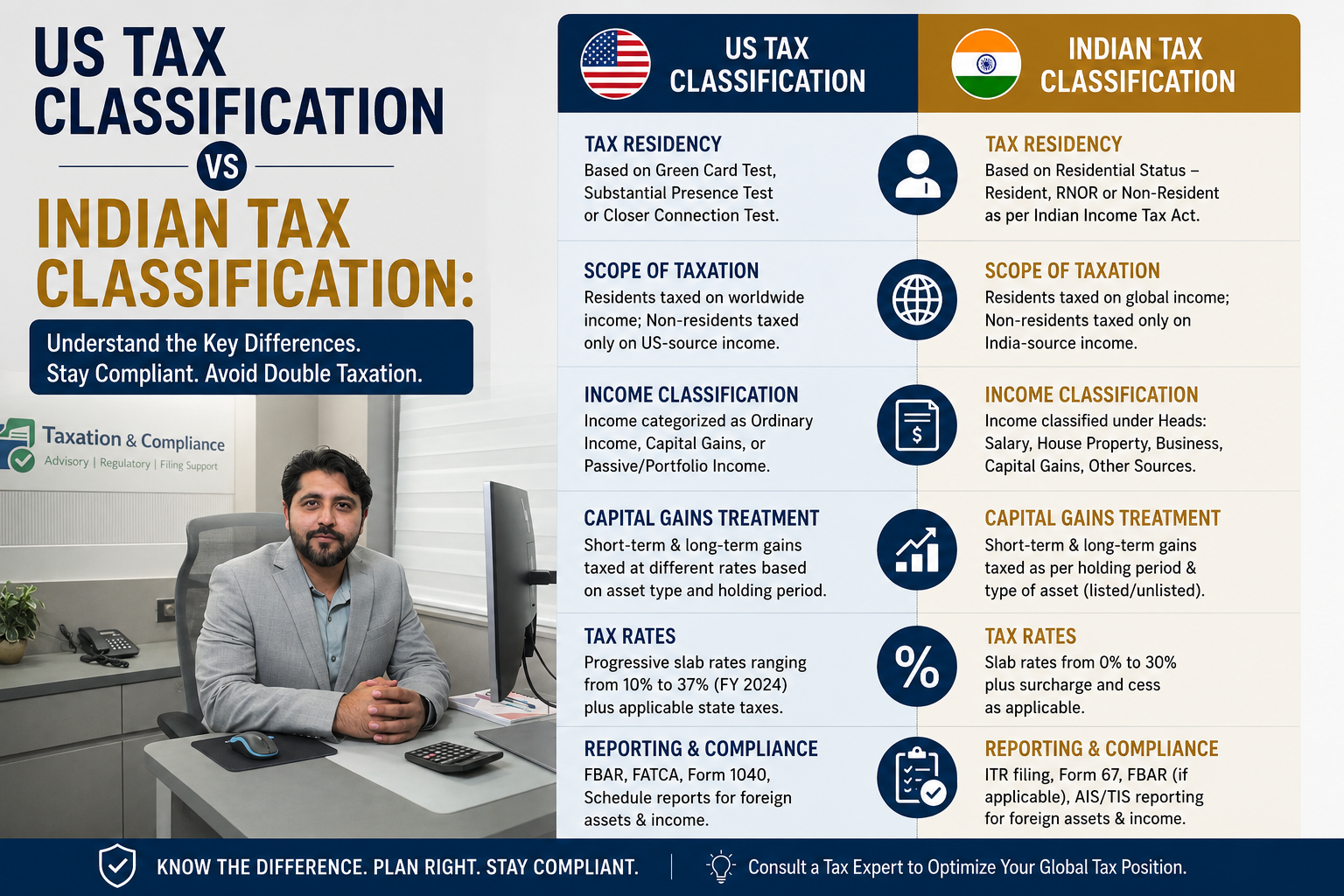
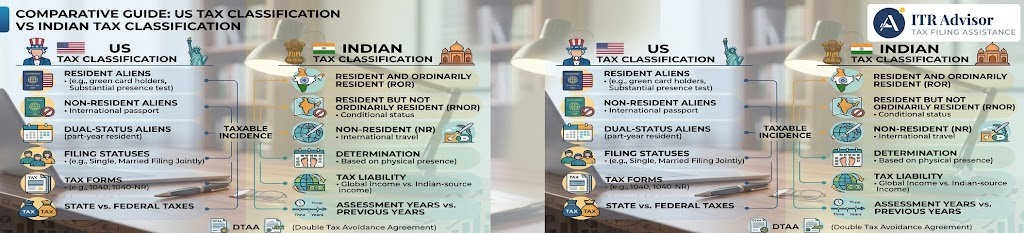
US Tax Classification vs Indian Tax Classification
A recent international transaction valued at nearly ₹46,000 crore made headlines same income, same numbers, but a completely different tax outcome depending on which country’s rulebook you apply. If you understand Indian tax classification well, that confidence can actually work against you the moment you step into US tax classification, because the two systems are not built the same way at all.
Same Income, Two Very Different Tax Outcomes
Look closely at a large cross-border deal like this and you stop seeing “income” you start seeing tax strategy. India and the US tax the same rupee (or dollar) very differently, not because the amount changes, but because each country classifies it differently before tax even enters the picture. Getting this classification wrong is one of the most common and costly mistakes founders and NRIs make when they start operating across both jurisdictions.
How India Classifies Income: Five Clean Heads
Indian tax classification is structured and predictable. Every rupee you earn falls under one of five heads: Salary, House Property, Business or Profession, Capital Gains, or Other Sources. Once you know which head applies, the tax treatment mostly follows a fixed, well-documented path.
How US Tax Classification Actually Works: Three Layers, Not Heads
US tax classification doesn’t use heads at all. Instead, it stacks three layers on top of every dollar of income, and each layer changes the outcome.
Layer 1: Tax Type
Income is first tagged as ordinary income, capital gains, or dividends. This layer alone decides your applicable tax rate.
Layer 2: Effort
Next, income is marked as earned or unearned. This layer determines which credits and benefits you can claim.
Layer 3: Activity
Finally, income is classified as passive or non-passive. This decides whether a loss can offset your tax today, or gets locked up for future years.
Applying US Tax Classification to Real Income Types
Here’s how the same three income types play out differently once you move from Indian heads to US tax classification layers:
Income Type
India (Heads)
US (Three Layers)
Running a business actively
Business or Profession
Ordinary + Earned + Non-Passive
Rental income from property
House Property
Ordinary + Unearned + Passive
Gain from selling stock
Capital Gains
Capital Gains + Unearned
At the scale of a ₹46,000 crore transaction, this isn’t just classification paperwork it’s tax engineering. India gives you structure. The US gives you strategy, and how you stack the three layers can significantly change what lands in your pocket.
CA Manish, who leads international accounting, financial modeling, and US taxation advisory at Adwani & Co LLP, has seen this misclassification trip up even experienced Indian founders expanding into US markets.
Why This Matters for Founders, Investors, and NRIs
If you’re an Indian founder raising US capital, an NRI with US rental or investment income, or a CPA firm supporting cross-border clients, this difference isn’t academic. Misreading passive versus non-passive activity, for instance, can trap real losses that should have offset your current year tax bill. Aligning your structuring from how you hold rental property to how you time a stock exit with US IRS classification rules (see IRS Publication 925 on passive activity guidance) is what actually protects your after-tax return, not just your top-line income.
India classifies income into five fixed heads: Salary, House Property, Business, Capital Gains, Other Sources. The US classifies income across three layers: Tax Type, Effort, and Activity not heads. The same business, rental, or stock income can land in very different US tax categories depending on how it’s earned. Passive versus non-passive classification decides whether losses save tax now or stay locked up. Cross-border founders and NRIs need both frameworks mapped correctly before structuring income.
FAQs on US Tax Classification vs Indian Tax Classification
1.How is US tax classification different from Indian tax classification?
India uses five fixed income heads, while the US applies three layers tax type, effort, and activity to the same income.
2.What is the difference between earned and unearned income in the US?
Earned income comes from active work or business; unearned income comes from investments, rent, or capital gains, affecting available credits.
3.Why does passive versus non-passive classification matter for US taxation?
It determines whether losses from that activity can offset your current year tax or must be carried forward to future years.
4.How does this affect NRIs earning income in both India and the US?
NRIs need to map the same income under both systems separately, since classification not just the amount drives the final tax outcome.
Conclusion
Indian tax classification rewards structure; US tax classification rewards strategy. Founders and NRIs operating across both systems need to stop assuming one framework explains the other the same income, mapped incorrectly, can mean a materially different tax bill. To learn more about our international accounting, financial reporting, Virtual CFO, and cross-border advisory support, connect with Adwani & Co LLP
Author CA. Manish R. Mata Practising In India (Ex – PwC), At Adwani & Co LLP leads the International Accounting & Tax Support vertical, delivering structured execution assistance to US CPA firms and overseas businesses.
Disclaimer:
Adwani & Co LLP is a multi-disciplinary professional services platform. The blogs shared are for educational and informational purposes only and are intended to promote awareness around finance, accounting, taxation, reporting, and business advisory topics. Nothing contained herein should be construed as solicitation or advertisement of professional services. Where professional services are required under applicable laws or regulations, such services are rendered in accordance with relevant professional and regulatory requirements. The content has been reviewed for technical accuracy by professionals associated with Adwani & Co LLP.
Can AI be confidently wrong? If you have spent any time evaluating finance-focused AI tools, you already know the answer is yes and that is exactly the problem worth unpacking. AI hallucination in finance is not a rare glitch. It is a structural risk that shows up quietly, dressed up as a well-written, professional-sounding answer.
What Is AI Hallucination in Finance, Really?
In simple terms, AI hallucination in finance happens when a model produces a response that reads as polished and authoritative, but is factually incorrect, unsupported by reliable sources, based on outdated rules, or missing important context. The danger is not that the answer sounds wrong it is that it sounds exactly right, which is what makes it easy to trust and hard to catch.
Having spent time evaluating and training finance-focused Large Language Models after years in finance, taxation, and audit, this is one of the clearest lessons that keeps surfacing: training AI is not only about generating better answers. It is equally about teaching a model when to answer, and more importantly, when to be careful.
Three Everyday Examples of AI Hallucination in Finance
The Investment Scenario
An AI tool states that a particular stock will “definitely” deliver a 15% return. No one human advisor or algorithm can guarantee market performance. A genuinely useful financial response would instead walk through assumptions, historical data, risk factors, and the uncertainty inherent in any projection.
The Tax Scenario
An AI model applies a tax provision that has since been amended or withdrawn. Tax law changes constantly a rule that was accurate last year, or even last quarter, may no longer hold. Regulatory bodies such as the IRS regularly update guidance, which is precisely why static, memorized answers are risky in a domain that moves this fast.
The Financial Planning Scenario
An AI tool recommends aggressive investment options without accounting for a person’s risk profile, financial goals, time horizon, or personal circumstances. The suggestion may be technically defensible in isolation, yet entirely unsuitable once real-world context is added back in.
Why AI Hallucination in Finance Carries Bigger Stakes Than It Looks
In most everyday applications, a hallucinated answer is a minor inconvenience. In finance, taxation, and accounting, the same failure can translate into missed compliance deadlines, incorrect filings, mispriced risk, or advice that quietly steers a business or individual in the wrong direction. This is exactly where human expertise becomes non-negotiable not as a formality, but as the layer that catches what a fluent, confident-sounding model may miss.
What Responsible AI Model Evaluation Looks Like in Finance
Evaluating a finance-focused AI model is not simply a language-quality exercise. It requires validating accuracy against current rules, the soundness of the underlying reasoning, whether relevant context has been captured, practical applicability to a real business situation, and the real-world consequences of getting it wrong. A confident answer is not the bar. A responsible answer is.
This is the perspective CA Manish, Head Consultant – International Accounting, Financial Modeling & US Taxation at Adwani & Co LLP, brings from his recent work evaluating and training finance-focused LLMs a vantage point shaped by years of practical experience across financial modeling, valuation, FP&A, and cross-border accounting engagements.
What This Means for Businesses and Finance Professionals Today
As AI tools become more embedded in accounting, tax research, and financial planning workflows, the more useful question is rarely whether AI can produce an answer. It is whether that answer has been checked against current rules, real context, and professional judgment before anyone acts on it. Businesses and accounting professionals adopting AI-assisted tools benefit from pairing them with structured review the same discipline applied to bookkeeping cleanups, MIS reporting, and financial statement review.
Firms exploring how AI fits into their reporting and advisory workflows can learn more about our Virtual CFO Services for a structured, human-reviewed approach to financial decision-making.
Key Takeaways
AI hallucination in finance means a confident-sounding answer that may be inaccurate, outdated, or missing context.
Investment, tax, and financial planning scenarios each show how a technically fluent answer can still be wrong or unsuitable.
Tax and regulatory rules change frequently, so static AI answers carry real risk in finance.
Responsible AI model evaluation checks accuracy, reasoning, context, and real-world consequences not just language quality.
Human expertise remains essential to validate AI-generated financial and tax guidance before it is acted upon.
It is when an AI tool gives a confident, professional-sounding financial or tax response that is factually incorrect, outdated, or missing important context.
2.Can AI give wrong financial advice?
Yes. AI can produce technically fluent recommendations such as aggressive investment suggestions that are unsuitable once a person’s risk profile, goals, and circumstances are factored in.
3.Why is AI hallucination riskier in tax matters?
Tax law changes frequently, so an AI response based on an outdated provision may be confidently wrong, leading to compliance errors if not verified against current rules.
4.How is AI evaluated for financial accuracy?
Proper evaluation checks accuracy, reasoning, context, practical applicability, and real-world consequences not just whether the language sounds polished
Conclusion
AI hallucination in finance is less about AI being unreliable and more about understanding where its confidence outpaces its correctness. As finance-focused AI tools continue to evolve, the professionals and firms who benefit most will be the ones who pair these tools with structured, expert-led review rather than treating a fluent answer as a final one.
Author CA. Manish R. Mata Practising In India (Ex – PwC), At Adwani & Co LLP leads the International Accounting & Tax Support vertical, delivering structured execution assistance to US CPA firms and overseas businesses.
Disclaimer
Adwani & Co LLP is a multi-disciplinary professional services platform. The blogs shared are for educational and informational purposes only and are intended to promote awareness around finance, accounting, taxation, reporting, and business advisory topics. Nothing contained herein should be construed as solicitation or advertisement of professional services. Where professional services are required under applicable laws or regulations, such services are rendered in accordance with relevant professional and regulatory requirements. The content has been reviewed for technical accuracy by professionals associated with Adwani & Co LLP.
Smart Business Growth Strategy: Stop Pushing Harder and Find the Bypass
Here is a truth that most business owners learn too late: the biggest obstacle to growth is almost never what you think it is. You blame the sales team. You blame the market. You blame the economy. But the real problem the one quietly draining your revenue, your margins, and your energy is usually hiding in plain sight, disguised as something you have always accepted as normal.
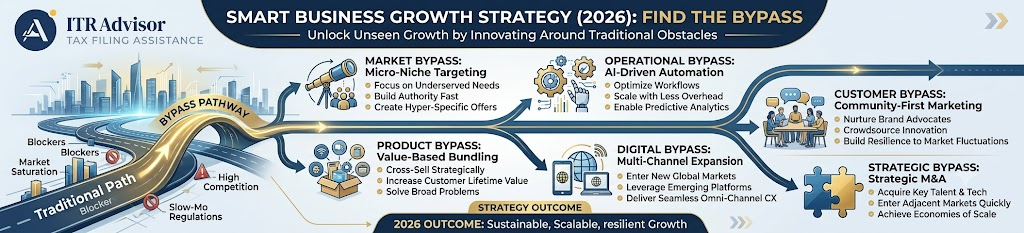
The most effective smart business growth strategy is not about pushing harder through obstacles. It is about finding the bypass the smarter, faster, less crowded path that everyone else overlooked.
At Adwani and Company, we see this pattern repeatedly. Businesses generating ₹50 crore, ₹100 crore, or more in revenue come to us frustrated. Growth has stalled. Costs are rising. Customers are complaining. And the owner is convinced the solution is more effort, more investment, more pressure.
It rarely is.
In this blog, we will explore why the most powerful smart business growth strategy often involves subtraction, not addition removing the hidden friction points that silently sabotage your business. We will share a real-world example, actionable frameworks, and the thinking that seat separates businesses that scale from businesses that struggle.
Why Pushing Harder Is Not a Smart Business Growth Strategy
There is a deeply ingrained belief in Indian business culture that success comes from relentless effort. Work longer hours. Hire more salespeople. Spend more on marketing. Push, push, push.
And effort absolutely matters. Nobody builds a successful business without hard work.
But here is the problem: effort without direction is just friction. And friction, compounded over months and years, destroys businesses.
Consider this scenario. You are walking briskly one morning clear mind, strong focus, productive energy. Then you encounter a group blocking your path. Moving slowly. Chatting casually. Unaware of anyone behind them.
You have three options:
Wait behind them patient, but slow.
Force your way through aggressive, but creates conflict.
Find a side lane a simple bypass that gets you ahead without friction.
Option three is almost always the best choice. And it is almost always the one people overlook.
Business works the same way. The most effective smart business growth strategy is not about exerting more force against the same obstacle. It is about recognising the obstacle for what it is and finding a smarter route around it.
The Hidden Bottleneck: A Real-World Business Growth Strategy Example
Let us look at a situation that Dr. Haresh Adwani and the advisory team at Adwani and Company encountered with a client a mid-sized manufacturing business with annual revenue exceeding ₹50 crore.
The Symptoms
The business was showing classic signs of stagnation:
Revenue growth had slowed to near zero.
Customer complaints were increasing quarter over quarter.
Gross margins were shrinking despite stable pricing.
The operations team was working harder but achieving less.
The owner was convinced the problem was sales. “We need more customers. We need a better sales team. We need to spend more on marketing.”
The Diagnosis
When we looked deeper beyond the P&L statement and into the operational mechanics a different picture emerged.
The root cause was not sales. It was one supplier.
This supplier was well-known in the market. Popular. In demand. Every manufacturer wanted to work with them. And because of that dominant position:
Prices kept rising 8–12% annually, far above market averages.
Deliveries kept slipping lead times had grown from 2 weeks to 6 weeks.
Quality became inconsistent rejection rates had doubled in 18 months.
The business was haemorrhaging money, not because of a sales problem, but because of a supplier dependency problem. More than ₹50 crore in annual revenue was being exposed to decisions made by someone else’s business.
The Bypass
Instead of renegotiating harder (pushing through the crowd), we helped the client find the bypass.
We conducted a comprehensive supplier review evaluating alternatives across quality, pricing, delivery reliability, and scalability. The result was a newer, less crowded supplier that offered:
15% lower pricing on key raw materials.
60% faster delivery times from 6 weeks back to under 2 weeks.
Significantly better quality consistency rejection rates dropped by 70%.
The shift looked small on paper. One supplier changed.
The impact was anything but small:
Metric
Before Bypass
After Bypass
Raw material cost
₹18.5 crore/year
₹15.7 crore/year
Average delivery time
6 weeks
1.5 weeks
Quality rejection rate
8.2%
2.4%
Customer complaints
45/month
12/month
Revenue growth (next 12 months)
~0%
18%
That is the power of a well-executed business growth strategy not more effort, but better decisions.
Pattern Recognition: The Core of Every Great Business Growth Strategy
Warren Buffett does not succeed because he works harder than other investors. He succeeds because he sees patterns others miss. Steve Jobs did not build Apple by outspending competitors. He built it by recognising what customers wanted before they knew they wanted it.
The best smart business growth strategy is rooted in pattern recognition the ability to look at a complex business and identify the one lever that, when pulled, unlocks disproportionate results.
As Dr. Haresh Adwani often explains: “Numbers tell you what is happening. Patterns tell you why. And understanding why is where real advisory value begins.”
Most business owners are drowning in data. Revenue reports, expense dashboards, sales funnels, customer analytics. But data without interpretation is noise. The role of a strategic advisor is to cut through that noise and find the signal the one insight that changes the trajectory.
Five Signs Your Business Needs a Bypass, Not More Effort
How do you know when pushing harder is the wrong approach? Here are five patterns we frequently identify at Adwani and Company:
1. Revenue Is Growing but Margins Are Shrinking
If your top line is increasing but your bottom line is flat or declining, you have a structural problem not a sales problem. The bypass might be in your cost structure, your pricing model, or your customer mix.
2. Your Best People Are Burning Out
When high performers start leaving or disengaging, it is rarely about compensation. It is usually about friction inefficient processes, unclear priorities, or systemic bottlenecks that make their work unnecessarily difficult. The bypass is operational, not motivational.
3. Customer Complaints Are Increasing Despite Good Products
This almost always points to a supply chain or delivery issue. Your product may be excellent, but if it arrives late, arrives damaged, or arrives inconsistently, customers will leave. The bypass is upstream, not downstream.
4. You Are Over-Dependent on One Supplier, One Client, or One Channel
Concentration risk is the silent killer of mid-sized businesses. If more than 30% of your revenue or supply chain depends on a single entity, you are one decision away from crisis. The bypass is diversification systematic, strategic, and planned.
5. You Keep Solving the Same Problems
If the same issues resurface every quarter cash flow crunches, inventory mismatches, compliance delays you are treating symptoms, not causes. The bypass requires going deeper and restructuring the root process.
How to Build a Smart Business Growth Strategy Around Finding Bypasses
Here is a practical framework that any business owner can implement:
Step 1: Map Your Friction Points
List every area where your business experiences recurring delays, cost overruns, or quality issues. Be brutally honest. Common areas include procurement, logistics, compliance, hiring, and collections.
Step 2: Quantify the Cost of Friction
For each friction point, estimate the annual cost in money, time, and opportunity. You will be surprised how much “accepted” inefficiency is actually costing you. A ₹50 crore business can easily be losing ₹3–5 crore annually to friction it has never measured.
Step 3: Identify the Biggest Lever
Not all friction points are equal. Find the one that, if resolved, would have the largest cascading impact on revenue, margins, and customer satisfaction. This is your primary bypass.
Step 4: Explore Alternatives Relentlessly
Do not accept the first alternative you find. Evaluate multiple options. Test small before committing large. The best business growth strategy decisions are informed, not impulsive.
Step 5: Execute and Measure
Implement the change, track the metrics, and iterate. A bypass is not a one-time fix it is a new path that needs to be maintained and optimised over time.
The Role of Advisory in Modern Business Growth Strategy
Here is something most business owners do not want to hear: you cannot see your own blind spots.
You are too close to the business. You have too many emotional attachments to existing relationships, processes, and decisions. The supplier who is costing you ₹3 crore a year might also be someone you have known for 15 years. The process that is bleeding efficiency might be one you designed yourself.
This is where external advisory becomes invaluable not to replace your judgment, but to complement it with objectivity.
At Adwani and Company, our advisory approach goes beyond spreadsheets and compliance. Led by Dr. Haresh Adwani, our team works with business owners to identify hidden friction, quantify its impact, and design practical solutions that drive measurable growth.
Whether it is a supplier review, a cost restructuring, a compliance overhaul, or a full strategic reassessment, the goal is always the same: find the bypass that unlocks your next phase of growth.
The Ministry of Corporate Affairs (MCA) and regulatory frameworks like the Companies Act increasingly demand that businesses maintain robust governance and operational structures. A strong business growth strategy must account for compliance as a growth enabler, not just a cost centre.
Frequently Asked Questions
1. What is a smart business growth strategy?
A business growth strategy is a structured plan to increase revenue, improve margins, and scale operations sustainably. It involves identifying opportunities, removing bottlenecks, and making strategic decisions about markets, products, pricing, and operations.
2. Why does pushing harder sometimes fail as a business growth strategy?
Because effort without direction creates friction. If the underlying problem is structural a bad supplier, an inefficient process, a flawed pricing model more effort will not solve it. You need to identify and address the root cause.
3. How do I identify hidden bottlenecks in my business?
Start by mapping every area where recurring problems occur delays, cost overruns, complaints, rework. Quantify the cost of each. The largest hidden cost is usually your biggest bottleneck and your most valuable bypass.
4. How often should a business review its growth strategy?
At minimum, annually. However, high-growth businesses benefit from quarterly strategic reviews. Market conditions, supplier dynamics, and customer needs change constantly your business growth strategy must evolve accordingly.
5. Can a single supplier really impact business growth?
Absolutely. As our real-world example demonstrated, one over-relied-upon supplier can silently erode margins, delay deliveries, and damage customer relationships putting crores of revenue at risk.
Conclusion: The Smartest Business Growth Strategy Is Seeing What Others Miss
Every business owner faces crowded paths saturated markets, rising costs, difficult suppliers, demanding customers. The instinct is to push harder, move faster, and outwork the competition.
But the most successful businesses the ones that scale sustainably and profitably do something different. They pause. They observe. They find the bypass.
The side lane nobody noticed. The supplier nobody evaluated. The process nobody questioned. The insight nobody connected.
That is not laziness. That is strategic intelligence. And it is the foundation of every truly effective business growth strategy.
Where in your business are you pushing harder when you should be looking for the bypass?
If you want expert guidance to identify hidden growth opportunities, streamline operations, and build a business growth strategy that actually works, connect with Adwani and Company today. Dr. Haresh Adwani and our advisory team are ready to help you find the path that transforms your business.
Author CA. Manish R. Mata Practising In India (Ex – PwC), At Adwani & Co LLP leads the International Accounting & Tax Support vertical, delivering structured execution assistance to US CPA firms and overseas businesses.