
Author: Pavan Adwani

  • Income Tax Search & Seizure: Your Rights, Risks & Legal Remedies

    Income Tax Search & Seizure: Your Rights, Risks & Legal Remedies

    15 June 2026• Pavan Adwani

    Income Tax Search & Seizure

    When the Income Tax Department Knocks Without Warning

    Imagine it is early morning. You hear a firm knock at your door, and a group of officials identifies themselves as officers from the Income Tax Department. They carry a warrant. They are here to search your premises under Section 132 of the Income Tax Act. Your heart races. You do not know what to say, what to hand over, or what rights you have.

    This scenario commonly called an income tax raid is one of the most stressful financial events a taxpayer can face. Yet, for thousands of individuals and businesses across India, it is a very real possibility. The Income Tax Department’s Investigation Wing has intensified search and seizure operations in recent years, leveraging advanced data analytics, the Annual Information Statement (AIS), and cross-referencing between GST returns and ITR filings to identify discrepancies worth pursuing.

    Here is the critical point: an income tax search and seizure operation does not automatically mean you are guilty of anything. It means the department has reason to believe that undisclosed income or assets may exist on your premises. You have legal rights, procedural safeguards protect you, and expert representation can make an enormous difference to the outcome.

    This comprehensive guide prepared by the expert team at Adwani and Company, led byDr. Haresh Adwani, PhD in Commerce and law graduate walks you through the complete income tax search and seizure process: what triggers it, what officers can and cannot do, what your rights are, how penalties work, and most importantly, how to protect yourself before one ever happens.
    Read our detailed guide on: ITR 1 vs ITR 2 vs ITR 3 vs ITR 4: The Definitive Guide to Picking the Right Income Tax Return Form for AY 2026-27


    What Is Income Tax Search and Seizure Under Section 132?

    The income tax search and seizure power flows directly from Section 132 of the Income Tax Act, 1961. It is one of the most significant and most feared enforcement tools available to the Income Tax Department.

    Legally speaking, Income Tax search and seizure operation allows authorized Income Tax officers to enter and inspect any premises residential, commercial, or otherwise seize books of accounts, documents, cash, jewellery, and other valuables believed to represent undisclosed income, and record statements from persons present at the scene.

    The Income Tax Department’s official position, as reflected in its operational guidelines, is clear: search and seizure is a measure of last resort, reserved for situations where normal assessment channels cannot adequately unearth concealed income.

    Search vs. Survey : An Important Distinction

    Many taxpayers confuse a search with a survey. They are legally distinct operations with very different powers.

    A survey under Section 133A is comparatively mild. It can only be conducted at business premises during normal working hours. Officers can inspect books of account and records but cannot seize assets during a survey.

    An Income tax search and seizure is far more intrusive. It can happen at any hour, at any premises home, office, bank locker, or any other location. Officers can seize physical assets including cash, gold, jewellery, and digital records. Statements recorded during a search carry evidentiary value in subsequent assessment proceedings.

    Understanding this distinction matters deeply because the two operations require different responses, and the consequences of each are fundamentally different.


    What Triggers an Income Tax Search and Seizure?

    The Income Tax Department does not conduct searches randomly. Before any search warrant is issued under Section 132, the authorized officer must have documented “reason to believe” a legal standard that requires credible, concrete information rather than mere suspicion.

    Common triggers that lead to an income tax search and seizure include:

    1. Credible Intelligence Reports

    The department’s Investigation Wing collects intelligence from multiple sources informants, government data systems, financial intelligence units about individuals or businesses holding substantial undisclosed income or assets.

    2. Significant Mismatch in Financial Data

    India’s tax infrastructure now cross-references GST returns, ITR data, AIS (Annual Information Statement), banking transactions, property registrations, and foreign remittances. A business declaring ₹40 lakh turnover while showing GST credits for ₹1.8 crore worth of input purchases is an obvious red flag.

    3. Lavish Expenditure Inconsistent With Declared Income

    High-value wedding expenditure, luxury real estate purchases, or acquisition of expensive vehicles that are not commensurate with declared income routinely trigger investigation wing activity.

    4. Tip-Offs From Associated Parties

    Former employees, business partners, or related parties sometimes provide information to the Income Tax Department. Such information, when independently verified, can form the basis of a search warrant.

    5. Duplicate Books or Manipulated Accounts

    Evidence of double accounting maintaining one set of books for tax purposes and another for actual business is a direct trigger for an income tax search and seizure under Section 132.

    As Dr. Haresh Adwani explains: “The vast majority of search operations today are data-driven. With AIS, GSTN data, and property registry data all feeding into one analytical system, discrepancies that once went unnoticed for years now surface within months. Clean books are your best protection.”


    The Step-by-Step Income Tax Search and Seizure Process

    Understanding exactly what happens during an income tax search helps you respond calmly, correctly, and in a legally sound manner.

    Step 1 : Authorization and Warrant

    No search can begin without a valid written warrant of authorization issued by a senior authority typically the Principal Director General, Director General, Principal Commissioner, or Commissioner of Income Tax. This authorization must be based on documented reasons that meet the legal standard of “reason to believe.”

    The Supreme Court of India, in landmark decisions including Pooran Mal v. Director of Inspection [1974] 93 ITR 505, upheld the constitutional validity of Section 132, holding that search powers directed at persons who have evaded tax on solid grounds are a reasonable restriction on fundamental rights.

    Step 2 : Arrival at Premises and Identification

    Officers must identify themselves and present the search warrant. You have the right to examine this warrant carefully. The search team must be accompanied by at least two independent local witnesses (panchas).

    Step 3 : The Search Operation

    During the search, officers may:

    1.Enter and inspect every room, locker, safe, cupboard, or storage area

    2. Break open any locked containers if keys are not provided

    3. Examine all books of account, ledgers, digital files, and correspondence

    4. Seize cash, jewelry, documents, electronic devices, and any other valuables believed to represent undisclosed income

    5.Record statements from persons present

    The entire process is documented through a formal

    Panchnamaa contemporaneous record of proceedings that lists every item seized, every statement recorded, and all actions taken. A copy of the Panchnama must be provided to you at the conclusion of the search.

    Step 4 : Post-Search Assessment

    An income tax search and seizure triggers a special assessment process under Section 153A of the Income Tax Act. The Assessing Officer will issue notices requiring you to file returns for the current year plus the preceding six assessment years or up to ten years in cases involving serious undisclosed foreign assets or assets exceeding a prescribed threshold.

    This is where the financial impact of a search operation becomes concrete. Every year in the six-year window can be reopened, reassessed, and subjected to additions, penalties, and interest.

    Tax Rates and Penalties After an Income Tax Search

    This is the section that taxpayers fear most and rightfully so. The tax treatment of undisclosed income discovered during a search is significantly harsher than regular income.

    Section 115BBE: Flat Tax on Unexplained Income

    Any income discovered during a search that cannot be explained — undisclosed cash, unexplained jewellery, unaccounted business receipts is taxed at a flat rate of 60% under Section 115BBE. With applicable surcharge and cess, the effective tax rate rises to approximately 77% to 83%. No deductions or exemptions are available against this income.

    Section 271AAC: Additional Penalty

    A penalty of 10% of the tax payable under Section 115BBE is levied under Section 271AAC, in addition to the tax already assessed.

    Section 276C: Prosecution

    Where willful tax evasion is established and the evaded amount exceeds ₹25 lakh, prosecution proceedings under Section 276C can be initiated. Conviction can lead to imprisonment of six months to seven years along with fines.

    Practical Example:

    Mr. Arvind Mehta runs a retail business in Mumbai. During an income tax search and seizure operation, officers discover ₹45 lakh in unaccounted cash kept in a safe, along with records of off-book sales totaling ₹1.2 crore over four years. Here is how his exposure is computed:

    Item Amount

    Undisclosed cash seized ₹45,00,000

    Undisclosed income from books ₹1,20,00,000

    Total Undisclosed Income ₹1,65,00,000

    Tax @ 60% under Section 115BBE ₹99,00,000

    Surcharge + Cess (approx.) ₹18,00,000

    Penalty under Section 271AAC (10%) ₹9,90,000

    Total Liability ₹1,26,90,000**

    In other words, Mr. Mehta faces a liability of approximately ₹1.27 crore on undisclosed income of ₹1.65 crore effectively losing over 77% of the undisclosed amount to taxes and penalties, without accounting for interest under Section 234A or potential prosecution proceedings.

    This example illustrates precisely why proactive compliance declaring all income, reconciling books correctly, and filing accurate ITRs is infinitely less costly than facing an income tax search and seizure


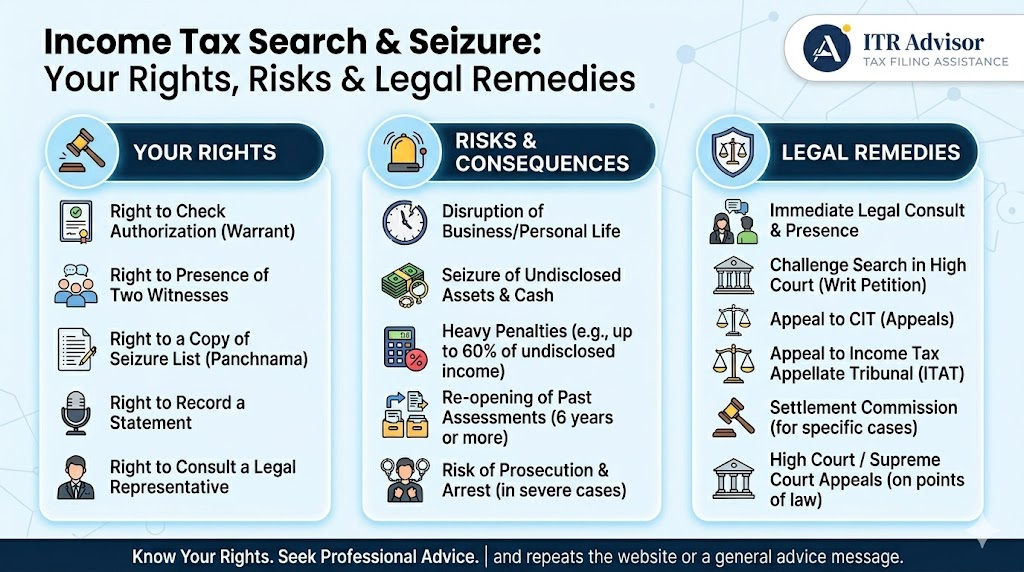
    Your Legal Rights During an Income Tax Search and Seizur

    Here is what most taxpayers do not know

    you have significant legal rights during a search operation. Exercising them correctly, without obstruction, can materially affect the outcome of the subsequent assessment

    1.Verify the Warrant

    You have the right to examine the search warrant and verify the identity of every officer present. Ask to see identity cards. Note the warrant number and the name of the authorizing officer.

    2.Call Your Chartered Accountant or Legal Advisor

    You have the right to inform your CA or legal advisor about the search. At Adwani and Company, Dr. Haresh Adwani and the team are available to advise clients through search operations, helping them respond to statements and requests in a legally sound manner.

    3.Receive a Copy of the Panchnama

    At the conclusion of the search, officers must provide you with a signed copy of the Panchnama, listing every item seized and every statement recorded. Retain this document carefully it forms the foundation of your entire post-search legal strategy.

    4.Retract Statements Made Under Coercion

    Statements recorded during a search carry evidentiary weight. However, the law provides that statements extracted under coercion or undue influence can be retracted within a reasonable time. If you believe a statement was recorded under pressure, consult a qualified tax expert immediately.

    5.Object to Retention Beyond 180 Days

    The Income Tax Department cannot retain seized books of account or documents for more than 180 days without a valid extension order. If retention is extended, you have the right to make a formal application objecting to the extension.

    6. Seek Judicial Review

    If you believe the search was conducted without valid authorization, without meeting the legal standard of “reason to believe,” or with procedural lapses, you have the right to challenge the search in the appropriate High Court. Courts have the power to quash unlawful searches, and a significant percentage of additions made during search assessments are reversed in appeals on evidentiary grounds.


    How to Prevent an Income Tax Search and Seizure

    The most effective legal strategy is one that ensures a search never happens in the first place. The Income Tax Department’s own advisories consistently emphasize that voluntary, accurate, and timely compliance is the clearest protection against enforcement action.

    Here are the key preventive practices recommended by Adwani and Company:

    1. File accurate ITRs every year: Ensure all sources of income, including interest, dividends, capital gains, freelance income, and rental income, are properly declared.

    2. Reconcile GST and ITR data: Your GST turnover and your ITR income must be consistent. Large, unexplained gaps are automatic red flags in the department’s analytical systems.

    3. Maintain proper books of account: Preserve vouchers, invoices, bank statements, and supporting documents for at least seven years.

    4. Explain large cash transactions: Any cash deposits above ₹10 lakh or large withdrawals should have documented explanations. The Annual Information Statement (AIS) on incometax.gov.in shows exactly what data the department has about your financial transactions.

    5. Declare all assets in the ITR: The ITR Schedule AL (Assets and Liabilities) is compulsory for taxpayers with income above ₹50 lakh. Correct disclosure here is critical.

    6. Respond promptly to notices: An ignored income tax notice escalates. A prompt, documented response demonstrates good faith and prevents matters from reaching search stage. *[Learn more about our Tax Compliance and Risk Management Services]*

    Frequently Asked Questions

    Q1. What is the difference between an income tax search and an income tax survey?

    A search under Section 132 can be conducted at any time, at any premises, and includes the power to seize assets. A survey under Section 133A is conducted at business premises during business hours and does not include the power to seize assets.

    Q2. Can income tax officers arrest me during a search and seizure?

    No. Unlike customs, excise, or enforcement directorate operations, income tax officers do not have the power of arrest during a search and seizure operation. No person can be detained or arrested solely on the basis of an income tax search under Section 132.

    Q3. What tax rate applies to undisclosed income found during a search?

    Unexplained income discovered during an income tax search is taxed at a flat rate of 60% under Section 115BBE, plus surcharge and cess — bringing the effective rate to approximately 77% to 83%. No deductions or exemptions apply.

    Q4. How many years can be reassessed after an income tax search?

    The Income Tax Department can reopen and reassess the current assessment year plus the preceding six years — a total of seven years. In cases involving significant undisclosed foreign assets or income above a prescribed threshold, the window can extend to ten years

    05.How can Adwani and Company help if I receive a post-search assessment notice

    Adwani and Company, under the leadership of Dr. Haresh Adwani, provides end-to-end support for taxpayers facing post-search assessments — from reviewing the Panchnama and preparing explanations for seized items, to representing clients at assessment hearings, Commissioner of Income Tax (Appeals), and the Income Tax Appellate Tribunal (ITAT).
     

    Conclusion

    An income tax search and seizure is a powerful legal tool but it is not beyond challenge, and facing one does not mean the end of the road. The Income Tax Act provides significant procedural safeguards precisely because the legislature recognized that such a drastic power must be exercised responsibly.

    What determines the outcome of a search and its aftermath is not just what happens during the search itself, but the quality of your documentation, the accuracy of your prior filings, and the expertise of the professionals who represent you in the months that follow.

    Compliance is not just about paying taxes. It is about building a financial record so clean, so consistent, and so well-documented that an income tax search would yield nothing because there is nothing to find. That is the standard every taxpayer should aspire to.”

    If you are facing an income tax search, have received a post-search assessment notice, or simply want to ensure your tax affairs are structured to minimize enforcement risk connect with Adwani and Company today.

    Our team, brings together decades of experience in income tax representation, search assessment defense, ITAT appeals, and proactive tax risk management. Whether you are an individual, a family business, or a growing company, we ensure you face the Income Tax Department from a position of strength, compliance, and confidence.

    Author

    Pavan Adwani – Corporate Advisory, Tax Compliance & Regulatory Management.He is actively involved in advising business entities on corporate compliance, tax management, and regulatory frameworks, with a structured and process-oriented approach.

    Disclaimer

    ITRAdvisor.in is an educational and informational platform focused on tax awareness and compliance updates. Nothing contained herein should be construed as solicitation or advertisement of professional services. Professional services, where applicable, are rendered in accordance with ICAI guidelines. This article is published on ITRAdvisor.in, a tax and compliance knowledge platform. The content has been reviewed for technical accuracy by professionals associated with Adwani & Co LLP.

  • Income Tax AY 2026-27: The Proven Guide to New ITR Forms, Rules & Avoiding Costly Mistakes

    Income Tax AY 2026-27: The Proven Guide to New ITR Forms, Rules & Avoiding Costly Mistakes

    Why AY 2026-27 Could Be the Most Important Tax Year of Your Life

    Income tax AY 2026-27 is here and it brings the most sweeping changes to India’s tax filing system in over six decades. If you file the wrong ITR form, miss a renamed document, or skip the new Aadhaar validation rule, your return will be flagged as defective. The penalties are real, the deadlines are firm, and the window to prepare is shrinking fast.

    This is your proven, step-by-step guide to everything that has changed and exactly what you must do to file correctly, confidently, and on time.

    Income Tax AY 2026-27
    Income Tax AY 2026-27

    What Has Changed in Income Tax AY 2026-27? (Key Highlights)

    Before we go deep, here is a rapid summary of every major change under the new Income Tax Act, 2025 and Income Tax Rules, 2026, both effective from 1 April 2026:

    • ✅ All ITR forms (ITR-1 to ITR-7) have been fully revamped
    • ITR-1 now permits up to two house properties a landmark change for salaried taxpayers
    • LTCG up to ₹1.25 lakh under Section 112A is now reportable directly in ITR-1
    • ✅ Deductions under Sections 80C–80U must now be selected via a precise sub-section drop-down
    • ✅ The 28-digit Aadhaar Enrolment ID is no longer accepted — only the 12-digit Aadhaar Number is valid
    • Dual contact details (two emails + two mobile numbers) are now mandatory for every filer
    • Form 16 has been renamed Form 130 and Form 26AS is now Form 168
    • ✅ Both AY 2026-27 and TY 2026-27 now coexist on the e-filing portal choosing the wrong one is a critical and costly mistake

    Each of these is explained in full below.

    The Legal Foundation: Income Tax Act 2025 & Income Tax Rules 2026

    The Income Tax Act, 1961 served Indian taxpayers for 65 years. From 1 April 2026, it has been replaced procedurally by the Income Tax Act, 2025, supported by the freshly issued Income Tax Rules, 2026.

    What this means in practice:

    • Tax slabs and rates remain broadly similar for most taxpayers
    • But the reporting procedures, form structures, document names, and validation rules have been comprehensively redesigned
    • All ITR forms have been rebuilt from scratch under the new legal framework
    • Dozens of statutory documents that employers and professionals have used for years now carry entirely new names and form numbers

    According to the Income Tax Department of India at incometax.gov.in, the restructuring aims to reduce ambiguity in declarations, improve accuracy of TDS credit reconciliation, and tighten alignment between taxpayer-reported income and the government’s own Annual Information Statement (AIS) data.

    The message for every taxpayer is simple: last year’s approach will not work in income tax AY 2026-27. The rules have changed and those who adapt early will have a smooth season while those who don’t will face notices, defective return orders, and delays.

    Learn more about our Taxation & Compliance Services at ITR Advisor we help individuals, businesses, and professionals navigate every update with confidence.

    Critical ITR Filing Due Dates for AY 2026-27 Do Not Miss These

    Missing a deadline costs money. Under Section 234F, late filing attracts a fee of up to ₹5,000. Beyond the fee, late filers may lose the right to carry forward capital losses and face delays in TDS refund processing.

    Mark these dates in your calendar right now:

    Taxpayer CategoryApplicable FormsLast Date
    Salaried, pensioners, non-audit individualsITR-1 & ITR-231 July 2026
    Non-audit businesses & professionalsITR-3 & ITR-431 August 2026
    Tax audit cases (businesses & firms)ITR-3, ITR-5 & ITR-631 October 2026
    Transfer pricing casesAs applicable30 November 2026

    Each of these changes is explained in detail below.

    Expert advice from Pavan Adwani: “Do not wait until July. The new forms demand far more granular data than before reconciled AIS, precise sub-section deduction mapping, and verified Aadhaar details. Taxpayers who start in June file better returns and get refunds faster.”

    🔗 Read our detailed guide on ITR Filing Deadlines and Late Filing Penalties


    Which ITR Form Should You File for AY 2026-27? Complete Guide

    Filing the wrong ITR form results in a defective return notice from the department. Here is the definitive breakdown of all seven forms:

    ITR-1 (SAHAJ) – Massively Expanded for AY 2026-27

    Who can use it: Resident individuals earning salary or pension income, with up to two house properties (NEW), income from other sources, and LTCG under Section 112A of up to ₹1.25 lakh with no brought-forward losses (NEW).

    This is the biggest practical change in the income tax AY 2026-27 filing season. Millions of salaried taxpayers who were previously forced to file the more complex ITR-2 solely because of two house properties or small capital gains can now use the simpler SAHAJ form.

    ITR-2 – Capital Gains, Foreign Assets, Multiple Properties

    Who must use it: Individuals and HUFs with LTCG exceeding ₹1.25 lakh, more than two house properties, foreign assets or foreign income, or those who are directors in a company or hold unlisted shares.

    ITR-3 – Business or Profession Income

    Who must use it: Individuals and HUFs with income from a business or profession – including F&O traders, intraday stock traders, and all proprietorship businesses not opting for presumptive taxation.

    ITR-4 (SUGAM) – Presumptive Taxation Made Simple

    Who can use it: Individuals, HUFs, and firms that opt for the presumptive income scheme under:

    • Section 44AD – businesses with gross turnover up to ₹2 crore
    • Section 44ADA – professionals (doctors, CAs, lawyers, engineers) with receipts up to ₹50 lakh
    • Section 44AE – goods transport operators

    If you are eligible, this form eliminates the need for detailed bookkeeping and dramatically simplifies your compliance burden.

    ITR-5, ITR-6, ITR-7

    • ITR-5: Firms, LLPs, AOPs, and BOIs
    • ITR-6: All companies not claiming Section 11 exemptions
    • ITR-7: Trusts, research institutions, political parties, and specified entities under Sections 139(4A)–139(4D)

    🔗 Not sure which ITR form applies to you? Read our detailed ITR-1 vs ITR-2 vs ITR-3 vs ITR-4 comparison guide

    5 Game-Changing Updates Inside the New ITR Forms for AY 2026-27

    1. Two House Properties Now Allowed in ITR-1 A Game-Changer for the Middle Class

    Previously, owning two houses automatically disqualified you from filing ITR-1. You had no option but to use ITR-2, with all its additional complexity. This year that wall has come down. Under the new Income Tax Rules, 2026, individuals with up to two residential properties whether self-occupied, rented, or deemed let-out can continue using ITR-1, provided the rest of their income qualifies.

    This single change benefits tens of millions of taxpayers across India.

    2. Small Investors Get LTCG Relief in ITR-1

    If you redeemed equity mutual funds or sold listed shares during FY 2025-26 and earned Long-Term Capital Gains under Section 112A of ₹1.25 lakh or less, and you have no capital losses brought forward from earlier years, you no longer need to file ITR-2. You can report these gains directly in ITR-1.

    This is enormous relief for retail SIP investors who had small gains but were burdened with ITR-2 filings simply because of them.

    3. Mandatory Drop-Down for Every Deduction No More Lump-Sum Entry

    This is the change most likely to trip people up. The new forms no longer allow you to enter a single combined figure under Section 80C. You must now select the exact sub-section for each investment from a mandatory drop-down menu:

    • 80C(a) → EPF contributions
    • 80C(b) → PPF deposits
    • 80C(c) → Life insurance premiums
    • 80C(d) → ELSS mutual fund investments
    • 80C(e) → Tuition fees
    • 80D → Health insurance premiums
    • And so on across 80C to 80U

    What to do now: Collect every investment proof and map each one to the correct sub-section before you open the e-filing portal. Getting this wrong even with the right total amount can result in a defective return.

    4. Aadhaar Enrolment ID Is Dead Only 12-Digit Aadhaar Accepted

    The 28-digit Aadhaar Enrolment ID that many taxpayers used in previous years is no longer accepted on the e-filing portal under any circumstances. Only your 12-digit Aadhaar Number is valid for income tax AY 2026-27 filing.

    Additionally, your Aadhaar must be actively linked to your PAN. If it is not, your return will be declared invalid and your TDS refunds will be withheld. Check your PAN-Aadhaar linking status at incometax.gov.in today.

    5. Two Contact Details Are Now Compulsory

    The new ITR forms require every filer to provide two separate email addresses and two separate mobile numbers. The department uses these for OTP verification, refund intimation, and official notices. If either contact becomes inactive, the department may be unable to reach you and that creates compliance risk.

    Update your contact details before filing to ensure both sets are active and accessible.


    Renamed Forms Under Income Tax Rules 2026 The Complete List

    This is the change that is catching even experienced professionals off-guard. Under the Income Tax Rules, 2026, the names and numbers of almost every major statutory form have changed. Referencing old form names in tax proceedings or correspondence can cause serious complications.

    Here is the complete renaming reference table:

    Old NameNew Form NumberWhat It Is
    Form 16Form 130Employer’s TDS certificate for salary income
    Form 26ASForm 168Tax Credit Statement (TDS, TCS, advance tax)
    Form 15G / 15HForm 121Self-declaration for non-deduction of TDS on interest
    Form 3CA / 3CB / 3CDForm 26Unified Tax Audit Report
    Forms 26QB / 26QC / 26QD / 26QEForm 141Property purchase & rent TDS challan/return

    For HR teams and employers: Update your payroll software templates, TDS certificate formats, and employee communication templates immediately. Issuing a document labelled “Form 16” instead of “Form 130” during the income tax AY 2026-27 season may create confusion during employee tax filing and in any departmental proceedings.


    AY 2026-27 vs TY 2026-27 The Costly Portal Confusion You Must Avoid

    The e-filing portal at incometax.gov.in now simultaneously supports two compliance frameworks, and this is creating genuine confusion:

    AY 2026-27 (Assessment Year 2026-27) Select this to file your regular annual return reporting income earned in FY 2025-26 (1 April 2025 to 31 March 2026). This is what almost every individual taxpayer needs to select.

    TY 2026-27 (Tax Year 2026-27) This is for ongoing compliance obligations under the new Income Tax Act, 2025, tracking transactions from 1 April 2026 onward. This is NOT your annual return for past income.

    Selecting TY 2026-27 when you intend to file your regular annual return is a critical and costly mistake your submission will be misclassified and you may face a notice for non-filing of the actual return.

    Always choose AY 2026-27 for your standard annual income tax return. When in doubt, consult a professional.


    Real-World Example: Choosing the Right ITR Form for AY 2026-27

    Here is a practical scenario from the advisory files of Pavan Adwani that illustrates how the new rules work:

    Case Study: Priya Senior Analyst, Pune

    Priya earns ₹13.8 lakh annually from her job. She owns two flats one self-occupied, one rented at ₹15,000/month. In December 2025, she redeemed equity mutual funds she had held for over two years, earning LTCG of ₹78,000 under Section 112A. She has no carried-forward capital losses.

    Income ComponentAmount
    Salary Income₹13,80,000
    Rental Income (after 30% standard deduction)₹1,26,000
    LTCG under Section 112A₹78,000
    Less: Section 80C (EPF + LIC)₹1,50,000
    Less: Standard Deduction₹75,000

    Which form should Priya use?

    Under the old rules, Priya would have been compelled to file ITR-2 due to two house properties and capital gains.

    Under the income tax AY 2026-27 rules: Priya’s LTCG is below ₹1.25 lakh, she has no brought-forward losses, and the new rules permit two house properties in ITR-1. She now qualifies for the simpler ITR-1 (SAHAJ) saving time, reducing complexity, and lowering her risk of filing errors.


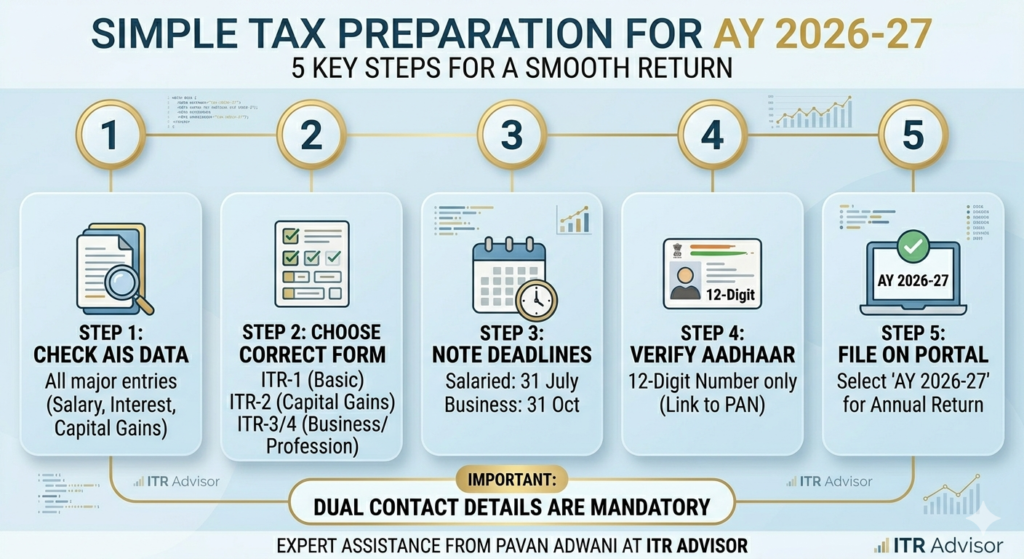
    Proven 5-Step Action Plan for Filing Income Tax AY 2026-27 Without Stress

    Step 1: Download Your AIS and Reconcile Every Entry

    Log in to incometax.gov.in, navigate to the AIS section, and download your Annual Information Statement. Cross-check every transaction salary, dividends, mutual fund redemptions, interest income, property transactions against your own records. Raise objections on the portal for any incorrect entries before you file.

    Step 2: Gather Capital Gain Statements from Every AMC and Broker

    Get your Consolidated Account Statement (CAS) from CAMS or KFintech. Download individual capital gain statements from every mutual fund house where you redeemed units in FY 2025-26. Know your LTCG and STCG separately, by asset class and holding period.

    Step 3: Map Every Deduction to the Correct Sub-Section

    Create a simple table listing each investment/expenditure, the amount, the supporting document, and the exact sub-section it falls under. This preparation prevents errors in the new mandatory drop-down system.

    Step 4: Verify PAN-Aadhaar Linkage Right Now

    Do not wait until the day you file. Verifying and completing PAN-Aadhaar linkage takes a few days to reflect in the system. Check your status today at the official portal.

    Step 5: Update Both Sets of Contact Details

    Log into the e-filing portal and ensure your primary and secondary email and mobile number are both active. This is now a mandatory field in the new ITR forms a missing or inactive contact can block your return from being processed.

    🔗 Want us to handle all of this for you? Book an ITR Filing Consultation with ITR Advisor

    Conclusion: Income Tax AY 2026-27 Demands Preparation — Start Today

    The income tax AY 2026-27 season is the most consequential filing season Indian taxpayers have faced in a generation. The transition to the Income Tax Act, 2025 and Income Tax Rules, 2026 has changed how you select your ITR form, how you claim deductions, what documents your employer must give you, and how the e-filing portal validates your identity.

    The good news: every single one of these changes is manageable provided you start now, not in the last week of July.

    Reconcile your AIS. Map your deductions. Verify your Aadhaar-PAN linkage. Know your correct ITR form. And if any part of this feels overwhelming, work with a qualified professional who already knows the new rules inside out.

    As Pavan Adwani says: “The biggest tax mistakes are never made because someone didn’t know the rules. They are made because someone didn’t start early enough to apply them correctly. In AY 2026-27, that margin for error is smaller than ever.”

    Frequently Asked Questions About Income Tax Filing AY 2026-27

    Q1. What are the biggest income tax changes for AY 2026-27?

    The major changes include: revamped ITR forms under the Income Tax Act, 2025 and Rules, 2026; expanded eligibility for ITR-1 (now allows two house properties and LTCG up to ₹1.25 lakh); mandatory sub-section-level reporting of deductions; rejection of Aadhaar Enrolment IDs; dual contact details requirement; and comprehensive renaming of statutory forms such as Form 16 (now Form 130) and Form 26AS (now Form 168).

    Q2. What is the last date to file ITR for AY 2026-27 for salaried individuals?

    For salaried individuals and non-audit cases filing ITR-1 or ITR-2, the due date is 31 July 2026. Filing after this date attracts a late filing fee under Section 234F and may result in loss of certain deductions.

    Q3. Can I report capital gains in ITR-1 for AY 2026-27?

    Yes, but with conditions. You can report LTCG under Section 112A up to ₹1.25 lakh in ITR-1, provided there are no brought-forward or carry-forward capital losses from previous years. If your LTCG exceeds ₹1.25 lakh or you have any capital losses, you must use ITR-2.

    Q4. What is the difference between AY 2026-27 and TY 2026-27 on the e-filing portal?

    AY 2026-27 is used for reporting income earned in FY 2025-26 this is your regular annual return. TY 2026-27 relates to current-year compliance under the new Income Tax Act, 2025 for transactions from April 2026. Most taxpayers filing their standard return should select AY 2026-27. Choosing TY 2026-27 by mistake will result in a misclassified filing.

    Q5. What happens if my Aadhaar is not linked to my PAN when I file?

    Your return will be treated as invalid by the department. You may also face withholding of TDS refunds and be unable to complete the OTP-based verification process. Link your Aadhaar to PAN at incometax.gov.in before attempting to file.

    Ready to File Your Income Tax Return for AY 2026-27?

    Don’t navigate the most complex tax season in years on your own.

    Connect with ITR Advisor today powered by the expertise of Pavan Adwani and a team of seasoned tax and compliance professionals. Whether you are a salaried individual, a business owner, or a company navigating the new audit framework, we are here to make AY 2026-27 your smoothest filing year yet.

    👉 Get Expert ITR Filing Assistance at ITR Advisor

    Author

    Pavan Adwani – Corporate Advisory, Tax Compliance & Regulatory Management.He is actively involved in advising business entities on corporate compliance, tax management, and regulatory frameworks, with a structured and process-oriented approach.