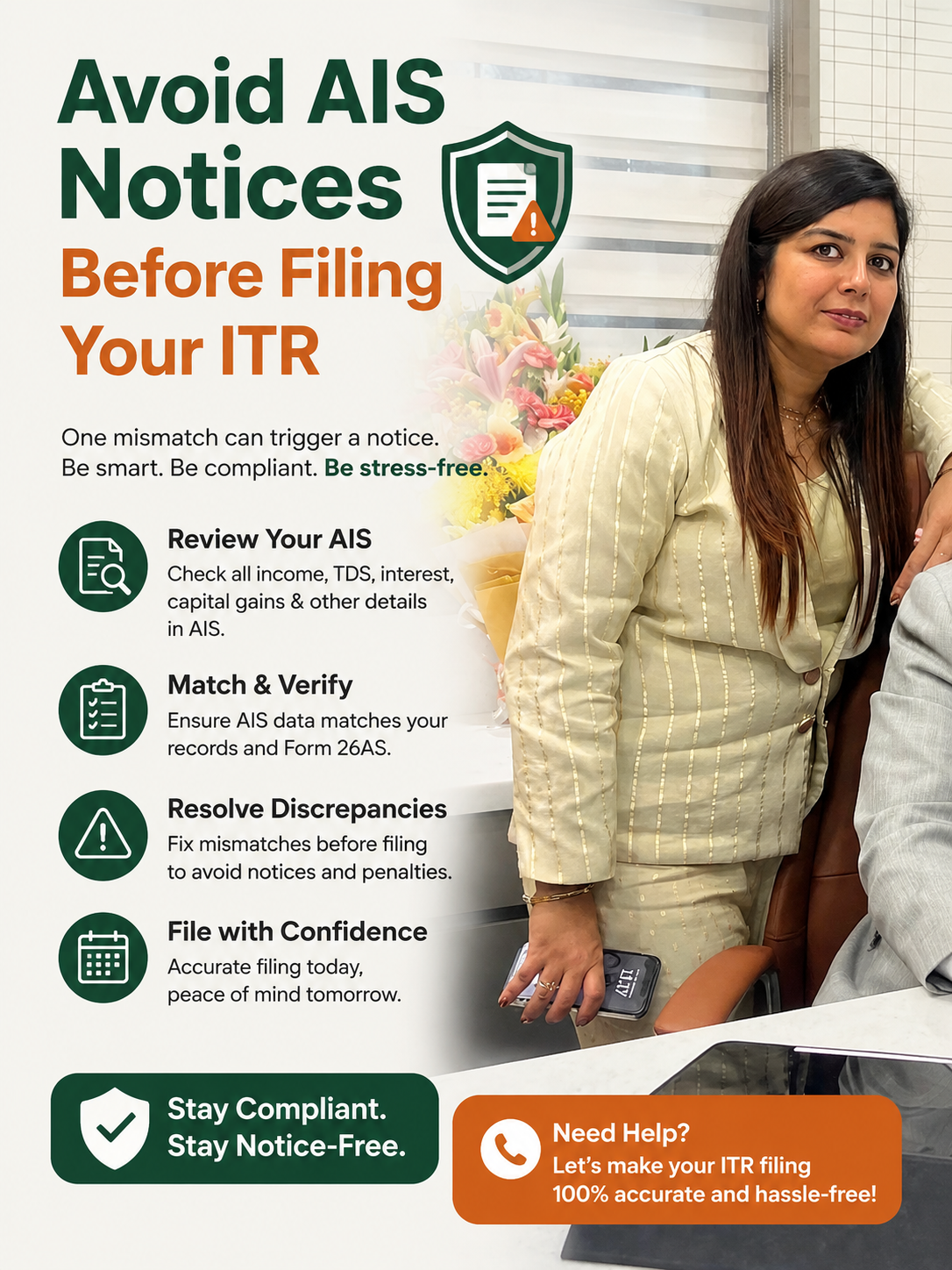
Avoid AIS Notices Before Filing Your ITR
Opened your inbox to find an Income Tax Department email asking you to “explain a discrepancy” before you have even filed your return? It happens to thousands of salaried taxpayers every season, and it almost always traces back to one document: the Annual Information Statement, or AIS. If the numbers in your AIS do not match what you are about to declare in your ITR, you are not just risking a delayed refund you are inviting a AIS notice. This guide walks you through exactly how AIS notices ITR filing AY 2026-27 cases arise, and the precise steps salaried taxpayers should take to avoid one before they even click submit.
What Is the AIS and Why It Decides Whether You Get a Notice
The Annual Information Statement is a consolidated financial profile that the Income Tax Department builds for every PAN, pulling data directly from your employer, banks, mutual fund houses, stock brokers, and registrars. It covers salary, interest income, dividends, securities transactions, and high-value spends essentially everything the department already knows about you before you file a single form.
Many taxpayers assume AIS is the same as Form 26AS. It is not. Form 26AS captures only TDS and TCS entries, while AIS is far broader and includes the underlying transaction data itself. Understanding the Form 26AS vs AIS difference 2026 is the first step toward a clean filing, because the department’s automated systems cross-check your ITR against both.
How an AIS Mismatch Turns Into an Income Tax Notice
When the income you declare in your ITR does not align with what AIS already shows, the system does not wait for a human officer to notice. Risk-based automated matching flags the gap almost instantly, and the most common outcome is a notice under the e-Verification Scheme or a query under Section 143(1)(a), asking you to reconcile the difference or file a revised return.
For salaried employees, the usual triggers are surprisingly routine: a mid-year salary revision your employer reported differently, interest income from a savings account or fixed deposit you forgot to add, dividend income that slipped through, or capital gains on mutual funds that were not separately declared. None of these are deliberate evasion but to an automated matching engine, unexplained is indistinguishable from undisclosed.
Read our detailed guide on : AIS vs Form 26AS Mismatch in 2026: The Silent Trigger Behind Most Income Tax Notices
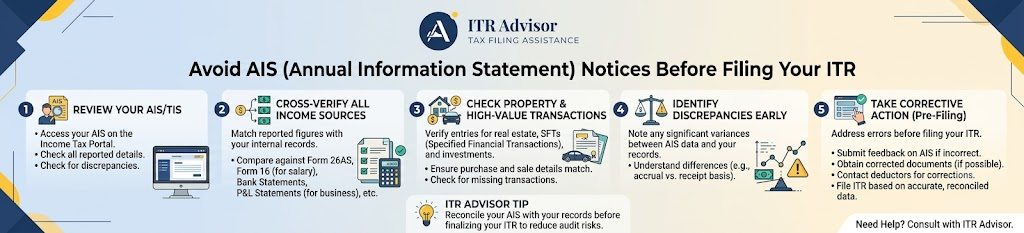
Step-by-Step: How to Avoid an AIS Notice Before You File
1. Download and Reconcile, Don’t Skip
Log in to the income tax e-filing portal, open the AIS module, and download both the AIS and the Taxpayer Information Summary (TIS). Compare every line item against your Form 16, salary slips, bank interest certificates, and capital gains statements before you touch the ITR form.
2. Submit Feedback on Every Incorrect Entry
If an entry in AIS is wrong, duplicated, or simply does not belong to you, use the “Add Feedback” option against that specific transaction. This creates a documented trail showing you proactively flagged the discrepancy a detail that matters enormously if a notice does arrive later.
3. File With the Correct Figures, Not Just the Pre-Filled Ones
Submitting AIS feedback alone does not change your ITR. You still need to file your return using the figures you believe are accurate, supported by your own documentation, even while the feedback is under review.
4. Re-Check Closer to the Deadline
AIS data is dynamic and keeps updating as employers and banks file revised TDS returns. A statement downloaded in April can look materially different by late May or June, so re-verify shortly before you actually file.
Expert Insight According to Dr. Haresh Adwani, tax advisory expert and a key voice behind Adwani & Co LLP’s compliance practice, the single biggest reason salaried taxpayers receive AIS-driven notices is not concealment it is simply filing too early, before banks and employers have finished updating their reported data for the year.
What Happens If You Already Filed and Then Spot a Mismatch
If you have already submitted your return and later notice an AIS discrepancy, a belated or revised return is usually the cleanest fix, provided it is filed within the applicable timelines specified by the Income Tax Department. Acting before a formal notice lands is always preferable to responding after one does.
Key Takeaways
AIS is broader than Form 26AS and drives most automated notices. Always reconcile AIS and TIS against your own documents before filing. Submit feedback on incorrect entries and file with verified figures. Re-check AIS closer to your filing date since data updates continuously.
Frequently Asked Questions
Q1. What triggers an AIS mismatch notice for salaried employees?
Unreported interest, dividend, or capital gains income, or salary figures that differ from employer-reported data, are the most common triggers. The system flags any unexplained gap automatically.
Q2. Is Form 26AS the same as AIS?
No. Form 26AS shows only TDS/TCS data, while AIS covers a much wider range of income and transaction details reported by third parties.
Q3. Can I correct a wrong entry in my AIS before filing?
Yes, you can submit feedback against any incorrect or duplicate entry directly on the AIS portal, which creates a record of your objection.
Q4. Does submitting AIS feedback automatically update my ITR?
No. Feedback only flags the entry for review; you must still file your return using the figures you believe are correct.
Q5. What should I do if I get a notice despite reconciling AIS?
Respond within the stated timeline with supporting documents such as Form 16, bank certificates, and your AIS feedback trail, or seek professional guidance promptly.
Conclusion:
An AIS notice rarely means you did something wrong it usually means a data point somewhere was never reconciled. With AY 2026-27 filings now in motion, the safest strategy for any salaried taxpayer is simple: download your AIS, match it line by line against your real records, fix what is wrong, and only then file. That single habit prevents the vast majority of notices before they are ever issued.
If you want expert guidance on reconciling your AIS or responding to an AIS notice, connect with itradvisor.in today and file your AY 2026-27 return with complete confidence.
About the Author – Nidhi Adwani
Nidhi Adwani is the Human Resources Manager at Adwani & Co. She is a Law Graduate and holds an MBA in Human Resources. She manages recruitment, employee engagement, team development, workplace culture, and the firm’s social media and content activities. Passionate about people and organizational growth, she also contributes articles for ITRAdvisor and Adwani & Co. Her writing focuses on HR practices, leadership, workplace engagement, and professional development, offering practical insights for professionals and businesses.
At ITRAdvisor.in, we help taxpayers with:
✔️ ITR Filing Review
✔️ AIS Reconciliation
✔️ Capital Gains Reporting
✔️ NRI Taxation
✔️ Tax Notice Response
✔️ Revised Returns
✔️ Income Tax Planning
✔️ Refund and Compliance Issues
Visit ITRAdvisor.in today for professional guidance and consultation.
Early action can often prevent bigger tax problems later.