
Balance Sheet Health Check
Every year, profitable businesses quietly slide into financial stress not because sales dried up, but because nobody read the balance sheet as anything more than a compliance formality. If your only question this tax season is “how much profit did we make?”, you’re missing the real story your business is trying to tell you.
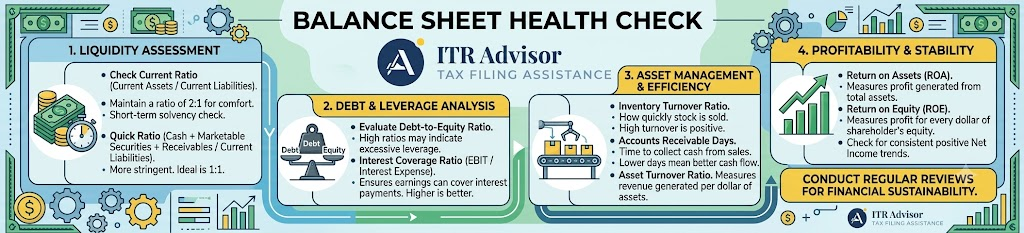
Tax season is here. Accountants and finance teams are finalising books, reconciling GST and TDS, and preparing balance sheets for filing. But a genuine balance sheet health check asks a bigger question than compliance: are you using this exercise to understand your business’s financial health, or just to satisfy the Income Tax Department?
Why a Balance Sheet Health Check Matters More Than the Profit Number
A company can report a healthy profit and still face real financial stress. Revenue may be growing, but customers may be paying late. Profits may look impressive on paper, while actual cash flow stays weak. Sales may have increased, yet inventory may be quietly consuming working capital, and borrowings may be rising faster than the business itself.
This is exactly why a disciplined balance sheet health check matters: it exposes the gap between reported profit and the underlying financial strength of the business a gap the profit and loss statement alone will never show you.
Five Questions Every Balance Sheet Health Check Should Answer
- Where is the cash actually sitting, and how much of it is genuinely available?
- How much money is stuck with customers as overdue receivables?
- How efficiently is working capital being used to generate revenue?
- Are borrowings funding growth, or are they quietly funding inefficiency?
- Is the business financially stronger today than it was 12 months ago?
These questions turn a routine balance sheet health check from a year-end formality into an early-warning system one that flags problems while they are still fixable, not after they’ve become a cash crunch.
Example:
Profit-Rich, Cash-Poor A manufacturing business showed 18% profit growth for the year, yet struggled to pay statutory dues on time. A closer balance sheet health check revealed receivables had ballooned by 40%, and short-term borrowings were funding the gap a classic profit-rich, cash-poor pattern that the P&L never revealed.
GST, TDS, and Statutory Mismatches Hiding in Plain Sight
A balance sheet health check should also cover statutory exposure, not just financial ratios. GST input tax credit mismatches, delayed TDS deposits, or unreconciled AIS and Form 26AS entries quietly build future liability even while a business looks compliant on the surface. Regular reconciliation, in line with the framework maintained on the GST portal and reporting norms under the Ministry of Corporate Affairs, is what keeps books and balance sheets genuinely accurate.
Turning the Balance Sheet Into a Leadership Dashboard
Don’t treat the balance sheet as a document prepared once a year for auditors, bankers, or the Income Tax Department. Treat it as a leadership dashboard. Profit tells you how the business performed. A proper balance sheet health check tells you what the business has actually become its liquidity, its debt discipline, and its true staying power.
This is a distinction Dr. Haresh Adwani, founder of Adwani & Co LLP and a PhD in Commerce with a law background, has long emphasised with business owners: compliance and financial health are related, but they are not the same exercise, and confusing the two is where most businesses first go wrong.
Read our detailed guide on Can the Tax Department Club Profits but Conveniently Ignore Losses? A Landmark ITAT Ruling on Section 64 Clubbing Provisions
Key Takeaway
A balance sheet health check is not an annual formality it is a leadership tool. Track cash position, receivables ageing, working capital efficiency, and borrowing trends alongside profit, and use every tax season as a checkpoint for your business’s true financial health, not just its statutory compliance.
Balance Sheet Health Check: Frequently Asked Questions
1.What is a balance sheet health check for a business?
It is a structured review of assets, liabilities, receivables, and borrowings to assess real financial strength, not just profitability.
2.Can a profitable business still face financial stress?
Yes. Strong profit can mask weak cash flow, rising receivables, or growing debt all visible only through a balance sheet health check.
3.What is the difference between cash flow and profit?
Profit is an accounting figure; cash flow is the actual money available. A business can be profitable yet cash-starved.
4.How often should business owners review their balance sheet?
Ideally quarterly, not just at year end frequent reviews catch working capital or borrowing issues while they’re still manageable.
5.Does GST or TDS mismatch affect balance sheet health?
Yes. Unreconciled GST credits or delayed TDS deposits create hidden liabilities that a balance sheet health check should always flag.
Conclusion: Make Your Balance Sheet Work for You
This tax season, don’t stop at reconciling ledgers and filing returns. Run a genuine balance sheet health check — one that weighs cash, receivables, working capital, and borrowings as seriously as profit. Business owners, what is one number you review regularly to understand your business’s health?
About the Author:
Mukesh Chavan is a dedicated indirect taxation and compliance professional associated with Adwani & Co LLP, specializing in GST advisory, GST audits, GST assessments, and RERA compliance services. With extensive experience in handling complex regulatory matters, he assists businesses in ensuring compliance with evolving GST laws and real estate regulations while minimizing risks and enhancing operational efficiency.
Mukesh has successfully guided clients through GST registrations, return compliance, departmental assessments, audits, litigation support, and tax planning strategies. He also possesses significant expertise in RERA compliance, helping real estate developers, promoters, and stakeholders navigate regulatory requirements and maintain seamless project compliance.
Through his articles and professional insights, Mukesh aims to simplify complex GST and RERA provisions, offering practical guidance that empowers businesses to remain compliant, avoid disputes, and make informed decisions in an increasingly dynamic regulatory environment. His approach combines technical expertise with practical business understanding, enabling clients to focus on growth while meeting their statutory obligations with confidence.
| Not Sure If Your Return Is Clean? If you’re unsure whether your return has been reported correctly, a quick review today can help avoid a much bigger problem later. If you want expert guidance, connect with itradvisor.in today. |
| Need Help Before You File? If you’re a salaried professional, business owner, freelancer, or NRI and want to ensure your ITR matches your AIS and Form 26AS before submission — ITRAdvisor.in is where to start. Visit itradvisor.in for expert tax guidance, AIS reconciliation checklists, and professional support backed by Adwani & Co LLP. |
Disclaimer:
ITRAdvisor.in is an educational and informational platform focused on tax awareness and compliance updates. Nothing contained herein should be construed as solicitation or advertisement of professional services. Professional services, where applicable, are rendered in accordance with ICAI guidelines. This article is published on ITRAdvisor.in, a tax and compliance knowledge platform.
The content has been reviewed for technical accuracy by professionals associated with Adwani & Co LLP.