AI Hallucination in Finance
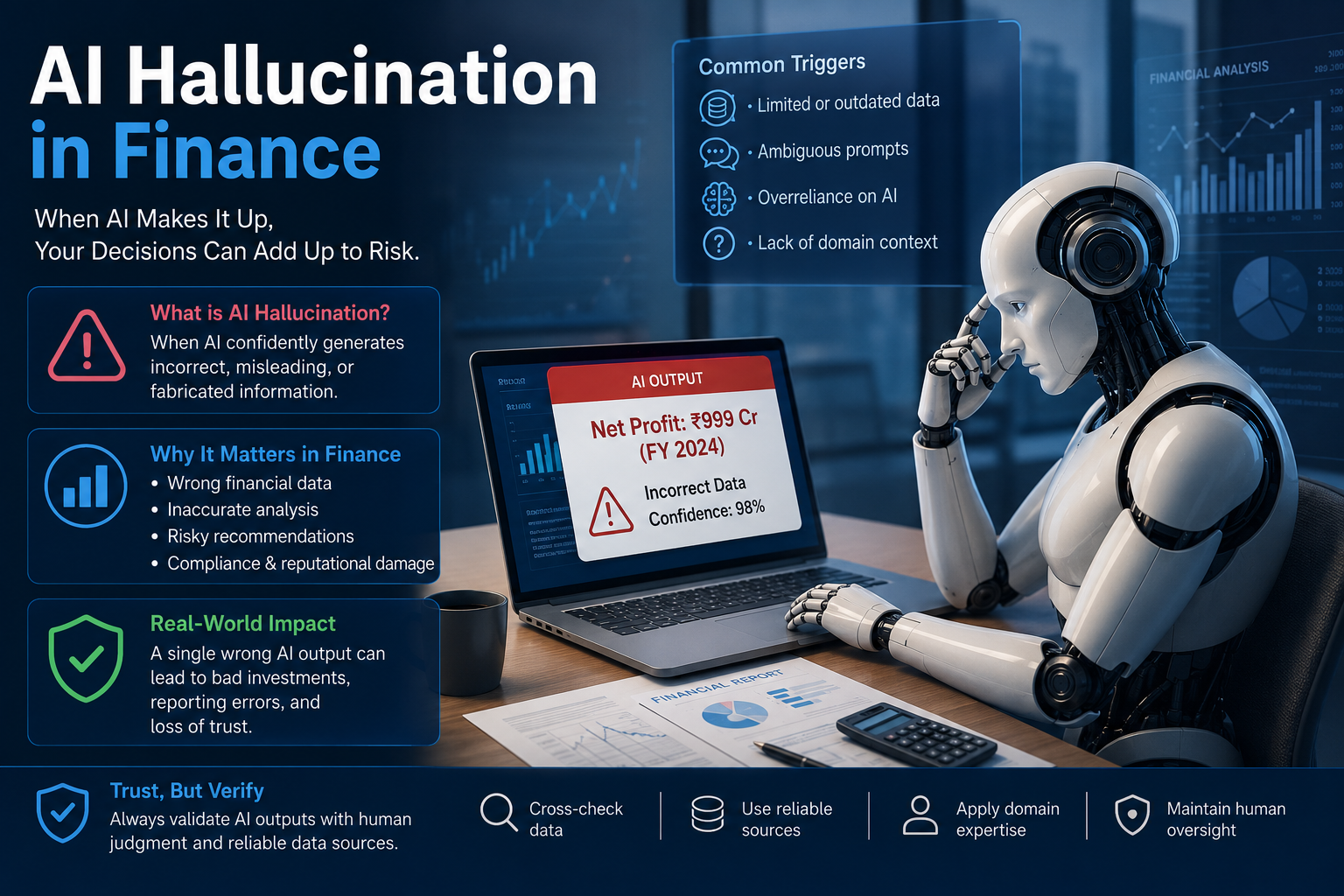
Can AI be confidently wrong? If you have spent any time evaluating finance-focused AI tools, you already know the answer is yes and that is exactly the problem worth unpacking. AI hallucination in finance is not a rare glitch. It is a structural risk that shows up quietly, dressed up as a well-written, professional-sounding answer.
What Is AI Hallucination in Finance, Really?
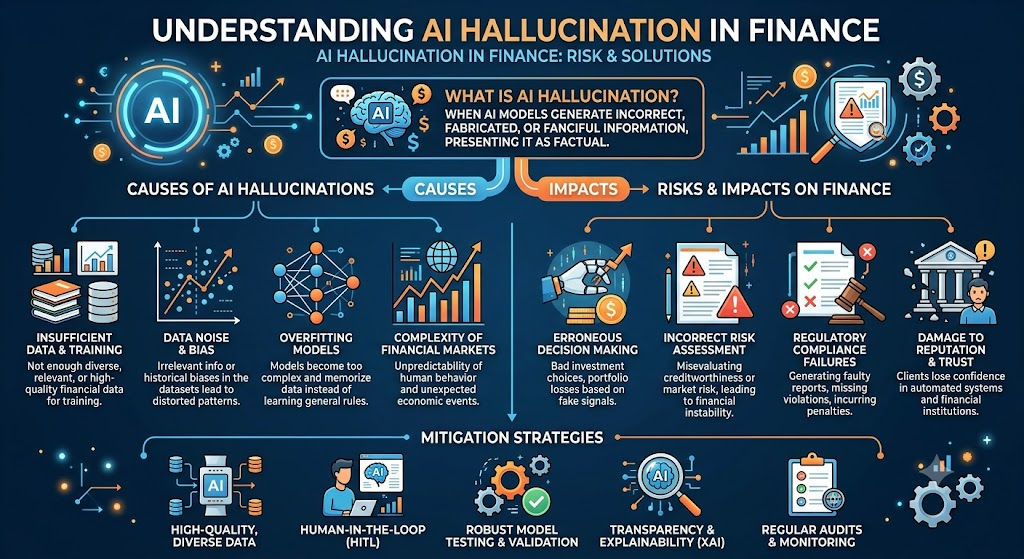
In simple terms, AI hallucination in finance happens when a model produces a response that reads as polished and authoritative, but is factually incorrect, unsupported by reliable sources, based on outdated rules, or missing important context. The danger is not that the answer sounds wrong it is that it sounds exactly right, which is what makes it easy to trust and hard to catch.
Having spent time evaluating and training finance-focused Large Language Models after years in finance, taxation, and audit, this is one of the clearest lessons that keeps surfacing: training AI is not only about generating better answers. It is equally about teaching a model when to answer, and more importantly, when to be careful.
Three Everyday Examples of AI Hallucination in Finance
The Investment Scenario
An AI tool states that a particular stock will “definitely” deliver a 15% return. No one human advisor or algorithm can guarantee market performance. A genuinely useful financial response would instead walk through assumptions, historical data, risk factors, and the uncertainty inherent in any projection.
The Tax Scenario
An AI model applies a tax provision that has since been amended or withdrawn. Tax law changes constantly a rule that was accurate last year, or even last quarter, may no longer hold. Regulatory bodies such as the IRS regularly update guidance, which is precisely why static, memorized answers are risky in a domain that moves this fast.
The Financial Planning Scenario
An AI tool recommends aggressive investment options without accounting for a person’s risk profile, financial goals, time horizon, or personal circumstances. The suggestion may be technically defensible in isolation, yet entirely unsuitable once real-world context is added back in.
Why AI Hallucination in Finance Carries Bigger Stakes Than It Looks
In most everyday applications, a hallucinated answer is a minor inconvenience. In finance, taxation, and accounting, the same failure can translate into missed compliance deadlines, incorrect filings, mispriced risk, or advice that quietly steers a business or individual in the wrong direction. This is exactly where human expertise becomes non-negotiable not as a formality, but as the layer that catches what a fluent, confident-sounding model may miss.
What Responsible AI Model Evaluation Looks Like in Finance
Evaluating a finance-focused AI model is not simply a language-quality exercise. It requires validating accuracy against current rules, the soundness of the underlying reasoning, whether relevant context has been captured, practical applicability to a real business situation, and the real-world consequences of getting it wrong. A confident answer is not the bar. A responsible answer is.
This is the perspective CA Manish, Head Consultant – International Accounting, Financial Modeling & US Taxation at Adwani & Co LLP, brings from his recent work evaluating and training finance-focused LLMs a vantage point shaped by years of practical experience across financial modeling, valuation, FP&A, and cross-border accounting engagements.
What This Means for Businesses and Finance Professionals Today
As AI tools become more embedded in accounting, tax research, and financial planning workflows, the more useful question is rarely whether AI can produce an answer. It is whether that answer has been checked against current rules, real context, and professional judgment before anyone acts on it. Businesses and accounting professionals adopting AI-assisted tools benefit from pairing them with structured review the same discipline applied to bookkeeping cleanups, MIS reporting, and financial statement review.
Firms exploring how AI fits into their reporting and advisory workflows can learn more about our Virtual CFO Services for a structured, human-reviewed approach to financial decision-making.
Key Takeaways
- AI hallucination in finance means a confident-sounding answer that may be inaccurate, outdated, or missing context.
- Investment, tax, and financial planning scenarios each show how a technically fluent answer can still be wrong or unsuitable.
- Tax and regulatory rules change frequently, so static AI answers carry real risk in finance.
- Responsible AI model evaluation checks accuracy, reasoning, context, and real-world consequences not just language quality.
Human expertise remains essential to validate AI-generated financial and tax guidance before it is acted upon.
Read our detailed guide on Why Financial Model
Frequently Asked Questions
1.What is AI hallucination in finance?
It is when an AI tool gives a confident, professional-sounding financial or tax response that is factually incorrect, outdated, or missing important context.
2.Can AI give wrong financial advice?
Yes. AI can produce technically fluent recommendations such as aggressive investment suggestions that are unsuitable once a person’s risk profile, goals, and circumstances are factored in.
3.Why is AI hallucination riskier in tax matters?
Tax law changes frequently, so an AI response based on an outdated provision may be confidently wrong, leading to compliance errors if not verified against current rules.
4.How is AI evaluated for financial accuracy?
Proper evaluation checks accuracy, reasoning, context, practical applicability, and real-world consequences not just whether the language sounds polished
Conclusion
AI hallucination in finance is less about AI being unreliable and more about understanding where its confidence outpaces its correctness. As finance-focused AI tools continue to evolve, the professionals and firms who benefit most will be the ones who pair these tools with structured, expert-led review rather than treating a fluent answer as a final one.
Author
CA. Manish R. Mata Practising In India (Ex – PwC), At Adwani & Co LLP leads the International Accounting & Tax Support vertical, delivering structured execution assistance to US CPA firms and overseas businesses.
Disclaimer
Adwani & Co LLP is a multi-disciplinary professional services platform. The blogs shared are for educational and informational purposes only and are intended to promote awareness around finance, accounting, taxation, reporting, and business advisory topics. Nothing contained herein should be construed as solicitation or advertisement of professional services. Where professional services are required under applicable laws or regulations, such services are rendered in accordance with relevant professional and regulatory requirements. The content has been reviewed for technical accuracy by professionals associated with Adwani & Co LLP.