
23 June 2026•Dr. Haresh Adwani
Share Trading Tax Income or Capital Gains
Every year, tens of thousands of Indian investors file their income tax return with one genuinely confusing question hovering over them: are my share market profits taxable as capital gains or as business income? Get it right, and you pay the correct tax at the correct rate in the correct ITR form. Get it wrong, and you’re looking at a defective return notice, a tax demand with interest, or worse a scrutiny assessment from the Income Tax Department’s AI-driven risk engine that flags the mismatch between your broker’s SFT (Statement of Financial Transactions) data and what you declared. This is not an academic question. In AY 2026-27, with CBDT’s near-real-time data integration with NSE and BSE, the classification of share trading income has become one of the most consequential decisions in personal income tax compliance.
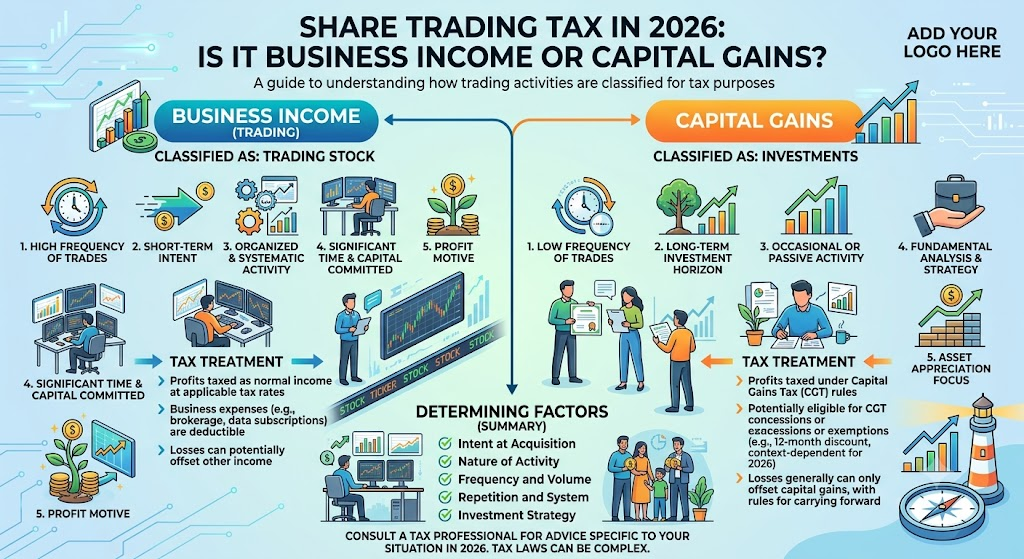
Why Share Trading Tax Classification Matters More Than Ever in 2026
The Income Tax Act, 1961 does not explicitly define when a person is a ‘trader’ versus an ‘investor’ in shares. This deliberate ambiguity has led to decades of litigation and some very clear CBDT guidance through circulars and court-tested principles that every taxpayer dealing in shares must understand.
The classification directly determines three things: the applicable tax rate, the ITR form you must file, and whether losses can be set off against other income. Filing in the wrong category is not a minor clerical error it is a substantive tax position that can unravel entirely during a scrutiny assessment.
The Core Rule: 4 Types of Share Trading Activity, 4 Different Tax Treatments
Indian income tax law recognises four distinct share trading scenarios, each with a different tax classification, applicable rate, and filing requirement. Understanding which bucket your activity falls into is the foundational step in share trading tax compliance for AY 2026-27.
1. Delivery-Based Investing: Capital Gains (LTCG / STCG)
If you buy shares, take delivery to your demat account, and sell them later this is investing, not trading. The gains are taxed as capital gains. The holding period determines the rate:
- Short-Term Capital Gains (STCG) : held for 12 months or less: taxed at 20% (revised post-Budget 2024, up from 15%) under Section 111A
- Long-Term Capital Gains (LTCG) : held for more than 12 months: taxed at 12.5% on gains above ₹1.25 lakh (Budget 2024 raised the exemption from ₹1 lakh) under Section 112A
LTCG and STCG from listed equity shares go into Schedule CG of ITR-2 or ITR-3. Importantly, LTCG from shares does not benefit from indexation a position the Finance Act 2024 confirmed explicitly.
2. Intraday Equity Trading: Speculative Business Income
If you buy and sell shares on the same day without taking delivery commonly known as MIS (Margin Intraday Square-off) orders this is classified as speculative business income under Section 43(5) of the Income Tax Act. This is a critical distinction that many retail traders miss entirely.
Speculative business losses can only be set off against speculative business income not against salary, rental income, or even F&O profits. They can be carried forward for four years (not eight), and only against future speculative income. You must file ITR-3 for intraday trading income. ITR-1 or ITR-2 are not valid.
3.F&O Trading: Non-Speculative Business Income
Futures and Options (F&O) trading is explicitly excluded from the definition of speculative transactions under Section 43(5)(d). F&O profits and losses are treated as non-speculative business income which means they can be set off against any other head of income except salary in the same year, and carried forward for eight years against any business income.
The F&O turnover calculation (premium received on options sold + absolute value of profit/loss on futures) determines whether a tax audit under Section 44AB is required. For FY 2025-26 (AY 2026-27), the threshold is ₹10 crore for digital transactions. This is an area where many active options traders unknowingly cross the audit threshold without realising it.
Share Trading Tax Income or Capital Gains
Every year, tens of thousands of Indian investors file their income tax return with one genuinely confusing question hovering over them: are my share market profits taxable as capital gains or as business income? Get it right, and you pay the correct tax at the correct rate in the correct ITR form. Get it wrong, and you’re looking at a defective return notice, a tax demand with interest, or worse — a scrutiny assessment from the Income Tax Department’s AI-driven risk engine that flags the mismatch between your broker’s SFT (Statement of Financial Transactions) data and what you declared. This is not an academic question. In AY 2026-27, with CBDT’s near-real-time data integration with NSE and BSE, the classification of share trading income has become one of the most consequential decisions in personal income tax compliance.
Why Share Trading Tax Classification Matters More Than Ever in 2026
The Income Tax Act, 1961 does not explicitly define when a person is a ‘trader’ versus an ‘investor’ in shares. This deliberate ambiguity has led to decades of litigation and some very clear CBDT guidance through circulars and court-tested principles that every taxpayer dealing in shares must understand.
The classification directly determines three things: the applicable tax rate, the ITR form you must file, and whether losses can be set off against other income. Filing in the wrong category is not a minor clerical error it is a substantive tax position that can unravel entirely during a scrutiny assessment.
Critical Warning for Active Traders:
If your F&O turnover exceeds ₹10 crore (or ₹2 crore if opting out of 44AD), a tax audit by a Chartered Accountant under Section 44AB is mandatory. Filing ITR-3 without the audit report (Form 3CA/3CB + 3CD) in such cases is a non-compliant return.
4. High-Frequency Delivery Trading: The Grey Zone
This is where things get genuinely complicated. If you are buying and selling shares in delivery mode but with very high frequency multiple trades a day, short holding periods, large volumes the Income Tax Department may reclassify your activity from capital gains to business income, even though you technically took delivery.
CBDT Circular No. 6/2016 provides the framework for this classification, and the courts have consistently held that frequency of transactions, intention at the time of purchase, volume of trading, and ratio of trading profits to dividend income are all relevant factors. If CBDT‘s data from your broker’s SFT filing shows 500+ delivery trades in a year, you can expect scrutiny on whether capital gains treatment is appropriate.
Share Trading Tax Classification: Quick Reference Table for AY 2026-27
| Trading Activity | Tax Classification | Tax Rate (AY 2026-27) | ITR Form | Schedule |
| Delivery-based equity shares (held ≤12 months) | STCG Capital Gains | 20% flat (post-Budget 2024) | ITR-2 / ITR-3 | Schedule CG |
| Delivery-based equity shares (held >12 months) | LTCG Capital Gains | 12.5% (above ₹1.25L exempt) | ITR-2 / ITR-3 | Schedule CG |
| Intraday equity trading (MIS orders) | Speculative Business Income | Slab rate; set-off only vs spec. income | ITR-3 mandatory | Schedule BP |
| F&O trading (futures & options) | Non-Speculative Business Income | Slab rate; audit if turnover >₹10Cr | ITR-3 mandatory | Schedule BP |
| Equity mutual funds (held ≤12 months) | STCG — Capital Gains | 20% flat | ITR-2 / ITR-3 | Schedule CG |
| Equity mutual funds (held >12 months) | LTCG — Capital Gains | 12.5% (above ₹1.25L) | ITR-2 / ITR-3 | Schedule CG |
Which ITR Form Is Correct for Share Trading Income in 2026?
ITR form selection is the single most common error in share trading tax filing. Here is the definitive guide:
- ITR-1 (Sahaj): Not valid for any share trading income capital gains or business. If you have any share market activity, ITR-1 is the wrong form.
- ITR-2: Valid for investors with only capital gains (delivery-based LTCG/STCG). Not valid if you have any intraday or F&O income.
- ITR-3: Mandatory for intraday traders, F&O traders, and investors who also trade. This is the most comprehensive form and handles all four categories above.
- ITR-4 (Sugam): Not valid for capital gains income. Only appropriate for those opting for presumptive taxation under 44AD/44ADA and F&O trading cannot be reported under presumptive taxation.
Read our detailed guide on ITR-1 vs ITR-2 vs ITR-4: Which Form to Fill Based on Your Income Type 2026 to avoid the most common ITR form selection mistakes.
The Expert Angle: How CBDT and Courts Determine Your Trading Classification
According to Dr. Haresh Adwani, PhD in Commerce and law graduate at Adwani & Co LLP, the question of whether share trading income is business income or capital gains is ultimately a question of fact and the burden of proof lies entirely with the taxpayer. The Income Tax Department does not need to prove that you are a trader; you need to demonstrate that you are an investor.
The key factors that courts and assessing officers examine:
- Intention: Was the purchase made with the intent to hold or to sell quickly for profit?
- Frequency: High-frequency trades over a short period strongly suggest business activity
- Funding: Were shares bought with borrowed funds? Borrowing to invest in shares is a business indicator
- Head of income in prior years: If you have been reporting the same shares as capital gains for years and then switch to business income (or vice versa), the assessing officer will examine the consistency
- Magnitude of activity vs. other income: If share profits are your dominant income source, business income classification becomes harder to resist
CBDT’s 2016 circular permits taxpayers to choose either capital gains or business income classification for their listed equity portfolio but only once. Having made the choice, you must be consistent year after year. Switching classifications opportunistically to minimise tax in different years is a recognised red flag in faceless scrutiny assessments.
For authoritative reference, the Income Tax Department’s guidance on capital gains is available at incometax.gov.in, including the Schedule CG instructions in the ITR filing utility.
Share Trading Losses in 2026: Set-Off & Carry Forward Rules That Can Save You Tax
Losses from share trading are one of the most under-utilised tax assets in India. Here is how the set-off hierarchy works:
- STCG loss from shares: Can be set off against any other capital gain (LTCG or STCG from any asset). Cannot be set off against salary or business income. Carry forward: 8 years.
- LTCG loss from shares: Can only be set off against LTCG. Carry forward: 8 years under the new post-Budget 2024 rules. Note: LTCG losses now arise given the 12.5% tax on gains above ₹1.25 lakh a new planning opportunity.
- Intraday (Speculative) loss: Set off only against speculative business income. Carry forward: 4 years only.
- F&O (Non-Speculative Business) loss: Set off against any business income or income from other heads (except salary). Carry forward: 8 years against business income. This is the most valuable loss in a trader’s hands — and is the core reason why F&O loss tax benefit planning is now a standard year-end exercise for active market participants.
Crucial Deadline Alert: To carry forward any trading loss (capital or business), you must file your ITR on or before the due date — July 31, 2026 for individuals without audit, October 31, 2026 for those requiring audit. A late-filed return forfeits the carry-forward benefit entirely for capital loss (though business loss carry-forward under Sec 72 may still be allowed if the return is filed under 139(1)
Key Takeaways
| ✅ Delivery-based share investing = Capital Gains (LTCG at 12.5% / STCG at 20%). File ITR-2 or ITR-3. ✅ Intraday equity trading = Speculative Business Income. File ITR-3 only. Losses carry forward 4 years — speculative only. ✅ F&O trading = Non-Speculative Business Income. File ITR-3. Losses carry forward 8 years — broadest set-off rights. ✅ High-frequency delivery traders risk reclassification to business income by CBDT — consistency of classification matters. ✅ ITR-1, ITR-4 are not valid for any taxpayer with share market income or losses. ✅ LTCG exemption threshold is now ₹1.25 lakh (Budget 2024). Tax rate is 12.5% — no indexation. ✅ To carry forward losses, file ITR on or before the due date — late filing forfeits this benefit. |
Frequently Asked Questions (FAQs)
Q1. Is share trading income taxable as business income or capital gains in India 2026?
It depends on the type of trading. Delivery-based investing is capital gains (LTCG/STCG). Intraday equity is speculative business income, and F&O trading is non-speculative business income — each with different tax rates and ITR forms.
Q2. What is the LTCG tax rate on shares and equity mutual funds for AY 2026-27?
LTCG on listed equity shares and equity mutual funds is taxed at 12.5% on gains exceeding ₹1.25 lakh per financial year, with no indexation benefit, under Section 112A as amended by Budget 2024.
Q3. Which ITR form should I file for intraday and F&O trading income?
ITR-3 is mandatory for both intraday (speculative) and F&O (non-speculative) trading income. Filing ITR-1 or ITR-2 when you have such income makes your return defective under Section 139(9).
Q4. Can F&O losses be set off against salary income?
No. F&O losses (non-speculative business loss) cannot be set off against salary income in the same year. They can be set off against other business income or income from house property, and carried forward for 8 years.
Q5. Can I choose to treat my share trading profits as capital gains instead of business income?
CBDT’s 2016 circular permits taxpayers with listed equity investments to choose capital gains treatment, provided you are consistent year after year. Switching classifications annually is a red flag during scrutiny assessments.
Conclusion:
The question of whether your share trading activity qualifies as business income or capital gains is not something to resolve by Googling at the last minute before the ITR filing deadline. It is a tax position that must be decided at the beginning of the financial year, maintained consistently, and supported by your actual trading behaviour. With CBDT now receiving real-time SFT data from brokers covering every buy and sell transaction above ₹10 lakh, the margin for error has shrunk to near zero.
About the Author
Dr. Haresh Adwani
Ph.D. in Commerce | Law Graduate | Managing Partner, Adwani & Co LLP Dr. Haresh Adwani holds a Ph.D. in Commerce and is a qualified Law graduate with over two decades of hands-on experience in GST advisory, direct taxation, and statutory compliance for businesses across
Disclaimer: ITRAdvisor.in is an educational and informational platform focused on tax awareness and compliance updates. Nothing contained herein should be construed as solicitation or advertisement of professional services. Professional services, where applicable, are rendered in accordance with ICAI guidelines. This article is published on ITRAdvisor.in, a tax and compliance knowledge platform. The content has been reviewed for technical accuracy by professionals associated with Adwani & Co LLP. pant, or someone navigating all three simultaneously — your tax treatment, ITR form selection, and loss utilisation strategy need to be correct, consistent, and complete.
Learn more about our Income Tax Filing Services for Traders & Investors — covering ITR-3 filing, tax audit support under Section 44AB, F&O turnover calculation, and capital gains reconciliation with your broker’s statement.
Visit ITRAdvisor.in today for professional guidance and consultation.
Early action can often prevent bigger tax problems later