
NRI ITR Filing in India
Thousands of NRIs pay more tax than they legally need to, and most don’t find out until a refund gets stuck, a notice lands, or a property sale turns complicated. If you live abroad but still earn even a rupee of income in India, NRI ITR filing isn’t a formality you can skip. It’s the one step that decides whether you overpay the taxman or claim back what’s rightfully yours.
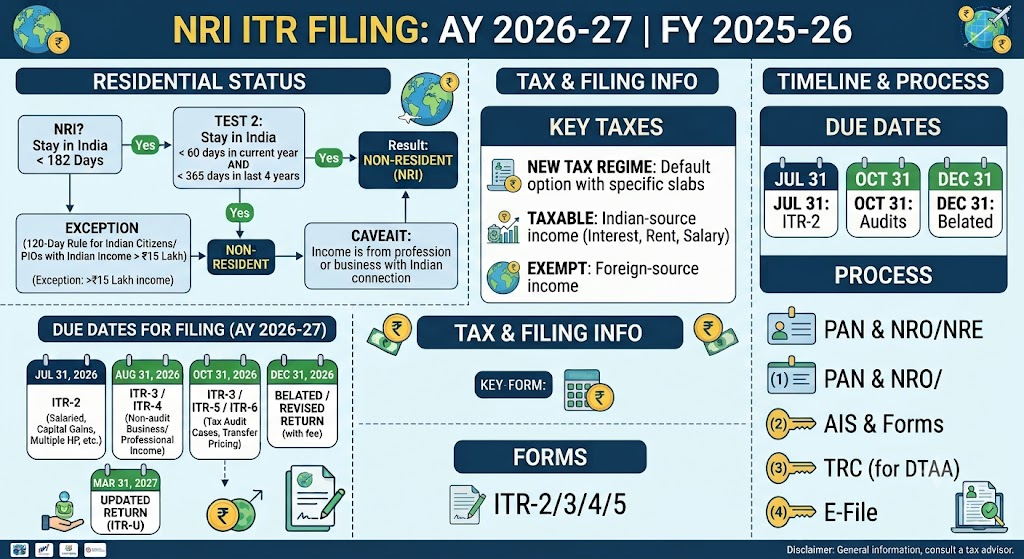
Do NRIs Really Need NRI ITR Filing While Living Abroad?
This is the single biggest myth in NRI taxation. Living outside India does not exempt you from Indian tax law the moment income actually arises here. NRI ITR filing becomes mandatory whenever you have rental income from an Indian property, capital gains, or interest income, regardless of how small the amount seems. And here’s the part most NRIs miss: TDS being deducted at source does not close the matter. If the flat TDS rate is higher than your actual tax liability, skipping NRI ITR filing means walking away from a refund you’re legally entitled to.
The NRI ITR Filing Questions We Hear Every Season
Every filing season, the questions from NRI clients follow a familiar pattern:
- Do I need to file an ITR if I only earn rental income from India?
- TDS has already been deducted on my income. Do I still need to file a return?
- I sold a property in India. Can I claim a refund of excess TDS?
- My NRO account earned interest. Is it taxable?
- I transferred money between my NRE and NRO accounts. Is there any tax implication?
- Can I claim deductions under Section 80C or 80D as an NRI?
- What documents do I need to keep ready before filing?
- Will NRI ITR filing help me in future property transactions, loans, or repatriation of funds?
Each of these has a concrete, individual answer, and getting it wrong is exactly what leads to overpaid tax or a delayed refund.
Read our detailed guides on NRE vs NRO Account Taxation in India: What Every NRI Should Know
Also Read:NRI International Tax India 2026: DTAA, FEMA & Residency Rules You Must Know
NRI ITR Filing After a Property Sale: Claiming Your TDS Refund
When an NRI sells property in India, the buyer typically deducts TDS at a much higher rate than the actual capital gains tax owed. Without NRI ITR filing, that excess amount simply sits with the government. Filing a return lets you compute the real capital gains, apply eligible exemptions, and claim back the difference as a refund, often a meaningful sum on a mid-sized property transaction.
NRO Interest, NRE-NRO Transfers, and NRI ITR Filing
Interest earned on an NRO account is fully taxable in India and usually carries TDS close to 30%. NRE account interest, by contrast, is exempt for a genuine non-resident. A common point of confusion is transferring funds between your own NRE and NRO accounts. This movement, by itself, is not a fresh taxable event, but it should be documented carefully since it can surface during AIS or Form 26AS reconciliation, and accurate NRI ITR filing keeps that record clean and defensible.
Deductions and Documents for Smooth NRI ITR Filing
NRIs remain eligible for several deductions under the Income Tax Act, including Section 80C (life insurance, ELSS, children’s tuition fees) and Section 80D (health insurance premiums), subject to certain conditions. Before NRI ITR filing, keep the following ready: PAN, passport copy confirming residential status, NRE and NRO bank statements, Form 26AS and AIS, TDS certificates, and the sale deed if a property transaction is involved. Proper NRI ITR filing today also strengthens your position for future loans, property purchases, and smooth repatriation of funds through proper banking channels.
Key Takeaway
• NRI ITR filing is mandatory once taxable Indian income exists, TDS deduction alone does not end the obligation.
• Property sales, NRO interest, and rental income are the most common triggers for NRI ITR filing.
• Timely NRI ITR filing is the only route to recovering excess TDS as a refund. • Good documentation today prevents AIS/Form 26AS mismatch notices tomorrow.
For nearly five decades, Adwani & Co LLP has guided NRI clients through exactly these questions, under the stewardship of Dr. Haresh Adwani, who holds a PhD in Commerce and is also a law graduate. That depth of experience is precisely why a few weeks of planning ahead of the filing season routinely saves NRIs from unnecessary tax outflow and months of avoidable follow-up with the Income Tax Department.
Frequently Asked Questions
1.Can I claim a TDS refund through NRI ITR filing after selling property?
Yes. If TDS deducted exceeds your actual capital gains tax, NRI ITR filing is how you claim that excess amount back.
2.Is interest on an NRO account taxable for NRIs?
Yes, NRO interest is fully taxable in India, unlike NRE account interest, which is generally exempt.
3.Do NRE to NRO fund transfers attract tax?
Not by themselves, but they should be documented properly to avoid mismatches during NRI ITR filing and AIS reconciliation.
4.Can NRIs claim deductions under Section 80C and 80D?
Yes, subject to certain conditions, making accurate NRI ITR filing essential to actually claim
Conclusion: Make NRI ITR Filing Work in Your Favour
NRI ITR filing isn’t just about compliance, it’s about not leaving your own money on the table. Rental income, property sales, NRO interest, and fund transfers all carry tax implications that only proper filing can resolve in your favour. If you’re an NRI with income, investments, or property in India, review your tax position before the filing rush begins.
Author
Dr. Haresh Adwani
PhD (Commerce) · Adwani & Company, Pune
Dr. Haresh Adwani is a PhD holder in Commerce with over 20 years of experience in NRI taxation, FEMA compliance, international financial advisory, and tax notice resolution. He is one of Pune’s most trusted NRI tax advisors, specialising in residential status assessment, DTAA planning, and cross-border compliance for professionals returning from the US, UK, UAE, Canada, and Australia.
Disclaimer:
ITRAdvisor.in is an educational and informational platform focused on tax awareness and compliance updates. Nothing contained herein should be construed as solicitation or advertisement of professional services. Professional services, where applicable, are rendered in accordance with ICAI guidelines. This article is published on ITRAdvisor.in, a tax and compliance knowledge platform. The content has been reviewed for technical accuracy by professionals associated with Adwani & Co LLP.
If you want expert guidance on NRI ITR filing, connect with itradvisor.in today, and take the guesswork out of your Indian tax compliance.