
F&O Trading Taxation in India (2026): The Complete, Definitive Guide Every Trader Must Read

24 June 2026•Mukesh Chavhan
F&O Trading Taxation in India
Every year, thousands of F&O traders receive income tax notices not because they evaded tax, but because they simply did not know how to report their futures and options income correctly. F&O trading taxation in India is one of the most misunderstood areas of personal finance. Whether you made a profit or suffered a loss in the markets, the Income Tax Department expects you to account for every rupee and the rules have significant implications for your AY 2026-27 ITR filing.
This comprehensive guide breaks it all down in plain, practical language that a working professional or active trader can actually act on.
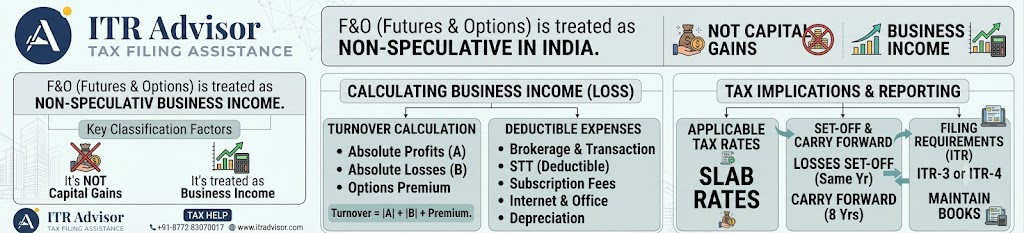
Why F&O Taxation in India Is a Compliance Priority in 2026
The Income Tax Department receives transaction-level data directly from stock exchanges through Statement of Financial Transactions (SFT). If you traded in F&O even for a single contract it likely reflects in your AIS (Annual Information Statement). Ignoring it during ITR filing invites notices, penalties, and even reassessment.
As per the Income Tax Act, 1961,F&O transactions are treated as non-speculative business income a classification that carries specific advantages (and obligations) that most traders are unaware of.
Is F&O Income Business Income or Speculative Income? The Critical Distinction
This is perhaps the most important question in F&O trading tax. Many traders incorrectly assume F&O falls under ‘speculative’ income (like intraday equity trading). That assumption can be costly.
| KEY RULE: F&O = Non-Speculative Business Income |
| Under Section 43(5) of the Income Tax Act, derivatives trading (including futures and options) is explicitly excluded from the definition of ‘speculative transaction’. |
| This means F&O income profit or loss is treated as normal business income under the head ‘Profits and Gains of Business or Profession’ (PGBP). |
This has a powerful practical implication: F&O losses can be set off against almost any other income, unlike speculative losses which can only be set off against other speculative gains.
F&O Income Tax Treatment: How Profits and Losses Are Taxed in AY 2026-27
F&O Profit: How It Is Taxed
F&O trading profit is added to your total income and taxed at the applicable slab rate whether you are salaried, a professional, or a business owner. There is no special flat rate like crypto (30%) or LTCG (12.5%).
For example: If your salary is ₹8 lakh and your net F&O profit for FY 2025-26 is ₹2 lakh, your total taxable income becomes ₹10 lakh, taxed at applicable slab rates under either the old or new tax regime.
F&O Loss: The Tax Benefit You Must Not Miss
F&O loss tax benefit is one of the most underutilised advantages available to traders. Here is exactly how it works:
| Scenario | Set-Off Available Against | Carry Forward |
| F&O Loss (same year) | Any income except salary* (house property, business, capital gains, other sources) | Yes |
| Remaining F&O Loss | Future F&O profits (non-speculative business income) | Up to 8 assessment years |
| Condition | ITR must be filed before due date (usually July 31) | Mandatory for carry forward |
Important: F&O losses cannot be directly set off against salary income in the same year. However, F&O losses can be set off against business income, house property income, capital gains, and other sources in the same year and carried forward against F&O profits for up to 8 years.
Which ITR Form for F&O Traders in AY 2026-27?
| ITR Form Selection for F&O Traders |
| ITR-3: For individuals and HUFs with income from business/profession, including F&O. This is the correct form if you have F&O activity PLUS salary, capital gains, or any other income. |
| ITR-4 (Sugam): NOT applicable for F&O traders. ITR-4 is only for presumptive taxation under Sections 44AD/44ADA — F&O trading cannot be declared under presumptive taxation. |
A critical point: even if you are salaried and traded F&O only occasionally, you must file ITR-3. Filing ITR-1 or ITR-2 when you have F&O transactions is a compliance defect that can lead to notices.
Read our detailed guide on ITR 1 vs ITR 2 vs ITR 3 vs ITR 4: The Definitive Guide to Picking the Right Income Tax Return Form for AY 2026-27
Which ITR Form for F&O Traders in AY 2026-27?
| ITR Form Selection for F&O Traders |
| ITR-3: For individuals and HUFs with income from business/profession, including F&O. This is the correct form if you have F&O activity PLUS salary, capital gains, or any other income. |
| ITR-4 (Sugam): NOT applicable for F&O traders. ITR-4 is only for presumptive taxation under Sections 44AD/44ADA F&O trading cannot be declared under presumptive taxation. |
A critical point: even if you are salaried and traded F&O only occasionally, you must file ITR-3. Filing ITR-1 or ITR-2 when you have F&O transactions is a compliance defect that can lead to notices.
Is Tax Audit Mandatory for F&O Traders? Understanding the Turnover Threshold
Tax audit under Section 44AB becomes relevant for F&O traders based on ‘turnover’ and the calculation of F&O turnover is different from regular business turnover.
How to Calculate F&O Turnover
- For Futures: Absolute value of settlement profit/loss on each trade (favourable + unfavourable)
- For Options: Premium received on sale of options + absolute value of any settlement profit/loss on option trades
| Turnover (F&O) | Profit/Loss Situation | Tax Audit Required? |
| Up to ₹1 crore | Profit | No (if profit > 6% of turnover) |
| Up to ₹1 crore | Loss or profit < 6% | Yes (Section 44AB) |
| ₹1 crore to ₹10 crore | Any (if 95%+ transactions digital) | No (increased threshold) |
| Above ₹10 crore | Any | Yes mandatory |
Key Takeaways:
1. F&O is non-speculative business income taxed at your slab rate, not a flat rate.
2. F&O losses can be set off against business, house property, capital gains, and other source income (NOT salary in the same year).
3. Unabsorbed F&O losses can be carried forward for 8 assessment years.
4. File ITR-3 (not ITR-4) if you have any F&O transactions, regardless of quantum.
5. Tax audit under Section 44AB may apply if turnover crosses the threshold with a loss or low profit.
6. Always reconcile your F&O data with AIS before filing the IT Department has exchange data.
How to Show F&O Loss and Profit in ITR: Step-by-Step Guide
- Step 1: Download your F&O ledger/contract notes from your broker. Compile all profits and losses.
- Step 2: Calculate your F&O turnover as described above.
- Step 3: Determine if tax audit is applicable. If yes, get it done by a CA before filing.
- Step 4: In ITR-3, enter F&O income under ‘Schedule BP’ (Business and Profession). Report gross receipts, expenses, and net profit or loss.
- Step 5: If you have a net loss, fill Schedule CYLA (Current Year Loss Adjustment) and Schedule CFL (Carry Forward Losses) appropriately.
- Step 6: Cross-check all figures with your AIS on the Income Tax portal (incometax.gov.in) before submitting.
Expert Insight
According to Dr. Haresh Adwani, a commerce PhD and legal professional associated with Adwani & Co LLP, one of the most common errors made by F&O traders is failing to file ITR before the due date thereby forfeiting the right to carry forward losses. ‘The carry-forward benefit is automatic under the law, but only if you file on time. Missing the deadline can cost you lakhs in future tax relief,’ he notes.
Legitimate Business Expenses F&O Traders Can Claim as Deductions
Since F&O is treated as a business, you can claim genuine business expenses to reduce your taxable income. These may include:
- Brokerage and transaction charges paid to the broker
- Internet charges used for trading
- Subscription to market data feeds or research platforms
- Depreciation on computer or laptop used for trading
- Professional fees paid to a CA for ITR or audit
- Home office expenses (proportionate, if you trade from home)
Important: All expenses must be genuine, documented, and directly related to the F&O trading business. The Income Tax Department may scrutinise excessive or unrelated expense claims.
Explore More on ITRAdvisor.in
If you found this guide useful, you may also want to read:
- Learn more about ITR-3 filing for traders and professionals
- Read our detailed guide on LTCG and STCG on shares and mutual funds in 2026
- Understand how to read your AIS and reconcile it with your ITR before filing
- Explore old vs new tax regime calculator for FY 2026-27 to decide which is better for you
- Read our guide on advance tax due dates FY 2026-27 — mandatory if your F&O income creates tax liability
Frequently Asked Questions:
Q1. Is F&O income taxable in India even if I made a loss?
Yes even F&O losses must be reported in your ITR. Filing correctly is mandatory and enables you to carry forward losses for up to 8 years to set off against future F&O profits.
Q2. Can F&O loss be set off against salary income?
No F&O losses cannot be directly set off against salary income in the same year. However, they can be set off against business income, house property income, capital gains, or other source income in the same year.
Q3. Which ITR form should a salaried person with F&O trading file?
A salaried individual with F&O transactions must file ITR-3, not ITR-1 or ITR-2. ITR-4 is not applicable for F&O income as it cannot be declared under presumptive taxation.
Q4. How long can F&O losses be carried forward?
F&O losses (being non-speculative business losses) can be carried forward for up to 8 assessment years, provided the ITR for the year of loss is filed within the due date.
Q5. Is a tax audit compulsory if I have F&O losses?
If your F&O turnover is below ₹1 crore but you have a net loss (or profit less than 6% of turnover), a tax audit under Section 44AB is typically required. Consult a qualified CA to confirm your specific situation.
Conclusion: F&O Taxation Is Not Optional : But It Does Not Have to Be Overwhelming
F&O trading taxation in India is governed by clear rules the problem is that most traders either don’t know them or learn them after receiving a notice. The good news is that once you understand the non-speculative business income classification, the set-off and carry-forward benefits, the correct ITR form, and the tax audit thresholds, F&O compliance becomes manageable.
File on time, report accurately, and claim every deduction you are legally entitled to. The Income Tax Department’s AIS platform ensures they already have your trading data so your ITR should tell the same story.
About the Author:
Mukesh Chavan is a dedicated indirect taxation and compliance professional associated with Adwani & Co LLP, specializing in GST advisory, GST audits, GST assessments, and RERA compliance services. With extensive experience in handling complex regulatory matters, he assists businesses in ensuring compliance with evolving GST laws and real estate regulations while minimizing risks and enhancing operational efficiency.
Mukesh has successfully guided clients through GST registrations, return compliance, departmental assessments, audits, litigation support, and tax planning strategies. He also possesses significant expertise in RERA compliance, helping real estate developers, promoters, and stakeholders navigate regulatory requirements and maintain seamless project compliance.
Through his articles and professional insights, Mukesh aims to simplify complex GST and RERA provisions, offering practical guidance that empowers businesses to remain compliant, avoid disputes, and make informed decisions in an increasingly dynamic regulatory environment. His approach combines technical expertise with practical business understanding, enabling clients to focus on growth while meeting their statutory obligations with confidence.
Disclaimer
ITRAdvisor.in is an educational and informational platform focused on tax awareness and compliance updates. Nothing contained herein should be construed as solicitation or advertisement of professional services. Professional services, where applicable, are rendered in accordance with ICAI guidelines. This article is published on ITRAdvisor.in, a tax and compliance knowledge platform. The content has been reviewed for technical accuracy by professionals associated with Adwani & Co LLP.
At ITRAdvisor.in, we help taxpayers with:
✔️ ITR Filing Review
✔️ AIS Reconciliation
✔️ Capital Gains Reporting
✔️ NRI Taxation
✔️ Tax Notice Response
✔️ Revised Returns
✔️ Income Tax Planning
✔️ Refund and Compliance Issues
Visit ITRAdvisor.in today for professional guidance and consultation.
Early action can often prevent bigger tax problems later.