
Received a Notice for High-Value Transactions? Here’s How to File Your ITR Correctly and Avoid Costly Mistakes for AY 2026-27
Nidhi Adwani April 2026 7 min read
Received a Notice for High-Value Transactions? Don’t Ignore It.
Many taxpayers are shocked when they receive a compliance notice from the Income Tax Department despite believing they have done nothing wrong.
A common reaction is:
“I paid tax on my salary. Why am I getting a notice for my bank transactions?”
The answer often lies in high-value transactions reported to the Income Tax Department through various financial institutions.
Today, banks, mutual funds, registrars, property authorities, and financial institutions report specified transactions directly to the department.
If your Income Tax Return (ITR) does not adequately explain these high value transactions, you may receive a notice seeking clarification.
The good news?
A notice does not automatically mean tax evasion or wrongdoing.
However, incorrect reporting can lead to tax demands, scrutiny, penalties, and prolonged compliance issues.
Let’s understand what triggers these notices and how to file your return correctly.
What Are High-Value Transactions?
High-value transactions are significant financial activities that are reported to the Income Tax Department through various reporting mechanisms.
These high value transactions become visible in:
- Annual Information Statement (AIS)
- Taxpayer Information Summary (TIS)
- Specified Financial Transaction (SFT) reports
The department compares this information with the income reported in your ITR.
Any inconsistency can trigger automated compliance checks.
Common High-Value Transactions That Can Trigger Notices
1.Large Cash Deposits in Bank Accounts
Large cash deposits frequently attract scrutiny, especially when the declared income does not support the deposited amount.
Common situations include:
- Business cash deposits
- Sale proceeds received in cash
- Agricultural income claims
- Cash savings accumulated over time
If the source is not properly explained, notices may follow.
2.High Credit Card Spending
Many taxpayers are surprised to learn that significant credit card expenditure may be reported.
The department may seek clarification when spending appears inconsistent with reported income.
For example:
- Salary income of ₹8 lakh
- Credit card expenditure of ₹18 lakh
Such mismatches can trigger questions.
3. Property Purchases
Real estate transactions are closely monitored.
The department may compare:
- Purchase value
- Source of funds
- Loan information
- Reported income
Property transactions often trigger scrutiny when funding sources are unclear.
4. Mutual Fund Investments
Large mutual fund investments are frequently reported through financial institutions.
Common issues include:
- Investments not matching declared income
- Redemption transactions omitted from ITR
- Capital gains not reported
Many taxpayers mistakenly believe only profits need reporting.
5.Share Market Transactions
With increasing participation in stock markets, this has become one of the most common reasons for notices.
Typical mistakes include:
- Not reporting capital gains
- Ignoring loss transactions
- Missing dividend income
- Incorrect tax calculations
6.Foreign Travel and Overseas Spending
High overseas expenditure may sometimes attract attention if the reported income appears insufficient to support the expenses incurred.
7. Fixed Deposits and Interest Income
Many taxpayers invest substantial sums in fixed deposits but forget to disclose the resulting interest income.
Since banks report information directly, such mismatches are easily identified.
What Is AIS and Why Is It So Important?
AIS (Annual Information Statement) has become one of the most important documents for taxpayers.
It contains information relating to:
- Bank interest
- Dividend income
- Securities transactions
- Mutual fund transactions
- Property transactions
- Tax deducted at source (TDS)
- Foreign remittances
- High-value financial activities
Many notices today arise because taxpayers file returns without reviewing AIS.
Also Read: How a Smart AIS Review Before Filing ITR Can Save Salaried Taxpayers from Costly Income Tax Notices in AY 2026-27https://itradvisor.in/blog/smart-ais-review-before-filing-itr
What Is SFT Reporting?
SFT stands for Specified Financial Transaction.
Various institutions are required to report certain transactions to the Income Tax Department.
These reports help the department verify whether financial activities align with declared income.
SFT reporting has significantly increased transparency and reduced the possibility of undisclosed transactions remaining unnoticed.
The Biggest Mistake Taxpayers Make
The most common mistake is filing an ITR based only on:
- Form 16
- Salary details
- TDS certificates
Without checking:
- AIS
- Form 26AS
- Capital gains reports
- Mutual fund statements
- Bank interest income
This often leads to avoidable notices.
How to File Your ITR Correctly If You Have High-Value Transactions
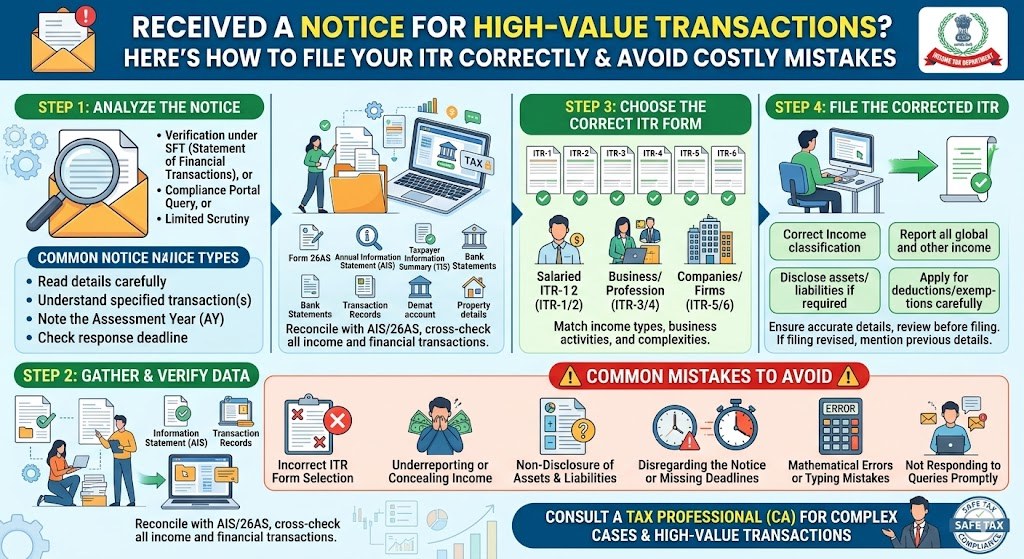
Step 1: Download and Review AIS
Before filing:
✔️ Review all transactions appearing in AIS
✔️ Verify accuracy
✔️ Check whether any transaction appears unfamiliar
Step 2: Reconcile Income Sources
Match:
- Salary income
- Interest income
- Dividend income
- Capital gains
- Rental income
- Business income
with AIS and Form 26AS.
Step 3: Report Capital Gains Properly
Many taxpayers report only profits and ignore losses.
This is a mistake.
All relevant transactions should be reported appropriately.
Step 4: Maintain Documentation
Keep records of:
- Property purchases
- Loan statements
- Mutual fund investments
- Bank transactions
- Gift deeds
- Sale agreements
Proper documentation helps support explanations if required.
Step 5: Choose the Correct ITR Form
Selecting the wrong ITR form can create compliance issues.
A professional review is particularly important where multiple income sources exist.
Real-Life Example
A salaried employee earning ₹16 lakh annually filed his own return.
He reported:
✔️ Salary income
But forgot to report:
❌ Mutual fund redemption
❌ Dividend income
❌ Fixed deposit interest
All these transactions appeared in AIS.
A compliance notice was subsequently issued seeking clarification.
The matter was resolved, but only after additional effort, documentation, and correspondence.
Most importantly, the notice could have been avoided through proper review before filing.
Frequently Asked Questions
1.Does a high-value transaction always lead to a notice?
No. However, transactions that are inconsistent with reported income may attract scrutiny.
2.What should I do if a transaction in AIS is incorrect?
The discrepancy should be reviewed carefully and appropriate action should be taken before filing the return.
3.Can cash deposits trigger an income tax notice?
Yes. Large cash deposits are among the most common reasons for notices
4.Are mutual fund transactions reported to the Income Tax Department?
Yes. Certain investment and redemption transactions may appear in AIS and related reporting systems.
5. Should I file my return based only on Form 16?
No. AIS, Form 26AS, capital gains statements, and other relevant information should also be reviewed.
Warning Signs You Should Not Ignore
Consider professional assistance if:
⚠️ Your AIS contains unfamiliar entries
⚠️ You purchased property during the year
⚠️ You redeemed mutual funds
⚠️ You traded in shares
⚠️ You made substantial cash deposits
⚠️ Your credit card expenditure is significantly high
⚠️ You received an income tax notice
⚠️ You have multiple income sources
Need Help Understanding Your AIS or High-Value Transactions?
Every year, thousands of taxpayers receive notices because they file returns without understanding what the Income Tax Department already knows through AIS and SFT reporting.
At Adwani & Co. | ITR Advisor, we help taxpayers:
✅ Review AIS and TIS
✅ Analyze high-value transactions
✅ Report capital gains correctly
✅ File accurate ITRs
✅ Respond to notices
✅ Reduce the risk of future scrutiny
✅ Reconcile AIS with income disclosures
Book an AIS & ITR Review Before Filing
If your AIS shows transactions you don’t understand, don’t guess.
A single reporting mistake can lead to notices, delays, additional tax demands, and unnecessary stress.
Our experts can review your AIS, explain the transactions, identify potential issues, and help you file your return correctly.
📞 Contact Adwani & Co. today for a professional AIS review and error-free ITR filing