
Income Tax Act 2025: The New Law Behind Every Tax Notice

Income Tax Act 2025
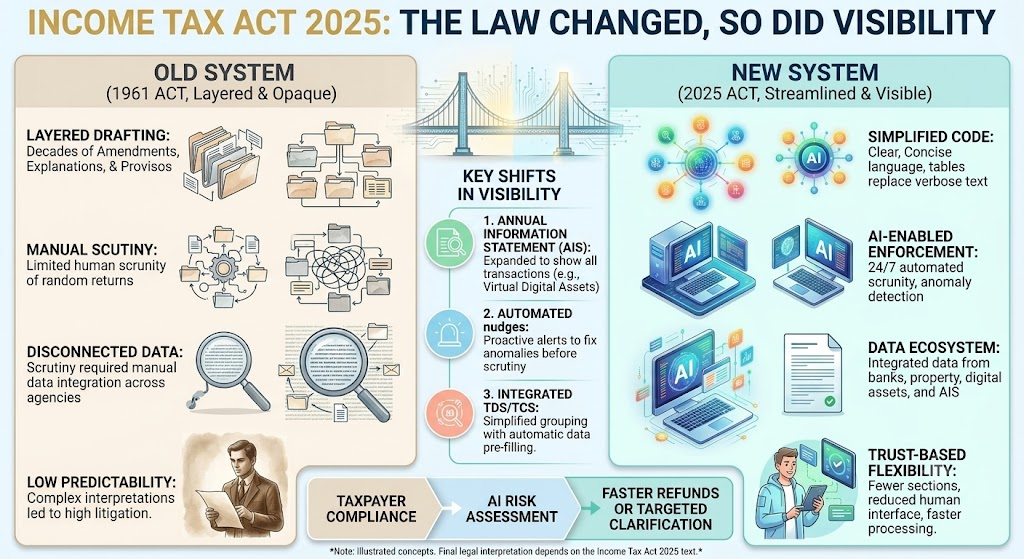
On 1st April 2026, India quietly retired a law that had governed every tax return, every notice, and every assessment for six decades. The Income Tax Act, 1961 stood repealed, and the Income Tax Act, 2025 took its place. Most taxpayers barely noticed the headline. What they should notice is what the Income Tax Act 2025 actually changes not the tax you owe, but how completely the system already knows about your money before you ever open your ITR form.
What Is the Income Tax Act 2025, and Why Does It Matter?
The Income Tax Act 2025 is not a rebranding exercise. It is a full re-codification of India’s direct tax law, replacing the Income Tax Act, 1961 with effect from 1st April 2026. Where the 1961 Act had grown to roughly 819 sections and 14 schedules after six decades of patchwork amendments, the Income Tax Act 2025 consolidates the law into approximately 536 sections and 16 schedules shorter, more logically grouped, and written in plainer language.
Importantly, the Income Tax Act 2025 does not introduce a new tax or change how much you pay. Tax rates and slabs continue to be governed by the annual Finance Act. What changes is structure, terminology, and most significantly for ordinary taxpayers the depth of automated compliance built into the law itself.
Tax Year Replaces Previous Year and Assessment Year
One of the most visible changes under the Income Tax Act 2025 is terminology. The old distinction between “previous year” and “assessment year,” which confused generations of taxpayers, has been replaced with a single unified concept: the Tax Year, running from 1st April to 31st March. Income earned from 1st April 2026 onward falls under Tax Year 2026-27 and is governed entirely by the Income Tax Act 2025, while income up to 31st March 2026 continues to be assessed under the erstwhile Income Tax Act, 1961.
TDS and TCS Provisions Are Now Consolidated
Under the 1961 Act, TDS provisions were scattered across more than 60 separate sections. The Income Tax Act 2025 consolidates salary TDS and other TDS/TCS provisions into a small set of unified sections with clear rate tables for residents, non-residents, and other categories of deductees. For practitioners and taxpayers alike, this reduces the room for cross-referencing errors — but it also means TDS and TCS data matched against your PAN is now cleaner, faster, and easier for the department to reconcile automatically.
The Real Story: Why the Income Tax Act 2025 Makes AIS More Powerful Than Ever
Here is what most discussions of the Income Tax Act 2025 miss: the law’s biggest practical impact isn’t a new section number. It is how much visibility the tax department already has into your finances and how the Income Tax Act 2025 formalises and strengthens that automated compliance architecture.
Consider how information already reaches the Income Tax Department, often before you file anything:
- Banks report specified high-value transactions large cash deposits, big fixed deposits, and high-value credit card spends.
- Mutual fund houses, registrars, and sub-registrars report your investments and property transactions.
- TDS and TCS data from employers, banks, and buyers is matched automatically against your PAN.
- All of this consolidates into your Annual Information Statement (AIS) a financial mirror of you that the department sees before you file your return.
Under the Income Tax Act 2025, this matching architecture is not an add-on; it is built into the law’s core design. Section 532 of the new Act gives the faceless assessment and administration framework a direct statutory foundation, rather than relying purely on administrative schemes as it did under the 1961 Act. In practical terms, the entire compliance system is designed to be more automated, more digital, and less dependent on taxpayers disclosing things manually.
A Real Example: How an AIS Mismatch Becomes a Tax Notice
To understand why the Income Tax Act 2025’s emphasis on automated matching matters, consider a simple, realistic example:
| Reported In | Amount Reflected |
| Form 16 (Salary + TDS) | ₹9,40,000 |
| AIS – Interest from Fixed Deposits | ₹62,000 |
| ITR filed by taxpayer (interest omitted) | ₹9,40,000 only |
| Result | Automated AIS mismatch → Notice under the Income Tax Act 2025 framework |
In this example, the taxpayer wasn’t hiding income deliberately the FD interest was simply overlooked while filing. But because the Income Tax Act 2025 strengthens automated cross-verification between AIS, Form 26AS, and the ITR, even a small, unintentional mismatch of this kind is flagged systematically. Under the new compliance framework, mismatches not deliberate under-reporting are consistently the single biggest reason ordinary taxpayers receive notices.
Read our Detailed guide on AIS vs Form 26AS Mismatch in 2026: The Silent Trigger Behind Most Income Tax Notices
Stricter Reporting for NRIs Under the Income Tax Act 2025
The Income Tax Act 2025 also tightens provisions around foreign asset disclosure for NRIs and returning Indians. Failure to disclose foreign bank accounts, overseas property, or foreign shareholdings can attract significant penalties under the new framework, even though income such as interest from NRE accounts continues to remain tax-free. Combined with data-sharing arrangements between banks, registrars, and the Income Tax Department, this makes proactive, accurate disclosure more important than ever.
How ITR Advisors Helps You Stay Ahead of the Income Tax Act 2025
This is precisely the kind of structural shift where professional guidance earns its value. At Adwani and Company, a Pune-based firm with roots going back to 1977, clients receive structured guidance on transitioning to the Income Tax Act 2025 from AIS reconciliation to TDS consolidation to NRI compliance.
Senior Partner Dr. Haresh Adwani, a PhD holder in Commerce and a law graduate, brings a rare combination of technical taxation expertise and legal grounding to how the firm interprets the Income Tax Act 2025 for clients. Dr. Haresh Adwani frequently notes that the shift to the new Act isn’t primarily about renumbered sections it’s about taxpayers understanding that their AIS, not their ITR, is now the primary document the department relies on.
This legal-plus-taxation perspective is particularly valuable under the Income Tax Act 2025, where faceless assessments, automated notices, and digital enforcement now rest on a clearer statutory footing than before.
Key Takeaways on the Income Tax Act 2025
- The Income Tax Act 2025 replaced the Income Tax Act, 1961 with effect from 1st April 2026, without changing tax rates.
- The new law uses a single “Tax Year” concept instead of previous year and assessment year.
- AIS, TDS, and TCS matching against your PAN is central to compliance under the Income Tax Act 2025.
- Mismatches between AIS and your ITR not deliberate under-reporting are the leading cause of notices.
NRIs face stricter foreign asset disclosure requirements under the new framework.
Frequently Asked Questions on the Income Tax Act 2025
1.When did the Income Tax Act 2025 come into effect?
The Income Tax Act 2025 took effect on 1st April 2026, replacing the Income Tax Act, 1961 for Tax Year 2026-27 and onward.
2.Does the Income Tax Act 2025 increase my tax liability?
No. The Income Tax Act 2025 does not impose any new tax; rates continue to be set by the annual Finance Act. The changes are structural and procedural.
3.What is the Annual Information Statement (AIS) and why does it matter under the Income Tax Act 2025?
AIS is a consolidated statement of your financial transactions reported to the department by banks, employers, and registrars. Under the Income Tax Act 2025, matching your ITR against your AIS is central to avoiding notices.
4.What replaces “assessment year” under the Income Tax Act 2025?
The Income Tax Act 2025 replaces both “previous year” and “assessment year” with a single, unified “Tax Year” running from 1st April to 31st March.
5.Will pending assessments under the old law be affected by the Income Tax Act 2025?
No. Assessments and proceedings relating to periods before 1st April 2026 continue under the Income Tax Act, 1961 through transitional provisions.
6.How can I avoid a notice under the new Income Tax Act 2025 compliance framework?
Check your AIS and Form 26AS carefully against your return before filing, and reconcile every reported transaction, however small, before submission.
Conclusion: The Income Tax Act 2025 Rewards Awareness, Not Fear
The Income Tax Act 2025 is ultimately about visibility. Your ITR was never the only document telling the government about your finances it was always the summary. Under the Income Tax Act 2025, the underlying story, written transaction by transaction through AIS, TDS, and TCS matching, is more visible and more automated than ever before. The law has changed; the visibility it enables has only gotten sharper.
About Author
Archana Dahibhate is a finance professional at Adwani & Co LLP, specializing in taxation, accounting, and regulatory compliance. She is passionate about simplifying complex tax and business concepts into practical insights that help businesses and individuals make informed decisions. Through her articles, she shares reliable, up-to-date guidance on taxation, GST, and financial compliance.
At ITRAdvisor.in, we help taxpayers with:
✔️ ITR Filing Review
✔️ AIS Reconciliation
✔️ Capital Gains Reporting
✔️ NRI Taxation
✔️ Tax Notice Response
✔️ Revised Returns
✔️ Income Tax Planning
✔️ Refund and Compliance Issues
If you are unsure whether your return has been filed correctly or want a professional review before submission, consulting an experienced tax professional can help avoid costly mistakes.
Visit ITRAdvisor.in for expert assistance with your Income Tax Return and tax compliance requirements.
Disclaimer: ITRAdvisor.in is an educational and informational platform focused on tax awareness and compliance updates. Nothing contained herein should be construed as solicitation or advertisement of professional services. Professional services, where applicable, are rendered in accordance with ICAI guidelines. This article is published on ITRAdvisor.in, a tax and compliance knowledge platform. The content has been reviewed for technical accuracy by professionals associated with Adwani & Co LLP
A prominent “File Your ITR Now” button near the top and again at the end of the article
Need help filing your Income Tax Return? Click the WhatsApp icon and our team will guide you through the process and assist you with your ITR filing.
Have questions about your ITR? Click the WhatsApp icon to connect with our tax experts for quick guidance and personalized assistance.