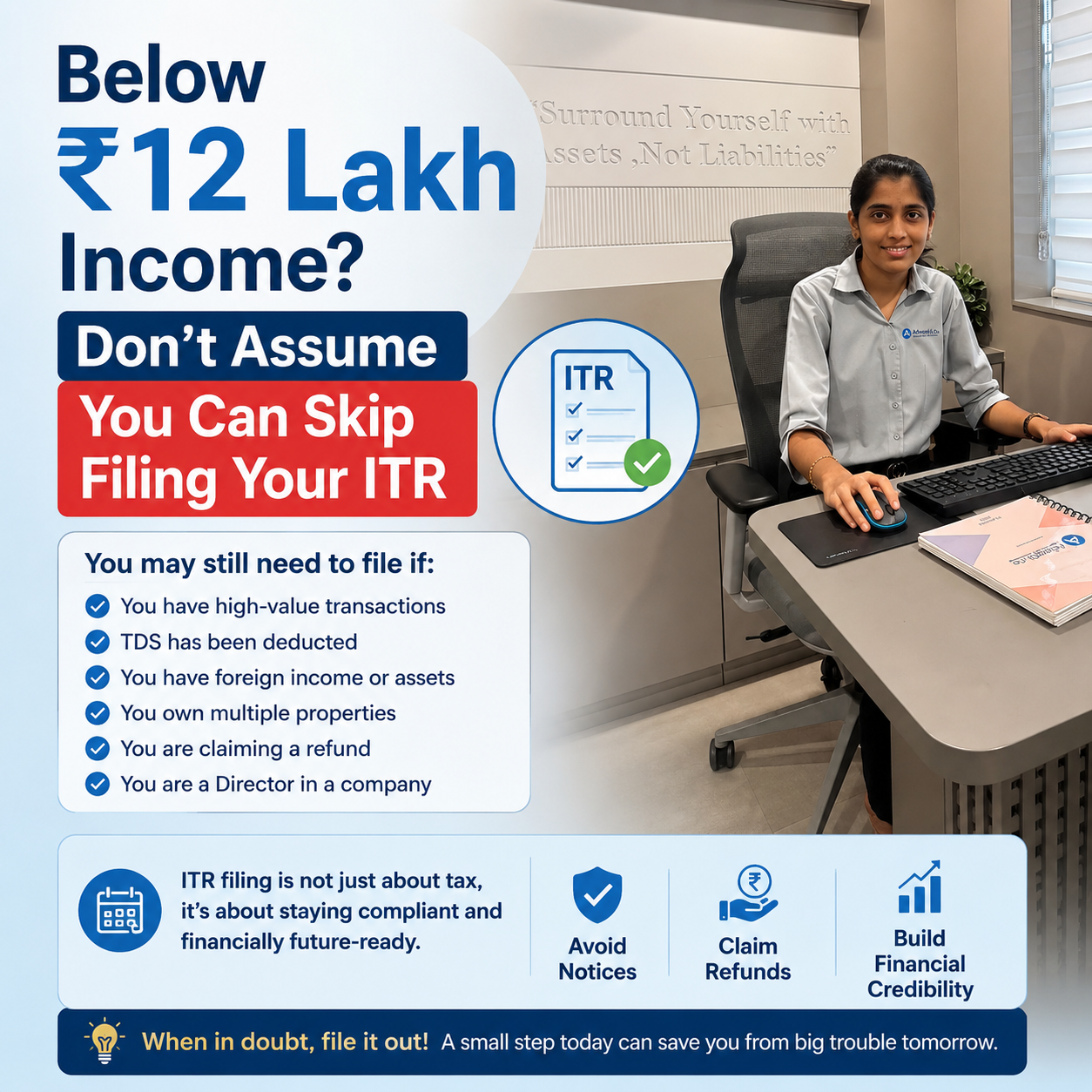
Below ₹12 Lakh Income
Every year around this time, the same question lands in our inbox: “My income is below ₹12 lakh, so I don’t need to file my ITR right?” It’s a comforting assumption, and it’s also wrong. Since the new tax regime pushed the zero-tax threshold up to ₹12 lakh, thousands of taxpayers have quietly stopped filing, assuming nil liability means no obligation. That single assumption could cost you a refund, a loan approval, or worse, an income tax notice.
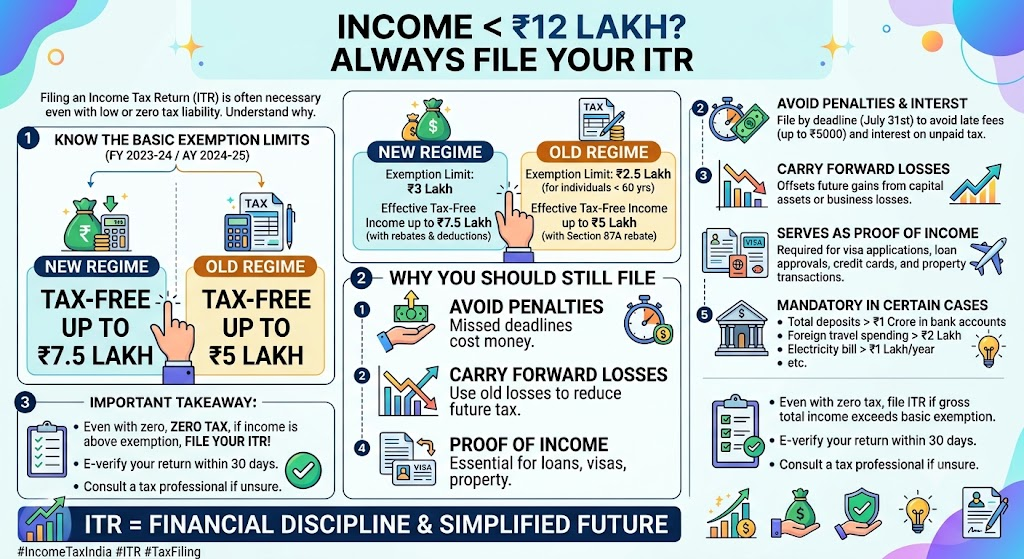
Zero Tax Liability Is Not the Same as No ITR Filing Obligation
Under the current provisions, a rebate under Section 87A can bring your tax liability to zero if your taxable income falls within the ₹12 lakh limit. But the Income Tax Act does not say that a nil tax liability automatically waives your obligation to file. Filing requirements are governed by separate conditions under Section 139(1), including gross total income before deductions, specified high-value transactions, and asset ownership. In other words, ITR filing below 12 lakh income depends on far more than your final tax bill.
Read our detailed guide on Old vs New Tax Regime 2025: Stop Guessing, Start Calculating
The Triggers Most Taxpayers Overlook
Several situations make ITR filing below 12 lakh mandatory, regardless of your tax payable:
- Deposits exceeding ₹1 crore in a current account, or ₹50 lakh in savings accounts, during the year
- Foreign travel expenses above ₹2 lakh
- Electricity bill payments crossing ₹1 lakh annually
- Ownership of foreign assets or signing authority in a foreign account
- Being a director in a company or holding unlisted equity shares
- Business turnover or professional receipts crossing prescribed thresholds
The Income Tax Department‘s data-matching systems, built on AIS and Form 26AS reporting, are specifically designed to flag these specified transactions even when a return isn’t filed. Ignoring the requirement doesn’t go unnoticed.
Why Filing ITR Below 12 Lakh Works in Your Favour
Beyond compliance, there’s a strong practical case for filing your ITR even with zero tax payable. A filed return is often the single document that proves your income and financial credibility banks ask for it before sanctioning home loans, embassies request it for visa applications, and credit card issuers use it to assess eligibility. Skipping it because your liability is nil can quietly close doors you didn’t expect to need.
Read our detailed guide on Old vs New Tax Regime 2026 to see how the ₹12 lakh rebate actually works before deciding your filing status.
Claiming Back Your TDS Refund
If your employer or a client deducted TDS during the year, and your actual tax liability was lower or nil, filing your ITR is the only route to claim that refund. Many taxpayers leave money with the department simply because they assumed filing wasn’t required.
Expert Perspective
Dr. Haresh Adwani, founder of Adwani & Co LLP and a PhD in Commerce with a law degree, has long advised clients that the safest approach is to verify eligibility every year rather than carry forward last year’s assumption, since thresholds, rebates, and specified transaction limits are revised frequently under CBDT notifications and Finance Act amendments.
When in doubt, cross-check your position against the official guidance on incometax.gov.in before deciding to skip your return for AY 2026-27. Learn more about our ITR Filing Services if you’d like a professional to verify your obligation before the deadline.
Key Takeaways
A ₹12 lakh income and zero tax liability do not automatically exempt you from ITR filing.
Specified transactions high-value deposits, foreign travel, foreign assets can independently trigger mandatory filing.
A filed ITR strengthens loan, visa, and credit applications even when no tax is due.
TDS refunds can only be claimed by filing a return. Always verify your filing obligation instead of assuming it based on income alone.
Frequently Asked Questions on ITR Filing Below 12 Lakh
1.Is ITR filing mandatory if my income is below ₹12 lakh?
Not always exempt zero tax under the rebate doesn’t remove the filing obligation if specified transactions or conditions under Section 139(1) apply.
2.Can I still get a refund if I don’t file my ITR?
No. Any excess TDS deducted during the year can only be claimed back by filing your income tax return for that year.
3.Does zero tax liability mean I don’t need to file ITR at all?
No. Zero liability and the requirement to file are governed by separate rules, and high-value transactions can still trigger mandatory filing.
4.What happens if I skip ITR filing despite being required to file?
You may face penalties under the Income Tax Act and lose the ability to claim refunds, carry forward losses, or use the return for loan and visa purposes.
Conclusion
The ₹12 lakh threshold has simplified tax outgo for many, but it hasn’t simplified the filing rules. Whether ITR filing below 12 lakh applies to you depends on your transactions, assets, and income sources not just your final tax bill. Verifying your position takes a few minutes; getting it wrong can take much longer to fix.
About the Author
Vaishnavi Hole is a CA Finalist and Direct Tax Associate at Adwani & Co LLP, specializing in direct taxation, income tax compliance, and advisory services. She is passionate about simplifying complex tax laws into practical, easy-to-understand insights for businesses and individuals. Through her articles, Vaishnavi shares well-researched perspectives on direct tax developments, compliance, and regulatory updates to help readers make informed financial decisions.
Disclaimer
ITRAdvisor.in is an educational and informational platform focused on tax awareness and compliance updates. Nothing contained herein should be construed as solicitation or advertisement of professional services. Professional services, where applicable, are rendered in accordance with ICAI guidelines. This article is published on ITRAdvisor.in, a tax and compliance knowledge platform. The content has been reviewed for technical accuracy by professionals associated with Adwani & Co LLP.
At ITRAdvisor.in, we help taxpayers with:
✔️ ITR Filing Review
✔️ AIS Reconciliation
✔️ Capital Gains Reporting
✔️ NRI Taxation
✔️ Tax Notice Response
✔️ Revised Returns
✔️ Income Tax Planning
✔️ Refund and Compliance Issues
If you are unsure whether your return has been filed correctly or want a professional review before submission, consulting an experienced tax professional can help avoid costly mistakes.
Visit ITRAdvisor.in for expert assistance with your Income Tax Return and tax compliance requirements.
Disclaimer: ITRAdvisor.in is an educational and informational platform focused on tax awareness and compliance updates. Nothing contained herein should be construed as solicitation or advertisement of professional services. Professional services, where applicable, are rendered in accordance with ICAI guidelines. This article is published on ITRAdvisor.in, a tax and compliance knowledge platform. The content has been reviewed for technical accuracy by professionals associated with Adwani & Co LLP
A prominent “File Your ITR Now” button near the top and again at the end of the article
Need help filing your Income Tax Return? Click the WhatsApp icon and our team will guide you through the process and assist you with your ITR filing.
Have questions about your ITR? Click the WhatsApp icon to connect with our tax experts for quick guidance and personalized assistance.