Tag: AIS MISMATCH

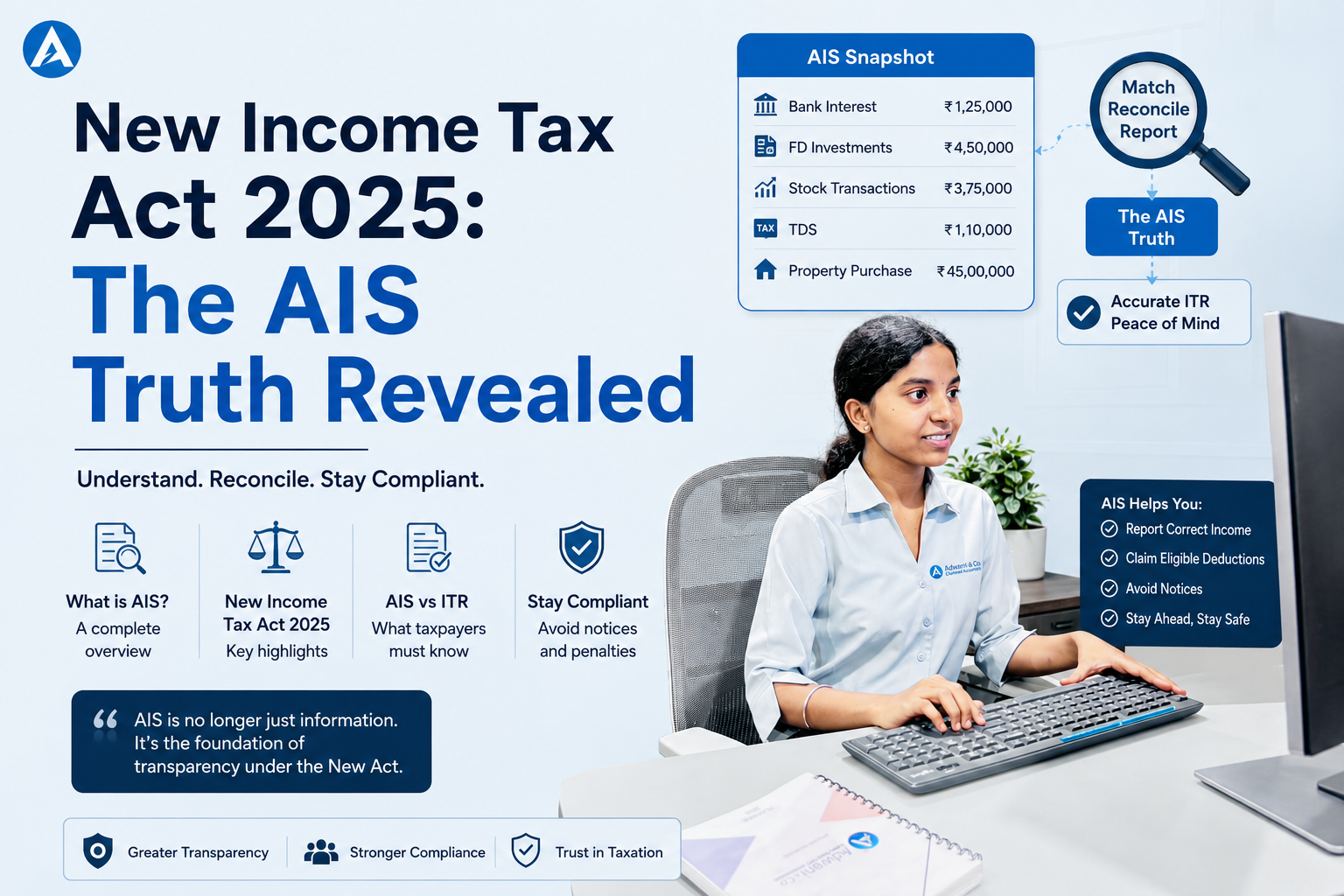
  • New Income Tax Act 2025: The AIS Truth Revealed

    New Income Tax Act 2025: The AIS Truth Revealed

    AIS Truth Revealed : New Income Tax Act 2025

    My CA mentioned something about a new Income Tax Act does it actually change anything for me?” A colleague asked me that on 1st April 2026, and the honest answer surprised him. That day, India quietly retired a 60-year-old law. The Income Tax Act, 1961, which governed every return, notice, and assessment for six decades, was replaced by the Income Tax Act 2025. Most taxpayers didn’t even notice but here’s exactly what the Income Tax Act 2025 means for how closely the department is already watching your money.
    What the Income Tax Act 2025 Actually Changes

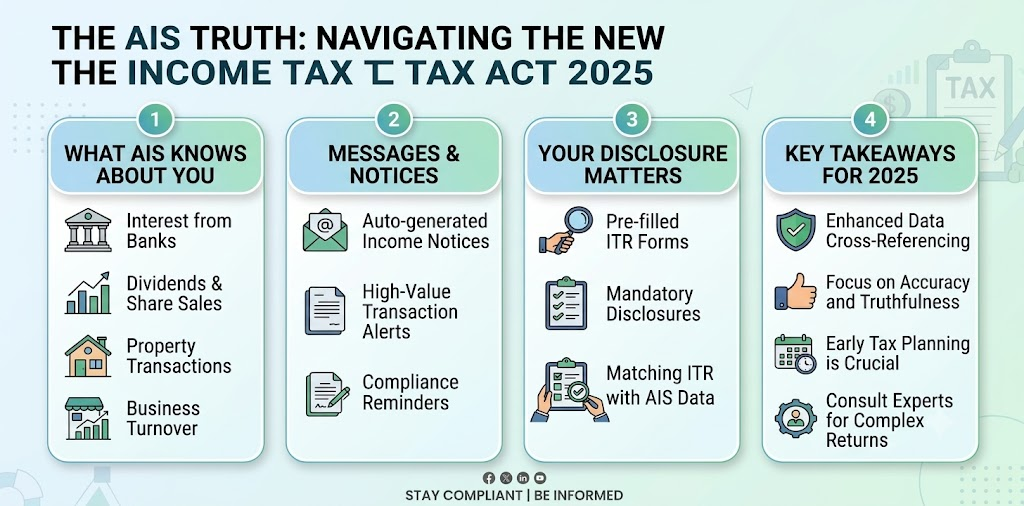
    The Income Tax Act 2025 isn’t just a rename of the old statute. It’s built around a system that already knows more about your finances than most taxpayers realise. Banks report specified high-value transactions large cash deposits, big fixed deposits, and high-value credit card spends directly to the tax department. Mutual funds, registrars, and sub-registrars report your investments and property purchases, often before you even sit down to file. TDS and TCS data from employers, banks, and buyers gets matched automatically against your PAN.


    How AIS Under the Income Tax Act 2025 Tracks Every Rupee

    Your Annual Information Statement Is the Real Story

    All of this data lands in one place: your Annual Information Statement, or AIS a financial mirror the department sees before you do. Under the Income Tax Act 2025, this matching is only getting tighter, with the compliance framework designed to be more automated, more digital, and less dependent on taxpayers disclosing things manually. You can review your own statement directly on the Income Tax Department’s e-filing portal before filing.

    Why AIS Mismatches Trigger Notices

    Your ITR isn’t the only document telling the government about your finances it’s simply the summary. The real story is already being written, transaction by transaction, long before you file. Mismatches between your AIS and your return are the single biggest reason ordinary taxpayers receive notices under the Income Tax Act 2025 not deliberate under-reporting, just unawareness of what’s already on record.

    Staying Compliant Under the Income Tax Act 2025

    Dr. Haresh Adwani, a PhD holder in Commerce and a law graduate associated with Adwani & Co LLP, notes that most Income Tax Act 2025 notices are entirely avoidable with one simple habit: checking your AIS and Form 26AS before filing, not after.

    Learn more about our ITR Filing guidance

    read our detailed guide on Form 26AS vs AIS differences to understand exactly what the department already knows.


    Key Takeaways

    • The Income Tax Act 2025 has replaced the 1961 law with a more automated, digital-first compliance framework.
    • Banks, mutual funds, registrars, and employers already report your high-value transactions to the tax department.
    • Your AIS is a financial mirror that exists before you file check it against your ITR every time.

    Most notices under the Income Tax Act 2025 stem from AIS mismatches, not intentional under-reporting.


    Frequently Asked Questions

    1. What is the Income Tax Act 2025?

    It’s the new law that replaced the Income Tax Act, 1961, effective from 1st April 2026, restructuring provisions around a more automated compliance and reporting framework.

    2. How does AIS relate to the Income Tax Act 2025?

    AIS consolidates bank, investment, TDS, and property data reported to the department, giving it visibility into your finances before you file your return.

    3. Why did I get a notice even though I filed my return correctly?

    Most such notices arise from a mismatch between your AIS/Form 26AS and your ITR figures, not from actual under-reporting of income.

    4. How can I avoid a mismatch notice under the Income Tax Act 2025?

    Download and review your AIS on the Income Tax Department portal and reconcile it against your return before submission.

    Final Word: Visibility Hasn’t Gone Anywhere

    My colleague’s question wasn’t really about the law it was about visibility, and whether the system sees him before he even speaks. It does. Under the Income Tax Act 2025, that visibility is only getting sharper. Check your AIS, match it against what you’re about to file, and file with confidence

    About Author

    Archana Dahibhate is a finance professional at Adwani & Co LLP, specializing in taxation, accounting, and regulatory compliance. She is passionate about simplifying complex tax and business concepts into practical insights that help businesses and individuals make informed decisions. Through her articles, she shares reliable, up-to-date guidance on taxation, GST, and financial compliance.

    At ITRAdvisor.in, we help taxpayers with:

    ✔️ ITR Filing Review

    ✔️ AIS Reconciliation

    ✔️ Capital Gains Reporting

    ✔️ NRI Taxation

    ✔️ Tax Notice Response

    ✔️ Revised Returns

    ✔️ Income Tax Planning

    ✔️ Refund and Compliance Issues

    If you are unsure whether your return has been filed correctly or want a professional review before submission, consulting an experienced tax professional can help avoid costly mistakes.

    Visit ITRAdvisor.in for expert assistance with your Income Tax Return and tax compliance requirements.

    Disclaimer: ITRAdvisor.in is an educational and informational platform focused on tax awareness and compliance updates. Nothing contained herein should be construed as solicitation or advertisement of professional services. Professional services, where applicable, are rendered in accordance with ICAI guidelines. This article is published on ITRAdvisor.in, a tax and compliance knowledge platform. The content has been reviewed for technical accuracy by professionals associated with Adwani & Co LLP

    A prominent “File Your ITR Now” button near the top and again at the end of the article

    Need help filing your Income Tax Return? Click the WhatsApp icon and our team will guide you through the process and assist you with your ITR filing.

    Have questions about your ITR? Click the WhatsApp icon to connect with our tax experts for quick guidance and personalized assistance.
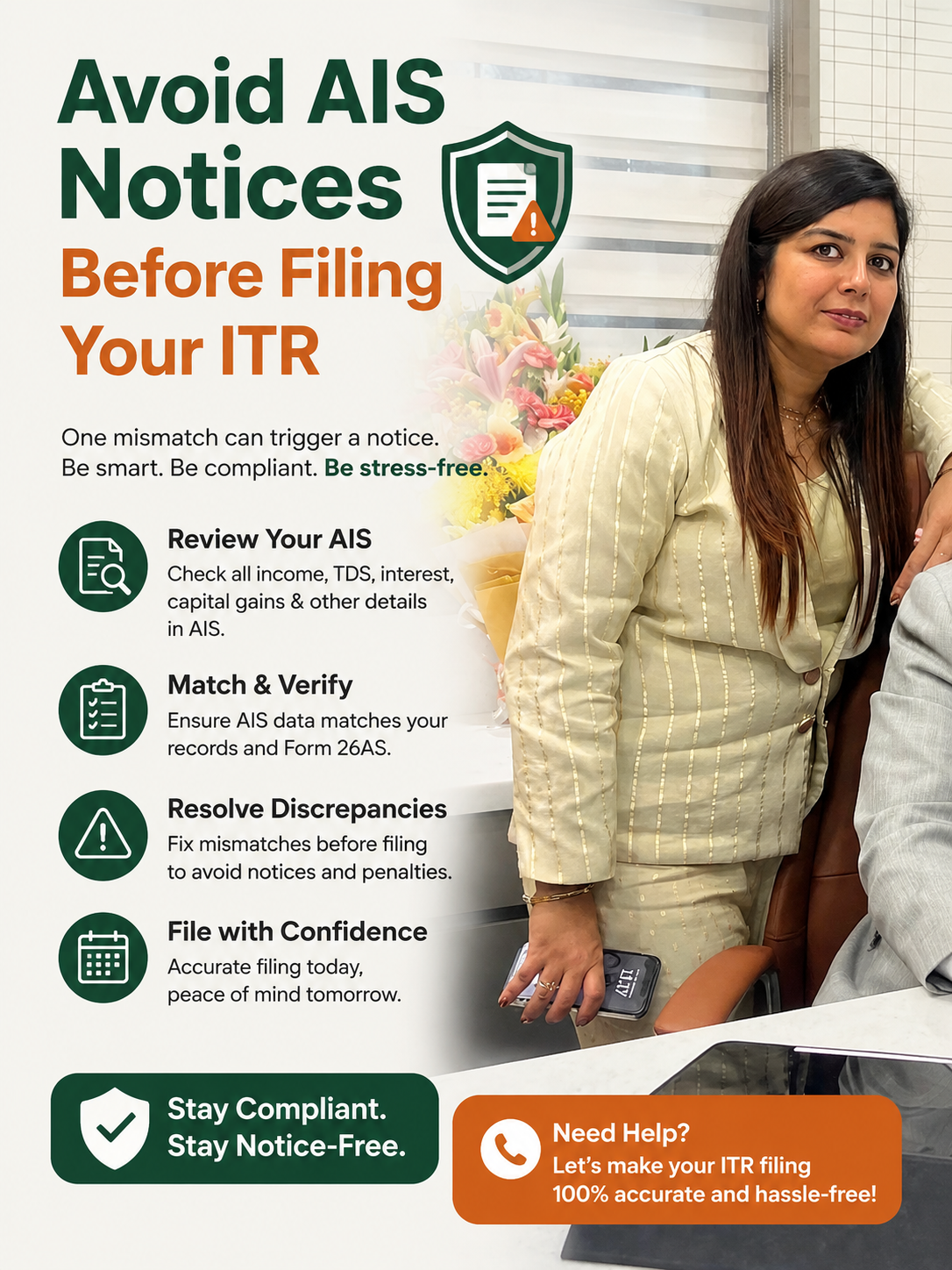
  • Avoid AIS Notices Before Filing Your ITR : Complete Guide for Salaried Taxpayers AY 2026-27

    Avoid AIS Notices Before Filing Your ITR : Complete Guide for Salaried Taxpayers AY 2026-27

    Avoid AIS Notices Before Filing Your ITR

    Opened your inbox to find an Income Tax Department email asking you to “explain a discrepancy” before you have even filed your return? It happens to thousands of salaried taxpayers every season, and it almost always traces back to one document: the Annual Information Statement, or AIS. If the numbers in your AIS do not match what you are about to declare in your ITR, you are not just risking a delayed refund you are inviting a AIS notice. This guide walks you through exactly how AIS notices ITR filing AY 2026-27 cases arise, and the precise steps salaried taxpayers should take to avoid one before they even click submit.


    What Is the AIS and Why It Decides Whether You Get a Notice

    The Annual Information Statement is a consolidated financial profile that the Income Tax Department builds for every PAN, pulling data directly from your employer, banks, mutual fund houses, stock brokers, and registrars. It covers salary, interest income, dividends, securities transactions, and high-value spends essentially everything the department already knows about you before you file a single form.

    Many taxpayers assume AIS is the same as Form 26AS. It is not. Form 26AS captures only TDS and TCS entries, while AIS is far broader and includes the underlying transaction data itself. Understanding the Form 26AS vs AIS difference 2026 is the first step toward a clean filing, because the department’s automated systems cross-check your ITR against both.


    How an AIS Mismatch Turns Into an Income Tax Notice

    When the income you declare in your ITR does not align with what AIS already shows, the system does not wait for a human officer to notice. Risk-based automated matching flags the gap almost instantly, and the most common outcome is a notice under the e-Verification Scheme or a query under Section 143(1)(a), asking you to reconcile the difference or file a revised return.

    For salaried employees, the usual triggers are surprisingly routine: a mid-year salary revision your employer reported differently, interest income from a savings account or fixed deposit you forgot to add, dividend income that slipped through, or capital gains on mutual funds that were not separately declared. None of these are deliberate evasion but to an automated matching engine, unexplained is indistinguishable from undisclosed.

    Read our detailed guide on : AIS vs Form 26AS Mismatch in 2026: The Silent Trigger Behind Most Income Tax Notices


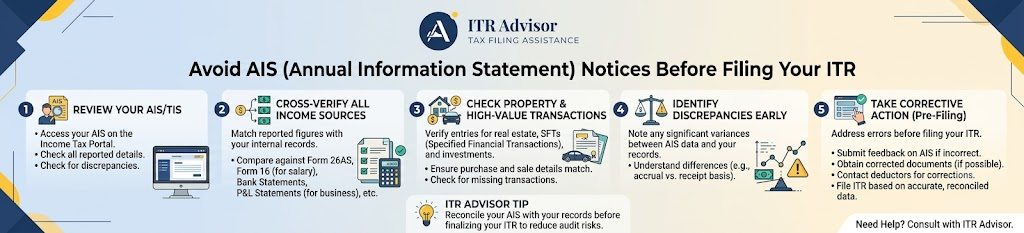
    Step-by-Step: How to Avoid an AIS Notice Before You File

    1. Download and Reconcile, Don’t Skip

    Log in to the income tax e-filing portal, open the AIS module, and download both the AIS and the Taxpayer Information Summary (TIS). Compare every line item against your Form 16, salary slips, bank interest certificates, and capital gains statements before you touch the ITR form.

    2. Submit Feedback on Every Incorrect Entry

    If an entry in AIS is wrong, duplicated, or simply does not belong to you, use the “Add Feedback” option against that specific transaction. This creates a documented trail showing you proactively flagged the discrepancy a detail that matters enormously if a notice does arrive later.

    3. File With the Correct Figures, Not Just the Pre-Filled Ones

    Submitting AIS feedback alone does not change your ITR. You still need to file your return using the figures you believe are accurate, supported by your own documentation, even while the feedback is under review.

    4. Re-Check Closer to the Deadline

    AIS data is dynamic and keeps updating as employers and banks file revised TDS returns. A statement downloaded in April can look materially different by late May or June, so re-verify shortly before you actually file.

    Expert Insight According to Dr. Haresh Adwani, tax advisory expert and a key voice behind Adwani & Co LLP’s compliance practice, the single biggest reason salaried taxpayers receive AIS-driven notices is not concealment it is simply filing too early, before banks and employers have finished updating their reported data for the year.


    What Happens If You Already Filed and Then Spot a Mismatch

    If you have already submitted your return and later notice an AIS discrepancy, a belated or revised return is usually the cleanest fix, provided it is filed within the applicable timelines specified by the Income Tax Department. Acting before a formal notice lands is always preferable to responding after one does.

    Key Takeaways

    AIS is broader than Form 26AS and drives most automated notices. Always reconcile AIS and TIS against your own documents before filing. Submit feedback on incorrect entries and file with verified figures. Re-check AIS closer to your filing date since data updates continuously.

    Frequently Asked Questions

    Q1. What triggers an AIS mismatch notice for salaried employees?

    Unreported interest, dividend, or capital gains income, or salary figures that differ from employer-reported data, are the most common triggers. The system flags any unexplained gap automatically.

    Q2. Is Form 26AS the same as AIS?

    No. Form 26AS shows only TDS/TCS data, while AIS covers a much wider range of income and transaction details reported by third parties.

    Q3. Can I correct a wrong entry in my AIS before filing?

    Yes, you can submit feedback against any incorrect or duplicate entry directly on the AIS portal, which creates a record of your objection.

    Q4. Does submitting AIS feedback automatically update my ITR?

    No. Feedback only flags the entry for review; you must still file your return using the figures you believe are correct.

    Q5. What should I do if I get a notice despite reconciling AIS?

    Respond within the stated timeline with supporting documents such as Form 16, bank certificates, and your AIS feedback trail, or seek professional guidance promptly.

    Conclusion:

    An AIS notice rarely means you did something wrong it usually means a data point somewhere was never reconciled. With AY 2026-27 filings now in motion, the safest strategy for any salaried taxpayer is simple: download your AIS, match it line by line against your real records, fix what is wrong, and only then file. That single habit prevents the vast majority of notices before they are ever issued.

    If you want expert guidance on reconciling your AIS or responding to an AIS notice, connect with itradvisor.in today and file your AY 2026-27 return with complete confidence.

    About the Author – Nidhi Adwani

    Nidhi Adwani is the Human Resources Manager at Adwani & Co. She is a Law Graduate and holds an MBA in Human Resources. She manages recruitment, employee engagement, team development, workplace culture, and the firm’s social media and content activities. Passionate about people and organizational growth, she also contributes articles for ITRAdvisor and Adwani & Co. Her writing focuses on HR practices, leadership, workplace engagement, and professional development, offering practical insights for professionals and businesses.

    At ITRAdvisor.in, we help taxpayers with:

    ✔️ ITR Filing Review

    ✔️ AIS Reconciliation

    ✔️ Capital Gains Reporting

    ✔️ NRI Taxation

    ✔️ Tax Notice Response

    ✔️ Revised Returns

    ✔️ Income Tax Planning

    ✔️ Refund and Compliance Issues

    Visit ITRAdvisor.in today for professional guidance and consultation.

    Early action can often prevent bigger tax problems later.

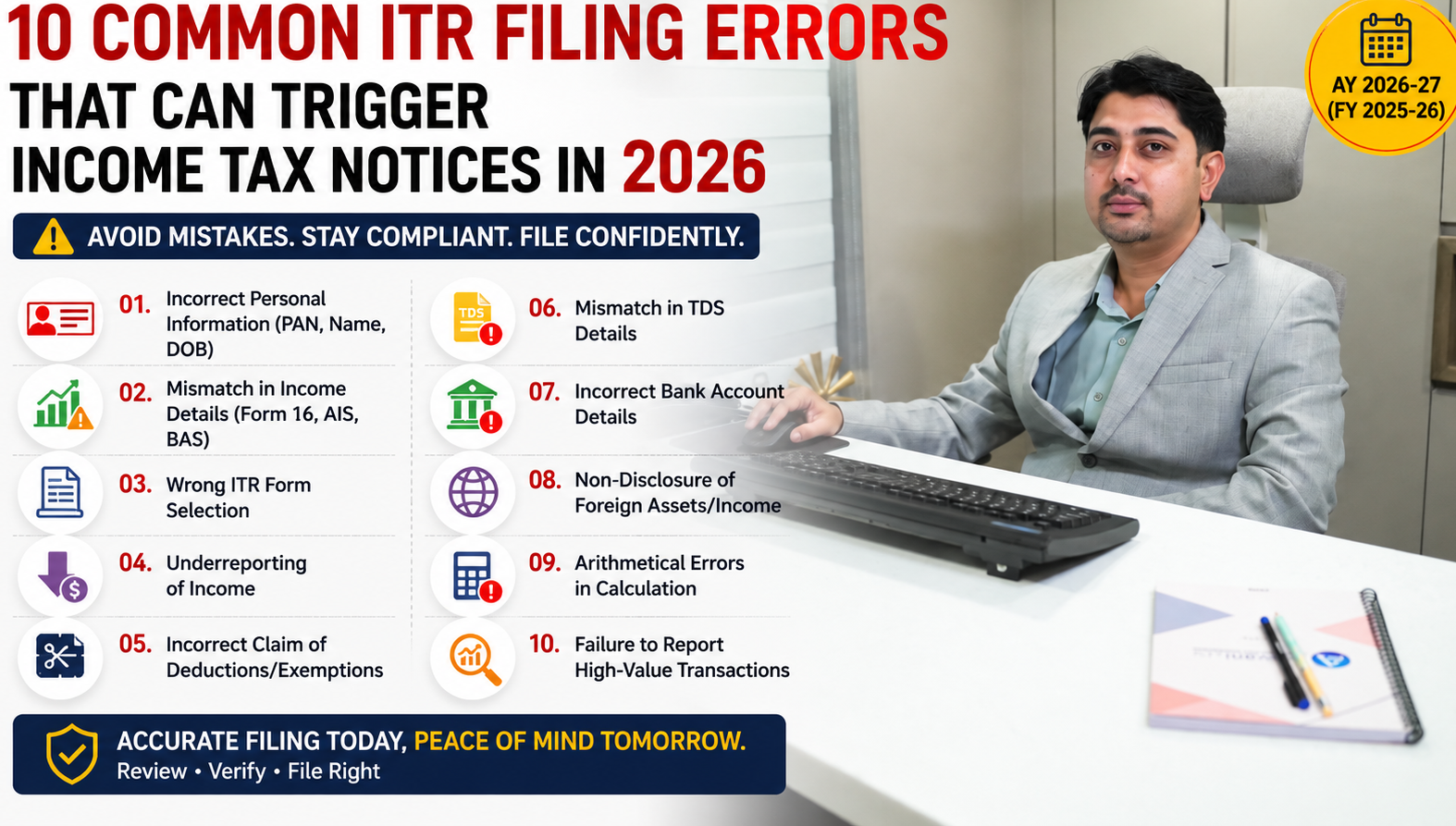
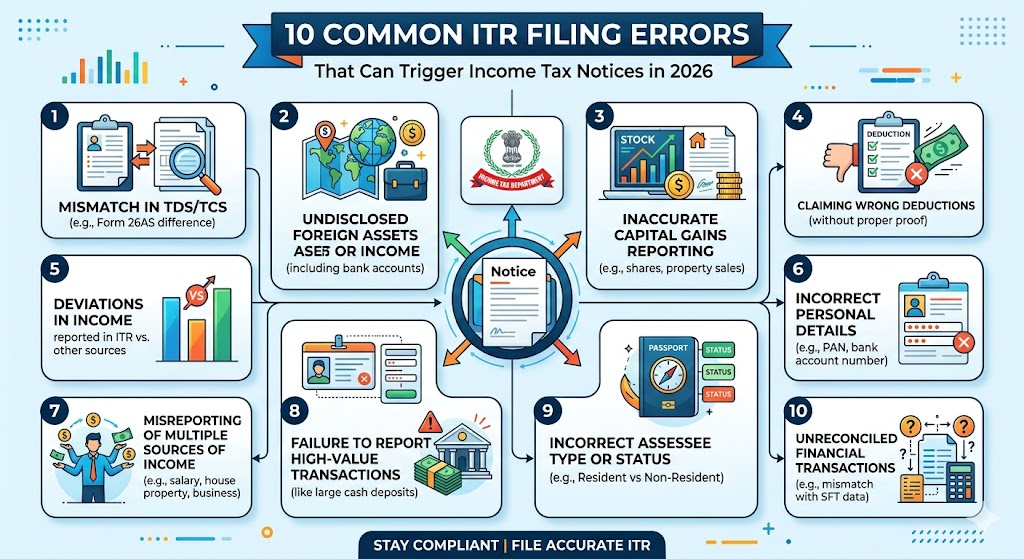
  • 10 Common ITR Filing Errors That Can Trigger Income Tax Notices in 2026

    10 Common ITR Filing Errors That Can Trigger Income Tax Notices in 2026

    08 June 2026• Prafull Nile

    10 Common ITR Filing Errors

    Filing your Income Tax Return (ITR) may appear simple, especially with pre-filled data available on the Income Tax Portal. However, thousands of taxpayers receive notices every year due to avoidable mistakes while filing their returns.

    Many taxpayers believe that if tax has been deducted or Form 16 has been issued, there is no possibility of receiving a notice. Unfortunately, this is not always true.

    The Income Tax Department now uses data from:

    • Annual Information Statement (AIS)
    • Form 26AS
    • Banks
    • Mutual Funds
    • Stock Brokers
    • Property Registrars
    • Credit Card Companies

    As a result, even small filing errors can result in tax demands, refund delays, scrutiny, or notices.

    Let’s look at the most common ITR filing mistakes and how to avoid them.

    1. Not Checking AIS Before Filing

    This is currently one of the biggest mistakes taxpayers make.

    Many individuals file their returns using only Form 16 without reviewing the Annual Information Statement (AIS).

    AIS may contain:

    • FD interest
    • Dividend income
    • Share transactions
    • Mutual fund redemptions
    • Property transactions
    • Foreign remittances

    If income reflected in AIS is not reported in the ITR, the department may issue a notice.

    Example

    A salaried employee reported salary income based on Form 16 but forgot to include ₹38,000 FD interest reflected in AIS.

    The mismatch was later identified during return processing.

    Also Read our detailed guide on: Salary vs AIS Mismatch in Your ITR : Dangerous, Common & Completely Fixable

    1. Incorrect Selection of ITR Form

    Using the wrong ITR form is a common mistake.

    Examples:

    • Using ITR 1 despite having capital gains
    • Using ITR 1 despite owning foreign assets
    • Using ITR 4 despite being ineligible

    An incorrect form can make the return defective.

    1. Not Reporting Interest Income

    Many taxpayers assume that because TDS has been deducted, interest income need not be reported.

    This is incorrect.

    Commonly missed income includes:

    • Savings account interest
    • Fixed Deposit interest
    • Recurring Deposit interest

    The income must generally be disclosed in the return.

    1. Ignoring Dividend Income

    Dividend income received from shares and mutual funds is often forgotten during filing.

    Since this information is generally available to the department, non-reporting can create mismatches.

    1. Incorrect Capital Gains Reporting

    This is one of the most frequent reasons for notices.

    Taxpayers often:

    • Forget to report share transactions
    • Ignore mutual fund redemptions
    • Miscalculate capital gains
    • Fail to report property sales

    Example

    A taxpayer sold mutual funds worth ₹12 lakh and assumed there was no taxable gain because the amount was reinvested.

    The transaction appeared in AIS but was omitted from the ITR.

    A notice was later received seeking clarification.

    1. Claiming Deductions Without Proper Documentation

    Many taxpayers claim deductions under:

    • Section 80C
    • Section 80D
    • Section 80G

    without maintaining supporting records.

    If questioned by the department, documentary evidence may be required.

    1. Not Reporting Foreign Assets

    This mistake is particularly common among NRIs returning to India.

    Foreign bank accounts, investments, and other reportable assets may require disclosure depending on residential status and applicable provisions.

    Failure to disclose can have serious consequences.

    1. Not Reconciling Form 26AS

    Before filing, taxpayers should compare:

    • Form 16
    • Form 26AS
    • AIS
    • Bank records

    Differences should be investigated before submission.

    1. Incorrect Bank Account Details

    A simple mistake in bank account information can result in:

    • Refund failure
    • Delayed processing
    • Additional compliance issues

    Always verify account details carefully.

    1. Filing in a Hurry Before the Deadline

    Many taxpayers wait until the last few days before the due date.

    As a result, important items are overlooked, including:

    • AIS mismatches
    • Capital gains
    • Interest income
    • Foreign assets
    • TDS discrepancies

    Rushed filing often leads to mistakes that could have been avoided.


    Real-Life Example: Notice Due to AIS Mismatch

    Mr. Sharma filed his Income Tax Return based solely on Form 16 provided by his employer.

    A few months later, he received a communication from the Income Tax Department.

    Upon review, it was found that:

    • FD interest of ₹62,000 reflected in AIS was not reported.
    • Dividend income of ₹14,000 was omitted.
    • Mutual fund redemption transactions were not disclosed.

    Although the omissions were unintentional, additional compliance was required to resolve the matter.

    This situation is becoming increasingly common as the department relies heavily on AIS data.


    Can I Correct an ITR Filing Mistake?

    In many situations, taxpayers may be able to rectify mistakes by filing a revised return within the applicable timelines.

    However, early identification of errors is important.

    The longer a mistake remains uncorrected, the greater the risk of notices, demands, or penalties.


    How to Avoid ITR Filing Errors:

    Before filing your return:

    ✔️ Verify Form 16

    ✔️ Check AIS thoroughly

    ✔️ Review Form 26AS

    ✔️ Reconcile bank interest

    ✔️ Verify dividend income

    ✔️ Check capital gains statements

    ✔️ Confirm bank account details

    ✔️ Select the correct ITR form

    ✔️ Review foreign asset disclosures

    ✔️ Seek professional advice for complex transactions

    Frequently Asked Questions

    1.Can a small mistake in ITR trigger a notice?

    Yes. Even small mismatches between the ITR and AIS can result in communications from the Income Tax Department.

    2.Can I revise my ITR after filing?

    In many cases, taxpayers can file a revised return within the prescribed timelines.

    3.Is AIS more important than Form 16?

    Both are important. However, AIS often contains additional information that may not appear in Form 16.

    What is the most common ITR filing mistake

    Currently, failure to reconcile AIS before filing is among the most common errors.

    Final Thoughts

    Most Income Tax notices are not issued because taxpayers intentionally hide income. They are often the result of simple mistakes, omissions, or mismatches.

    A careful review of AIS, Form 26AS, interest income, capital gains, and deductions before filing can significantly reduce the risk of future notices and tax disputes.

    Taking a few extra minutes before filing can save months of stress later.

    Many taxpayers file their returns themselves and later discover mistakes that result in notices, refund delays, or additional tax demands.

    About the Author : Prafull Nile

    Prafull Nile is a senior taxation and accounting professional associated with Adwani & Co LLP, bringing over 19 years of extensive experience in direct taxation, tax audits, income tax assessments, GST audits, and financial statement finalization. He has successfully managed diverse client engagements across industries, providing strategic guidance on tax compliance, assessments, and regulatory matters. In addition to his technical expertise, Prafull leads and mentors teams, ensuring high standards of service delivery and operational excellence. His practical approach, deep understanding of tax laws, and commitment to client success make him a trusted advisor for businesses and professionals navigating complex financial and compliance requirements.

    At ITRAdvisor.in, we help taxpayers with:

    ✔️ ITR Filing Review

    ✔️ AIS Reconciliation

    ✔️ Capital Gains Reporting

    ✔️ NRI Taxation

    ✔️ Tax Notice Response

    ✔️ Revised Returns

    ✔️ Income Tax Planning

    ✔️ Refund and Compliance Issues

    If you are unsure whether your return has been filed correctly or want a professional review before submission, consulting an experienced tax professional can help avoid costly mistakes.

    Visit ITRAdvisor.in for expert assistance with your Income Tax Return and tax compliance requirements.

    Disclaimer: ITRAdvisor.in is an educational and informational platform focused on tax awareness and compliance updates. Nothing contained herein should be construed as solicitation or advertisement of professional services. Professional services, where applicable, are rendered in accordance with ICAI guidelines. This article is published on ITRAdvisor.in, a tax and compliance knowledge platform. The content has been reviewed for technical accuracy by professionals associated with Adwani & Co LLP.

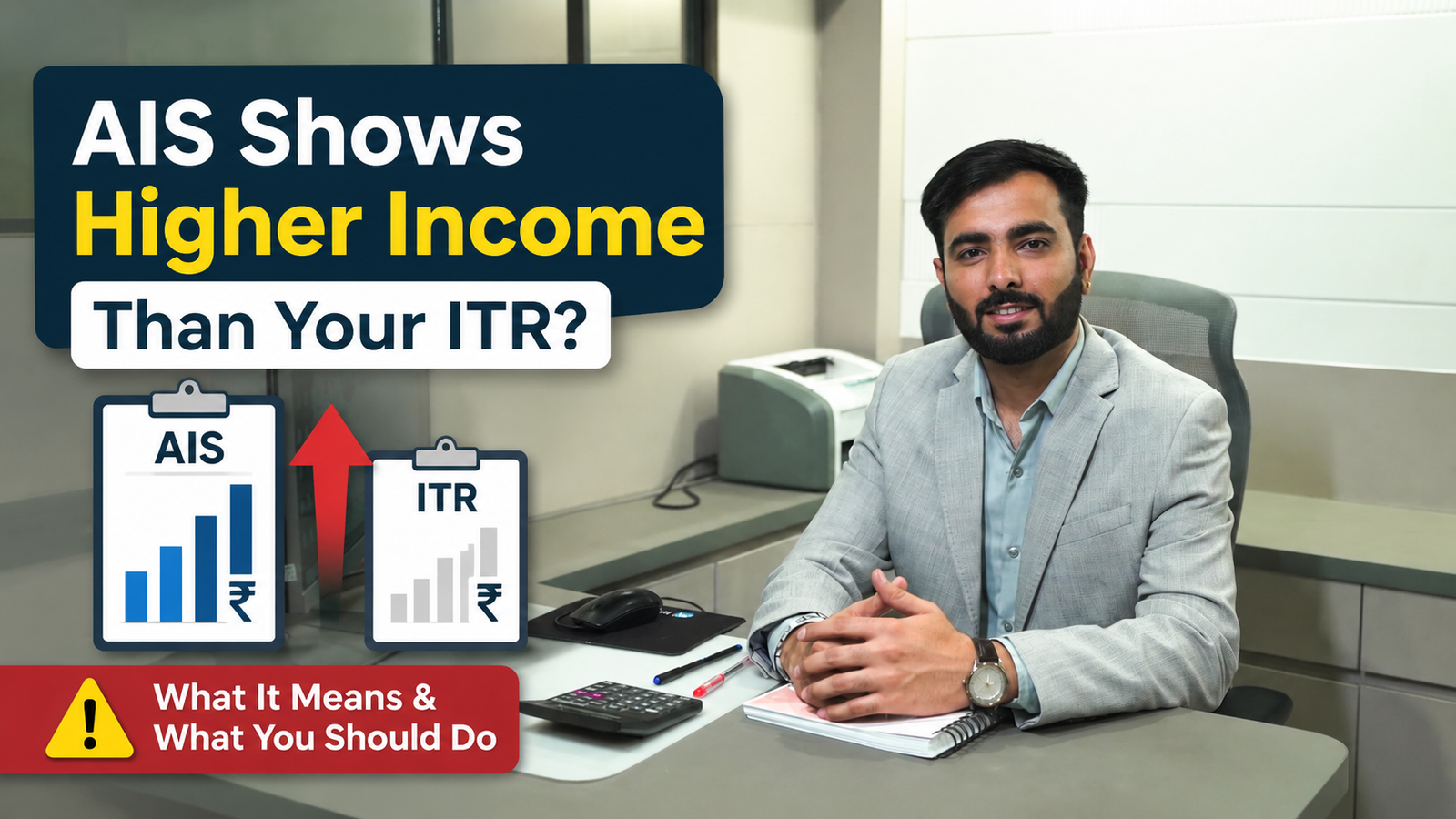
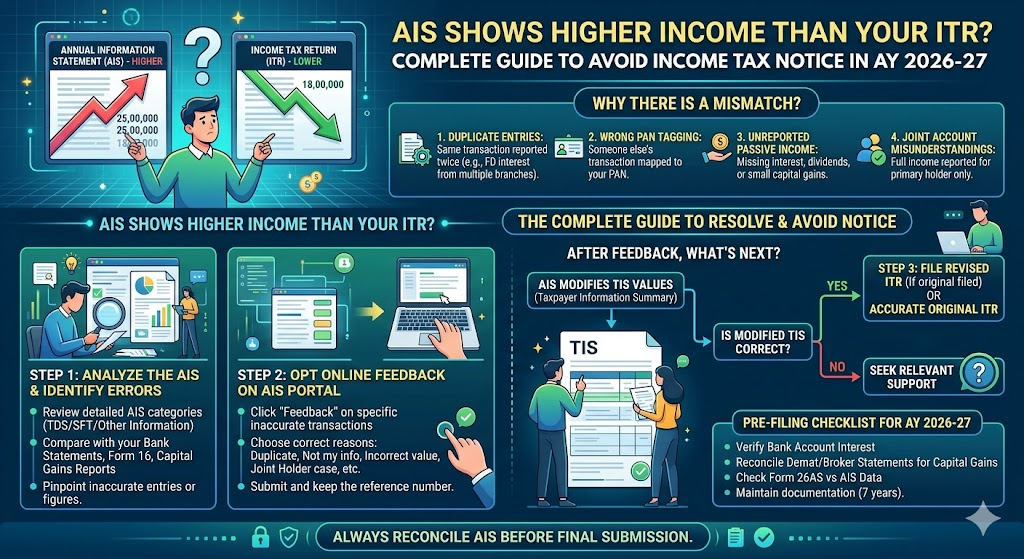
  • AIS Shows Higher Income Than Your ITR? Complete Guide to Avoid Income Tax Notice in AY 2026-27

    AIS Shows Higher Income Than Your ITR? Complete Guide to Avoid Income Tax Notice in AY 2026-27

    CA Dipesh Gurubakshani June 2026 9 min read

    AIS Shows More Income Than Your ITR? Don’t Ignore It

    Have you checked your Annual Information Statement (AIS) before filing your Income Tax Return (ITR)?

    Many taxpayers receive Income Tax notices because the income reported in their ITR does not match the information available with the Income Tax Department through AIS.

    If your AIS shows higher income than what you have reported in your ITR, it could trigger scrutiny, notices, or demands from the Income Tax Department.

    In this guide, we explain what AIS is, common AIS mismatches, how to correct errors, and what steps you should take before filing your ITR for AY 2026-27.


    What is AIS (Annual Information Statement)?

    The Annual Information Statement (AIS) is a comprehensive statement available on the Income Tax Portal that contains details of various financial transactions reported to the Income Tax Department.

    AIS includes information such as:

    • Savings bank interest
    • Fixed deposit interest
    • Dividend income
    • Purchase and sale of shares and mutual funds
    • Salary income
    • Rent received
    • Foreign remittances
    • Credit card payments
    • High-value transactions
    • Tax Deducted at Source (TDS)
    • Tax Collected at Source (TCS)

    The Income Tax Department uses AIS to verify whether taxpayers have correctly reported their income in the ITR.


    Why AIS is Important Before Filing ITR

    Many taxpayers rely only on Form 16, bank statements, or investment records while filing their returns.

    However, the Income Tax Department compares your ITR with the data available in AIS.

    Even if you unintentionally omit income, the mismatch may result in:

    • Defective return notices
    • Scrutiny notices
    • Tax demands
    • Penalties
    • Interest liability

    Therefore, checking AIS before filing your return has become essential.

    Read our detailed guide on :How to Download AIS from the Income Tax Portal : The Ultimate Step by Step Guide for AY 2026-27


    Common AIS Errors and Mismatches

    1. Fixed Deposit Interest Not Reported

    Banks report FD interest to the Income Tax Department even if the interest is not credited to your account.

    Many taxpayers miss reporting FD interest, leading to an AIS mismatch.

    2. Savings Bank Interest Missing

    Interest earned from savings accounts is often overlooked while filing returns.

    However, banks report this information in AIS.

    3. Dividend Income Not Included

    Companies and mutual funds report dividend payments.

    Failure to report dividend income may create discrepancies.

    4. Capital Gains Not Reported Correctly

    Share and mutual fund transactions are reported by brokers and RTAs.

    Many taxpayers report only sale proceeds or forget to calculate capital gains accurately.

    5.Duplicate Reporting in AIS

    Sometimes AIS may show duplicate transactions due to reporting by multiple entities.

    Such cases require verification before filing.

    6. Incorrect Salary Information

    Employers may revise TDS returns, causing differences between Form 16 and AIS.

    7. High-Value Transactions

    Property purchases, foreign remittances, credit card payments, and other specified financial transactions may appear in AIS.

    Ignoring them can invite questions from the tax department.


    What Happens If You Ignore AIS Mismatches?

    Ignoring AIS discrepancies can lead to serious consequences.

    The Income Tax Department may:

    • Issue notices seeking clarification
    • Add omitted income during assessment
    • Levy additional tax
    • Charge interest under applicable provisions
    • Impose penalties in certain cases

    Many taxpayers receive notices simply because they failed to reconcile AIS before filing their return.


    How to Check AIS Online

    Follow these steps:

    1. Login to the Income Tax e-Filing Portal.

    2. Go to “Services”.

    3. Click on “Annual Information Statement (AIS)”.

    4. Open AIS and review all reported transactions.

    5. Compare AIS data with:

    • Form 16
    • Form 26AS
    • Bank statementsBank statements
    • Broker statements
    • Mutual fund statements
    • Books of accounts

    How to Submit Feedback in AIS

    If you find incorrect information in AIS, you can submit feedback directly through the portal.

    Common feedback options include:

    • Information is correct
    • Information is not fully correct
    • Information relates to another PAN
    • Duplicate information
    • Information is denied

    Providing feedback helps the Income Tax Department understand discrepancies and may prevent future issues.


    Example of an AIS Mismatch


    Mr. Sharma filed his ITR showing interest income of ₹12,000.

    However, AIS reflected:

    • Savings account interest: ₹12,000
    • FD interest: ₹45,000
    • Total interest as per AIS: ₹57,000

    Since FD interest was omitted from the return, the Income Tax Department may issue a notice seeking clarification.

    This is one of the most common AIS-related mistakes observed every year.


    Best Practices to Avoid AIS-Related Notices

    Before filing your ITR:

    • ✅ Download and review AIS
    • ✅ Compare AIS with Form 26AS
    • ✅ Verify bank interest income
    • ✅ Check dividend income
    • ✅ Review share and mutual fund transactions
    • ✅ Verify salary details
    • ✅ Reconcile TDS entries
    • ✅ Submit feedback wherever required
    • ✅ Seek professional assistance for complex transactions

    Frequently Asked Questions (FAQs)

    1. Is AIS mandatory for filing ITR?

    While AIS is not mandatory, checking it before filing your return is strongly recommended to avoid mismatches.

    2.Can AIS contain incorrect information?

    Yes. AIS may occasionally contain duplicate or incorrect entries. Such errors can be addressed through the feedback mechanism.

    3.Can I revise my ITR if AIS shows additional income?

    Yes, taxpayers can file a revised return within the prescribed time limit if any income was omitted.

    4. Will I definitely receive a notice if AIS and ITR do not match?

    Not necessarily. However, significant mismatches increase the likelihood of scrutiny or notices.

    Author

    CA Dipesh Gurubakshani is a Chartered Accountant with Adwani & Co LLP, Pune, specialising in income tax audit, direct taxation, and accounting advisory. He supports clients across statutory compliance, financial reporting, and income tax matters with a focus on accuracy, regulatory adherence, and disciplined execution.

    Disclaimer: ITRAdvisor.in is an educational and informational platform focused on tax awareness and compliance updates. Nothing contained herein should be construed as solicitation or advertisement of professional services. Professional services, where applicable, are rendered in accordance with ICAI guidelines. This article is published on ITRAdvisor.in, a tax and compliance knowledge platform. The content has been reviewed for technical accuracy by professionals associated with Adwani & Co LLP.

    Need Help With AIS Mismatch or Income Tax Notice?

    If your AIS shows higher income than your ITR, do not ignore it. Our team at ITR Advisor assists taxpayers across India and NRIs worldwide with:

    • AIS reconciliation
    • Income Tax Return filing
    • Revised Return filing
    • Income Tax Notice replies
    • Scrutiny and assessment support
    • Contact us today for professional assistance and ensure your return is filed accurately and compliantly.