Tag: GST

  • Blocked Input Tax Credit (ITC) Under GST: A Cost You Can Avoid If You Know the Rules

    Blocked Input Tax Credit (ITC) Under GST: A Cost You Can Avoid If You Know the Rules

    Blocked ITC under GST

    A mid-sized manufacturing company recently renovated its corporate office new furniture, decorative lighting, a redesigned employee lounge, and an upgraded cafeteria. Every vendor invoice carried GST, so the finance team assumed the entire input tax credit was available to claim. During a routine GST review, they discovered otherwise: a significant portion of that credit was blocked under Section 17(5) of the CGST Act. The result was an unplanned tax outflow, interest, and the start of a dispute nobody had budgeted for.
    This is one of the most common and most expensive mistakes businesses make while claiming blocked input tax credit under GST.


    What Is Blocked ITC Under GST?

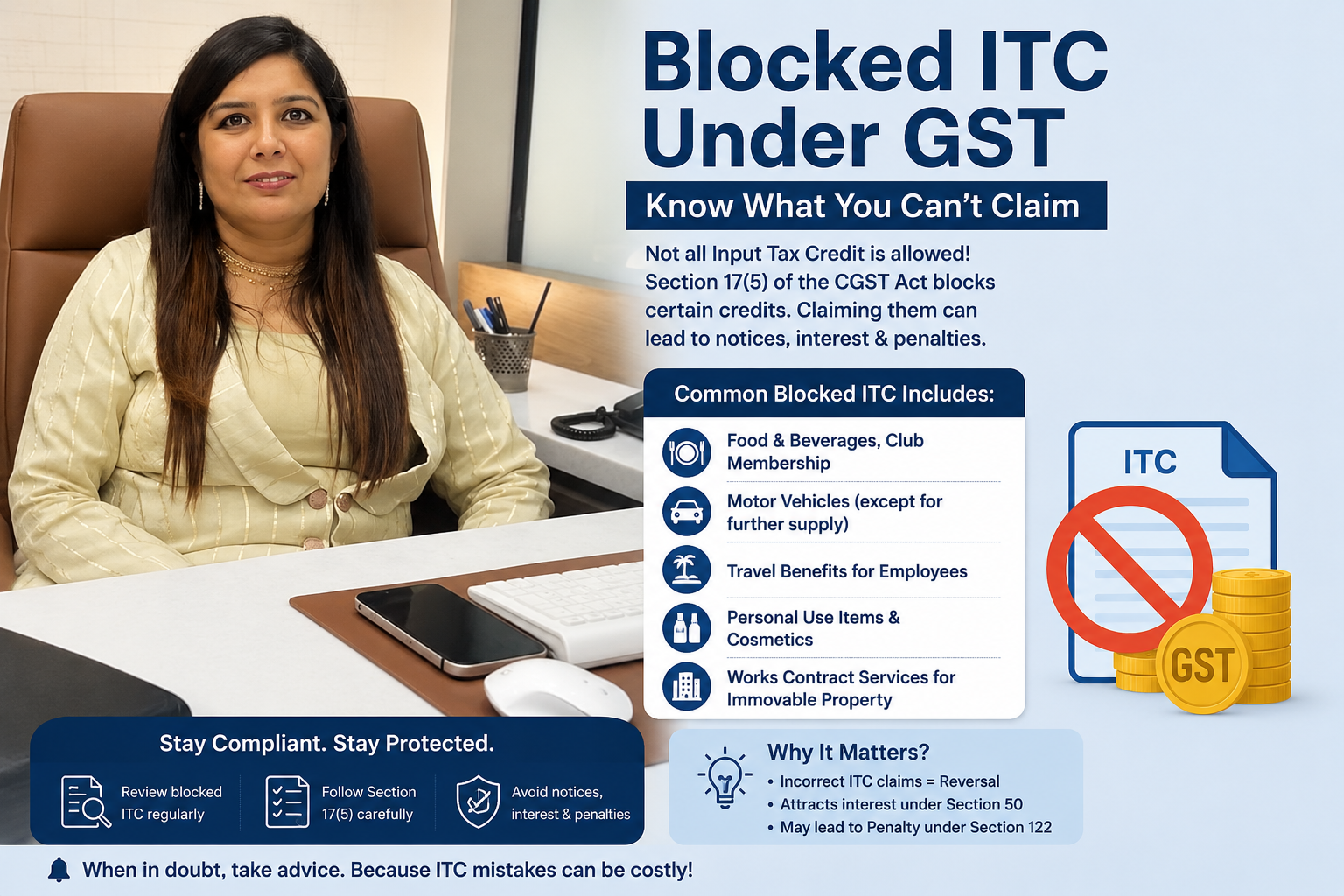
    Not every rupee of GST paid on a business expense is creditable. Section 17(5) of the CGST Act carves out a specific list of “blocked credits” expenses on which ITC cannot be claimed, regardless of whether the purchase was genuinely used for business. Understanding this list is essential before any GST return is filed, because a wrongly claimed credit invites reversal, interest, and scrutiny later.


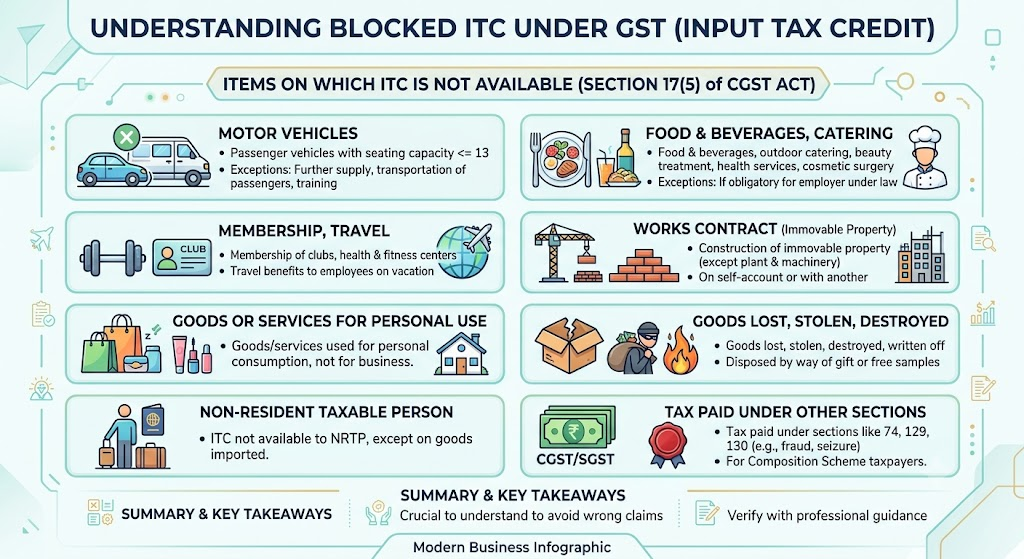
    Common Categories of Blocked ITC Under Section 17(5)

    Food, Beverages, Club Memberships and Health Benefits

    Input tax credit on food and beverages, club or gym memberships, and health and fitness services is blocked in most cases, with only narrow statutory exceptions.

    Motor Vehicles

    ITC on motor vehicles used for transporting persons is restricted unless the vehicle is used for further supply, passenger transport, or driving training a distinction many businesses overlook.

    Works Contract Services and Immovable Property

    Credit on works contract services and on goods or services used for constructing immovable property is blocked, except where the construction is for further supply of works contract services.

    Employee Travel Benefits and Personal Consumption

    GST paid on leave travel concession, employee perquisites, and any expense of a personal nature is not eligible for input tax credit, even when routed through the company.


    Why “GST Was Paid” Doesn’t Mean ITC Is Automatically Eligible

    This is the misconception behind most blocked ITC under GST disputes. A valid tax invoice and timely payment satisfy only part of the eligibility test. The credit must also survive the Section 17(5) filter and that filter applies irrespective of whether the expense was, in substance, used for the furtherance of business. As Dr. Haresh Adwani often points out to clients undergoing GST reviews, eligibility should be verified at the time of booking the expense, not months later during an assessment.


    The 3-Question ITC Eligibility Checklist

    Before claiming any input tax credit under GST, run every expense through these questions:

    • Is the expense incurred in the course or furtherance of business?
    • Is the credit specifically blocked under Section 17(5) of the CGST Act?
    • Is the credit backed by a valid tax invoice, and does it appear correctly matched in GSTR-2B?

    How a Proactive GST Review Prevents Costly Reversals

    Cross-checking claimed ITC against the GST Portal’s GSTR-2B statement, and against the blocked-credit list published by the GST authorities, is the single most effective way to avoid interest and litigation later. A periodic internal review ideally before the annual return is filed catches blocked credits while correction is still straightforward, rather than after a departmental audit has already flagged them.

    Read our detailed guide on GST Compliance Checklist India 2026


    Key Takeaway on Blocked ITC under GST

    Paying GST on an invoice is not the same as being entitled to claim it as credit. Section 17(5) of the CGST Act blocks ITC on several everyday business expenses food, club memberships, select motor vehicles, immovable property construction, and personal-use benefits regardless of the purpose behind the spend. A disciplined, checklist-driven review before filing is the most reliable way to protect your working capital from unnecessary reversals.

    Frequently Asked Questions on Blocked ITC under GST

    Q1. What is blocked ITC under GST?

    Blocked ITC refers to credit that Section 17(5) of the CGST Act specifically disallows, even if GST was validly paid on the invoice.

    Q2. Can businesses claim ITC on motor vehicles under GST?

    Only in limited cases such as vehicles used for further supply, passenger transport services, or driving training is ITC on motor vehicles allowed.

    Q3. Is ITC available on office renovation expenses?

    ITC on works contract services or goods used for constructing immovable property is generally blocked, except where used for further supply of such services.

    Q4. How can businesses avoid blocked ITC claims?

    Running every expense through the Section 17(5) checklist and reconciling claims against GSTR-2B before filing significantly reduces the risk of reversal

    Conclusion

    Blocked ITC under GST is one of the quiet ways businesses lose money not through fraud or error, but through assumption. Knowing exactly which expenses fall under Section 17(5) of the CGST Act, and building a habit of checking eligibility before filing, turns a common costly mistake into a routine compliance step.

    About the Author – Nidhi Adwani

    Nidhi Adwani is the Human Resources Manager at Adwani & Co. She is a Law Graduate and holds an MBA in Human Resources. She manages recruitment, employee engagement, team development, workplace culture, and the firm’s social media and content activities. Passionate about people and organizational growth, she also contributes articles for ITRAdvisor and Adwani & Co. Her writing focuses on HR practices, leadership, workplace engagement, and professional development, offering practical insights for professionals and businesses.

    Disclaimer:

    ITRAdvisor.in is an educational and informational platform focused on tax awareness and compliance updates. Nothing contained herein should be construed as solicitation or advertisement of professional services. Professional services, where applicable, are rendered in accordance with ICAI guidelines. This article is published on ITRAdvisor.in, a tax and compliance knowledge platform.

    The content has been reviewed for technical accuracy by professionals associated with Adwani & Co LLP.
    At ITRAdvisor.in, we help taxpayers with:

    ✔️ ITR Filing Review

    ✔️ AIS Reconciliation

    ✔️ Capital Gains Reporting

    ✔️ NRI Taxation

    ✔️ Tax Notice Response

    ✔️ Revised Returns

    ✔️ Income Tax Planning

    ✔️ Refund and Compliance Issues

    Visit ITRAdvisor.in today for professional guidance and consultation.

    Early action can often prevent bigger tax problems later.

    Disclaimer ITRAdvisor.in is an educational and informational platform focused on tax awareness and compliance updates. Nothing contained herein should be construed as solicitation or advertisement of professional services. Professional services, where applicable, are rendered in accordance with ICAI guidelines. This article is published on ITRAdvisor.in, a tax and compliance knowledge platform. The content has been reviewed for technical accuracy by professionals associated with Adwani & Co LLP.
  • E-Way Bill Under GST: The Registration Myth That Trips Up Growing Businesses

    E-Way Bill Under GST: The Registration Myth That Trips Up Growing Businesses

    E-Way Bill Under GST

    “We’ve registered on the E-Way Bill portal. So now we need an E-Way Bill for every invoice right?” That was the first question a client asked us right after completing their registration. Getting the answer wrong could have cost them a detained shipment.

    The E-Way Bill Under GST Question Every Growing Business Eventually Asks

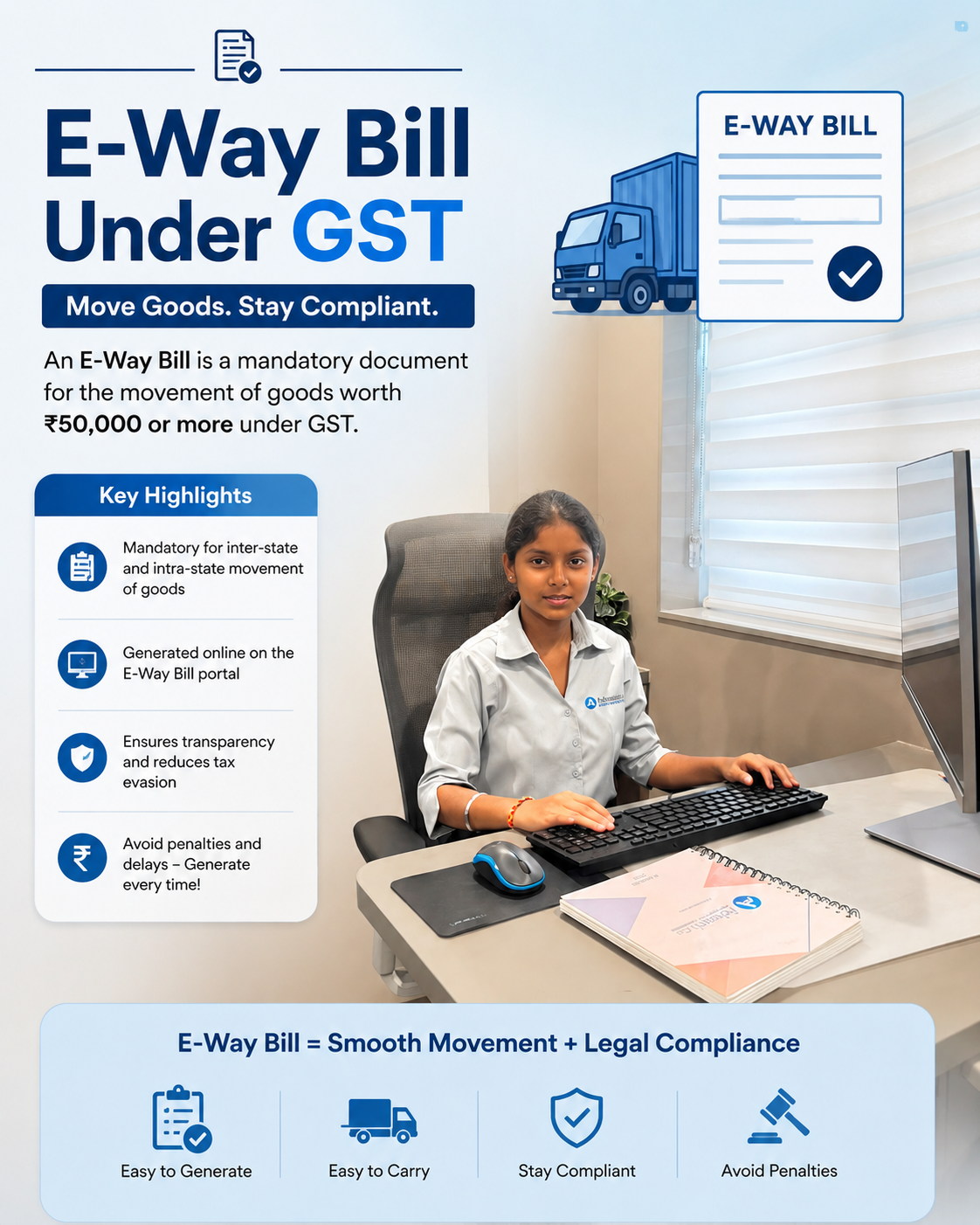
    As this client’s business expanded, more consignments started crossing the prescribed threshold, and it was the right time for them to register on the eWay Bill portal using their GSTIN so they could generate an eWay Bill whenever required. But registering for an eWay Bill under GST does not mean an eWay Bill under GST is required for every invoice that goes out the door.

    Registration only enables generation. Whether one is actually needed depends entirely on the nature of the transaction and the applicable GST provisions not on the fact that the facility exists.


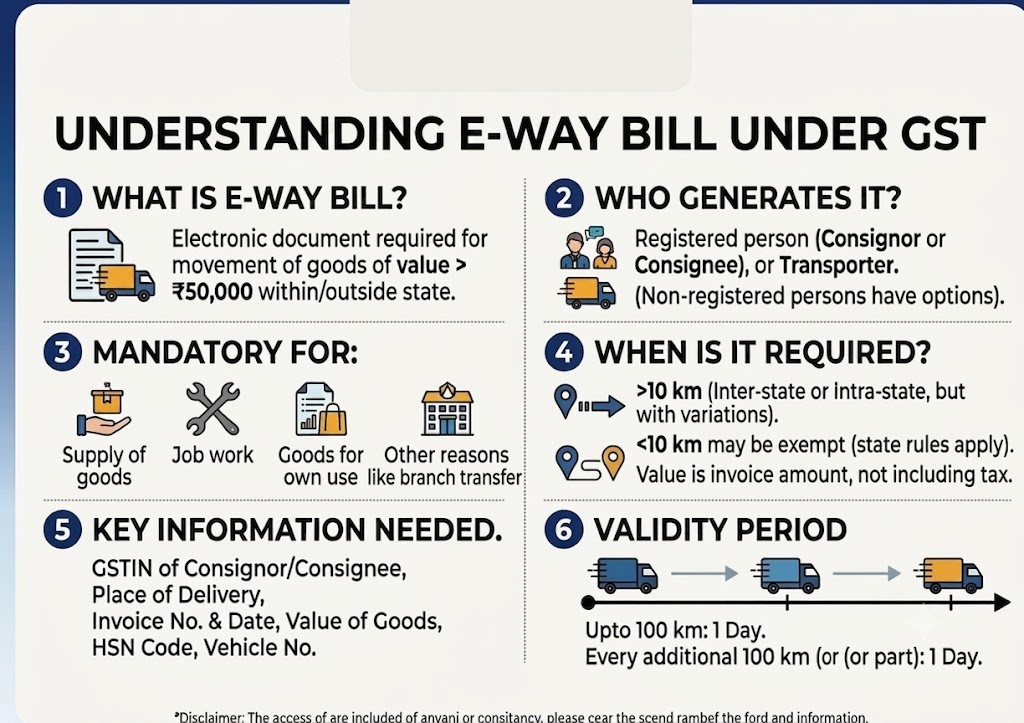
    Four Questions to Ask Before Generating an E-Way Bill Under GST

    • Is there an actual movement of goods?
    • Does the consignment value exceed the prescribed limit generally ₹50,000, subject to notified state-specific variations?
    • Is the movement covered under any exemption?

    Who is responsible for generating it the supplier, the recipient, or the transporter?

    These four checks, more than any rulebook, decide whether an eWay Bill under GST is genuinely required for a given consignment.

    Read our detailed guide on The Ultimate GST Compliance Checklist for Small Businesses in India : FY 2026-27 Survival Guide


    Why GST Registration Does Not Automatically Enable E-Way Bill Under GST

    One of the biggest misconceptions businesses carry is that GST registration automatically enables E-Way Bill generation. It does not. Every business must complete a separate registration on the E-Way Bill portal, distinct from its GST registration, before it can generate an E-Way Bill under GST at all. Skipping this step is one of the most common reasons consignments get stuck at the last minute, on the GST portal’s linked E-Way Bill system.


    The 180-Day Rule Every eWay Bill Under GST User Should Know

    Another compliance point that trips up even experienced businesses: under current provisions on the E-Way Bill portal, an E-Way Bill under GST cannot be generated for an invoice or delivery challan older than 180 days from its date. Delayed documentation can therefore create compliance challenges that have nothing to do with the underlying transaction and everything to do with timing.

    The Real Lesson Behind This E-Way Bill Under GST Misconception

    Dr. Haresh Adwani, PhD in Commerce and a law degree who regularly advises growing businesses on GST logistics compliance, often notes that most GST compliance issues do not arise because businesses ignore the law they arise because businesses misunderstand exactly when the law applies. An E-Way Bill under GST is a perfect example: the rule itself is simple, but assuming registration equals obligation is what catches people out.


    Key Takeaways on eWay Bill Under GST

    • Registering on the E-Way Bill portal only enables generation it does not make an E-Way Bill under GST mandatory for every invoice.
    • An eWay Bill under GST is needed only when goods actually move, the consignment value crosses the threshold, and no exemption applies.
    • GST registration and E-Way Bill portal registration are two separate steps completing one does not complete the other.

    An E-Way Bill under GST cannot be generated for documents older than 180 days, so timely action matters.


    Frequently Asked Questions

    Does GST registration automatically allow me to generate an E-Way Bill under GST?

    No. A separate registration on the E-Way Bill portal is required before any E-Way Bill under GST can be generated.

    Is an E-Way Bill under GST required for every invoice?

    No. It depends on whether goods are moving, the consignment value crosses the prescribed limit, and whether an exemption applies.

    What is the value limit for an E-Way Bill under GST?

    Generally ₹50,000 per consignment, though several states have notified their own intra-state variations.

    Can an E-Way Bill under GST be generated for an old invoice?

    No. Current provisions do not allow generation for any invoice or delivery challan older than 180 days.

    Final Word: Getting E-Way Bill Under GST Right, Not Just Registered

    Most GST compliance issues don’t arise because businesses ignore the law they arise because businesses misunderstand exactly when it applies. Getting the fundamentals of an E-Way Bill under GST right, from registration to the 180-day rule, protects your consignments from unnecessary delays. In Part 2, we’ll walk through the most common E-Way Bill mistakes we see in practice. If you want expert guidance on GST logistics compliance, connect with itradvisor.in today.

    About the AuthorSejal Kadam

    Sejal Kadam is an Indirect Tax Associate at Adwani & Co LLP with a strong interest in GST, indirect taxation, and regulatory compliance. She contributes to helping businesses navigate evolving tax laws through practical, research-backed insights. Through her articles, Sejal aims to simplify complex GST and compliance topics, enabling businesses and professionals to make informed decisions with confidence.

    Visit ITRAdvisor.in for expert-reviewed tax guidance, practical tools, and authoritative content designed for small business owners across India. Stay compliant. Stay financially aware.

    At ITRAdvisor.in, we help taxpayers with:

    ✔️ ITR Filing Review

    ✔️ AIS Reconciliation

    ✔️ Capital Gains Reporting

    ✔️ NRI Taxation

    ✔️ Tax Notice Response

    ✔️ Revised Returns

    ✔️ Income Tax Planning

    ✔️ Refund and Compliance Issues

    If you are unsure whether your return has been filed correctly or want a professional review before submission, consulting an experienced tax professional can help avoid costly mistakes.

    Visit ITRAdvisor.in for expert assistance with your Income Tax Return and tax compliance requirements.

    Disclaimer: ITRAdvisor.in is an educational and informational platform focused on tax awareness and compliance updates. Nothing contained herein should be construed as solicitation or advertisement of professional services. Professional services, where applicable, are rendered in accordance with ICAI guidelines. This article is published on ITRAdvisor.in, a tax and compliance knowledge platform. The content has been reviewed for technical accuracy by professionals associated with Adwani & Co LLP

    A prominent “File Your ITR Now” button near the top and again at the end of the article

    Need help filing your Income Tax Return? Click the WhatsApp icon and our team will guide you through the process and assist you with your ITR filing.

    Have questions about your ITR? Click the WhatsApp icon to connect with our tax experts for quick guidance and personalized assistance.

  • Self-Invoice for RCM: The GST Step Too Many Businesses Skip

    Self-Invoice for RCM: The GST Step Too Many Businesses Skip

    Self-Invoice for RCM

    You paid GST under Reverse Charge Mechanism (RCM) on time. Good. But did you also issue a self-invoice for that RCM transaction? If not, your ITC claim and your audit file may already be at risk.

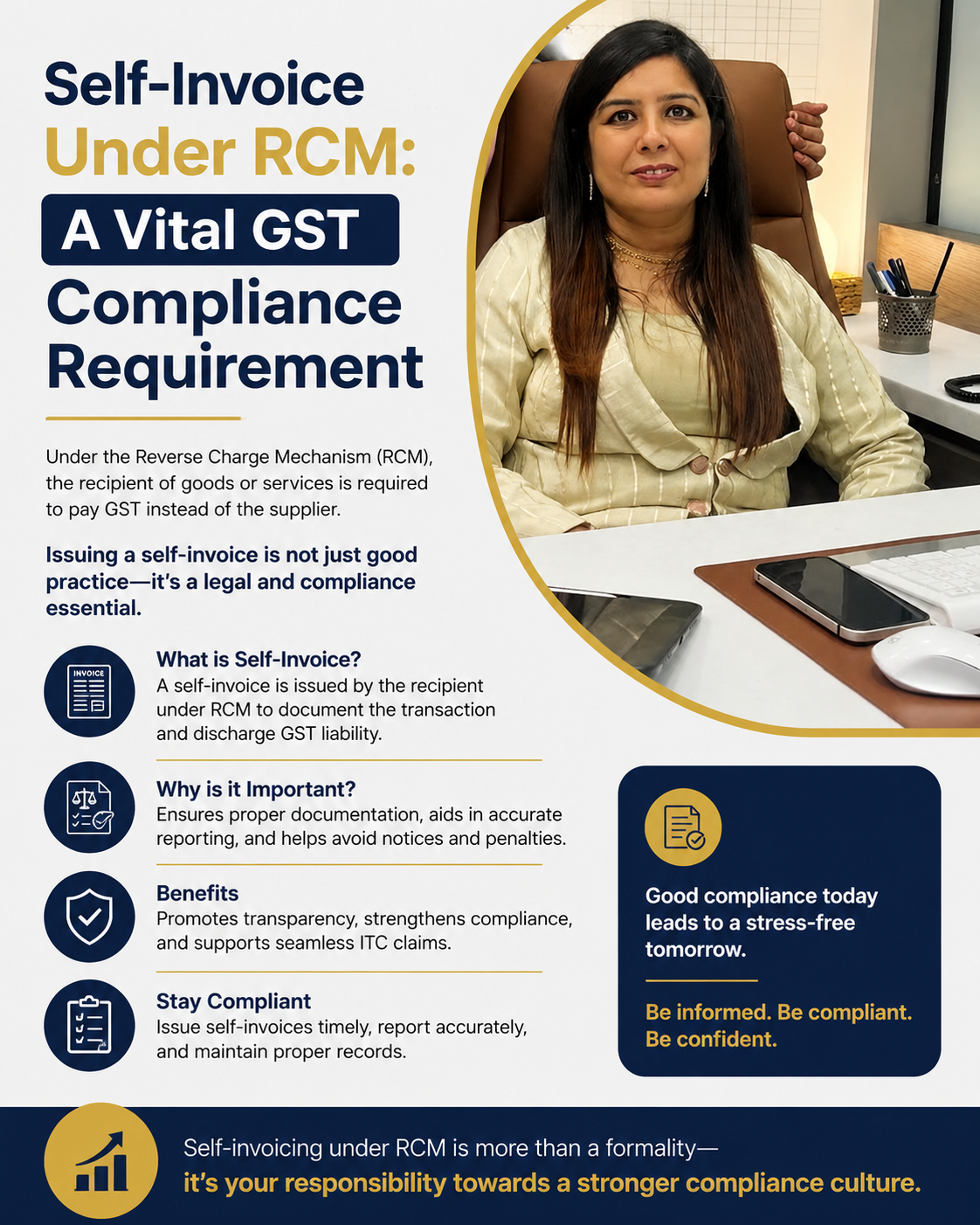
    Many businesses treat RCM as a payment obligation and stop there. In reality, a self-invoice for RCM is a separate, mandatory document and skipping it is one of the most common GST compliance gaps we see at ITRAdvisor.in.

    What Is a Self-Invoice for RCM?

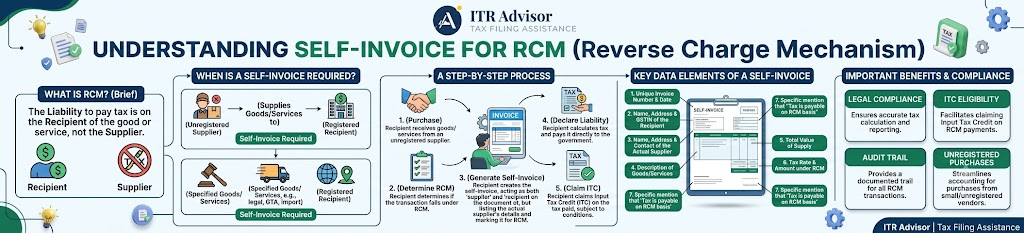
    Under Section 31(3)(f) of the CGST Act, when a registered person receives taxable goods or services from an unregistered supplier and is liable to pay GST under RCM, the recipient not the supplier must issue the invoice. This is the self-invoice for RCM. It exists because an unregistered supplier cannot legally issue a GST-compliant tax invoice, so the law shifts that responsibility to you.

    Why the Self-Invoice for RCM Actually Matters

    • It supports the GST you paid in cash under RCM.
    • Without it, you cannot claim ITC on that RCM payment under Rule 36(1)(b).
    • It strengthens your documentation trail during GST audits and scrutiny.
    • It closes a gap officers routinely check, since RCM leaves no supplier-side trail.

    The 30-Day Deadline Most Businesses Miss

    Since Rule 47A took effect on 1st November 2024, a self-invoice for RCM must be issued within 30 days of receiving the goods or services not at month-end, and not whenever convenient. Miss this window and you risk interest on delayed tax and penalty exposure under Section 122, on top of ITC disputes.

    The self-invoice must also be reported in Table 13 of GSTR-1, paired with a payment voucher under Section 31(3)(g) when payment is actually made to the unregistered supplier.

    Common Self-Invoicing Mistakes Under RCM

    • Paying RCM tax correctly but never generating the self-invoice.
    • Issuing it weeks late, well outside the 30-day window.
    • Not labelling it clearly as a self-billed invoice.

    Forgetting the accompanying payment voucher.

    Key Takeaways

    • A self-invoice for RCM is mandatory under Section 31(3)(f) whenever you buy from an unregistered supplier under reverse charge.
    • You must issue it within 30 days of receipt, under Rule 47A.
    • No self-invoice generally means no valid ITC claim on that RCM payment.

    Read our detailed guide on GST Compliance Checklist India 2026: 7 Essential Rules to Avoid Notices and Penalties

    Frequently Asked Questions on Self-Invoice for RCM

    1. Is a self-invoice for RCM always required?

    Yes, whenever you’re liable to pay GST under RCM on a supply from an unregistered supplier.

    2. What happens if I don’t issue a self-invoice for RCM?

    You may lose your ITC claim on that RCM payment and face questions during a GST audit.

    3. What is the deadline to issue a self-invoice under RCM?

    Within 30 days of receipt, as mandated by Rule 47A effective 1st November 2024.

    4. Is a payment voucher the same as a self-invoice?

    No. The self-invoice records the supply; the payment voucher separately records the payment.

    Conclusion: Don’t Let Paperwork Undo Correct Tax Payment

    Paying GST under RCM is only half the compliance story. Issuing a proper, timely self-invoice for RCM is what protects your ITC, your audit trail, and your peace of mind. As Dr. Haresh Adwani, founding expert at Adwani & Co LLP, often points out, GST compliance is not just about depositing tax it is about proving that tax was correctly deposited, with the right document, at the right time.

    Learn more about our GST Compliance Checklist 2026, or read our detailed guide on GST Input Tax Credit Rules 2026.

    For the official framework, refer to the GST Portal and the Central Board of Indirect Taxes and Customs for the latest notifications on invoicing and reverse charge.

    About the Author – Nidhi Adwani

    Nidhi Adwani is the Human Resources Manager at Adwani & Co. She is a Law Graduate and holds an MBA in Human Resources. She manages recruitment, employee engagement, team development, workplace culture, and the firm’s social media and content activities. Passionate about people and organizational growth, she also contributes articles for ITRAdvisor and Adwani & Co. Her writing focuses on HR practices, leadership, workplace engagement, and professional development, offering practical insights for professionals and businesses.

    At ITRAdvisor.in, we help taxpayers with:

    ✔️ ITR Filing Review

    ✔️ AIS Reconciliation

    ✔️ Capital Gains Reporting

    ✔️ NRI Taxation

    ✔️ Tax Notice Response

    ✔️ Revised Returns

    ✔️ Income Tax Planning

    ✔️ Refund and Compliance Issues

    Visit ITRAdvisor.in today for professional guidance and consultation.

    Early action can often prevent bigger tax problems later.

    Disclaimer ITRAdvisor.in is an educational and informational platform focused on tax awareness and compliance updates. Nothing contained herein should be construed as solicitation or advertisement of professional services. Professional services, where applicable, are rendered in accordance with ICAI guidelines. This article is published on ITRAdvisor.in, a tax and compliance knowledge platform. The content has been reviewed for technical accuracy by professionals associated with Adwani & Co LLP.
  • Same Water. Different GST. A Lesson in Classification.2026

    Same Water. Different GST. A Lesson in Classification.2026

    Same Water. Different GST

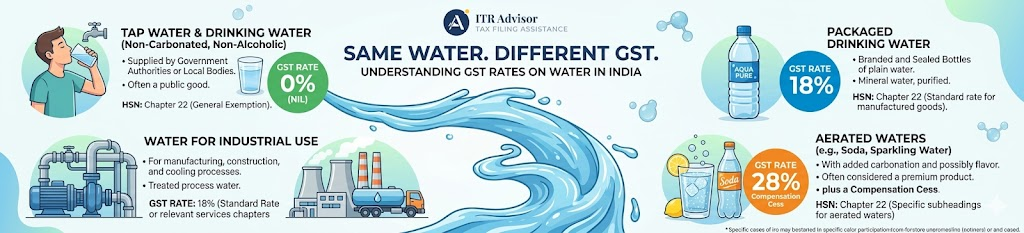
    Two bottles of water sit on the same shelf. Same factory. Same liquid inside. But one attracts 5% GST and the other attracts 28% plus cess. Why different GST ?If that surprises you, you are not alone.

    The GST classification of water is one of the most practically important and most misunderstood areas of GST compliance for businesses in India’s food, beverage, hospitality, and FMCG sectors. And yet, hundreds of businesses continue to apply a blanket rate based on the word ‘water’ on the label, without ever mapping the product to its correct HSN code.

    The result is predictable: short payment of GST, mismatched GSTR-3B filings, wrong input tax credit claims, and increasingly in 2026 a GST show cause notice from a department that now cross-verifies e-invoices, e-way bills, and return filings in near real time.

    GST Classification of Water: Why ‘Same Product’ Is Never Simple

    Under India’s GST framework, tax liability follows the product’s HSN (Harmonised System of Nomenclature) classification not the product’s name or its physical appearance. The GST Council has assigned water products across two distinct chapters of the tariff schedule, and the applicable rate depends entirely on what has been added, how the water has been processed, and how it is packaged and sold. This is why the GST compliance checklist for any business selling water products must begin with a classification check not a rate assumption


    GST Rate on Water Products: Complete HSN Classification Table 2026

    Water / Beverage CategoryHSN CodeGST RateDeciding Factor
    Tap water / municipal supply2201NILSupplied through distribution system
    Pipeline-supplied water2201NILNon-commercial, public utility
    Packaged drinking water (≤20 L)220112%Commercially packaged & sealed
    Packaged drinking water (>20 L)22015%Bulk jars, post-GST Council revision
    Natural mineral water (bottled)220112%Commercially bottled for sale
    Plain soda / aerated water220118%Carbonated, no added sugar or flavour
    Flavoured / sweetened water220228% + CessAny added sugar, flavour, or sweetener
    Carbonated soft drinks / cola220228% + CessSweetened aerated beverages
    Ice (commercial)220118%Manufactured ice sold commercially

    2026 Rate Alert Packaged drinking water in bottles up to 20 litres now attracts 12% GST revised upward from the earlier 5% rate. Bulk jars above 20 litres continue at 5%. Verify your current rate master against the GST Portal (gst.gov.in) before your next GSTR-3B filing.


    Wrong GST Classification: What It Actually Costs a Business

    Consider a distributor supplying three water products: 1-litre mineral water bottles, 500 ml flavoured water pouches, and bulk 20-litre packaged water jars. If mineral water is billed at 5% instead of 12%, and flavoured water at 12% instead of 28%, the monthly GST short-payment on a combined turnover of ₹15 lakh can easily exceed ₹1 lakh and over a financial year, that exposure compounds to a significant tax liability plus interest at 18% per annum under Section 50 of the CGST Act.

    Under the GST compliance framework, this is treated as a short payment and depending on whether the assessing officer determines it was the result of negligence or otherwise, penalties under Sections 122 to 125 of the CGST Act may also follow.

    As Dr. Haresh Adwani, PhD in Commerce and law graduate, notes from advisory practice: classification disputes are among the most litigated areas of GST today and most of them were avoidable with a single HSN verification before billing began.


    3 Reasons GST Classification Errors on Water Products Keep Happening

    • Billing teams classify by product name, not HSN code ‘water’ gets one rate across all variants
    • Rate masters set up at GST registration 2016 or 2017 were never updated after GST Council revisions
    • Carbonated and non-carbonated products are treated identically missing the Chapter 2201 vs 2202 distinction that determines whether the rate is 18% or 28% plus cess

    The GST e-invoicing mandatory threshold now covers a significant share of businesses, and every HSN code on an e-invoice is visible to the department’s analytics system. Businesses that have been getting away with wrong classification in a paper-based world will find that window closing in 2026.


    Quick GST Compliance Checklist: Water & Beverages

      1. Map every water product to HSN 2201 or 2202 never classify by product name alone

      2. Check whether carbonation + added sugar/flavour moves the product to Chapter 2202 (28% + cess)

      3. Confirm the current rate on gst.gov.in packaged water rates changed in recent Council meetings

      4. Reconcile your GSTR-2B input tax credit against correctly classified purchase invoices   5. Review your GST e-invoicing setup to ensure HSN codes auto-populate correctly from your ERP


    Key Takeaways

    • GST classification of water depends on HSN code, not the product label Chapter 2201 vs 2202 determines everything
    • Packaged drinking water (≤20L): 12% | bulk jars (>20L): 5% | plain soda: 18% | flavoured/sweetened: 28% + cess
    • Wrong classification = short payment, 18% p.a. interest, ITC mismatch, and possible GST show cause notice
    • The GST Portal now cross-checks e-invoice HSN data with GSTR-3B filings errors are increasingly auto-flagged
    • A one-time classification review of your entire product portfolio can protect years of GSTR-3B filing accuracy

    → Read our detailed guide on GST Show Cause Notice: Meaning, Types & How to Reply

    → Learn more: GST Compliance Checklist 2026 Monthly, Quarterly & Annual Returns

    Frequently Asked Questions on GST Classification of Water

    Q1. What is the GST rate on packaged drinking water in India 2026?

    Packaged drinking water in bottles or pouches up to 20 litres attracts 12% GST under HSN 2201; bulk jars above 20 litres are taxed at 5%. Always verify the current rate on gst.gov.in before filing.

    Q2. Why is flavoured water taxed at 28% GST while plain mineral water is taxed at 12%?

    Adding sugar, flavouring, or sweeteners moves the product from HSN Chapter 2201 to Chapter 2202, which attracts 28% GST plus compensation cess. The composition not the physical form determines the classification.

    Q3. Can wrong GST classification of a water product trigger a GST show cause notice?

    Yes. The department’s analytics system flags HSN-wise rate mismatches between GSTR-1 and GSTR-3B, and wrong classification leading to short payment can result in a Section 73 demand notice with interest and penalties.

    Q4. What is the HSN code for mineral water under GST?

    Natural mineral water whether sparkling or still falls under HSN 2201 and attracts 12% GST when commercially packaged and sold. Tap water and pipeline supply remain at NIL.

    Q5. How does GST e-invoicing affect classification compliance for water products?

    Every HSN code reported on a mandatory e-invoice is visible to the GSTN analytics system; wrong HSN codes auto-surface in GSTR-2B reconciliation and can trigger scrutiny before a return is even reviewed manually.

    Conclusion

    before asking ‘What is the GST rate?’, ask ‘How is my product classified?’ That sequence is not just a mindset shift — it is the practical foundation of correct GST compliance for every business that deals in water, beverages, food, or any other classified good.

    The GST classification of water tells us everything we need to know about how the entire GST framework works: the rate follows the classification, and the classification follows the HSN code not the product name, not the price, and not what a competitor is charging.

    For businesses with multi-product portfolios, a periodic classification review is no longer optional. It is basic tax hygiene in 2026.

    About the Author – Nidhi Adwani

    Nidhi Adwani is the Human Resources Manager at Adwani & Co. She is a Law Graduate and holds an MBA in Human Resources. She manages recruitment, employee engagement, team development, workplace culture, and the firm’s social media and content activities. Passionate about people and organizational growth, she also contributes articles for ITRAdvisor and Adwani & Co. Her writing focuses on HR practices, leadership, workplace engagement, and professional development, offering practical insights for professionals and businesses.

    Visit ITRAdvisor.in today for professional guidance and consultation.

    Early action can often prevent bigger tax problems later.