Income Tax Filing for Salaried Individuals
Every July, millions of salaried professionals across India suddenly remember the same thing the income tax return deadline is approaching. The result? Rushed filings, missed deductions, wrong form selection, and sometimes a penalty notice a few months later. If that sounds familiar, you are not alone.
Income tax filing for salaried individuals is not complicated but it does demand the right information, at the right time, applied the right way. For Assessment Year 2026-27 (covering Financial Year 2025-26), the stakes have risen further. The Income Tax Department of India has upgraded its data-matching engine, and any mismatch between what you file and what the system already knows about you through your Annual Information Statement (AIS) or Form 26AS can trigger a scrutiny notice.
This guide, developed with inputs from Dr. Haresh Adwani a Ph.D. in Commerce, law graduate, and seasoned tax professional associated with Adwani and Company gives you a complete, accurate, and actionable roadmap for ITR filing in AY 2026-27. Whether you are a first-time filer or an experienced salaried employee looking to optimise your tax outgo, you will find everything you need here.
What is Income Tax Filing for Salaried Individuals?
Income tax filing for salaried individuals is the annual process of declaring your total earnings for a financial year to the Income Tax Department of India, computing the tax liability, and either paying the balance or claiming a refund for excess tax deducted at source (TDS).
For AY 2026-27, the applicable financial year is FY 2025-26 from 1 April 2025 to 31 March 2026. As per the Income Tax Department (incometax.gov.in), every individual whose gross income exceeds the basic exemption limit, or from whose income TDS has been deducted, must file an Income Tax Return (ITR).
Which is correct form for Income Tax Filing for Salaried Individuals
For most salaried employees, the correct form is ITR-1 (SAHAJ), applicable when:
- Total income does not exceed ₹50 lakh
- Income is from salary, one house property, or other sources (like interest)
- There is no capital gains income
- No income from business or profession
Tax Filing for Salaried Individuals in AY 2026-27 is also important beyond legal compliance it builds your financial credibility, supports loan applications, facilitates visa processing, and is essential for claiming any TDS refund.
Learn more about our ITR Filing Services for Salaried Professionals
Income Tax Slabs AY 2026-27: New Regime vs Old Regime for Salaried Individuals
One of the most debated questions in income tax filing for salaried individuals is: which tax regime should I choose? The government made the New Tax Regime the default from FY 2024-25, but salaried employees still retain the freedom to opt for the Old Regime while filing their ITR.
New Tax Regime AY 2026-27 Slabs
| Income Slab | Tax Rate |
| Up to ₹3,00,000 | Nil (0%) |
| ₹3,00,001 – ₹7,00,000 | 5% |
| ₹7,00,001 – ₹10,00,000 | 10% |
| ₹10,00,001 – ₹12,00,000 | 15% |
| ₹12,00,001 – ₹15,00,000 | 20% |
| Above ₹15,00,000 | 30% |
Key benefits under New Regime:
Rebate under Section 87A means zero tax if income is up to ₹7 lakh. Standard deduction of ₹75,000 is available for salaried employees.
Old Tax Regime : Key Slabs
- Up to ₹2,50,000 : Nil
- ₹2,50,001 to ₹5,00,000 : 5%
- ₹5,00,001 to ₹10,00,000 : 20%
- Above ₹10,00,000 : 30%
- Allows major deductions: Section 80C, 80D, HRA, LTA, home loan interest, NPS, and more
Expert Insight:
Dr. Haresh Adwani consistently advises that the optimal regime depends on your total eligible deductions. If your combined deductions under the Old Regime exceed approximately ₹3.75 lakh, it is likely more tax-efficient than the New Regime. A personalised comparison not a generic one is always the smarter starting point.
Documents Required for Income Tax Filing for Salaried Individuals: AY 2026-27 Checklist
Preparation is the single most underrated step in income tax filing for salaried individuals. The Income Tax Department strongly advises taxpayers to gather all financial records before logging into the e-filing portal. Here is what you need:
Primary Documents
- Form 16: Issued by your employer contains salary breakup, allowances, and TDS details
- Form 26AS: Tax credit statement showing all TDS, advance tax, and refunds download from incometax.gov.in
- Annual Information Statement (AIS): Captures a far wider data set including stock transactions, mutual fund investments, and foreign remittances
Supporting Documents
- Bank statements for all accounts (savings and FD interest)
- Investment proof : PPF, ELSS mutual funds, LIC premiums, NPS statements
- Home loan interest certificate (for Section 24(b) deduction)
- Rent receipts and landlord PAN (for HRA exemption)
- Medical insurance premium receipts (for Section 80D)
- PAN card and Aadhaar (mandatory for filing and e-verification)
Government Source Note: As per recent Ministry of Finance advisories and updates on the Income Tax portal, the Annual Information Statement (AIS) now cross-references data from banks, depositories, mutual funds, and the GST Portal. Verifying your AIS before filing is no longer optional it is essential.
How to do Income Tax Filing for Salaried Individuals Online for Salaried Employees
Step-by-Step (AY 2026-27)
The Income Tax Department’s e-filing portal (incometax.gov.in) offers a guided ITR filing experience. Here is a clear, step-by-step process for income tax return filing for salaried employees in AY 2026-27:
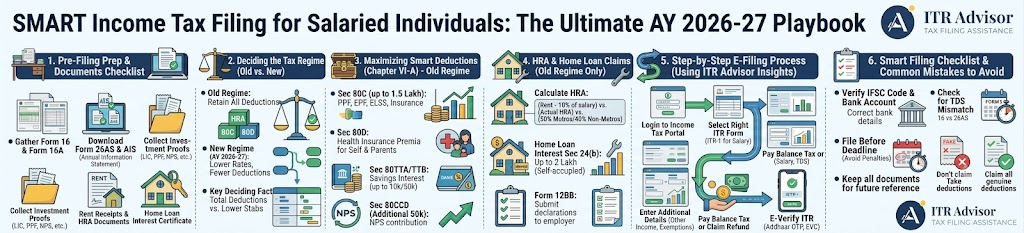
1: Log In to the e-Filing Portal
Visit incometax.gov.in and sign in with your PAN credentials. First-time users must complete a one-time registration. Ensure your mobile number linked to Aadhaar is active for OTP-based e-verification later.
2: Select the Correct ITR Form
For most salaried individuals with income below ₹50 lakh and no capital gains, ITR-1 (SAHAJ) is the applicable form. If you have capital gains, more than one house property, or any foreign income, you must use ITR-2. Using the wrong form is one of the most common and consequential errors.
3: Verify Pre-Filled Data Carefully
The portal now pre-fills salary, TDS, and certain income data from your employer’s records and the AIS. Do not skip this verification. Cross-check every figure against your Form 16 and Form 26AS. Any discrepancy must be resolved before you submit the return.
4: Choose Your Tax Regime
Select Old or New Tax Regime. The portal’s built-in calculator will display your estimated tax under both options review the numbers before making your final choice. Once filed under a chosen regime for a year, switching has limitations in subsequent years.
5: Enter All Income and Deductions
Declare all sources of income salary, bank interest, rental income, freelance earnings, dividends, and any other receipts. Under the Old Regime, fill in all applicable deduction sections (80C, 80D, HRA, home loan interest, NPS contributions under 80CCD(1B), etc.).
6: Pay Tax Due and E-Verify
If any tax balance remains after TDS, pay it via Challan 280 before submitting the return. After submission, e-verify within 30 days using Aadhaar OTP, net banking, or a Digital Signature Certificate (DSC). An unverified return is treated as invalid a mistake that can cost you dearly.
Internal Link: Learn more about our Assisted ITR Filing Service
Practical Example:
Income Tax Calculation for a Salaried Employee AY 2026-27
Let us look at a real-world illustration that Dr. Haresh Adwani frequently uses in tax advisory sessions to explain how regime selection impacts actual tax outgo.
Case Study: Rohit Sharma, IT Professional, Pune | Annual CTC: ₹12,00,000
| Head | Old Regime (₹) | New Regime (₹) |
| Gross Salary | 12,00,000 | 12,00,000 |
| Standard Deduction | 50,000 | 75,000 |
| Section 80C (PPF + ELSS) | 1,50,000 | Not Applicable |
| Section 80D (Health Insurance) | 25,000 | Not Applicable |
| HRA Exemption | 90,000 | Not Applicable |
| Taxable Income | 8,85,000 | 11,25,000 |
| Total Tax Payable (incl. cess) | ~₹91,260 | ~₹98,800 |
Result: In Rohit’s case, the Old Tax Regime saves approximately ₹7,540 more in annual tax. This is because his combined deductions total ₹2,65,000 comfortably above the break-even threshold. This is exactly the personalised analysis that Dr. Haresh Adwani recommends before every ITR filing season.
Top Deductions Available to Salaried Individuals in AY 2026-27
Strategic deduction planning is the cornerstone of smart income tax filing for salaried individuals under the Old Regime. Here are the most impactful deductions:
Section 80C : Up to ₹1.5 Lakh
The most widely used deduction covers EPF contributions, PPF, ELSS mutual funds, LIC premiums, National Savings Certificate (NSC), ULIP, children’s tuition fees, and home loan principal repayment.
Section 80D : Health Insurance Premium
Up to ₹25,000 for self, spouse, and children. An additional ₹25,000 (or ₹50,000 for senior citizens) for parents’ health insurance. This deduction is available even under Group Mediclaim policies where the employee contributes.
HRA Exemption : Section 10(13A)
Available to salaried individuals paying rent. The exempt amount is the lowest of: actual HRA received, 50% of basic salary (metro cities) or 40% (non-metro), or rent paid minus 10% of basic salary. Ensure you have rent receipts and the landlord’s PAN if annual rent exceeds ₹1 lakh.
Section 80CCD(1B) : Additional NPS Deduction
An additional ₹50,000 deduction for NPS contributions, over and above the ₹1.5 lakh Section 80C limit. This makes NPS a powerful tax-saving vehicle for those who want to build a retirement corpus while reducing their income tax liability.
Section 24(b) : Home Loan Interest
Up to ₹2 lakh deduction on interest paid on a home loan for a self-occupied property. If the property is let out, the entire interest is deductible (subject to set-off and carry-forward limits).
Section 80TTA : Savings Account Interest
Up to ₹10,000 for non-senior citizens on savings bank account interest. Senior citizens may claim up to ₹50,000 under Section 80TTB, covering both savings and fixed deposit interest.
Government Source:
As per advisories from the Ministry of Corporate Affairs (MCA) and the GST Portal, professionals earning freelance income alongside a salary must also report it under ‘Income from Business/Profession’ and may require GST registration if turnover exceeds ₹20 lakh. (gst.gov.in)
How to Claim Your TDS Refund Through Income Tax Filing
A question that dominates search queries every filing season: how do I get my TDS refund? If your employer or bank deducted more tax than your actual liability, the Income Tax Department processes a refund after you file your return. Here is how to ensure it reaches you:
- Verify all TDS entries in Form 26AS and cross-reference with your AIS for completeness
- Ensure your bank account is pre-validated on the e-filing portal and marked as ‘Refund-enabled’
- File your ITR accurately mismatches between your filing and AIS data are the single biggest cause of refund delays
- E-verify your return within 30 days of filing; an unverified ITR is not considered a valid return
- Track refund status at incometax.gov.in under the ‘Refund/Demand Status’ section or through the NSDL TIN portal
Based on recent filing seasons, refunds are typically credited within 20 to 45 days of successful e-verification when returns are filed without discrepancies. Adwani and Company’s clients have consistently benefited from early, accurate filing that avoids the last-minute portal rush.
Read our detailed guide on :How to Track Your Income Tax Refund Status Online
Critical Mistakes That Can Derail Your Income Tax Filing for AY 2026-27
Over years of tax practice, Dr. Haresh Adwani has identified a recurring set of mistakes that cost salaried individuals thousands in penalties, delayed refunds, and unwanted scrutiny:
1. Choosing the Wrong ITR Form
Using ITR-1 when you have capital gains income, more than one house property, or foreign assets is a direct invitation to a defective return notice. Always verify your eligibility before selecting the form.
2. Ignoring the Annual Information Statement (AIS)
The AIS captures data from banks, depositories, mutual funds, and even foreign remittances. If your ITR does not match what the AIS already shows, the department’s system flags it automatically. Review your AIS on the portal before filing.
3. Not Reporting All Sources of Income
Freelance income, rental receipts, savings account interest, dividend income, and capital gains all must be reported. Under-reporting is a legal offence that can result in assessment proceedings.
4. Forgetting to E-Verify the Return
Filing your return and forgetting to e-verify it is the same as not filing at all. E-verify within 30 days using Aadhaar OTP, net banking, or a Digital Signature Certificate.
5. Missing the Deadline
The income tax filing deadline for salaried individuals for AY 2026-27 is typically 31 July 2026 (subject to official confirmation by the Income Tax Department). A late return under Section 234F attracts a penalty of ₹5,000, or ₹1,000 if income is below ₹5 lakh. Additionally, interest under Sections 234A and 234B applies on outstanding tax.
6. Wrong Bank Account Details
Even a single digit error in your bank account number can delay or misdirect your TDS refund. Verify account details on the portal before submitting your return.
Why Salaried Professionals Trust Adwani and Company for ITR Filing
Navigating income tax filing for salaried individuals correctly demands more than just filling in numbers on a form. It requires understanding which deductions are genuinely applicable, which regime saves more, and how your filing interacts with the department’s increasingly sophisticated data-matching systems.
Dr. Haresh Adwani a Ph.D. holder in Commerce and a law graduate with hands-on expertise in tax litigation, compliance, and financial advisory leads a team at Adwani and Company that has helped hundreds of salaried professionals across India file accurately, claim maximum legitimate deductions, and navigate the occasional scrutiny notice with confidence.
ITR Advisors provides guidance in Income Tax Filing for Salaried Individuals:
- Personalised Old vs New Regime analysis before every filing
- End-to-end assisted ITR filing for salaried employees
- AIS and Form 26AS reconciliation and discrepancy resolution
- Guidance on deduction optimisation under Sections 80C, 80D, HRA, NPS, and home loans
- Expert handling of TDS refunds and income tax notices
- Year-round tax planning consultations for salaried individuals
The firm is accessible online and in-person, making expert guidance available regardless of where in India you are based.
External Authority: For official tax slab notifications and ITR form specifications, visit the Income Tax Department of India at incometax.gov.in and the Ministry of Finance portal at finmin.nic.in.
Frequently Asked Questions
1. Which ITR form should salaried employees use for AY 2026-27?
Most salaried individuals with total income up to ₹50 lakh from salary, one house property, and other sources (excluding capital gains) should use ITR-1 (SAHAJ). If you have capital gains, more than one property, or any directorship or foreign asset, you must use ITR-2.
2. Is income tax filing mandatory for all salaried employees?
Yes, if your gross income exceeds the basic exemption limit — ₹2,50,000 under the Old Regime and ₹3,00,000 under the New Regime — you are required to file an ITR. Even if TDS has fully covered your liability, filing establishes financial credibility and enables refund claims.
3. What is the deadline for income tax filing for salaried individuals for AY 2026-27?
The standard deadline is 31 July 2026, subject to any extension announced by the Income Tax Department. Filing before the deadline avoids the penalty under Section 234F and ensures faster processing of any TDS refunds. Always check incometax.gov.in for official deadline updates.
4. Can I file my income tax return without Form 16?
Yes. While Form 16 is the primary salary document, you can file using salary slips, Form 26AS, and your Annual Information Statement (AIS) if your employer has not issued Form 16. Ensure that all TDS entries reflected in Form 26AS are accurately reported in your return.
5. How long does the TDS refund take after income tax filing?
Refunds are typically processed within 20 to 45 days of successful e-verification, provided the return is filed accurately with no mismatches against AIS or Form 26AS data. You can track your refund status on incometax.gov.in under the ‘Refund/Demand Status’ section.
Conclusion:
Income tax filing for salaried individuals in AY 2026-27 is simultaneously simpler and more consequential than ever before. The e-filing portal has become more intuitive, but the Income Tax Department’s data analytics capability has also grown sharper. A return that is merely filed on time but filed inaccurately with wrong regime choice, missed income, or unverified form selection can result in notices, penalties, and interest that far outweigh any convenience gained.
The smart approach is to treat your ITR not as an annual compliance checkbox, but as a year-round financial planning exercise. Understand your deductions, reconcile your AIS before filing, compare your tax under both regimes, and file well before the 31 July 2026 deadline to avoid last-minute portal congestion.
And when in doubt, remember that a qualified expert adds more value than any online calculator. Dr. Haresh Adwani and the team at Adwani and Company have guided hundreds of salaried professionals through precisely this process from first-time filers navigating ITR-1 to senior executives managing multi-source income and complex deduction structures.
Ready for Income Tax Filing for Salaried Individuals return for AY 2026-27 with complete confidence?
Connect with ITR Advisor today. Let the team ensure your ITR is accurate, optimised, and filed on time so you never leave money on the table or invite a notice you did not see coming.
Visit: itradvisor.in | adwaniandco.com
About the Author – Nidhi Adwani
Nidhi Adwani is the Human Resources Manager at Adwani & Co. She is a Law Graduate and holds an MBA in Human Resources. She manages recruitment, employee engagement, team development, workplace culture, and the firm’s social media and content activities. Passionate about people and organizational growth, she also contributes articles for ITRAdvisor and Adwani & Co. Her writing focuses on HR practices, leadership, workplace engagement, and professional development, offering practical insights for professionals and businesses.
Visit ITRAdvisor.in today for professional guidance and consultation.
Early action can often prevent bigger tax problems later
Disclaimer: ITRAdvisor.in is an educational and informational platform focused on tax awareness and compliance updates. Nothing contained herein should be construed as solicitation or advertisement of professional services. Professional services, where applicable, are rendered in accordance with ICAI guidelines. This article is published on ITRAdvisor.in, a tax and compliance knowledge platform. The content has been reviewed for technical accuracy by professionals associated with Adwani & Co LLP.