
FPI and India Bonds
₹16,000 crore. One month. From foreign investors. That’s the scale of FPI investment flowing into Indian government bonds in June 2026 and it’s not noise. It’s a signal worth decoding.
If you’ve been tracking stock markets while ignoring the bond market, you may be missing the bigger story. FPI investment in India government bonds has surged to approximately US$1.84 billion in June 2026 alone making this one of the strongest monthly debt market inflows India has seen in over a year.
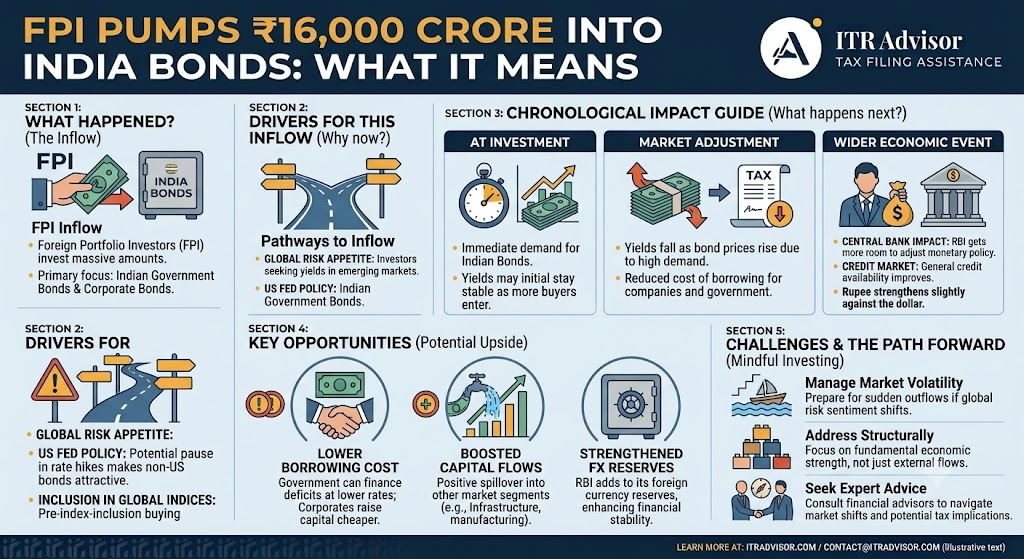
April and May together saw relatively modest foreign participation. June changed the conversation. The question every informed investor and taxpayer should be asking: why now, and what does it mean for you?
FPI Investment in India Government Bonds: What the Data Says
The India bond market inflows for June 2026 tell a compelling story. Foreign portfolio investors including global pension funds, sovereign wealth funds, and asset managers have collectively committed US$1.84 billion to Indian government securities (G-Secs) in the first half of June alone.
This isn’t reactive trading. Institutional investors of this scale make decisions months in advance, based on macroeconomic fundamentals, policy signals, and long-term return expectations.
June 2026 FPI Bond Inflow Snapshot
Total inflow: ~₹16,000 crore (US$1.84 billion)
Period: First half of June 2026
Context: One of the highest monthly inflows in 12+ months Comparison: Exceeds combined April + May 2026 inflows
Why FPI Investment in India Government Bonds Is Rising
Three structural forces are working together to drive this surge and understanding them helps you read the broader economic picture.
1. India’s Entry Into the JPMorgan EM Bond Index
India’s phased inclusion in JPMorgan’s Emerging Market Government Bond Index has been the single biggest catalyst for sustained FPI investment in Indian G-Secs. Index-tracking funds globally are now obligated to hold a proportion of Indian government bonds. This creates structural, non-discretionary demand not sentiment-driven flows that reverse with headlines.
2. RBI’s Fully Accessible Route (FAR)
The Reserve Bank of India introduced the Fully Accessible Route (FAR), allowing foreign investors to purchase specified Indian government securities without any investment ceiling. According to the RBI’s official FAR framework, this route significantly simplifies foreign access to India’s sovereign debt market removing the friction that previously deterred large institutional allocations.
3. India’s Macroeconomic Stability in a Volatile World
In 2026, global markets are navigating uncertainty elevated debt levels in developed economies, sticky inflation in parts of Europe, and geopolitical tensions. Against this backdrop, India’s macroeconomic stability is a genuine differentiator. Controlled inflation, robust forex reserves, and consistent GDP growth projections make India bond market inflows a rational, not just sentimental, choice for global capital.
As noted in frameworks aligned with India’s Ministry of Finance economic assessments, sustained foreign participation in the debt market supports efficient government borrowing, strengthens rupee stability, and improves India’s standing in global capital markets.
FPI Investment in India Bonds: What It Means for Indian Taxpayers
This isn’t just a market story. FPI bond inflows have direct downstream effects on Indian taxpayers and investors effects that rarely make the financial headlines but matter enormously for planning.
- Lower bond yields over time → lower interest rates across the economy → cheaper home loans and business credit
- Rupee support from FPI inflows → lower imported inflation → moderate impact on your cost of living
- Positive sentiment spill-over → often precedes equity market confidence → relevant for your LTCG & STCG on mutual funds and shares
- Improved government fiscal position → greater scope for tax relief or infrastructure spending in future budgets
For investors holding government bonds or bond mutual funds: the tax treatment remains unchanged. Interest income from G-Secs is taxable at your applicable slab rate. Capital gains on selling before maturity attract STCG (at slab rate) or LTCG (12.5% without indexation), depending on whether the holding period exceeds 24 months.
Read our guide on: Capital Gain Tax on Mutual Funds : Complete Guide for AY 2026-27
The Real Opportunity: Understanding Capital Flows, Not Just Markets
As Dr. Haresh Adwani PhD in Commerce and law graduate puts it: major financial decisions are shaped by economic fundamentals and long-term policy expectations, not daily market noise. The ₹16,000 crore in FPI investment in India government bonds is not a reaction to a single headline. It is the result of months of macroeconomic analysis by some of the world’s most sophisticated institutional investors.
For Indian taxpayers, business owners, and individual investors, the real opportunity lies in understanding the ‘why’ behind capital flows and calibrating your financial decisions accordingly. Is your fixed-income allocation positioned for a potentially declining yield environment? Is your advance tax planning aligned with the broader economic cycle? These are the questions that compound over time. For NRI investors navigating India’s debt market, there are additional FEMA compliance considerations.
Key Takeaways
Foreign investors invested ~₹16,000 crore (US$1.84B) in India government bonds in June 2026 alone among the highest monthly inflows in over a year.
India’s inclusion in JPMorgan’s EM Bond Index is creating structural, recurring demand for Indian G-Secs from global index funds.
The RBI’s Fully Accessible Route (FAR) removes investment ceilings for FPIs on specified government securities.
For Indian taxpayers, rising FPI bond inflows can signal lower future interest rates affecting home loans, business credit, and fixed-income returns. Understanding capital flows is as strategically important as tracking daily stock market indices.
Frequently Asked Questions
Q1: What is FPI investment in India government bonds?
FPI (Foreign Portfolio Investment) in India government bonds refers to overseas institutional investors pension funds, sovereign wealth funds, asset managers buying Indian government securities (G-Secs). These flows affect bond yields, borrowing costs, and the Indian rupee.
Q2: Why are foreign investors buying Indian government bonds in 2026?
Key drivers include India’s inclusion in JPMorgan’s EM Bond Index, the RBI’s Fully Accessible Route (FAR) removing investment caps, attractive yield premium over US Treasuries, and India’s macroeconomic stability with controlled inflation and strong forex reserves.
Q3: How does FPI bond investment affect Indian taxpayers?
Large FPI inflows into bonds can gradually lower yields reducing borrowing costs on home loans and business credit. Stable bond markets also support a stronger rupee, which affects import costs and inflation factors that indirectly influence your tax planning.
Q4: Is interest or gain from Indian government bonds taxable?
Yes. Interest income from G-Secs is taxable as income from other sources per your income tax slab. Capital gains on selling government bonds before maturity attract STCG (at slab rate) or LTCG (12.5% post-Budget 2024) depending on the holding period
Q5: Where can I track FPI investment flows in India bonds?
SEBI’s official FPI data dashboard and NSDL’s FPI tracker publish weekly and monthly debt/equity inflow data. The Reserve Bank of India’s monthly bulletin also reports capital flow trends in India’s debt market.
Conclusion: FPI Bond Inflows Are a Macro Signal : Know What to Do
The ₹16,000 crore FPI investment in India government bonds in June 2026 is more than a market statistic. It reflects a structural shift in global investor confidence toward India’s debt market — driven by index inclusion, improved market access, and macroeconomic credibility.
For Indian taxpayers and investors, it’s a reminder that the bond market is not a sideshow. Understanding capital flows is as strategically important as tracking your portfolio. And when FPI sentiment improves, it often creates downstream benefits — in interest rates, rupee stability, and fiscal space — that eventually reach your EMI, your returns, and your tax planning.
Stay informed. Stay ahead.
About the Author : Prafull Nile
Prafull Nile is a senior taxation and accounting professional associated with Adwani & Co LLP, bringing over 19 years of extensive experience in direct taxation, tax audits, income tax assessments, GST audits, and financial statement finalization. He has successfully managed diverse client engagements across industries, providing strategic guidance on tax compliance, assessments, and regulatory matters. In addition to his technical expertise, Prafull leads and mentors teams, ensuring high standards of service delivery and operational excellence. His practical approach, deep understanding of tax laws, and commitment to client success make him a trusted advisor for businesses and professionals navigating complex financial and compliance requirements.
At ITRAdvisor.in, we help taxpayers with:
✔️ ITR Filing Review
✔️ AIS Reconciliation
✔️ Capital Gains Reporting
✔️ NRI Taxation
✔️ Tax Notice Response
✔️ Revised Returns
✔️ Income Tax Planning
✔️ Refund and Compliance Issues
If you are unsure whether your return has been filed correctly or want a professional review before submission, consulting an experienced tax professional can help avoid costly mistakes.
Visit ITRAdvisor.in for expert assistance with your Income Tax Return and tax compliance requirements.
Disclaimer: ITRAdvisor.in is an educational and informational platform focused on tax awareness and compliance updates. Nothing contained herein should be construed as solicitation or advertisement of professional services. Professional services, where applicable, are rendered in accordance with ICAI guidelines. This article is published on ITRAdvisor.in, a tax and compliance knowledge platform. The content has been reviewed for technical accuracy by professionals associated with Adwani & Co LLP
A prominent “File Your ITR Now” button near the top and again at the end of the article
Need help filing your Income Tax Return? Click the WhatsApp icon and our team will guide you through the process and assist you with your ITR filing.
Have questions about your ITR? Click the WhatsApp icon to connect with our tax experts for quick guidance and personalized assistance.