22 June 2026•Mukesh Chavhan
AIS vs Form 26AS Mismatch and Tax Notices
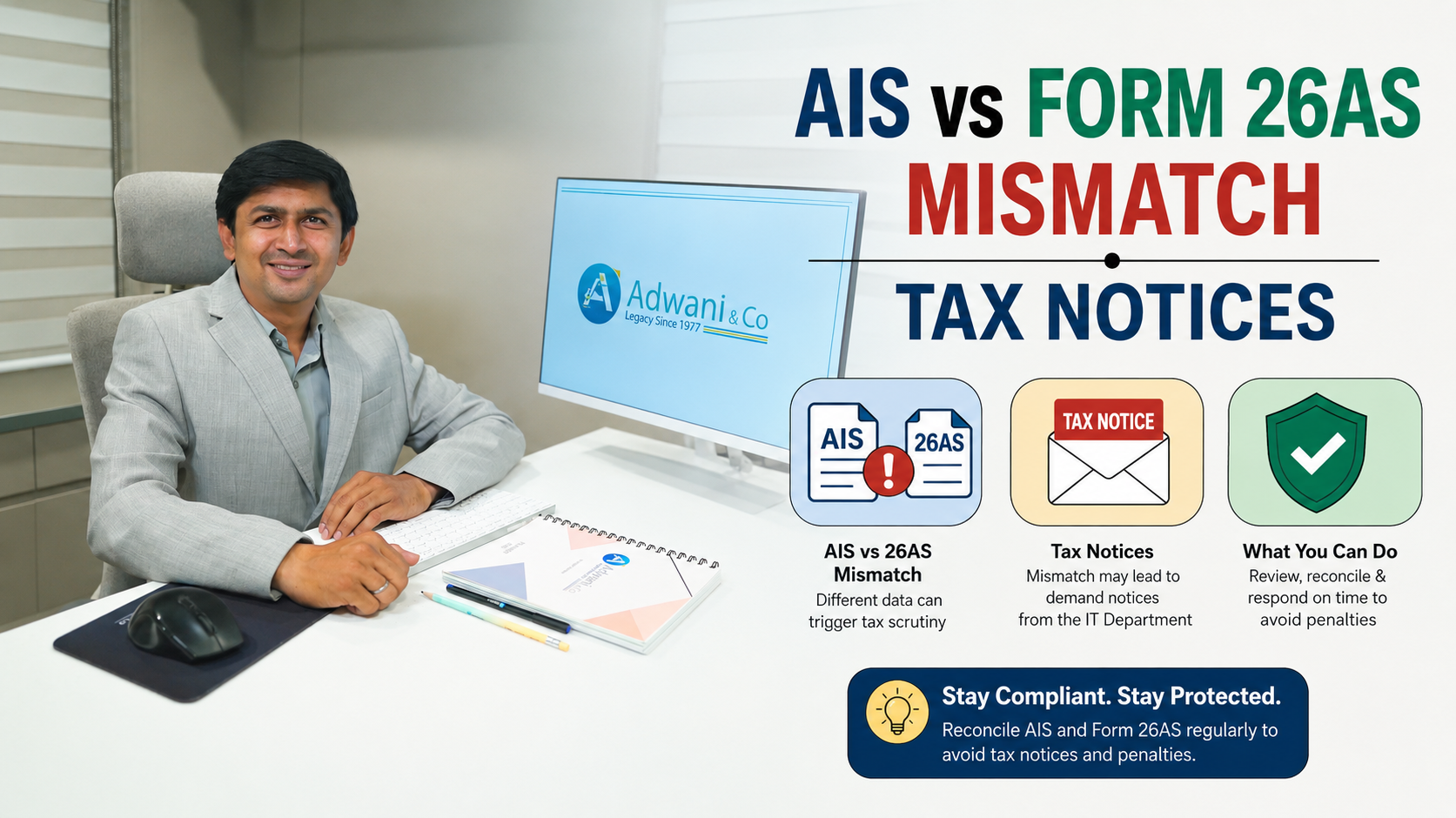
A ₹500 omission can create more trouble than a ₹5 lakh deduction claim. Many taxpayers still believe that if they don’t mention a transaction in their Income Tax Return (ITR), it will simply go unnoticed. That mindset belongs to the past.
Today, the Income Tax Department uses advanced data analytics to cross-check your ITR against information sourced from banks, employers, brokers, registrars, and financial institutions. If the numbers don’t match between your AIS, Form 26AS, and what you file the system flags it automatically. The result? An income tax notice you didn’t expect.
What Is AIS vs Form 26AS and Why the AIS vs Form 26AS Mismatch Matters
To understand the risk of an AIS vs Form 26AS mismatch, you first need to know what these two documents actually are.
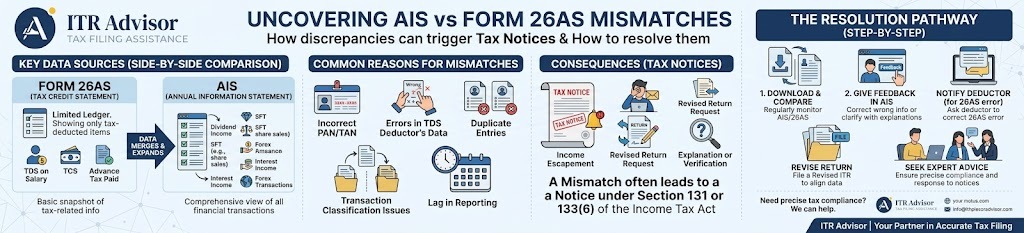
Form 26AS is your consolidated tax credit statement it shows TDS deducted by employers, banks, and others, along with TCS and advance tax payments made against your PAN.
The Annual Information Statement (AIS) is a significantly more comprehensive document introduced by the Income Tax Department. It aggregates data from multiple reporting sources and shows:
- Salary and TDS reported by your employer
- Interest income from savings accounts and Fixed Deposits
- Dividend income credited to your account
- Purchase and sale of shares and mutual funds (reported by stock exchanges)
- Property purchase or sale transactions (reported by registrars)
- High-value financial transactions above prescribed thresholds
- Tax Collected at Source (TCS) on foreign remittances, car purchases, and more
- Rent received, professional receipts, and other reportable incomes
The Taxpayer Information Summary (TIS) sits alongside the AIS and provides category-wise aggregated figures. Together, these three form the Income Tax Department’s full picture of your financial life even before you file your ITR.
How an AIS vs Form 26AS Mismatch Triggers an Income Tax Notice
When you submit your ITR, the department’s system compares your declared income with the data already available in your AIS and Form 26AS. If there is a significant discrepancy even on a single line item it can trigger one or more of the following:
- A request for clarification or additional information
- Delay in processing your income tax refund
- A notice under Section 143(1) for prima facie adjustments
- In serious cases, scrutiny assessment under Section 143(2)
- Re-opening of assessments under Section 147/148 for unreported income
The objective isn’t to create fear. As the Income Tax Department has consistently communicated through its compliance campaigns at incometax.gov.in, the aim is to promote accurate, voluntary tax compliance — and to reduce the need for enforcement action.
Key Takeaways
- Your AIS reflects far more data than your Form 26AS always check both before filing.
- Even small mismatches in interest income, dividend, or capital gains can attract automated notices.
- The Income Tax Department’s systems compare your ITR with AIS data in real time after you submit.
- Reconcile discrepancies proactively if AIS shows incorrect data, submit feedback directly on the AIS portal.
An unreported capital gain or dividend however small is not invisible to the department.
How to Reconcile AIS vs Form 26AS Mismatch Before Filing Your ITR
Step 1 : Download Both Documents
Log in to the Income Tax e-filing portal at incometax.gov.in. Under ‘Services’, access your AIS and also download Form 26AS from the TRACES portal. Compare them side by side.
Step 2 : Identify Every Income Source
Cross-check salary, interest from FDs and savings accounts, dividend credits, capital gains from mutual funds and shares (including LTCG and STCG), and any TCS entries particularly on foreign remittances.
Step 3 : Submit AIS Feedback If Data Is Incorrect
The AIS portal allows you to flag incorrect information using the feedback option. If a transaction shown in your AIS does not belong to you or the amount is incorrect submit feedback online. The department takes this into account during processing.
Step 4 : Declare All Income in Your ITR
Even if you believe a transaction amount is minor, declare it. The cost of non-disclosure interest, penalties, and notices far exceeds the tax you would have paid. Most issues arise not from intentional evasion, but from the erroneous assumption that small omissions don’t matter.
Example:
Why Even Small AIS vs Form 26AS Mismatches Are Flagged
Ramesh, a salaried professional in Pune, received ₹14,800 as dividend from a mutual fund in FY 2025-26. He did not recall receiving it and left it out of his ITR. However, the Asset Management Company had already reported this to the Income Tax Department via SFT (Statement of Financial Transactions). The AIS showed the income; his ITR didn’t. The result was a Section 143(1) adjustment notice asking him to pay tax plus interest on the unreported dividend.
AIS vs Form 26AS Mismatch Checklist: Before You Click Submit
Before you finalise and submit your ITR for AY 2026-27, ask yourself:
- Have I reviewed and compared my AIS and Form 26AS thoroughly?
- Have I reported all taxable income including interest, dividends, and capital gains?
- Have I accounted for any TCS entries (foreign travel, car purchase, overseas education)?
- Have I disclosed high-value transactions such as property sale or purchase of mutual funds?
- Is my income from freelancing or professional work aligned with what clients may have reported?
According to the CBDT’s compliance framework (cbdt.gov.in), taxpayers are expected to reconcile their ITR with information available in Form 26AS and AIS before filing. A proactive approach saves weeks of correspondence later.
As Dr. Haresh Adwani, PhD in Commerce and law graduate associated with Adwani & Co LLP, has noted in advisory practice: most AIS-related notices could have been avoided entirely if taxpayers had reviewed their AIS portal data once before filing. The information was always there the gap was awareness.
Read our detaited guide on : Received a notice? Read our Income Tax Notice Reply Guide
GST Show Cause Notice 2026: A Complete Legal Guide to Understanding and Responding
Frequently Asked Questions
Q1. What is the difference between AIS and Form 26AS in 2026?
Form 26AS primarily shows TDS, TCS, and advance tax payments. The AIS is a broader document that also includes interest income, dividends, capital gains, property transactions, and other high-value financial transactions reported to the Income Tax Department.
Q2. Can an AIS vs Form 26AS mismatch cause an income tax notice?
Yes. If income reported in your ITR does not match what is shown in your AIS, the department’s automated system can issue a notice under Section 143(1) or send a compliance query requesting explanation for the discrepancy.
Q3. What should I do if the AIS shows incorrect information?
You can submit feedback directly on the AIS portal at incometax.gov.in, marking the transaction as incorrect, duplicate, or not belonging to you. The department reviews such feedback during the ITR processing stage
Q4. Will I get an income tax notice for a small unreported dividend or interest income?
The system is automated and threshold-agnostic in many cases. Even a small unreported dividend or savings account interest can create a mismatch flag. The safest course is to declare all income, irrespective of amount.
Q5. Is reconciling AIS and Form 26AS mandatory before filing an ITR?
While not separately mandated as a distinct legal step, the CBDT consistently advises taxpayers to review both documents before filing. Practically, it is essential to avoid mismatches that lead to notice, refund delays, or additional tax demand.
Conclusion:
Your financial footprint is now fully visible to the Income Tax Department — even before you file. The AIS captures your salary, dividends, interest, capital gains, and high-value transactions from every reporting source. A mismatch between what they see and what you file is no longer a grey area it is a data point that triggers automated action.
In most tax issues, the problem isn’t intentional evasion. It’s assumption the assumption that a small omission won’t matter. It does. Take ten minutes before you file, compare your AIS with Form 26AS, and make sure your ITR reflects reality.
A few extra minutes of review today can save weeks of unnecessary correspondence tomorrow.
About the Author:
Mukesh Chavan is a dedicated indirect taxation and compliance professional associated with Adwani & Co LLP, specializing in GST advisory, GST audits, GST assessments, and RERA compliance services. With extensive experience in handling complex regulatory matters, he assists businesses in ensuring compliance with evolving GST laws and real estate regulations while minimizing risks and enhancing operational efficiency.
Mukesh has successfully guided clients through GST registrations, return compliance, departmental assessments, audits, litigation support, and tax planning strategies. He also possesses significant expertise in RERA compliance, helping real estate developers, promoters, and stakeholders navigate regulatory requirements and maintain seamless project compliance.
Through his articles and professional insights, Mukesh aims to simplify complex GST and RERA provisions, offering practical guidance that empowers businesses to remain compliant, avoid disputes, and make informed decisions in an increasingly dynamic regulatory environment. His approach combines technical expertise with practical business understanding, enabling clients to focus on growth while meeting their statutory obligations with confidence.
| Not Sure If Your Return Is Clean? If you’re unsure whether your return has been reported correctly, a quick review today can help avoid a much bigger problem later. If you want expert guidance, connect with itradvisor.in today. |
| Need Help Before You File? If you’re a salaried professional, business owner, freelancer, or NRI and want to ensure your ITR matches your AIS and Form 26AS before submission — ITRAdvisor.in is where to start. Visit itradvisor.in for expert tax guidance, AIS reconciliation checklists, and professional support backed by Adwani & Co LLP. |
Disclaimer
ITRAdvisor.in is an educational and informational platform focused on tax awareness and compliance updates. Nothing contained herein should be construed as solicitation or advertisement of professional services. Professional services, where applicable, are rendered in accordance with ICAI guidelines. This article is published on ITRAdvisor.in, a tax and compliance knowledge platform. The content has been reviewed for technical accuracy by professionals associated with Adwani & Co LLP.