
Income Tax Notice After Filing ITR? Here’s What Every Taxpayer Must Know
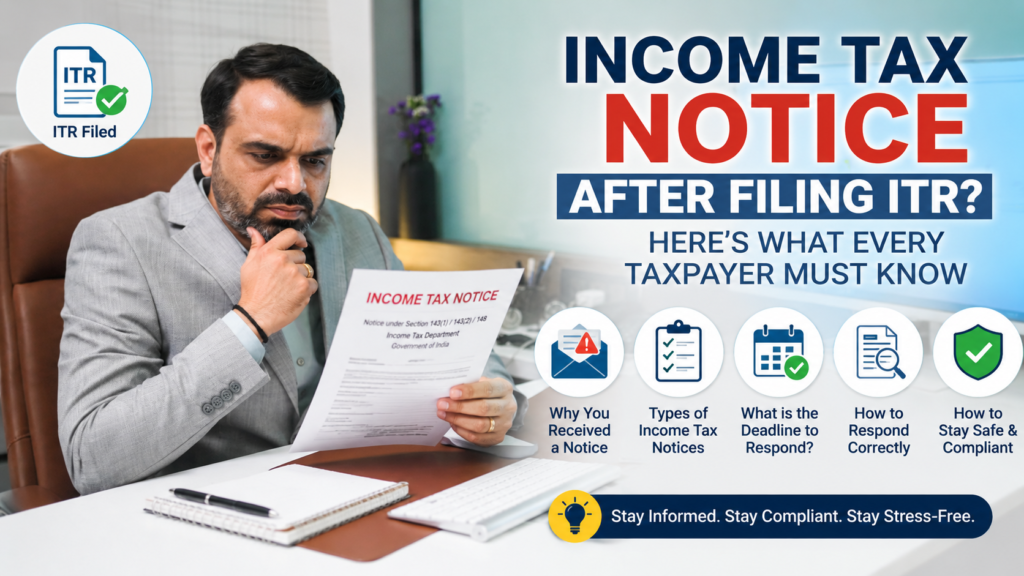
One of the most common questions taxpayers ask after filing their Income Tax Return (ITR) is
“I have already filed my return. Why did I receive an Income Tax Notice?”
Receiving a notice from the Income Tax Department can be stressful. However, a notice does not automatically mean you have done something wrong. In many cases, the notice is simply a request for clarification, additional information, or correction of a mismatch.
Understanding the reason behind the notice and responding appropriately can help avoid unnecessary penalties, interest, and prolonged scrutiny.
In this guide, we explain the most common reasons for receiving an income tax notice after filing your ITR and the steps you should take.
Can You Receive an Income Tax Notice Even After Filing Your Return?
Yes.
Filing your return does not guarantee that the Income Tax Department will not seek further clarification.
The department now uses advanced data analytics, AIS (Annual Information Statement), TIS (Taxpayer Information Summary), SFT reporting, bank transaction data, and employer reporting to verify the accuracy of returns.
Any mismatch or omission can trigger a notice.
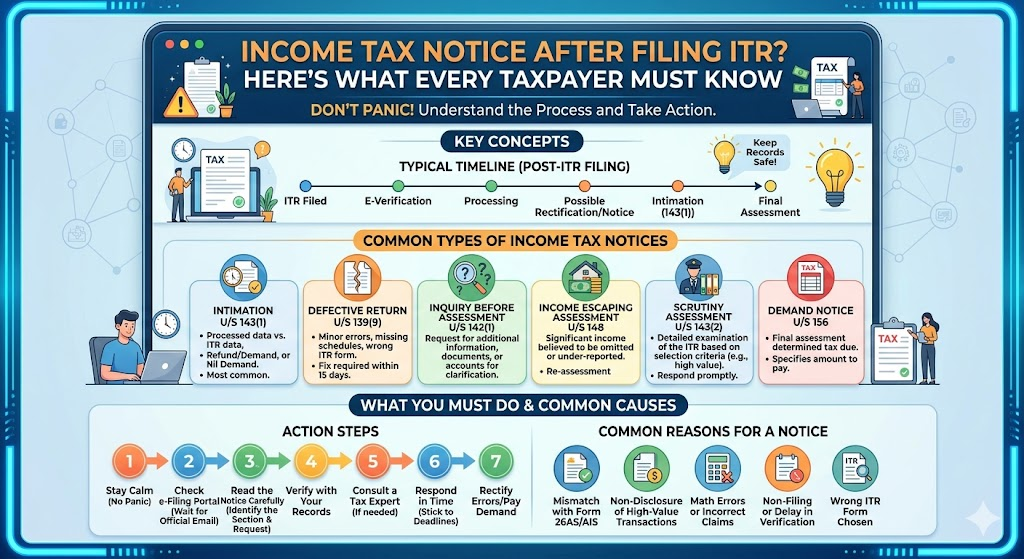
Top 7 Reasons Why Taxpayers Receive Income Tax Notices
1. Income Reported in AIS Is Missing in ITR
One of the most common reasons for notices is a mismatch between income reported in AIS and income declared in your return.
Examples:
* Interest income from savings accounts
* Fixed deposit interest
* Dividend income
* Capital gains from shares or mutual funds
* Foreign remittances
Even small omissions can trigger automated compliance checks.
2. High-Value Transactions Reported to the Department
Banks, mutual funds, registrars, and other institutions report specified financial transactions to the Income Tax Department.
Examples include:
* Large cash deposits
* Property purchases
* Significant mutual fund investments
* High credit card spending
* Foreign travel expenses
If your declared income does not support these transactions, the department may seek clarification.
3. Claiming Excess Deductions
Incorrect deduction claims frequently lead to notices.
Common areas include:
* Section 80C
* Section 80D
* Home loan interest
* HRA exemption
* Donations under Section 80G
Taxpayers should retain documentary evidence supporting every deduction claimed.
4. Mismatch in TDS Details
Your return should match the information available in:
* Form 26AS
* AIS
* TDS certificates
Common issues include:
* Missing TDS credits
* Incorrect TAN details
* Employer reporting errors
* Duplicate TDS claims
5. Non-Disclosure of Capital Gains
Many taxpayers assume that no tax liability means no reporting requirement.
This is incorrect.
Capital gains arising from:
* Shares
* Mutual funds
* Property sales
* Gold investments
must generally be reported even if the tax payable is nil.
6. Foreign Income or Foreign Assets Not Disclosed
Residents holding foreign assets or earning foreign income have specific disclosure requirements.
Examples include:
* Foreign bank accounts
* Overseas shares
* Foreign ESOPs
* Rental income from foreign properties
Non-disclosure can attract serious consequences.
7. Return Selected for Scrutiny
Sometimes a return is selected for scrutiny based on risk parameters determined by the department.
Selection does not necessarily imply wrongdoing.
The department may simply require supportingThe department may simply require supporting documents and explanations.
Types of Income Tax Notices After Filing ITR
Notice Under Section 143(1)
This is an intimation generated after processing the return.
It may indicate:
* No demand and no refund
* Refund due
* Additional tax payable
This is not necessarily a scrutiny notice.
Notice Under Section 139(9)
This is issued when the return is considered defective.
Examples:
* Missing schedules
* Incorrect reporting
* Incomplete information
Timely correction can resolve the issue.
Notice Under Section 143(2)
This indicates that the return has been selected for detailed scrutiny.
Taxpayers may be required to provide:
* Bank statements
* Investment proofs
* Income records
* Supporting documents
Notice Under Section 148
Issued when the department believes income may have escaped assessment.
Such notices should be handled carefully and preferably with professional assistance.
Read our Article: Income Tax Notice India 2026: Every Section Explained What It Means and How to Respond
What Should You Do If You Receive an Income Tax Notice?
Step 1: Read the Notice Carefully
Do not panic.
Identify:
* Notice section
* Assessment year
* Response deadline
* Information requested
Step 2: Verify the Notice
Check the notice through your Income Tax portal account.
Ensure it is genuine and not a phishing attempt.
Step 3: Gather Supporting Documents
Depending on the notice, collect:
* Form 16
* Form 26AS
* AIS
* Bank statements
* Investment proofs
* Capital gain statements
* Property documents
Step 4: Respond Before the Deadline
Ignoring notices can result in:
* Additional tax demands
* Penalties
* Prosecution in serious cases
Timely response is critical.
Step 5: Seek Professional Advice
Complex notices involving:
* Capital gains
* Foreign assets
* High-value transactions
* Reassessment proceedings
should be reviewed by a qualified tax professional.
How to Avoid Income Tax Notices in Future
Before filing your return:
✅ Review AIS thoroughly
✅ Match Form 26AS with Form 16
✅ Report all bank interest
✅ Disclose capital gains
✅ Verify deductions
✅ Report foreign assets where applicable
✅ Maintain proper documentation
A careful review before filing can significantly reduce the risk of future notices.
Real-Life Example
A salaried employee earning ₹18 lakh annually filed his return independently.
He reported salary income correctly but forgot to disclose:
* Savings account interest
* Fixed deposit interest
* Dividend income
These entries appeared in AIS but not in the return.
The department later issued a compliance notice seeking clarification.
The issue was resolved through revised reporting, but the taxpayer experienced avoidable stress and delays.
Frequently Asked Questions (FAQs)
1.Is an income tax notice always bad news?
No. Many notices are routine communications seeking clarification or correction.
2.Can I ignore an income tax notice?
No. Every notice should be reviewed and responded to appropriately.
3.How long do I have to respond?
The deadline depends on the specific notice. Always check the notice carefully.
4.Can I revise my return after receiving a notice?
In many situations, corrective action or revised filing may be possible, subject to applicable provisions.
5.Can a CA help me respond to a notice?
Yes. Professional guidance can help ensure accurate and timely compliance.
About Author
Dr. Haresh Adwani holds a PhD in Commerce and brings over 20 years of expertise in GST compliance, income tax advisory, FEMA, and corporate law. Services include GST audit, ITR filing, GST appeal representation, notice response, NRI taxation, and FEMA compliance.
Need Help With an Income Tax Notice?
Received an Income Tax Notice after filing your ITR?
Our team at Adwani & Co. / ITR Advisor assists taxpayers across India with:
* Income Tax Notice Replies
* AIS & TIS Mismatch Review
* Defective Return Notices
* Scrutiny Assessments
* Capital Gains Reporting
* NRI Taxation Issues
* Revised Return Filing
Get your notice reviewed by our experts before responding.