Tag: ITR

  • AIS Shows Higher Income Than Your ITR? Complete Guide to Avoid Income Tax Notice in AY 2026-27

    AIS Shows Higher Income Than Your ITR? Complete Guide to Avoid Income Tax Notice in AY 2026-27

    CA Dipesh Gurubakshani June 2026 9 min read

    AIS Shows More Income Than Your ITR? Don’t Ignore It

    Have you checked your Annual Information Statement (AIS) before filing your Income Tax Return (ITR)?

    Many taxpayers receive Income Tax notices because the income reported in their ITR does not match the information available with the Income Tax Department through AIS.

    If your AIS shows higher income than what you have reported in your ITR, it could trigger scrutiny, notices, or demands from the Income Tax Department.

    In this guide, we explain what AIS is, common AIS mismatches, how to correct errors, and what steps you should take before filing your ITR for AY 2026-27.

    What is AIS (Annual Information Statement)?

    The Annual Information Statement (AIS) is a comprehensive statement available on the Income Tax Portal that contains details of various financial transactions reported to the Income Tax Department.

    AIS includes information such as:

    • Savings bank interest
    • Fixed deposit interest
    • Dividend income
    • Purchase and sale of shares and mutual funds
    • Salary income
    • Rent received
    • Foreign remittances
    • Credit card payments
    • High-value transactions
    • Tax Deducted at Source (TDS)
    • Tax Collected at Source (TCS)

    The Income Tax Department uses AIS to verify whether taxpayers have correctly reported their income in the ITR.


    Why AIS is Important Before Filing ITR

    Many taxpayers rely only on Form 16, bank statements, or investment records while filing their returns.

    However, the Income Tax Department compares your ITR with the data available in AIS.

    Even if you unintentionally omit income, the mismatch may result in:

    • Defective return notices
    • Scrutiny notices
    • Tax demands
    • Penalties
    • Interest liability

    Therefore, checking AIS before filing your return has become essential.

    Read our detailed guide on :How to Download AIS from the Income Tax Portal : The Ultimate Step by Step Guide for AY 2026-27


    Common AIS Errors and Mismatches

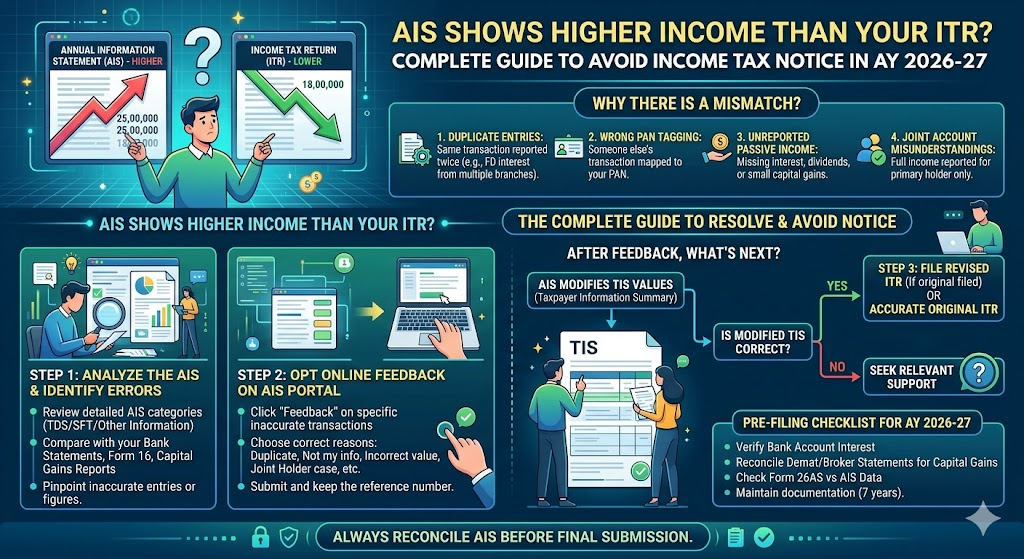
    1. Fixed Deposit Interest Not Reported

    Banks report FD interest to the Income Tax Department even if the interest is not credited to your account.

    Many taxpayers miss reporting FD interest, leading to an AIS mismatch.

    2. Savings Bank Interest Missing

    Interest earned from savings accounts is often overlooked while filing returns.

    However, banks report this information in AIS.

    3. Dividend Income Not Included

    Companies and mutual funds report dividend payments.

    Failure to report dividend income may create discrepancies.

    4. Capital Gains Not Reported Correctly

    Share and mutual fund transactions are reported by brokers and RTAs.

    Many taxpayers report only sale proceeds or forget to calculate capital gains accurately.

    5.Duplicate Reporting in AIS

    Sometimes AIS may show duplicate transactions due to reporting by multiple entities.

    Such cases require verification before filing.

    6. Incorrect Salary Information

    Employers may revise TDS returns, causing differences between Form 16 and AIS.

    7. High-Value Transactions

    Property purchases, foreign remittances, credit card payments, and other specified financial transactions may appear in AIS.

    Ignoring them can invite questions from the tax department.


    What Happens If You Ignore AIS Mismatches?

    Ignoring AIS discrepancies can lead to serious consequences.

    The Income Tax Department may:

    • Issue notices seeking clarification
    • Add omitted income during assessment
    • Levy additional tax
    • Charge interest under applicable provisions
    • Impose penalties in certain cases

    Many taxpayers receive notices simply because they failed to reconcile AIS before filing their return.


    How to Check AIS Online

    Follow these steps:

    1. Login to the Income Tax e-Filing Portal.

    2. Go to “Services”.

    3. Click on “Annual Information Statement (AIS)”.

    4. Open AIS and review all reported transactions.

    5. Compare AIS data with:

    • Form 16
    • Form 26AS
    • Bank statementsBank statements
    • Broker statements
    • Mutual fund statements
    • Books of accounts

    How to Submit Feedback in AIS

    If you find incorrect information in AIS, you can submit feedback directly through the portal.

    Common feedback options include:

    • Information is correct
    • Information is not fully correct
    • Information relates to another PAN
    • Duplicate information
    • Information is denied

    Providing feedback helps the Income Tax Department understand discrepancies and may prevent future issues.


    Example of an AIS Mismatch


    Mr. Sharma filed his ITR showing interest income of ₹12,000.

    However, AIS reflected:

    • Savings account interest: ₹12,000
    • FD interest: ₹45,000
    • Total interest as per AIS: ₹57,000

    Since FD interest was omitted from the return, the Income Tax Department may issue a notice seeking clarification.

    This is one of the most common AIS-related mistakes observed every year.


    Best Practices to Avoid AIS-Related Notices

    Before filing your ITR:

    • ✅ Download and review AIS
    • ✅ Compare AIS with Form 26AS
    • ✅ Verify bank interest income
    • ✅ Check dividend income
    • ✅ Review share and mutual fund transactions
    • ✅ Verify salary details
    • ✅ Reconcile TDS entries
    • ✅ Submit feedback wherever required
    • ✅ Seek professional assistance for complex transactions

    Frequently Asked Questions (FAQs)

    1. Is AIS mandatory for filing ITR?

    While AIS is not mandatory, checking it before filing your return is strongly recommended to avoid mismatches.

    2.Can AIS contain incorrect information?

    Yes. AIS may occasionally contain duplicate or incorrect entries. Such errors can be addressed through the feedback mechanism.

    3.Can I revise my ITR if AIS shows additional income?

    Yes, taxpayers can file a revised return within the prescribed time limit if any income was omitted.

    4. Will I definitely receive a notice if AIS and ITR do not match?

    Not necessarily. However, significant mismatches increase the likelihood of scrutiny or notices.

    Author

    CA Dipesh Gurubakshani is a Chartered Accountant with Adwani & Co LLP, Pune, specialising in income tax audit, direct taxation, and accounting advisory. He supports clients across statutory compliance, financial reporting, and income tax matters with a focus on accuracy, regulatory adherence, and disciplined execution.

    Disclaimer: ITRAdvisor.in is an educational and informational platform focused on tax awareness and compliance updates. Nothing contained herein should be construed as solicitation or advertisement of professional services. Professional services, where applicable, are rendered in accordance with ICAI guidelines. This article is published on ITRAdvisor.in, a tax and compliance knowledge platform. The content has been reviewed for technical accuracy by professionals associated with Adwani & Co LLP.

    Need Help With AIS Mismatch or Income Tax Notice?

    If your AIS shows higher income than your ITR, do not ignore it. Our team at ITR Advisor assists taxpayers across India and NRIs worldwide with:

    • AIS reconciliation
    • Income Tax Return filing
    • Revised Return filing
    • Income Tax Notice replies
    • Scrutiny and assessment support
    • Contact us today for professional assistance and ensure your return is filed accurately and compliantly.
  • Received a Notice for High-Value Transactions? Here’s How to File Your ITR Correctly and Avoid Costly Mistakes for AY 2026-27

    Received a Notice for High-Value Transactions? Here’s How to File Your ITR Correctly and Avoid Costly Mistakes for AY 2026-27

    Nidhi Adwani April 2026 7 min read

    Received a Notice for High-Value Transactions? Don’t Ignore It.

    Many taxpayers are shocked when they receive a compliance notice from the Income Tax Department despite believing they have done nothing wrong.

    A common reaction is:

    I paid tax on my salary. Why am I getting a notice for my bank transactions?”

    The answer often lies in high-value transactions reported to the Income Tax Department through various financial institutions.

    Today, banks, mutual funds, registrars, property authorities, and financial institutions report specified transactions directly to the department.

    If your Income Tax Return (ITR) does not adequately explain these high value transactions, you may receive a notice seeking clarification.

    The good news?

    A notice does not automatically mean tax evasion or wrongdoing.

    However, incorrect reporting can lead to tax demands, scrutiny, penalties, and prolonged compliance issues.

    Let’s understand what triggers these notices and how to file your return correctly.


    What Are High-Value Transactions?

    High-value transactions are significant financial activities that are reported to the Income Tax Department through various reporting mechanisms.

    These high value transactions become visible in:

    • Annual Information Statement (AIS)
    • Taxpayer Information Summary (TIS)
    • Specified Financial Transaction (SFT) reports

    The department compares this information with the income reported in your ITR.

    Any inconsistency can trigger automated compliance checks.


    Common High-Value Transactions That Can Trigger Notices

    1.Large Cash Deposits in Bank Accounts

    Large cash deposits frequently attract scrutiny, especially when the declared income does not support the deposited amount.

    Common situations include:

    • Business cash deposits
    • Sale proceeds received in cash
    • Agricultural income claims
    • Cash savings accumulated over time

    If the source is not properly explained, notices may follow.

    2.High Credit Card Spending

    Many taxpayers are surprised to learn that significant credit card expenditure may be reported.

    The department may seek clarification when spending appears inconsistent with reported income.

    For example:

    • Salary income of ₹8 lakh
    • Credit card expenditure of ₹18 lakh

    Such mismatches can trigger questions.

    3. Property Purchases

    Real estate transactions are closely monitored.

    The department may compare:

    • Purchase value
    • Source of funds
    • Loan information
    • Reported income

    Property transactions often trigger scrutiny when funding sources are unclear.

    4. Mutual Fund Investments

    Large mutual fund investments are frequently reported through financial institutions.

    Common issues include:

    • Investments not matching declared income
    • Redemption transactions omitted from ITR
    • Capital gains not reported

    Many taxpayers mistakenly believe only profits need reporting.

    5.Share Market Transactions

    With increasing participation in stock markets, this has become one of the most common reasons for notices.

    Typical mistakes include:

    • Not reporting capital gains
    • Ignoring loss transactions
    • Missing dividend income
    • Incorrect tax calculations

    6.Foreign Travel and Overseas Spending

    High overseas expenditure may sometimes attract attention if the reported income appears insufficient to support the expenses incurred.

    7. Fixed Deposits and Interest Income

    Many taxpayers invest substantial sums in fixed deposits but forget to disclose the resulting interest income.

    Since banks report information directly, such mismatches are easily identified.


    What Is AIS and Why Is It So Important?

    AIS (Annual Information Statement) has become one of the most important documents for taxpayers.

    It contains information relating to:

    • Bank interest
    • Dividend income
    • Securities transactions
    • Mutual fund transactions
    • Property transactions
    • Tax deducted at source (TDS)
    • Foreign remittances
    • High-value financial activities

    Many notices today arise because taxpayers file returns without reviewing AIS.

    Also Read: How a Smart AIS Review Before Filing ITR Can Save Salaried Taxpayers from Costly Income Tax Notices in AY 2026-27https://itradvisor.in/blog/smart-ais-review-before-filing-itr


    What Is SFT Reporting?

    SFT stands for Specified Financial Transaction.

    Various institutions are required to report certain transactions to the Income Tax Department.

    These reports help the department verify whether financial activities align with declared income.

    SFT reporting has significantly increased transparency and reduced the possibility of undisclosed transactions remaining unnoticed.


    The Biggest Mistake Taxpayers Make

    The most common mistake is filing an ITR based only on:

    • Form 16
    • Salary details
    • TDS certificates

    Without checking:

    • AIS
    • Form 26AS
    • Capital gains reports
    • Mutual fund statements
    • Bank interest income

    This often leads to avoidable notices.


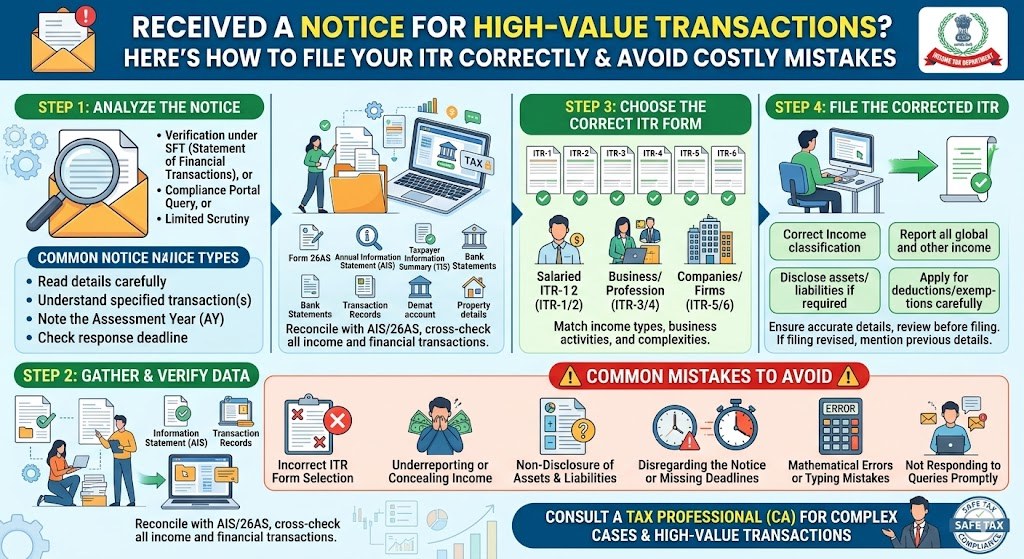
    How to File Your ITR Correctly If You Have High-Value Transactions

    Step 1: Download and Review AIS

    Before filing:

    ✔️ Review all transactions appearing in AIS

    ✔️ Verify accuracy

    ✔️ Check whether any transaction appears unfamiliar

    Step 2: Reconcile Income Sources

    Match:

    • Salary income
    • Interest income
    • Dividend income
    • Capital gains
    • Rental income
    • Business income

    with AIS and Form 26AS.

    Step 3: Report Capital Gains Properly

    Many taxpayers report only profits and ignore losses.

    This is a mistake.

    All relevant transactions should be reported appropriately.

    Step 4: Maintain Documentation

    Keep records of:

    • Property purchases
    • Loan statements
    • Mutual fund investments
    • Bank transactions
    • Gift deeds
    • Sale agreements

    Proper documentation helps support explanations if required.

    Step 5: Choose the Correct ITR Form

    Selecting the wrong ITR form can create compliance issues.

    A professional review is particularly important where multiple income sources exist.


    Real-Life Example

    A salaried employee earning ₹16 lakh annually filed his own return.

    He reported:

    ✔️ Salary income

    But forgot to report:

    ❌ Mutual fund redemption

    ❌ Dividend income

    ❌ Fixed deposit interest

    All these transactions appeared in AIS.

    A compliance notice was subsequently issued seeking clarification.

    The matter was resolved, but only after additional effort, documentation, and correspondence.

    Most importantly, the notice could have been avoided through proper review before filing.


    Frequently Asked Questions

    1.Does a high-value transaction always lead to a notice?

    No. However, transactions that are inconsistent with reported income may attract scrutiny.

    2.What should I do if a transaction in AIS is incorrect?

    The discrepancy should be reviewed carefully and appropriate action should be taken before filing the return.

    3.Can cash deposits trigger an income tax notice?

    Yes. Large cash deposits are among the most common reasons for notices

    4.Are mutual fund transactions reported to the Income Tax Department?

    Yes. Certain investment and redemption transactions may appear in AIS and related reporting systems.

    5. Should I file my return based only on Form 16?

    No. AIS, Form 26AS, capital gains statements, and other relevant information should also be reviewed.

    Warning Signs You Should Not Ignore

    Consider professional assistance if:

    ⚠️ Your AIS contains unfamiliar entries

    ⚠️ You purchased property during the year

    ⚠️ You redeemed mutual funds

    ⚠️ You traded in shares

    ⚠️ You made substantial cash deposits

    ⚠️ Your credit card expenditure is significantly high

    ⚠️ You received an income tax notice

    ⚠️ You have multiple income sources


    Need Help Understanding Your AIS or High-Value Transactions?

    Every year, thousands of taxpayers receive notices because they file returns without understanding what the Income Tax Department already knows through AIS and SFT reporting.

    At Adwani & Co. | ITR Advisor, we help taxpayers:

    ✅ Review AIS and TIS

    ✅ Analyze high-value transactions

    ✅ Report capital gains correctly

    ✅ File accurate ITRs

    ✅ Respond to notices

    ✅ Reduce the risk of future scrutiny

    ✅ Reconcile AIS with income disclosures


    Book an AIS & ITR Review Before Filing

    If your AIS shows transactions you don’t understand, don’t guess.

    A single reporting mistake can lead to notices, delays, additional tax demands, and unnecessary stress.

    Our experts can review your AIS, explain the transactions, identify potential issues, and help you file your return correctly.

    📞 Contact Adwani & Co. today for a professional AIS review and error-free ITR filing