
21 June 2026• Prafull nile
Smartest Salaried Employees
If You Think Filing a Salary ITR Is Still Simple, This Will Change Your Mind
Picture this: You are a salaried professional. You earn well. Your company’s payroll team handles your TDS every month. You get your Form 16 in June, hand it to a local accountant or plug it into an online portal, file your return in twenty minutes, and go on with your life.
Two months later, you receive an Income Tax Department notice asking why your ITR does not match your Annual Information Statement.
You had no idea your FD interest was being reported. You forgot about the mutual funds you redeemed last October. You did not realise your credit card spend pattern was flagged for inconsistency with your declared income.
This scenario is playing out across India for AY 2026-27 and it is happening to careful, responsible, tax-compliant salaried professionals who simply did not know how much the system had changed.
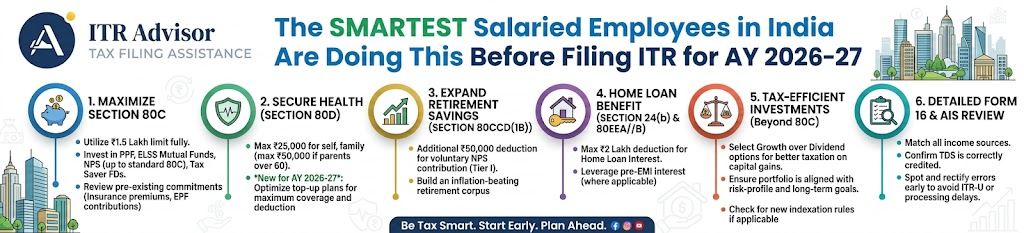
ITR filing for salaried employees today is a sophisticated exercise. At ITR Advisor, our tax professionals work with employees across every sector IT, banking, healthcare, manufacturing, government to ensure their income tax returns are filed with the accuracy, completeness, and professional review that modern compliance demands.
This guide breaks down everything you need to know the risks, the right process, the expert advantage, and how to make sure AY 2026-27 is the year you file without a single worry.
How Income Tax Return Filing for Smartest Salaried Employees Has Changed in AY 2026-27
The Income Tax Department, through guidelines and compliance frameworks published on its official portal www.incometax.gov.in, has steadily built one of the most comprehensive taxpayer surveillance systems in Asia. Today, the department receives financial data from:
- All scheduled banks (interest, cash deposits, high-value transfers)
- SEBI-registered stock brokers and depositories (equity trades, LTCG, STCG)
- Mutual fund registrars (SIP redemptions, fund switches, dividend payouts)
- Post offices and NBFCs (recurring deposits, interest income)
- Property registrars (real estate purchases and sales)
- Foreign exchange dealers (overseas remittances)
- Credit card issuers (annual spends above reporting thresholds)
- Employers (salary, TDS, perquisites)
Every piece of this data is compiled into your Annual Information Statement (AIS) a financial fingerprint of your entire year. The Income Tax Department’s processing systems then compare your AIS against your filed ITR. Any gap between the two is a mismatch and mismatches generate notices.
This is the environment in which ITR filing for salaried employees in AY 2026-27 is happening. The era of filing using only Form 16 is over.
The 8 Costliest Mistakes Smartest Salaried Employees Make in ITR Filing And How to Avoid Them
Understanding the common failure points is the first step toward getting your return right.
1. Treating Form 16 as the Complete Picture
Form 16 is your salary TDS certificate nothing more. It captures what your employer paid you and the tax deducted at source. It does not capture:
- Interest income from savings accounts, FDs, or RDs
- Dividend received from shares or mutual funds
- Capital gains from equity sales or MF redemptions
- Rental income
- Freelance or consulting income
- Foreign salary or perquisites
If these are in your AIS but absent from your ITR, a notice will follow.
2. Filing the Wrong ITR Form
This is more common than most taxpayers realise. Every year, thousands of Smartest salaried employees file ITR-1 when they should have filed ITR-2 simply because they did not account for their capital gains, foreign assets, or multiple income sources.
- ITR-1: Salary income below ₹50 lakh, one house property, no capital gains, no foreign assets
- ITR-2: Capital gains from any source, two or more house properties, foreign assets or income, NRI status
- ITR-3: Business or professional income alongside salary
Filing the wrong form triggers a Section 139(9) defective return notice and requires you to refile. This also delays any pending refund.
3.Skipping the Old vs New Tax Regime Comparision
The tax regime decision is one of the highest-impact choices in your entire return. Yet most salaried employees either stay with what their employer assumed or choose based on incomplete information.
Real Example:
Anil, a 38-year-old banker in Pune earning ₹22 lakh annually, had his employer default him to the new tax regime. His total tax liability under the new regime: ₹2,92,500. When his tax consultant ran the old regime calculation factoring in ₹1.5 lakh under Section 80C, ₹50,000 NPS contribution under 80CCD(1B), ₹25,000 health insurance under 80D, and ₹3.6 lakh HRA exemption his liability dropped to ₹2,24,200. He was unknowingly overpaying ₹68,300 every year. A single professional review corrected this permanently.
Read our detailed guide on Old vs New Tax Regime: Which Is Better for Salaried Employees in AY 2026-27.
4. Not Reporting Capital Gains from SIPs and Stock Trading
India’s investor base has exploded. Millions of salaried employees now have active portfolios on platforms like Zerodha, Groww, Angel One, and Kite many of whom do not realise that every redemption, switch, or sale is a taxable event.
Short-term capital gains (STCG) from equity mutual funds are taxed at 20%. Long-term capital gains (LTCG) above ₹1.25 lakh are taxed at 12.5%. Both must be reported along with your cost of acquisition, date of purchase, and date of sale.
Your AMC or broker provides a capital gains statement. If you are filing without one, your return is almost certainly incomplete.
5.Missing Interest Income from All Bank Accounts
Most salaried professionals have more bank accounts than they actively manage a salary account, a savings account from a previous employer, an old joint account with a parent, an RD opened years ago. Each of these reports interest to the Income Tax Department. Each of these appears in your AIS.
Missing any one of them creates a mismatch.
Pro tip: Before filing, download your AIS from the income tax portal and create a checklist of every interest entry. Cross-check against your actual bank records. If an entry is incorrect, raise feedback on the portal before filing.
6. Incorrect or Undocumented HRA Claims
HRA (House Rent Allowance) is one of the most commonly claimed and most commonly scrutinised exemptions in salary ITR filing. Issues arise when:
- Rent is paid to a parent but no proper rent agreement exists
- Rent exceeds ₹1 lakh annually but the landlord’s PAN was not furnished to the employer
- HRA is claimed in the ITR but the employer’s Form 16 does not reflect it (regime mismatch)
The Income Tax Department has the ability to cross-verify HRA claims through property registration data and landlord PAN records. Claims without documentation are a scrutiny risk.
7. Ignoring Crypto and Digital Asset Transactions
Virtual Digital Assets (VDAs), including cryptocurrency, are taxable at a flat 30% under Section 115BBH. Losses from crypto cannot be set off against any other income. TDS at 1% applies on certain transactions.
If you transacted in crypto during FY 2025-26, it must be disclosed in your ITR regardless of whether you made a profit. Ignoring it when your exchange has reported transactions in AIS is a serious compliance risk.
8 . Selecting the Wrong Bank Account for Refund Credit
A surprisingly common issue: taxpayers enter an old or inactive bank account for refund credit. The refund fails, and the taxpayer does not realise it for months. Always verify that your bank account is pre-validated on the income tax portal and linked to your PAN before submitting your return.
Who Absolutely Must File an Income Tax Return in AY 2026-27
While most salaried employees with income above the basic exemption limit are required to file, the Income Tax Act also mandates ITR filing based on certain activities regardless of taxable income. As per the department’s provisions, you must file even if your income is below the exemption limit if:
- You have deposited more than ₹1 crore in bank accounts during the year
- You have spent more than ₹2 lakh on foreign travel
- You have paid more than ₹1 lakh in electricity bills
- You hold foreign assets or have signing authority over foreign accounts
- You have received income from property located abroad
- Your aggregate TDS and TCS deductions exceed ₹25,000
Additionally, filing ITR even when not strictly required creates a verified income record that is essential for home loans, personal loans, visa applications, and financial planning.
Learn more about our ITR Filing Eligibility Assessment Services.
Expert ITR Filing for Special Categories of Salaried Employees
ITR Filing for Government Employees and PSU Staff
Government employees and public sector staff often have additional income sources such as arrears (with relief under Section 89), pension, gratuity, leave encashment, and LTC. Each of these has specific treatment under the Income Tax Act. Incorrect handling of arrear relief, in particular, frequently results in excess tax payment that could have been avoided.
ITR Filing for Doctors, Engineers, and Consultants with Dual Income
Many salaried professionals doctors, architects, engineers also earn consulting or professional fees alongside their primary salary. This dual income profile requires careful handling: the consulting income may need to be reported under “Profits and Gains from Business or Profession,” and the correct ITR form (usually ITR-3) must be selected.
At ITR Advisor, our experts handle combined salary-plus-profession returns with full accuracy and proper schedule completion.
NRI Income Tax Return Filing for Indians Working Abroad
For Non-Resident Indians earning from Indian sources rental income, NRO account interest, Indian equity investments, or salary credited to Indian accounts NRI income tax return filing is mandatory when income exceeds the basic exemption limit.
The residential status determination (NRI vs RNOR vs Resident) is critical and must be based on days of physical presence in India. DTAA benefits, if applicable, must be claimed correctly using Form 67 where foreign taxes have been paid.
The Real Value of Filing Your ITR on Time : Beyond Just Compliance
Timely income tax return filing for salaried employees delivers benefits that go well beyond avoiding penalties:
Financial Documentation: ITR is the most widely accepted income proof for home loans, vehicle loans, and personal finance applications. Most banks require the last 2–3 years’ ITRs for loan processing.
Visa Applications: Several countries including the US, UK, Canada, and Schengen zone nations require ITR documents as part of visa income proof requirements.
Carry Forward of Losses: Capital losses (from equity, MFs, or property) can only be carried forward to offset future gains if the return is filed on time. A belated return forfeits this benefit.
Faster Refund Processing: Returns filed early in the season are typically processed sooner. Late filers often experience longer refund wait times as system loads increase.
Avoiding Compounding Interest: Late filing on a return with tax payable results in interest under Sections 234A, 234B, and 234C which compounds monthly and can add significantly to your total tax cost.
Why ITR Advisor Is the Right Choice for Smartest Salaried Employees Your Income Tax Return Filing in AY 2026-27
At ITR Advisor, we do not just enter numbers into a form. We bring professional tax expertise to every return we handle.
Here is what sets our expert ITR filing service apart:
Complete AIS and Form 26AS Reconciliation : We review every entry in your AIS before filing and ensure your return reflects a fully reconciled picture.
Regime Optimisation : We run a proper old vs new tax regime comparison for your specific income and deduction profile, ensuring you pay the least tax legally possible.
Capital Gains Accuracy : We calculate STCG and LTCG across equity, mutual funds, ESOPs, and property using your actual transaction statements.
Notice Risk Assessment : We proactively identify entries in your AIS that could trigger scrutiny and ensure proper disclosure and documentation before submission.
Post-Filing Support : If a notice or intimation arrives after filing, our team handles the response, revision, and compliance follow-through.Pan-India Digital Service We serve clients across Pune, Mumbai, Delhi, Bengaluru, Hyderabad, Chennai, and every corner of India through a fully secure digital filing process
Frequently Asked Questions
Q1. What is the last date to file salary ITR for AY 2026-27?
The standard due date for salaried employees is 31st July 2026. Belated returns can be filed up to 31st December 2026 with a late fee. Filing before the due date is always advisable to preserve all tax benefits, carry-forward rights, and timely refund processing.
Q2. Can I file ITR for salaried income without a CA?
Yes, but the risk of errors increases significantly when your income involves capital gains, foreign assets, RSUs, crypto, or multiple employers. Expert-assisted filing ensures accuracy, AIS reconciliation, and proper regime selection — reducing notice risk substantially.
Q3. How long does expert ITR filing take with ITR Advisor?
Simple salary returns are typically processed within 1–2 business days of receiving all required documents. Returns with capital gains, RSUs, or foreign income may take 2–4 business days depending on the complexity.
Q4. What if I received two Form 16s from different employers in the same year?
Both employers’ salary and TDS details must be consolidated in a single ITR. Failing to do so results in incomplete disclosure and a likely mismatch notice. This is a common situation for employees who switched jobs and requires careful aggregation of income and TDS credits.
Q5. Is capital gains from selling ancestral property taxable for salaried employees?
Yes. Capital gains from property sale — including inherited or ancestral property — are taxable. The cost of acquisition for inherited property is determined by its fair market value as of April 1, 2001. LTCG from property is taxed at 12.5% without indexation benefit (post-July 2024 amendments). Professional calculation is strongly recommended.
Q6. Do I need to show my PPF maturity amount in ITR?
PPF maturity proceeds are fully exempt from income tax. However, if the amount appears in your AIS, it is good practice to show it in the exempt income schedule of your ITR to prevent any potential mismatch query.
Q7. What is the penalty for filing an incorrect ITR?
Under Section 270A, under-reporting of income can attract a penalty of 50% of the tax on under-reported income. Misreporting (with intent) can result in a penalty of 200% of such tax. Accurate and complete filing is always the safer and smarter path.
Conclusion
Tax compliance in India has entered a new era. The gap between “filing a return” and “filing a correct and complete return” has never been wider and the consequences of that gap have never been more serious.
For Smartest Salaried Employees across India, ITR filing for AY 2026-27 demands a professional, systematic approach: reviewing AIS, comparing tax regimes, reporting every income source, documenting every deduction, and ensuring that what you submit aligns with what the Income Tax Department already knows.
The cost of getting it right the first time in time, money, and professional fees is a fraction of the cost of responding to a notice, revising a return, or managing a tax demand.
About the Author : Prafull Nile
Prafull Nile is a senior taxation and accounting professional associated with Adwani & Co LLP, bringing over 19 years of extensive experience in direct taxation, tax audits, income tax assessments, GST audits, and financial statement finalization. He has successfully managed diverse client engagements across industries, providing strategic guidance on tax compliance, assessments, and regulatory matters. In addition to his technical expertise, Prafull leads and mentors teams, ensuring high standards of service delivery and operational excellence. His practical approach, deep understanding of tax laws, and commitment to client success make him a trusted advisor for businesses and professionals navigating complex financial and compliance requirements.
At ITRAdvisor.in, we help taxpayers with:
✔️ ITR Filing Review
✔️ AIS Reconciliation
✔️ Capital Gains Reporting
✔️ NRI Taxation
✔️ Tax Notice Response
✔️ Revised Returns
✔️ Income Tax Planning
✔️ Refund and Compliance Issues
If you are unsure whether your return has been filed correctly or want a professional review before submission, consulting an experienced tax professional can help avoid costly mistakes.
Visit ITRAdvisor.in for expert assistance with your Income Tax Return and tax compliance requirements.
Disclaimer: ITRAdvisor.in is an educational and informational platform focused on tax awareness and compliance updates. Nothing contained herein should be construed as solicitation or advertisement of professional services. Professional services, where applicable, are rendered in accordance with ICAI guidelines. This article is published on ITRAdvisor.in, a tax and compliance knowledge platform. The content has been reviewed for technical accuracy by professionals associated with Adwani & Co LLP
A prominent “File Your ITR Now” button near the top and again at the end of the article
Need help filing your Income Tax Return? Click the WhatsApp icon and our team will guide you through the process and assist you with your ITR filing.
Have questions about your ITR? Click the WhatsApp icon to connect with our tax experts for quick guidance and personalized assistance.
ITR Advisor is here to make sure you get it right. Connect with our tax experts today for complete, accurate, and worry-free salary ITR filing for AY 2026-27.
© 2026 ITR Advisor. All rights reserved. This content is for informational purposes only and does not constitute professional tax, legal, or financial advice. For personalized guidance, please consult a qualified tax professional.