

Here’s Exactly What It Means — and What You Must Do Right Now (2026)
Nidhi Adwani June 2026 6min Read
Credit Card Income Tax Notice 2026: Why You Got It and How to Respond
You swiped your credit card freely for travel, electronics, luxury shopping, or simply to manage monthly expenses and then one day, a notice landed in your inbox from the Income Tax Department. If this sounds familiar, you are not alone. Thousands of Indian taxpayers receive income tax notices on credit card usage every year, and in 2026, the scrutiny has only intensified thanks to AI-powered detection systems.
Here’s the critical truth: getting a credit card income tax notice does not automatically mean you have done something wrong. It means the Income Tax Department’s systems have flagged a mismatch between your reported income and your spending pattern. What you do next and how fast makes all the difference.
This guide breaks down exactly why these notices are issued, what Rule 114E really means, and how to craft a factual, legally sound response to protect yourself.
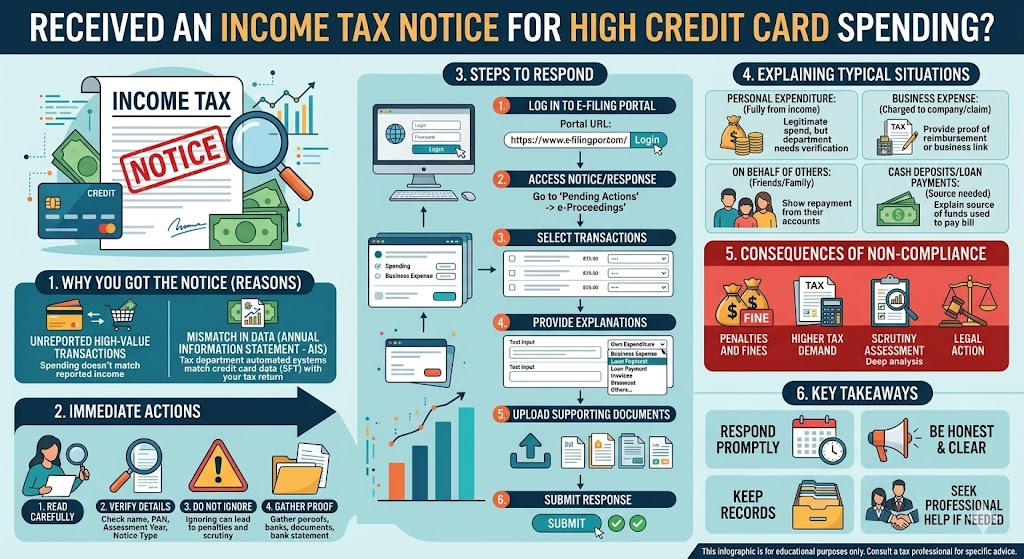
Why Does the Income Tax Department Send Notices for Credit Card Spending?
The Income Tax Department does not randomly pick taxpayers. It relies on a structured, data-driven system called the Statement of Financial Transactions (SFT) governed by Rule 114E of the Income Tax Rules, 1962. Under this rule, banks and financial institutions are legally required to report certain high-value transactions directly to the Income Tax Department.
Credit card spending crosses the reporting radar when:
- Your total credit card payments in a financial year exceed ₹1 lakh (cash payments toward credit card bills), or
- Your aggregate credit card expenditure exceeds ₹10 lakh in a financial year (payment by any mode).
Once this data is uploaded into the Annual Information Statement (AIS) on the income tax portal, the system automatically cross-checks it against the income declared in your ITR. If the spending appears disproportionate to your declared income a mismatch alert is triggered, and a notice follows.
Read our detailed guide on Received a Credit Card Income Tax Notice? Here’s the Ultimate Guide to Protect Yourself in 2025
High-Value Transactions Reported Under Rule 114E Quick Reference
To understand your credit card income tax scrutiny risk, here are the key SFT thresholds you must know:
| Transaction Type | Reporting Threshold |
| Credit card payment (any mode) | ₹10 lakh or more in a year |
| Credit card payment (cash only) | ₹1 lakh or more in a year |
| Cash deposit – Savings Account | ₹10 lakh or more in a year |
| Cash deposit – Current Account | ₹50 lakh or more in a year |
| Fixed deposit (non-banking) | ₹10 lakh or more in a year |
| Property purchase / sale | ₹30 lakh or more per transaction |
| Share/mutual fund purchase | ₹10 lakh or more in a year |
Important: All of the above transactions are visible to the IT Department in your AIS. Any unexplained discrepancy between your AIS data and your ITR is a potential trigger for a notice or faceless assessment.
How AI Is Powering Income Tax Scrutiny for High Credit Card Spends in 2026
The Income Tax Department has significantly upgraded its compliance infrastructure. As highlighted in CBDT communications, the department now uses advanced data analytics and AI-driven systems to identify taxpayers whose lifestyle expenditure is inconsistent with declared income a process sometimes called the ‘non-filer monitoring system’ (NMS).
In practical terms, this means:
- Your credit card spends are now directly visible in your AIS on incometax.gov.in visible to you and the department alike.
- AI systems flag cases where total spends across categories (travel, electronics, dining, luxury) exceed a reasonable proportion of declared income.
- Even UPI transactions and digital payments above certain thresholds are increasingly being tracked and correlated.
Types of Income Tax Notices You May Receive for Credit Card Spending
Notice Under Section 142(1) : Inquiry Before Assessment
This is the most common notice for credit card-related scrutiny. The Assessing Officer asks you to furnish documents, bank statements, credit card statements, and explanations for the spending mismatch.
Notice Under Section 148 : Income Escaping Assessment
If the department believes income has escaped assessment i.e., your actual income was higher than what you declared they can issue a reassessment notice under Section 148. Read our detailed guide on Income Tax Reassessment Notice Under Section 148: Rights, Timeline & Reply.
Notice Under Section 139(9) : Defective Return
If your ITR was filed incorrectly or key schedules were left blank despite high-value transactions appearing in Form 26AS or AIS, your return may be treated as defective.
Note on time limits: The Income Tax Department generally cannot issue a notice beyond 3 years from the end of the relevant assessment year for income below ₹50 lakh, and up to 10 years for income exceeding ₹50 lakh that has escaped assessment. Read our detailed guide on Income Tax Notice Time Limit 2026 for the full breakdown.
Also Read :Credit Card Income Tax Notice: Essential Guide to Avoid Penalties
How to Respond to an Income Tax Notice on Credit Card Usage : Step by Step
Dr. Haresh Adwani, a senior chartered accountant and co-founder of Adwani & Co LLP, consistently advises clients: a timely, document-backed response is infinitely better than ignoring or delaying a notice. Here’s the structured approach:
- Do Not Panic : Read the Notice Carefully
Identify the section under which it is issued, the assessment year it pertains to, and the specific query. Each notice has a due date for response note it immediately.
2.Verify Your AIS and Form 26AS
Log in to incometax.gov.in, download your AIS, and cross-check every credit card transaction flagged. Errors in AIS can be disputed online through the ‘Feedback’ feature on the portal itself.
3.Gather Source-of-Fund Evidence
For every high-value credit card spend, document the source: salary slips, bank statements, gift deeds, inheritance documents, savings withdrawals, or business income proof. The department wants to know WHERE the money came from not just that you spent it.
4.File a Factual, Measured Written Response
Submit your response on the Income Tax portal under ‘e-Proceedings’. Attach all supporting documents. Keep the language factual and professional. Avoid admissions that go beyond what the notice actually asks.
5.Respond Before the Deadline
Missing a notice deadline converts a manageable inquiry into an ex-parte assessment where the department passes an order based only on its data, potentially adding significant demand and penalties.
Learn more about our ITR Filing & Notice Response Service for expert-assisted notice handling.
Common Mistakes That Escalate a Credit Card Notice into a Full Tax Demand
- Ignoring the notice entirely : silence is treated as admission
- Responding after the deadline : the department can proceed ex-parte
- Submitting a vague or generic response without supporting documents
- Not verifying your AIS for errors before responding
- Filing a revised ITR hastily without professional guidance
Key Takeaways:
What Every Credit Card User Must Know About Income Tax Notices
- Credit card payments of ₹10 lakh or more in a year are reported to the Income Tax Department under Rule 114E via the SFT mechanism.
- Your Annual Information Statement (AIS) on incometax.gov.in shows every flagged transaction check it before filing your ITR.
- A credit card income tax notice is a query, not a conviction a well-documented, timely response resolves most cases.
- AI-driven scrutiny by the IT Department has intensified in 2026 lifestyle spending is now actively cross-checked against declared income.
Never ignore a notice. Always respond via the e-Proceedings portal with supporting documents before the deadline.
Frequently Asked Questions
Q1. What is the credit card spending limit to avoid an income tax notice in India?
Credit card payments aggregating ₹10 lakh or more in a financial year are reported to the Income Tax Department under Rule 114E by your bank. However, a notice is issued only when spending appears disproportionate to your declared income, so filing an accurate ITR is the real safeguard.
Q2. How does the Income Tax Department know about my credit card spending?
Banks are mandated under Rule 114E to submit a Statement of Financial Transactions (SFT) to the Income Tax Department reporting high-value credit card transactions. This data is directly reflected in your Annual Information Statement (AIS) on incometax.gov.in.
Q3. How should I reply to an income tax notice on credit card usage?
Log in to incometax.gov.in, navigate to ‘e-Proceedings’, and submit a written response with supporting documents (bank statements, income proof, source-of-fund evidence) before the deadline mentioned in the notice. Engaging a tax professional is strongly advised for complex cases.
Q4. Can the Income Tax Department send a notice for past credit card spending?
Yes. For incomes below ₹50 lakh, the department can issue a notice up to 3 years from the end of the relevant assessment year. For cases involving income exceeding ₹50 lakh that has escaped assessment, this window extends up to 10 years.
Q5. Will high UPI or digital payments also trigger an income tax notice in 2026?
UPI and digital payments are increasingly being monitored by the Income Tax Department, and large patterns of cash equivalents or high-frequency high-value transactions may attract scrutiny. Read our detailed guide on Will Income Tax Track Your UPI & WhatsApp Payments for complete clarity.
Conclusion:
Receiving a credit card income tax notice in 2026 is not the end of the world but treating it casually can make it one. India’s tax enforcement has become smarter, faster, and more data-driven than ever before. The Income Tax Department knows what you spend; the question is whether your declared income justifies it.
The solution is straightforward: file accurate ITRs every year, verify your AIS before filing, keep documentation of large expenditures, and respond to every notice promptly with facts and evidence. A well-prepared taxpayer has nothing to fear from any notice.
About the Author
Dr. Haresh Adwani
Ph.D. in Commerce | Law Graduate | Managing Partner, Adwani & Co LLP Dr. Haresh Adwani holds a Ph.D. in Commerce and is a qualified Law graduate with over two decades of hands-on experience in GST advisory, direct taxation, and statutory compliance for businesses across
Disclaimer
ITRAdvisor.in is an educational and informational platform focused on tax awareness and compliance updates. Nothing contained herein should be construed as solicitation or advertisement of professional services. Professional services, where applicable, are rendered in accordance with ICAI guidelines. This article is published on ITRAdvisor.in, a tax and compliance knowledge platform.
The content has been reviewed for technical accuracy by professionals associated with Adwani & Co LLP.