
The Ultimate Freelancer ITR Filing Guide for AY 2026-27
File Smart. Claim More. Pay Only What You Owe.
Dr. Haresh Adwani June 2026 9 min Read
Freelancer ITR Filing AY 2026-27: Everything You Need to Know
You deliver world-class work design, code, content, consulting and then comes the one thing that trips up almost every freelancer in India: tax filing. If you’ve been Googling ‘how to file ITR for freelancer’ or wondering which ITR form freelancers must use for AY 2026-27, you’re not alone. And you’ve landed in exactly the right place.
Freelancers, independent consultants, and self-employed professionals face a unique tax situation. Unlike salaried individuals whose employer handles TDS and Form 16, freelancers must manage their own advance tax, deductions, GST obligations, and ITR filing. The good news? India’s tax law has a powerful provision Section 44ADA that makes freelancer tax compliance far simpler and more tax-efficient than most people realize.
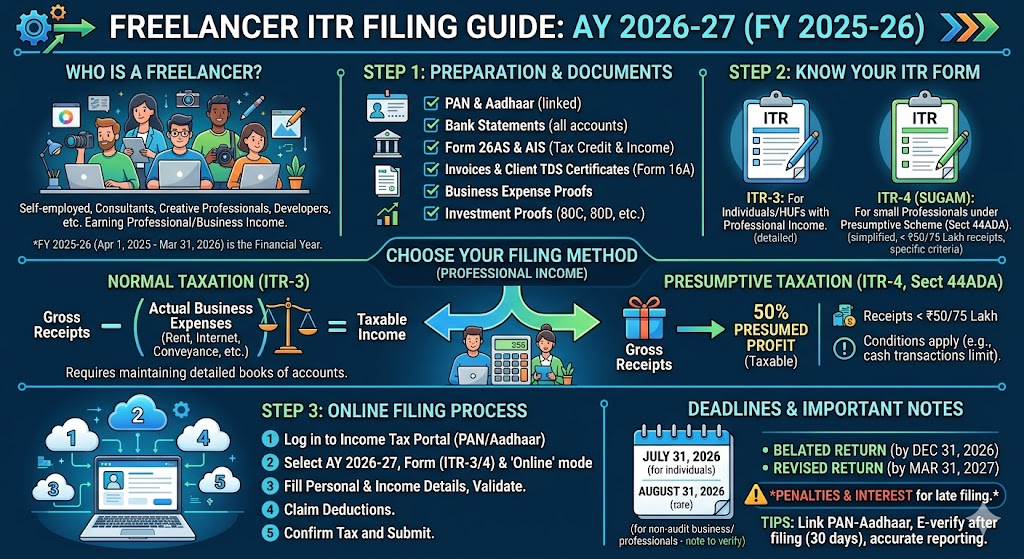
This guide walks you through every critical step of freelancer ITR filing for AY 2026-27 from selecting the right form to claiming deductions and filing before the deadline without stress.
Which ITR Form Should a Freelancer File for AY 2026-27?
This is the most common question and getting it wrong can lead to a defective return notice from the Income Tax Department. Here’s what you need to know:
- ITR-4 (Sugam): This is the correct form for most freelancers and self-employed professionals who opt for the Presumptive Taxation Scheme under Section 44ADA. If your gross professional receipts are up to ₹75 lakh in FY 2025-26, ITR-4 is your go-to form.
- ITR-3: If you maintain books of accounts, have multiple income sources (business + capital gains + house property), or your receipts exceed ₹75 lakh, you must file ITR-3.
- ITR-1 (Sahaj): Not applicable for freelancers. Do not make this common mistake.
Read our detailed guide on :ITR-1 vs ITR-2 vs ITR-4: Which Form to Fill Based on Your Income Type 2026 to avoid form mismatch errors.
Understanding Section 44ADA: The Freelancer’s Best Tax Friend
Section 44ADA of the Income Tax Act is a game changer for freelance professionals such as doctors, lawyers, architects, engineers, designers, content writers, software consultants, and other notified professionals. Under this presumptive taxation scheme for AY 2026-27:
- 50% of your gross professional receipts is deemed as your net taxable income (profit).
- You do not need to maintain detailed books of accounts.
- No requirement for a tax audit (unless you declare profit lower than 50% and your income exceeds the basic exemption limit).
- The gross receipt limit for Section 44ADA is ₹75 lakh for FY 2025-26.
Example: If a freelance graphic designer earned ₹12 lakh in FY 2025-26, only ₹6 lakh (50%) is treated as taxable income. After applying the standard deduction of ₹75,000 under the new tax regime, the effective taxable income drops further, making Section 44ADA an exceptionally tax-efficient route.
Advance Tax for Freelancers: Deadlines You Cannot Miss in FY 2026-27
One of the most overlooked compliance areas for freelancers is advance tax. Since no TDS is deducted on most freelance payments (or TDS is deducted at a lower rate), you are required to pay advance tax if your total tax liability exceeds ₹10,000 in a year.
Advance Tax Due Dates FY 2026-27 for Freelancers:
- 15th June 2026: Pay at least 15% of total estimated tax
- 15th September 2026: Cumulative 45% of total estimated tax
- 15th December 2026: Cumulative 75% of total estimated tax
- 15th March 2027: 100% of total estimated tax
Important: Freelancers opting for Section 44ADA can pay 100% advance tax in one installment by 15th March a significant compliance relief compared to regular businesspersons.
Missing advance tax deadlines attracts interest under Sections 234B and 234C of the Income Tax Act. Read our detailed guide on Advance Tax Due Dates FY 2026-27 for complete installment schedules and penalty calculations.
Smart Tax Deductions Every Freelancer Must Claim in AY 2026-27
Even if you opt for Section 44ADA, certain deductions are still available to freelancers that can significantly reduce your final tax liability. According to guidelines from the Income Tax Department, the following deductions apply:
- Standard Deduction of ₹75,000 under the new tax regime (from FY 2025-26 onwards)
- Section 80C: Up to ₹1.5 lakh via PPF, ELSS, LIC, NSC applicable only under the old regime
- Section 80D: Health insurance premium for self and family
- Section 80CCD(1B): Additional ₹50,000 via NPS contribution available under old regime
- Home loan interest under Section 24(b) if applicable
If you are under the old tax regime: Learn more about our Tax Planning Service to identify the most beneficial deductions for your specific income profile.
Dr. Haresh Adwani, a practising chartered accountant and founder of Adwani & Co LLP, advises freelancers to carefully model both old and new tax regimes before AY 2026-27 filing, especially given the enhanced standard deduction under the new regime.
Read our detailed guide on Old vs New Tax Regime 2026 for a personalised calculation.
Step-by-Step: How to File Freelancers ITR for Online for AY 2026-27
Here’s a simplified step-by-step filing process for freelancers ITR in India following the workflow outlined on incometax.gov.in:
Step 1 : Collect Your Financial Records: Gather all invoices raised, payments received, TDS certificates (Form 16A), and your bank statements for FY 2025-26.
Step 2 : Download and Verify Form 26AS & AIS: Log in to the Income Tax portal. Match your TDS credits, high-value transactions, and income details. Any mismatch here is a red flag. Read our detailed guide on Form 26AS vs AIS vs TIS: Key Differences & How to Match Them Before Filing ITR.
Step 3 : Choose Your Tax Regime: Decide between old and new tax regime. For most freelancers earning under ₹15 lakh without major deductions, the new regime is now more favourable.
Step 4 : Select ITR-4 (If Section 44ADA Applies): Login to incometax.gov.in → e-File → Income Tax Returns → File Income Tax Return → Select AY 2026-27 → ITR-4.
Step 5 : Fill in Income Details: Under the ‘Business/Profession’ schedule in ITR-4, enter your gross receipts and declare 50% as profit under 44ADA.
Step 6 : Claim Deductions & Compute Tax: Enter eligible deductions and let the system compute your final tax payable.
Step 7 : Pay Self-Assessment Tax (If Any): If tax is payable after TDS and advance tax, pay it via Challan 280 before filing.
Step 8 : Verify and Submit: e-Verify via Aadhaar OTP, net banking, or DSC. Your ITR is filed!
Read our detailed guide on How to File ITR Online 2026: Step-by-Step Guide for Salaried & Freelancers for a more detailed walkthrough with screenshots.
GST Registration for Freelancers: Do You Need It?
A frequently misunderstood area for freelancers is GST compliance. Under current GST rules:
- GST registration is mandatory if your aggregate turnover exceeds ₹20 lakh (₹10 lakh for special category states) in a financial year.
- If you provide services to clients outside India (export of services), you are exempt from GST but registration may still be beneficial for claiming refunds on input tax credits.
- Freelancers registered under GST must file GSTR-1 and GSTR-3B returns regularly.
Non-compliance with GST obligations can attract notices under the GST portal (gstn.gov.in). Learn more about our GST Compliance Service to stay audit-proof.
Key Takeaways
What Every Freelancer Must Remember for AY 2026-27
- File ITR-4 if your gross professional receipts are up to ₹75 lakh Section 44ADA makes it simple.
- Only 50% of your gross receipts is taxable under Section 44ADA a powerful built-in deduction.
- Pay advance tax on time to avoid interest under Sections 234B and 234C.
- Verify Form 26AS and AIS before filing mismatches can trigger scrutiny notices.
- The ITR filing last date for AY 2026-27 (non-audit cases) is 31st July 2026 file on time to avoid penalties.
- GST registration is mandatory once your annual receipts cross ₹20 lakh.
Frequently Asked Questions (FAQs)
Q1. Which ITR form should a freelancer file for AY 2026-27?
Most freelancers should file ITR-4 (Sugam) if their gross receipts are up to ₹75 lakh and they opt for the presumptive taxation scheme under Section 44ADA. ITR-3 applies if receipts exceed this limit or if books of accounts are maintained.
Q2. What is Section 44ADA and who is eligible in AY 2026-27?
Section 44ADA allows notified professionals (doctors, lawyers, engineers, consultants, designers, etc.) to declare 50% of gross receipts as taxable income without maintaining books. Eligibility requires gross professional receipts of up to ₹75 lakh in FY 2025-26.
Q3. Do freelancers need to pay advance tax for FY 2026-27?
Yes, if total tax liability exceeds ₹10,000 in the year. Freelancers under Section 44ADA enjoy the benefit of paying 100% of advance tax in a single installment by 15th March 2027, unlike regular taxpayers who pay in four installments.
Q4. Is GST registration mandatory for all freelancers in India?
GST registration is mandatory only if your aggregate annual turnover exceeds ₹20 lakh (₹10 lakh in special category states). Freelancers providing export services to foreign clients are generally exempt but may benefit from voluntary GST registration for ITC refunds.
Q5. What is the last date for freelancer ITR filing for AY 2026-27?
The due date for ITR filing AY 2026-27 for non-audit cases (including most freelancers under Section 44ADA) is 31st July 2026. A late filing fee of up to ₹5,000 under Section 234F applies if you miss this deadline.
Conclusion: File Right, Save More, Stay Compliant
Freelancing gives you freedom and with the right tax knowledge, it also gives you the freedom to keep more of what you earn. The ITR filing process for freelancers in India for AY 2026-27 is far more streamlined than most people think, especially with the powerful benefits of Section 44ADA and the new tax regime.
The key is to start early: reconcile your Form 26AS and AIS now, decide your tax regime, calculate your advance tax liability, and file before the 31st July 2026 deadline. Don’t let procrastination convert a simple filing into a panic-driven exercise with penalties.
| 🚀 Need Expert Help with Your Freelancer ITR? Stop second-guessing your taxes. Connect with the experts at itradvisor.in today for personalised guidance on freelancer ITR filing, Section 44ADA, advance tax planning, and GST compliance — all in one place. 👉 Visit itradvisor.in | Expert Tax Guidance. Zero Confusion. |