
Are You Paying GST on Inpatient Medicines Unnecessarily? Know Your Rights Now
GST on Inpatient Medicines
You’ve just been discharged from the hospital after a week-long inpatient stay. The final bill arrives and buried inside it is a line item: ‘GST on medicines.’ You pay it without question because, honestly, who challenges a hospital bill? But here’s the truth that most patients in India never find out: you may have been charged GST on inpatient medicines that is completely illegal under Indian GST law.
What Does Indian GST Law Actually Say About Inpatient Medicines?
Under the Central Goods and Services Tax (CGST) Act, 2017, health care services provided by a clinical establishment are fully exempt from GST. The key provision is Notification No. 12/2017 – Central Tax (Rate), which specifically exempts ‘services by a clinical establishment, an authorised medical practitioner or para-medics’ from the GST net.
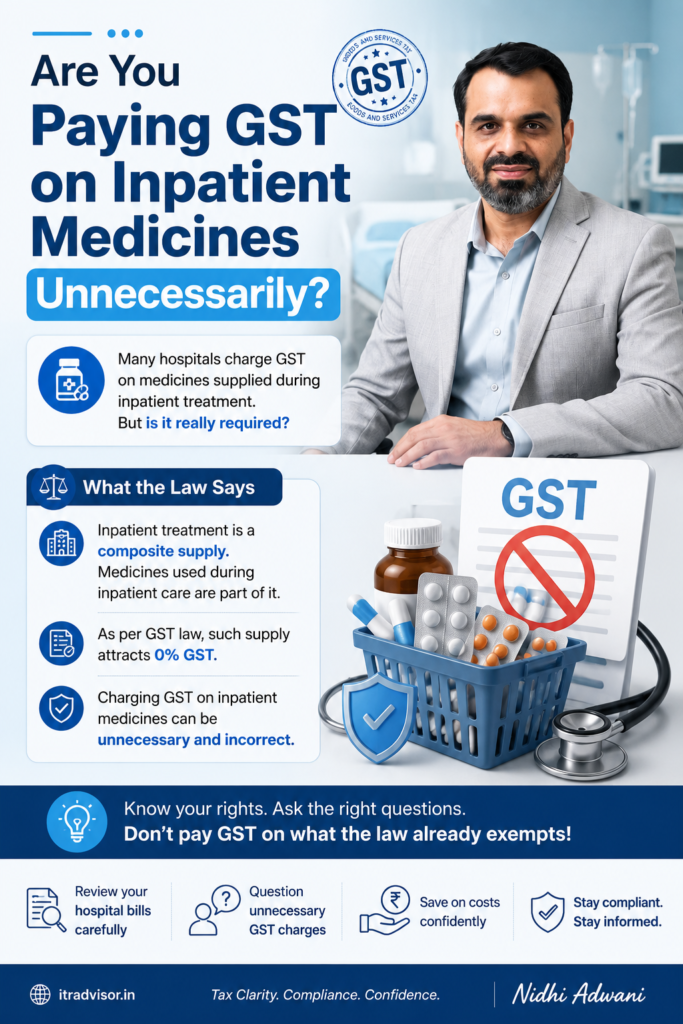
More importantly, the CBIC (Central Board of Indirect Taxes and Customs) has consistently clarified that when medicines and consumables are supplied to an inpatient as part of a composite healthcare service meaning the supply of medicine is bundled with the treatment the entire package is treated as a healthcare service and is therefore exempt from GST. The medicines do not attract GST separately in such cases.
| Illustrative Example Mr. Ramesh is admitted to a private hospital in Pune for a knee surgery. The hospital administers anaesthesia, antibiotics, and post-operative medications during his stay. Since these medicines are part of his inpatient treatment package, the entire composite supply qualifies as a healthcare service and should be billed without GST on the medicines component. |
When Is GST Actually Applicable on Hospital Medicines?
The exemption applies specifically to inpatient (IPD) settings. The scenario changes when:
- You visit a hospital pharmacy as an outpatient (OPD) and buy medicines to take home GST at applicable slab rates (5%, 12%, or 18%) applies here.
- A hospital sells medicines over the counter without any linked treatment.
- Cosmetic or elective procedures that don’t qualify as ‘healthcare services’ are involved.
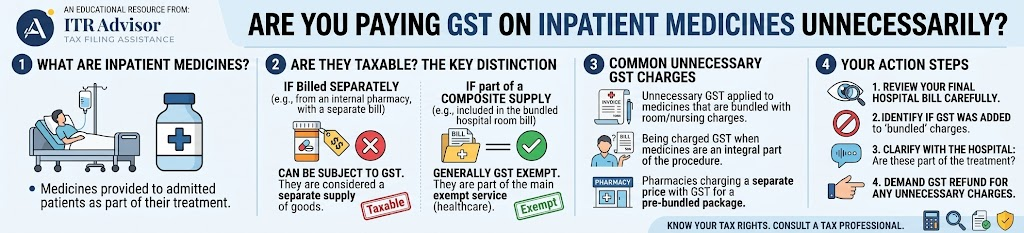
The critical legal distinction is composite supply vs. independent supply. When medicines are consumed as part of IPD care, they form a composite healthcare service. When sold independently at a retail pharmacy counter, they are a separate supply and GST applies normally.
Why Do Some Hospitals Still Charge GST on Inpatient Medicines?
This remains one of the most common GST compliance errors in the Indian healthcare sector. Several hospitals particularly smaller nursing homes and non-corporate setups either misunderstand the composite supply rule or bifurcate their inpatient invoices to show medicines as a separate line item, creating a false impression of taxability.
In some cases, hospitals may be incorrectly availing Input Tax Credit (ITC) on medicines they procure and passing on a GST charge to patients to offset their books. This practice is not legally tenable and has been flagged in multiple CBIC clarifications.
What the GST Portal and CBIC Say
As per guidance available on gst.gov.in and CBIC circulars, healthcare services rendered by hospitals, including all composite supplies such as medicines, diagnostics, and room charges during inpatient stay, are exempted under Entry 74 of Notification No. 12/2017 Central Tax (Rate). Patients are well within their rights to question any GST line item on their inpatient bill and request a corrected invoice.
How to Identify If You Have Been Wrongly Charged GST on Inpatient Medicines
Check your hospital discharge bill carefully. Look for:
- A separate GST charge applied specifically to medicines or consumables.
- GST percentages of 5%, 12%, or 18% on items administered during your IPD stay.
- Any line item labelled ‘pharmacy charges’ with GST added on top.
If you notice any of these, you are entitled to raise a formal objection with the hospital’s billing department. You can also file a complaint with the GST helpdesk or the relevant State GST authority if the hospital refuses to correct the bill.
Read our detailed guide on GST Compliance Checklist India 2026: 7 Essential Rules to Avoid Notices and Penalties
Key Takeaways
- Medicines administered during inpatient (IPD) stays are part of a composite healthcare service and are fully exempt from GST under Indian law.
- The exemption is governed by Notification No. 12/2017 – Central Tax (Rate) under the CGST Act, 2017.
- Outpatient pharmacy purchases do attract GST the exemption is specific to inpatient composite supplies.
- Patients have the right to question and dispute incorrect GST charges on their hospital bills.
When in doubt, consult a qualified GST professional or visit gst.gov.in for official guidance.
Frequently Asked Questions (FAQs) on GST on Inpatient Medicines
1.Is GST charged on medicines during hospitalization in India?
No. Medicines administered as part of an inpatient hospital stay form a composite healthcare service, which is exempt from GST under Notification No. 12/2017 Central Tax (Rate). GST should not be charged on such medicines.
2.What is the GST rate on medicines at a hospital pharmacy for outpatients?
Outpatient purchases from a hospital pharmacy attract GST at standard slab rates typically 5% on most formulations, 12% on certain drugs, and 18% on some items. The exemption applies only to inpatient composite supplies.
3.Can I dispute a GST charge on my inpatient hospital bill?
Yes. You can formally raise the issue with the hospital’s billing department, citing CBIC circulars and Notification No. 12/2017. If unresolved, a complaint can be filed with the State GST authority or the GST helpdesk on gst.gov.in.
4.Does the GST exemption on inpatient medicines apply to all hospitals?
The exemption applies to all clinical establishments recognized under applicable law including private hospitals, nursing homes, and clinics provided the medicines are supplied as part of composite inpatient care and not sold separately.
5.What if the hospital shows GST on medicines as a separate line item in the IPD bill?
A separate billing line does not change the legal character of the supply. If those medicines were administered during your inpatient treatment, the composite supply rule still applies and GST should not be payable. Request a revised invoice.
Conclusion: Don’t Pay GST on Inpatient Medicines Without Questioning It
The Indian GST law is clear healthcare services, including medicines consumed during inpatient hospital stays, are exempt from GST. The confusion arises because of billing practices, lack of awareness, and occasional non-compliance by healthcare providers. As a patient, you have every legal right to scrutinize your hospital bill and challenge unjust GST charges.
Tax and compliance expert Dr. Haresh Adwani emphasizes that awareness of GST exemptions in healthcare can save families significant amounts especially during extended or critical hospitalizations where medicine costs are high. Knowing the law is your first line of defence.
Learn more about our Tax Advisory Services to get expert support on GST compliance, dispute resolution, and tax plan
Author
Dr. Haresh Adwani
PhD (Commerce) · Adwani & Company, Pune
Dr. Haresh Adwani is a PhD holder in Commerce with over 20 years of experience in NRI taxation, FEMA compliance, international financial advisory, and tax notice resolution. He is one of Pune’s most trusted NRI tax advisors, specialising in residential status assessment, DTAA planning, and cross-border compliance for professionals returning from the US, UK, UAE, Canada, and Australia.