
Medical Tourism in India 2026: The Ultimate FEMA & GST Compliance Guide

Dr. Haresh Adwani April 2026 13 min read
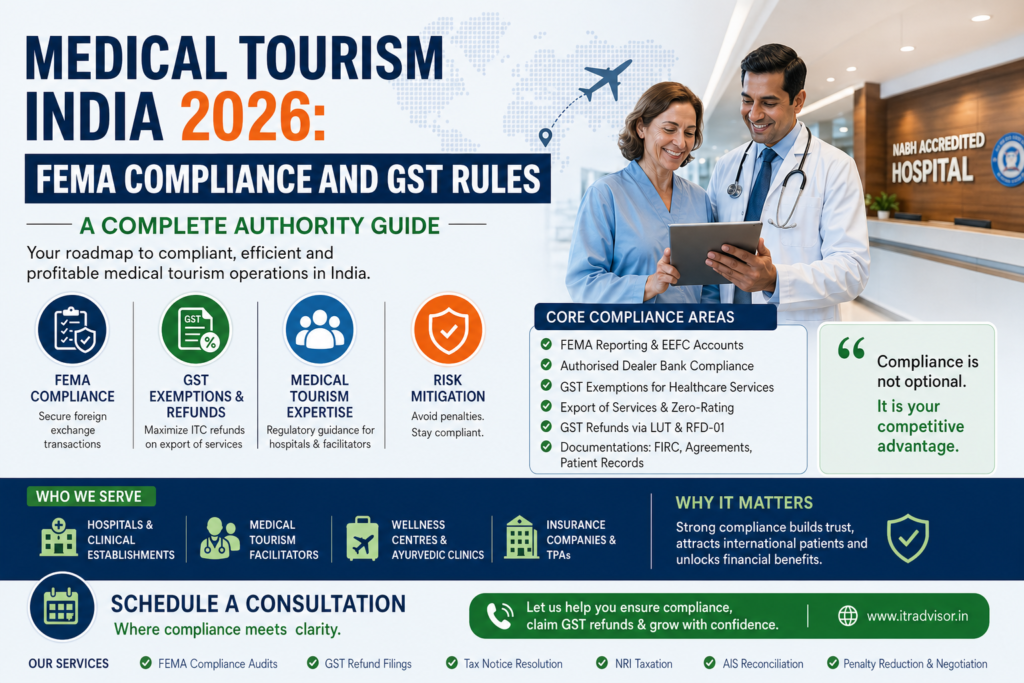
Medical Tourism in India Demands Regulatory Expertise
India’s medical tourism sector was valued at over USD 9 billion and is growing at double-digit rates, driven by 60–80% lower treatment costs than Western nations, NABH accredited hospitals, and an internationally trained medical workforce. Yet this growth story carries a compliance warning: hospitals, medical facilitators, and intermediaries operating in this space face a layered regulatory environment that intersects FEMA 1999, GST law, and RBI master directions.
This guide authored by , with over two decades of advisory experience in healthcare taxation and FEMA compliance provides a comprehensive, legally authoritative reference for every stakeholder in the medical tourism value chain.
Also Read:
Why Foreign Patients Choose India for Medical Tourism
India’s medical tourism proposition rests on four pillars recognized by the Ministry of Tourism, Government of India:
- Cost advantage: A cardiac bypass costing USD 1,30,000 in the United States is performed in India for USD 7,000–10,000 with equivalent outcomes.
- Clinical accreditation: NABH and JCI accredited hospitals in Mumbai, Chennai, Delhi, Hyderabad, and Bengaluru meet international quality standards.
- Specialisation: Cardiac surgery, oncology, orthopaedics, IVF, and Ayurvedic wellness are India’s strongest medical tourism draws.
- Visa facilitation: The Medical Visa (M-Visa) and Medical Attendant Visa (MX-Visa) provide structured legal entry for foreign patients and up to two attendants.
The Regulatory Framework: FEMA 1999 and Medical Tourism
For every hospital and facilitator handling foreign patients, the Foreign Exchange Management Act (FEMA) 1999 governs the receipt, reporting, and use of foreign currency. This is the most frequently overlooked compliance area and the one with the heaviest penalties.
Classification as Service Exporters
Hospitals and medical tourism facilitators receiving foreign currency payments are classified as service exporters under FEMA. This classification triggers a specific set of reporting and banking obligations:
- All foreign currency receipts must be deposited in an Exchange Earners’ Foreign Currency (EEFC) account or converted within RBI-prescribed timelines.
- Medical services provided to foreign patients qualify as ‘export of services’ under FEMA, making them eligible for Advance Authorisation and, where applicable, duty drawback benefits.
- Every foreign currency transaction must be processed through an Authorised Dealer (AD) bank direct offshore receipts held outside the Indian banking system are a FEMA violation.
- Medical facilitators earning commission from overseas principals must receive those commissions in accordance with RBI guidelines on payment for services.
FEMA Compliance Obligations: Quick Reference
| Requirement | Detail |
| Foreign currency receipt | Must be deposited in EEFC account or converted within prescribed timelines |
| Authorized Dealer Bank | All forex transactions routed through AD bank only |
| FIRC (Foreign Inward Remittance Certificate) | Must be obtained for every foreign currency receipt critical for GST refund claims |
| RBI Reporting | Transactions reported per RBI Master Directions; AD bank assists in compliance |
| Compounding for violations | FEMA violations can be compounded voluntarily under Section 15 preferable to ED proceedings |
GST Framework for Medical Tourism: What Is Exempt and What Is Not
The GST treatment of medical tourism services is nuanced. Getting it wrong either by incorrectly charging GST on exempt services or by failing to claim legitimate export-of-service refunds has direct financial consequences.
Core Healthcare Exemption (Notification No. 12/2017-Central Tax (Rate)
Healthcare services provided by a clinical establishment, an authorized medical practitioner, or a paramedic are comprehensively exempt from GST. This exemption covers diagnosis, treatment, and care for illness, injury, deformity, abnormality, or pregnancy and applies equally to Indian and foreign patients.
Practical Example:
A foreign patient undergoing a kidney transplant at a Mumbai hospital pays Rs. 8,00,000 covering surgery, anaesthesia, nursing, medicines, and room rent. The entire amount is GST exempt. No GST should appear on the hospital invoice.
Services That Attract GST in the Medical Tourism Context
| Service Type | GST Rate | Notes |
| Core healthcare services (inpatient/outpatient) | Exempt (0%) | Notification 12/2017-CT(Rate) |
| Medical facilitation / coordination services | 18% | Third-party agent services to foreign patients |
| Cosmetic / aesthetic surgery (non-medical) | 18% | Not covered by healthcare exemption |
| Spa, wellness, yoga packages (non-clinical) | 18% | Unless part of clinical treatment protocol |
| Hotel accommodation for patients | 12%–18% | Depends on daily tariff |
| Air ambulance services | 5% | Specific pharmaceutical/medical rate |
Export of Services and Zero-Rating: Unlocking GST Refunds
When a hospital provides healthcare to a foreign patient and receives payment in foreign currency, the supply qualifies as ‘export of services’ under Section 2(6) of the IGST Act if four conditions are met: (1) the supplier is in India, (2) the recipient is outside India, (3) the place of supply is outside India, and (4) payment is received in foreign exchange.
Zero-rating entitles the hospital to claim a refund of all Input Tax Credit (ITC) paid on inputs and input services a significant financial benefit that the majority of hospitals currently fail to leverage. The refund mechanism requires filing Form GST RFD-01 along with the FIRC, a Letter of Undertaking (LUT filed annually in Form GST RFD-11), and patient admission records.
Compliance Checklist: Medical Tourism Stakeholders 2026
For Hospitals and Clinical Establishments
- Maintain current NABH or JCI accreditation as required by the government’s medical tourism empanelment policy.
- Register as a service exporter with your Authorised Dealer bank and update FEMA compliance documentation annually.
- Obtain and archive FIRC for every foreign currency receipt this is mandatory for both FEMA compliance and GST export-of-service refunds.
- File LUT annually on the GST portal before raising invoices in foreign currency to avoid IGST on exports.
- File GSTR-1, GSTR-3B, and GST RFD-01 correctly for all zero-rated supply periods.
- Never charge GST on core healthcare services verify each billing line item against the exemption notification.
For Medical Tourism Facilitators and Agents
- Register under GST if annual turnover from facilitation services exceeds Rs. 20 lakh (Rs. 10 lakh for special category states).
- Charge 18% GST on all coordination and facilitation fees this is mandatory and non-negotiable.
- Ensure all commission income from foreign principals is received through AD bank channels and documented.
- Maintain written patient referral agreements with overseas principals essential for FEMA and GST documentation.
The Three Most Costly Compliance Mistakes in Medical Tourism
Mistake 1: Charging GST on Exempt Healthcare Services
Adding GST to inpatient hospital bills is both legally incorrect and creates patient dissatisfaction. Every billing line item must be verified against the healthcare exemption notification before any GST is applied.
Mistake 2: Failing to Claim Export-of-Service GST Refunds
Hospitals that treat foreign patients and receive foreign currency are entitled to ITC refunds on all inputs. Failing to file RFD-01 means forfeiting substantial refunds often running into lakhs per financial year.
Mistake 3: Non-Compliance with FEMA Reporting Timelines
Delayed conversion of foreign currency or failure to report receipts to the AD bank are FEMA violations. The Enforcement Directorate can levy penalties and initiate adjudication proceedings. Voluntary compounding under Section 15 of FEMA before the ED initiates action is always the preferred path.
Conclusion: Compliance Is Not Optional It Is Competitive Advantage
Medical tourism is one of India’s most promising growth sectors, but it operates in a tightly regulated environment. Hospitals and facilitators that build robust FEMA and GST compliance frameworks not only protect themselves from enforcement action they build the institutional credibility that attracts international patients and overseas referral partnerships.
For specialised guidance on FEMA compliance audits, GST refund filings, and structuring agreements with overseas medical facilitators, consult Adwani & Company. Visit www.itradvisor.in to schedule a consultation.
Frequently Asked Questions
1. Is GST applicable on hospital charges paid by a foreign patient in India?
No, core healthcare services provided by clinical establishments are exempt from GST, irrespective of whether the patient is Indian or foreign.
2. Can a hospital claim GST refund when treating foreign patients?
Yes. If payment is received in foreign exchange and the conditions for ‘export of services’ under IGST are satisfied, the hospital can claim a refund of ITC paid on inputs.
3. What FEMA compliance is required for receiving payment from foreign medical tourists?
Payments must be routed through authorised dealer banks, deposited within prescribed timelines, and reported correctly. A FIRC must be obtained for each foreign currency receipt..
4. Is cosmetic surgery for foreign patients subject to GST?
Yes. Cosmetic or aesthetic surgeries not performed to treat illness or deformity attract 18% GST. Only medically necessary procedures fall within the healthcare exemption.
5. What is a Letter of Undertaking (LUT) in the context of medical tourism GST?
An LUT (filed in Form GST RFD-11) allows a registered taxpayer to export services without paying IGST upfront. Hospitals serving foreign patients should file the LUT annually on the GST portal before raising invoices in foreign currency.
6. Do medical tourism agents or facilitators need to register under GST?
Yes. If a facilitator’s annual turnover from facilitation services exceeds Rs. 20 lakh (Rs. 10 lakh for special category states), GST registration is mandatory and 18% GST must be charged on coordination and facilitation fees.7
7.Can FEMA violations in medical tourism be compounded?
Yes. Under Section 15 of FEMA, violations can be compounded by the RBI’s Compounding Authority on application. It is strongly advisable to seek voluntary compounding before the Enforcement Directorate initiates proceedings..
Dr. Haresh Adwani is a PHD Holder In commerce with 20 years of experience in income tax compliance, NRI taxation, international financial advisory, and tax notice resolution. Medical tourism Tax advisor Pune,
Services: ITR filing • Tax notice resolution • AIS reconciliation • NRI taxation • Financial footprint analysis • Penalty reduction & negotiation
Schedule a consultation: Adwani & Company Where compliance meets clarity.