
NRI Returning to India ? Tax Rules You Must Know Before Filing ITR for AY 2026-27

CA Dipesh Gurubakshani June 2026 7 min read
NRI Returning to India After Working Abroad? Understand Your Tax Status Before Filing ITR
Thousands of Non-Resident Indians (NRIs) return to India every year after working in countries such as the USA, UK, UAE, Canada, Australia, Singapore, and other parts of the world.
One of the biggest mistakes returning NRIs make is assuming that all their foreign income automatically becomes taxable in India.
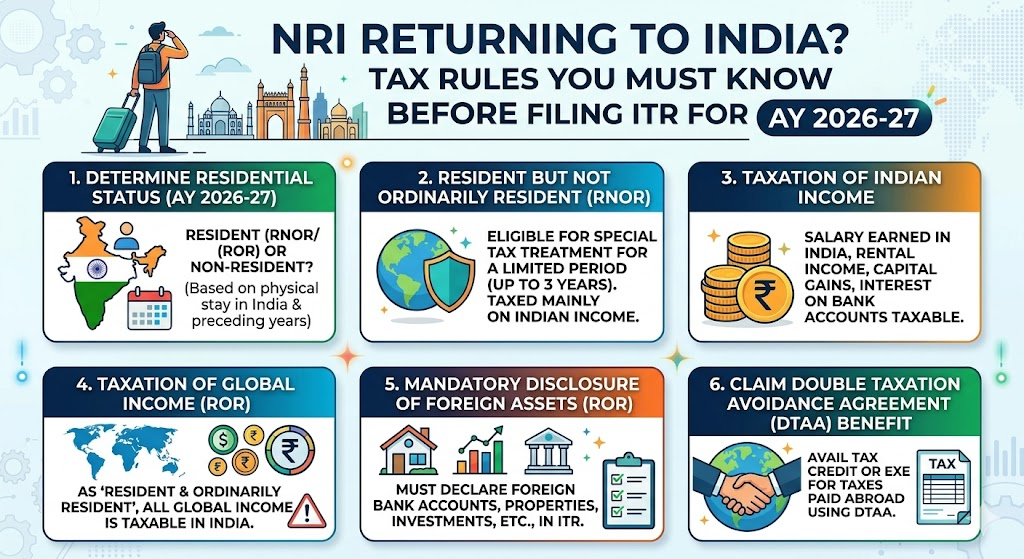
The reality is different.
Your tax liability depends on your residential status under the Income Tax Act, which may be classified as:
- Non-Resident (NRI)
- Resident but Not Ordinarily Resident (RNOR)
- Resident and Ordinarily Resident (ROR)
Understanding these categories can help you save tax legally and avoid costly mistakes while filing your Income Tax Return (ITR) for AY 2026-27.
Why Determining Residential Status Is Important
Your residential status determines:
- Whether foreign income is taxable in India
- Whether foreign bank accounts need disclosure
- Whether foreign assets need reporting
- Eligibility for tax benefits
- Applicable ITR forms
Even a small mistake in determining residential status can result in notices, penalties, or double taxation issues.
Resident vs NRI vs RNOR – Understanding the Difference
1. Non-Resident Indian (NRI)
You are generally treated as an NRI if your stay in India during the relevant financial year does not exceed the prescribed limits under the Income Tax Act.
For NRIs:
Taxable in India
✔️ Salary received in India
✔️ Rental income from Indian property
✔️ Capital gains from Indian assets
✔️ Interest on Indian bank deposits (subject to applicable provisions)
Not Taxable in India
✔️ Salary earned abroad
✔️ Foreign business income
✔️ Foreign investment income
✔️ Foreign rental income
2.Resident but Not Ordinarily Resident (RNOR)
RNOR is a special transitional status available to many NRIs returning to India.
This status can provide significant tax benefits.
A returning NRI may qualify as RNOR depending upon past residential history and conditions prescribed under the Income Tax Act.
Read our Detailed guide on:The 120-Day Rule That Is Silently Taxing Thousands of NRIs in India :Are You at Risk?
Major Benefit of RNOR Status
During the RNOR period:
✔️ Foreign income generally remains outside Indian taxation, provided it is not derived from a business controlled from India or a profession set up in India.
✔️ Global income disclosure requirements are comparatively relaxed compared to Resident and Ordinarily Resident taxpayers.
For many returning NRIs, RNOR status can result in substantial tax savings.
3. Resident and Ordinarily Resident (ROR)
Once RNOR benefits expire, an individual may become Resident and Ordinarily Resident.
This is the most comprehensive tax category.
Taxable in India
✔️ Indian income
✔️ Foreign salary
✔️ Foreign interest income
✔️ Foreign rental income
✔️ Foreign dividends
✔️ Foreign capital gains
✔️ Global income from all sources
In other words, worldwide income generally becomes taxable in India.
Taxability of Foreign Income After Returning to India
One of the most frequently asked questions is:
“Do I need to pay tax in India on my foreign income after returning?”
The answer depends on your residential status.
Type of Income NRI RNOR ROR
Foreign Salary Not Taxable Generally Not Taxable Taxable
Foreign Bank Interest Not Taxable Generally Not Taxable Taxable
Foreign Rental Income Not Taxable Generally Not Taxable Taxable
Foreign Capital Gains Not Taxable Generally Not Taxable Taxable
Indian Rental Income Taxable Taxable Taxable
Therefore, determining RNOR eligibility can have a major impact on tax planning.
Foreign Bank Accounts : Disclosure Requirements
Many NRIs maintain
- Savings accounts abroad
- Salary accounts
- Investment accounts
- Retirement accounts
- Brokerage accounts
Once you become Resident and Ordinarily Resident, disclosure of foreign assets and accounts becomes extremely important.
Failure to disclose foreign assets may attract severe consequences under applicable laws.
Before filing your ITR, review:
- Foreign bank accounts
- Foreign shares
- Mutual funds
- Retirement accounts
- Real estate holdings
- Foreign insurance policies
Proper disclosure is essential for compliance.
Common Mistakes Returning NRIs Make
- Assuming RNOR Benefits Automatically Apply
Many taxpayers assume they are RNOR without verifying eligibility.
Always calculate residential status carefully.
- Ignoring Foreign Income
Some returning NRIs continue receiving:
- Foreign salary arrears
- Overseas pension
- Interest income
- Dividends
The tax treatment depends on residential status.
- Not Reviewing Double Taxation Relief
India has tax treaties with many countries.
Failure to claim treaty benefits may result in paying more tax than necessary.
- Incorrect ITR Form Selection
Using the wrong ITR form can lead to defective return notices and processing delays.
- Non-Disclosure of Foreign Assets
Many returning NRIs are unaware of disclosure requirements applicable after becoming Resident and Ordinarily Resident.
This is one of the most serious compliance errors.
- Continuing NRO/NRE Accounts Without Review
Returning NRIs should review banking arrangements and ensure compliance with RBI and income tax regulations.
Example
Returning NRI from UAE
Mr. Shah worked in Dubai for 12 years and permanently returned to India during FY 2025-26.
He continues to hold:
- UAE bank deposits
- Foreign mutual funds
- Rental property in Dubai
If he qualifies as RNOR, foreign income may continue to enjoy favourable tax treatment during the RNOR period, subject to applicable provisions.
However, once he becomes Resident and Ordinarily Resident, worldwide income may become taxable in India.
Understanding this transition can help avoid unnecessary tax liability.
Checklist Before Filing ITR for AY 2026-27:
✅ Determine residential status correctly
✅ Evaluate RNOR eligibility
✅ Review foreign income sources
✅ Check tax treaty benefits
✅ Verify foreign asset disclosures
✅ Select the correct ITR form
✅ Reconcile foreign tax credits
✅ Review NRE and NRO accounts
✅ Maintain supporting documentation
Frequently Asked Questions (FAQs)
1.Can a returning NRI claim RNOR status?
Yes, subject to satisfying the conditions prescribed under the Income Tax Act.
2.Is foreign salary taxable after returning to India?
It depends on your residential status and the period to which the salary relates.
3.Are foreign bank accounts required to be disclosed?
Disclosure requirements depend on residential status and applicable reporting provisions.
4.Can I claim credit for foreign taxes paid?
Yes, relief may be available under Double Taxation Avoidance Agreements (DTAAs) and other provisions, subject to conditions.
5.Is foreign rental income taxable in India?
It depends on whether you are NRI, RNOR, or Resident and Ordinarily Resident.
Author
CA Dipesh Gurubakshani is a Chartered Accountant with Adwani & Co LLP, Pune, specialising in income tax audit, direct taxation, and accounting advisory. He supports clients across statutory compliance, financial reporting, and income tax matters with a focus on accuracy, regulatory adherence, and disciplined execution.
Need Professional Assistance With NRI Tax Filing?
Returning to India can create complex tax issues involving:
- RNOR status determination
- Foreign income taxation
- DTAA benefits
- Foreign tax credit claims
- Foreign asset disclosures
- NRI and returning resident tax planning
At ITR Advisor, we assist NRIs and returning Indians worldwide with accurate tax compliance and strategic tax planning.
If you have recently returned to India or plan to return soon, consult our NRI tax experts before filing your Income Tax Return for AY 2026-27.
Disclaimer: ITRAdvisor.in is an educational and informational platform focused on tax awareness and compliance updates. Nothing contained herein should be construed as solicitation or advertisement of professional services. Professional services, where applicable, are rendered in accordance with ICAI guidelines. This article is published on ITRAdvisor.in, a tax and compliance knowledge platform. The content has been reviewed for technical accuracy by professionals associated with Adwani & Co LLP.