
Same Water. Different GST. A Lesson in Classification.2026
Same Water. Different GST
Two bottles of water sit on the same shelf. Same factory. Same liquid inside. But one attracts 5% GST and the other attracts 28% plus cess. Why different GST ?If that surprises you, you are not alone.
The GST classification of water is one of the most practically important and most misunderstood areas of GST compliance for businesses in India’s food, beverage, hospitality, and FMCG sectors. And yet, hundreds of businesses continue to apply a blanket rate based on the word ‘water’ on the label, without ever mapping the product to its correct HSN code.
The result is predictable: short payment of GST, mismatched GSTR-3B filings, wrong input tax credit claims, and increasingly in 2026 a GST show cause notice from a department that now cross-verifies e-invoices, e-way bills, and return filings in near real time.
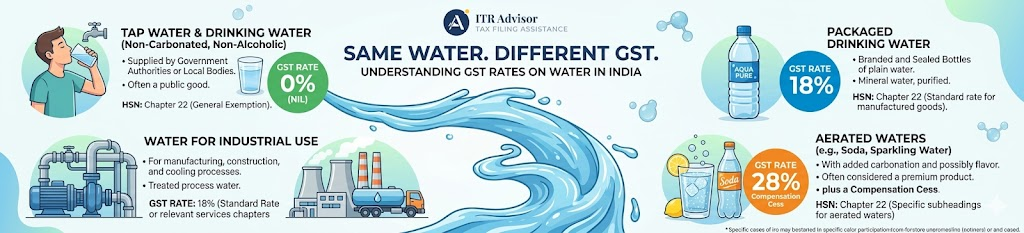
GST Classification of Water: Why ‘Same Product’ Is Never Simple
Under India’s GST framework, tax liability follows the product’s HSN (Harmonised System of Nomenclature) classification not the product’s name or its physical appearance. The GST Council has assigned water products across two distinct chapters of the tariff schedule, and the applicable rate depends entirely on what has been added, how the water has been processed, and how it is packaged and sold. This is why the GST compliance checklist for any business selling water products must begin with a classification check not a rate assumption
GST Rate on Water Products: Complete HSN Classification Table 2026
| Water / Beverage Category | HSN Code | GST Rate | Deciding Factor |
| Tap water / municipal supply | 2201 | NIL | Supplied through distribution system |
| Pipeline-supplied water | 2201 | NIL | Non-commercial, public utility |
| Packaged drinking water (≤20 L) | 2201 | 12% | Commercially packaged & sealed |
| Packaged drinking water (>20 L) | 2201 | 5% | Bulk jars, post-GST Council revision |
| Natural mineral water (bottled) | 2201 | 12% | Commercially bottled for sale |
| Plain soda / aerated water | 2201 | 18% | Carbonated, no added sugar or flavour |
| Flavoured / sweetened water | 2202 | 28% + Cess | Any added sugar, flavour, or sweetener |
| Carbonated soft drinks / cola | 2202 | 28% + Cess | Sweetened aerated beverages |
| Ice (commercial) | 2201 | 18% | Manufactured ice sold commercially |
2026 Rate Alert Packaged drinking water in bottles up to 20 litres now attracts 12% GST revised upward from the earlier 5% rate. Bulk jars above 20 litres continue at 5%. Verify your current rate master against the GST Portal (gst.gov.in) before your next GSTR-3B filing.
Wrong GST Classification: What It Actually Costs a Business
Consider a distributor supplying three water products: 1-litre mineral water bottles, 500 ml flavoured water pouches, and bulk 20-litre packaged water jars. If mineral water is billed at 5% instead of 12%, and flavoured water at 12% instead of 28%, the monthly GST short-payment on a combined turnover of ₹15 lakh can easily exceed ₹1 lakh and over a financial year, that exposure compounds to a significant tax liability plus interest at 18% per annum under Section 50 of the CGST Act.
Under the GST compliance framework, this is treated as a short payment and depending on whether the assessing officer determines it was the result of negligence or otherwise, penalties under Sections 122 to 125 of the CGST Act may also follow.
As Dr. Haresh Adwani, PhD in Commerce and law graduate, notes from advisory practice: classification disputes are among the most litigated areas of GST today and most of them were avoidable with a single HSN verification before billing began.
3 Reasons GST Classification Errors on Water Products Keep Happening
- Billing teams classify by product name, not HSN code ‘water’ gets one rate across all variants
- Rate masters set up at GST registration 2016 or 2017 were never updated after GST Council revisions
- Carbonated and non-carbonated products are treated identically missing the Chapter 2201 vs 2202 distinction that determines whether the rate is 18% or 28% plus cess
The GST e-invoicing mandatory threshold now covers a significant share of businesses, and every HSN code on an e-invoice is visible to the department’s analytics system. Businesses that have been getting away with wrong classification in a paper-based world will find that window closing in 2026.
Quick GST Compliance Checklist: Water & Beverages
1. Map every water product to HSN 2201 or 2202 never classify by product name alone
2. Check whether carbonation + added sugar/flavour moves the product to Chapter 2202 (28% + cess)
3. Confirm the current rate on gst.gov.in packaged water rates changed in recent Council meetings
4. Reconcile your GSTR-2B input tax credit against correctly classified purchase invoices 5. Review your GST e-invoicing setup to ensure HSN codes auto-populate correctly from your ERP
Key Takeaways
- GST classification of water depends on HSN code, not the product label Chapter 2201 vs 2202 determines everything
- Packaged drinking water (≤20L): 12% | bulk jars (>20L): 5% | plain soda: 18% | flavoured/sweetened: 28% + cess
- Wrong classification = short payment, 18% p.a. interest, ITC mismatch, and possible GST show cause notice
- The GST Portal now cross-checks e-invoice HSN data with GSTR-3B filings errors are increasingly auto-flagged
- A one-time classification review of your entire product portfolio can protect years of GSTR-3B filing accuracy
→ Read our detailed guide on GST Show Cause Notice: Meaning, Types & How to Reply
→ Learn more: GST Compliance Checklist 2026 Monthly, Quarterly & Annual Returns
Frequently Asked Questions on GST Classification of Water
Q1. What is the GST rate on packaged drinking water in India 2026?
Packaged drinking water in bottles or pouches up to 20 litres attracts 12% GST under HSN 2201; bulk jars above 20 litres are taxed at 5%. Always verify the current rate on gst.gov.in before filing.
Q2. Why is flavoured water taxed at 28% GST while plain mineral water is taxed at 12%?
Adding sugar, flavouring, or sweeteners moves the product from HSN Chapter 2201 to Chapter 2202, which attracts 28% GST plus compensation cess. The composition not the physical form determines the classification.
Q3. Can wrong GST classification of a water product trigger a GST show cause notice?
Yes. The department’s analytics system flags HSN-wise rate mismatches between GSTR-1 and GSTR-3B, and wrong classification leading to short payment can result in a Section 73 demand notice with interest and penalties.
Q4. What is the HSN code for mineral water under GST?
Natural mineral water whether sparkling or still falls under HSN 2201 and attracts 12% GST when commercially packaged and sold. Tap water and pipeline supply remain at NIL.
Q5. How does GST e-invoicing affect classification compliance for water products?
Every HSN code reported on a mandatory e-invoice is visible to the GSTN analytics system; wrong HSN codes auto-surface in GSTR-2B reconciliation and can trigger scrutiny before a return is even reviewed manually.
Conclusion
before asking ‘What is the GST rate?’, ask ‘How is my product classified?’ That sequence is not just a mindset shift — it is the practical foundation of correct GST compliance for every business that deals in water, beverages, food, or any other classified good.
The GST classification of water tells us everything we need to know about how the entire GST framework works: the rate follows the classification, and the classification follows the HSN code not the product name, not the price, and not what a competitor is charging.
For businesses with multi-product portfolios, a periodic classification review is no longer optional. It is basic tax hygiene in 2026.
About the Author – Nidhi Adwani
Nidhi Adwani is the Human Resources Manager at Adwani & Co. She is a Law Graduate and holds an MBA in Human Resources. She manages recruitment, employee engagement, team development, workplace culture, and the firm’s social media and content activities. Passionate about people and organizational growth, she also contributes articles for ITRAdvisor and Adwani & Co. Her writing focuses on HR practices, leadership, workplace engagement, and professional development, offering practical insights for professionals and businesses.
Visit ITRAdvisor.in today for professional guidance and consultation.
Early action can often prevent bigger tax problems later.