
Salary Above ₹10 Lakh? Don’t File Your ITR Until You Check These 12 Tax-Saving Opportunities

Nidhi Adwani June 2026 6min Read
Many salaried employees assume that once TDS has been deducted by their employer, there is little they can do to save tax.
That assumption often results in taxpayers paying more tax than legally required.
Every year, we meet salaried professionals earning ₹10 lakh, ₹20 lakh, ₹30 lakh or even higher salaries who miss important deductions, exemptions, and disclosures while filing their Income Tax Return (ITR).
The result?
- Higher tax outgo
- Reduced refunds
- Incorrect return filing
- Future notices due to reporting mistakes
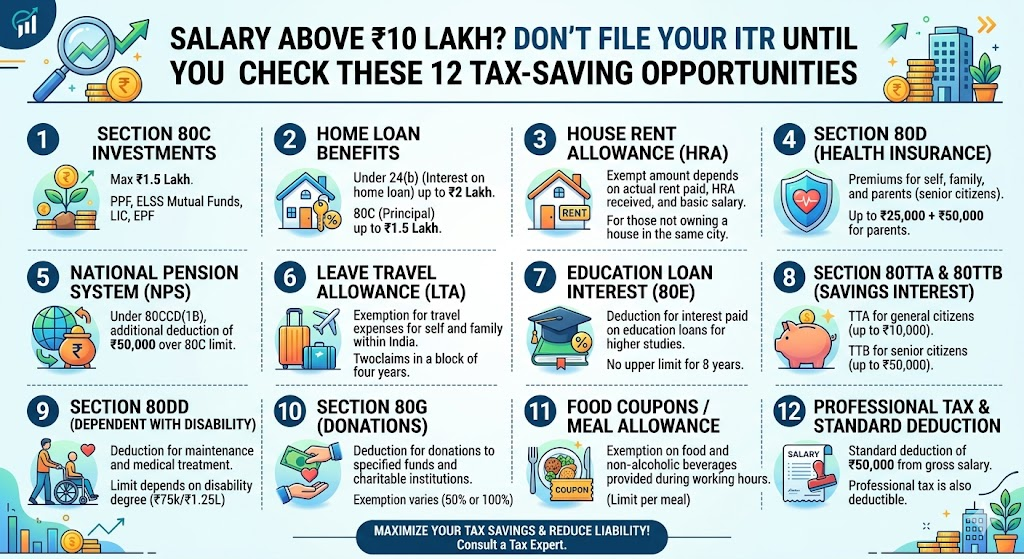
Before filing your ITR for AY 2026-27, review these 12 important tax-saving opportunities.
1.Section 80C Investments : Up to ₹1.5 Lakh Deduction
Under the Old Tax Regime, Section 80C remains one of the most popular deductions.
Eligible investments include:
- Employee Provident Fund (EPF)
- Public Provident Fund (PPF)
- ELSS Mutual Funds
- Life Insurance Premium
- Tax Saving Fixed Deposits
- Principal Repayment of Home Loan
- Sukanya Samriddhi Yojana
Many taxpayers invest throughout the year but forget to claim the full deduction while filing.
2.Health Insurance Premium : Section 80D
Health insurance can provide valuable tax benefits.
Deduction limits generally include:
- Self and family
- Parents
- Senior citizen parents
Many salaried individuals fail to claim premiums paid for parents.
This often results in avoidable tax payments.
3.Home Loan Interest Deduction
If you have a housing loan for a self-occupied property, interest paid may qualify for deduction under applicable provisions of the Income Tax Act.
Common mistakes include:
- Claiming incorrect amounts
- Ignoring co-borrower benefits
- Not collecting annual interest certificates
4. House Rent Allowance (HRA)
Even high-income salaried employees frequently make HRA mistakes.
Common issues include:
- Incorrect rent calculations
- Missing landlord PAN details
- Not maintaining rent receipts
A properly computed HRA claim can significantly reduce taxable income.
5.National Pension System (NPS) Benefits
NPS offers additional tax-saving opportunities beyond Section 80C.
Many salaried taxpayers overlook employer contributions and available deductions while filing their return.
A review of salary structure often reveals missed tax benefits.
6. Interest Income Deductions
Interest earned from:
- Savings accounts
- Fixed deposits
- Recurring deposits
must be reported correctly.
While reporting is mandatory, certain deductions may be available under applicable provisions.
Many taxpayers either forget to disclose interest income or fail to claim eligible deductions.
7.Education Loan Interest
Interest paid on education loans may qualify for deduction subject to conditions.
This benefit is often missed by:
- Young professionals
- Working executives
- Parents servicing eligible education loans
8.Donations Under Section 80G
Donations made to eligible institutions may qualify for tax deductions.
Before claiming:
✔️ Verify registration details
✔️ Maintain donation receipts
✔️ Ensure compliance with applicable rules
Incorrect claims can trigger scrutiny.
9.Leave Travel Allowance (LTA)
Employees receiving LTA often forget to claim eligible exemptions.
Important considerations include:
- Travel documentation
- Eligible family members
- Conditions prescribed under tax laws
Review your salary structure before filing your return.
10.Additional Benefits for Homeowners
Apart from standard housing loan benefits, taxpayers may be eligible for additional deductions depending on circumstances and applicable provisions.
Professional review can help identify opportunities often missed in self-filed returns.
11. Choosing the Right Tax Regime
One of the biggest mistakes today is selecting the wrong tax regime.
Many taxpayers automatically accept the regime chosen by their employer without performing a proper comparison.
A detailed tax computation can determine whether:
- Old Tax Regime is beneficial
- New Tax Regime is beneficial
- The difference can amount to thousands or even lakhs of rupees.
12. Reviewing AIS Before Filing ITR
This is perhaps the most overlooked step.
Before filing:
- ✔️ Download AIS
- ✔️ Review interest income
- ✔️ Verify dividend income
- ✔️ Check mutual fund transactions
- ✔️ Confirm share transactions
- ✔️ Match TDS details
Also Read: How a Smart AIS Review Before Filing ITR Can Save Salaried Taxpayers from Costly Income Tax Notices in AY 2026-27https://itradvisor.in/blog/smart-ais-review-before-filing-itr
Many notices issued by the Income Tax Department arise due to AIS mismatches.
- Common Mistakes Salaried Taxpayers Make
- Every filing season, we frequently see taxpayers making these errors:
- ❌ Selecting the wrong ITR form
- ❌ Missing interest income
- ❌ Ignoring capital gains from shares or mutual funds
- ❌ Choosing the wrong tax regime
- ❌ Claiming incorrect deductions
- ❌ Not reviewing AIS and Form 26AS
- ❌ Filing returns based solely on Form 16
These mistakes can lead to:
- Reduced refunds
- Additional tax demands
- Income tax notices
- Delayed processing
Case Study:
How a Salaried Employee Saved Tax Through Proper Review
A salaried employee earning ₹18 lakh annually approached us after preparing his return independently.
He believed there was no further tax planning possible because TDS had already been deducted.
During our review, we identified:
- Unclaimed health insurance deduction
- Missed NPS benefits
- Incorrect tax regime selection
- Reporting gaps in investment disclosures The result was a significantly improved tax position and a correctly filed return. This is why professional review becomes increasingly valuable as income levels rise. Why High-Income Salaried Employees Should Not Depend Only on Form 16 Form 16 is important, but it is not a complete tax filing document.
Your return may also need to account for:
- Bank interest
- Dividend income
- Capital gains
- Foreign assets
- Rental income
- Multiple employers
- ESOP transactions
- Freelance income
- Relying only on Form 16 can lead to incomplete reporting.
Frequently Asked Questions
1.Is Form 16 sufficient for filing ITR?
Not always. Additional income and disclosures may also need to be reported
2.Can incorrect deduction claims trigger a notice?
Yes. Unsupported or incorrect claims can attract scrutiny from the Income Tax Department.
3.Is salary above ₹10 lakh taxable under the new regime?
Yes. Taxability depends on total income, deductions, rebates, and applicable tax provisions.
4.Should salaried employees choose the old or new tax regime?
The answer varies from person to person. A tax comparison should be performed before filing.
5.Can I claim deductions after my employer has deducted TDS?
In many cases, eligible deductions can still be claimed while filing your return, subject to applicable provisions.
Need Help Filing Your ITR?
If your salary income exceeds ₹10 lakh, a professional review can help ensure:
✅ Correct tax regime selection
✅ Maximum eligible tax benefits
✅ Proper AIS reconciliation
✅ Accurate reporting of all income
✅ Error-free ITR filing
✅ Reduced risk of notices
At Adwani & Co. ITR Advisor, we assist salaried professionals across India with accurate, compliant, and tax-efficient return filing.
Our Services
- Salaried ITR Filing
- Tax Regime Comparison
- AIS & Form 26AS Review
- Capital Gains Reporting
- ESOP Taxation
- NRI Taxation
- Notice Assistance
- Refund Optimization
Book Your ITR Review Today
Don’t assume your employer has taken care of everything.
A professional review before filing can help you avoid costly mistakes and identify tax-saving opportunities that are often overlooked.
Contact Adwani & Co. today and file your return with confidence.