Tag: GST compliance India

  • Complete GST Compliance Checklist for Small Businesses in Pune: Essential Guide for FY 2026–27

    Complete GST Compliance Checklist for Small Businesses in Pune: Essential Guide for FY 2026–27

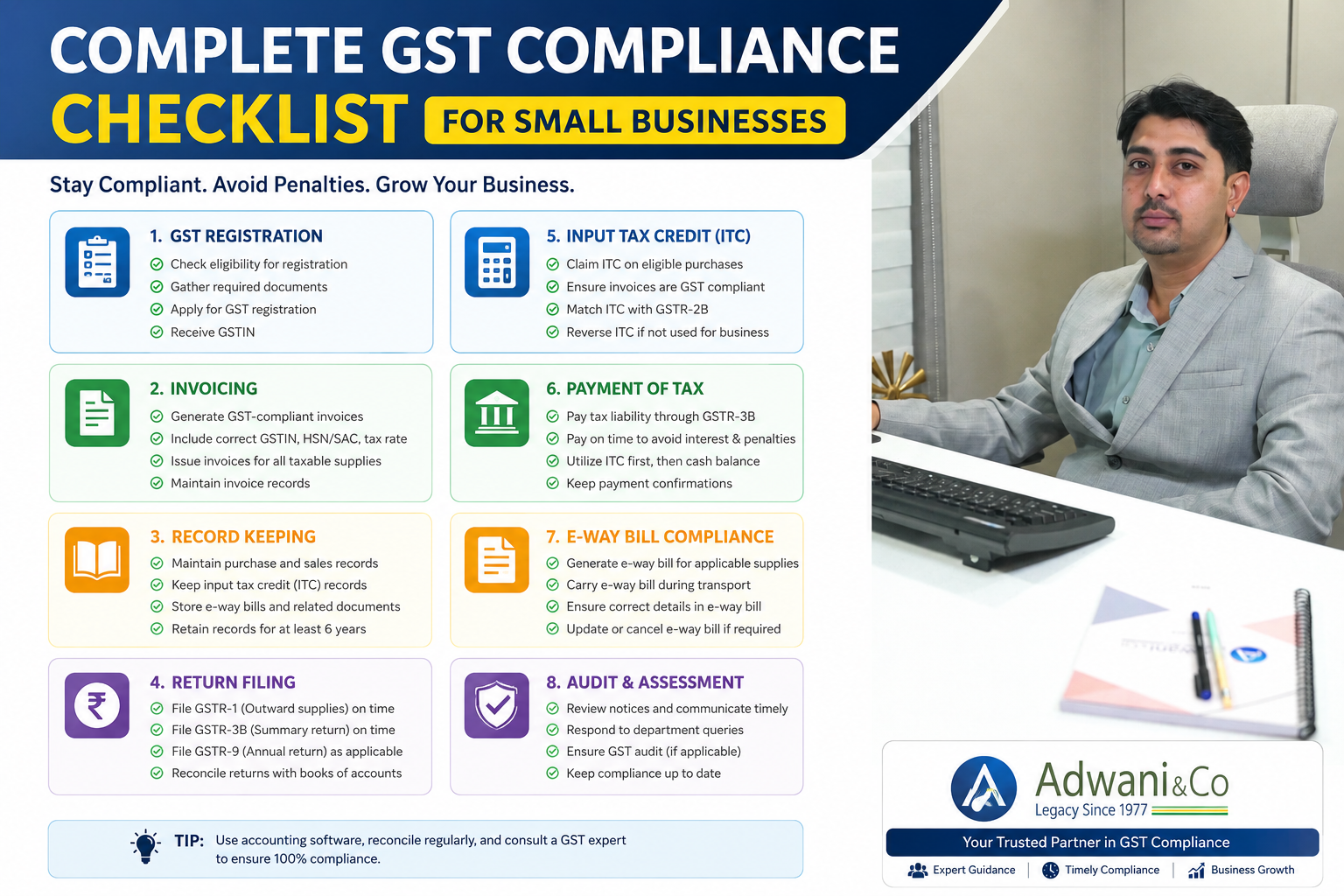
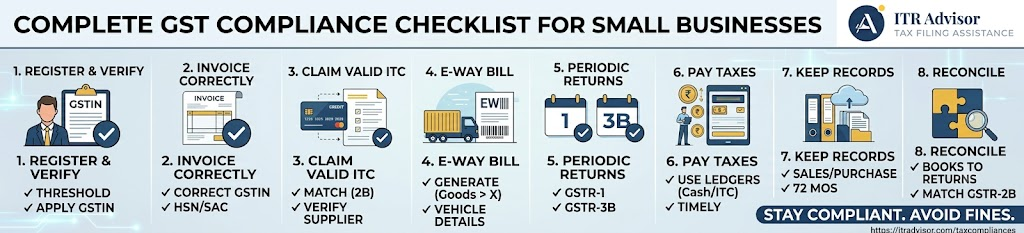
    GST Compliance Checklist for Small Businesses in Pune

    Running a small business in Pune whether it is a trading shop in Chinchwad, a manufacturing unit in Bhosari MIDC, a restaurant in Koregaon Park, or a service firm in Baner means navigating one of the most compliance-dense tax frameworks in India. GST is not a one-time registration event; it is a continuous, monthly, quarterly, and annual cycle of filings, reconciliations, and record-keeping. Miss a deadline and the penalties start adding up. Miss a reconciliation and your Input Tax Credit evaporates. Miss a compliance threshold and you risk GST notices, scrutiny, or worse, cancellation of your GST registration. This checklist exists so that Pune’s small business owners never have to miss a step.
    Step 1: GST Registration Compliance for Small Businesses in Pune

    Before anything else, confirm that your GST registration status is current and accurate. Under the GST Act, registration is mandatory if your annual aggregate turnover exceeds ₹40 lakh (for goods suppliers) or ₹20 lakh (for service providers) in Maharashtra. Businesses making inter-state supplies, e-commerce sellers, and those liable for reverse charge mechanism (RCM) must register regardless of turnover.

    GST compliance checklist for registration:

    • Verify that your GSTIN is active on the GST Portal (gst.gov.in) under the ‘Search Taxpayer’ function.
    • Ensure all business addresses including godowns, branches, or additional Pune locations are declared as additional places of business in your GST registration.
    • Confirm that your principal place of business, HSN/SAC codes, and authorised signatory details are up to date.
    • If your turnover has crossed the mandatory threshold during FY 2026-27, apply for GST registration immediately — delayed voluntary registration is treated as non-compliance.
    • If you opted for the GST Composition Scheme (available for eligible Pune traders and manufacturers with turnover up to ₹1.5 crore), verify you are filing CMP-08 quarterly and GSTR-4 annually.

    Step 2: GST Return Filing Deadlines for FY 2026–27 : Complete Calendar for Pune Businesses

    The most common cause of GST notices for small businesses in Pune is missed or delayed return filings. The GST return compliance calendar for FY 2026-27 is as follows:

    Return / FilingWho Must FileDue Date (FY 2026-27)Penalty for Late Filing
    GSTR-1 (Monthly)Regular taxpayers with turnover > ₹5 crore11th of following month₹50/day (nil return ₹20/day), max ₹10,000
    GSTR-1 (Quarterly/IFF)QRMP scheme taxpayers (turnover ≤ ₹5 crore)13th of month after quarter-end₹50/day, max ₹10,000
    GSTR-3B (Monthly)Regular taxpayers (auto-populated from FY 2025-26)20th/22nd/24th (based on state/zone)₹50/day + 18% interest on tax due
    GSTR-3B (Quarterly)QRMP scheme taxpayers22nd/24th after quarter-end₹50/day + 18% interest on tax due
    GSTR-9 (Annual Return)Turnover > ₹2 crore (FY 2025-26 basis)31st December 2026₹200/day, max 0.25% of turnover
    GSTR-9C (Reconciliation)Turnover > ₹5 crore31st December 2026Same as GSTR-9 penalty structure
    CMP-08 (Composition)Composition scheme taxpayers18th of month after quarter-end₹50/day, max ₹2,000
    GSTR-4 (Composition Annual)Composition scheme taxpayers30th April 2027₹50/day, max ₹2,000

    For Pune businesses on the QRMP (Quarterly Return Monthly Payment) scheme, note that tax must still be paid monthly either through the Fixed Sum Method or Self-Assessment Method even though the return itself is quarterly. QRMP is generally the right choice for Pune MSMEs and small traders with turnover below ₹5 crore.

    Step 3: Input Tax Credit (ITC) Reconciliation: The Most Critical GST Compliance Task

    Input Tax Credit is the primary financial benefit of GST registration for small businesses in Pune. But ITC can be claimed only if the conditions under Section 16 of the CGST Act are satisfied and this is where most Pune small business owners inadvertently lose money.

    ITC GST Compliance Checklist for FY 2026-27

    • Reconcile GSTR-2B (auto-generated ITC statement) with your purchase register and books of accounts every month before filing GSTR-3B.
    • ITC is available only if the supplier has filed GSTR-1 and the invoice appears in your GSTR-2B. Follow up actively with non-compliant suppliers whose invoices are missing.
    • Ensure ITC is claimed within the time limit: for FY 2025-26 invoices, the deadline to claim ITC is the earlier of the due date of September 2026 GSTR-3B or the date of filing the annual return.
    • Do not claim ITC on blocked credits under Section 17(5) of the CGST Act these include motor vehicles (with exceptions), food and beverages, personal use goods, and construction services.
    • If you have both taxable and exempt supplies, calculate and reverse ineligible ITC under the proportionate method as required by the CGST Rules.

    Step 4: E-Invoicing Compliance for Pune Small Businesses

    The GST e-invoicing threshold has been progressively lowered by CBIC. As of FY 2026-27, e-invoicing under the GST framework is mandatory for all registered taxpayers with aggregate annual turnover exceeding ₹5 crore in any preceding financial year. For many growing Pune traders, manufacturers, and service exporters, this threshold is now a near-term reality.

    E-invoicing GST compliance checklist:

    • Verify whether your FY 2024-25 or FY 2025-26 turnover crossed ₹5 crore if yes, e-invoicing is mandatory for all B2B transactions from the applicable date.
    • Ensure your accounting or ERP software is integrated with the Invoice Registration Portal (IRP) at einvoice1.gst.gov.in to generate an IRN (Invoice Reference Number) and QR code for each B2B invoice.
    • E-invoices issued without an IRN are invalid for ITC purposes — your buyer in Pune or elsewhere cannot claim ITC on such invoices, which can damage your business relationships.
    • Retain copies of all e-invoices with IRN for at least six years as required under the GST record-keeping rules.

    Step 5: GST Record-Keeping and Audit Trail Requirements

    Under Section 35 of the CGST Act, every registered taxpayer must maintain a complete set of records at the principal place of business — or at each additional place of business in Pune — for a minimum of six years from the due date of the annual return for that year.

    Records that must be maintained for GST compliance checklist:

    • Purchase invoices, sales invoices, debit notes, and credit notes for all inward and outward supplies.
    • Stock registers showing opening stock, purchases, production/manufacture, sales, and closing stock with HSN classification.
    • Input Tax Credit ledger, Electronic Cash Ledger, and Electronic Liability Register (accessible on the GST Portal).
    • Bank statements reconciled with GST turnover for the year.
    • For exporters and SEZ suppliers: shipping bills, LUTs (Letter of Undertaking), and refund applications filed.

    Key Takeaways:

    •  GST registration is mandatory for Pune businesses with turnover above ₹40L (goods) or ₹20L (services). Verify your GSTIN is active on gst.gov.in.

    •  File GSTR-1 and GSTR-3B on time every month or quarter. Late filing penalties start at ₹50/day and interest at 18% on unpaid tax accrues daily.

    •  Reconcile GSTR-2B with your purchase register monthly before filing GSTR-3B this is the single most important step to protect your ITC.

    •  E-invoicing is mandatory for businesses with turnover above ₹5 crore. Invoices without a valid IRN from the IRP portal are ineligible for ITC.

    •  Composition scheme taxpayers in Pune must file CMP-08 quarterly and GSTR-4 annually by April 30, 2027.

    •  Maintain all GST records for six years. The GST Department conducts audits and scrutiny up to six years from the relevant annual return due date.

    Step 6: Common GST Compliance Mistakes That Pune Small Businesses Must Avoid

    Reconciliation skipped: Filing GSTR-3B without cross-checking GSTR-2B leads to incorrect ITC claims, reversal demands, and scrutiny notices.

    Turnover under-reporting: GST officers increasingly use e-way bill data, e-invoicing records, and bank statement analysis to detect turnover mismatches.

    RCM non-compliance: Reverse Charge Mechanism liability on services like legal fees, GTA freight, and import of services is often missed by small businesses.

    HSN code errors: Incorrect HSN/SAC classification leads to wrong tax rate application and potential demand with interest.

    Debit/Credit note delays: Credit notes for sales returns or rate revisions must be issued and declared within the prescribed time limits to avoid ITC reversal complications for your buyers.

    Read our detailed guide on GST Compliance Checklist India 2026: 7 Essential Rules to Avoid Notices and Penalties


    Expert Insight: GST Compliance Is Not Annual It’s a Monthly Discipline

    Dr. Haresh Adwani, a PhD in Commerce and tax expert associated with ITRAdvisor.in, has a clear message for Pune’s small business community: ‘The biggest GST compliance mistake I see among small businesses in Pune is treating GST as a year-end activity. By the time December comes and the annual return deadline approaches, the reconciliation gaps have compounded for twelve months. GSTR-2B mismatches, missed ITC claims, and overlooked RCM liabilities become expensive to fix retroactively. The businesses that stay clean are the ones that close their GST books monthly, not annually.’

    Frequently Asked Questions

    Q1. What is the GST registration threshold for small businesses in Pune, Maharashtra?

    In Maharashtra, GST registration is mandatory or businesses supplying goods with annual turnover above ₹40 lakh and for service providers above ₹20 lakh. Inter-state suppliers must register regardless of turnover.

    Q2. Which GST return scheme is better for a small Pune business monthly or QRMP?

    For Pune businesses with turnover below ₹5 crore, the QRMP (Quarterly Return Monthly Payment) scheme reduces return filing from 24 to 8 per year while still requiring monthly tax payments. Most small businesses find this significantly simpler.

    Q3. Is e-invoicing mandatory for my Pune small business in FY 2026-27?

    E-invoicing under GST is mandatory if your aggregate turnover in any preceding financial year exceeded ₹5 crore. Check your FY 2024-25 or FY 2025-26 turnover to confirm applicability for the current year.

    Q4. What is the penalty for late GST return filing in India?

    The late fee for delayed GSTR-1 or GSTR-3B filing is ₹50 per day (₹20/day for nil returns), subject to a maximum of ₹10,000. Interest at 18% per annum also accrues on unpaid GST liability from the due date.

    Q5. When is the GSTR-9 annual return due for FY 2025-26?

    The GSTR-9 annual return for FY 2025-26 is due by December 31, 2026. It is mandatory for businesses with turnover above ₹2 crore. GSTR-9C (reconciliation statement) applies to businesses above ₹5 crore.

    Conclusion

    GST compliance checklist for small businesses in Pune is not a checkbox exercise it is a continuous operational discipline that directly protects your cash flow, your Input Tax Credit, and your business reputation. The CBIC and GST Council have progressively tightened enforcement mechanisms: e-invoicing mandates, automated GSTR-2B mismatches, e-way bill data triangulation, and AI-driven scrutiny selection mean that gaps in GST compliance are increasingly difficult to hide and increasingly expensive to fix.

    The good news is that the GST compliance framework, while demanding, is entirely manageable with the right processes. A monthly reconciliation routine, timely GSTR-1 and GSTR-3B filings, clean ITC documentation, and proper e-invoicing integration will keep your Pune business fully compliant and free from notices, penalties, and demand orders.

    Is your Pune small business fully GST compliant for FY 2026-27?

    ITRAdvisor.in provides clear, actionable guidance on GST registration, return filing, ITC reconciliation, e-invoicing, and GST notice responses for small businesses across Pune and Maharashtra. Whether you are a first-time GST registrant or an established business trying to clean up your compliance record, our resources are built for you.

    About the Author : Prafull Nile

    Prafull Nile is a senior taxation and accounting professional associated with Adwani & Co LLP, bringing over 19 years of extensive experience in direct taxation, tax audits, income tax assessments, GST audits, and financial statement finalization. He has successfully managed diverse client engagements across industries, providing strategic guidance on tax compliance, assessments, and regulatory matters. In addition to his technical expertise, Prafull leads and mentors teams, ensuring high standards of service delivery and operational excellence. His practical approach, deep understanding of tax laws, and commitment to client success make him a trusted advisor for businesses and professionals navigating complex financial and compliance requirements.

    At ITRAdvisor.in, we help taxpayers with:

    ✔️ ITR Filing Review

    ✔️ AIS Reconciliation

    ✔️ Capital Gains Reporting

    ✔️ NRI Taxation

    ✔️ Tax Notice Response

    ✔️ Revised Returns

    ✔️ Income Tax Planning

    ✔️ Refund and Compliance Issues

    If you are unsure whether your return has been filed correctly or want a professional review before submission, consulting an experienced tax professional can help avoid costly mistakes.

    Visit ITRAdvisor.in for expert assistance with your Income Tax Return and tax compliance requirements.

    Disclaimer: ITRAdvisor.in is an educational and informational platform focused on tax awareness and compliance updates. Nothing contained herein should be construed as solicitation or advertisement of professional services. Professional services, where applicable, are rendered in accordance with ICAI guidelines. This article is published on ITRAdvisor.in, a tax and compliance knowledge platform. The content has been reviewed for technical accuracy by professionals associated with Adwani & Co LLP

    A prominent “File Your ITR Now” button near the top and again at the end of the article

    Need help filing your Income Tax Return? Click the WhatsApp icon and our team will guide you through the process and assist you with your ITR filing.

    Have questions about your ITR? Click the WhatsApp icon to connect with our tax experts for quick guidance and personalized assistance.

  • Same Water. Different GST. A Lesson in Classification.2026

    Same Water. Different GST. A Lesson in Classification.2026

    Same Water. Different GST

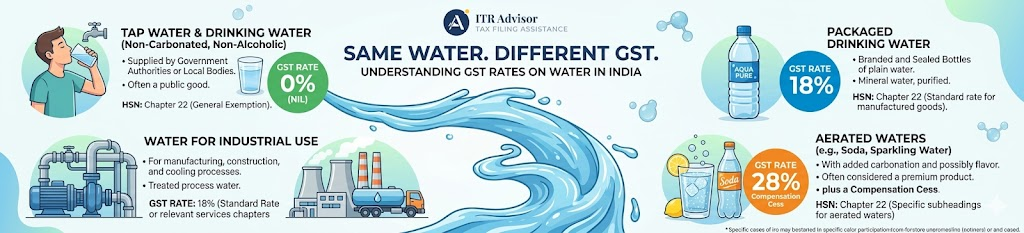
    Two bottles of water sit on the same shelf. Same factory. Same liquid inside. But one attracts 5% GST and the other attracts 28% plus cess. Why different GST ?If that surprises you, you are not alone.

    The GST classification of water is one of the most practically important and most misunderstood areas of GST compliance for businesses in India’s food, beverage, hospitality, and FMCG sectors. And yet, hundreds of businesses continue to apply a blanket rate based on the word ‘water’ on the label, without ever mapping the product to its correct HSN code.

    The result is predictable: short payment of GST, mismatched GSTR-3B filings, wrong input tax credit claims, and increasingly in 2026 a GST show cause notice from a department that now cross-verifies e-invoices, e-way bills, and return filings in near real time.

    GST Classification of Water: Why ‘Same Product’ Is Never Simple

    Under India’s GST framework, tax liability follows the product’s HSN (Harmonised System of Nomenclature) classification not the product’s name or its physical appearance. The GST Council has assigned water products across two distinct chapters of the tariff schedule, and the applicable rate depends entirely on what has been added, how the water has been processed, and how it is packaged and sold. This is why the GST compliance checklist for any business selling water products must begin with a classification check not a rate assumption


    GST Rate on Water Products: Complete HSN Classification Table 2026

    Water / Beverage CategoryHSN CodeGST RateDeciding Factor
    Tap water / municipal supply2201NILSupplied through distribution system
    Pipeline-supplied water2201NILNon-commercial, public utility
    Packaged drinking water (≤20 L)220112%Commercially packaged & sealed
    Packaged drinking water (>20 L)22015%Bulk jars, post-GST Council revision
    Natural mineral water (bottled)220112%Commercially bottled for sale
    Plain soda / aerated water220118%Carbonated, no added sugar or flavour
    Flavoured / sweetened water220228% + CessAny added sugar, flavour, or sweetener
    Carbonated soft drinks / cola220228% + CessSweetened aerated beverages
    Ice (commercial)220118%Manufactured ice sold commercially

    2026 Rate Alert Packaged drinking water in bottles up to 20 litres now attracts 12% GST revised upward from the earlier 5% rate. Bulk jars above 20 litres continue at 5%. Verify your current rate master against the GST Portal (gst.gov.in) before your next GSTR-3B filing.


    Wrong GST Classification: What It Actually Costs a Business

    Consider a distributor supplying three water products: 1-litre mineral water bottles, 500 ml flavoured water pouches, and bulk 20-litre packaged water jars. If mineral water is billed at 5% instead of 12%, and flavoured water at 12% instead of 28%, the monthly GST short-payment on a combined turnover of ₹15 lakh can easily exceed ₹1 lakh and over a financial year, that exposure compounds to a significant tax liability plus interest at 18% per annum under Section 50 of the CGST Act.

    Under the GST compliance framework, this is treated as a short payment and depending on whether the assessing officer determines it was the result of negligence or otherwise, penalties under Sections 122 to 125 of the CGST Act may also follow.

    As Dr. Haresh Adwani, PhD in Commerce and law graduate, notes from advisory practice: classification disputes are among the most litigated areas of GST today and most of them were avoidable with a single HSN verification before billing began.


    3 Reasons GST Classification Errors on Water Products Keep Happening

    • Billing teams classify by product name, not HSN code ‘water’ gets one rate across all variants
    • Rate masters set up at GST registration 2016 or 2017 were never updated after GST Council revisions
    • Carbonated and non-carbonated products are treated identically missing the Chapter 2201 vs 2202 distinction that determines whether the rate is 18% or 28% plus cess

    The GST e-invoicing mandatory threshold now covers a significant share of businesses, and every HSN code on an e-invoice is visible to the department’s analytics system. Businesses that have been getting away with wrong classification in a paper-based world will find that window closing in 2026.


    Quick GST Compliance Checklist: Water & Beverages

      1. Map every water product to HSN 2201 or 2202 never classify by product name alone

      2. Check whether carbonation + added sugar/flavour moves the product to Chapter 2202 (28% + cess)

      3. Confirm the current rate on gst.gov.in packaged water rates changed in recent Council meetings

      4. Reconcile your GSTR-2B input tax credit against correctly classified purchase invoices   5. Review your GST e-invoicing setup to ensure HSN codes auto-populate correctly from your ERP


    Key Takeaways

    • GST classification of water depends on HSN code, not the product label Chapter 2201 vs 2202 determines everything
    • Packaged drinking water (≤20L): 12% | bulk jars (>20L): 5% | plain soda: 18% | flavoured/sweetened: 28% + cess
    • Wrong classification = short payment, 18% p.a. interest, ITC mismatch, and possible GST show cause notice
    • The GST Portal now cross-checks e-invoice HSN data with GSTR-3B filings errors are increasingly auto-flagged
    • A one-time classification review of your entire product portfolio can protect years of GSTR-3B filing accuracy

    → Read our detailed guide on GST Show Cause Notice: Meaning, Types & How to Reply

    → Learn more: GST Compliance Checklist 2026 Monthly, Quarterly & Annual Returns

    Frequently Asked Questions on GST Classification of Water

    Q1. What is the GST rate on packaged drinking water in India 2026?

    Packaged drinking water in bottles or pouches up to 20 litres attracts 12% GST under HSN 2201; bulk jars above 20 litres are taxed at 5%. Always verify the current rate on gst.gov.in before filing.

    Q2. Why is flavoured water taxed at 28% GST while plain mineral water is taxed at 12%?

    Adding sugar, flavouring, or sweeteners moves the product from HSN Chapter 2201 to Chapter 2202, which attracts 28% GST plus compensation cess. The composition not the physical form determines the classification.

    Q3. Can wrong GST classification of a water product trigger a GST show cause notice?

    Yes. The department’s analytics system flags HSN-wise rate mismatches between GSTR-1 and GSTR-3B, and wrong classification leading to short payment can result in a Section 73 demand notice with interest and penalties.

    Q4. What is the HSN code for mineral water under GST?

    Natural mineral water whether sparkling or still falls under HSN 2201 and attracts 12% GST when commercially packaged and sold. Tap water and pipeline supply remain at NIL.

    Q5. How does GST e-invoicing affect classification compliance for water products?

    Every HSN code reported on a mandatory e-invoice is visible to the GSTN analytics system; wrong HSN codes auto-surface in GSTR-2B reconciliation and can trigger scrutiny before a return is even reviewed manually.

    Conclusion

    before asking ‘What is the GST rate?’, ask ‘How is my product classified?’ That sequence is not just a mindset shift — it is the practical foundation of correct GST compliance for every business that deals in water, beverages, food, or any other classified good.

    The GST classification of water tells us everything we need to know about how the entire GST framework works: the rate follows the classification, and the classification follows the HSN code not the product name, not the price, and not what a competitor is charging.

    For businesses with multi-product portfolios, a periodic classification review is no longer optional. It is basic tax hygiene in 2026.

    About the Author – Nidhi Adwani

    Nidhi Adwani is the Human Resources Manager at Adwani & Co. She is a Law Graduate and holds an MBA in Human Resources. She manages recruitment, employee engagement, team development, workplace culture, and the firm’s social media and content activities. Passionate about people and organizational growth, she also contributes articles for ITRAdvisor and Adwani & Co. Her writing focuses on HR practices, leadership, workplace engagement, and professional development, offering practical insights for professionals and businesses.

    Visit ITRAdvisor.in today for professional guidance and consultation.

    Early action can often prevent bigger tax problems later.

  • GST Show Cause Notice 2026: A Complete Legal Guide to Understanding and Responding

    GST Show Cause Notice 2026: A Complete Legal Guide to Understanding and Responding

    Dr. Haresh Adwani April 2026 8 min read

    GST Show Cause Notice
    GST Show Cause Notice 2026

    What Is a GST Show Cause Notice (SCN)?

    A GST Show Cause Notice (SCN) is a formal legal communication issued by a GST officer under the CGST/SGST Act 2017. It requires the recipient to explain “show cause” why a specified action (typically a tax demand, interest levy, or penalty confirmation) should not proceed.

    A GST Show Cause Notice is the beginning of a legal process, not its conclusion. You have every right to present your case with evidence. The danger is not the notice itself it is an uninformed, delayed, or undocumented response.

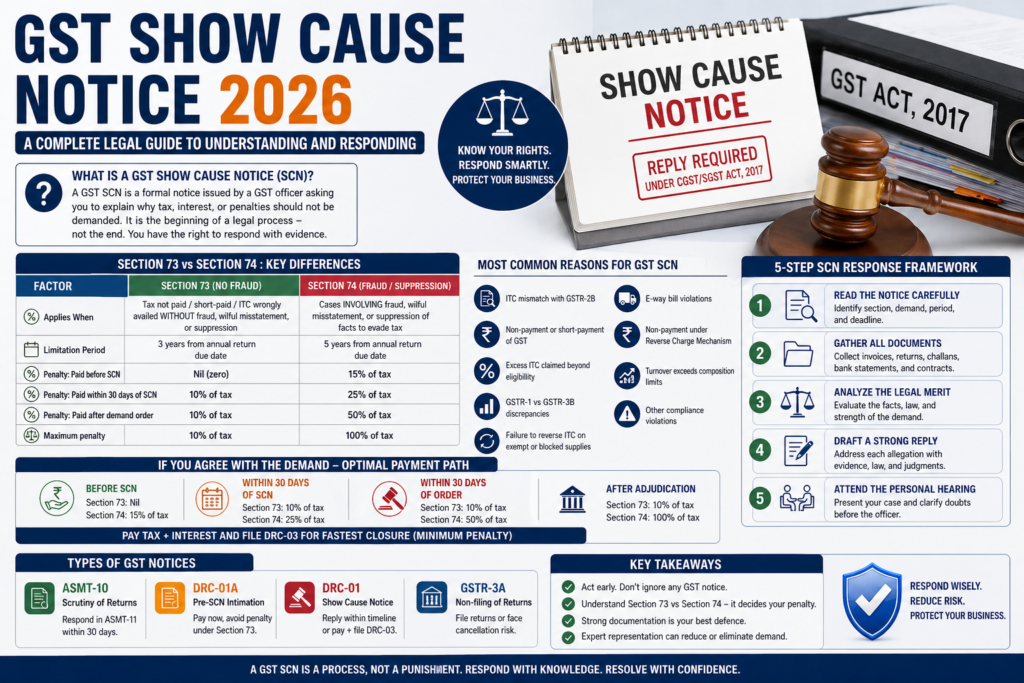
    The Two Critical GST SCN Provisions: Section 73 vs Section 74

    Every GST Show Cause Notice is issued under one of two provisions and this distinction is the most important piece of information in the notice. It determines your penalty exposure, response urgency, and the cost of resolution at every stage.

    FactorSection 73 (No Fraud)Section 74 (Fraud / Suppression)
    Applies whenTax not paid / short-paid / ITC wrongly availed WITHOUT fraud, wilful misstatement, or suppressionCases INVOLVING fraud, wilful misstatement, or suppression of facts to evade tax
    Penalty: Paid before SCNNil (zero)15% of tax
    Penalty: Paid within 30 days of SCN10% of tax25% of tax
    Penalty: Paid after demand order10% of tax50% of tax
    Maximum penalty (contested and confirmed)10% of tax100% of tax
    Limitation period for SCN3 years from annual return due date5 years from annual return due date

    Most Common Reasons for a GST Show Cause Notice in 2026

    • ITC mismatch: ITC claimed in GSTR-3B does not reconcile with auto-populated GSTR 2B data.
    • Non-payment or short payment of GST on taxable supplies.
    • Excess ITC claimed beyond Section 16 eligibility conditions.
    • Discrepancy between GSTR 1 outward supply data and GSTR-3B tax payment.
    • Failure to reverse ITC on exempt supplies or blocked credits under Section 17(5).
    • E-way bill violations goods transported without valid documentation.
    • Non-payment of GST under Reverse Charge Mechanism on applicable services.
    • Turnover exceeding composition scheme limits without transitioning to regular registration.

    Types of GST Show Cause Notice Notices: A Complete Reference

    ASMT-10: Scrutiny of Filed Returns

    Issued under Section 61 when a GST officer identifies discrepancies in your filed returns (typically between GSTR-1, GSTR-3B, and GSTR-2B). Respond in Form ASMT-11 within 30 days with a documented reconciliation. A well-drafted ASMT-11 response prevents escalation to a formal SCN in most cases.

    DRC-01A: Pre-SCN Intimation Your Zero-Penalty Opportunity

    DRC-01A is a pre-notice intimation that gives you the opportunity to voluntarily accept the demand and pay the tax with interest before formal proceedings begin. Proactive payment at DRC-01A stage under Section 73 results in zero penalty. This is the most cost-effective resolution point for any GST dispute. Treat DRC-01A with the same urgency as a formal SCN.

    DRC-01: The Formal Show Cause Notice

    DRC-01 is the primary show cause notice under Section 73 or 74. Upon receipt, you must either pay the demand with interest and file DRC-03 (voluntary payment challan), or file a detailed written reply within the prescribed deadline typically 30 days. This is the most consequential notice to respond to correctly.

    GSTR-3A: Notice for Non-Filing of Returns

    Issued under Section 46 when returns have not been filed for two or more consecutive tax periods. Continued non-filing after GSTR-3A can result in GSTIN cancellation, creating severe business continuity risks.

    Also Read:

    https://itradvisor.in/blog/gst-composition-scheme

    The 5-Step GST Show Cause Notice Response Framework

    Step 1: Read the Notice Carefully and Identify the Section

    Identify: (1) Section 73 or 74, (2) the exact demand tax, interest, and proposed penalty, (3) the specific transactions or return periods in question, and (4) your response deadline. Section 73 vs 74 is the single most important data point.

    Step 2: Gather Every Relevant Document

    Assemble: tax invoices, e-way bills, filed GSTR-1 and GSTR-3B returns, purchase invoices, GSTR-2B statements, DRC-03 challans, bank statements, and supplier contracts. Strong, organised documentation is your most powerful defence.

    Step 3: Analyse the Legal Merit of the Demand

    Not every GST SCN represents genuine tax liability. Many notices are generated by automated system mismatches ITC gaps that have valid explanations such as late supplier filings. Expert analysis can identify grounds to contest the demand entirely or substantially reduce admitted liability. Do not assume the department’s position is correct without review.

    Step 4: Draft and File a Legally Complete Written Response

    Your reply must address each allegation individually with supporting evidence, cite the relevant legal provisions and CBIC circulars, reference favourable High Court and Tribunal judgments, and where genuine liability is admitted quantify it separately from contested amounts.

    Step 5: Attend the Personal Hearing

    You have a statutory right to a personal hearing before the adjudicating authority. Always request it. The hearing is frequently the turning point in a GST SCN case additional context, documentation, and direct clarification often resolve the matter before any demand order is passed.

    If You Agree with the GST Demand: The Optimal Payment Path

    Payment TimingSection 73 PenaltySection 74 Penalty
    Before SCN is issuedNIL (zero)15% of tax
    Within 30 days of SCN10% of tax25% of tax
    Within 30 days of demand order10% of tax50% of tax
    After adjudication (contested and confirmed)10% of tax100% of tax

    To pay and close proceedings: File DRC-03 on the GST portal recording the voluntary payment of tax and interest. This is the standard mechanism to close Section 73 proceedings with minimum (or zero) penalty.

    GST Show Cause Notice Timelines and Limitation Periods (2026)

    • Section 73 SCN limitation: Must be issued within 3 years from the due date of the annual return for the relevant year (5 years if no return was filed).
    • Section 74 SCN limitation: Must be issued within 5 years from the due date of the annual return.
    • ASMT-10 response deadline: 30 days from notice date (extendable on application to the adjudicating officer).
    • DRC-01 response deadline: As specified in the notice typically 30 days.

    Conclusion: A GST Show Cause Notice Is a Process Respond Wisely

    A GST Show Cause Notice is the opening of a legal conversation, not a final verdict. With the right approach timely response, strong documentation, correct legal citations, and expert representation most GST SCNs are resolved in the taxpayer’s favour or with substantially reduced liability.

    Adwani & Company’s dedicated GST litigation team manages every stage of a GST dispute: SCN analysis, Section 73/74 determination, ITC reconciliation, response drafting, personal hearing representation, and appeals. Contact Dr. Haresh Adwani at www.itradvisor.in typically within 24 hours.

    Frequently Asked Questions

    Q1. How long do I have to respond to a GST SCN?

    The notice specifies the deadline typically 30 days from the date of issue. You can apply to the adjudicating officer for an extension before the deadline expires. Never wait until the last day; response preparation requires time.

    Q2. Can a GST SCN be challenged directly in court?

    Courts generally require exhaustion of statutory remedies first. However, if the SCN is issued beyond the limitation period, lacks proper jurisdiction, or has procedural defects, a writ petition in the High Court may be maintainable. Adwani & Company has successfully pursued such writs where appropriate.

    Q3. What happens if I ignore a GST SCN?

    The GST officer issues an ex-parte demand order confirming the full tax, interest, and penalty on a best-judgment basis. Your GSTIN may also be suspended. Ignoring a GST SCN eliminates all legal defence and is always the worst possible course of action.

    Q4. What is the difference between a GST SCN and a Demand Order?

    A GST SCN is your opportunity to respond before any decision is made. A Demand Order (Form DRC-07) is the adjudicating officer’s final decision confirming the liability. A Demand Order can be appealed before the Appellate Authority within three months.

    About the Author
    Dr. Haresh Adwani
    Ph.D. in Commerce | 20+ years in Tax, FEMA & Financial Advisory Expert in: GST advisory · Income tax litigation · FEMA compliance · NRI taxation · F&O taxation · Corporate structuring
    Website: www.itradvisor.in