Tag: Tax Saving

  • Tax Saving vs Wealth Creation in India: Are You Investing Smart or Just Buying a Deduction?

    Tax Saving vs Wealth Creation in India: Are You Investing Smart or Just Buying a Deduction?

    Tax Saving vs Wealth Creation

    Every year, as March 31 approaches, millions of Indian taxpayers rush to ‘finish off’ their Section 80C limit. Life insurance premiums get paid. Tax-saving Fixed Deposits get booked. ELSS funds get subscribed sometimes at the last minute, without a second thought. But here is the uncomfortable question that very few people ask themselves: If there were no tax benefit attached to this investment, would you still make it? That single question is the difference between tax saving and genuine wealth creation in India and understanding it could be the most financially important thing you do this year.

    The Section 80C Habit: How Tax Saving Became a Financial Reflex in India

    For decades, tax saving and investing were treated as the same activity by most Indian middle-class households. The logic was simple and appealing: invest ₹1.5 lakh under Section 80C, reduce your taxable income, get a tax refund, and feel financially responsible. The products that became staples of this approach included:

    • LIC traditional endowment and money-back policies
    • 5-year tax-saving Fixed Deposits at banks and post offices
    • ELSS (Equity Linked Savings Scheme) mutual funds with a 3-year lock-in
    • Public Provident Fund (PPF) and National Savings Certificates (NSC)
    • Employee Provident Fund (EPF) contributions

    None of these instruments are inherently bad. But the problem arises when tax saving in India becomes the primary or only reason for investment decisions. When you invest because of a tax deadline rather than a financial goal, you are not building wealth. You are buying a deduction.

    Warning: The Hidden Cost of Deadline-Driven Tax Saving

    • You may lock money into products that earn 4–6% returns while inflation runs at 5–6% effectively zero real growth
    • High-premium LIC policies taken for 80C often have poor surrender value if financial needs change
    • Tax-saving FDs are fully taxable on maturity the tax saved upfront may be recovered by the government later

    Investing under pressure in March reduces your ability to select the right product for your actual goals


    How the New Tax Regime Has Changed the Tax Saving vs Wealth Creation Debate in India

    The Income Tax Department’s push toward the New Tax Regime backed by significant structural changes in Budget 2024 and continuing into AY 2026-27 has fundamentally altered the calculus of tax-saving investing in India. Under the new regime, most deductions including Section 80C, 80D, and HRA are not available. In exchange, taxpayers benefit from a zero-tax threshold on income up to ₹12 lakh under Section 87A (as announced in Budget 2025) and a revised standard deduction of ₹75,000 for salaried individuals.

    This means that a large segment of Indian taxpayers — particularly those in the ₹8–15 lakh annual income bracket may already have a lower or even zero tax liability under the new regime, without making a single 80C investment. And yet, many continue to invest in lock-in products simply out of habit or peer pressure, without running the actual numbers.

    According to guidance from the Income Tax Department of India (incometaxindia.gov.in), taxpayers can switch between the old and new tax regimes each year (subject to specific conditions for business income). This flexibility makes it more important than ever to evaluate whether your tax-saving investments are still serving a purpose or simply tying up capital that could be working harder for you.

    Read our detailed guide on Old vs New Tax Regime 2025: Stop Guessing, Start Calculating


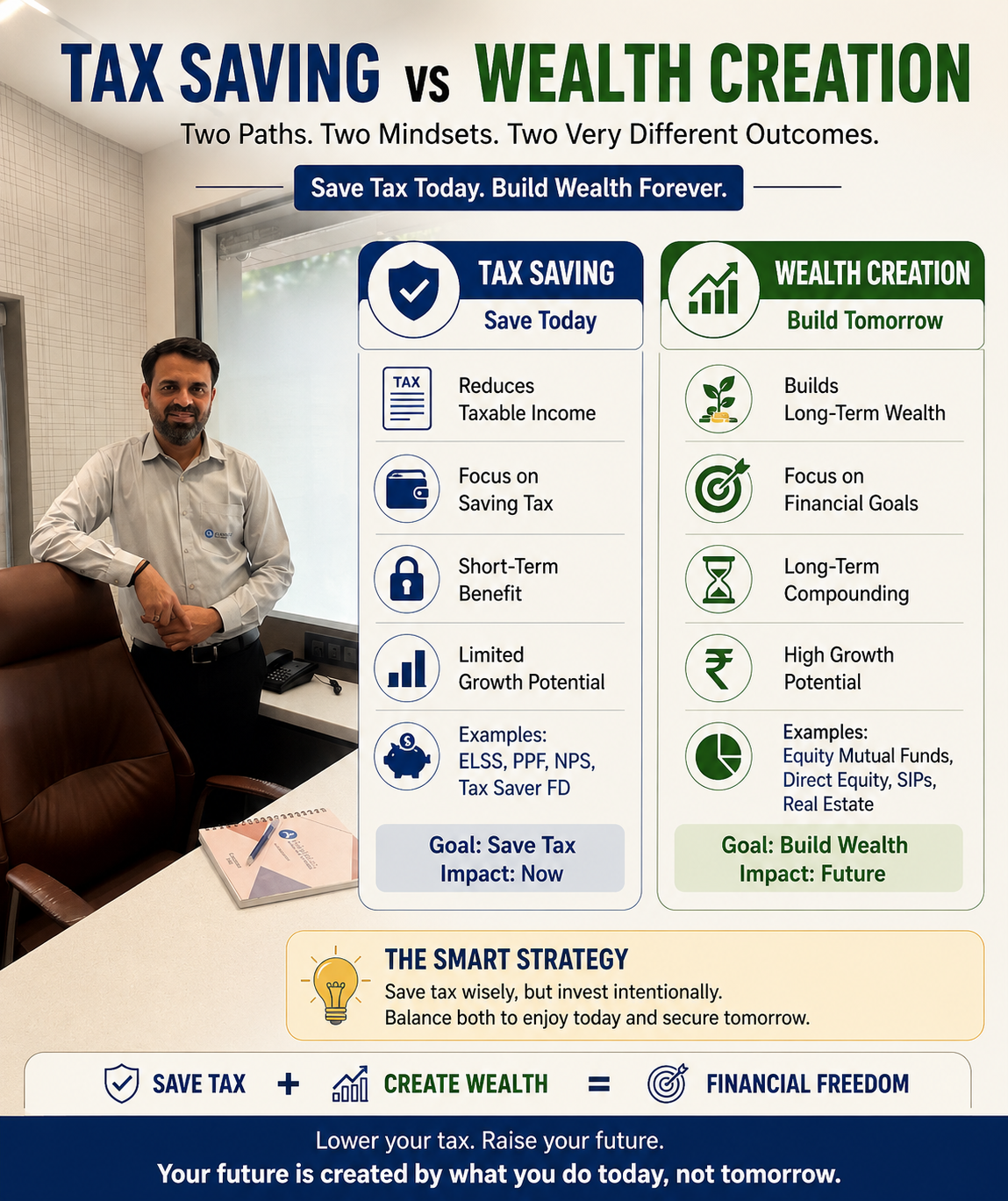
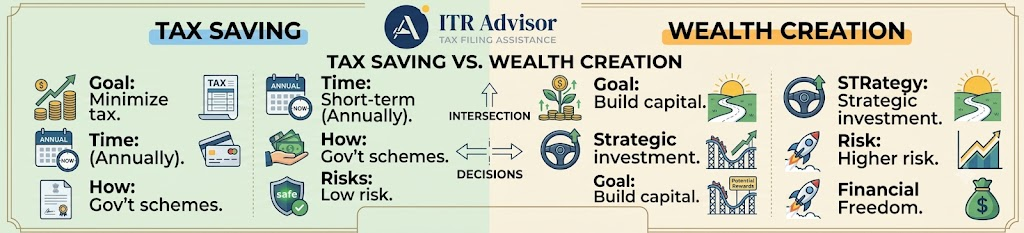
    Tax Saving vs Wealth Creation in India: A Side-by-Side Comparison

    Let us be specific. The table below captures the fundamental difference between a tax-saving approach and a wealth creation approach to investing in India:

    DimensionTax Saving FocusWealth Creation Focus
    Primary GoalReduce tax liability this financial yearGrow net worth over 5, 10, 20 years
    Decision DriverMarch 31 deadline pressureLife goals: retirement, home, education
    Typical ProductsLIC endowment, tax-saving FD, NSCEquity mutual funds, NPS, direct equity, index funds
    Risk AwarenessOften low safety prioritised over returnsCalibrated risk taken for inflation-beating returns
    New Regime Impact80C deductions no longer availableInvestment logic holds regardless of tax regime
    Returns Expectation4–6% (often below inflation)10–14% CAGR over long term (equity-linked)
    Real Wealth Built?Moderate tax saved, but corpus modestSignificant compounding works powerfully over time

    The data is clear: wealth creation in India requires a different mindset, a different product selection process, and a different time horizon than tax saving. The two can overlap for example, ELSS mutual funds offer both but they should never be conflated


    A Real Example: How Tax Saving Investments vs Wealth Creation Investments Perform Over 20 Years

    Consider Rajesh, a 35-year-old salaried professional in Pune earning ₹15 lakh per annum. Every year, he invests ₹1.5 lakh under Section 80C in a traditional LIC endowment policy with an effective return of approximately 5% per annum. Over 20 years, his maturity corpus would be approximately ₹49–52 lakh.

    Now consider his colleague Priya. She switches to the new tax regime (where 80C is irrelevant), and instead invests the same ₹1.5 lakh per year in a diversified equity mutual fund SIP averaging 12% CAGR consistent with long-term Nifty 50 returns over 15–20 year periods. After 20 years, Priya’s corpus would be approximately ₹1.37 crore nearly three times Rajesh’s corpus.

    Rajesh saved tax. Priya built wealth. Both invested the same amount. The difference? Rajesh’s investment decision was driven by Section 80C. Priya’s was driven by a financial goal retirement.


    Key Insight:

    • ₹1.5 lakh/year at 5% for 20 years → ~₹50 lakh maturity corpus
    • ₹1.5 lakh/year at 12% for 20 years → ~₹1.37 crore maturity corpus
    • The difference of ₹87 lakh is the cost of investing for a deduction instead of for wealth

    LTCG on equity mutual funds above ₹1.25 lakh per year is taxed at only 12.5% under Section 112A still far more tax-efficient than interest income


    What Wealth Creation in India Actually Looks Like: Smart Investment Alternatives

    The shift in conversations Dr. Haresh Adwani has observed at Adwani and Company during this ITR season is telling. Fewer clients are asking ‘How do I finish my Section 80C?’ and more are asking about mutual funds, equity SIPs, retirement planning, and financial independence. This is not just a trend it reflects a maturing financial culture in India.

    Here are the wealth creation investment strategies that make sense with or without a tax benefit attached:

    1. Equity Mutual Funds and SIPs for Long-Term Wealth Creation

    Index funds and diversified equity mutual funds remain the most accessible and proven vehicle for wealth creation in India. With no lock-in (outside ELSS), full liquidity, and the power of compounding over 10–20 years, equity mutual funds outperform most tax-saving instruments by a significant margin. SEBI’s investor education portal (investor.sebi.gov.in) consistently highlights goal-based SIP investing as the most reliable path to long-term wealth for retail investors.

    2. National Pension System (NPS) for Retirement Planning

    NPS offers an additional deduction of ₹50,000 under Section 80CCD(1B) over and above the ₹1.5 lakh 80C limit and it remains available even under certain corporate tax arrangements. More importantly, it functions as a genuine retirement wealth-building vehicle with equity exposure and annuity options. For taxpayers under the new regime, NPS still has partial tax advantages, making it one of the smartest straddlers of both worlds.

    3. Direct Equity Investing with LTCG Tax Efficiency

    Post-Budget 2024 amendments, long-term capital gains (LTCG) on listed equity shares held for more than 12 months are taxed at 12.5% above ₹1.25 lakh of gains per year. This remains one of the most tax-efficient return profiles available to Indian investors. For individuals with the knowledge and risk appetite, building a portfolio of quality businesses over time is genuine wealth creation in India and it requires zero 80C motivation.

    4. ELSS Mutual Funds: The Best of Both Worlds

    For taxpayers who remain on the old tax regime and want to maximise both tax saving and wealth creation, ELSS mutual funds are still the most intelligent Section 80C instrument. They carry a mandatory 3-year lock-in, but are equity linked, historically return-positive over 5–10 year holding periods, and allow SIP investing. The tax benefit is a bonus not the reason to invest.


    The 3 Questions That Separate Tax Savers from Wealth Creators in India

    Dr. Haresh Adwani, PhD in Commerce and a law graduate with deep expertise in integrated tax and financial planning, advocates a three-question framework before every investment decision. This framework simple but powerful ensures that your investments serve your life goals rather than your tax receipt:

    1. Does this investment fit my financial goals? (Not just ‘Does it qualify for 80C?’)
    2. Do I fully understand the risks, lock-in, liquidity, and real returns of this product?
    3. Would I still invest in this if there was zero tax benefit attached to it?

    If the answer to question three is a clear no, that is a signal worth paying attention to. You may be buying a deduction not building wealth.

    Common Mistake: What Many Indian Investors Get Wrong About Tax Planning

    • Treating tax planning as a year-end activity rather than a year-round financial strategy
    • Confusing tax saving instruments with wealth-creating instruments they are not always the same
    • Not comparing the new vs old tax regime before committing to 80C investments every April
    • Ignoring the impact of inflation on low-return tax-saving products over a 15–20 year period

    Missing the additional ₹50,000 NPS deduction under Section 80CCD(1B) a widely underutilised wealth-and-tax benefit

    Frequently Asked Questions

    Q: Is Section 80C investment still worth it under the new tax regime in India for AY 2026-27?

    A: Under the new tax regime, Section 80C deductions are not available. If you opt for the new regime, focus on investments that deliver the best returns for your goals not tax deductions. Evaluate both regimes with a CA before deciding.

    Q: What is the difference between tax saving and wealth creation in India?

    A: Tax saving reduces your current year’s tax liability through specific investments or deductions. Wealth creation builds your long-term net worth through returns that compound over time ideally in a tax-efficient way.

    Q: Which investments are best for wealth creation in India without depending on Section 80C?

    A: Equity mutual funds, index funds, direct equity, NPS, and goal-based SIPs are the most powerful wealth creation vehicles in India. Their returns typically outperform 80C instruments significantly over a 10–20 year period.

    Q: Can I switch between old and new tax regime every year in India?

    A: Salaried individuals can switch between regimes each financial year. However, those with business or professional income face restrictions. Consulting a CA like the team at Adwani and Company is advisable before switching.

    Q: How is LTCG on equity mutual funds taxed in India after Budget 2024?

    A: Long-term capital gains on equity mutual funds held over 12 months are taxed at 12.5% above ₹1.25 lakh per year under Section 112A. This makes equity investing one of the most tax-efficient wealth creation strategies in India.

    Q: What is the three-question framework for smart investing in India?

    A: Before any investment, ask: Does it fit my financial goal? Do I understand its risk and return profile? Would I still invest in it without a tax benefit? If the last answer is ‘no’, reconsider your investment rationale.

    Conclusion: Good Tax Planning Serves Wealth Creation : Not the Other Way Around

    The conversation around tax saving vs wealth creation in India is evolving and that is a genuinely positive development. The fact that more taxpayers today are asking about mutual funds, retirement planning, equity investing, and financial independence, rather than just ‘how to finish 80C’, reflects a maturing financial consciousness across India’s working population.

    But the shift must be made deliberately and with good information. Not all tax saving instruments are poor wealth creators. Not all wealth creation strategies ignore tax efficiency. The goal is alignment ensuring that every investment serves both your tax situation and your life goals simultaneously.

    That alignment is exactly what Adwani and Company has been delivering to clients across Pune and India for nearly five decades. With Dr. Haresh Adwani’s integrated expertise in commerce, law, and taxation at the helm, the firm is uniquely positioned to help you answer the most important question in personal finance: Are you building wealth or just buying a deduction?

    About the Author
    Dr. Haresh Adwani
    Ph.D. in Commerce | Law Graduate | Managing Partner, Adwani & Co LLP

    Dr. Haresh Adwani holds a Ph.D. in Commerce and is a qualified Law graduate with over two decades of hands-on experience in GST advisory, direct taxation, and statutory compliance for businesses across

    Disclaimer: ITRAdvisor.in is an educational and informational platform focused on tax awareness and compliance updates. Nothing contained herein should be construed as solicitation or advertisement of professional services. Professional services, where applicable, are rendered in accordance with ICAI guidelines. This article is published on ITRAdvisor.in, a tax and compliance knowledge platform. The content has been reviewed for technical accuracy by professionals associated with Adwani & Co LLP. pant, or someone navigating all three simultaneously your tax treatment, ITR form selection, and loss utilisation strategy need to be correct, consistent, and complete.

    Learn more about our Income Tax Filing Services for Traders & Investors covering ITR-3 filing, tax audit support under Section 44AB, F&O turnover calculation, and capital gains reconciliation with your broker’s statement.

    Visit ITRAdvisor.in today for professional guidance and consultation.

    Early action can often prevent bigger tax problems later

    If you or someone you know has received a Section 148 income tax reassessment notice, do not panic but do act quickly and smartly. The law is on your side, provided you know where to look.

    📞 Take Action Today

    Need help evaluating whether your income tax reassessment notice is valid?

    Connect with the experts at itradvisor.in for a detailed assessment of your notice, legal objection drafting, and end-to-end reply support. Visit: www.itradvisor.in | Powered by Adwani & Co LLP


  • Smart Investment Decisions in India 2026

    Smart Investment Decisions in India 2026

    CA Dipesh Gurubakshani June 2026 9 min read

    Smart Investment Decisions

    Investment Planning Tax Saving Section 80CELSSCA Advice India Income Tax Act Financial Planning 2026

    The investment decision took 60 seconds. Not because the client was reckless but because the right groundwork had already been laid. With a clear picture of his tax liability, eligible deductions, and long-term goals, the answer was obvious. This is what truly smart investment decisions in India look like.

    Most Indians make investment decisions backwards. They pick a product a mutual fund, an insurance policy, an FD and then scramble in March wondering if it saves tax. The result? Rushed choices, suboptimal returns, and a tax bill that could have been much smaller.

    The truth is that smart investment decisions in India are not about picking the highest yielding instrument. They are about understanding how money, law, and time interact and making a deliberate, informed choice well before the financial year ends. This blog breaks down exactly how to do that, drawing on the principles that guide the advisory work at Adwani and Company,

    ₹1.5LMax deduction under Section 80C per year

    ₹1.25LTax-free LTCG on equity per financial year

    30%Max tax slab for individuals above ₹15L income

    60 sec Time for a confident investment call with the right plan


    Why Smart Investment Decisions in India Start with Tax, Not Returns

    Here is a question most investors never ask: “How much of this return will I actually keep after tax?” A savings instrument yielding 8% might deliver only 5.6% post-tax if you are in the 30% bracket. Meanwhile, an ELSS fund delivering 12% CAGR combined with the Section 80C deduction could outperform nearly every traditional instrument on an effective basis.

    According to guidelines published by the Income Tax Department of India, individuals can claim deductions on a wide range of investments and expenditures under Chapter VI-A of the Income Tax Act, 1961. These deductions directly reduce your taxable income meaning every rupee deducted is a rupee on which you pay zero tax.

    The key insight that separates average investors from truly informed ones: smart investment decisions in India treat tax savings as part of the return, not as a bonus on top of it. This mental shift changes everything about how you evaluate an instrument.

    Learn more about our Tax Planning Services  customised strategies for salaried professionals, business owners, and HNIs.


    The 60-Second Investment Decision: How Prepared Investors Think

    A client once walked into the office of Adwani and Company in early February, looking stressed. He had ₹1.5 lakhs to invest before March 31st and had been scrolling through product comparisons for weeks. Within 60 seconds of reviewing his tax profile, Dr. Haresh Adwani identified that the client was in the 30% slab, had no existing 80C investments, and had capital gains from a mutual fund redemption. The recommendation was immediate and precise: ELSS for the current year, with a staggered SIP to begin the next financial year, and a review of capital gains against the ₹1.25 lakh exemption limit.

    The decision was fast because the analysis was already done. This is the real lesson: smart investment decisions in India appear effortless when the foundation tax profile, risk appetite, cash flow, and goal mapping is already in place. Preparation is what makes confidence possible.


    Practical example:

    Two investors, same amount, different outcomes

    Income slab30% bracket (₹25L annual income)

    Investment amount₹1,50,000

    Investor A: 5-year FD @ 7%Interest taxed at 30% → Effective yield: ~4.9%

    Investor B: ELSS @ 12% CAGR₹1.5L deduction saves ₹46,800 in tax immediately

    5-year value (ELSS)~₹2,64,000 + ₹46,800 tax saving = ₹3,10,800 effective

    5-year value (FD)~₹1,96,000 post-tax

    Advantage of smart investment decision~₹1,14,800 additional wealth created


    Smart Investment Decisions in India: Top Tax-Saving Instruments Explained

    1. ELSS : Equity Linked Savings Scheme

    ELSS funds offer the dual benefit of equity-linked market returns and a deduction under Section 80C up to ₹1.5 lakh per year. With a 3-year lock-in (the shortest among 80C instruments), they are the go-to for investors comfortable with moderate risk. Long-term capital gains above ₹1.25 lakh are taxed at a preferential 12.5%, making ELSS one of the most tax-efficient instruments for smart investment decisions in India.

    2. Public Provident Fund (PPF)

    For those seeking capital protection, PPF offers an EEE (Exempt-Exempt-Exempt) status meaning the contribution, the interest earned, and the maturity amount are all tax-free. The 15-year lock-in suits long-term goals like retirement. While returns are lower than equity, the tax-free compounding makes the effective yield competitive for debt investors.

    3. National Pension System (NPS)

    NPS allows an additional deduction of ₹50,000 under Section 80CCD(1B) — over and above the ₹1.5 lakh 80C limit. For a person in the 30% bracket, this alone saves ₹15,600 annually. The new tax regime also allows employers’ NPS contributions as a deduction, making it a compelling instrument for smart investment decisions in India among salaried employees.

    4. Health Insurance —:Section 80D

    Often overlooked as an “investment,” health insurance premiums are deductible under Section 80D. For individuals below 60, the limit is ₹25,000 (self and family) plus ₹25,000 for parents, rising to ₹50,000 if parents are senior citizens. Dr. Haresh Adwani frequently points out that health insurance is one of the highest-ROI financial decisions an Indian can make — it protects wealth while reducing tax burden simultaneously.

    Read our detailed guide on :Section 80GGC Deduction Disallowance: ITAT Rules That Suspicion Is Not Enough, A Guide for Indian Taxpayers


    The Role of a Chartered Accountant in Smart Investment Decisions

    A great CA does not merely file your returns. A great CA becomes your financial co-pilot helping you see opportunities that spreadsheets and fintech apps can miss. At Adwani and Company, the approach to investment advisory is anchored in both financial analysis and legal precision. Dr. Haresh Adwani’s dual expertise a PhD in Commerce and a formal legal education means that every recommendation considers not just tax efficiency but also legal compliance, documentation requirements, and audit defensibility.

    “The biggest tax mistake Indians make is treating investment planning as a year-end activity. True wealth creation starts with a plan made at the beginning of the financial year and revisited every quarter.”

    The Ministry of Corporate Affairs (MCA) and the Income Tax Department have increasingly digitised compliance which means discrepancies between your investment records and tax filings are easier to detect than ever. Having a qualified CA review your investment-linked deductions before filing is not optional; it is essential.


    How Smart Investment Decisions in India Protect Your Wealth Long-Term

    Beyond annual tax saving, smart investment decisions in India create a compounding effect on wealth. Consider this: a 35-year-old who begins tax-optimised investing with ₹3 lakh per year across ELSS, PPF, and NPS, saving approximately ₹93,000 in annual taxes, will have deployed that tax saving as additional capital for 25 years. At a modest 8% annual growth, that recycled tax saving alone compounds to over ₹71 lakh by retirement. This is wealth that would simply not exist without deliberate planning.

    • Start early in the financial year : April decisions beat March panic
    • Review your tax slab before choosing instruments : old vs new regime matters
    • Diversify across 80C, 80CCD, and 80D for maximum deduction coverage
    • Account for capital gains before adding new equity positions
    • Involve a qualified CA self-filing misses nuanced deductions regularly

    Common Mistakes That Derail Smart Investment Decisions in India

    Even informed investors fall into predictable traps. The most common one: choosing the new tax regime without actually calculating whether the old regime (with deductions) delivers a better post-tax outcome. The answer is not universal it depends entirely on the individual’s deduction profile.

    Other critical errors include overlooking Form 26AS before filing (which reflects TDS deducted by employers and banks), missing the ₹1.25 lakh LTCG exemption on equity, or failing to declare foreign assets and income as now mandated by the Income Tax Act’s Schedule FA. Adwani and Company regularly helps clients catch these gaps before they become notices from the Department.

    A detailed, forward-looking financial review — not just a tax filing exercise — is what separates reactive taxpayers from proactive wealth builders making genuinely smart investment decisions in India. Learn more about our ITR Filing and Compliance Services — accurate, audit-ready returns with zero last-minute stress

    Frequently Asked Questions

    1.What is the best tax-saving investment option in India for salaried employees in 2026?

    For salaried employees in the 30% tax bracket, a combination of ELSS (for 80C), NPS (for the additional ₹50,000 deduction under 80CCD(1B)), and health insurance (80D) typically provides the best post-tax outcome. The choice between old and new tax regimes should be calculated individually — a qualified CA at Adwani and Company can model both scenarios for your specific income profile.

    Conclusion:

    That client who made his investment decision in 60 seconds was not fortunate. He was prepared. Behind those 60 seconds was a year of structured planning, a clear tax profile, and the guidance of professionals who understood both the numbers and the law. That is the promise of smart investment decisions in India: not speed, but confidence born from clarity.

    The Indian tax code, under the Income Tax Act, 1961 and as updated through successive Union Budgets, offers a remarkable range of legal tools to reduce your liability and grow your wealth. But these tools only work when they are used deliberately, early, and in the right combination for your specific financial situation.

    Whether you are a salaried professional, a business owner, or an HNI investor, the principles remain the same: understand your tax exposure, choose instruments that serve both financial and tax goals, and work with an expert who can see the full picture. At Adwani and Company, Dr. Haresh Adwani brings a rare combination of academic rigour, legal knowledge, and practical CA experience to every client engagement ensuring that your investment decisions are not just smart, but provably so.

    Author

    CA Dipesh Gurubakshani is a Chartered Accountant with Adwani & Co LLP, Pune, specialising in income tax audit, direct taxation, and accounting advisory. He supports clients across statutory compliance, financial reporting, and income tax matters with a focus on accuracy, regulatory adherence, and disciplined execution.

    Disclaimer: ITRAdvisor.in is an educational and informational platform focused on tax awareness and compliance updates. Nothing contained herein should be construed as solicitation or advertisement of professional services. Professional services, where applicable, are rendered in accordance with ICAI guidelines. This article is published on ITRAdvisor.in, a tax and compliance knowledge platform. The content has been reviewed for technical accuracy by professionals associated with Adwani & Co LLP.

  • Old vs New Tax Regime 2025: Stop Guessing, Start Calculating

    Old vs New Tax Regime 2025: Stop Guessing, Start Calculating

    CA Dipesh Gurubakshani April 2026 11 min read


    Every April, millions of Indian taxpayers face a question that could determine whether they save ₹50,000 or silently lose it: Should I choose the old vs new tax regime? Most people answer it the wrong way by asking colleagues, following guesswork, or simply doing nothing and letting the default kick in. That ‘nothing’ decision alone costs thousands of taxpayers lakhs of rupees every year.

    The truth is, there is no universally correct answer. Whether the old vs new tax regime works better for you depends entirely on your income level, your deductions, your lifestyle, and your financial discipline. What this guide does is cut through the confusion and give you a clear, number-backed, expert-driven framework to make the right call for your life, not someone else’s.

    With the Income Tax Act, 2025 now fully in effect and the new regime established as the default option, the stakes have never been higher. Let’s break it down completely.


    Understanding the Old vs New Tax Regime : What Actually Changed

    India’s personal income tax system today operates with two distinct parallel structures, each with its own slab rates, deduction rules, and strategic advantages. Every individual taxpayer whether salaried, self-employed, or running a business must choose one at the time of filing returns.

    What is the Old Tax Regime?

    The old tax regime has been the backbone of Indian income taxation for decades. It allows taxpayers to legally reduce their taxable income by claiming a wide range of deductions and exemptions. The Income Tax Department of India permits deductions such as:

    • House Rent Allowance (HRA) under Section 10(13A)
    • Standard Deduction of ₹50,000 for salaried individuals
    • Section 80C deductions up to ₹1.5 lakh (PPF, ELSS, EPF, LIC, home loan principal)
    • Section 80D for health insurance premiums (up to ₹25,000–₹50,000 depending on age)
    • Home loan interest deduction under Section 24(b) up to ₹2 lakh for self-occupied property
    • Leave Travel Allowance (LTA) and other specific exemptions

    The key benefit: these deductions shrink your taxable income before slab rates are applied, meaning your effective tax rate can be significantly lower than what the published rates suggest.

    What is the New Tax Regime?

    Introduced in Budget 2020 and significantly restructured in Budget 2023, the new tax regime offers lower headline slab rates in exchange for giving up most deductions. Under the Income Tax Act, 2025, the new regime is now the default meaning taxpayers who do not actively opt out will be assessed under this regime.

    The new regime is designed to simplify tax compliance, reduce paperwork, and appeal to those who prefer lower rates over complex deduction planning. It still allows the standard deduction of ₹75,000 (revised upward in 2024) and the employer’s NPS contribution under Section 80CCD(2) two benefits that are frequently overlooked.


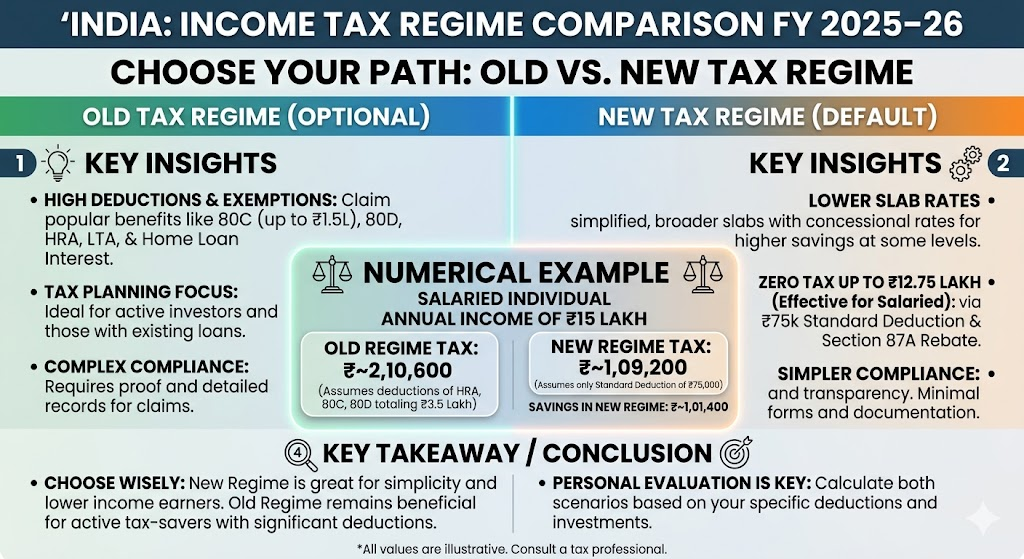
    Old Tax vs New Tax Regime : Slab Rate Comparison for FY 2025–26

    Income SlabOld Regime RateNew Regime (FY 2025–26)
    Up to ₹3,00,000NilNil
    ₹3,00,001 – ₹7,00,0005%5%
    ₹7,00,001 – ₹10,00,00020%10%
    ₹10,00,001 – ₹12,00,00030%15%
    ₹12,00,001 – ₹15,00,00030%20%
    Above ₹15,00,00030%30%

    On paper, the new regime’s lower rates between ₹7 lakh and ₹15 lakh look very attractive. But slab rates only tell half the story. Your effective tax rate the percentage of income you actually pay after deductions can be dramatically different. This is the calculation that Dr. Haresh Adwani, of Adwani and Company, insists every taxpayer must do before making their regime choice.


    Key Deductions You Lose in the New Tax Regime : And Why It Matters for Tax Saving

    Understanding the deduction gap is central to the old vs new tax regime comparison. Here are the most impactful deductions that are not available in the new regime:

    HRA (House Rent Allowance): For salaried employees in metro and Tier-1 cities, HRA exemption often ranges from ₹1 lakh to ₹3 lakh annually. This is one of the most powerful salary components from a tax perspective and it simply does not exist in the new regime.

    Section 80C (₹1.5 lakh limit): Covers PPF, ELSS mutual funds, home loan principal repayment, life insurance premiums, NSC, and children’s tuition fees. For any disciplined investor, this deduction is almost automatic and it saves up to ₹46,800 in taxes at the highest slab.

    Section 80D (Health Insurance): Premiums paid for self and family can be deducted up to ₹25,000 (or ₹50,000 for senior citizens). In the new regime, this benefit disappears entirely.

    Home Loan Interest Section 24(b): Up to ₹2 lakh annually on interest for a self-occupied property. For taxpayers with an ongoing home loan, this single deduction can be decisive in regime selection.

    LTA (Leave Travel Allowance): Tax-exempt travel allowance available in the old regime for domestic travel twice in a four-year block. Not available in the new regime.

    Learn more about our Taxation & Compliance Services — our CA team at Adwani and Company https://www.adwaniandco.com/blog/income-tax-filing-for-salaried-individuals


    Real-World Numerical Example: Old vs New Tax Regime at ₹16 Lakh Income

    Let’s apply real numbers to understand the difference between Old vs New Tax Regime . Consider Priya, a salaried software professional in Pune earning ₹16 lakh gross annually, with HRA, active 80C investments, a health insurance policy, and a home loan.

    ItemOld RegimeNew Regime
    Gross Salary Income₹16,00,000₹16,00,000
    Standard Deduction−₹50,000−₹75,000
    HRA Exemption−₹1,80,000Not Applicable
    Section 80C (PPF + ELSS)−₹1,50,000Not Applicable
    Section 80D (Health Ins.)−₹25,000Not Applicable
    Home Loan Interest (24b)−₹1,20,000Not Applicable
    Net Taxable Income₹10,75,000₹15,25,000
    Approx. Tax (incl. cess)~₹1,45,000~₹2,05,000

    CASESTUDY

    In this case, Priya saves approximately ₹60,000 more by choosing the old regime. This calculation assumes actual deduction claims and is illustrative individual results will vary based on specific figures.

    This is the calculation that most taxpayers never run. As Dr. Haresh Adwani, founder of Adwani and Company, consistently guides clients: the regime that appears more generous at the slab level is frequently more expensive once your actual deductions are factored in.

    Also Read https://itradvisor.in/blog/income-tax-notice


    Which Income Band Benefits More : A Practical Old vs New Tax Regime Breakdown

    Income Up to ₹12.75 Lakh

    Under the new tax regime for FY 2025–26, taxpayers with income up to ₹12 lakh may have zero tax liability due to the revised Section 87A rebate (up to ₹60,000). Combined with the ₹75,000 standard deduction for salaried individuals, effective tax-free income rises to ₹12.75 lakh. For this income band especially those with minimal investments the new regime is a clear winner. This is one of the most significant improvements the government has introduced, as clearly outlined in the Finance Bill 2025 notified by the Ministry of Finance.

    Income Between ₹12.75 Lakh and ₹18 Lakh

    This is the battleground zone. If you have HRA, 80C investments, and a home loan, the old regime almost certainly wins. If your deductions are limited to just the standard deduction, the new regime may be comparable or marginally better. Running the actual calculation is non-negotiable at this income level.

    Income Above ₹18–20 Lakh

    For higher income brackets, the new regime’s lower slab rates begin to overpower the benefit of deductions but only if your total deductions are below a certain threshold. The break-even point varies depending on your HRA amount and home loan outstanding. Adwani and Company, has observed that even at ₹20 lakh+ income, taxpayers with substantial home loans and maximum 80C investments often fare better in the old regime.


    Critical Mistakes to Avoid When Choosing Your Tax Regime

    Mistake 1: Not Informing Your Employer Before April 1

    The new tax regime is the default. If you want the old regime, you must proactively inform your employer before the start of the financial year. Failure to do so means TDS will be deducted under the new regime throughout the year potentially resulting in either a year-end tax demand or the hassle of claiming a refund.

    Mistake 2: Deciding Based on Slab Rates Alone

    Comparing tax regimes using published slab tables without running your actual income and deductions is like comparing cars by looking only at the price tag. Always calculate your net taxable income under both regimes before deciding.

    Our tax advisory team offers this comparison service as part of every annual tax planning engagement.

    Mistake 3: Ignoring the NPS Employer Contribution in the New Regime

    Section 80CCD(2) allows a deduction for your employer’s NPS contribution up to 14% of your basic salary even in the new regime (versus 10% for private sector in the old regime). Many employees overlook this during CTC negotiation. Restructuring your salary to maximize this benefit is one of the smartest tax moves available under the new regime, and one that Adwani and Company actively helps clients implement.

    Mistake 4: Forgetting the Business Income Switching Rule

    Taxpayers with business or professional income who file under ITR3 or ITR4 face a critical restriction: they can switch from the new regime back to the old regime only once in their lifetime. After reverting to the new regime, they cannot switch back to old. This rule under Section 115BAC is frequently misunderstood and can result in irreversible tax decisions. Salaried individuals have no such restriction they can switch every year freely.

    Mistake 5: Assuming the Same Answer as Last Year Still Applies

    Your income changes. Your deductions change. Interest rates change. The regime that was optimal in FY 2024–25 may not be optimal in FY 2025–26. Annual reassessment ideally before April is essential. The Income Tax Department’s official calculator at incometax.gov.in is updated for each assessment year and provides a reliable starting point.


    Old vs New Tax Regime for Freelancers and Business Owners

    Self-employed individuals, consultants, and business owners operate under a different set of rules. The ability to claim business expenses rent, travel, depreciation, professional fees, and utilities as deductions against income makes tax planning more nuanced for this group.

    For businesses with turnover up to ₹3 crore, the presumptive taxation scheme under Section 44AD is compatible with the new regime and offers simplicity without the burden of maintaining detailed books purely for deduction purposes. Similarly, professionals with receipts up to ₹75 lakh can opt for Section 44ADA presumptive taxation.

    Importantly, your business structure whether you operate as a proprietorship, LLP (registered under the Ministry of Corporate Affairs), or private limited company significantly affects how income is taxed. The regime choice applies to individual promoters on their personal income; companies and LLPs are taxed under separate corporate rates and are not directly subject to the old vs new regime choice. Read our detailed guide on Company Formation and Tax Structuring for a complete breakdown.


    A 5-Step Framework to Choose the Right Tax Regime Recommended by Dr. Haresh Adwani

    Dr. Haresh Adwani recommends the following structured approach for every individual taxpayer before each financial year begins:

    1. Step 1 : Project your total income: Include salary, rental income, business income, capital gains, and any other sources for the year.
    2. Step 2 : List every deduction you will legitimately claim: HRA, 80C investments, 80D premiums, home loan interest, NPS, LTA, and any other applicable items.
    3. Step 3 : Compute net taxable income under both regimes: Subtract your applicable deductions from gross income under the old regime; subtract only the standard deduction and eligible items under the new regime.
    4. Step 4 : Apply slab rates to each and calculate total tax: Include surcharge (if applicable) and the 4% health and education cess as specified by the Income Tax Department.
    5. Step 5 : Choose the lower outcome and communicate it: Inform your employer before April 1 if you are salaried, or record your regime choice in your ITR filing.

    This entire process, with a CA’s guidance, can be completed in under 30 minutes yet it directly determines how many thousands of rupees stay in your pocket every year.


    Conclusion: Old vs New Tax Regime : Make a Decision, Not a Guess

    The old vs new tax regime debate is not a philosophical discussion it is a mathematical calculation. And yet, year after year, lakhs of Indian taxpayers make this choice on instinct, peer advice, or sheer inertia.

    Your tax planning is deeply personal. The deductions you claim, the salary structure you have, the investments you maintain these are unique to you. The regime that saves your colleague ₹45,000 could cost you ₹70,000, and vice versa. With the Income Tax Act, 2025 and the new default regime now in play, the consequences of an uninformed choice are larger than ever before. The framework is simple: project your income, list your deductions, calculate tax under both regimes, and choose the lower number. Do this before April 1 every year, communicate it to your employer, and revisit it annually as your income and life situation evolve

    1: Which is better old vs new tax regime for a ₹10 lakh salary?

    At ₹10 lakh gross salary, the answer depends on your deductions. If you claim HRA, 80C, and 80D, the old regime typically results in lower tax. If your deductions are minimal, the new regime’s lower rates may be beneficial. Always calculate both before deciding one size does not fit all.

    2: Can I switch between old and new tax regime every year?

    Yes, if you are a salaried employee. You can switch your regime preference every financial year by informing your employer or selecting the regime at the time of ITR filing. Taxpayers with business or professional income, however, can switch from the new regime to the old regime only once after reverting to the new regime, they cannot switch back.

    3: Is HRA exempt in the new tax regime?

    No. House Rent Allowance exemption under Section 10(13A) is not available in the new tax regime. For employees renting homes in metro cities where HRA forms a significant part of CTC, this is often the single biggest reason the old regime turns out cheaper.

    4: What deductions are actually allowed in the new tax regime?

    The new regime permits the standard deduction of ₹75,000 for salaried employees, employer NPS contributions under Section 80CCD(2) up to 14% of basic salary, and a few other specific allowances like transport and conveyance. Most other major deductions 80C, 80D, HRA, LTA, 24(b) home loan interest are not available.

    5: Is income up to ₹12 lakh completely tax-free in 2025?

    Under the new tax regime for FY 2025–26, taxpayers with income up to ₹12 lakh may enjoy zero tax liability due to the Section 87A rebate (rebate of up to ₹60,000). For salaried individuals, the ₹75,000 standard deduction additionally pushes the effective zero-tax threshold to ₹12.75 lakh. Eligibility depends on the specific nature of income consult a CA to confirm your individual situation.

    6: What happens if I forget to inform my employer about regime choice?

    Your employer will default to deducting TDS under the new regime. If the old regime would have resulted in lower tax for you, you may have excess TDS deducted throughout the year which you can claim as a refund when filing your return. Conversely, if the old regime results in higher tax and TDS has been deducted at new regime rates, you may face a tax demand at filing time. Informing your employer before the financial year begins avoids both scenarios.

    7: Should I consult a CA to choose my tax regime?

    Absolutely especially if your annual income exceeds ₹10 lakh, if you have business income, a home loan, HRA, NPS, or investment income. A qualified Chartered Accountant like those at Adwani and Company can conduct a precise, personalized comparison across both regimes and help you legally structure your income for maximum savings year after year.
     

    About the Author

    CA Dipesh Gurubakshani is a Chartered Accountant with Adwani & Co LLP, Pune, specialising in income tax audit, direct taxation, and accounting advisory. He supports clients across statutory compliance, financial reporting, and income tax matters with a focus on accuracy, regulatory adherence, and disciplined execution.

    Don’t leave money on the table. Don’t assume. Don’t defer. Run the calculation today and if you need expert guidance, Adwani and Company is ready to help.