
Urgent & Powerful Tax Saving Tips Before July 31 for AY 2026-27 : Don’t Miss the Deadline!

•Dr. Haresh Adwani June 2026
Tax Saving Tips Before July 31 for AY 2026-27
The clock is ticking. July 31, 2026, is the ITR filing last date for AY 2026-27, and if you haven’t already taken stock of your tax saving opportunities, you are leaving real money on the table. Whether you’re a salaried professional, freelancer, or a small business owner, the weeks leading up to this deadline are your last genuine window to legally reduce your tax liability for FY 2025-26.
This isn’t just a filing reminder it’s your strategic playbook. Let’s walk through the most impactful tax saving moves you can still make before the deadline hits.
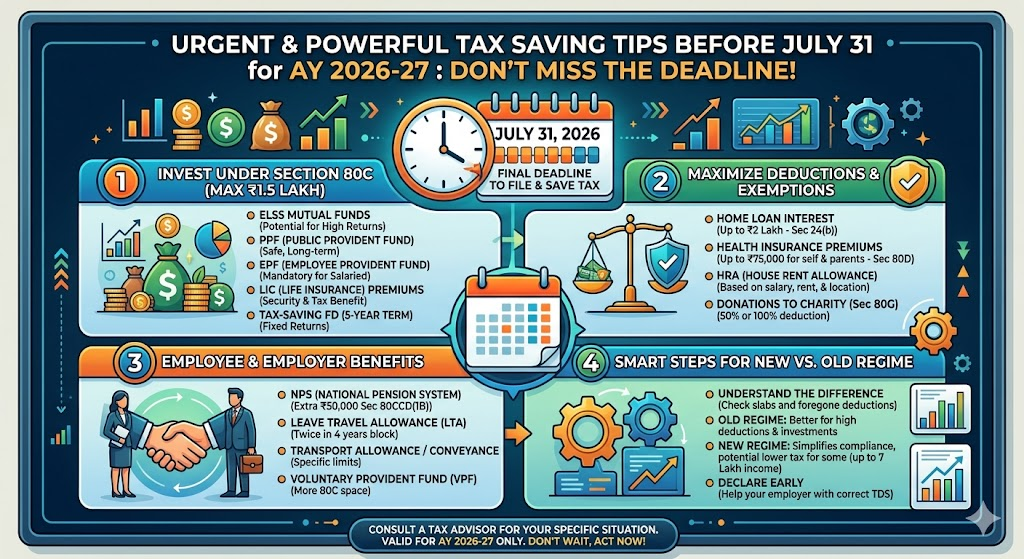
Why the July 31 Deadline for AY 2026-27 Is Critical
Under the Income Tax Act, 1961, the due date for filing an ITR for individuals, HUFs, and non-audit cases is July 31st of the assessment year. For AY 2026-27, this translates to the last date being 31st July 2026. Missing this deadline doesn’t just attract a late filing fee of up to ₹5,000 under Section 234F it also locks you out of several beneficial provisions, including carrying forward certain losses.
The Income Tax Department has made it clear through CBDT guidelines that filing on time is the foundation of good tax compliance. Don’t wait for an extension that may never come.
Step 1 : Choose the Right Tax Regime Before Filing Your ITR
One of the most consequential decisions you’ll make this filing season is: Old Tax Regime or New Tax Regime for FY 2026-27?
The new tax regime for FY 2026-27 offers zero income tax on income up to ₹12 lakh (after rebate under Section 87A), with a simplified slab structure. It also now includes a standard deduction of ₹75,000 for salaried individuals a significant upgrade.
However, if you have substantial deductions particularly Section 80C investments (up to ₹1.5 lakh), HRA, home loan interest (Section 24b), and NPS contributions (Section 80CCD(1B)) the old tax regime may still work out cheaper for you. Read our detailed guide on Old vs New Tax Regime 2026 to run your numbers before you file.
Pro Tip: Use the ITR filing portal’s built-in regime comparison calculator or get a professional assessment before locking in your choice. Once the ITR is filed, switching is not possible for that year.
Step 2 : Maximize Your Deductions Before July 31 (Checklist)
Even if most investments had to be made by March 31, 2026, here’s what you can still do before filing:
Deductions You Must Claim While Filing
- Section 80C (up to ₹1.5 lakh): ELSS, PPF, LIC premium, home loan principal, NSC, tuition fees ensure all investments made in FY 2025-26 are accurately declared.
- Section 80D Health Insurance Premium: Up to ₹25,000 for self/family; ₹50,000 for senior citizen parents. This deduction is often underclaimed.
- Section 80CCD(1B) NPS Contribution: An additional ₹50,000 over and above the 80C limit available only under the old tax regime.
- Section 24(b) Home Loan Interest: Up to ₹2 lakh for a self-occupied property. If you have a home loan, this is a powerful deduction to claim.
- HRA Exemption: Cross-verify your actual rent paid vs. employer-declared HRA. Discrepancies can trigger notices.
- Standard Deduction of ₹75,000 (new regime) or ₹50,000 (old regime for salaried): Automatically available ensure it reflects correctly in your ITR.
Learn more about our ITR Filing Service to ensure every deduction is captured accurately
Step 3 : Verify Form 26AS, AIS & TIS Before Filing
One of the most overlooked yet critical pre filing steps is reconciling your Form 26AS, AIS (Annual Information Statement), and TIS (Taxpayer Information Summary). These documents reflect what banks, employers, and other third parties have reported to the Income Tax Department against your PAN.
A mismatch between your income and what’s reported in AIS can trigger income tax scrutiny notices something you definitely want to avoid.
Step 4 : Don’t Forget Advance Tax Compliance for FY 2026-27
If you are a freelancer, consultant, business owner, or have capital gains income, advance tax is your responsibility. The advance tax due dates for FY 2026-27 are:
| Installment | Due Date | % of Total Tax |
| 1st | June 15, 2026 | 15% |
| 2nd | September 15, 2026 | 45% |
| 3rd | December 15, 2026 | 75% |
| 4th | March 15, 2027 | 100% |
Failing to pay advance tax leads to interest under Sections 234B and 234C. This year, with capital gains from shares and mutual funds being taxable, many salaried individuals with F&O or equity portfolios fall into the advance tax net without realising it.
Step 5 : File the Correct ITR Form
This may sound basic, but filing the wrong ITR form is a common mistake that results in defective return notices. Here’s a quick guide:
- ITR(1) (Sahaj): Salaried income, one house property, other sources income up to ₹50 lakh
- ITR(2): Capital gains, multiple properties, foreign income/assets
- ITR(4) (Sugam): Presumptive income under Section 44AD, 44ADA, 44AE
Read our ITR-1 vs ITR-2 vs ITR-4 selection guide to pick the right form for your income type in AY 2026-27.
Expert Insight : What Tax Professionals Recommend
According to Dr. Haresh Adwani, a trusted voice in Indian taxation and compliance, many taxpayers lose significant amounts not because of high tax rates, but due to poor documentation, wrong regime selection, and failure to claim legitimate deductions. “Filing early, filing correctly, and filing with complete documentation is the single most powerful tax strategy available to the Indian taxpayer,” he notes.
This view aligns with the Income Tax Department’s consistent push toward voluntary and timely compliance and for good reason. Early filers get faster refunds, fewer notices, and a cleaner compliance record.
Key Takeaways
- July 31, 2026 is the last date to file ITR for AY 2026-27 late filing attracts ₹5,000 penalty under Section 234F
- Compare old vs new tax regime before filing don’t assume one is better without calculating
- Standard deduction of ₹75,000 is available under the new regime for salaried individuals
- Always verify Form 26AS, AIS, and TIS for mismatches before filing
- Freelancers and business owners must track advance tax due dates for FY 2026-27
- Choose the correct ITR form wrong form = defective return notice
- Every deduction saved is money back in your pocket claim 80C, 80D, 80CCD(1B), and 24(b) diligently
Fequently Asked Questions (FAQs)
Q1. What is the last date to file ITR for AY 2026-27?
The ITR filing last date for AY 2026-27 is July 31, 2026 for individuals and non audit cases. Filing after this date attracts a late fee of up to ₹5,000 under Section 234F.
Q2. Which tax regime is better for salaried employees in FY 2026-27?
It depends on your total deductions. The new tax regime benefits those with fewer deductions, while the old regime suits those with significant 80C, HRA, and home loan interest claims. Use a regime comparison calculator before deciding.
Q3. What is the standard deduction under the new tax regime in 2026?
The standard deduction under the new tax regime for FY 2025-26 (AY 2026-27) is ₹75,000 for salaried employees and pensioners a significant benefit introduced in the Union Budget
Q4. Can I still save tax if I missed the March 31 investment deadline?
Most investment-based deductions (like 80C) require investments before March 31. However, you can still maximize deductions by claiming HRA, home loan interest, health insurance premiums, and ensuring accurate reporting of all eligible expenses in your ITR.
Q5. What happens if I file the wrong ITR form for AY 2026-27?
Filing an incorrect ITR form results in a defective return notice under Section 139(9). You’ll be given 15 days to rectify it. However, repeated errors can delay refunds and invite scrutiny always verify which form applies to your income profile.
Conclusion
The ITR filing deadline for AY 2026-27 is not just a compliance formality it’s your last call to lock in every tax benefit legally available to you. From choosing the right regime and maximizing deductions to verifying AIS data and filing the correct form, every step matters.
Don’t let procrastination cost you thousands of rupees in avoidable penalties, missed refunds, or compliance complications down the road.
Ready to file smart this July 31? Connect with the experts at itradvisor.in today — because the right guidance now saves far more than the time it takes.
Learn more about our ITR Filing Service | Explore our complete guide on Income Tax Slabs FY 2026-27
About the Author
Dr. Haresh Adwani
Ph.D. in Commerce | Law Graduate | Managing Partner, Adwani & Co LLP Dr. Haresh Adwani holds a Ph.D. in Commerce and is a qualified Law graduate with over two decades of hands-on experience in GST advisory, direct taxation, and statutory compliance for businesses across
Disclaimer: ITRAdvisor.in is an educational and informational platform focused on tax awareness and compliance updates. Nothing contained herein should be construed as solicitation or advertisement of professional services. Professional services, where applicable, are rendered in accordance with ICAI guidelines. This article is published on ITRAdvisor.in, a tax and compliance knowledge platform. The content has been reviewed for technical accuracy by professionals associated with Adwani & Co LLP.