A tax notice arrived. But the biggest mistake happened before anyone even read it. The business owner saw the notice and immediately thought, “We have done something wrong.” The worry started before the actual matter was even understood.
This reaction plays out again and again in scrutiny assessments and tax litigation matters. The moment an income tax notice lands in the inbox, fear takes over before facts do. People start imagining penalties, disputes, and consequences when in reality, an income tax notice is simply a communication from the department, seeking information, clarification, or verification about a specific matter.
What an Income Tax Notice Actually Means
An income tax notice is not a judgment. It is not proof of wrongdoing. As per the framework laid out by the Income Tax Department, notices are routinely issued to verify information already available with the department, request missing documents, or seek an explanation for a transaction that doesn’t immediately reconcile with reported income.
In most cases, the underlying issue is far less serious than the panic suggests. It could be:
A missing document
A delayed response to an earlier communication
A difference in interpretation of a provision
A transaction that simply needs more explanation
Common Reasons Behind an Income Tax Notice
Many income tax notices today are triggered by data mismatches rather than deliberate concealment a mismatch between AIS/Form 26AS and the return filed, high-value transactions flagged under Rule 114E, or a reassessment query under Section 148. With faceless assessment now driving much of the department’s scrutiny process, notices are increasingly system-generated, which makes an informed, timely reply even more important.
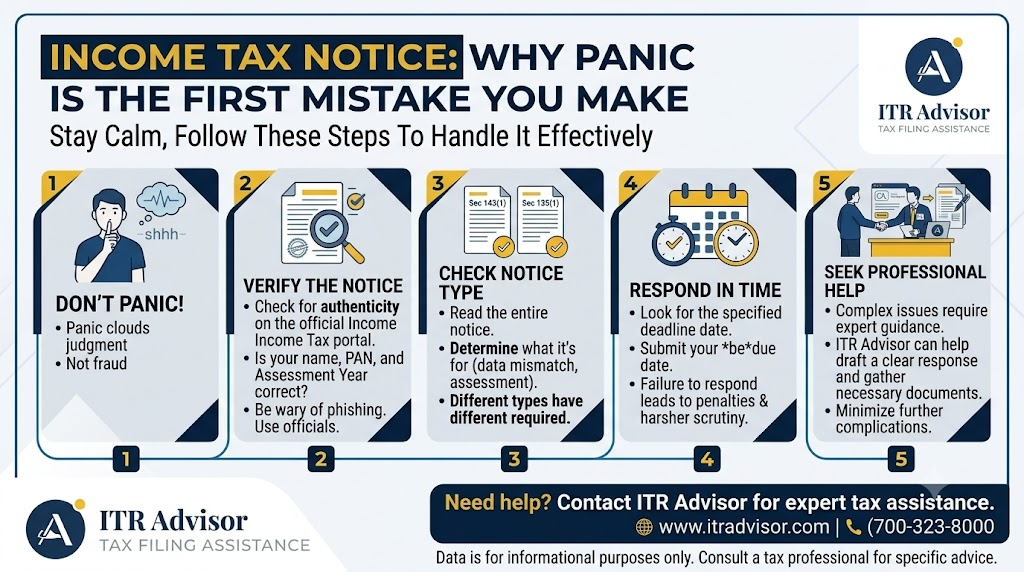
The biggest mistake businesses make is treating an income tax notice as a problem before understanding the reason behind it. A calmer, more structured approach works far better.
1. Understand What Is Being Asked
Read the notice carefully to identify the exact section, assessment year, and query involved before reacting.
2. Review the Facts and Supporting Documents
Match the notice against your records, invoices, bank statements, and filed returns before drafting any reply.
3. Analyse the Applicable Provisions
Check which section of the Income Tax Act the notice falls under, since the response strategy differs for each.
4. Decide the Right Response : Don’t Rush It
Tax matters are rarely resolved through panic. They are resolved through clarity, documentation, and the right strategy submitted within the given timeline.
Dr. Haresh Adwani, PhD in Commerce and is a law graduate with decades of experience handling scrutiny assessments and tax litigation, often notes that many tax issues become complicated not because of the original matter, but because of delayed action and incorrect assumptions. An income tax notice is not the end of the road it is a situation that needs careful evaluation.
Key Takeaway
An income tax notice is a request for information, not a penalty.
Most notices stem from missing documents, mismatches, or interpretation gaps.
Understand, review, analyse, then respond never react out of fear. Delayed or incorrect responses cause more damage than the original notice.
Frequently Asked Questions
1.What should I do first after receiving an income tax notice?
Read it carefully to identify the section and query, then gather the relevant documents before replying.
2.Does an income tax notice always mean a penalty is coming?
No. Most notices seek clarification or verification and do not automatically imply a penalty.
3.What is the usual time limit to reply to an income tax notice?
Time limits vary by section and are mentioned in the notice itself; missing them can lead to avoidable complications.
4.Can a minor income tax notice be ignored?
No notice should be ignored, even a minor one, since unanswered notices can escalate into larger compliance issues.
Final Word on Handling an Income Tax Notice
An income tax notice is a moment that calls for clarity, not panic. Understanding the query, checking your documents, and responding within the given provisions turns a stressful moment into a manageable compliance step.
Author
Dr. Haresh Adwani
PhD (Commerce) · Adwani & Company, Pune
Dr. Haresh Adwani is a PhD holder in Commerce with over 20 years of experience in NRI taxation, FEMA compliance, international financial advisory, and tax notice resolution. He is one of Pune’s most trusted NRI tax advisors, specialising in residential status assessment, DTAA planning, and cross-border compliance for professionals returning from the US, UK, UAE, Canada, and Australia.
Disclaimer
ITRAdvisor.in is an educational and informational platform focused on tax awareness and compliance updates. Nothing contained herein should be construed as solicitation or advertisement of professional services. Professional services, where applicable, are rendered in accordance with ICAI guidelines. This article is published on ITRAdvisor.in, a tax and compliance knowledge platform. The content has been reviewed for technical accuracy by professionals associated with Adwani & Co LLP.
Thousands of NRIs invest in India every year. Most don’t realise their biggest mistake happens after the money is already in, not before.
India continues to attract strong interest from NRIs looking to invest in real estate, stocks, mutual funds, start ups, and businesses. But many investors focus only on returns and overlook the NRI investment tax rules that decide how much of that return they actually keep.
Getting NRI investment tax India considerations right before you invest, not after, is what separates a smooth investment from a compliance headache. Here are five things every NRI should know.
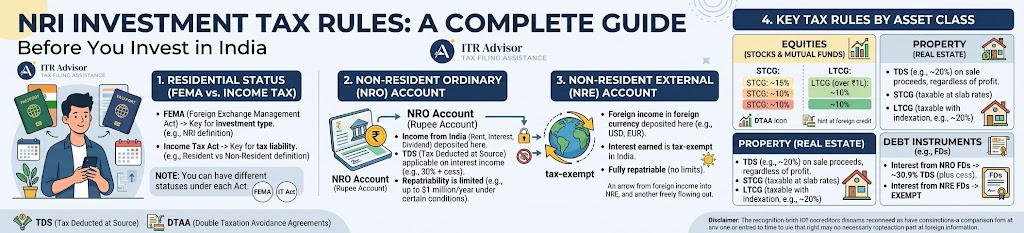
1. Your Residential Status Decides Your Tax Liability
Your tax liability in India depends on whether you qualify as an NRI or a Resident under the Income Tax Act, not on your passport or citizenship. Residential status is determined by the number of days spent in India during the financial year and preceding years, directly affecting which income gets taxed here and at what rate. Getting this classification wrong at the outset can distort every other tax calculation that follows.
2. TDS Rules on NRI Investment Income
Many investment incomes and property transactions involving NRIs carry mandatory TDS deduction at source, often at higher rates than for residents. Understanding applicable TDS rates upfront, whether on rental income, interest, or property sale proceeds, helps you plan cash flow and avoid surprises when funds are credited.
3. Capital Gains Taxability Varies by Asset
Capital gains tax NRI India treatment is not one-size-fits-all. Different investments, whether listed shares, mutual funds, or immovable property, attract different holding periods and tax rates. The classification between short-term and long-term capital gains can significantly change your final tax liability, so it’s worth mapping this out before committing capital.
Why DTAA Benefits Matter for NRI Investors
If your country of residence has a Double Taxation Avoidance Agreement with India, you may be eligible to reduce or avoid being taxed twice on the same income. Claiming DTAA benefits correctly requires proper documentation, including a Tax Residency Certificate, and is one of the most under-utilised reliefs among NRI taxpayers.
4. Documentation That Protects Your Repatriation
Keeping your PAN, bank records, investment proofs, and tax filings updated is not paperwork for its own sake. It is what ensures smooth compliance and hassle-free repatriation of funds when you eventually want to move proceeds abroad.
Government Frameworks Behind NRI Compliance
The Income Tax Department’s residency and TDS provisions, along with RBI’s FEMA regulations governing repatriation, together shape how NRI investment tax India obligations play out in practice. Staying aligned with both frameworks is what keeps an investment compliant from entry to exit.
Dr. Haresh Adwani, a PhD in Commerce and law graduate who has advised NRIs on cross-border investment and tax structuring for decades, frequently notes that taxpayers who plan their NRI investment tax India strategy before investing consistently retain more of their returns than those who address it afterward.
Key Takeaway onNRI Investment Tax Rules
Residential status under the Income Tax Act, not citizenship, decides your NRI tax liability
TDS applies to most NRI investment income and property transactions
Capital gains tax depends on asset type and holding period
DTAA benefits can meaningfully reduce double taxation for NRI investors
Updated documentation ensures smooth repatriation later
1.Do NRIs pay higher TDS on investment income in India?
Often yes. TDS on NRI investment income is generally higher than for residents, depending on the income type.
2.How are capital gains taxed for NRIs investing in India?
It depends on the asset and holding period, with different rates for short-term and long-term capital gains.
3.Can NRIs claim DTAA benefits on Indian investment income?
Yes, if their country of residence has a DTAA with India, subject to proper documentation like a Tax Residency Certificate.
4.What documents do NRIs need for smooth repatriation of investment proceeds?
Updated PAN, bank records, investment proofs, and tax compliance documents are essential for hassle-free repatriation.
Conclusion
NRI Investment Tax Rules
Smart investing isn’t just about choosing the right asset; it’s about planning your NRI investment tax India strategy correctly from day one. Residential status, TDS, capital gains, DTAA, and documentation together determine your real, post-tax return. If you’re an NRI planning to invest in India or unsure about the tax implications, connect with itradvisor.in today for expert guidance before you invest.
Author
Dr. Haresh Adwani
PhD (Commerce) · Adwani & Company, Pune
Dr. Haresh Adwani is a PhD holder in Commerce with over 20 years of experience in NRI taxation, FEMA compliance, international financial advisory, and tax notice resolution. He is one of Pune’s most trusted NRI tax advisors, specialising in residential status assessment, DTAA planning, and cross-border compliance for professionals returning from the US, UK, UAE, Canada, and Australia.
Disclaimer:
ITRAdvisor.in is an educational and informational platform focused on tax awareness and compliance updates. Nothing contained herein should be construed as solicitation or advertisement of professional services. Professional services, where applicable, are rendered in accordance with ICAI guidelines. This article is published on ITRAdvisor.in, a tax and compliance knowledge platform. The content has been reviewed for technical accuracy by professionals associated with Adwani & Co LLP
Thousands of NRIs pay more tax than they legally need to, and most don’t find out until a refund gets stuck, a notice lands, or a property sale turns complicated. If you live abroad but still earn even a rupee of income in India, NRI ITR filing isn’t a formality you can skip. It’s the one step that decides whether you overpay the taxman or claim back what’s rightfully yours.
Do NRIs Really Need NRI ITR Filing While Living Abroad?
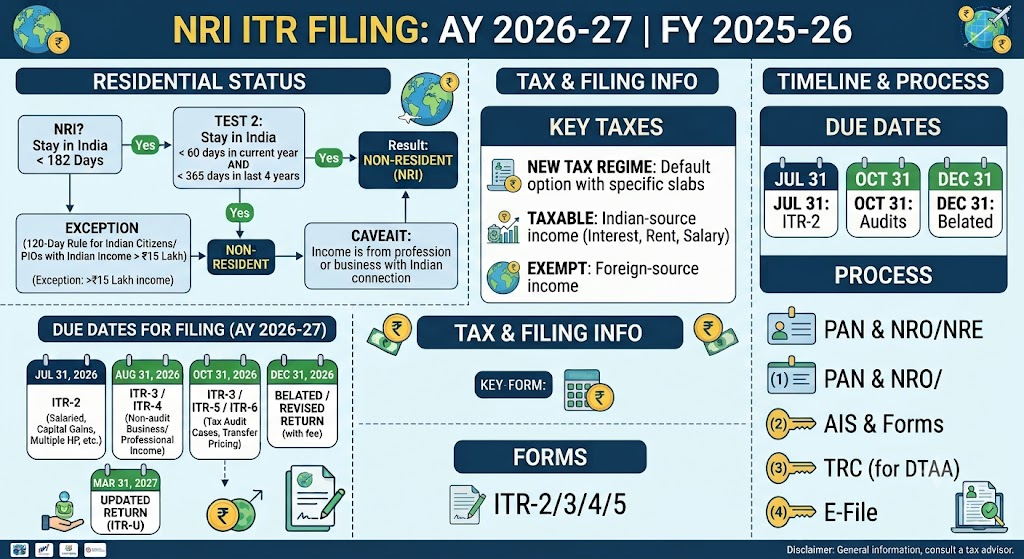
This is the single biggest myth in NRI taxation. Living outside India does not exempt you from Indian tax law the moment income actually arises here. NRI ITR filing becomes mandatory whenever you have rental income from an Indian property, capital gains, or interest income, regardless of how small the amount seems. And here’s the part most NRIs miss: TDS being deducted at source does not close the matter. If the flat TDS rate is higher than your actual tax liability, skipping NRI ITR filing means walking away from a refund you’re legally entitled to.
The NRI ITR Filing Questions We Hear Every Season
Every filing season, the questions from NRI clients follow a familiar pattern:
Do I need to file an ITR if I only earn rental income from India?
TDS has already been deducted on my income. Do I still need to file a return?
I sold a property in India. Can I claim a refund of excess TDS?
My NRO account earned interest. Is it taxable?
I transferred money between my NRE and NRO accounts. Is there any tax implication?
Can I claim deductions under Section 80C or 80D as an NRI?
What documents do I need to keep ready before filing?
Will NRI ITR filing help me in future property transactions, loans, or repatriation of funds?
Each of these has a concrete, individual answer, and getting it wrong is exactly what leads to overpaid tax or a delayed refund.
NRI ITR Filing After a Property Sale: Claiming Your TDS Refund
When an NRI sells property in India, the buyer typically deducts TDS at a much higher rate than the actual capital gains tax owed. Without NRI ITR filing, that excess amount simply sits with the government. Filing a return lets you compute the real capital gains, apply eligible exemptions, and claim back the difference as a refund, often a meaningful sum on a mid-sized property transaction.
NRO Interest, NRE-NRO Transfers, and NRI ITR Filing
Interest earned on an NRO account is fully taxable in India and usually carries TDS close to 30%. NRE account interest, by contrast, is exempt for a genuine non-resident. A common point of confusion is transferring funds between your own NRE and NRO accounts. This movement, by itself, is not a fresh taxable event, but it should be documented carefully since it can surface during AIS or Form 26AS reconciliation, and accurate NRI ITR filing keeps that record clean and defensible.
Deductions and Documents for Smooth NRI ITR Filing
NRIs remain eligible for several deductions under the Income Tax Act, including Section 80C (life insurance, ELSS, children’s tuition fees) and Section 80D (health insurance premiums), subject to certain conditions. Before NRI ITR filing, keep the following ready: PAN, passport copy confirming residential status, NRE and NRO bank statements, Form 26AS and AIS, TDS certificates, and the sale deed if a property transaction is involved. Proper NRI ITR filing today also strengthens your position for future loans, property purchases, and smooth repatriation of funds through proper banking channels.
Key Takeaway
• NRI ITR filing is mandatory once taxable Indian income exists, TDS deduction alone does not end the obligation.
• Property sales, NRO interest, and rental income are the most common triggers for NRI ITR filing.
• Timely NRI ITR filing is the only route to recovering excess TDS as a refund. • Good documentation today prevents AIS/Form 26AS mismatch notices tomorrow.
For nearly five decades, Adwani & Co LLP has guided NRI clients through exactly these questions, under the stewardship of Dr. Haresh Adwani, who holds a PhD in Commerce and is also a law graduate. That depth of experience is precisely why a few weeks of planning ahead of the filing season routinely saves NRIs from unnecessary tax outflow and months of avoidable follow-up with the Income Tax Department.
Frequently Asked Questions
1.Can I claim a TDS refund through NRI ITR filing after selling property?
Yes. If TDS deducted exceeds your actual capital gains tax, NRI ITR filing is how you claim that excess amount back.
2.Is interest on an NRO account taxable for NRIs?
Yes, NRO interest is fully taxable in India, unlike NRE account interest, which is generally exempt.
3.Do NRE to NRO fund transfers attract tax?
Not by themselves, but they should be documented properly to avoid mismatches during NRI ITR filing and AIS reconciliation.
4.Can NRIs claim deductions under Section 80C and 80D?
Yes, subject to certain conditions, making accurate NRI ITR filing essential to actually claim
Conclusion: Make NRI ITR Filing Work in Your Favour
NRI ITR filing isn’t just about compliance, it’s about not leaving your own money on the table. Rental income, property sales, NRO interest, and fund transfers all carry tax implications that only proper filing can resolve in your favour. If you’re an NRI with income, investments, or property in India, review your tax position before the filing rush begins.
Dr. Haresh Adwani is a PhD holder in Commerce with over 20 years of experience in NRI taxation, FEMA compliance, international financial advisory, and tax notice resolution. He is one of Pune’s most trusted NRI tax advisors, specialising in residential status assessment, DTAA planning, and cross-border compliance for professionals returning from the US, UK, UAE, Canada, and Australia.
Disclaimer:
ITRAdvisor.in is an educational and informational platform focused on tax awareness and compliance updates. Nothing contained herein should be construed as solicitation or advertisement of professional services. Professional services, where applicable, are rendered in accordance with ICAI guidelines. This article is published on ITRAdvisor.in, a tax and compliance knowledge platform. The content has been reviewed for technical accuracy by professionals associated with Adwani & Co LLP.
If you want expert guidance on NRI ITR filing, connect with itradvisor.in today, and take the guesswork out of your Indian tax compliance.
You’ve just been discharged from the hospital after a week-long inpatient stay. The final bill arrives and buried inside it is a line item: ‘GST on medicines.’ You pay it without question because, honestly, who challenges a hospital bill? But here’s the truth that most patients in India never find out: you may have been charged GST on inpatient medicines that is completely illegal under Indian GST law.
What Does Indian GST Law Actually Say About Inpatient Medicines?
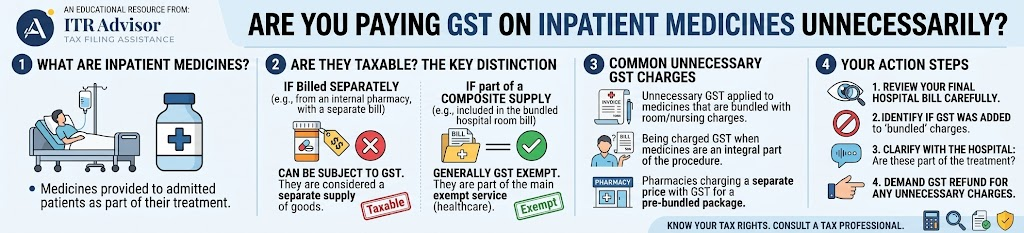
Under the Central Goods and Services Tax (CGST) Act, 2017, health care services provided by a clinical establishment are fully exempt from GST. The key provision is Notification No. 12/2017 – Central Tax (Rate), which specifically exempts ‘services by a clinical establishment, an authorised medical practitioner or para-medics’ from the GST net.
More importantly, the CBIC (Central Board of Indirect Taxes and Customs) has consistently clarified that when medicines and consumables are supplied to an inpatient as part of a composite healthcare service meaning the supply of medicine is bundled with the treatment the entire package is treated as a healthcare service and is therefore exempt from GST. The medicines do not attract GST separately in such cases.
Illustrative Example Mr. Ramesh is admitted to a private hospital in Pune for a knee surgery. The hospital administers anaesthesia, antibiotics, and post-operative medications during his stay. Since these medicines are part of his inpatient treatment package, the entire composite supply qualifies as a healthcare service and should be billed without GST on the medicines component.
When Is GST Actually Applicable on Hospital Medicines?
The exemption applies specifically to inpatient (IPD) settings. The scenario changes when:
You visit a hospital pharmacy as an outpatient (OPD) and buy medicines to take home GST at applicable slab rates (5%, 12%, or 18%) applies here.
A hospital sells medicines over the counter without any linked treatment.
Cosmetic or elective procedures that don’t qualify as ‘healthcare services’ are involved.
The critical legal distinction is composite supply vs. independent supply. When medicines are consumed as part of IPD care, they form a composite healthcare service. When sold independently at a retail pharmacy counter, they are a separate supply and GST applies normally.
Why Do Some Hospitals Still Charge GST on Inpatient Medicines?
This remains one of the most common GST compliance errors in the Indian healthcare sector. Several hospitals particularly smaller nursing homes and non-corporate setups either misunderstand the composite supply rule or bifurcate their inpatient invoices to show medicines as a separate line item, creating a false impression of taxability.
In some cases, hospitals may be incorrectly availing Input Tax Credit (ITC) on medicines they procure and passing on a GST charge to patients to offset their books. This practice is not legally tenable and has been flagged in multiple CBIC clarifications.
What the GST Portal and CBIC Say
As per guidance available on gst.gov.in and CBIC circulars, healthcare services rendered by hospitals, including all composite supplies such as medicines, diagnostics, and room charges during inpatient stay, are exempted under Entry 74 of Notification No. 12/2017 Central Tax (Rate). Patients are well within their rights to question any GST line item on their inpatient bill and request a corrected invoice.
How to Identify If You Have Been Wrongly Charged GST on Inpatient Medicines
Check your hospital discharge bill carefully. Look for:
A separate GST charge applied specifically to medicines or consumables.
GST percentages of 5%, 12%, or 18% on items administered during your IPD stay.
Any line item labelled ‘pharmacy charges’ with GST added on top.
If you notice any of these, you are entitled to raise a formal objection with the hospital’s billing department. You can also file a complaint with the GST helpdesk or the relevant State GST authority if the hospital refuses to correct the bill.
Medicines administered during inpatient (IPD) stays are part of a composite healthcare service and are fully exempt from GST under Indian law.
The exemption is governed by Notification No. 12/2017 – Central Tax (Rate) under the CGST Act, 2017.
Outpatient pharmacy purchases do attract GST the exemption is specific to inpatient composite supplies.
Patients have the right to question and dispute incorrect GST charges on their hospital bills.
When in doubt, consult a qualified GST professional or visit gst.gov.in for official guidance.
Frequently Asked Questions (FAQs) on GST on Inpatient Medicines
1.Is GST charged on medicines during hospitalization in India?
No. Medicines administered as part of an inpatient hospital stay form a composite healthcare service, which is exempt from GST under Notification No. 12/2017 Central Tax (Rate). GST should not be charged on such medicines.
2.What is the GST rate on medicines at a hospital pharmacy for outpatients?
Outpatient purchases from a hospital pharmacy attract GST at standard slab rates typically 5% on most formulations, 12% on certain drugs, and 18% on some items. The exemption applies only to inpatient composite supplies.
3.Can I dispute a GST charge on my inpatient hospital bill?
Yes. You can formally raise the issue with the hospital’s billing department, citing CBIC circulars and Notification No. 12/2017. If unresolved, a complaint can be filed with the State GST authority or the GST helpdesk on gst.gov.in.
4.Does the GST exemption on inpatient medicines apply to all hospitals?
The exemption applies to all clinical establishments recognized under applicable law including private hospitals, nursing homes, and clinics provided the medicines are supplied as part of composite inpatient care and not sold separately.
5.What if the hospital shows GST on medicines as a separate line item in the IPD bill?
A separate billing line does not change the legal character of the supply. If those medicines were administered during your inpatient treatment, the composite supply rule still applies and GST should not be payable. Request a revised invoice.
Conclusion: Don’t Pay GST on Inpatient Medicines Without Questioning It
The Indian GST law is clear healthcare services, including medicines consumed during inpatient hospital stays, are exempt from GST. The confusion arises because of billing practices, lack of awareness, and occasional non-compliance by healthcare providers. As a patient, you have every legal right to scrutinize your hospital bill and challenge unjust GST charges.
Tax and compliance expert Dr. Haresh Adwani emphasizes that awareness of GST exemptions in healthcare can save families significant amounts especially during extended or critical hospitalizations where medicine costs are high. Knowing the law is your first line of defence.
Learn more about our Tax Advisory Services to get expert support on GST compliance, dispute resolution, and tax plan
Dr. Haresh Adwani is a PhD holder in Commerce with over 20 years of experience in NRI taxation, FEMA compliance, international financial advisory, and tax notice resolution. He is one of Pune’s most trusted NRI tax advisors, specialising in residential status assessment, DTAA planning, and cross-border compliance for professionals returning from the US, UK, UAE, Canada, and Australia.
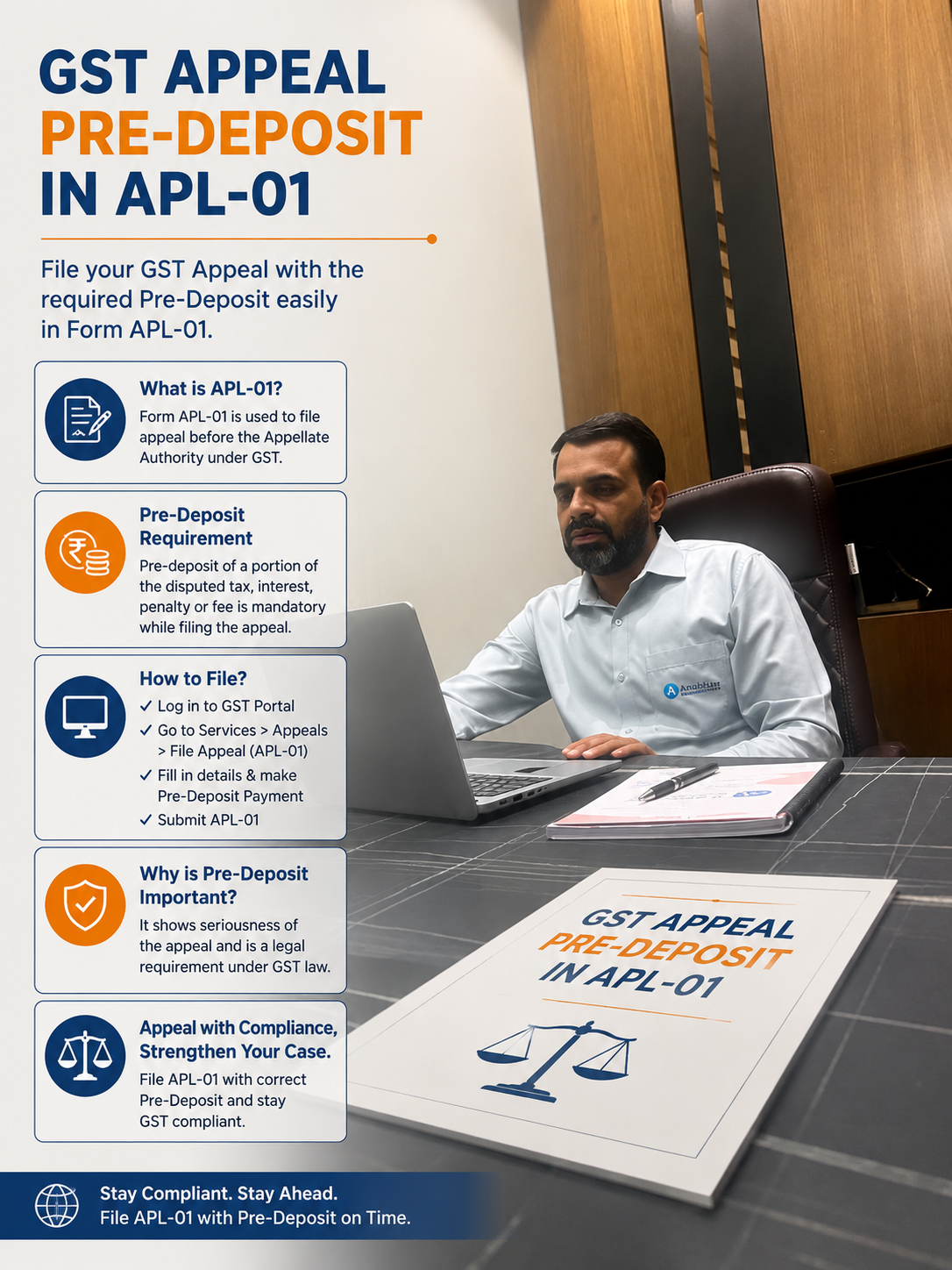
If you’ve ever tried to file a GST appeal after receiving a demand order, you know how unforgiving the GSTN portal can be. A single locked field, an uneditable pre-deposit amount, and your entire GST show cause notice reply appeal collapses before it even begins. For months, taxpayers and tax professionals across India were struggling silently with exactly this problem the pre-deposit field in Form APL-01 was simply not accepting inputs. That nightmare is over. After a long-awaited GST portal fix in April 2026, the APL-01 pre-deposit field is now editable, and here’s everything you need to know to file your GST appeal correctly.
What Is GST Appeal Pre-Deposit and Why Does It Matter?
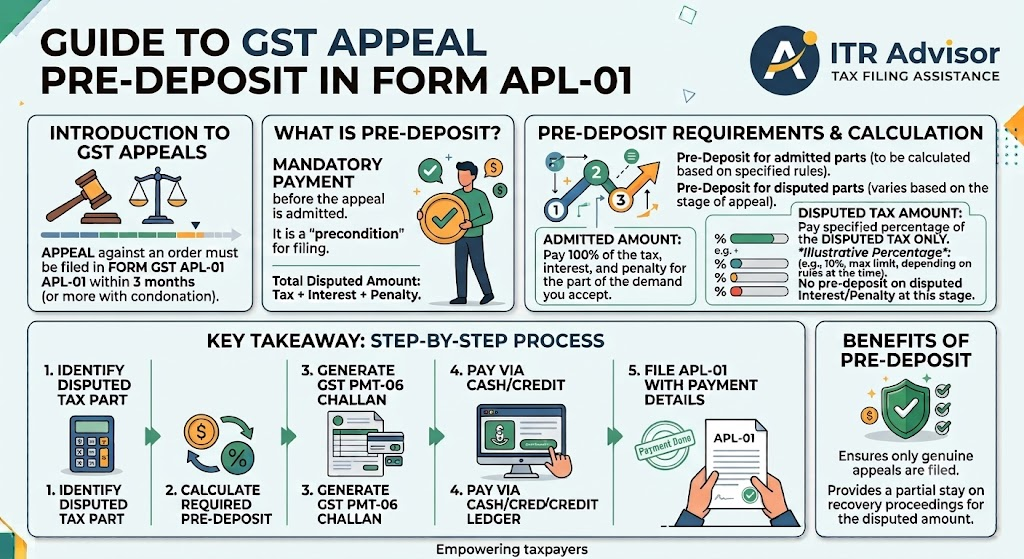
Under Section 107 of the CGST Act, 2017, a taxpayer who wishes to appeal against a GST demand order before the Appellate Authority is required to deposit a portion of the disputed tax amount upfront. This mandatory pre-deposit for GST appeal is not optional without it, the appeal is not even admitted. The Income Tax Department’s analogy here is instructive: just as you cannot contest an assessment without meeting procedural requirements, the GST law demands that appellants demonstrate financial seriousness before the dispute is heard.
Specifically, the GST appeal pre-deposit requirement is:
10% of the disputed tax, interest, and penalty for a first appeal before the Appellate Authority (Section 107(6))
20% of the disputed tax for a second appeal before the GST Appellate Tribunal (Section 112(8))
This amount must be paid through the Electronic Cash Ledger or Electronic Credit Ledger, and the ARN (Acknowledgment Reference Number) of the payment must be correctly entered in Form APL-01
The APL-01 Pre-Deposit Field Problem: What Was Going Wrong?
Between late 2024 and early 2026, a critical technical bug on the GSTN portal made it impossible for many taxpayers to enter or edit the pre-deposit amount in the APL-01 form. The field appeared greyed out, or the entered value would reset to zero upon submission. This was not a user error it was a confirmed portal-level glitch that impacted a large number of GST appeal pre-deposit 2026 filings.
The consequences were severe:
Appeals were filed without the mandatory pre-deposit amount being captured
Several Appellate Authorities dismissed appeals on technical grounds, citing non-compliance with pre-deposit conditions
Taxpayers who had already paid the 10% pre-deposit could not link it to their appeal due to the locked field
CA firms had to resort to offline submissions and hardcopy representations to circumvent the portal issue
April 2026 GST Portal Fix: What Has Changed in APL-01?
The GST Network (GSTN) rolled out a backend portal update in April 2026 that specifically addressed the APL-01 pre-deposit field freeze issue. As of this update, the following improvements are live on the portal:
1. Pre-Deposit Amount Field Is Now Fully Editable
Taxpayers can now directly enter the pre-deposit amount paid under the Electronic Cash Ledger (ECL) or Electronic Credit Ledger (ECRL) while filing Form APL-01. The amount auto-validates against the challan details on record.
2. ARN / CIN Linkage Is Seamless
The portal now correctly links the Challan Identification Number (CIN) or ARN of the pre-deposit payment to the appeal form. This eliminates the need for manual reconciliation, which was the biggest pain point in the earlier GST portal version.
3. Split Pre-Deposit Across Tax Heads Now Supported
A known limitation was that the portal did not support split pre-deposits across CGST, SGST/UTGST, and IGST heads in one filing. The April 2026 fix allows taxpayers to enter pre-deposit amounts separately for each tax head, making it far easier to handle appeals involving interstate supplies or disputed ITC mismatches.
4. Real-Time Pre-Deposit Validation
After entering the pre-deposit details, the form now runs a real-time check against the demand order amount and flags mismatches before final submission. This proactive validation is a significant improvement over the earlier system where errors surfaced only post-submission.
GST Appeal Pre-Deposit: Quick Reference Table
Appeal Level
Pre-Deposit %
Form
Time Limit
First Appeal (GST Officer → Appellate Authority)
10% of disputed tax
APL-01 (GSTN Portal)
3 months from order date
Second Appeal (Appellate Authority → Tribunal)
20% of disputed tax
APL-05 (Tribunal)
3 months from order
High Court / Supreme Court
As directed by Court
WP / SLP
No fixed limit
Step-by-Step: How to File GST Appeal in APL-01 After the Portal Fix
Now that the APL-01 pre-deposit field is editable, here is the correct process to file a GST demand order appeal on the GSTN portal as of April 2026:
Step 1: Pay the Pre-Deposit First
Log in to the GST portal (gst.gov.in). Navigate to Services → Payments → Create Challan. Pay the required 10% of disputed tax under the applicable tax head (CGST/SGST/IGST). Note the CIN carefully.
Step 2: Open Form APL-01
Go to Services → User Services → My Applications → New Application → Appeal to Appellate Authority. Select the correct order against which you are appealing (DRC-07, OIO, or equivalent demand order).
Step 3: Enter Pre-Deposit Details
In the ‘Pre-Deposit Details’ section, which is now fully editable after the April 2026 fix, enter the CIN and the amount deposited for each tax head. The system will validate the amount against 10% of the demand.
Step 4: Upload Supporting Documents
Attach the demand order, your reply to the GST show cause notice, any hearing notices, and the payment challan. File size limits apply compress PDFs where necessary.
Step 5: Submit & Track
Submit the form. You will receive an ARN for the appeal. Track the status under My Applications. A hearing notice is typically issued by the Appellate Authority within 30–60 days.
Expert Perspective: Why Correct Pre-Deposit Entry Is Non-Negotiable
According to Dr. Haresh Adwani, a PhD in Commerce and law graduate associated with Adwani & Co LLP, the pre-deposit is not merely a procedural formality it is a jurisdictional requirement. The Appellate Authority does not have the power to condone non-compliance with Section 107(6). Even if the non-compliance was due to the portal’s technical bug, the burden of proving that the pre-deposit was indeed paid falls on the taxpayer.
This is why it is critically important to:
Always pay the pre-deposit before initiating the APL-01 filing, never simultaneously
Retain the original challan and CIN as primary evidence
Cross-verify the pre-deposit amount entered in APL-01 with the actual demand order figure
If the appeal period is expiring, file immediately and supplement with a condonation application if needed
The APL-01 pre-deposit field is now editable on the GSTN portal after the April 2026 fix.
✅ A 10% pre-deposit of disputed tax is mandatory for a first appeal under Section 107 of the CGST Act.
✅ Pay the pre-deposit via challan first, then enter the CIN in the APL-01 form never enter blank.
✅ The April 2026 update supports split pre-deposit across CGST, SGST, and IGST heads.
✅ If your earlier appeal was dismissed due to this portal bug, consult a GST professional immediately for remedial options. ✅ Always file within the 3-month limit from the date of the demand order condonation is discretionary, not guaranteed.
Frequently Asked Questions
Q1. What is the GST appeal pre-deposit amount required for filing APL-01?
For a first appeal before the Appellate Authority under Section 107(6), you must deposit 10% of the disputed tax, interest, and penalty. This amount must be paid before submitting Form APL-01 on the GSTN portal.
Q2. Is the APL-01 pre-deposit field editable now on the GST portal in 2026?
Yes. The GSTN rolled out a fix in April 2026 that makes the pre-deposit field in APL-01 fully editable. You can now enter the CIN, payment date, and tax-head-wise split correctly.
Q3. What happens if I filed a GST appeal without entering the pre-deposit amount due to the portal bug?
Your appeal may have been dismissed on technical grounds. You should immediately consult a GST professional and explore filing a fresh appeal with condonation of delay, or a writ petition before the High Court if the appeal period has expired.
Q4. Can I use the Electronic Credit Ledger (ITC balance) for the GST appeal pre-deposit?
Yes, the pre-deposit can be paid through both the Electronic Cash Ledger and the Electronic Credit Ledger. However, it must be from the same GSTIN under appeal, and the CIN or ARN must be linked in APL-01.
Q5. What is the time limit to file a GST appeal in Form APL-01 after a demand order?
The appeal must be filed within 3 months from the date of the demand order or OIO. The Appellate Authority can condone delays of up to 1 month for sufficient cause, but condonation beyond that is not permitted under the statute.
Conclusion: Don’t Let a Portal Glitch Cost You Your GST Appeal
The April 2026 GST portal fix is a much-needed correction that restores the integrity of the GST appeal process. But knowing that the pre-deposit field is editable is only the first step. Filing a GST appeal correctly with accurate pre-deposit entry, proper document attachment, and strict adherence to time limits requires both technical knowledge and practical experience. A wrongly filed APL-01 can result in your appeal being dismissed or the pre-deposit being forfeited, leaving you with no recourse against an unjust demand order.
The GST framework, as administered through gst.gov.in and supported by circulars from the Central Board of Indirect Taxes and Customs (CBIC), is complex but navigable with the right guidance.
Whether you are responding to a GST show cause notice, planning a Section 107 appeal, or recovering from a dismissed filing, expert support can make all the difference.
About the Author Dr. Haresh Adwani Ph.D. in Commerce | Law Graduate | Managing Partner, Adwani & Co LLP
Dr. Haresh Adwani holds a Ph.D. in Commerce and is a qualified Law graduate with over two decades of hands-on experience in GST advisory, direct taxation, and statutory compliance for businesses across
DisclaimerITRAdvisor.in is an educational and informational platform focused on tax awareness and compliance updates. Nothing contained herein should be construed as solicitation or advertisement of professional services. Professional services, where applicable, are rendered in accordance with ICAI guidelines. This article is published on ITRAdvisor.in, a tax and compliance knowledge platform. The content has been reviewed for technical accuracy by professionals associated with Adwani & Co LLP
Visit ITRAdvisor.in today for professional guidance and consultation.
Early action can often prevent bigger tax problems later
If you or someone you know has received a Section 148 income tax reassessment notice, do not panic but do act quickly and smartly. The law is on your side, provided you know where to look.
📞 Take Action Today
Need help evaluating whether your income tax reassessment notice is valid?
Connect with the experts at itradvisor.in for a detailed assessment of your notice, legal objection drafting, and end-to-end reply support. Visit: www.itradvisor.in | Powered by Adwani & Co LLP
An employee is told their ESOPs are worth Rs. 50 lakh. They celebrate. Two years later, at the time of exercise, a very different number appears on their tax statement. What went wrong? Nothing illegal. Just a number that was never properly understood or properly determined.
This is the quiet danger at the heart of ESOP valuation in India. And in 2026, as start up equity culture matures and the Income Tax Department sharpens its lens on perquisite taxation, getting this right is no longer optional for founders, CFOs, or the employees who accept these grants.
What Is ESOP Valuation in India and Why Does It Matter?
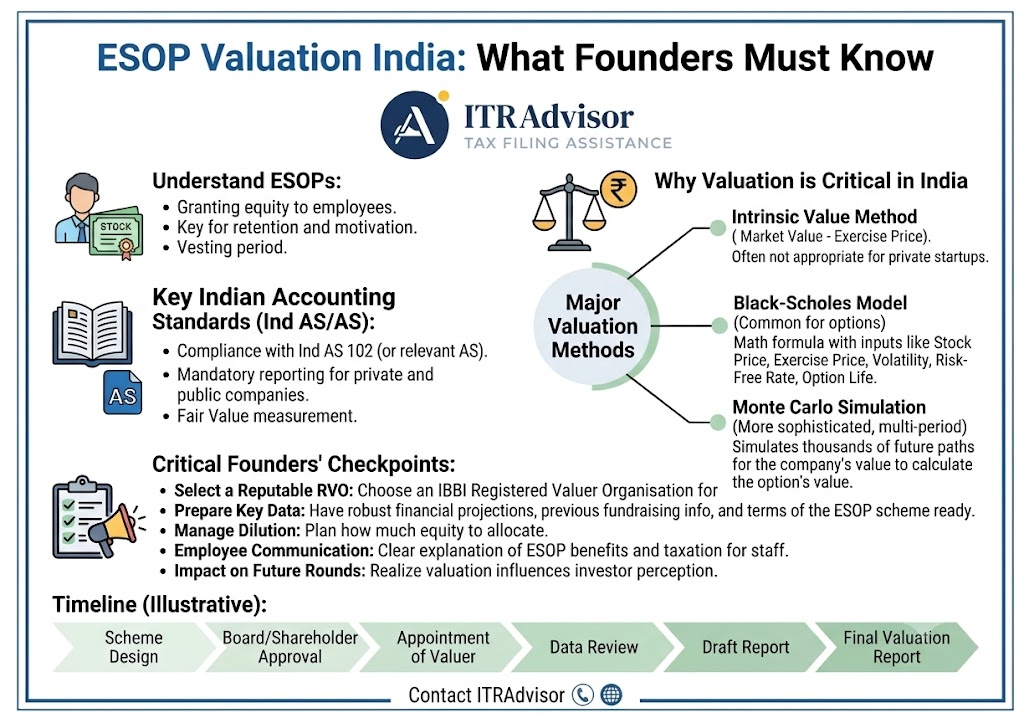
An Employee Stock Option Plan (ESOP) gives employees the right to purchase company shares at a pre-decided exercise price, typically lower than the fair market value (FMV). The difference between the FMV on the date of exercise and the exercise price is treated as a perquisite under the Income Tax Act, 1961, and is taxed as part of the employee’s salary income.
This is where ESOP valuation in India becomes critically important. The FMV on the date of exercise directly determines how much tax the employee pays. If the underlying valuation methodology is weak, arbitrary, or unsupported, it creates problems at multiple levels:
The employee faces unexpected ESOP perquisite tax liability in India that they were not prepared for.
The company faces questions during investor due diligence or SEBI scrutiny.
Regulatory compliance under the Companies Act and FEMA (for ESOPs with foreign participation) becomes difficult to defend.
Employee trust erodes when the promised equity value does not align with tax-time reality.
How Is ESOP Valuation Determined for Unlisted Companies in India?
For listed companies, the FMV of shares is straightforward it is the market price on the recognised stock exchange. For unlisted start ups, the process is more nuanced and more consequential.
As per the Income Tax Rules, the FMV of shares of an unlisted company for ESOP purposes is required to be determined by a SEBI-registered Category I Merchant Banker. This is not a valuation that the company can do internally or informally. A formally supported valuation report, applying recognised methodologies such as the Discounted Cash Flow (DCF) method or the Net Asset Value (NAV) approach, is the standard the Income Tax Department expects.
Common ESOP valuation methods for unlisted companies include:
Discounted Cash Flow (DCF): Projects future cash flows and discounts them to present value, most relevant for growth-stage startups with revenue visibility.
Comparable Company Multiples: Values the company basis revenue or EBITDA multiples of similar listed or recently funded peers.
Net Asset Value (NAV): Based on the company’s book value of assets minus liabilities; typically applied for asset-heavy businesses.
The choice of methodology and its supporting assumptions must be defensible both to employees asking questions and to tax authorities examining records.
ESOP Tax Implications in India 2026: Two Points of Taxation
A frequently misunderstood aspect of ESOP tax implications in India is that employees are potentially taxed twice:
1: At Exercise Perquisite Tax
When an employee exercises their options, the spread between FMV and exercise price is treated as salary income (perquisite) and taxed at the employee’s applicable slab rate. For start up employees, where FMV may have grown significantly between the grant date and exercise date, this can result in a substantial tax liability even before a single share has been sold.
Budget 2020 introduced a deferred tax payment option for employees of eligible startups recognised by DPIIT, allowing this perquisite tax to be deferred up to 48 months from the exercise date, or until the employee leaves, or until the shares are sold whichever is earlier. Eligible employees should verify their employer’s DPIIT recognition status on the government’s startup portal.
2: At Sale : Capital Gains Tax
When the employee eventually sells the shares, the gain from sale price minus the FMV at exercise is treated as capital gain. If the shares have been held for more than 24 months (for unlisted company shares), the gains qualify as long-term capital gains, attracting a lower tax rate than short-term capital gains. For listed shares, the holding period threshold is 12 months.
Why a Well-Supported ESOP Valuation Protects Everyone
Dr. Haresh Adwani, PhD in Commerce and founding partner of Adwani & Co LLP, has consistently highlighted that in ESOP structuring, the valuation is not just a number it is a document of governance. A credible, independently prepared valuation:
Gives employees a transparent, auditable basis for understanding the equity they receive.
Helps the company comply with CBDT ESOP valuation rules and withholding tax obligations on perquisites.
Strengthens the data room for the next funding round, where investors will scrutinise cap table and ESOP pool integrity.
Reduces the risk of tax notices and disallowances arising from valuation disputes.
Key Takeaways
ESOP valuation in India determines the perquisite tax an employee pays at the time of exercising options.
For unlisted companies, FMV must be certified by a SEBI-registered Category I Merchant Banker as per Income Tax Rules.
Employees of DPIIT-recognised startups may be eligible to defer ESOP perquisite tax by up to 48 months.
Tax on ESOP arises at two stages: exercise (as perquisite/salary) and sale (as capital gain).
A defensible valuation report protects both the employee and the company during due diligence and tax assessments.
Frequently Asked Questions on ESOP Valuation in India
Q1. What is the meaning of ESOP valuation in India and why does it affect my tax?
ESOP valuation determines the Fair Market Value (FMV) of your company’s shares at the time you exercise your options. The difference between FMV and your exercise price is taxed as a perquisite (salary income) under the Income Tax Act.
Q2. Who determines the ESOP valuation for unlisted companies in India?
As per Income Tax Rules, the FMV of shares of an unlisted company for ESOP purposes must be determined by a SEBI-registered Category I Merchant Banker. An informal or internally prepared valuation is not sufficient for tax compliance purposes.
Q3. Can ESOP perquisite tax be deferred for start up employees in India?
Yes. Employees of eligible startups recognised by DPIIT can defer the perquisite tax on ESOP exercise for up to 48 months from exercise, or until sale or separation whichever comes first. This benefit must be claimed correctly in the ITR.
Q4. At how many stages are ESOPs taxed in India?
ESOPs in India are potentially taxed at two stages: at exercise (the FMV-minus-exercise-price spread is taxed as salary/perquisite) and at sale (the profit from sale minus FMV at exercise is taxed as capital gains).
Q5. What ESOP valuation methods are used for start ups in India?
The most commonly applied ESOP valuation methods for unlisted Indian startups are the Discounted Cash Flow (DCF) method, Comparable Company Multiples, and the Net Asset Value (NAV) approach, with the choice depending on the company’s stage and business model.
Conclusion: The Valuation Behind the ESOP Is the Story
An ESOP is a promise of ownership. But the valuation behind that ESOP is a statement of how seriously a company takes its obligations to its employees, its investors, and the tax authorities who will eventually review the numbers.
In 2026, as ESOP culture deepens across India’s startup ecosystem, founders and CFOs who treat ESOP valuation as a compliance checkbox are taking an avoidable risk. And employees who accept ESOP grants without asking how the value was determined are leaving important questions unanswered.
The right question is not: ‘How many shares am I getting?’ It is: ‘How was this value determined, and what are my tax obligations when I exercise?’
About the Author Dr. Haresh Adwani Ph.D. in Commerce | Law Graduate | Managing Partner, Adwani & Co LLP
Dr. Haresh Adwani holds a Ph.D. in Commerce and is a qualified Law graduate with over two decades of hands-on experience in GST advisory, direct taxation, and statutory compliance for businesses across
Get Expert Clarity on Your ESOP Valuation and Tax Obligations Whether you are a founder structuring an ESOP pool, an employee planning to exercise options, or a CFO managing ESOP compliance, visit itradvisor.in for authoritative, plain-language guidance on ESOP valuation in India, perquisite tax, and capital gains reporting.
DisclaimerITRAdvisor.in is an educational and informational platform focused on tax awareness and compliance updates. Nothing contained herein should be construed as solicitation or advertisement of professional services. Professional services, where applicable, are rendered in accordance with ICAI guidelines. This article is published on ITRAdvisor.in, a tax and compliance knowledge platform. The content has been reviewed for technical accuracy by professionals associated with Adwani & Co LLP
Learn more about our Income Tax Filing Services for Traders & Investors covering ITR-3 filing, tax audit support under Section 44AB, F&O turnover calculation, and capital gains reconciliation with your broker’s statement.
Visit ITRAdvisor.in today for professional guidance and consultation.
Early action can often prevent bigger tax problems later
If you or someone you know has received a Section 148 income tax reassessment notice, do not panic but do act quickly and smartly. The law is on your side, provided you know where to look.
📞 Take Action Today
Need help evaluating whether your income tax reassessment notice is valid?
Connect with the experts at itradvisor.in for a detailed assessment of your notice, legal objection drafting, and end-to-end reply support. Visit: www.itradvisor.in | Powered by Adwani & Co LLP
Every year, as March 31 approaches, millions of Indian taxpayers rush to ‘finish off’ their Section 80C limit. Life insurance premiums get paid. Tax-saving Fixed Deposits get booked. ELSS funds get subscribed sometimes at the last minute, without a second thought. But here is the uncomfortable question that very few people ask themselves: If there were no tax benefit attached to this investment, would you still make it? That single question is the difference between tax saving and genuine wealth creation in India and understanding it could be the most financially important thing you do this year.
The Section 80C Habit: How Tax Saving Became a Financial Reflex in India
For decades, tax saving and investing were treated as the same activity by most Indian middle-class households. The logic was simple and appealing: invest ₹1.5 lakh under Section 80C, reduce your taxable income, get a tax refund, and feel financially responsible. The products that became staples of this approach included:
LIC traditional endowment and money-back policies
5-year tax-saving Fixed Deposits at banks and post offices
ELSS (Equity Linked Savings Scheme) mutual funds with a 3-year lock-in
Public Provident Fund (PPF) and National Savings Certificates (NSC)
Employee Provident Fund (EPF) contributions
None of these instruments are inherently bad. But the problem arises when tax saving in India becomes the primary or only reason for investment decisions. When you invest because of a tax deadline rather than a financial goal, you are not building wealth. You are buying a deduction.
Warning: The Hidden Cost of Deadline-Driven Tax Saving
You may lock money into products that earn 4–6% returns while inflation runs at 5–6% effectively zero real growth
High-premium LIC policies taken for 80C often have poor surrender value if financial needs change
Tax-saving FDs are fully taxable on maturity the tax saved upfront may be recovered by the government later
Investing under pressure in March reduces your ability to select the right product for your actual goals
How the New Tax Regime Has Changed the Tax Saving vs Wealth Creation Debate in India
The Income Tax Department’s push toward the New Tax Regime backed by significant structural changes in Budget 2024 and continuing into AY 2026-27 has fundamentally altered the calculus of tax-saving investing in India. Under the new regime, most deductions including Section 80C, 80D, and HRA are not available. In exchange, taxpayers benefit from a zero-tax threshold on income up to ₹12 lakh under Section 87A (as announced in Budget 2025) and a revised standard deduction of ₹75,000 for salaried individuals.
This means that a large segment of Indian taxpayers — particularly those in the ₹8–15 lakh annual income bracket may already have a lower or even zero tax liability under the new regime, without making a single 80C investment. And yet, many continue to invest in lock-in products simply out of habit or peer pressure, without running the actual numbers.
According to guidance from the Income Tax Department of India (incometaxindia.gov.in), taxpayers can switch between the old and new tax regimes each year (subject to specific conditions for business income). This flexibility makes it more important than ever to evaluate whether your tax-saving investments are still serving a purpose or simply tying up capital that could be working harder for you.
Tax Saving vs Wealth Creation in India: A Side-by-Side Comparison
Let us be specific. The table below captures the fundamental difference between a tax-saving approach and a wealth creation approach to investing in India:
Dimension
Tax Saving Focus
Wealth Creation Focus
Primary Goal
Reduce tax liability this financial year
Grow net worth over 5, 10, 20 years
Decision Driver
March 31 deadline pressure
Life goals: retirement, home, education
Typical Products
LIC endowment, tax-saving FD, NSC
Equity mutual funds, NPS, direct equity, index funds
Risk Awareness
Often low safety prioritised over returns
Calibrated risk taken for inflation-beating returns
New Regime Impact
80C deductions no longer available
Investment logic holds regardless of tax regime
Returns Expectation
4–6% (often below inflation)
10–14% CAGR over long term (equity-linked)
Real Wealth Built?
Moderate tax saved, but corpus modest
Significant compounding works powerfully over time
The data is clear: wealth creation in India requires a different mindset, a different product selection process, and a different time horizon than tax saving. The two can overlap for example, ELSS mutual funds offer both but they should never be conflated
A Real Example: How Tax Saving Investments vs Wealth Creation Investments Perform Over 20 Years
Consider Rajesh, a 35-year-old salaried professional in Pune earning ₹15 lakh per annum. Every year, he invests ₹1.5 lakh under Section 80C in a traditional LIC endowment policy with an effective return of approximately 5% per annum. Over 20 years, his maturity corpus would be approximately ₹49–52 lakh.
Now consider his colleague Priya. She switches to the new tax regime (where 80C is irrelevant), and instead invests the same ₹1.5 lakh per year in a diversified equity mutual fund SIP averaging 12% CAGR consistent with long-term Nifty 50 returns over 15–20 year periods. After 20 years, Priya’s corpus would be approximately ₹1.37 crore nearly three times Rajesh’s corpus.
Rajesh saved tax. Priya built wealth. Both invested the same amount. The difference? Rajesh’s investment decision was driven by Section 80C. Priya’s was driven by a financial goal retirement.
Key Insight:
₹1.5 lakh/year at 5% for 20 years → ~₹50 lakh maturity corpus
₹1.5 lakh/year at 12% for 20 years → ~₹1.37 crore maturity corpus
The difference of ₹87 lakh is the cost of investing for a deduction instead of for wealth
LTCG on equity mutual funds above ₹1.25 lakh per year is taxed at only 12.5% under Section 112A still far more tax-efficient than interest income
What Wealth Creation in India Actually Looks Like: Smart Investment Alternatives
The shift in conversations Dr. Haresh Adwani has observed at Adwani and Company during this ITR season is telling. Fewer clients are asking ‘How do I finish my Section 80C?’ and more are asking about mutual funds, equity SIPs, retirement planning, and financial independence. This is not just a trend it reflects a maturing financial culture in India.
Here are the wealth creation investment strategies that make sense with or without a tax benefit attached:
1. Equity Mutual Funds and SIPs for Long-Term Wealth Creation
Index funds and diversified equity mutual funds remain the most accessible and proven vehicle for wealth creation in India. With no lock-in (outside ELSS), full liquidity, and the power of compounding over 10–20 years, equity mutual funds outperform most tax-saving instruments by a significant margin. SEBI’s investor education portal (investor.sebi.gov.in) consistently highlights goal-based SIP investing as the most reliable path to long-term wealth for retail investors.
2. National Pension System (NPS) for Retirement Planning
NPS offers an additional deduction of ₹50,000 under Section 80CCD(1B) over and above the ₹1.5 lakh 80C limit and it remains available even under certain corporate tax arrangements. More importantly, it functions as a genuine retirement wealth-building vehicle with equity exposure and annuity options. For taxpayers under the new regime, NPS still has partial tax advantages, making it one of the smartest straddlers of both worlds.
3. Direct Equity Investing with LTCG Tax Efficiency
Post-Budget 2024 amendments, long-term capital gains (LTCG) on listed equity shares held for more than 12 months are taxed at 12.5% above ₹1.25 lakh of gains per year. This remains one of the most tax-efficient return profiles available to Indian investors. For individuals with the knowledge and risk appetite, building a portfolio of quality businesses over time is genuine wealth creation in India and it requires zero 80C motivation.
4. ELSS Mutual Funds: The Best of Both Worlds
For taxpayers who remain on the old tax regime and want to maximise both tax saving and wealth creation, ELSS mutual funds are still the most intelligent Section 80C instrument. They carry a mandatory 3-year lock-in, but are equity linked, historically return-positive over 5–10 year holding periods, and allow SIP investing. The tax benefit is a bonus not the reason to invest.
The 3 Questions That Separate Tax Savers from Wealth Creators in India
Dr. Haresh Adwani, PhD in Commerce and a law graduate with deep expertise in integrated tax and financial planning, advocates a three-question framework before every investment decision. This framework simple but powerful ensures that your investments serve your life goals rather than your tax receipt:
Does this investment fit my financial goals? (Not just ‘Does it qualify for 80C?’)
Do I fully understand the risks, lock-in, liquidity, and real returns of this product?
Would I still invest in this if there was zero tax benefit attached to it?
If the answer to question three is a clear no, that is a signal worth paying attention to. You may be buying a deduction not building wealth.
Common Mistake: What Many Indian Investors Get Wrong About Tax Planning
Treating tax planning as a year-end activity rather than a year-round financial strategy
Confusing tax saving instruments with wealth-creating instruments they are not always the same
Not comparing the new vs old tax regime before committing to 80C investments every April
Ignoring the impact of inflation on low-return tax-saving products over a 15–20 year period
Missing the additional ₹50,000 NPS deduction under Section 80CCD(1B) a widely underutilised wealth-and-tax benefit
Frequently Asked Questions
Q: Is Section 80C investment still worth it under the new tax regime in India for AY 2026-27?
A: Under the new tax regime, Section 80C deductions are not available. If you opt for the new regime, focus on investments that deliver the best returns for your goals not tax deductions. Evaluate both regimes with a CA before deciding.
Q: What is the difference between tax saving and wealth creation in India?
A: Tax saving reduces your current year’s tax liability through specific investments or deductions. Wealth creation builds your long-term net worth through returns that compound over time ideally in a tax-efficient way.
Q: Which investments are best for wealth creation in India without depending on Section 80C?
A: Equity mutual funds, index funds, direct equity, NPS, and goal-based SIPs are the most powerful wealth creation vehicles in India. Their returns typically outperform 80C instruments significantly over a 10–20 year period.
Q: Can I switch between old and new tax regime every year in India?
A: Salaried individuals can switch between regimes each financial year. However, those with business or professional income face restrictions. Consulting a CA like the team at Adwani and Company is advisable before switching.
Q: How is LTCG on equity mutual funds taxed in India after Budget 2024?
A: Long-term capital gains on equity mutual funds held over 12 months are taxed at 12.5% above ₹1.25 lakh per year under Section 112A. This makes equity investing one of the most tax-efficient wealth creation strategies in India.
Q: What is the three-question framework for smart investing in India?
A: Before any investment, ask: Does it fit my financial goal? Do I understand its risk and return profile? Would I still invest in it without a tax benefit? If the last answer is ‘no’, reconsider your investment rationale.
Conclusion: Good Tax Planning Serves Wealth Creation : Not the Other Way Around
The conversation around tax saving vs wealth creation in India is evolving and that is a genuinely positive development. The fact that more taxpayers today are asking about mutual funds, retirement planning, equity investing, and financial independence, rather than just ‘how to finish 80C’, reflects a maturing financial consciousness across India’s working population.
But the shift must be made deliberately and with good information. Not all tax saving instruments are poor wealth creators. Not all wealth creation strategies ignore tax efficiency. The goal is alignment ensuring that every investment serves both your tax situation and your life goals simultaneously.
That alignment is exactly what Adwani and Company has been delivering to clients across Pune and India for nearly five decades. With Dr. Haresh Adwani’s integrated expertise in commerce, law, and taxation at the helm, the firm is uniquely positioned to help you answer the most important question in personal finance: Are you building wealth or just buying a deduction?
About the Author Dr. Haresh Adwani Ph.D. in Commerce | Law Graduate | Managing Partner, Adwani & Co LLP
Dr. Haresh Adwani holds a Ph.D. in Commerce and is a qualified Law graduate with over two decades of hands-on experience in GST advisory, direct taxation, and statutory compliance for businesses across
Disclaimer: ITRAdvisor.in is an educational and informational platform focused on tax awareness and compliance updates. Nothing contained herein should be construed as solicitation or advertisement of professional services. Professional services, where applicable, are rendered in accordance with ICAI guidelines. This article is published on ITRAdvisor.in, a tax and compliance knowledge platform. The content has been reviewed for technical accuracy by professionals associated with Adwani & Co LLP. pant, or someone navigating all three simultaneously your tax treatment, ITR form selection, and loss utilisation strategy need to be correct, consistent, and complete.
Learn more about our Income Tax Filing Services for Traders & Investors covering ITR-3 filing, tax audit support under Section 44AB, F&O turnover calculation, and capital gains reconciliation with your broker’s statement.
Visit ITRAdvisor.in today for professional guidance and consultation.
Early action can often prevent bigger tax problems later
If you or someone you know has received a Section 148 income tax reassessment notice, do not panic but do act quickly and smartly. The law is on your side, provided you know where to look.
📞 Take Action Today
Need help evaluating whether your income tax reassessment notice is valid?
Connect with the experts at itradvisor.in for a detailed assessment of your notice, legal objection drafting, and end-to-end reply support. Visit: www.itradvisor.in | Powered by Adwani & Co LLP
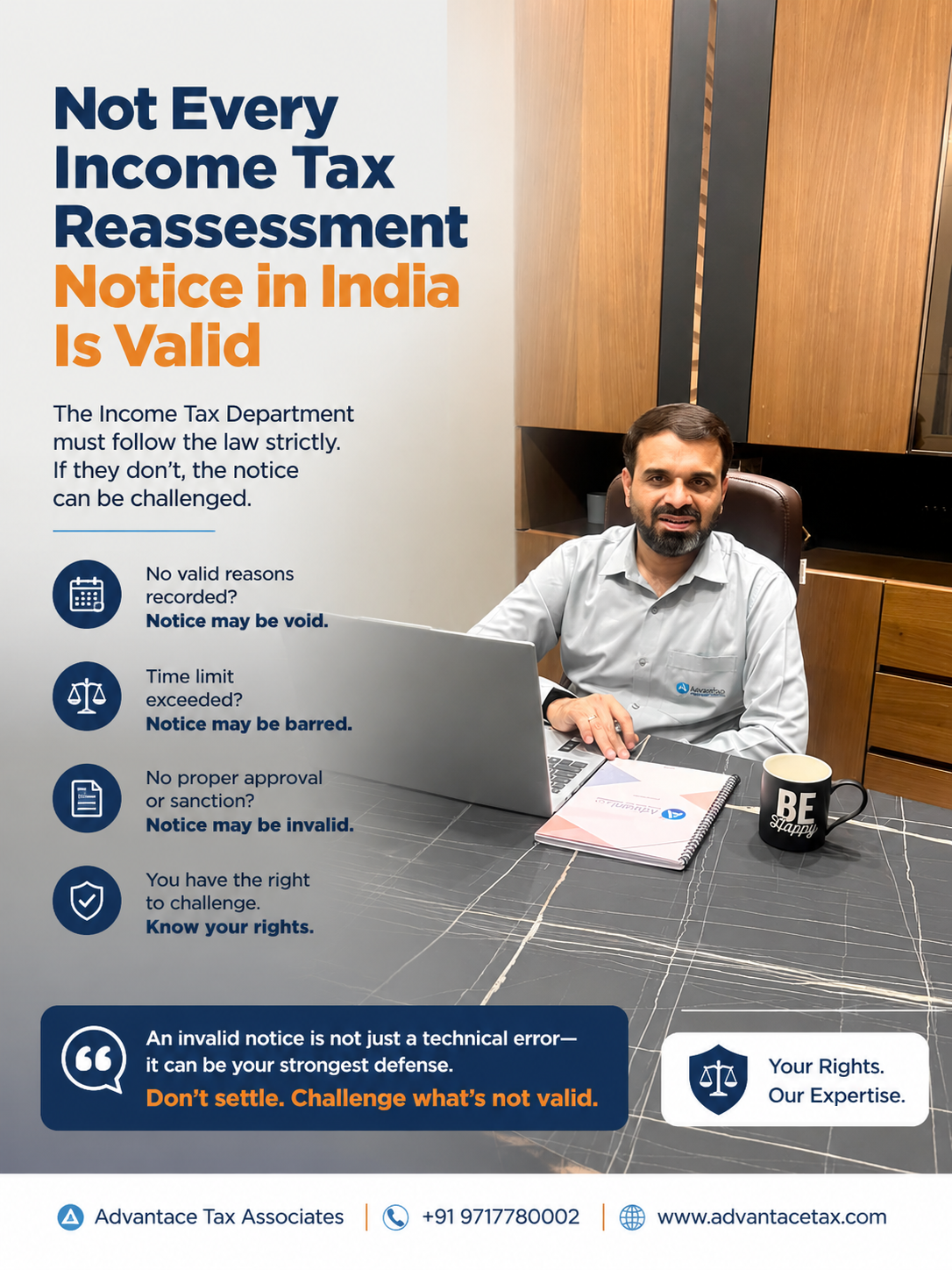
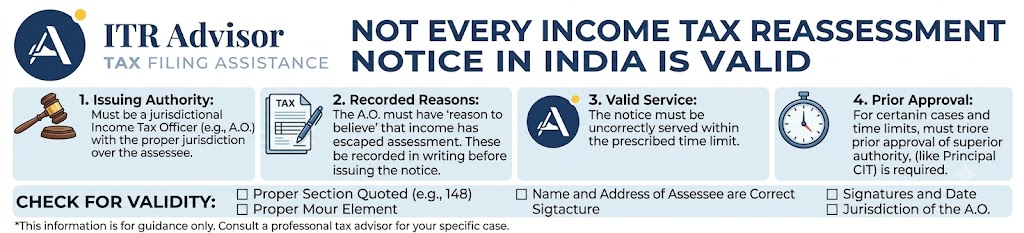
Not Every Income Tax Reassessment Notice in India Is Valid
You receive a notice from the Income Tax Department. Your first reaction? Panic. But here’s what most Indian taxpayers don’t know: not every income tax reassessment notice is legally valid. Many are issued outside the permitted time limit, without sufficient reason, or in violation of mandatory procedural safeguards. If you’ve received a Section 148 or Section 148A notice, you have every right and sometimes a strong legal case to challenge it before even responding on merit.
What Is an Income Tax Reassessment Notice Under Section 148?
Under the Income Tax Act, 1961 (applicable for AY 2025-26 and earlier; the Income Tax Act 2025 governs from AY 2026-27 onwards), the Assessing Officer (AO) can reopen a previously assessed return if they have “reason to believe” that income has escaped assessment. This is the legal basis for issuing a reassessment notice commonly referred to as a Section 148 notice or income tax reopening notice.
However, the Income Tax Department cannot simply reopen any year at will. The law imposes strict time limits and procedural conditions that must be satisfied before any valid reassessment notice can be issued. A failure to comply with even one of these conditions renders the income tax reassessment notice legally void.
Income Tax Reassessment Notice Time Limit: The Law Under Section 149
The income tax notice time limit for reopening an assessment is one of the most important safeguards available to taxpayers. As per Section 149 of the Income Tax Act, 1961:
Section 149 : Reassessment Time Limits Up to 3 years from end of relevant Assessment Year: General cases (escaped income up to ₹50 lakh) Up to 10 years from end of relevant AY: Cases where escaped income is ₹50 lakh or more AND the AO has ‘information’ as defined under Section 148 Note: No reassessment can be initiated beyond these limits, even if income has genuinely escaped.
Any income tax reassessment notice issued beyond the above income tax notice time limit is barred by limitation and is liable to be quashed a position consistently upheld by the Supreme Court and various High Courts across India.
The Mandatory Section 148A Process: Did the AO Follow It?
The Finance Act 2021 introduced a critical pre-notice safeguard Section 148A which made the reassessment process significantly more taxpayer-friendly. Before issuing a Section 148 reopening notice, the Assessing Officer is now required to:
Provide the taxpayer with a copy of the ‘information’ that triggered the inquiry
Issue a show-cause notice under Section 148A(b) and give the taxpayer a minimum 7-day opportunity to respond (extendable to 30 days)
Consider the taxpayer’s reply and pass a reasoned order under Section 148A(d) before issuing the Section 148 notice
If the AO skips or short-circuits this Section 148A process, the subsequent income tax reassessment notice is procedurally defective and legally challengeable. This is not a technicality — it is a statutory mandate enforced by multiple High Court rulings
3 Grounds on Which an Income Tax Reopening Notice Can Be Challenged
1. Notice Issued Beyond the Limitation Period
If the income tax reassessment notice arrives after the income tax notice time limit prescribed under Section 149, you can challenge it on grounds of limitation before the AO, and if rejected, before the ITAT or High Court via writ jurisdiction.
2. No Tangible Material or ‘Escapement of Income’
The AO must have concrete, credible information not mere suspicion or a fishing expedition to believe income has escaped assessment. The Supreme Court in landmark rulings has held that ‘reason to believe’ must be based on tangible material. A reassessment notice based on change of opinion about already-disclosed income is invalid.
3. Non-Compliance with Section 148A Mandatory Procedure
As discussed, failure to follow the Section 148A show-cause notice procedure before issuing a Section 148 income tax reassessment notice is a fatal procedural error that courts have used to quash such notices.
Real-World Example
Scenario: Mr. Ramesh filed his ITR for AY 2019-20. In March 2026, he receives a Section 148 notice for that year, claiming escaped income of ₹8 lakh.
Issue: AY 2019-20 falls beyond the 3-year general limit from March 2026, and the escaped income is under ₹50 lakh — so the 10-year extended limit does not apply. Result: This income tax reassessment notice is barred by limitation and can be successfully challenged.
What Should You Do If You Receive an Invalid Income Tax Reassessment Notice?
Do not ignore the notice file a reply within the stipulated time, even while challenging its validity
Raise preliminary legal objections regarding the income tax notice time limit and procedural defects in your written reply
Rely on the Supreme Court’s ruling in GKN Driveshafts (India) Ltd. vs. ITO (2003) the AO must dispose of objections before proceeding
If the AO overrules your objections without valid reasons, approach the High Court via a writ petition
Consult a qualified tax professional to assess the strength of your challenge
Key Takeaway
Not every income tax reassessment notice in India is valid or enforceable.
Check the date: Is the notice within the income tax notice time limit under Section 149?
Check the process: Did the AO follow the mandatory Section 148A procedure?
Check the basis: Is there a tangible, specific reason — not mere suspicion?
If any of these conditions are not met, the income tax reopening notice may be legally challenged and quashed. Source: Income Tax Department (incometax.gov.in) and CBDT Circulars on Reassessment Guidelines.
Frequently Asked Questions
Q1. What is the time limit to receive an income tax reassessment notice under Section 149?
For escaped income up to ₹50 lakh, the reassessment notice must be issued within 3 years from the end of the relevant Assessment Year. For escaped income of ₹50 lakh or more (with prescribed information), the limit is 10 years.
Q2. Can I challenge an income tax reassessment notice on legal grounds without replying on merits?
Yes. You can raise preliminary legal objections such as limitation or procedural defects in your reply. The AO is bound to pass a speaking order on these objections before proceeding with reassessment.
Q3. Is Section 148A mandatory before every income tax reopening notice?
Yes. Post-Finance Act 2021, the Section 148A show-cause procedure is mandatory before a Section 148 notice can be validly issued. Skipping it is a fatal procedural defect.
Q4. What happens if I ignore an income tax reassessment notice?
Ignoring the notice does not make it go away it can lead to ex-parte assessment and hefty demand. Always respond within time, even if you are challenging its validity.
Q5. Can a reassessment notice be issued for a year where income was already disclosed?
No. The Supreme Court has ruled that a reassessment notice based on a mere change of opinion where the income was already disclosed and examined is invalid and liable to be quashed.
Conclusion:
An income tax reassessment notice can be intimidating but it is not automatically final or correct. The Income Tax Act provides robust safeguards: a strict income tax notice time limit under Section 149, mandatory procedural steps under Section 148A, and the requirement of tangible material before reopening. As tax expert Dr. Haresh Adwani has consistently emphasized, taxpayers must evaluate every reassessment notice for legal validity before responding on merit because a legally defective notice deserves a legal challenge, not just a compliance reply.
About the Author Dr. Haresh Adwani Ph.D. in Commerce | Law Graduate | Managing Partner, Adwani & Co LLP Dr. Haresh Adwani holds a Ph.D. in Commerce and is a qualified Law graduate with over two decades of hands-on experience in GST advisory, direct taxation, and statutory compliance for businesses across
Disclaimer: ITRAdvisor.in is an educational and informational platform focused on tax awareness and compliance updates. Nothing contained herein should be construed as solicitation or advertisement of professional services. Professional services, where applicable, are rendered in accordance with ICAI guidelines. This article is published on ITRAdvisor.in, a tax and compliance knowledge platform. The content has been reviewed for technical accuracy by professionals associated with Adwani & Co LLP. pant, or someone navigating all three simultaneously — your tax treatment, ITR form selection, and loss utilisation strategy need to be correct, consistent, and complete.
Learn more about our Income Tax Filing Services for Traders & Investors — covering ITR-3 filing, tax audit support under Section 44AB, F&O turnover calculation, and capital gains reconciliation with your broker’s statement.
Visit ITRAdvisor.in today for professional guidance and consultation.
Early action can often prevent bigger tax problems later
If you or someone you know has received a Section 148 income tax reassessment notice, do not panic but do act quickly and smartly. The law is on your side, provided you know where to look.
📞 Take Action Today
Need help evaluating whether your income tax reassessment notice is valid?
Connect with the experts at itradvisor.in for a detailed assessment of your notice, legal objection drafting, and end-to-end reply support. Visit: www.itradvisor.in | Powered by Adwani & Co LLP
Every year, tens of thousands of Indian investors file their income tax return with one genuinely confusing question hovering over them: are my share market profits taxable as capital gains or as business income? Get it right, and you pay the correct tax at the correct rate in the correct ITR form. Get it wrong, and you’re looking at a defective return notice, a tax demand with interest, or worse a scrutiny assessment from the Income Tax Department’s AI-driven risk engine that flags the mismatch between your broker’s SFT (Statement of Financial Transactions) data and what you declared. This is not an academic question. In AY 2026-27, with CBDT’s near-real-time data integration with NSE and BSE, the classification of share trading income has become one of the most consequential decisions in personal income tax compliance.
Why Share Trading Tax Classification Matters More Than Ever in 2026
The Income Tax Act, 1961 does not explicitly define when a person is a ‘trader’ versus an ‘investor’ in shares. This deliberate ambiguity has led to decades of litigation and some very clear CBDT guidance through circulars and court-tested principles that every taxpayer dealing in shares must understand.
The classification directly determines three things: the applicable tax rate, the ITR form you must file, and whether losses can be set off against other income. Filing in the wrong category is not a minor clerical error it is a substantive tax position that can unravel entirely during a scrutiny assessment.
The Core Rule: 4 Types of Share Trading Activity, 4 Different Tax Treatments
Indian income tax law recognises four distinct share trading scenarios, each with a different tax classification, applicable rate, and filing requirement. Understanding which bucket your activity falls into is the foundational step in share trading tax compliance for AY 2026-27.
1. Delivery-Based Investing: Capital Gains (LTCG / STCG)
If you buy shares, take delivery to your demat account, and sell them later this is investing, not trading. The gains are taxed as capital gains. The holding period determines the rate:
Short-Term Capital Gains (STCG) : held for 12 months or less: taxed at 20% (revised post-Budget 2024, up from 15%) under Section 111A
Long-Term Capital Gains (LTCG) : held for more than 12 months: taxed at 12.5% on gains above ₹1.25 lakh (Budget 2024 raised the exemption from ₹1 lakh) under Section 112A
LTCG and STCG from listed equity shares go into Schedule CG of ITR-2 or ITR-3. Importantly, LTCG from shares does not benefit from indexation a position the Finance Act 2024 confirmed explicitly.
2. Intraday Equity Trading: Speculative Business Income
If you buy and sell shares on the same day without taking delivery commonly known as MIS (Margin Intraday Square-off) orders this is classified as speculative business income under Section 43(5) of the Income Tax Act. This is a critical distinction that many retail traders miss entirely.
Speculative business losses can only be set off against speculative business income not against salary, rental income, or even F&O profits. They can be carried forward for four years (not eight), and only against future speculative income. You must file ITR-3 for intraday trading income. ITR-1 or ITR-2 are not valid.
3.F&O Trading: Non-Speculative Business Income
Futures and Options (F&O) trading is explicitly excluded from the definition of speculative transactions under Section 43(5)(d). F&O profits and losses are treated as non-speculative business income which means they can be set off against any other head of income except salary in the same year, and carried forward for eight years against any business income.
The F&O turnover calculation (premium received on options sold + absolute value of profit/loss on futures) determines whether a tax audit under Section 44AB is required. For FY 2025-26 (AY 2026-27), the threshold is ₹10 crore for digital transactions. This is an area where many active options traders unknowingly cross the audit threshold without realising it.
Share Trading Tax Income or Capital Gains
Every year, tens of thousands of Indian investors file their income tax return with one genuinely confusing question hovering over them: are my share market profits taxable as capital gains or as business income? Get it right, and you pay the correct tax at the correct rate in the correct ITR form. Get it wrong, and you’re looking at a defective return notice, a tax demand with interest, or worse — a scrutiny assessment from the Income Tax Department’s AI-driven risk engine that flags the mismatch between your broker’s SFT (Statement of Financial Transactions) data and what you declared. This is not an academic question. In AY 2026-27, with CBDT’s near-real-time data integration with NSE and BSE, the classification of share trading income has become one of the most consequential decisions in personal income tax compliance.
Why Share Trading Tax Classification Matters More Than Ever in 2026
The Income Tax Act, 1961 does not explicitly define when a person is a ‘trader’ versus an ‘investor’ in shares. This deliberate ambiguity has led to decades of litigation and some very clear CBDT guidance through circulars and court-tested principles that every taxpayer dealing in shares must understand.
The classification directly determines three things: the applicable tax rate, the ITR form you must file, and whether losses can be set off against other income. Filing in the wrong category is not a minor clerical error it is a substantive tax position that can unravel entirely during a scrutiny assessment.
Critical Warning for Active Traders:
If your F&O turnover exceeds ₹10 crore (or ₹2 crore if opting out of 44AD), a tax audit by a Chartered Accountant under Section 44AB is mandatory. Filing ITR-3 without the audit report (Form 3CA/3CB + 3CD) in such cases is a non-compliant return.
4. High-Frequency Delivery Trading: The Grey Zone
This is where things get genuinely complicated. If you are buying and selling shares in delivery mode but with very high frequency multiple trades a day, short holding periods, large volumes the Income Tax Department may reclassify your activity from capital gains to business income, even though you technically took delivery.
CBDT Circular No. 6/2016 provides the framework for this classification, and the courts have consistently held that frequency of transactions, intention at the time of purchase, volume of trading, and ratio of trading profits to dividend income are all relevant factors. If CBDT‘s data from your broker’s SFT filing shows 500+ delivery trades in a year, you can expect scrutiny on whether capital gains treatment is appropriate.
Share Trading Tax Classification: Quick Reference Table for AY 2026-27
Trading Activity
Tax Classification
Tax Rate (AY 2026-27)
ITR Form
Schedule
Delivery-based equity shares (held ≤12 months)
STCG Capital Gains
20% flat (post-Budget 2024)
ITR-2 / ITR-3
Schedule CG
Delivery-based equity shares (held >12 months)
LTCG Capital Gains
12.5% (above ₹1.25L exempt)
ITR-2 / ITR-3
Schedule CG
Intraday equity trading (MIS orders)
Speculative Business Income
Slab rate; set-off only vs spec. income
ITR-3 mandatory
Schedule BP
F&O trading (futures & options)
Non-Speculative Business Income
Slab rate; audit if turnover >₹10Cr
ITR-3 mandatory
Schedule BP
Equity mutual funds (held ≤12 months)
STCG — Capital Gains
20% flat
ITR-2 / ITR-3
Schedule CG
Equity mutual funds (held >12 months)
LTCG — Capital Gains
12.5% (above ₹1.25L)
ITR-2 / ITR-3
Schedule CG
Which ITR Form Is Correct for Share Trading Income in 2026?
ITR form selection is the single most common error in share trading tax filing. Here is the definitive guide:
ITR-1 (Sahaj): Not valid for any share trading income capital gains or business. If you have any share market activity, ITR-1 is the wrong form.
ITR-2: Valid for investors with only capital gains (delivery-based LTCG/STCG). Not valid if you have any intraday or F&O income.
ITR-3: Mandatory for intraday traders, F&O traders, and investors who also trade. This is the most comprehensive form and handles all four categories above.
ITR-4 (Sugam): Not valid for capital gains income. Only appropriate for those opting for presumptive taxation under 44AD/44ADA and F&O trading cannot be reported under presumptive taxation.
The Expert Angle: How CBDT and Courts Determine Your Trading Classification
According to Dr. Haresh Adwani, PhD in Commerce and law graduate at Adwani & Co LLP, the question of whether share trading income is business income or capital gains is ultimately a question of fact and the burden of proof lies entirely with the taxpayer. The Income Tax Department does not need to prove that you are a trader; you need to demonstrate that you are an investor.
The key factors that courts and assessing officers examine:
Intention: Was the purchase made with the intent to hold or to sell quickly for profit?
Frequency: High-frequency trades over a short period strongly suggest business activity
Funding: Were shares bought with borrowed funds? Borrowing to invest in shares is a business indicator
Head of income in prior years: If you have been reporting the same shares as capital gains for years and then switch to business income (or vice versa), the assessing officer will examine the consistency
Magnitude of activity vs. other income: If share profits are your dominant income source, business income classification becomes harder to resist
CBDT’s 2016 circular permits taxpayers to choose either capital gains or business income classification for their listed equity portfolio but only once. Having made the choice, you must be consistent year after year. Switching classifications opportunistically to minimise tax in different years is a recognised red flag in faceless scrutiny assessments.
For authoritative reference, the Income Tax Department’s guidance on capital gains is available at incometax.gov.in, including the Schedule CG instructions in the ITR filing utility.
Share Trading Losses in 2026: Set-Off & Carry Forward Rules That Can Save You Tax
Losses from share trading are one of the most under-utilised tax assets in India. Here is how the set-off hierarchy works:
STCG loss from shares: Can be set off against any other capital gain (LTCG or STCG from any asset). Cannot be set off against salary or business income. Carry forward: 8 years.
LTCG loss from shares: Can only be set off against LTCG. Carry forward: 8 years under the new post-Budget 2024 rules. Note: LTCG losses now arise given the 12.5% tax on gains above ₹1.25 lakh a new planning opportunity.
Intraday (Speculative) loss: Set off only against speculative business income. Carry forward: 4 years only.
F&O (Non-Speculative Business) loss: Set off against any business income or income from other heads (except salary). Carry forward: 8 years against business income. This is the most valuable loss in a trader’s hands — and is the core reason why F&O loss tax benefit planning is now a standard year-end exercise for active market participants.
Crucial Deadline Alert: To carry forward any trading loss (capital or business), you must file your ITR on or before the due date — July 31, 2026 for individuals without audit, October 31, 2026 for those requiring audit. A late-filed return forfeits the carry-forward benefit entirely for capital loss (though business loss carry-forward under Sec 72 may still be allowed if the return is filed under 139(1)
Key Takeaways
✅ Delivery-based share investing = Capital Gains (LTCG at 12.5% / STCG at 20%). File ITR-2 or ITR-3. ✅ Intraday equity trading = Speculative Business Income. File ITR-3 only. Losses carry forward 4 years — speculative only. ✅ F&O trading = Non-Speculative Business Income. File ITR-3. Losses carry forward 8 years — broadest set-off rights. ✅ High-frequency delivery traders risk reclassification to business income by CBDT — consistency of classification matters. ✅ ITR-1, ITR-4 are not valid for any taxpayer with share market income or losses. ✅ LTCG exemption threshold is now ₹1.25 lakh (Budget 2024). Tax rate is 12.5% — no indexation. ✅ To carry forward losses, file ITR on or before the due date — late filing forfeits this benefit.
Frequently Asked Questions (FAQs)
Q1. Is share trading income taxable as business income or capital gains in India 2026?
It depends on the type of trading. Delivery-based investing is capital gains (LTCG/STCG). Intraday equity is speculative business income, and F&O trading is non-speculative business income — each with different tax rates and ITR forms.
Q2. What is the LTCG tax rate on shares and equity mutual funds for AY 2026-27?
LTCG on listed equity shares and equity mutual funds is taxed at 12.5% on gains exceeding ₹1.25 lakh per financial year, with no indexation benefit, under Section 112A as amended by Budget 2024.
Q3. Which ITR form should I file for intraday and F&O trading income?
ITR-3 is mandatory for both intraday (speculative) and F&O (non-speculative) trading income. Filing ITR-1 or ITR-2 when you have such income makes your return defective under Section 139(9).
Q4. Can F&O losses be set off against salary income?
No. F&O losses (non-speculative business loss) cannot be set off against salary income in the same year. They can be set off against other business income or income from house property, and carried forward for 8 years.
Q5. Can I choose to treat my share trading profits as capital gains instead of business income?
CBDT’s 2016 circular permits taxpayers with listed equity investments to choose capital gains treatment, provided you are consistent year after year. Switching classifications annually is a red flag during scrutiny assessments.
Conclusion:
The question of whether your share trading activity qualifies as business income or capital gains is not something to resolve by Googling at the last minute before the ITR filing deadline. It is a tax position that must be decided at the beginning of the financial year, maintained consistently, and supported by your actual trading behaviour. With CBDT now receiving real-time SFT data from brokers covering every buy and sell transaction above ₹10 lakh, the margin for error has shrunk to near zero.
About the Author Dr. Haresh Adwani Ph.D. in Commerce | Law Graduate | Managing Partner, Adwani & Co LLP Dr. Haresh Adwani holds a Ph.D. in Commerce and is a qualified Law graduate with over two decades of hands-on experience in GST advisory, direct taxation, and statutory compliance for businesses across
Disclaimer: ITRAdvisor.in is an educational and informational platform focused on tax awareness and compliance updates. Nothing contained herein should be construed as solicitation or advertisement of professional services. Professional services, where applicable, are rendered in accordance with ICAI guidelines. This article is published on ITRAdvisor.in, a tax and compliance knowledge platform. The content has been reviewed for technical accuracy by professionals associated with Adwani & Co LLP. pant, or someone navigating all three simultaneously — your tax treatment, ITR form selection, and loss utilisation strategy need to be correct, consistent, and complete.
Learn more about our Income Tax Filing Services for Traders & Investors — covering ITR-3 filing, tax audit support under Section 44AB, F&O turnover calculation, and capital gains reconciliation with your broker’s statement.
Visit ITRAdvisor.in today for professional guidance and consultation.
Early action can often prevent bigger tax problems later
Here is a question that cuts right to the heart of fair taxation: if the Income Tax Department can use Section 64 clubbing provisions to pull a spouse’s investment profit into the donor’s taxable income, can it simply look the other way when the very same investment bleeds a loss? A recent ruling from the Income Tax Appellate Tribunal (ITAT), Lucknow Bench Vipin Yadav vs. ITO has answered this question decisively, and every Indian taxpayer involved in F&O trading, equity investing, or spousal gifting strategies needs to understand what the Tribunal said.
What Are Section 64 Clubbing Provisions and Why Do They Matter?
Under Section 64(1)(iv) of the Income Tax Act, 1961, income arising from assets gifted directly or indirectly by a person to their spouse is not taxed in the spouse’s hands. Instead, that income is ‘clubbed’ added back to the income of the person who made the gift and taxed accordingly.
This clubbing of income provision was designed by the legislature as an anti-avoidance measure, preventing affluent taxpayers from splitting their taxable income by routing investments through their spouse and taking advantage of lower tax slabs or basic exemption limits.
The Income Tax Department of India has applied Section 64(1)(iv) extensively over the years, clubbing income from equity dividends, interest on gifted fixed deposits, rental income from gifted property, and profits from F&O trading conducted using gifted capital. As per the department’s own compliance guidelines, such income must be disclosed in the donor’s ITR with proper attribution to the gifted assets.
But a critical gap existed in the law’s application one that the Tribunal has now addressed.
The Vipin Yadav vs. ITO Case: Facts That Set Up the Landmark ITAT Ruling
The facts of this case are simple, which is precisely what makes the legal principle so powerful.
A husband gifted funds to his wife in good faith.
The wife deployed the gifted capital in equity markets and F&O trading.
The trades resulted in losses not profits.
The husband took a logical stand: under Section 64 clubbing provisions, if profits from the gifted funds would have been taxable in his hands, losses from the same funds must also be eligible for treatment in his hands.
The Income Tax Department rejected this position, arguing that the clubbing provisions apply only to income and a loss is not income.
The matter escalated to the ITAT, Lucknow Bench, which then examined a fundamental question of tax equity.
The ITAT’s Ruling: Symmetry in Section 64 Clubbing Cannot Be Ignored
The ITAT deliberated on a core principle of legal and tax fairness: can a statutory provision be applied selectively activated when there is income, but switched off when there is a loss arising from the identical source?
The Tribunal’s answer was emphatic. Where income from a gifted asset is liable to be clubbed under Section 64(1)(iv) with the donor’s taxable income, losses arising from that very same gifted asset cannot be excluded or ignored merely because they are losses rather than positive income.
This ruling establishes what legal practitioners describe as the symmetry principle in the application of clubbing provisions the same provision that brings in the profit must equally bring in the loss.
The Critical Condition: Documentation and Traceability
The ITAT ruling came with one firm qualifier and this is where practical tax planning becomes crucial. The taxpayer must establish a clear, verifiable, and well-documented link between:
The amount gifted to the spouse (with a proper gift deed or written record),
The specific investment made using those gifted funds (supported by bank transfer records and broker statements), and
The loss that arose from that specific investment.
Without this paper trail, no claim of clubbing the loss can succeed. This emphasis on documentation aligns with the Income Tax Department’s broader compliance framework, which requires taxpayers to maintain books of accounts and supporting evidence for all claimed deductions, set-offs, and credits.
Dr. Haresh Adwani, PhD in Commerce and a law graduate leading Adwani & Co LLP, has consistently advised clients that when it comes to Section 64 clubbing provisions, documentation is not optional it is the entire foundation of the claim.
Why This ITAT Ruling Matters for F&O Traders and Equity Investors in 2026
India’s retail F&O trading participation has surged significantly. As SEBI data repeatedly shows, the majority of individual F&O traders report net losses in any given financial year. The F&O loss tax benefit specifically the ability to set off non-speculative business losses against other business income and carry them forward for up to 8 assessment years under Section 72 is already significant for many taxpayers.
Now, with the ITAT ruling in Vipin Yadav vs. ITO, the scope of this benefit potentially extends to cases where a spouse has traded using gifted funds. Here is what this means practically:
A donor-spouse who gifted capital for F&O trading may now club the resulting loss into their own income computation.
This clubbed F&O loss, being a non-speculative business loss, can be set off against business income in the donor’s hands in the same year.
If unabsorbed, the loss can be carried forward for 8 years — making the F&O loss tax benefit significantly more valuable when properly documented and claimed.
Similarly, short-term capital losses (STCG losses) on equity shares or mutual funds arising from gifted funds may also deserve similar treatment under the symmetry principle, though each case must be evaluated independently.
This ruling does not give taxpayers a free pass to manufacture losses through gifted investments. The link between gift and investment must be genuine, direct, and documentable.
KEY TAKEAWAYS
1. Section 64(1)(iv) clubbing is not a one-way street losses from gifted assets deserve the same treatment as profits.
2. The ITAT Lucknow Bench in Vipin Yadav vs. ITO has established the symmetry principle for clubbing provisions.
3. Clear documentation linking gifted funds → specific investment → resulting loss is mandatory for any such claim.
4. F&O losses clubbed with the donor’s income can be carried forward for up to 8 years under Section 72. 5. Always consult a qualified CA before claiming clubbed losses in your ITR to ensure accurate disclosure.
Explore More on ITRAdvisor.in
These related guides will help you plan better:
Read our detailed guide on F&O Loss Tax Benefit 2026: Set-Off Against Business Income & 8-Year Carry Forward
Read our detailed guide on LTCG & STCG on Shares & Mutual Funds 2026: New Rates After Budget Amendment
Learn more about our ITR Filing Services for Traders and Investors
Read our detailed guide on Income Tax Reassessment Notice Under Section 148: Rights, Timeline & Reply
Read our detailed guide on Old vs New Tax Regime 2026: Calculator, Slabs & Which to Choose
Frequently Asked Questions
Q: What does Section 64(1)(iv) say about gifted assets and income tax?
A: Section 64(1)(iv) requires that income from assets gifted to a spouse be clubbed with the donor’s taxable income. The ITAT ruling in Vipin Yadav vs. ITO now clarifies that losses from the same source must receive equal treatment.
Q: Can F&O trading losses from funds gifted to a spouse be set off against my income?
A: Yes — provided you establish a clear documentary link between the gifted funds, the F&O investment, and the resulting loss. The ITAT has ruled that clubbing provisions apply symmetrically to both profits and losses.
Q: How long can F&O losses be carried forward under Indian income tax law?
A: Non-speculative business losses — which include F&O trading losses — can be carried forward for up to 8 assessment years and set off against future business income, subject to timely ITR filing.
Q: What documents are needed to claim clubbing of F&O loss from gifted funds?
A: You need a gift deed or written record of the transfer, bank proof of funds moving to the spouse, broker statements showing the investment and loss, and linking evidence connecting the gifted capital to the specific trades.
Q: Does this ITAT ruling apply to equity and mutual fund losses as well?
A: The symmetry principle established may extend to STCG losses on equity and mutual fund investments made with gifted funds, but each case depends on facts, documentation, and the nature of the asset — always consult a qualified CA.
Conclusion
Vipin Yadav vs. ITO is a compact ruling with an outsized impact. The ITAT has sent a clear signal: Section 64 clubbing provisions are not a selective tool to be applied only when it serves the tax department’s interest. Tax law must be consistent — and if income from a gifted asset is clubbed in the donor’s hands, the loss from that very same asset must receive the same treatment, provided the documentation stands firm.
For anyone involved in F&O trading, equity investing, or tax planning through spousal gifting strategies, this ruling is essential reading. Review your documentation, revisit your ITR disclosures for open assessment years, and ensure your claims are watertight.
Ready to review your clubbing provisions, F&O loss claims, or ITR filings? Get expert guidance at ITRAdvisor.in — India’s trusted tax knowledge platform. Visit: www.itradvisor.in
Dr. Haresh Adwani — Ph.D. in Commerce · Law Graduate · Chartered Accountant. Dr. Adwani brings deep expertise in income tax law, GST compliance, corporate advisory, and financial strategy. As the founding partner of Adwani and Company, he has helped hundreds of salaried individuals, businesses, and startups navigate India’s complex tax landscape with clarity and confidence.
Disclaimer: ITRAdvisor.in is an educational and informational platform focused on tax awareness and compliance updates. Nothing contained herein should be construed as solicitation or advertisement of professional services. Professional services, where applicable, are rendered in accordance with ICAI guidelines. This article is published on ITRAdvisor.in, a tax and compliance knowledge platform. The content has been reviewed for technical accuracy by professionals associated with Adwani & Co LLP.Disclaimer