Author: Mukesh Chavhan

  • Balance Sheet Health Check: What Your Profit Number Isn’t Telling You

    Balance Sheet Health Check: What Your Profit Number Isn’t Telling You

    Balance Sheet Health Check

    Every year, profitable businesses quietly slide into financial stress not because sales dried up, but because nobody read the balance sheet as anything more than a compliance formality. If your only question this tax season is “how much profit did we make?”, you’re missing the real story your business is trying to tell you.
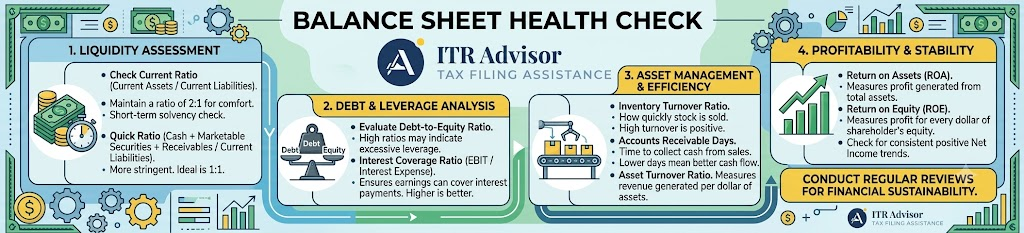
    Tax season is here. Accountants and finance teams are finalising books, reconciling GST and TDS, and preparing balance sheets for filing. But a genuine balance sheet health check asks a bigger question than compliance: are you using this exercise to understand your business’s financial health, or just to satisfy the Income Tax Department?


    Why a Balance Sheet Health Check Matters More Than the Profit Number

    A company can report a healthy profit and still face real financial stress. Revenue may be growing, but customers may be paying late. Profits may look impressive on paper, while actual cash flow stays weak. Sales may have increased, yet inventory may be quietly consuming working capital, and borrowings may be rising faster than the business itself.

    This is exactly why a disciplined balance sheet health check matters: it exposes the gap between reported profit and the underlying financial strength of the business a gap the profit and loss statement alone will never show you.


    Five Questions Every Balance Sheet Health Check Should Answer

    • Where is the cash actually sitting, and how much of it is genuinely available?
    • How much money is stuck with customers as overdue receivables?
    • How efficiently is working capital being used to generate revenue?
    • Are borrowings funding growth, or are they quietly funding inefficiency?
    • Is the business financially stronger today than it was 12 months ago?

    These questions turn a routine balance sheet health check from a year-end formality into an early-warning system one that flags problems while they are still fixable, not after they’ve become a cash crunch.

    Example:

    Profit-Rich, Cash-Poor A manufacturing business showed 18% profit growth for the year, yet struggled to pay statutory dues on time. A closer balance sheet health check revealed receivables had ballooned by 40%, and short-term borrowings were funding the gap a classic profit-rich, cash-poor pattern that the P&L never revealed.


    GST, TDS, and Statutory Mismatches Hiding in Plain Sight

    A balance sheet health check should also cover statutory exposure, not just financial ratios. GST input tax credit mismatches, delayed TDS deposits, or unreconciled AIS and Form 26AS entries quietly build future liability even while a business looks compliant on the surface. Regular reconciliation, in line with the framework maintained on the GST portal and reporting norms under the Ministry of Corporate Affairs, is what keeps books and balance sheets genuinely accurate.


    Turning the Balance Sheet Into a Leadership Dashboard

    Don’t treat the balance sheet as a document prepared once a year for auditors, bankers, or the Income Tax Department. Treat it as a leadership dashboard. Profit tells you how the business performed. A proper balance sheet health check tells you what the business has actually become its liquidity, its debt discipline, and its true staying power.

    This is a distinction Dr. Haresh Adwani, founder of Adwani & Co LLP and a PhD in Commerce with a law background, has long emphasised with business owners: compliance and financial health are related, but they are not the same exercise, and confusing the two is where most businesses first go wrong.

    Read our detailed guide on Can the Tax Department Club Profits but Conveniently Ignore Losses? A Landmark ITAT Ruling on Section 64 Clubbing Provisions


    Key Takeaway

    A balance sheet health check is not an annual formality it is a leadership tool. Track cash position, receivables ageing, working capital efficiency, and borrowing trends alongside profit, and use every tax season as a checkpoint for your business’s true financial health, not just its statutory compliance.


    Balance Sheet Health Check: Frequently Asked Questions

    1.What is a balance sheet health check for a business?

    It is a structured review of assets, liabilities, receivables, and borrowings to assess real financial strength, not just profitability.

    2.Can a profitable business still face financial stress?

    Yes. Strong profit can mask weak cash flow, rising receivables, or growing debt all visible only through a balance sheet health check.

    3.What is the difference between cash flow and profit?

    Profit is an accounting figure; cash flow is the actual money available. A business can be profitable yet cash-starved.

    4.How often should business owners review their balance sheet?

    Ideally quarterly, not just at year end frequent reviews catch working capital or borrowing issues while they’re still manageable.

    5.Does GST or TDS mismatch affect balance sheet health?

    Yes. Unreconciled GST credits or delayed TDS deposits create hidden liabilities that a balance sheet health check should always flag.

    Conclusion: Make Your Balance Sheet Work for You

    This tax season, don’t stop at reconciling ledgers and filing returns. Run a genuine balance sheet health check — one that weighs cash, receivables, working capital, and borrowings as seriously as profit. Business owners, what is one number you review regularly to understand your business’s health?

    About the Author:

    Mukesh Chavan is a dedicated indirect taxation and compliance professional associated with Adwani & Co LLP, specializing in GST advisory, GST audits, GST assessments, and RERA compliance services. With extensive experience in handling complex regulatory matters, he assists businesses in ensuring compliance with evolving GST laws and real estate regulations while minimizing risks and enhancing operational efficiency.

    Mukesh has successfully guided clients through GST registrations, return compliance, departmental assessments, audits, litigation support, and tax planning strategies. He also possesses significant expertise in RERA compliance, helping real estate developers, promoters, and stakeholders navigate regulatory requirements and maintain seamless project compliance.

    Through his articles and professional insights, Mukesh aims to simplify complex GST and RERA provisions, offering practical guidance that empowers businesses to remain compliant, avoid disputes, and make informed decisions in an increasingly dynamic regulatory environment. His approach combines technical expertise with practical business understanding, enabling clients to focus on growth while meeting their statutory obligations with confidence.

    Not Sure If Your Return Is Clean?
    If you’re unsure whether your return has been reported correctly, a quick review today can help avoid a much bigger problem later. If you want expert guidance, connect with itradvisor.in today.
    Need Help Before You File? If you’re a salaried professional, business owner, freelancer, or NRI and want to ensure your ITR matches your AIS and Form 26AS before submission — ITRAdvisor.in is where to start. Visit itradvisor.in for expert tax guidance, AIS reconciliation checklists, and professional support backed by Adwani & Co LLP.

    Disclaimer:

    ITRAdvisor.in is an educational and informational platform focused on tax awareness and compliance updates. Nothing contained herein should be construed as solicitation or advertisement of professional services. Professional services, where applicable, are rendered in accordance with ICAI guidelines. This article is published on ITRAdvisor.in, a tax and compliance knowledge platform.

    The content has been reviewed for technical accuracy by professionals associated with Adwani & Co LLP.

  • Hidden Loan Costs Every Indian Borrower Must Know Before Signing

    Hidden Loan Costs Every Indian Borrower Must Know Before Signing

    Hidden Loan Costs

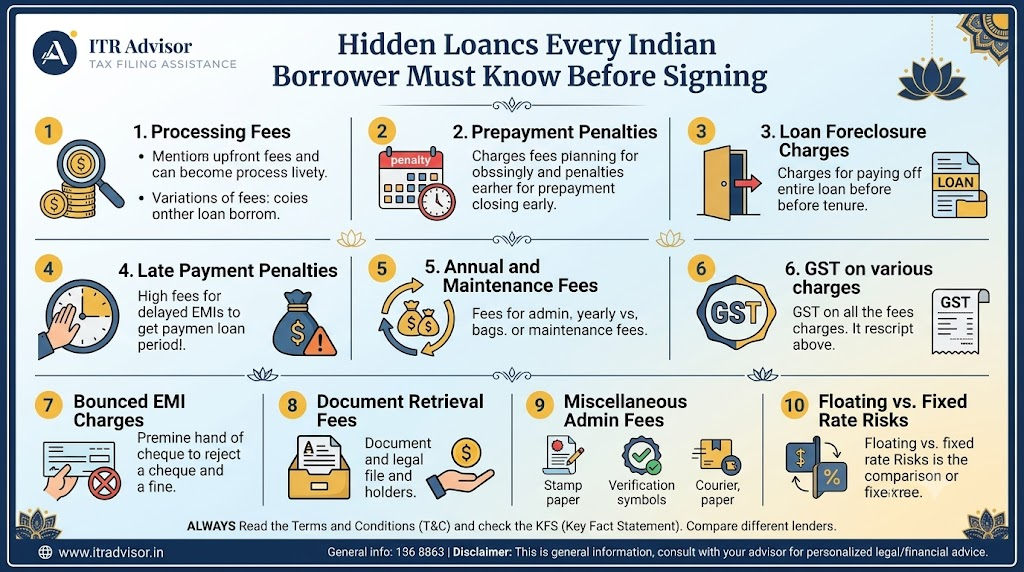
    The advertised interest rate is rarely the real price of a loan. Between processing fees, GST, foreclosure penalties, and bounce charges, Indian borrowers routinely end up paying far more than the number printed in bold on the offer letter. Knowing these hidden loan costs before you sign can save you thousands, sometimes lakhs, over the life of the loan.

    Why the Interest Rate Alone Never Tells the Full Story

    Lenders compete on interest rate because it is the easiest number to advertise. But the true cost of borrowing includes every fee layered on top: processing charges, statutory duties, penal interest, and taxes. Two loans with identical interest rates can have very different total costs once these hidden loan costs are added in. This is why the Annual Percentage Rate, not the headline interest rate, is the number serious borrowers should compare.


    Common Hidden Loan Costs in India

    Processing Fee and GST

    Most banks and NBFCs charge a one-time processing fee of roughly 0.5% to 3% of the loan amount, deducted directly from your disbursal. On top of this, 18% GST applies to the processing fee itself, along with documentation and verification charges. A borrower sanctioned five lakh rupees may actually receive several thousand rupees less, while EMIs continue to be calculated on the full sanctioned amount.

    Foreclosure and Prepayment Charges

    Closing a loan early feels like good financial discipline, but fixed-rate personal loans often carry prepayment or foreclosure charges of 2% to 5% of the outstanding principal. Some lenders impose a lock-in period before any early repayment is even allowed.

    Bounce and Penal Charges

    A single missed EMI can trigger a bounce fee, a separate bank dishonour charge, and penal interest of 1% to 3% per month on the overdue amount, in addition to lasting damage to your credit score.


    GST on Loan Charges: What Borrowers Often Miss

    A common misconception is that GST applies to loan interest. It does not interest on a loan is treated as a financial service exempt from GST. However, processing fees, foreclosure charges, and documentation fees are treated as taxable services and attract 18% GST. Business borrowers can often claim Input Tax Credit on this GST if the loan is used for business purposes, making it worth checking with your accountant before assuming the fee is a pure cost.


    How to Calculate the Real Cost of a Loan

    Add up total EMI payments over the tenure, the processing fee, GST on that fee, any prepayment charges you are likely to trigger, and documentation costs. This combined figure, not the interest rate in isolation, is what should guide your comparison across lenders. Reading the Key Fact Statement carefully, rather than relying on marketing material, is the single most effective way to avoid surprises.

    According to Dr. Haresh Adwani, a Pune-based tax and financial advisory expert with a PhD in Commerce, borrowers who calculate the effective cost of a loan, including GST and processing charges, before signing are far less likely to face repayment stress later.

    Read our detailed guide on GST Compliance Checklist India 2026: 7 Essential Rules to Avoid Notices and Penalties


    Key Takeaway on Hidden Loan Costs

    The advertised interest rate is only part of the story. Processing fees, GST, foreclosure charges, and penal interest can meaningfully raise your real borrowing cost. Always request a full charge breakdown and compare the total cost, not just the rate, before signing.


    Frequently Asked Questions on Hidden Loan Costs

    1.Is GST charged on personal loan interest?

    No. Interest on a loan is an exempt financial service, but processing and foreclosure charges attract 18% GST.

    2.What is a reasonable processing fee for a loan in India?

    Processing fees typically range from 0.5% to 3% of the loan amount, plus GST, depending on the lender.

    3.Can I avoid foreclosure charges on my loan?

    Some lenders waive foreclosure charges after a lock-in period; always check the loan agreement before assuming it is free.

    Conclusion on Hidden Loan Costs

    Hidden loan costs can quietly turn an affordable loan into an expensive one. Before you sign, ask for a complete breakdown of fees, understand where GST applies, and calculate your real repayment cost. If you want expert guidance on evaluating a loan offer or understanding GST on financial charges, connect with itradvisor.in today.

    About the Author:

    Mukesh Chavan is a dedicated indirect taxation and compliance professional associated with Adwani & Co LLP, specializing in GST advisory, GST audits, GST assessments, and RERA compliance services. With extensive experience in handling complex regulatory matters, he assists businesses in ensuring compliance with evolving GST laws and real estate regulations while minimizing risks and enhancing operational efficiency.

    Mukesh has successfully guided clients through GST registrations, return compliance, departmental assessments, audits, litigation support, and tax planning strategies. He also possesses significant expertise in RERA compliance, helping real estate developers, promoters, and stakeholders navigate regulatory requirements and maintain seamless project compliance.

    Through his articles and professional insights, Mukesh aims to simplify complex GST and RERA provisions, offering practical guidance that empowers businesses to remain compliant, avoid disputes, and make informed decisions in an increasingly dynamic regulatory environment. His approach combines technical expertise with practical business understanding, enabling clients to focus on growth while meeting their statutory obligations with confidence.

    Not Sure If Your Return Is Clean?
    If you’re unsure whether your return has been reported correctly, a quick review today can help avoid a much bigger problem later. If you want expert guidance, connect with itradvisor.in today.
    Need Help Before You File? If you’re a salaried professional, business owner, freelancer, or NRI and want to ensure your ITR matches your AIS and Form 26AS before submission — ITRAdvisor.in is where to start. Visit itradvisor.in for expert tax guidance, AIS reconciliation checklists, and professional support backed by Adwani & Co LLP.

    Disclaimer:

    ITRAdvisor.in is an educational and informational platform focused on tax awareness and compliance updates. Nothing contained herein should be construed as solicitation or advertisement of professional services. Professional services, where applicable, are rendered in accordance with ICAI guidelines. This article is published on ITRAdvisor.in, a tax and compliance knowledge platform.

    The content has been reviewed for technical accuracy by professionals associated with Adwani & Co LLP.

  • Capital Gains Exemption 2026: Asset View vs Gain View Explained

    Capital Gains Exemption 2026: Asset View vs Gain View Explained

    Capital Gains Exemption

    Sold a house or a bundle of long-held shares this year and now staring at a capital gains figure that makes your stomach drop? You probably don’t have to pay tax on the full amount. Most taxpayers overpay not because they picked the wrong section, but because they never understood whether their capital gains exemption is judged by the asset they buy or the gain they invest.

    What Is Capital Gains Exemption?

    Capital gains exemption lets a taxpayer reduce or avoid tax on profit from selling property, land, gold, or securities, provided the proceeds or gains are reinvested in a specified manner within a prescribed time. The Income Tax Department recognises several such provisions commonly Sections 54, 54F and 54EC each built around a different combination of asset sold and asset purchased. The confusion begins when taxpayers assume all these sections work the same way. They don’t.


    Asset View vs Gain View: The Real Difference

    The Asset View : Sections 54 and 54F

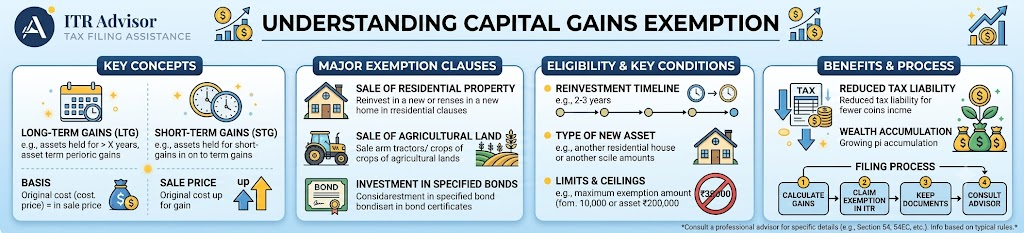
    Sections 54 and 54F anchor the capital gains exemption to the new asset you acquire a residential house in India. Section 54 applies when you sell a house and buy another; Section 54F applies when you sell any other long-term asset and reinvest the net consideration into a house. The exemption is proportionate to how much you reinvest.

    The Gain View : Section 54EC

    Section 54EC exempts gains from selling land or building when the gain amount, not the full sale proceeds, is invested in specified bonds (REC, NHAI, PFC, IRFC, or HUDCO) within six months, capped at ₹50 lakh a year. No particular asset needs to be purchased — only the gain needs a home.


    Choosing the Right Capital Gains Exemption Route

    Most taxpayers can combine both views reinvesting part of the gain in a house under Section 54 or 54F, and the remainder in Section 54EC bonds within six months, subject to each provision’s caps.

    • Sold a house? Compare Section 54 (asset view) against 54EC (gain view).
    • Sold land, gold, or shares? Section 54F is your asset-view option.
    • Can’t decide immediately? A Capital Gains Account Scheme deposit protects your window.

    Key Takeaways

    • Capital gains exemption is either asset-based (Sections 54, 54F) or gain-based (Section 54EC).
    • Section 54EC is capped at ₹50 lakh a year with a strict six-month window.

    Combining both views, where eligible, can maximise your exemption.

    Read our detailed guide on Tax Saving vs Wealth Creation in India: Are You Investing Smart or Just Buying a Deduction?


    Why Professional Guidance Matters

    According to Dr. Haresh Adwani of Adwani & Co LLP, most capital gains exemption claims fail scrutiny not from picking the wrong section, but from missing the reinvestment timeline or the CGAS deposit deadline a risk that grows as the Income Tax Act, 2025 renumbers these provisions from April 2026. The Income Tax Department’s official guidance and notified Section 54EC bond lists are a useful starting point, though joint ownership and NRI cases need individual review.


    Frequently Asked Questions on Capital Gains Exemption

    1.Can I combine Section 54 and Section 54EC?

    Yes. You can split your capital gains exemption between a new house under Section 54 and bonds under Section 54EC.

    2.What if I can’t reinvest before filing my return?

    Deposit the gain in a Capital Gains Account Scheme before the filing due date to preserve the exemption.

    3.Does capital gains exemption apply to short-term gains?

    No. Sections 54, 54F and 54EC apply only to long-term capital gains

    Conclusion: Plan Your Capital Gains Exemption the Smart Way

    Capital gains exemption rewards taxpayers who understand whether their provision watches the asset bought or the gain invested. Get this right before your reinvestment deadline, and connect with itradvisor.in today for guidance on your capital gains exemption claim for AY 2026-27.

    About the Author:

    Mukesh Chavan is a dedicated indirect taxation and compliance professional associated with Adwani & Co LLP, specializing in GST advisory, GST audits, GST assessments, and RERA compliance services. With extensive experience in handling complex regulatory matters, he assists businesses in ensuring compliance with evolving GST laws and real estate regulations while minimizing risks and enhancing operational efficiency.

    Mukesh has successfully guided clients through GST registrations, return compliance, departmental assessments, audits, litigation support, and tax planning strategies. He also possesses significant expertise in RERA compliance, helping real estate developers, promoters, and stakeholders navigate regulatory requirements and maintain seamless project compliance.

    Through his articles and professional insights, Mukesh aims to simplify complex GST and RERA provisions, offering practical guidance that empowers businesses to remain compliant, avoid disputes, and make informed decisions in an increasingly dynamic regulatory environment. His approach combines technical expertise with practical business understanding, enabling clients to focus on growth while meeting their statutory obligations with confidence.

    At ITRAdvisor.in, we help NRIs and returning Indians with:

    ✔️ NRE and NRO taxation

    ✔️ Residential status determination

    ✔️ Returning NRI tax planning

    ✔️ DTAA advisory

    ✔️ Foreign asset reporting

    ✔️ NRI Income Tax Return filing

    ✔️ Tax notice handling

    ✔️ Capital gains and property taxation

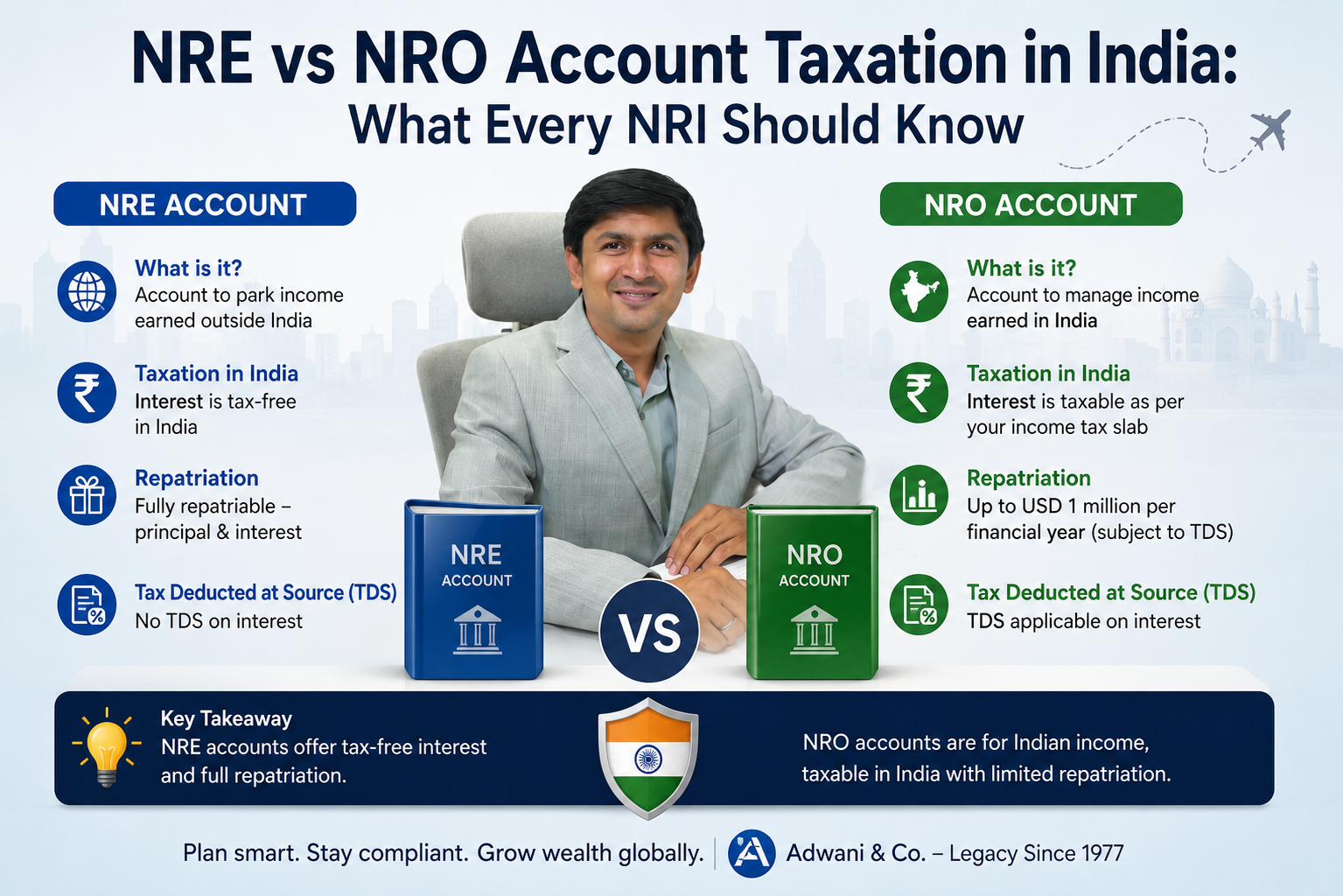
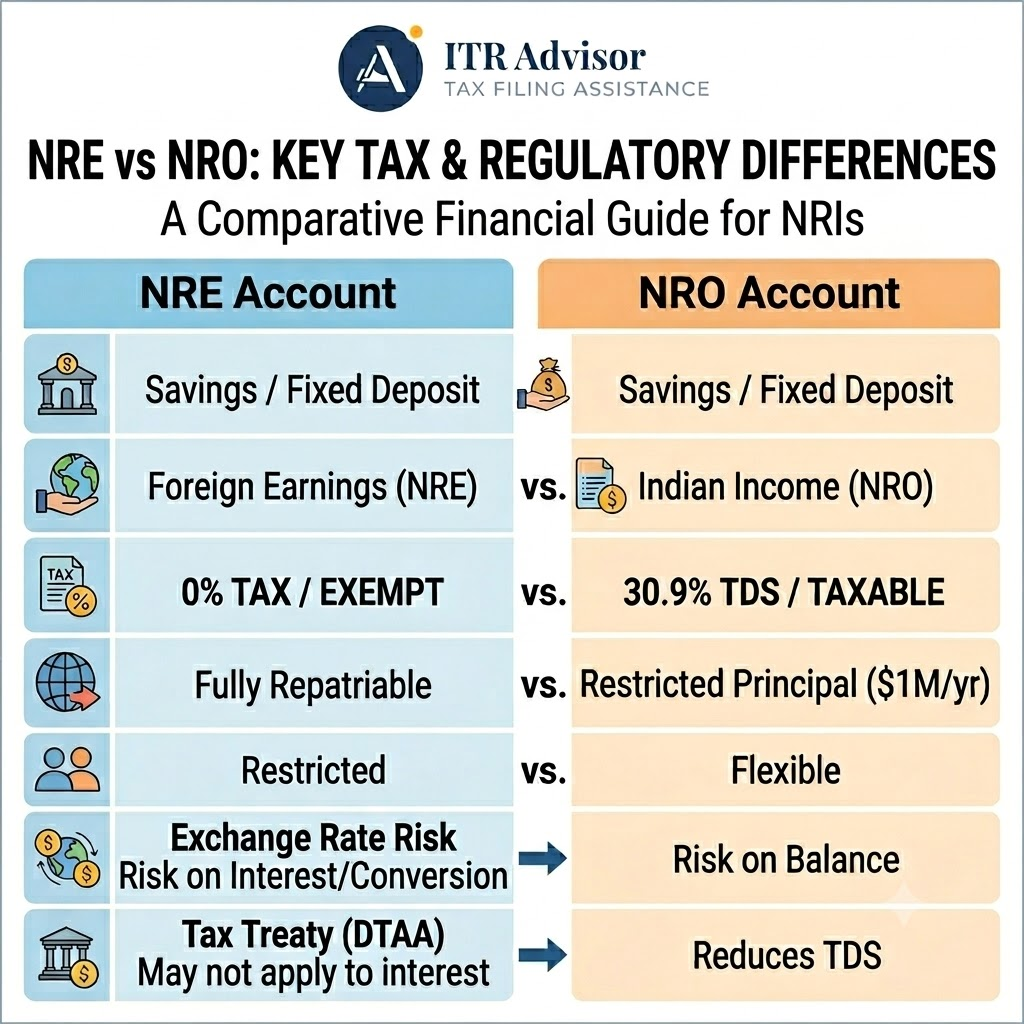
    If you are unsure whether your NRE interest is taxable, whether you need to file an ITR in India, or how to handle NRO income, professional guidance can help avoid costly mistakes.

    Visit ITRAdvisor.in to schedule a consultation and get clarity on your NRI tax obligations.

    Disclaimer: ITRAdvisor.in is an educational and informational platform focused on tax awareness and compliance updates. Nothing contained herein should be construed as solicitation or advertisement of professional services. Professional services, where applicable, are rendered in accordance with ICAI guidelines. This article is published on ITRAdvisor.in, a tax and compliance knowledge platform. The content has been reviewed for technical accuracy by professionals associated with Adwani & Co LLP.
  • Section 80GGC Deduction Disallowance: ITAT Rules That Suspicion Is Not Enough : A Critical Guide for Indian Taxpayers

    Section 80GGC Deduction Disallowance: ITAT Rules That Suspicion Is Not Enough : A Critical Guide for Indian Taxpayers

    Section 80GGC Deduction Disallowance

    Imagine claiming a perfectly legal tax deduction one that the Income Tax Act explicitly allows and having it disallowed by your Assessing Officer simply because he found it suspicious. No evidence. No proof of wrongdoing. Just suspicion. This is precisely the situation that the Income Tax Appellate Tribunal (ITAT) recently pushed back against in a landmark ruling on Section 80GGC deductions, and it has important implications for every Indian taxpayer who has donated to a registered political party.

    What Is Section 80GGC? Understanding the Deduction for Political Contributions

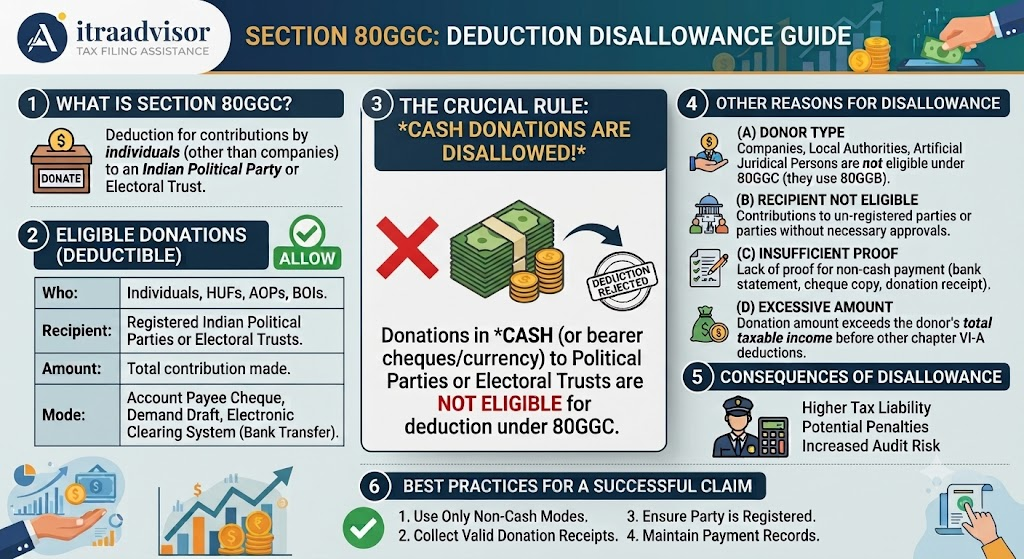
    Section 80GGC of the Income Tax Act provides a full 100% deduction on contributions made by any person (other than a company or local authority) to a registered political party or an electoral trust. This is one of the few deductions in the Indian tax code that allows complete relief there is no upper ceiling on the deduction amount, subject to the conditions below.

    To claim the Section 80GGC deduction, the contribution must satisfy all of the following conditions:

    • The donor must be an individual, HUF, firm, AOP, or BOI not a company or a local authority.
    • The contribution must be made to a political party registered under Section 29A of the Representation of the People Act, 1951, or to an electoral trust.
    • The payment must be made through any mode other than cash. Contributions made in cash are explicitly excluded from the Section 80GGC deduction benefit.
    • The taxpayer must obtain a receipt from the political party or electoral trust acknowledging the donation.

    When these conditions are satisfied, the Section 80GGC deduction is a legitimate and fully supported claim under the Income Tax Act. Disallowing it requires evidence — not conjecture.


    The ITAT Ruling: Why Suspicion Alone Cannot Disallow a Section 80GGC Deduction

    In a significant ruling that reinforces taxpayer rights, the Income Tax Appellate Tribunal held that mere suspicion on the part of the Assessing Officer (AO) without any concrete, tangible evidence of fraud, bogus payment, or non-compliance with Section 80GGC conditions is legally insufficient to disallow a Section 80GGC deduction claim.

    The facts in the case were straightforward: the taxpayer had made a documented, non-cash contribution to a registered political party, claimed the Section 80GGC deduction in the ITR, and produced the relevant receipt. The AO, however, raised doubts about the genuineness of the transaction and disallowed the deduction without examining the political party’s records, without issuing a summons, and without pointing to any specific defect in the documentation.

    The ITAT found this approach fundamentally flawed. The tribunal emphasised a principle that runs through Indian tax jurisprudence: the burden of proof lies on the tax department to establish that a claimed deduction is fraudulent or ineligible not on the taxpayer to disprove a suspicion. If the AO had genuine doubts, the correct course was to investigate the political party, verify the receipt independently, or conduct enquiries under Sections 131 or 133(6) of the Income Tax Act. None of that happened. Disallowance of the Section 80GGC deduction was accordingly set aside.


    Worked Example: What a Valid Section 80GGC Deduction Looks Like

    ParameterDetail
    TaxpayerSalaried individual, AY 2026-27
    Gross Total Income₹18,00,000
    Donation Made ToRegistered political party (Sec. 29A, RPA 1951)
    Amount Donated₹2,00,000 (via NEFT)
    ReceiptObtained from the political party
    80GGC Deduction₹2,00,000 (100% of donation, no ceiling)
    Net Taxable Income₹16,00,000 after 80GGC deduction
    Outcome If AO Disallows Without EvidenceAppealable at CIT(A) and ITAT — taxpayer likely to succeed per this ruling

    What Indian Taxpayers Must Do to Protect Their Section 80GGC Deduction Claim

    The ITAT ruling is a relief, but it does not mean taxpayers can afford to be careless with documentation. If your Section 80GGC deduction is questioned, your first line of defence is the quality of your paperwork. Here is what you must have:

    Documentation Checklist for Section 80GGC Deduction

    • Receipt from the registered political party or electoral trust specifically acknowledging the donation amount, date, and your PAN.
    • Bank statement or payment proof showing the NEFT/cheque/digital transfer cash donations are entirely ineligible under Section 80GGC.
    • Confirmation that the party is registered under Section 29A of the Representation of the People Act, 1951 you can verify this through the Election Commission of India’s published list.
    • Copy of your ITR showing the Section 80GGC deduction has been correctly entered in Schedule VI-A.

    If your Section 80GGC deduction is disallowed despite clean documentation, you have a strong appellate case, as this ITAT ruling demonstrates.

    Key Takeaways: Section 80GGC Deduction and the ITAT Ruling

    •  Section 80GGC allows a 100% tax deduction on contributions to registered political parties or electoral trusts with no upper limit.

    •  Cash donations are completely ineligible. All 80GGC contributions must be made through banking channels.

    •  The ITAT has ruled that an AO cannot disallow a Section 80GGC deduction based on suspicion alone concrete evidence of non-compliance is required.

    •  The burden of proving that a deduction is bogus lies with the tax department, not the taxpayer.

    •  Maintain a receipt from the political party, bank transfer proof, and ITR Schedule VI-A entry to defend any 80GGC disallowance. •  If your Section 80GGC deduction is wrongly disallowed, you can appeal to CIT(A) and then ITAT, where this ruling significantly strengthens your case.


    Expert Perspective: Proving Legitimacy Is About Documentation, Not Debate

    Dr. Haresh Adwani, a PhD in Commerce and tax practitioner associated with ITRAdvisor.in, puts it plainly: ‘The Section 80GGC deduction is one of the most straightforward claims in the Indian tax code 100% of a non-cash donation to a registered party, fully deductible. The problem arises not from the law but from poor record-keeping. Taxpayers who maintain a clear paper trail receipt, bank proof, PAN linkage rarely face sustained disallowance. The ITAT has now confirmed what we have always advised: suspicion is not a substitute for evidence, and taxpayers need not accept a disallowance that lacks legal foundation.’


    What to Do If Your Assessing Officer Disallows Your Section 80GGC Deduction

    If you receive a draft assessment order or a final order disallowing your Section 80GGC deduction without adequate grounds, your escalation path is clear:

    • File your objections with the Dispute Resolution Panel (DRP) if applicable, or file an appeal before the Commissioner of Income Tax (Appeals) [CIT(A)] within 30 days of receiving the demand order.
    • Cite this ITAT ruling in your appeal submissions to demonstrate that suspicion alone is legally insufficient for Section 80GGC disallowance.
    • Attach all documentation receipt, bank statement, ITR schedule as annexures to your appeal memorandum.
    • If the CIT(A) also rules against you, escalate to the ITAT, where the position on evidence-based disallowance is now well-established.

    Do not simply pay a demand arising from an unjustified Section 80GGC disallowance. The appellate system exists precisely for these situations, and taxpayers who engage it with proper documentation generally prevail.

    Read our detailed guide on ITR 1 vs ITR 2 vs ITR 3 vs ITR 4: The Definitive Guide to Picking the Right Income Tax Return Form for AY 2026-27


    Frequently Asked Questions: Section 80GGC Deduction

    Q1. Who is eligible to claim a Section 80GGC deduction?

    Any individual, HUF, firm, AOP, or BOI can claim the Section 80GGC deduction. Companies and local authorities are explicitly excluded from this provision.

    Q2. Is there a maximum limit on the Section 80GGC deduction?

    No. Section 80GGC allows a 100% deduction with no upper ceiling on the amount contributed to a registered political party or electoral trust, provided the payment is non-cash.

    Q3. Can my Assessing Officer disallow the Section 80GGC deduction without evidence?

    As per the ITAT ruling discussed in this article, a disallowance based purely on suspicion without evidence is not legally tenable. The AO must establish specific non-compliance to disallow the deduction.

    Q4. Where do I enter the Section 80GGC deduction in my ITR?

    The Section 80GGC deduction is entered in Schedule VI-A of ITR-1, ITR-2, ITR-3, or ITR-4 (as applicable), under the heading ‘Deductions under Chapter VI-A’.

    Q5. What happens if I made a cash donation to a political party? Can I still claim Section 80GGC?

    No. Section 80GGC explicitly bars deductions for cash donations. Only contributions made through banking channels (NEFT, cheque, UPI, demand draft) qualify for the deduction.

    Conclusion: Know Your Rights Under Section 80GGC and Claim Them Confidently

    The ITAT’s ruling on Section 80GGC deduction disallowance is a powerful reaffirmation of a fundamental principle: in India’s tax system, as in law more broadly, suspicion is not proof. If you have made a legitimate, documented, non-cash contribution to a registered political party and your Assessing Officer disallows the Section 80GGC deduction on vague grounds, you have both the right and the legal precedent to fight back.

    What protects you is not complicated it is a receipt, a bank statement, and a correctly filed ITR. If you have those, your Section 80GGC deduction stands on solid ground. If it is still challenged, the appellate route is well-established and, as this ITAT ruling shows, increasingly taxpayer-friendly where documentation is clean.

    Claimed a Section 80GGC deduction and received a disallowance notice?

    ITRAdvisor.in provides clear, authoritative guidance on all income tax deductions, ITAT rulings, and notice responses. Whether you need to understand your Section 80GGC eligibility, respond to a scrutiny notice, or appeal an unjust disallowance, our resources will walk you through every step.Visit ITRAdvisor.in today — because a legally correct claim deserves a legally correct outcome.

    About the Author:

    Mukesh Chavan is a dedicated indirect taxation and compliance professional associated with Adwani & Co LLP, specializing in GST advisory, GST audits, GST assessments, and RERA compliance services. With extensive experience in handling complex regulatory matters, he assists businesses in ensuring compliance with evolving GST laws and real estate regulations while minimizing risks and enhancing operational efficiency.

    Mukesh has successfully guided clients through GST registrations, return compliance, departmental assessments, audits, litigation support, and tax planning strategies. He also possesses significant expertise in RERA compliance, helping real estate developers, promoters, and stakeholders navigate regulatory requirements and maintain seamless project compliance.

    Through his articles and professional insights, Mukesh aims to simplify complex GST and RERA provisions, offering practical guidance that empowers businesses to remain compliant, avoid disputes, and make informed decisions in an increasingly dynamic regulatory environment. His approach combines technical expertise with practical business understanding, enabling clients to focus on growth while meeting their statutory obligations with confidence.

    Not Sure If Your Return Is Clean?
    If you’re unsure whether your return has been reported correctly, a quick review today can help avoid a much bigger problem later. If you want expert guidance, connect with itradvisor.in today.
    Need Help Before You File? If you’re a salaried professional, business owner, freelancer, or NRI and want to ensure your ITR matches your AIS and Form 26AS before submission — ITRAdvisor.in is where to start. Visit itradvisor.in for expert tax guidance, AIS reconciliation checklists, and professional support backed by Adwani & Co LLP.

    Disclaimer

    ITRAdvisor.in is an educational and informational platform focused on tax awareness and compliance updates. Nothing contained herein should be construed as solicitation or advertisement of professional services. Professional services, where applicable, are rendered in accordance with ICAI guidelines. This article is published on ITRAdvisor.in, a tax and compliance knowledge platform. The content has been reviewed for technical accuracy by professionals associated with Adwani & Co LLP.

  • F&O Trading Taxation in India (2026): The Complete, Definitive Guide Every Trader Must Read

    F&O Trading Taxation in India (2026): The Complete, Definitive Guide Every Trader Must Read

    24 June 2026•Mukesh Chavhan

    F&O Trading Taxation in India

    Every year, thousands of F&O traders receive income tax notices not because they evaded tax, but because they simply did not know how to report their futures and options income correctly. F&O trading taxation in India is one of the most misunderstood areas of personal finance. Whether you made a profit or suffered a loss in the markets, the Income Tax Department expects you to account for every rupee and the rules have significant implications for your AY 2026-27 ITR filing.

    This comprehensive guide breaks it all down in plain, practical language that a working professional or active trader can actually act on.


    Why F&O Taxation in India Is a Compliance Priority in 2026

    The Income Tax Department receives transaction-level data directly from stock exchanges through Statement of Financial Transactions (SFT). If you traded in F&O even for a single contract it likely reflects in your AIS (Annual Information Statement). Ignoring it during ITR filing invites notices, penalties, and even reassessment.

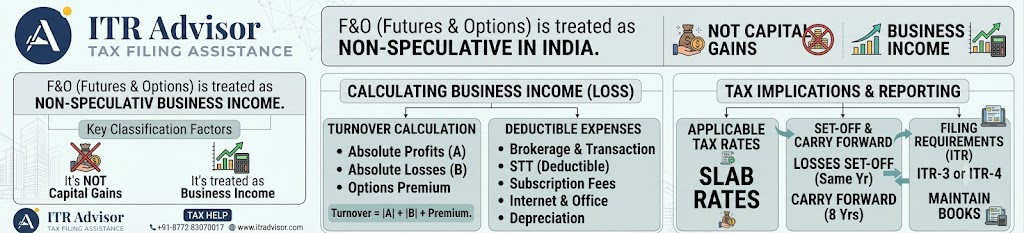
    As per the Income Tax Act, 1961,F&O transactions are treated as non-speculative business income — a classification that carries specific advantages (and obligations) that most traders are unaware of.


    Is F&O Income Business Income or Speculative Income? The Critical Distinction

    This is perhaps the most important question in F&O trading tax. Many traders incorrectly assume F&O falls under ‘speculative’ income (like intraday equity trading). That assumption can be costly.

    KEY RULE: F&O = Non-Speculative Business Income
    Under Section 43(5) of the Income Tax Act, derivatives trading (including futures and options) is explicitly excluded from the definition of ‘speculative transaction’.
    This means F&O income profit or loss is treated as normal business income under the head ‘Profits and Gains of Business or Profession’ (PGBP).

    This has a powerful practical implication: F&O losses can be set off against almost any other income, unlike speculative losses which can only be set off against other speculative gains.


    F&O Income Tax Treatment: How Profits and Losses Are Taxed in AY 2026-27

    F&O Profit: How It Is Taxed

    F&O trading profit is added to your total income and taxed at the applicable slab rate whether you are salaried, a professional, or a business owner. There is no special flat rate like crypto (30%) or LTCG (12.5%).

    For example: If your salary is ₹8 lakh and your net F&O profit for FY 2025-26 is ₹2 lakh, your total taxable income becomes ₹10 lakh, taxed at applicable slab rates under either the old or new tax regime.

    F&O Loss: The Tax Benefit You Must Not Miss

    F&O loss tax benefit is one of the most underutilised advantages available to traders. Here is exactly how it works:

    ScenarioSet-Off Available AgainstCarry Forward
    F&O Loss (same year)Any income except salary* (house property, business, capital gains, other sources)Yes
    Remaining F&O LossFuture F&O profits (non-speculative business income)Up to 8 assessment years
    ConditionITR must be filed before due date (usually July 31)Mandatory for carry forward

    Important: F&O losses cannot be directly set off against salary income in the same year. However, F&O losses can be set off against business income, house property income, capital gains, and other sources in the same year and carried forward against F&O profits for up to 8 years.


    Which ITR Form for F&O Traders in AY 2026-27?

    ITR Form Selection for F&O Traders
    ITR-3: For individuals and HUFs with income from business/profession, including F&O. This is the correct form if you have F&O activity PLUS salary, capital gains, or any other income.
    ITR-4 (Sugam): NOT applicable for F&O traders. ITR-4 is only for presumptive taxation under Sections 44AD/44ADA — F&O trading cannot be declared under presumptive taxation.

    A critical point: even if you are salaried and traded F&O only occasionally, you must file ITR-3. Filing ITR-1 or ITR-2 when you have F&O transactions is a compliance defect that can lead to notices.

    Read our detailed guide on ITR 1 vs ITR 2 vs ITR 3 vs ITR 4: The Definitive Guide to Picking the Right Income Tax Return Form for AY 2026-27

    Which ITR Form for F&O Traders in AY 2026-27?

    ITR Form Selection for F&O Traders
    ITR-3: For individuals and HUFs with income from business/profession, including F&O. This is the correct form if you have F&O activity PLUS salary, capital gains, or any other income.
    ITR-4 (Sugam): NOT applicable for F&O traders. ITR-4 is only for presumptive taxation under Sections 44AD/44ADA F&O trading cannot be declared under presumptive taxation.

    A critical point: even if you are salaried and traded F&O only occasionally, you must file ITR-3. Filing ITR-1 or ITR-2 when you have F&O transactions is a compliance defect that can lead to notices.


    Is Tax Audit Mandatory for F&O Traders? Understanding the Turnover Threshold

    Tax audit under Section 44AB becomes relevant for F&O traders based on ‘turnover’ and the calculation of F&O turnover is different from regular business turnover.

    How to Calculate F&O Turnover

    • For Futures: Absolute value of settlement profit/loss on each trade (favourable + unfavourable)
    • For Options: Premium received on sale of options + absolute value of any settlement profit/loss on option trades
    Turnover (F&O)Profit/Loss SituationTax Audit Required?
    Up to ₹1 croreProfitNo (if profit > 6% of turnover)
    Up to ₹1 croreLoss or profit < 6%Yes (Section 44AB)
    ₹1 crore to ₹10 croreAny (if 95%+ transactions digital)No (increased threshold)
    Above ₹10 croreAnyYes mandatory

    Key Takeaways:

    1. F&O is non-speculative business income taxed at your slab rate, not a flat rate.

    2. F&O losses can be set off against business, house property, capital gains, and other source income (NOT salary in the same year).

    3. Unabsorbed F&O losses can be carried forward for 8 assessment years.

    4. File ITR-3 (not ITR-4) if you have any F&O transactions, regardless of quantum.

    5. Tax audit under Section 44AB may apply if turnover crosses the threshold with a loss or low profit.

    6. Always reconcile your F&O data with AIS before filing the IT Department has exchange data.


    How to Show F&O Loss and Profit in ITR: Step-by-Step Guide

    • Step 1: Download your F&O ledger/contract notes from your broker. Compile all profits and losses.
    • Step 2: Calculate your F&O turnover as described above.
    • Step 3: Determine if tax audit is applicable. If yes, get it done by a CA before filing.
    • Step 4: In ITR-3, enter F&O income under ‘Schedule BP’ (Business and Profession). Report gross receipts, expenses, and net profit or loss.
    • Step 5: If you have a net loss, fill Schedule CYLA (Current Year Loss Adjustment) and Schedule CFL (Carry Forward Losses) appropriately.
    • Step 6: Cross-check all figures with your AIS on the Income Tax portal (incometax.gov.in) before submitting.

    Expert Insight

    According to Dr. Haresh Adwani, a commerce PhD and legal professional associated with Adwani & Co LLP, one of the most common errors made by F&O traders is failing to file ITR before the due date thereby forfeiting the right to carry forward losses. ‘The carry-forward benefit is automatic under the law, but only if you file on time. Missing the deadline can cost you lakhs in future tax relief,’ he notes.


    Legitimate Business Expenses F&O Traders Can Claim as Deductions

    Since F&O is treated as a business, you can claim genuine business expenses to reduce your taxable income. These may include:

    • Brokerage and transaction charges paid to the broker
    • Internet charges used for trading
    • Subscription to market data feeds or research platforms
    • Depreciation on computer or laptop used for trading
    • Professional fees paid to a CA for ITR or audit
    • Home office expenses (proportionate, if you trade from home)

    Important: All expenses must be genuine, documented, and directly related to the F&O trading business. The Income Tax Department may scrutinise excessive or unrelated expense claims.


    Explore More on ITRAdvisor.in

    If you found this guide useful, you may also want to read:

    • Learn more about ITR-3 filing for traders and professionals
    • Read our detailed guide on LTCG and STCG on shares and mutual funds in 2026
    • Understand how to read your AIS and reconcile it with your ITR before filing
    • Explore old vs new tax regime calculator for FY 2026-27 to decide which is better for you
    • Read our guide on advance tax due dates FY 2026-27 — mandatory if your F&O income creates tax liability

    Frequently Asked Questions:

    Q1. Is F&O income taxable in India even if I made a loss?

    Yes even F&O losses must be reported in your ITR. Filing correctly is mandatory and enables you to carry forward losses for up to 8 years to set off against future F&O profits.

    Q2. Can F&O loss be set off against salary income?

    No — F&O losses cannot be directly set off against salary income in the same year. However, they can be set off against business income, house property income, capital gains, or other source income in the same year.

    Q3. Which ITR form should a salaried person with F&O trading file?

    A salaried individual with F&O transactions must file ITR-3, not ITR-1 or ITR-2. ITR-4 is not applicable for F&O income as it cannot be declared under presumptive taxation.

    Q4. How long can F&O losses be carried forward?

    F&O losses (being non-speculative business losses) can be carried forward for up to 8 assessment years, provided the ITR for the year of loss is filed within the due date.

    Q5. Is a tax audit compulsory if I have F&O losses?

    If your F&O turnover is below ₹1 crore but you have a net loss (or profit less than 6% of turnover), a tax audit under Section 44AB is typically required. Consult a qualified CA to confirm your specific situation.

    Conclusion: F&O Taxation Is Not Optional : But It Does Not Have to Be Overwhelming

    F&O trading taxation in India is governed by clear rules the problem is that most traders either don’t know them or learn them after receiving a notice. The good news is that once you understand the non-speculative business income classification, the set-off and carry-forward benefits, the correct ITR form, and the tax audit thresholds, F&O compliance becomes manageable.

    File on time, report accurately, and claim every deduction you are legally entitled to. The Income Tax Department’s AIS platform ensures they already have your trading data — so your ITR should tell the same story.

    About the Author:

    Mukesh Chavan is a dedicated indirect taxation and compliance professional associated with Adwani & Co LLP, specializing in GST advisory, GST audits, GST assessments, and RERA compliance services. With extensive experience in handling complex regulatory matters, he assists businesses in ensuring compliance with evolving GST laws and real estate regulations while minimizing risks and enhancing operational efficiency.

    Mukesh has successfully guided clients through GST registrations, return compliance, departmental assessments, audits, litigation support, and tax planning strategies. He also possesses significant expertise in RERA compliance, helping real estate developers, promoters, and stakeholders navigate regulatory requirements and maintain seamless project compliance.

    Through his articles and professional insights, Mukesh aims to simplify complex GST and RERA provisions, offering practical guidance that empowers businesses to remain compliant, avoid disputes, and make informed decisions in an increasingly dynamic regulatory environment. His approach combines technical expertise with practical business understanding, enabling clients to focus on growth while meeting their statutory obligations with confidence.

    At ITRAdvisor.in, we help taxpayers with:

    ✔️ ITR Filing Review

    ✔️ AIS Reconciliation

    ✔️ Capital Gains Reporting

    ✔️ NRI Taxation

    ✔️ Tax Notice Response

    ✔️ Revised Returns

    ✔️ Income Tax Planning

    ✔️ Refund and Compliance Issues

    Visit ITRAdvisor.in today for professional guidance and consultation.

    Early action can often prevent bigger tax problems later.

  • AIS vs Form 26AS Mismatch in 2026: The Silent Trigger Behind Most Income Tax Notices

    AIS vs Form 26AS Mismatch in 2026: The Silent Trigger Behind Most Income Tax Notices

    22 June 2026•Mukesh Chavhan

    AIS vs Form 26AS Mismatch and Tax Notices

    A ₹500 omission can create more trouble than a ₹5 lakh deduction claim. Many taxpayers still believe that if they don’t mention a transaction in their Income Tax Return (ITR), it will simply go unnoticed. That mindset belongs to the past.

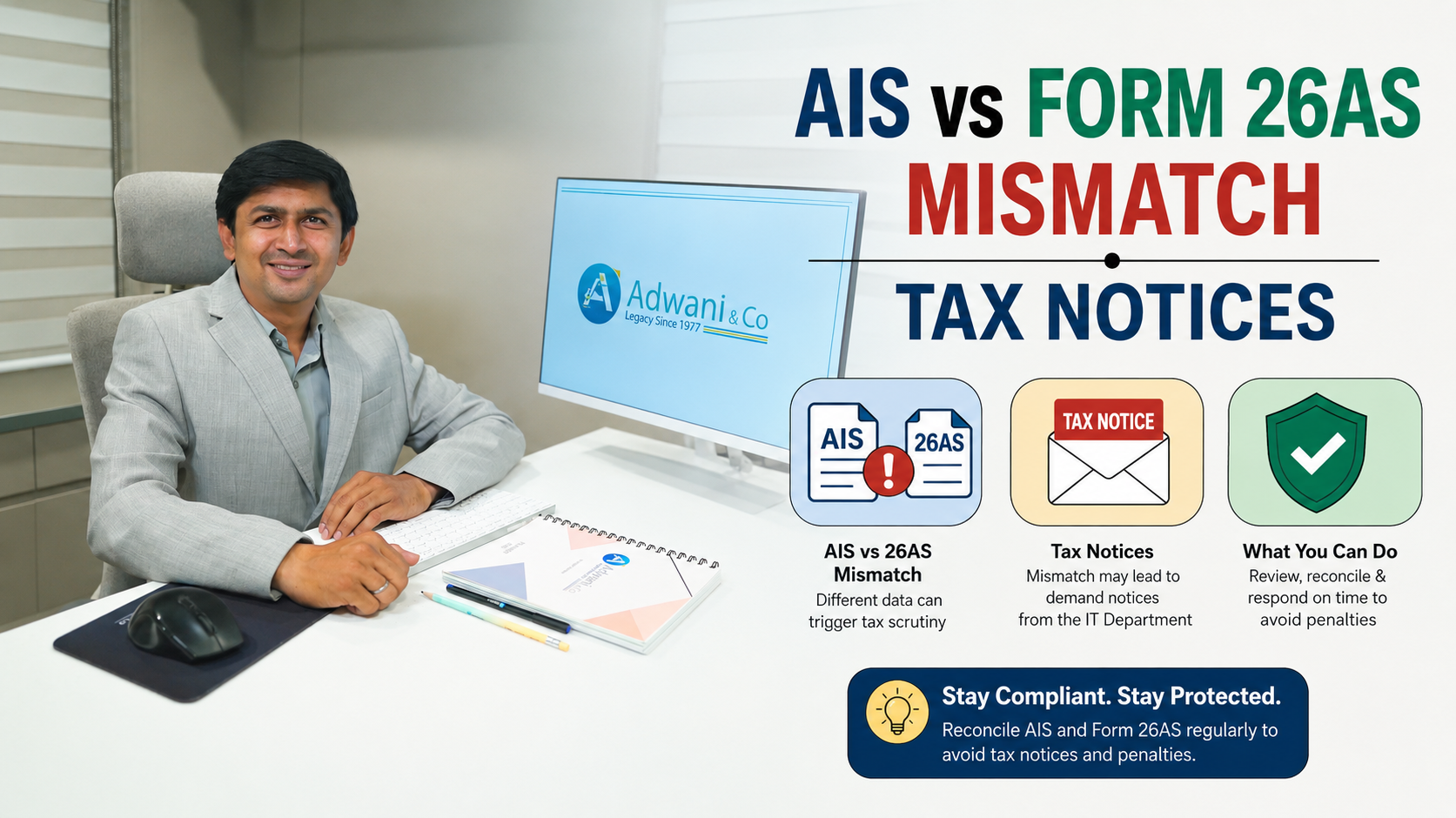
    Today, the Income Tax Department uses advanced data analytics to cross-check your ITR against information sourced from banks, employers, brokers, registrars, and financial institutions. If the numbers don’t match between your AIS, Form 26AS, and what you file the system flags it automatically. The result? An income tax notice you didn’t expect.

    What Is AIS vs Form 26AS and Why the AIS vs Form 26AS Mismatch Matters

    To understand the risk of an AIS vs Form 26AS mismatch, you first need to know what these two documents actually are.

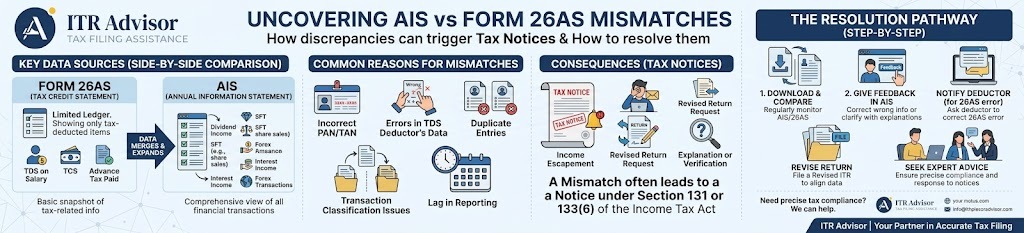
    Form 26AS is your consolidated tax credit statement it shows TDS deducted by employers, banks, and others, along with TCS and advance tax payments made against your PAN.

    The Annual Information Statement (AIS) is a significantly more comprehensive document introduced by the Income Tax Department. It aggregates data from multiple reporting sources and shows:

    • Salary and TDS reported by your employer
    • Interest income from savings accounts and Fixed Deposits
    • Dividend income credited to your account
    • Purchase and sale of shares and mutual funds (reported by stock exchanges)
    • Property purchase or sale transactions (reported by registrars)
    • High-value financial transactions above prescribed thresholds
    • Tax Collected at Source (TCS) on foreign remittances, car purchases, and more
    • Rent received, professional receipts, and other reportable incomes

    The Taxpayer Information Summary (TIS) sits alongside the AIS and provides category-wise aggregated figures. Together, these three form the Income Tax Department’s full picture of your financial life even before you file your ITR.


    How an AIS vs Form 26AS Mismatch Triggers an Income Tax Notice

    When you submit your ITR, the department’s system compares your declared income with the data already available in your AIS and Form 26AS. If there is a significant discrepancy even on a single line item it can trigger one or more of the following:

    • A request for clarification or additional information
    • Delay in processing your income tax refund
    • A notice under Section 143(1) for prima facie adjustments
    • In serious cases, scrutiny assessment under Section 143(2)
    • Re-opening of assessments under Section 147/148 for unreported income

    The objective isn’t to create fear. As the Income Tax Department has consistently communicated through its compliance campaigns at incometax.gov.in, the aim is to promote accurate, voluntary tax compliance — and to reduce the need for enforcement action.

    Key Takeaways

    • Your AIS reflects far more data than your Form 26AS always check both before filing.
    • Even small mismatches in interest income, dividend, or capital gains can attract automated notices.
    • The Income Tax Department’s systems compare your ITR with AIS data in real time after you submit.
    • Reconcile discrepancies proactively if AIS shows incorrect data, submit feedback directly on the AIS portal.

    An unreported capital gain or dividend however small is not invisible to the department.


    How to Reconcile AIS vs Form 26AS Mismatch Before Filing Your ITR

    Step 1 : Download Both Documents

    Log in to the Income Tax e-filing portal at incometax.gov.in. Under ‘Services’, access your AIS and also download Form 26AS from the TRACES portal. Compare them side by side.

    Step 2 : Identify Every Income Source

    Cross-check salary, interest from FDs and savings accounts, dividend credits, capital gains from mutual funds and shares (including LTCG and STCG), and any TCS entries particularly on foreign remittances.

    Step 3 : Submit AIS Feedback If Data Is Incorrect

    The AIS portal allows you to flag incorrect information using the feedback option. If a transaction shown in your AIS does not belong to you or the amount is incorrect submit feedback online. The department takes this into account during processing.

    Step 4 : Declare All Income in Your ITR

    Even if you believe a transaction amount is minor, declare it. The cost of non-disclosure interest, penalties, and notices far exceeds the tax you would have paid. Most issues arise not from intentional evasion, but from the erroneous assumption that small omissions don’t matter.


    Example:

    Why Even Small AIS vs Form 26AS Mismatches Are Flagged

    Ramesh, a salaried professional in Pune, received ₹14,800 as dividend from a mutual fund in FY 2025-26. He did not recall receiving it and left it out of his ITR. However, the Asset Management Company had already reported this to the Income Tax Department via SFT (Statement of Financial Transactions). The AIS showed the income; his ITR didn’t. The result was a Section 143(1) adjustment notice asking him to pay tax plus interest on the unreported dividend.


    AIS vs Form 26AS Mismatch Checklist: Before You Click Submit

    Before you finalise and submit your ITR for AY 2026-27, ask yourself:

    • Have I reviewed and compared my AIS and Form 26AS thoroughly?
    • Have I reported all taxable income including interest, dividends, and capital gains?
    • Have I accounted for any TCS entries (foreign travel, car purchase, overseas education)?
    • Have I disclosed high-value transactions such as property sale or purchase of mutual funds?
    • Is my income from freelancing or professional work aligned with what clients may have reported?

    According to the CBDT’s compliance framework (cbdt.gov.in), taxpayers are expected to reconcile their ITR with information available in Form 26AS and AIS before filing. A proactive approach saves weeks of correspondence later.

    As Dr. Haresh Adwani, PhD in Commerce and law graduate associated with Adwani & Co LLP, has noted in advisory practice: most AIS-related notices could have been avoided entirely if taxpayers had reviewed their AIS portal data once before filing. The information was always there the gap was awareness.

    Read our detaited guide on : Received a notice? Read our Income Tax Notice Reply Guide

    GST Show Cause Notice 2026: A Complete Legal Guide to Understanding and Responding

    Frequently Asked Questions

    Q1. What is the difference between AIS and Form 26AS in 2026?

    Form 26AS primarily shows TDS, TCS, and advance tax payments. The AIS is a broader document that also includes interest income, dividends, capital gains, property transactions, and other high-value financial transactions reported to the Income Tax Department.

    Q2. Can an AIS vs Form 26AS mismatch cause an income tax notice?

    Yes. If income reported in your ITR does not match what is shown in your AIS, the department’s automated system can issue a notice under Section 143(1) or send a compliance query requesting explanation for the discrepancy.

    Q3. What should I do if the AIS shows incorrect information?

    You can submit feedback directly on the AIS portal at incometax.gov.in, marking the transaction as incorrect, duplicate, or not belonging to you. The department reviews such feedback during the ITR processing stage

    Q4. Will I get an income tax notice for a small unreported dividend or interest income?

    The system is automated and threshold-agnostic in many cases. Even a small unreported dividend or savings account interest can create a mismatch flag. The safest course is to declare all income, irrespective of amount.

    Q5. Is reconciling AIS and Form 26AS mandatory before filing an ITR?

    While not separately mandated as a distinct legal step, the CBDT consistently advises taxpayers to review both documents before filing. Practically, it is essential to avoid mismatches that lead to notice, refund delays, or additional tax demand.

    Conclusion:

    Your financial footprint is now fully visible to the Income Tax Department — even before you file. The AIS captures your salary, dividends, interest, capital gains, and high-value transactions from every reporting source. A mismatch between what they see and what you file is no longer a grey area it is a data point that triggers automated action.

    In most tax issues, the problem isn’t intentional evasion. It’s assumption the assumption that a small omission won’t matter. It does. Take ten minutes before you file, compare your AIS with Form 26AS, and make sure your ITR reflects reality.

    A few extra minutes of review today can save weeks of unnecessary correspondence tomorrow.

    About the Author:

    Mukesh Chavan is a dedicated indirect taxation and compliance professional associated with Adwani & Co LLP, specializing in GST advisory, GST audits, GST assessments, and RERA compliance services. With extensive experience in handling complex regulatory matters, he assists businesses in ensuring compliance with evolving GST laws and real estate regulations while minimizing risks and enhancing operational efficiency.

    Mukesh has successfully guided clients through GST registrations, return compliance, departmental assessments, audits, litigation support, and tax planning strategies. He also possesses significant expertise in RERA compliance, helping real estate developers, promoters, and stakeholders navigate regulatory requirements and maintain seamless project compliance.

    Through his articles and professional insights, Mukesh aims to simplify complex GST and RERA provisions, offering practical guidance that empowers businesses to remain compliant, avoid disputes, and make informed decisions in an increasingly dynamic regulatory environment. His approach combines technical expertise with practical business understanding, enabling clients to focus on growth while meeting their statutory obligations with confidence.

    Not Sure If Your Return Is Clean?
    If you’re unsure whether your return has been reported correctly, a quick review today can help avoid a much bigger problem later. If you want expert guidance, connect with itradvisor.in today.
    Need Help Before You File? If you’re a salaried professional, business owner, freelancer, or NRI and want to ensure your ITR matches your AIS and Form 26AS before submission — ITRAdvisor.in is where to start. Visit itradvisor.in for expert tax guidance, AIS reconciliation checklists, and professional support backed by Adwani & Co LLP.

    Disclaimer

    ITRAdvisor.in is an educational and informational platform focused on tax awareness and compliance updates. Nothing contained herein should be construed as solicitation or advertisement of professional services. Professional services, where applicable, are rendered in accordance with ICAI guidelines. This article is published on ITRAdvisor.in, a tax and compliance knowledge platform. The content has been reviewed for technical accuracy by professionals associated with Adwani & Co LLP.
  • ITR Filing Mistakes That Quietly Trigger an Income Tax Notice

    ITR Filing Mistakes That Quietly Trigger an Income Tax Notice

    ITR Filing Mistakes

    A return takes fifteen minutes to file. Fixing one of the wrong ITR filing mistakes hiding inside it can take fifteen months. That gap between speed and consequence is exactly why taxpayers who file “on time” still end up facing an income tax notice they never saw coming.

    Why ITR Filing Mistakes Go Unnoticed at First

    Filing successfully and filing correctly aren’t the same thing. The portal checks the format of your submission not whether every figure matches what the department already knows. That is why ITR filing mistakes often surface weeks later, not on the day you submit.

    A Quick Case: One Missed Entry, Months of Follow-Up

    In a case reviewed recently, a taxpayer assumed the return was accurate simply because it had been accepted. The issue was small: income from one source wasn’t reported correctly. A notice followed, interest kept climbing, and the refund was held back while explanations went back and forth for months. In high-value cases, this kind of gap can turn into a tax demand running into lakhs or even crores.


    The Five Checks That Prevent Most ITR Filing Mistakes

    Before you click “Submit,” run through these checks — they catch the majority of ITR filing mistakes before they become an income tax notice:

    • Is every source of income reported, not just the obvious ones?
    • Have you picked the correct ITR form for your income type?
    • Are your deductions backed by documents you can actually produce?
    • Does your return match your AIS and Form 26AS, line by line?
    • Have you disclosed capital gains, foreign assets, or other reportable income, where applicable?

    Form 26AS vs AIS: Why This Match Matters Most

    Most income tax notices in 2026 trace back to one root cause: a mismatch between your filed return and your Form 26AS vs AIS data already on record. The Income Tax Department’s e-filing portal makes both statements available before filing, so reconciling them isn’t optional it’s the single highest-leverage check you can make.


    How Quickly Can an ITR Filing Mistake Become a Notice?

    Faster than most taxpayers expect. Once a mismatch is flagged, a notice can follow within the prescribed income tax notice time limit, and interest typically accrues from the point the shortfall existed not from the date the notice was issued.

    Key Takeaway

    ITR filing mistakes are rarely about dishonesty they’re almost always about a missed reconciliation step. Matching your return against your AIS and Form 26AS before submission remains the single most effective way to avoid an income tax notice altogether.

    Getting Expert Eyes on Your Return

    As Dr. Haresh Adwani, a Commerce Ph.D. holder and law graduate who frequently reviews such cases, notes most income tax notices are preventable with a thirty-minute reconciliation, not a thirty-day reply after the fact.

    Learn more about our ITR Filing Services, or

    Read our detailed guide Salary vs AIS Mismatch in Your ITR : Dangerous, Common & Completely Fixable

    Frequently Asked Questions

    What is the most common ITR filing mistake?

    Unreported income that already appears in your AIS or Form 26AS is the single most common trigger for a notice.

    How long does the department have to send an income tax notice?

    It depends on the type of notice and assessment year, but reassessment notices can be issued well within the prescribed income tax notice time limit — don’t assume an old return is automatically safe.

    Can I fix an ITR filing mistake after submission?

    Yes, a revised return is usually possible before the applicable deadline; after a notice is issued, a documented reply becomes necessary instead.

    Does choosing the wrong ITR form count as a mistake?

    Yes — filing under the wrong form is treated as a defective return and can independently trigger departmental queries.

    Conclusion: Review Before You Submit, Not After You’re Notified

    Filing fast feels productive, but ITR filing mistakes don’t announce themselves at the time of submission they surface later, as an income tax notice, a frozen refund, or months of correspondence. A few extra minutes of reconciliation today is consistently cheaper than the months it takes to undo a mismatch tomorrow.

    About the Author:

    Mukesh Chavan is a dedicated indirect taxation and compliance professional associated with Adwani & Co LLP, specializing in GST advisory, GST audits, GST assessments, and RERA compliance services. With extensive experience in handling complex regulatory matters, he assists businesses in ensuring compliance with evolving GST laws and real estate regulations while minimizing risks and enhancing operational efficiency.

    Mukesh has successfully guided clients through GST registrations, return compliance, departmental assessments, audits, litigation support, and tax planning strategies. He also possesses significant expertise in RERA compliance, helping real estate developers, promoters, and stakeholders navigate regulatory requirements and maintain seamless project compliance.

    Through his articles and professional insights, Mukesh aims to simplify complex GST and RERA provisions, offering practical guidance that empowers businesses to remain compliant, avoid disputes, and make informed decisions in an increasingly dynamic regulatory environment. His approach combines technical expertise with practical business understanding, enabling clients to focus on growth while meeting their statutory obligations with confidence.

    Not Sure If Your Return Is Clean?
    If you’re unsure whether your return has been reported correctly, a quick review today can help avoid a much bigger problem later. If you want expert guidance, connect with itradvisor.in today.

  • Form 16 for ITR Filing AY 2026-27: What It Covers : and What It Silently Misses

    Form 16 for ITR Filing AY 2026-27: What It Covers : and What It Silently Misses

    Form 16 for ITR Filing

    Every June, millions of salaried employees across India receive one document from their employer and immediately assume their tax homework is done. That document is Form 16. And that assumption? It is one of the most common and costliest tax filing mistakes of the year.

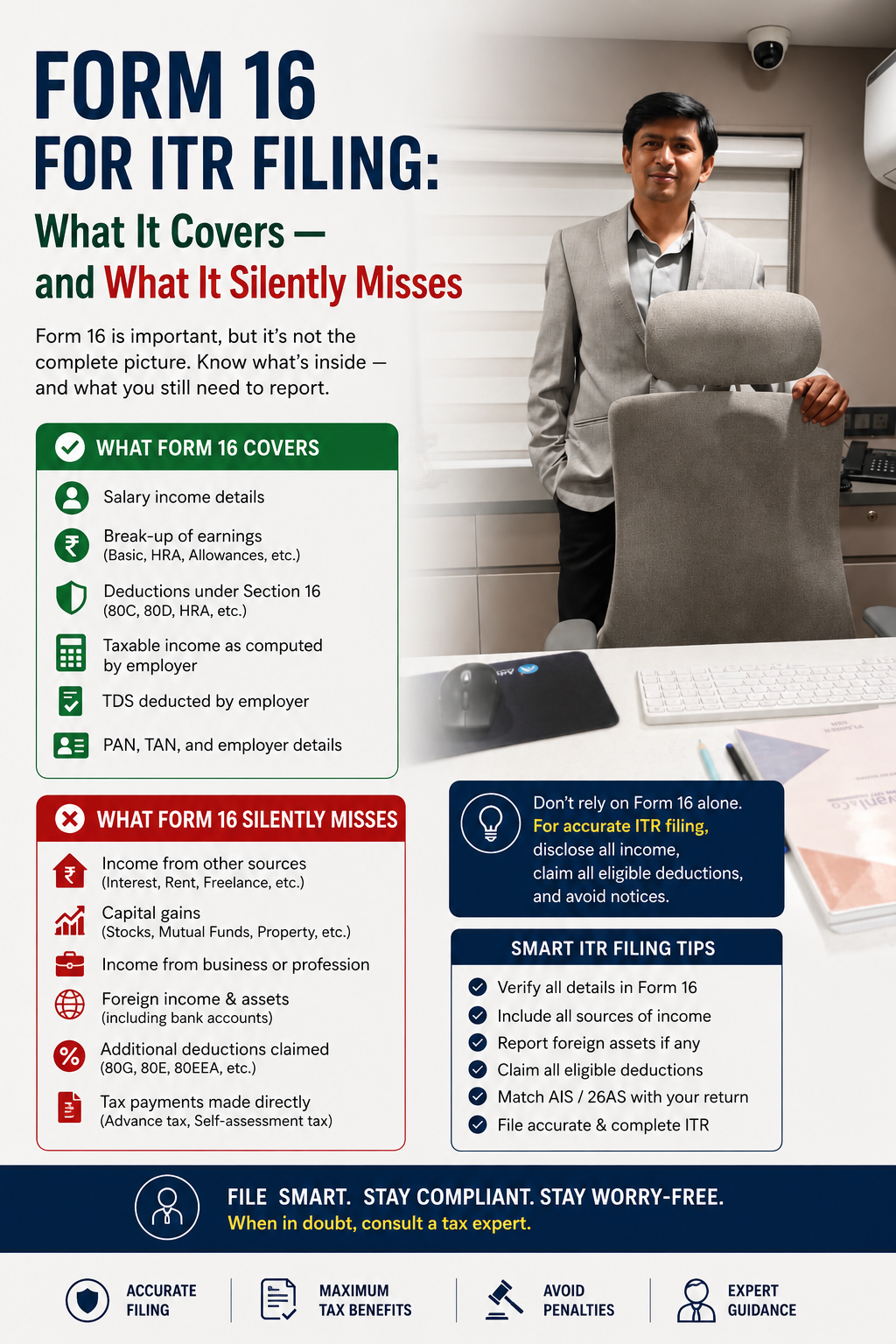
    Form 16 for ITR filling is important. But it is not the complete picture. For AY 2026-27, filing your Income Tax Return based only on Form 16 can leave out significant taxable income, trigger a mismatch with your Annual Information Statement (AIS), and even invite an income tax notice. This guide breaks down exactly what Form 16 covers, what it misses, and what you must do before hitting ‘Submit’ on the income tax portal.


    What Is Form 16 for ITR filling and Why Do Salaried Employees Receive It?

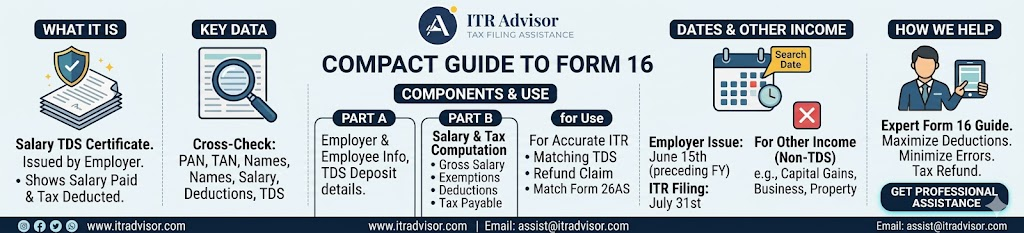
    Form 16 is a TDS certificate issued by your employer under Section 203 of the Income Tax Act, 1961. It certifies the amount of tax deducted at source (TDS) from your salary and deposited with the government on your behalf. As per the Income Tax Department, every employer who has deducted TDS from salary payments is required to issue Form 16 to employees by June 15 of the assessment year.

    The document has two parts:

    Part A : The TDS Summary

    Part A Covers:

    • Employer and employee PAN and TAN details
    • Quarter-wise TDS deducted and deposited

    Certificate number issued by TRACES (the government’s TDS reconciliation portal

    Part B : The Salary Breakdown

    Part B Covers:

    • Gross salary and allowances
    • Exempt allowances (HRA, LTA, etc.)
    • Deductions claimed under Chapter VIA (80C, 80D, 80G, etc.)
    • Net taxable salary and final tax computed

    Tax regime chosen (old or new)

    Also Read our Detailed guide on :Old vs New Tax Regime 2025: Stop Guessing, Start Calculating

    Together, Parts A and B give you a structured view of your salary income and the tax your employer calculated. But and this is critical Form 16 only reflects what your employer knows about your finances.

    What Form 16 for ITR filling Does NOT Cover: Income That Belongs in Your ITR

    This is where most salaried taxpayers go wrong when filing their ITR for AY 2026-27. Your employer can only deduct TDS on the salary they pay you. Any income earned outside of that employment relationship is completely invisible to them and therefore absent from Form 16.

    Here is income that will not appear in your Form 16 but must be disclosed in your ITR:

    • Interest income from savings accounts, fixed deposits, recurring deposits, and post office schemes often reported by banks to the Income Tax Department via Statement of Financial Transactions (SFT)
    • Capital gains from the sale of shares, equity mutual funds, debt funds, or property taxed at different rates under LTCG and STCG rules
    • Rental income from residential or commercial property let out during the year
    • Freelance, consulting, or professional income earned over and above your salary
    • Income from previous employers if you changed jobs during the financial year
    • Dividend income from shares and mutual funds now fully taxable in the hands of the investor
    • Winnings from online gaming, lottery, or other speculative sources

    Practical Example: Ramesh is a salaried IT professional in Pune earning ₹14 lakh annually. His employer deducts TDS and issues Form 16 reflecting zero additional tax liability. However, Ramesh also has ₹85,000 in FD interest and ₹1.2 lakh in STCG from selling equity mutual funds. None of this appears in his Form 16. If he files his ITR based only on Form 16 and ignores these, his AIS (Annual Information Statement) will show the mismatch and the Income Tax Department may send him a notice under Section 143(1)(a) for under-reporting of income.

    Form 16 vs AIS: Why a Mismatch Can Trigger an Income Tax Notice

    The Income Tax Department’s AIS and Form 26AS now capture a comprehensive view of your financial transactions far beyond what your employer reports. Banks report interest income. Brokers report capital gains. Mutual fund houses report redemptions. Registrars report property transactions.

    Before filing your ITR for AY 2026-27, always cross-verify your Form 16 with your AIS and Form 26AS available on the Income Tax e-filing portal. Any mismatch between what you declare and what the department already knows through third-party reporting can result in a defective return notice or tax demand.

    If you find a discrepancy, the correct approach is to file an accurate return reflecting your true total income not simply what Form 16 shows.

    How to File ITR Using Form 16 Correctly for AY 2026-27

    Here is a structured approach for salaried employees to use Form 16 as a starting point not an endpoint for ITR filing:

    Step 1: Download and Verify Form 16

    Ensure your Form 16 has a valid TRACES watermark and matches the TDS reflected in your Form 26AS. Part A details must be TRACES-generated; do not accept manually typed versions from employers.

    Step 2: Collect All Income Sources

    Gather interest certificates from all banks and NBFCs, capital gains statements from your broker or mutual fund house (from Consolidated Account Statement), and rent receipts if applicable.

    Step 3: Compute Total Income

    Add all sources to your salary income from Form 16. This gives you your actual gross total income, which may be significantly higher than what Form 16 reflects.

    Step 4: Choose the Right ITR Form

    If you only have salary and interest income, ITR-1 applies. If you have capital gains, you need ITR-2. Business or professional income alongside salary means ITR-3 or ITR-4. Read our detailed guide on ITR-1 vs ITR-2 vs ITR-4 for AY 2026-27.

    Step 5: File Before the Deadline

    The ITR filing deadline for AY 2026-27 for salaried individuals is July 31, 2026. Late filing attracts a penalty under Section 234F of up to ₹5,000, plus interest under Section 234A on any tax due.

    Key Takeaways

    • Form 16 is issued by your employer and covers only your salary income and TDS it is the starting point for your ITR, not the complete picture.
    • Income from FDs, capital gains, rent, freelancing, and dividends is NOT reflected in Form 16 but must be declared in your ITR.
    • A mismatch between Form 16 and your AIS/Form 26AS can trigger an income tax notice under Section 143(1)(a).
    • Always verify your Form 16 against your AIS before filing. The ITR deadline for AY 2026-27 is July 31, 2026.

    Choose the right ITR form based on your complete income not just your salary.

    As Dr. Haresh Adwani, PhD in Commerce and a practicing law graduate with decades of tax advisory experience, often emphasizes to his clients: “Form 16 tells you what your employer reported. Your ITR must tell the government the complete truth and those two numbers are rarely the same for most urban professionals.”

    Frequently Asked Questions

    1. Is Form 16 mandatory to file ITR for salaried employees?

    Form 16 is not legally mandatory to file ITR, but it is the most reliable document to report salary income accurately. You can file using salary slips and Form 26AS if your employer has not issued Form 16.

    2. Can I file ITR using only Form 16 without checking AIS?

    Filing without checking your AIS is risky. The Income Tax Department uses AIS data to auto-verify returns, and any mismatch can result in a defective return notice or demand for additional tax.

    3. What income is not included in Form 16 for ITR filing?

    FD interest, savings account interest, capital gains on shares and mutual funds, rental income, dividend income, and freelance earnings are not included in Form 16 and must be added separately while filing ITR.

    4. What happens if I file ITR based only on Form 16 and miss other income?

    The Income Tax Department may issue a notice under Section 143(1)(a) for under-reporting. You may also face additional tax demand with interest under Sections 234A, 234B, and 234C.

    5. Which ITR form should I use if I have capital gains along with salary income?

    If you have capital gains (LTCG or STCG) from shares or mutual funds along with salary, you must file ITR-2. ITR-1 does not allow disclosure of capital gains income.

    Conclusion:

    Form 16 is one of the most important tax documents an Indian salaried employee receives. But treating it as the only input for your Income Tax Return is a mistake that thousands of taxpayers repeat every year. From capital gains on mutual fund redemptions to bank FD interest quietly accumulating in your accounts your total taxable income is almost always larger than what your employer has captured.

    Filing an accurate, complete ITR protects you from notices, demands, and penalties and ensures you claim every refund you legitimately deserve. Take the time this season to check your AIS, gather all income sources, and file a return that truly reflects your financial year.

    About the Author:

    Mukesh Chavan is a dedicated indirect taxation and compliance professional associated with Adwani & Co LLP, specializing in GST advisory, GST audits, GST assessments, and RERA compliance services. With extensive experience in handling complex regulatory matters, he assists businesses in ensuring compliance with evolving GST laws and real estate regulations while minimizing risks and enhancing operational efficiency.

    Mukesh has successfully guided clients through GST registrations, return compliance, departmental assessments, audits, litigation support, and tax planning strategies. He also possesses significant expertise in RERA compliance, helping real estate developers, promoters, and stakeholders navigate regulatory requirements and maintain seamless project compliance.

    Through his articles and professional insights, Mukesh aims to simplify complex GST and RERA provisions, offering practical guidance that empowers businesses to remain compliant, avoid disputes, and make informed decisions in an increasingly dynamic regulatory environment. His approach combines technical expertise with practical business understanding, enabling clients to focus on growth while meeting their statutory obligations with confidence.

    Need Help with NRE/NRO Taxation?

    Whether you are an NRI, OCI holder, overseas employee, or a returning Indian, understanding the tax implications of NRE and NRO accounts is critical.

    At ITRAdvisor.in, we help NRIs and returning Indians with:

    ✔️ NRE and NRO taxation

    ✔️ Residential status determination

    ✔️ Returning NRI tax planning

    ✔️ DTAA advisory

    ✔️ Foreign asset reporting

    ✔️ NRI Income Tax Return filing

    ✔️ Tax notice handling

    ✔️ Capital gains and property taxation

    If you are unsure whether your NRE interest is taxable, whether you need to file an ITR in India, or how to handle NRO income, professional guidance can help avoid costly mistakes.

    Visit ITRAdvisor.in to schedule a consultation and get clarity on your NRI tax obligations.

    Disclaimer: ITRAdvisor.in is an educational and informational platform focused on tax awareness and compliance updates. Nothing contained herein should be construed as solicitation or advertisement of professional services. Professional services, where applicable, are rendered in accordance with ICAI guidelines. This article is published on ITRAdvisor.in, a tax and compliance knowledge platform. The content has been reviewed for technical accuracy by professionals associated with Adwani & Co LLP.

    A prominent “File Your ITR Now” button near the top and again at the end of the article.

    Need help filing your Income Tax Return? Click the WhatsApp icon and our team will guide you through the process and assist you with your ITR filing.

    Have questions about your ITR? Click the WhatsApp icon to connect with our tax experts for quick guidance and personalized assistance.