Tag: ITR Filing

  • The Ultimate Freelancer ITR Filing Guide for AY 2026-27

    The Ultimate Freelancer ITR Filing Guide for AY 2026-27

    File Smart. Claim More. Pay Only What You Owe.

    Dr. Haresh Adwani June 2026 9 min Read

    Freelancer ITR Filing AY 2026-27: Everything You Need to Know

    You deliver world-class work design, code, content, consulting and then comes the one thing that trips up almost every freelancer in India: tax filing. If you’ve been Googling ‘how to file ITR for freelancer’ or wondering which ITR form freelancers must use for AY 2026-27, you’re not alone. And you’ve landed in exactly the right place.

    Freelancers, independent consultants, and self-employed professionals face a unique tax situation. Unlike salaried individuals whose employer handles TDS and Form 16, freelancers must manage their own advance tax, deductions, GST obligations, and ITR filing. The good news? India’s tax law has a powerful provision Section 44ADA that makes freelancer tax compliance far simpler and more tax-efficient than most people realize.
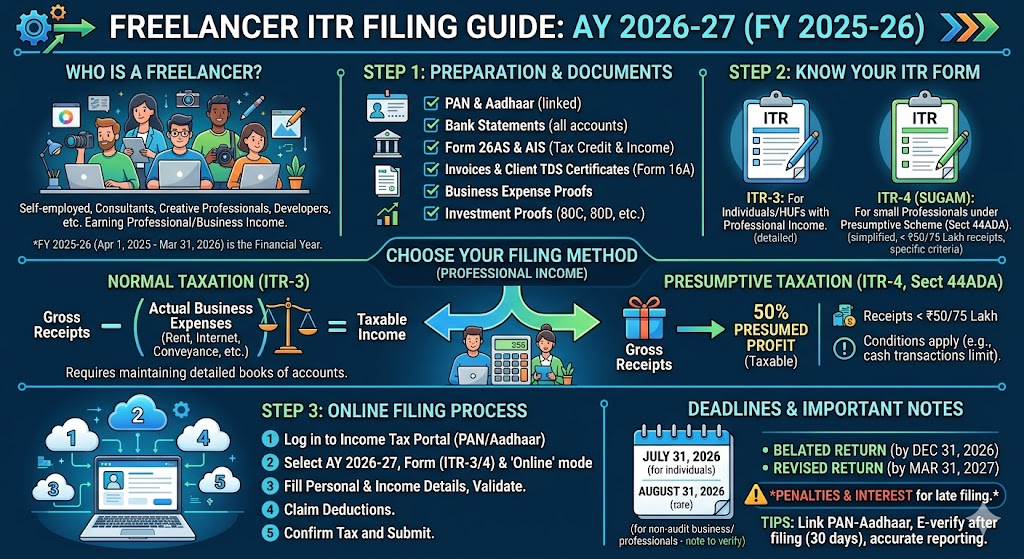
    This guide walks you through every critical step of freelancer ITR filing for AY 2026-27 from selecting the right form to claiming deductions and filing before the deadline without stress.


    Which ITR Form Should a Freelancer File for AY 2026-27?

    This is the most common question and getting it wrong can lead to a defective return notice from the Income Tax Department. Here’s what you need to know:

    • ITR-4 (Sugam): This is the correct form for most freelancers and self-employed professionals who opt for the Presumptive Taxation Scheme under Section 44ADA. If your gross professional receipts are up to ₹75 lakh in FY 2025-26, ITR-4 is your go-to form.
    • ITR-3: If you maintain books of accounts, have multiple income sources (business + capital gains + house property), or your receipts exceed ₹75 lakh, you must file ITR-3.
    • ITR-1 (Sahaj): Not applicable for freelancers. Do not make this common mistake.

    Read our detailed guide on :ITR-1 vs ITR-2 vs ITR-4: Which Form to Fill Based on Your Income Type 2026 to avoid form mismatch errors.


    Understanding Section 44ADA: The Freelancer’s Best Tax Friend

    Section 44ADA of the Income Tax Act is a game changer for freelance professionals such as doctors, lawyers, architects, engineers, designers, content writers, software consultants, and other notified professionals. Under this presumptive taxation scheme for AY 2026-27:

    • 50% of your gross professional receipts is deemed as your net taxable income (profit).
    • You do not need to maintain detailed books of accounts.
    • No requirement for a tax audit (unless you declare profit lower than 50% and your income exceeds the basic exemption limit).
    • The gross receipt limit for Section 44ADA is ₹75 lakh for FY 2025-26.

    Example: If a freelance graphic designer earned ₹12 lakh in FY 2025-26, only ₹6 lakh (50%) is treated as taxable income. After applying the standard deduction of ₹75,000 under the new tax regime, the effective taxable income drops further, making Section 44ADA an exceptionally tax-efficient route.


    Advance Tax for Freelancers: Deadlines You Cannot Miss in FY 2026-27

    One of the most overlooked compliance areas for freelancers is advance tax. Since no TDS is deducted on most freelance payments (or TDS is deducted at a lower rate), you are required to pay advance tax if your total tax liability exceeds ₹10,000 in a year.


    Advance Tax Due Dates FY 2026-27 for Freelancers:

    • 15th June 2026: Pay at least 15% of total estimated tax
    • 15th September 2026: Cumulative 45% of total estimated tax
    • 15th December 2026: Cumulative 75% of total estimated tax
    • 15th March 2027: 100% of total estimated tax

    Important: Freelancers opting for Section 44ADA can pay 100% advance tax in one installment by 15th March a significant compliance relief compared to regular businesspersons.

    Missing advance tax deadlines attracts interest under Sections 234B and 234C of the Income Tax Act. Read our detailed guide on Advance Tax Due Dates FY 2026-27 for complete installment schedules and penalty calculations.


    Smart Tax Deductions Every Freelancer Must Claim in AY 2026-27

    Even if you opt for Section 44ADA, certain deductions are still available to freelancers that can significantly reduce your final tax liability. According to guidelines from the Income Tax Department, the following deductions apply:

    • Standard Deduction of ₹75,000 under the new tax regime (from FY 2025-26 onwards)
    • Section 80C: Up to ₹1.5 lakh via PPF, ELSS, LIC, NSC applicable only under the old regime
    • Section 80D: Health insurance premium for self and family
    • Section 80CCD(1B): Additional ₹50,000 via NPS contribution available under old regime
    • Home loan interest under Section 24(b) if applicable

    If you are under the old tax regime: Learn more about our Tax Planning Service to identify the most beneficial deductions for your specific income profile.

    Dr. Haresh Adwani, a practising chartered accountant and founder of Adwani & Co LLP, advises freelancers to carefully model both old and new tax regimes before AY 2026-27 filing, especially given the enhanced standard deduction under the new regime.

    Read our detailed guide on Old vs New Tax Regime 2026 for a personalised calculation.


    Step-by-Step: How to File Freelancers ITR for Online for AY 2026-27

    Here’s a simplified step-by-step filing process for freelancers ITR in India following the workflow outlined on incometax.gov.in:

    Step 1 : Collect Your Financial Records: Gather all invoices raised, payments received, TDS certificates (Form 16A), and your bank statements for FY 2025-26.

    Step 2 : Download and Verify Form 26AS & AIS: Log in to the Income Tax portal. Match your TDS credits, high-value transactions, and income details. Any mismatch here is a red flag. Read our detailed guide on Form 26AS vs AIS vs TIS: Key Differences & How to Match Them Before Filing ITR.

    Step 3 : Choose Your Tax Regime: Decide between old and new tax regime. For most freelancers earning under ₹15 lakh without major deductions, the new regime is now more favourable.

    Step 4 : Select ITR-4 (If Section 44ADA Applies): Login to incometax.gov.in → e-File → Income Tax Returns → File Income Tax Return → Select AY 2026-27 → ITR-4.

    Step 5 : Fill in Income Details: Under the ‘Business/Profession’ schedule in ITR-4, enter your gross receipts and declare 50% as profit under 44ADA.

    Step 6 : Claim Deductions & Compute Tax: Enter eligible deductions and let the system compute your final tax payable.

    Step 7 : Pay Self-Assessment Tax (If Any): If tax is payable after TDS and advance tax, pay it via Challan 280 before filing.

    Step 8 : Verify and Submit: e-Verify via Aadhaar OTP, net banking, or DSC. Your ITR is filed!

    Read our detailed guide on How to File ITR Online 2026: Step-by-Step Guide for Salaried & Freelancers for a more detailed walkthrough with screenshots.


    GST Registration for Freelancers: Do You Need It?

    A frequently misunderstood area for freelancers is GST compliance. Under current GST rules:

    • GST registration is mandatory if your aggregate turnover exceeds ₹20 lakh (₹10 lakh for special category states) in a financial year.
    • If you provide services to clients outside India (export of services), you are exempt from GST but registration may still be beneficial for claiming refunds on input tax credits.
    • Freelancers registered under GST must file GSTR-1 and GSTR-3B returns regularly.

    Non-compliance with GST obligations can attract notices under the GST portal (gstn.gov.in). Learn more about our GST Compliance Service to stay audit-proof.

    Key Takeaways


    What Every Freelancer Must Remember for AY 2026-27

    • File ITR-4 if your gross professional receipts are up to ₹75 lakh Section 44ADA makes it simple.
    • Only 50% of your gross receipts is taxable under Section 44ADA a powerful built-in deduction.
    • Pay advance tax on time to avoid interest under Sections 234B and 234C.
    • Verify Form 26AS and AIS before filing mismatches can trigger scrutiny notices.
    • The ITR filing last date for AY 2026-27 (non-audit cases) is 31st July 2026 file on time to avoid penalties.
    • GST registration is mandatory once your annual receipts cross ₹20 lakh.

    Frequently Asked Questions (FAQs)

    Q1. Which ITR form should a freelancer file for AY 2026-27?

    Most freelancers should file ITR-4 (Sugam) if their gross receipts are up to ₹75 lakh and they opt for the presumptive taxation scheme under Section 44ADA. ITR-3 applies if receipts exceed this limit or if books of accounts are maintained.

    Q2. What is Section 44ADA and who is eligible in AY 2026-27?

    Section 44ADA allows notified professionals (doctors, lawyers, engineers, consultants, designers, etc.) to declare 50% of gross receipts as taxable income without maintaining books. Eligibility requires gross professional receipts of up to ₹75 lakh in FY 2025-26.

    Q3. Do freelancers need to pay advance tax for FY 2026-27?

    Yes, if total tax liability exceeds ₹10,000 in the year. Freelancers under Section 44ADA enjoy the benefit of paying 100% of advance tax in a single installment by 15th March 2027, unlike regular taxpayers who pay in four installments.

    Q4. Is GST registration mandatory for all freelancers in India?

    GST registration is mandatory only if your aggregate annual turnover exceeds ₹20 lakh (₹10 lakh in special category states). Freelancers providing export services to foreign clients are generally exempt but may benefit from voluntary GST registration for ITC refunds.

    Q5. What is the last date for freelancer ITR filing for AY 2026-27?

    The due date for ITR filing AY 2026-27 for non-audit cases (including most freelancers under Section 44ADA) is 31st July 2026. A late filing fee of up to ₹5,000 under Section 234F applies if you miss this deadline.

    Conclusion: File Right, Save More, Stay Compliant

    Freelancing gives you freedom and with the right tax knowledge, it also gives you the freedom to keep more of what you earn. The ITR filing process for freelancers in India for AY 2026-27 is far more streamlined than most people think, especially with the powerful benefits of Section 44ADA and the new tax regime.

    The key is to start early: reconcile your Form 26AS and AIS now, decide your tax regime, calculate your advance tax liability, and file before the 31st July 2026 deadline. Don’t let procrastination convert a simple filing into a panic-driven exercise with penalties.

    🚀 Need Expert Help with Your Freelancer ITR? Stop second-guessing your taxes. Connect with the experts at itradvisor.in today for personalised guidance on freelancer ITR filing, Section 44ADA, advance tax planning, and GST compliance — all in one place. 👉 Visit itradvisor.in | Expert Tax Guidance. Zero Confusion.

  • Income Tax Notice After Filing ITR? Here’s What Every Taxpayer Must Know

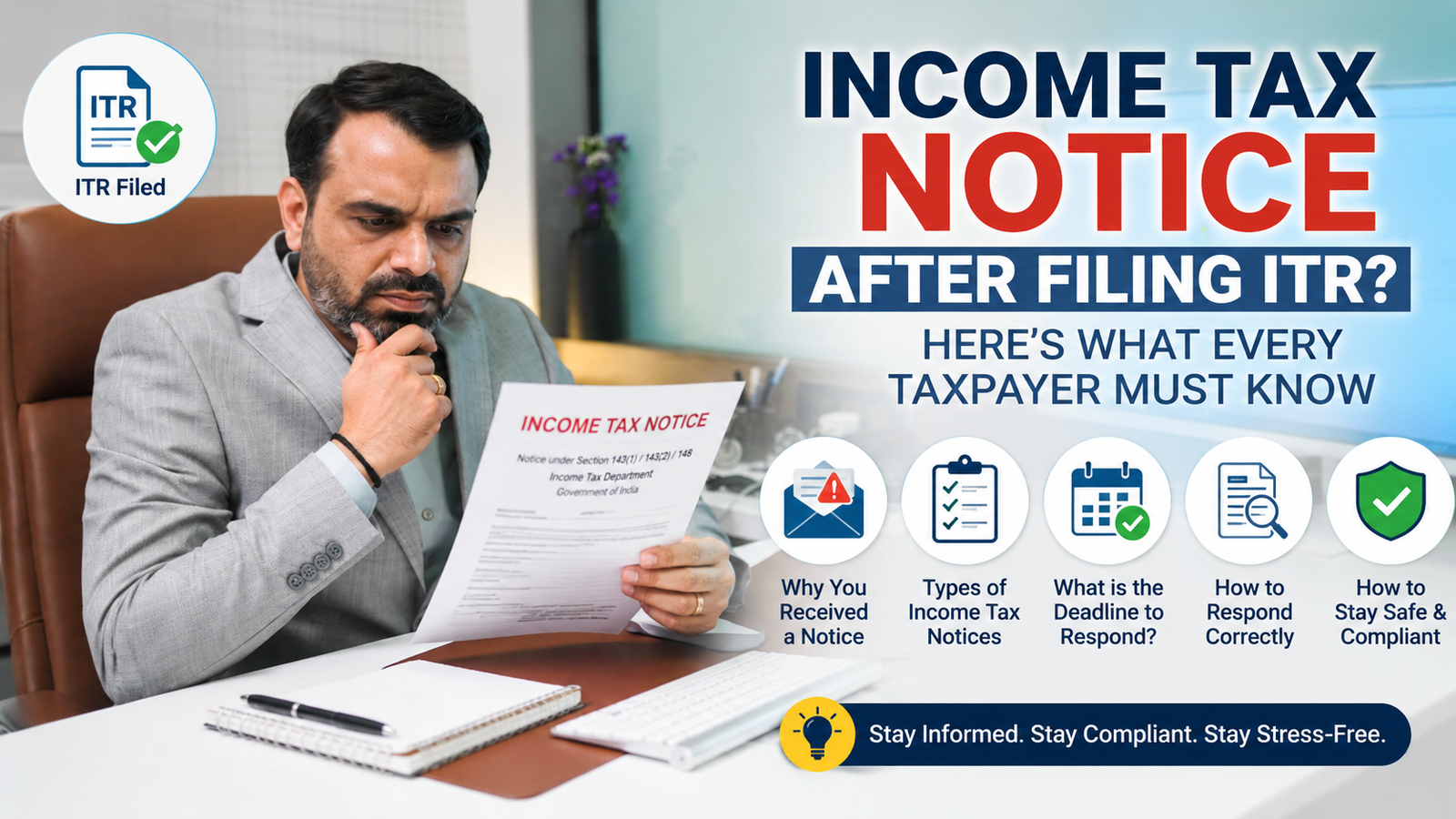
    Income Tax Notice After Filing ITR? Here’s What Every Taxpayer Must Know

    One of the most common questions taxpayers ask after filing their Income Tax Return (ITR) is

    I have already filed my return. Why did I receive an Income Tax Notice?”

    Receiving a notice from the Income Tax Department can be stressful. However, a notice does not automatically mean you have done something wrong. In many cases, the notice is simply a request for clarification, additional information, or correction of a mismatch.

    Understanding the reason behind the notice and responding appropriately can help avoid unnecessary penalties, interest, and prolonged scrutiny.

    In this guide, we explain the most common reasons for receiving an income tax notice after filing your ITR and the steps you should take.


    Can You Receive an Income Tax Notice Even After Filing Your Return?

    Yes.

    Filing your return does not guarantee that the Income Tax Department will not seek further clarification.

    The department now uses advanced data analytics, AIS (Annual Information Statement), TIS (Taxpayer Information Summary), SFT reporting, bank transaction data, and employer reporting to verify the accuracy of returns.

    Any mismatch or omission can trigger a notice.

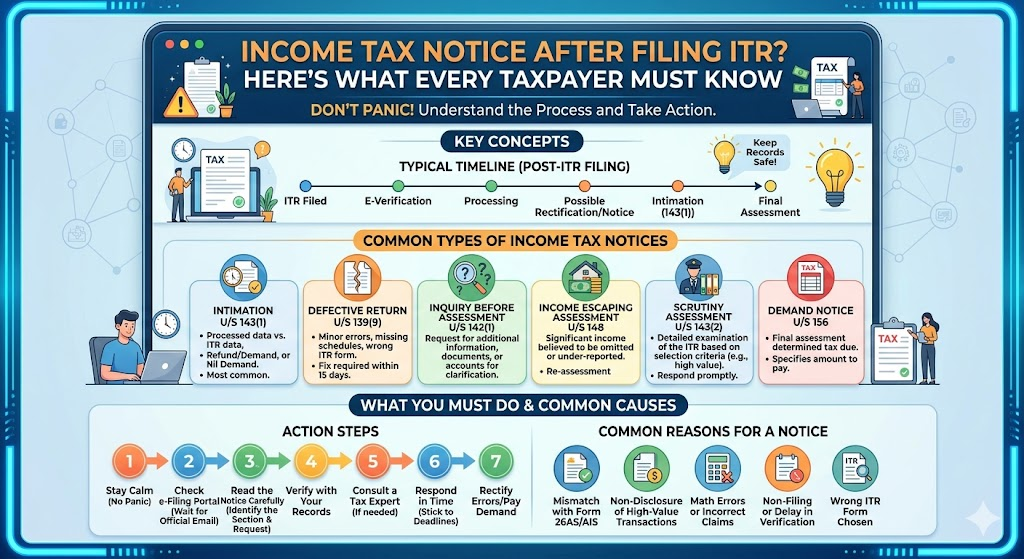
    Top 7 Reasons Why Taxpayers Receive Income Tax Notices

    1. Income Reported in AIS Is Missing in ITR

    One of the most common reasons for notices is a mismatch between income reported in AIS and income declared in your return.

    Examples:

    * Interest income from savings accounts

    * Fixed deposit interest

    * Dividend income

    * Capital gains from shares or mutual funds

    * Foreign remittances

    Even small omissions can trigger automated compliance checks.

    2. High-Value Transactions Reported to the Department

    Banks, mutual funds, registrars, and other institutions report specified financial transactions to the Income Tax Department.

    Examples include:

    * Large cash deposits

    * Property purchases

    * Significant mutual fund investments

    * High credit card spending

    * Foreign travel expenses

    If your declared income does not support these transactions, the department may seek clarification.

    3. Claiming Excess Deductions

    Incorrect deduction claims frequently lead to notices.

    Common areas include:

    * Section 80C

    * Section 80D

    * Home loan interest

    * HRA exemption

    * Donations under Section 80G

    Taxpayers should retain documentary evidence supporting every deduction claimed.

    Also Read :Section 80GGC Deduction Disallowance: ITAT Rules That Suspicion Is Not Enough, A Guide for Indian Taxpayers

    4. Mismatch in TDS Details

    Your return should match the information available in:

    * Form 26AS

    * AIS

    * TDS certificates

    Common issues include:

    * Missing TDS credits

    * Incorrect TAN details

    * Employer reporting errors

    * Duplicate TDS claims

    5. Non-Disclosure of Capital Gains

    Many taxpayers assume that no tax liability means no reporting requirement.

    This is incorrect.

    Capital gains arising from:

    * Shares

    * Mutual funds

    * Property sales

    * Gold investments

    must generally be reported even if the tax payable is nil.

    6. Foreign Income or Foreign Assets Not Disclosed

    Residents holding foreign assets or earning foreign income have specific disclosure requirements.

    Examples include:

    * Foreign bank accounts

    * Overseas shares

    * Foreign ESOPs

    * Rental income from foreign properties

    Non-disclosure can attract serious consequences.

    7. Return Selected for Scrutiny

    Sometimes a return is selected for scrutiny based on risk parameters determined by the department.

    Selection does not necessarily imply wrongdoing.

    The department may simply require supportingThe department may simply require supporting documents and explanations.


    Types of Income Tax Notices After Filing ITR

    Notice Under Section 143(1)

    This is an intimation generated after processing the return.

    It may indicate:

    * No demand and no refund

    * Refund due

    * Additional tax payable

    This is not necessarily a scrutiny notice.

    Notice Under Section  139(9)

    This is issued when the return is considered defective.

    Examples:

    * Missing schedules

    * Incorrect reporting

    * Incomplete information

    Timely correction can resolve the issue.

    Notice Under Section 143(2)

    This indicates that the return has been selected for detailed scrutiny.

    Taxpayers may be required to provide:

    * Bank statements

    * Investment proofs

    * Income records

    * Supporting documents

    Notice Under Section 148

    Issued when the department believes income may have escaped assessment.

    Such notices should be handled carefully and preferably with professional assistance.

    Read our Article: Income Tax Notice India 2026: Every Section Explained What It Means and How to Respond


    What Should You Do If You Receive an Income Tax Notice?

    Step 1: Read the Notice Carefully

    Do not panic.

    Identify:

    * Notice section

    * Assessment year

    * Response deadline

    * Information requested

    Step 2: Verify the Notice

    Check the notice through your Income Tax portal account.

    Ensure it is genuine and not a phishing attempt.

    Step 3: Gather Supporting Documents

    Depending on the notice, collect:

    * Form 16

    * Form 26AS

    * AIS

    * Bank statements

    * Investment proofs

    * Capital gain statements

    * Property documents

    Step 4: Respond Before the Deadline

    Ignoring notices can result in:

    * Additional tax demands

    * Penalties

    * Prosecution in serious cases

    Timely response is critical.

    Step 5: Seek Professional Advice

    Complex notices involving:

    * Capital gains

    * Foreign assets

    * High-value transactions

    * Reassessment proceedings

    should be reviewed by a qualified tax professional.


    How to Avoid Income Tax Notices in Future

    Before filing your return:

    ✅ Review AIS thoroughly

    ✅ Match Form 26AS with Form 16

    ✅ Report all bank interest

    ✅ Disclose capital gains

    ✅ Verify deductions

    ✅ Report foreign assets where applicable

    ✅ Maintain proper documentation

    A careful review before filing can significantly reduce the risk of future notices.


    Real-Life Example

    A salaried employee earning ₹18 lakh annually filed his return independently.

    He reported salary income correctly but forgot to disclose:

    * Savings account interest

    * Fixed deposit interest

    * Dividend income

    These entries appeared in AIS but not in the return.

    The department later issued a compliance notice seeking clarification.

    The issue was resolved through revised reporting, but the taxpayer experienced avoidable stress and delays.

    Frequently Asked Questions (FAQs)

     1.Is an income tax notice always bad news?

    No. Many notices are routine communications seeking clarification or correction.

    2.Can I ignore an income tax notice?

    No. Every notice should be reviewed and responded to appropriately.

    3.How long do I have to respond?

    The deadline depends on the specific notice. Always check the notice carefully.

    4.Can I revise my return after receiving a notice?

    In many situations, corrective action or revised filing may be possible, subject to applicable provisions.
     

    5.Can a CA help me respond to a notice?

    Yes. Professional guidance can help ensure accurate and timely compliance.

    About Author

    Dr. Haresh Adwani holds a PhD in Commerce and brings over 20 years of expertise in GST compliance, income tax advisory, FEMA, and corporate law. Services include GST audit, ITR filing, GST appeal representation, notice response, NRI taxation, and FEMA compliance.

    Need Help With an Income Tax Notice?

    Received an Income Tax Notice after filing your ITR?

    Our team at Adwani & Co. / ITR Advisor assists taxpayers across India with:

    * Income Tax Notice Replies

    * AIS & TIS Mismatch Review

    * Defective Return Notices

    * Scrutiny Assessments

    * Capital Gains Reporting

    * NRI Taxation Issues

    * Revised Return Filing

    Get your notice reviewed by our experts before responding.

  • ITR Filing 2026: Smart Strategies to Beat the Deadline, Slash Your Tax Bill & Secure Your Future

    ITR Filing 2026: Smart Strategies to Beat the Deadline, Slash Your Tax Bill & Secure Your Future

    CA Dipesh Gurubakshani May 2026 14 min read

    The Harsh Reality Most Indian Taxpayers Learn Too Late About ITR Filing 2026

    Imagine discovering on August 1st that you missed the July 31st deadline. Your refund of ₹38,000 is delayed. The Income Tax portal is overloaded. And you’re now staring at a penalty notice.

    This is not a hypothetical. It happens to lakhs of Indian taxpayers every single year.

    The truth is that ITR filing 2026 is far more than a routine government formality. Done right, it is your most powerful financial instrument the document that unlocks loan approvals, validates visa applications, shields you from scrutiny, and legally puts thousands of rupees back in your pocket. Done wrong or worse, done late it becomes a costly, avoidable nightmare.

    For Assessment Year 2026-27 (Financial Year 2025-26), the e-filing window is live on the Income Tax Department’s official portal at incometax.gov.in. Budget 2026 introduced sweeping changes to deadlines, revised return windows, and filing categories that every taxpayer — salaried, self-employed, NRI, or business owner must understand before hitting the submit button.

    This guide, curated by the experts at Adwani and Company, breaks down every aspect of ITR filing 2026 in plain language: the exact deadlines, the correct forms, the smartest deductions, the costliest mistakes, and how to ensure your return not only complies with the law but actively works in your financial favour.

    Learn more about our Income Tax Filing and Compliance Services


    ITR Filing 2026 Last Date: Your CategoryWise Deadline Breakdown

    One of the most consequential changes of Budget 2026 is the bifurcation of the ITR filing last date 2026 across taxpayer categories. This is no longer a single “July 31” deadline applicable to all. The Income Tax Department of India has assigned distinct deadlines based on your income type, the ITR form applicable to you, and whether a statutory tax audit is required.


    Here is the authoritative breakdown for AY 2026-27:

    Taxpayer CategoryApplicable ITR FormITR Filing Last Date 2026
    Salaried employees, pensioners, single house property ownersITR-1 / ITR-231 July 2026
    Freelancers, consultants, small business owners (non-audit)ITR-3 / ITR-431 August 2026
    Businesses and professionals requiring statutory tax audit under Section 44ABITR-3 / ITR-431 October 2026
    Belated return (missed original deadline)All applicable forms31 December 2026
    Updated Return under Section 139(8A)ITR-U31 March 2031

    Critical Portal Alert: When accessing the Income Tax e-filing portal for AY 2026-27, always select

    Tab 1 (Income Tax Act, 1961).

    Tab 2 is reserved for Tax Year 2026-27 filings, which relate to the next assessment cycle. Selecting the wrong tab will invalidate your return entirely a mistake that can result in missed refunds and unnecessary processing delays.

    At Adwani and Company, we routinely advises his clients: “Your ITR filing last date 2026 depends entirely on who you are as a taxpayer. The single biggest mistake people make is assuming their deadline is July 31st when it may legally be August 31st or even October 31st. Filing under a wrong assumption leads to either rushed errors or missed opportunities.”


    What Budget 2026 Changed for ITR Filing: 3 Reforms Every Filer Must Know

    Budget 2026 introduced taxpayer-friendly reforms that fundamentally alter the ITR filing landscape for AY 2026-27. Here are the three most impactful changes:

    1. Extended Deadline for Freelancers and Business Taxpayers

    For the very first time, non-audit filers using ITR-3 and ITR-4 covering freelancers, independent consultants, gig workers, and small business owners have been granted a one-month extension. The ITR filing last date 2026 for this category is now 31 August 2026, not July 31st.

    This reform acknowledges the greater complexity involved in business tax filing, where income from multiple sources, GST reconciliation, and expense tracking all require additional time to compile accurately.

    2. Revised ITR Window Extended to 31 March 2027

    Previously, taxpayers who wanted to correct errors in a filed return or claim missed deductions had until December 31st of the relevant assessment year. Budget 2026 has extended this window significantly: Revised ITR filing for AY 2026-27 is now open until 31 March 2027.

    This is one of the most taxpayer-friendly extensions in recent memory. If you file your return in July and later realize you missed a Section 80D deduction or reported a capital gain incorrectly, you now have until March 2027 to file a corrected return typically by paying a modest revision fee.

    3. Updated Return (ITR-U) Window Extended to 4 Years

    Under Section 139(8A) of the Income Tax Act, 1961, the Updated Return (ITR-U) mechanism has been extended to 48 months (4 years) from the close of the relevant assessment year. For AY 2026-27, eligible taxpayers can file an ITR-U as late as 31 March 2031.

    The ITR-U is particularly valuable for taxpayers who later discover unreported income from freelance assignments, stock market gains, fixed deposit interest, or foreign assets. Using the ITR-U proactively is always preferable to facing a scrutiny notice from the Income Tax Department.


    How to File ITR Online for AY 2026-27: A Step-by-Step Expert Walkthrough

    ITR filing 2026 online is more streamlined than ever, but the most expensive mistakes are still made by taxpayers who rush through the process. The team at Adwani and Company, led by Dr. Haresh Adwani, recommends the following structured approach:

    Step 1: Download and Verify Your Form 26AS and AIS

    Log in to incometax.gov.in and download both your Annual Information Statement (AIS) and your Form 26AS for FY 2025-26. Cross-check every TDS entry, bank interest credit, dividend income, and transaction reported by third parties (banks, brokers, mutual fund houses) against your own records.

    Any discrepancy between your declared income and the government’s data is an automatic scrutiny trigger. Resolve all mismatches with your employer, bank, or broker before filing.

    Step 2: Select the Correct ITR Form

    This is where a surprising number of taxpayers go wrong. The wrong ITR form results in a “defective return” notice and mandatory refiling.

    • ITR-1 (Sahaj): Salaried individuals, pensioners, one house property, income below ₹50 lakh
    • ITR-2: Individuals with capital gains income, more than one house property, or foreign assets
    • ITR-3: Business or professional income with books of accounts
    • ITR-4 (Sugam): Presumptive taxation under Sections 44AD, 44ADA, or 44AE

    Step 3: Compute Your Total Income and Maximize Deductions

    List every income source salary, rental income, interest, dividends, capital gains, freelance income and then systematically apply every deduction you are legally entitled to claim:

    • Section 80C: Up to ₹1.5 lakh (PPF, ELSS, life insurance premium, home loan principal)
    • Section 80D: Health insurance premium (₹25,000 for self; ₹50,000 for senior citizen parents)
    • HRA Exemption: Computed as the minimum of three prescribed values — not simply the full HRA received
    • Section 24(b): Home loan interest up to ₹2 lakh for self-occupied property
    • Section 80TTA: Savings account interest exemption up to ₹10,000
    • Section 80EEA: Additional home loan interest benefit for first-time buyers

    Most taxpayers filing independently leave ₹20,000 to ₹60,000 of legally valid deductions on the table simply because they are unaware of the full breadth of what they are entitled to claim.

    Step 4: E-File and E-Verify Within 30 Days

    Submit your ITR through the Income Tax portal and e-verify within 30 days using Aadhaar OTP, net banking, or a pre-validated bank account. A return that is filed but not e-verified is treated as invalid effectively as if you never filed at all.

    Step 5: Track Your Refund Status

    After successful e-verification, monitor your refund at incometax.gov.in under “My Account → Refund/Demand Status.” Early filers consistently receive refunds weeks before late filers, simply due to lower portal congestion.


    Real-World Example: How Expert ITR Filing 2026 Saved ₹42,000

    Consider the case of Suresh Mehta, a 36-year-old IT professional in Pune earning ₹13.5 lakh annually. For three consecutive years, Suresh filed his own return in the last week of July, claiming only Section 80C deductions and his standard employer-reported HRA.

    When he finally approached Adwani and Company for assisted ITR filing 2026, Dr. Haresh Adwani’s team conducted a thorough deduction review. Here is what they discovered:

    Deduction HeadCorrectly Claimed Amount
    Section 80C (PPF + ELSS mutual fund)₹1,50,000
    Section 80D (family health insurance)₹25,000
    HRA Exemption (recalculated correctly)₹84,000
    Home Loan Interest — Section 24(b)₹2,00,000
    Total Eligible Deductions₹4,59,000

    Suresh had been computing his HRA exemption using only the amount received from his employer ignoring the prescribed three-value minimum formula. He had also never claimed his home loan interest, assuming it was already “handled” by his employer’s TDS computation (it was not).

    The result: his taxable income dropped from ₹13.5 lakh to approximately ₹9 lakh. At applicable slab rates under the old regime, this translated to a verified tax saving of ₹42,000 tax he had been paying unnecessarily for three years.

    This is the measurable difference that expert-assisted ITR filing 2026 delivers.

    Learn more about our Deduction Maximization and Tax Planning Advisory


    The Real Cost of Missing the ITR Filing 2026 Deadline

    The Income Tax Act prescribes specific and escalating consequences for taxpayers who miss the ITR filing last date 2026. Under Section 234F, the late filing fee structure is:

    • ₹1,000 if total income is below ₹5 lakh
    • ₹5,000 if total income exceeds ₹5 lakh

    Beyond the direct financial penalty, late filers also face:

    • Interest under Section 234A at 1% per month on any outstanding tax payable
    • Loss of carry-forward entitlement for capital gains losses, business losses, and speculative losses a particularly painful consequence for active stock market investors and F&O traders
    • Heightened scrutiny probability from the Income Tax Department, including Section 143(2) notices and scrutiny assessments
    • Loan and visa complications lenders and embassies typically require the most recent 2-3 years of filed returns as proof of income

    The belated ITR deadline for AY 2026-27 is 31 December 2026. Beyond that date, the only option is the Updated Return (ITR-U) mechanism which carries a mandatory additional tax surcharge and cannot be used to claim deductions not already present in the original return.

    As the Income Tax Department of India consistently emphasizes through its public outreach, voluntary, timely compliance is both a legal obligation and the most economically rational path for every taxpayer.


    ITR Filing 2026 for Salaried vs Business Taxpayers: Key Differences

    Salaried Taxpayers (ITR-1 / ITR-2) Deadline: 31 July 2026

    Salaried individuals form the largest single category of Indian income tax filers. Their primary income documentation is Form 16 issued by employers, reflecting TDS deducted under Section 192. Key focus areas for ITR filing 2026 include:

    • Accurate HRA exemption computation
    • Full reconciliation of AIS data with actual income
    • Claiming all eligible deductions under Sections 80C through 80U
    • Correctly reporting capital gains from mutual fund redemptions or stock sales

    Business and Professional Taxpayers (ITR-3 / ITR-4) Deadline: 31 August or 31 October 2026

    Freelancers, consultants, traders, and business owners face greater filing complexity. Beyond income computation, they must:

    • Maintain and reconcile books of account for the full financial year
    • Cross-match GST returns (GSTR-1, GSTR-3B) with income tax filing to avoid discrepancies
    • Determine whether tax audit under Section 44AB applies based on turnover thresholds
    • Decide between presumptive taxation (Section 44ADA/44AD) and regular computation

    Adwani and Company is exceptionally well-positioned to guide business taxpayers through this intersection of tax law, GST compliance, and financial structuring.


    Critical ITR Filing Mistakes That Attract Income Tax Notices

    Based on years of practice and thousands of client filings, the team at Adwani and Company has identified the most common, costliest errors made during ITR filing 2026:

    1. Using the Wrong ITR Form: If you have capital gains even from a single mutual fund redemption ITR-1 is the wrong form. You need ITR-2. Incorrect form selection generates a defective return notice automatically.

    2. Ignoring AIS Discrepancies: The Annual Information Statement aggregates data from banks, brokers, employers, and other institutions. Failing to reconcile your declared income with the AIS is the single most common trigger for scrutiny notices.

    3. Omitting Bank Interest Income: Savings account interest, FD interest, and RD interest are all taxable in full. Even if TDS has been deducted, the gross interest must be reported in your ITR.

    4. Incorrect HRA Calculation: HRA exemption is the minimum of three specific values not simply the HRA component on your payslip. Incorrectly computing this costs thousands of rupees to many salaried filers.

    5. Filing Without E-Verifying: A submitted but unverified ITR is legally treated as a non-filing. Always e-verify within 30 days of submission.

    6. Overlooking Foreign Assets: Under Schedule FA in the ITR, any foreign bank accounts, investments, or insurance policies must be disclosed. Failure to disclose attracts penalties under the Black Money Act up to ₹10 lakh per undisclosed asset. The Ministry of Finance and CBDT have intensified FATCA and CRS-based scrutiny significantly in 2026.

    Read our detailed guide on how to respond on Income Tax notice https://www.adwaniandco.com/blog/income-tax-notice-received


    Why Adwani and Company Is the Most Trusted Name for ITR Filing 2026

    At Adwani and Company, ITR filing 2026 is handled not by automated software tools or generic templates — but by a team of qualified professionals under the personal supervision of Dr. Haresh Adwani, a PhD holder in Commerce and a trained legal professional with deep expertise in Indian tax statutes, FEMA regulations, and GST compliance.

    What makes Adwani and Company the right partner for ITR filing 2026:

    • Complete AIS and Form 26AS reconciliation prior to every filing eliminating the risk of income mismatch notices
    • Deduction maximization review a systematic analysis of every eligible deduction the client is legally entitled to claim, across all applicable sections
    • GST-ITR cross-verification ensuring your income tax return is fully consistent with your GST filing history, a critical requirement for all business taxpayers
    • Legal interpretation of gray areas Dr. Haresh Adwani’s law background enables the firm to advise on legally nuanced questions involving capital gains classification, HUF planning, NRI taxation, and business income restructuring
    • Year-round support extending beyond ITR filing season to cover assessments, scrutiny notices, revised returns, and proactive tax planning

    Clients across Pune and across India salaried professionals, business owners, NRIs, and high-net-worth individuals consistently choose Adwani and Company for one reason: they know their return is being handled by professionals who combine technical accuracy with genuine accountability.


    Conclusion:

    The ITR filing 2026 season for AY 2026-27 is open. The deadlines July 31st for salaried taxpayers, August 31st for freelancers and small businesses are firm. The penalties for delay are real. And the financial benefits of accurate, timely filing faster refunds, deduction savings, and a clean compliance record are equally real and equally substantial.

    Every rupee of deduction you miss is money you legally owe to yourself but chose not to claim. Every day you delay is a day the Income Tax portal gets busier, your refund gets slower, and your risk of an error-under-pressure grows.

    The Income Tax Department of India has made the e-filing infrastructure at incometax.gov.in more accessible than ever. But navigating the system correctly, reconciling AIS data, choosing the right form, computing deductions accurately, and understanding Budget 2026 changes that is where expert guidance makes the difference between a return that merely complies and one that genuinely serves your financial interests.

    “Filing your taxes on time and correctly is not a burden it is the single most powerful financial habit an Indian citizen can build. Your ITR is your financial identity. Make it count.”

    Frequently Asked Questions

    Q1. What is the ITR filing last date 2026 for salaried employees?

    The ITR filing last date 2026 for salaried individuals and pensioners filing ITR-1 or ITR-2 is 31 July 2026, as confirmed by the Central Board of Direct Taxes (CBDT) and the Income Tax Department of India.

    Q2. What is the ITR filing 2026 deadline for freelancers and consultants?

    Budget 2026 extended the ITR filing last date 2026 for non-audit freelancers, consultants, and small business owners to 31 August 2026. This is a new, category-specific deadline introduced for FY 2025-26 AY 2026-27 filers.

    Q3. What is the penalty for missing the ITR filing 2026 deadline?

    Under Section 234F, a late filing fee of ₹1,000 (income below ₹5 lakh) or ₹5,000 (income above ₹5 lakh) applies. Additionally, Section 234A interest at 1% per month accrues on any outstanding tax. You also lose the right to carry forward certain losses.

    Q4. Can I file a revised return after submitting my ITR?

    Yes. Budget 2026 extended the revised ITR window to 31 March 2027 for AY 2026-27. You can correct errors, add missed deductions, or update income figures by filing a revised return before this date.

    Q5. What documents are needed for ITR filing 2026?

    ? Key documents include: Form 16 (from employer), Form 26AS, Annual Information Statement (AIS), bank statements for the full year, investment proof for Section 80C, health insurance premium receipts, home loan interest certificate, and capital gains statements from your broker or mutual fund platform.

    Q6. Can Adwani and Company help with ITR filing 2026 for NRIs?

    Yes. Adwani and Company provides comprehensive ITR filing assistance for NRI taxpayers, covering capital gains on Indian property sales, rental income from Indian properties, NRE/NRO account treatment, RNOR status tax planning, and DTAA (Double Taxation Avoidance Agreement) benefit claims. Connect with Dr. Haresh Adwani’s team for a dedicated NRI tax consultation

    CA Dipesh Gurubakshani  is a Chartered Accountant with Adwani & Co LLP, Pune, specialising in income tax audit, direct taxation, and accounting advisory. He supports clients across statutory compliance, financial reporting, and income tax matters with a focus on accuracy, regulatory adherence, and disciplined execution.