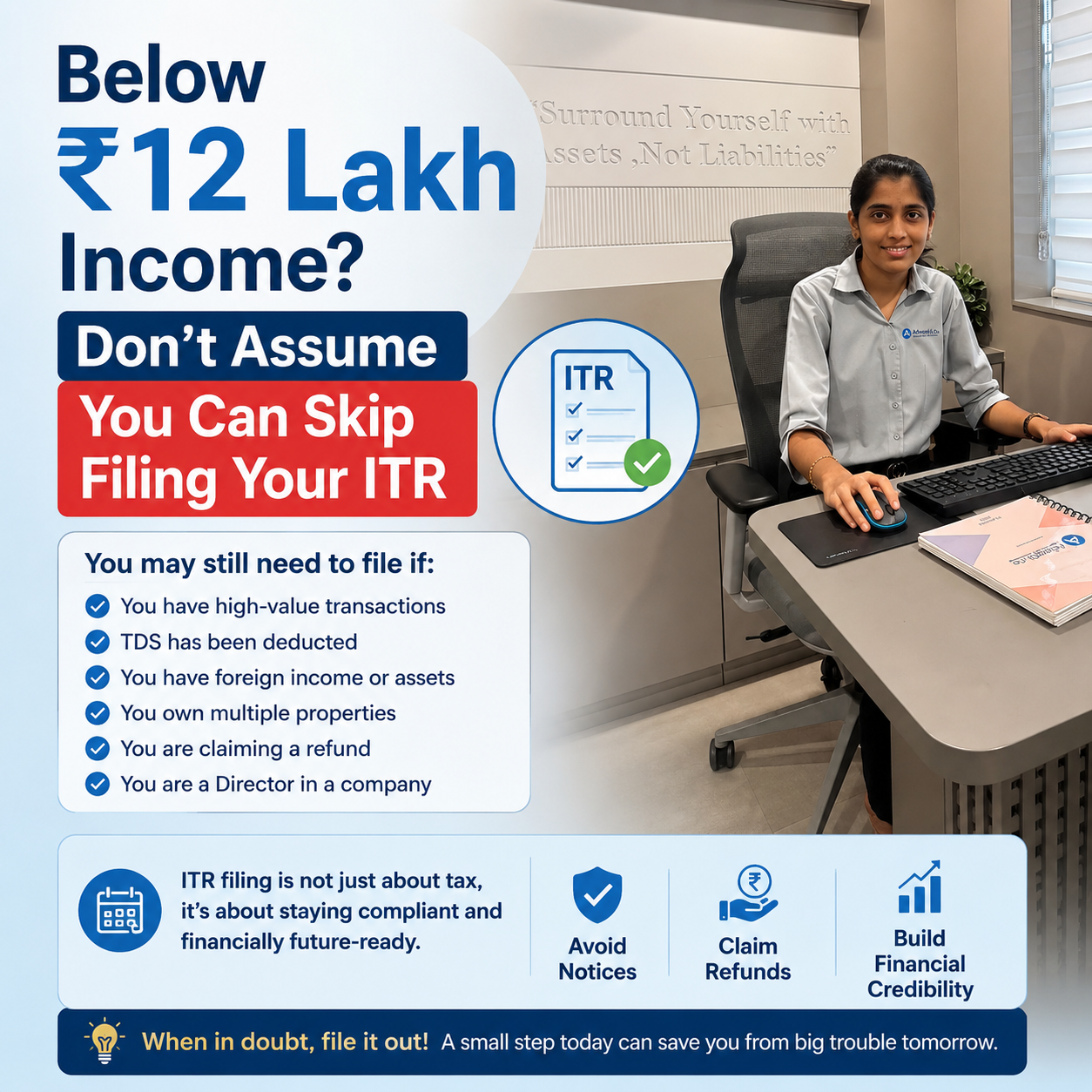
Every year around this time, the same question lands in our inbox: “My income is below ₹12 lakh, so I don’t need to file my ITR right?” It’s a comforting assumption, and it’s also wrong. Since the new tax regime pushed the zero-tax threshold up to ₹12 lakh, thousands of taxpayers have quietly stopped filing, assuming nil liability means no obligation. That single assumption could cost you a refund, a loan approval, or worse, an income tax notice.
Zero Tax Liability Is Not the Same as No ITR Filing Obligation
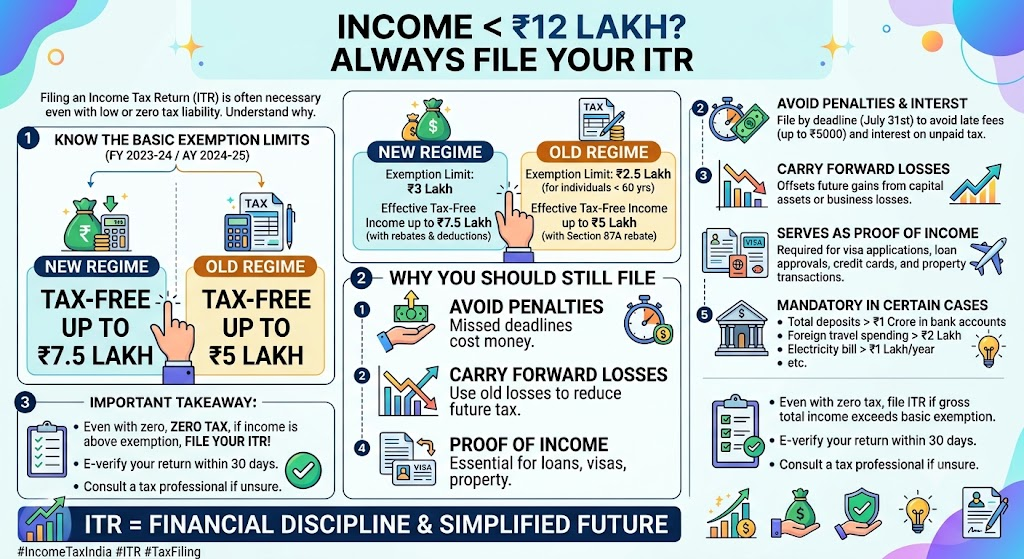
Under the current provisions, a rebate under Section 87A can bring your tax liability to zero if your taxable income falls within the ₹12 lakh limit. But the Income Tax Act does not say that a nil tax liability automatically waives your obligation to file. Filing requirements are governed by separate conditions under Section 139(1), including gross total income before deductions, specified high-value transactions, and asset ownership. In other words, ITR filing below 12 lakh income depends on far more than your final tax bill.
Several situations make ITR filing below 12 lakh mandatory, regardless of your tax payable:
Deposits exceeding ₹1 crore in a current account, or ₹50 lakh in savings accounts, during the year
Foreign travel expenses above ₹2 lakh
Electricity bill payments crossing ₹1 lakh annually
Ownership of foreign assets or signing authority in a foreign account
Being a director in a company or holding unlisted equity shares
Business turnover or professional receipts crossing prescribed thresholds
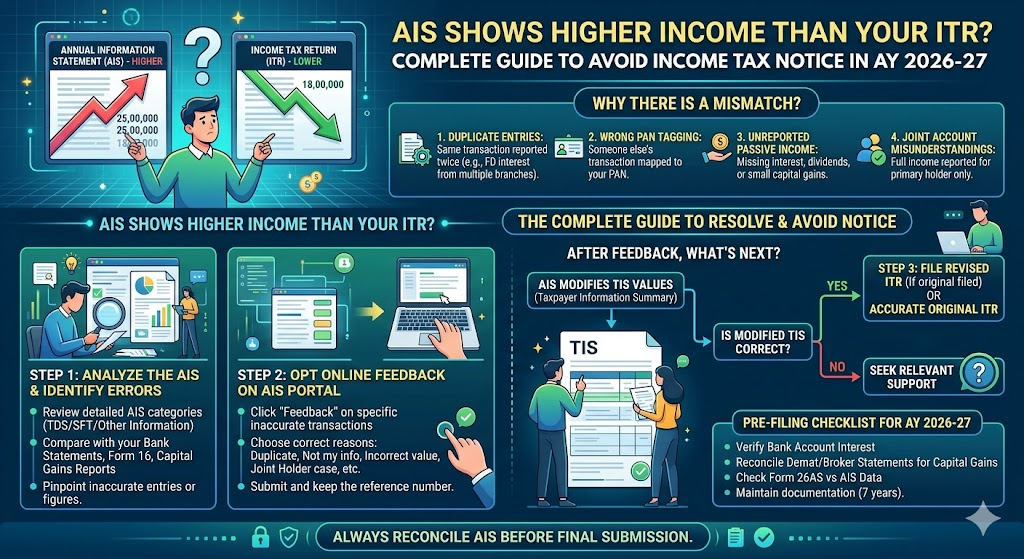
The Income Tax Department‘s data-matching systems, built on AIS and Form 26AS reporting, are specifically designed to flag these specified transactions even when a return isn’t filed. Ignoring the requirement doesn’t go unnoticed.
Why Filing ITR Below 12 Lakh Works in Your Favour
Beyond compliance, there’s a strong practical case for filing your ITR even with zero tax payable. A filed return is often the single document that proves your income and financial credibility banks ask for it before sanctioning home loans, embassies request it for visa applications, and credit card issuers use it to assess eligibility. Skipping it because your liability is nil can quietly close doors you didn’t expect to need.
Read our detailed guide on Old vs New Tax Regime 2026 to see how the ₹12 lakh rebate actually works before deciding your filing status.
Claiming Back Your TDS Refund
If your employer or a client deducted TDS during the year, and your actual tax liability was lower or nil, filing your ITR is the only route to claim that refund. Many taxpayers leave money with the department simply because they assumed filing wasn’t required.
Expert Perspective
Dr. Haresh Adwani, founder of Adwani & Co LLP and a PhD in Commerce with a law degree, has long advised clients that the safest approach is to verify eligibility every year rather than carry forward last year’s assumption, since thresholds, rebates, and specified transaction limits are revised frequently under CBDT notifications and Finance Act amendments.
When in doubt, cross-check your position against the official guidance on incometax.gov.in before deciding to skip your return for AY 2026-27. Learn more about our ITR Filing Services if you’d like a professional to verify your obligation before the deadline.
Key Takeaways
A ₹12 lakh income and zero tax liability do not automatically exempt you from ITR filing.
A filed ITR strengthens loan, visa, and credit applications even when no tax is due.
TDS refunds can only be claimed by filing a return. Always verify your filing obligation instead of assuming it based on income alone.
Frequently Asked Questions on ITR Filing Below 12 Lakh
1.Is ITR filing mandatory if my income is below ₹12 lakh?
Not always exempt zero tax under the rebate doesn’t remove the filing obligation if specified transactions or conditions under Section 139(1) apply.
2.Can I still get a refund if I don’t file my ITR?
No. Any excess TDS deducted during the year can only be claimed back by filing your income tax return for that year.
3.Does zero tax liability mean I don’t need to file ITR at all?
No. Zero liability and the requirement to file are governed by separate rules, and high-value transactions can still trigger mandatory filing.
4.What happens if I skip ITR filing despite being required to file?
You may face penalties under the Income Tax Act and lose the ability to claim refunds, carry forward losses, or use the return for loan and visa purposes.
Conclusion
The ₹12 lakh threshold has simplified tax outgo for many, but it hasn’t simplified the filing rules. Whether ITR filing below 12 lakh applies to you depends on your transactions, assets, and income sources not just your final tax bill. Verifying your position takes a few minutes; getting it wrong can take much longer to fix.
About the Author
Vaishnavi Hole is a CA Finalist and Direct Tax Associate at Adwani & Co LLP, specializing in direct taxation, income tax compliance, and advisory services. She is passionate about simplifying complex tax laws into practical, easy-to-understand insights for businesses and individuals. Through her articles, Vaishnavi shares well-researched perspectives on direct tax developments, compliance, and regulatory updates to help readers make informed financial decisions.
Disclaimer
ITRAdvisor.in is an educational and informational platform focused on tax awareness and compliance updates. Nothing contained herein should be construed as solicitation or advertisement of professional services. Professional services, where applicable, are rendered in accordance with ICAI guidelines. This article is published on ITRAdvisor.in, a tax and compliance knowledge platform. The content has been reviewed for technical accuracy by professionals associated with Adwani & Co LLP.
At ITRAdvisor.in, we help taxpayers with:
✔️ ITR Filing Review
✔️ AIS Reconciliation
✔️ Capital Gains Reporting
✔️ NRI Taxation
✔️ Tax Notice Response
✔️ Revised Returns
✔️ Income Tax Planning
✔️ Refund and Compliance Issues
If you are unsure whether your return has been filed correctly or want a professional review before submission, consulting an experienced tax professional can help avoid costly mistakes.
Visit ITRAdvisor.in for expert assistance with your Income Tax Return and tax compliance requirements.
Disclaimer: ITRAdvisor.in is an educational and informational platform focused on tax awareness and compliance updates. Nothing contained herein should be construed as solicitation or advertisement of professional services. Professional services, where applicable, are rendered in accordance with ICAI guidelines. This article is published on ITRAdvisor.in, a tax and compliance knowledge platform. The content has been reviewed for technical accuracy by professionals associated with Adwani & Co LLP
A prominent “File Your ITR Now” button near the top and again at the end of the article
Need help filing your Income Tax Return? Click the WhatsApp icon and our team will guide you through the process and assist you with your ITR filing.
Have questions about your ITR? Click the WhatsApp icon to connect with our tax experts for quick guidance and personalized assistance.
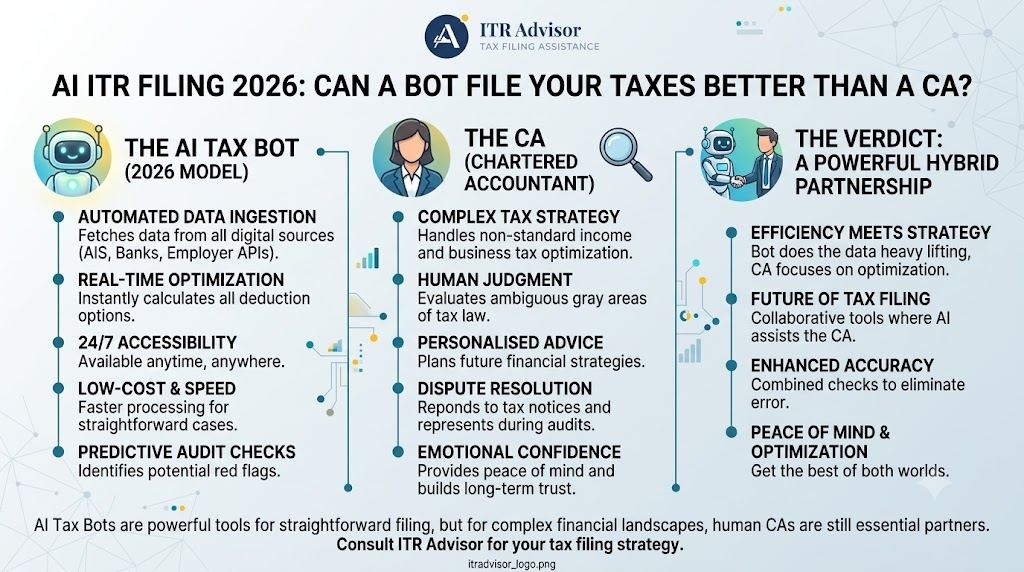
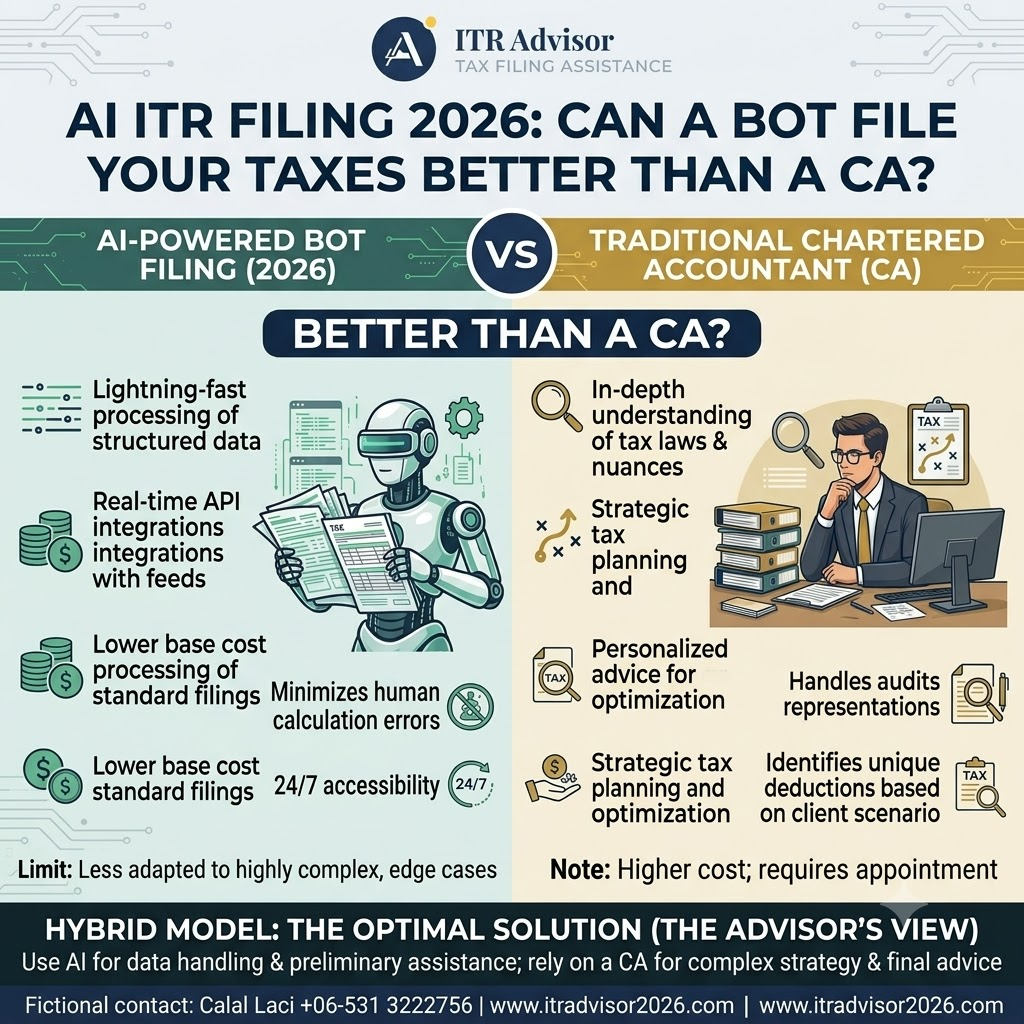
Everyone is asking whether AI can prepare income tax returns. Barely anyone is asking the more important question: who will defend the tax position behind them?
AI ITR filing tools in 2026 are genuinely impressive. They extract data from Form 16 and AIS, pre-populate schedules, flag mismatches with Form 26AS, and generate a draft return faster than any manual process. But here is what they cannot do: determine whether your tax position will hold up if the Income Tax Department sends a notice.
That gap between a technically filed return and a defensible one is exactly what taxpayers need to understand before trusting AI completely with their compliance.
What AI ITR Filing Tools Actually Do Well in 2026
To be fair, AI-assisted tax filing has made meaningful improvements to routine compliance. For straightforward salaried taxpayers with a single employer, Form 16, and standard deductions, AI tools deliver speed and accuracy that was difficult to match manually.
What AI handles reliably in ITR filing 2026:
Auto-fetching pre-filled data from the Income Tax Department’s AIS and Form 26AS
Matching TDS credits with Form 26AS entries to reduce demand notices on mismatch
Suggesting the correct ITR form based on income type — ITR-1, ITR-2, or ITR-4
Computing tax liability under both old and new tax regime and flagging which is lower
Identifying obvious gaps such as a missing TDS entry or an unreported interest income item
Tax risk in India rarely comes from a data extraction error. It comes from reasoning and reasoning is exactly where AI-generated tax returns have a structural gap.
Consider a taxpayer who claims a tax benefit. The numbers are correct. Every document is available. The return passes all system validation checks on the Income Tax Department’s e-filing portal. Yet the questions that matter most remain unanswered:
Questions AI Cannot Answer for Your ITR
→ Is the taxpayer actually eligible for this exemption or deduction?
→ Does a restriction, limitation, or anti-avoidance provision apply?
→ Is there a more advantageous tax position that has not been explored?
→ If the Income Tax Department issues a notice under Section 143(2) or 148, can the position be defended?
These are not rare edge cases. They arise in everyday situations F&O loss set-off against business income, HRA claims without proper rent documentation, deductions under Section 80C with incomplete evidence, or capital gains on equity funds where the holding period is borderline.
The Income Tax Department’s faceless assessment scheme and AI-driven scrutiny systems are specifically designed to catch reasoning inconsistencies not just arithmetic ones. Returns are risk-scored using cross-database matching of ITR data, AIS, GST turnover, MCA filings, and banking transactions. A return that is numerically clean but logically inconsistent across these sources remains a scrutiny risk.
A Real Example: When AI Filed Correctly but Wrongly
Practical Scenario
A freelancer with annual professional receipts of ₹18 lakh used an AI ITR filing tool for AY 2026-27.
The AI correctly:
• Selected ITR-4 (presumptive taxation under Section 44ADA)
• Applied the 50% deemed profit rate declaring ₹9 lakh as income
• Computed tax liability accurately under the new tax regime
What the AI did not evaluate:
• Whether the freelancer had claimed actual expenses exceeding the 50% deemed amount in a prior year, which triggers an obligation to maintain books of account
• Whether certain receipts were from a source that does not qualify under Section 44ADA
Result: The return was filed. But when a scrutiny notice arrived under Section 143(2) querying the presumptive scheme eligibility, there was no documentation trail to support the position. A professional review before filing would have flagged both risks in minutes.
AI ITR Filing 2026 and the Income Tax Notice Risk
As per guidance available through the Income Tax Department’s portal (incometax.gov.in) and CBDT’s risk management framework, cases are increasingly selected for scrutiny based on risk indicators not just mismatches. These indicators include unusual deduction patterns, turnover inconsistencies between ITR and GST returns, and high value transaction disclosures in AIS that do not align with reported income.
In that environment, AI ITR filing 2026 tools create a specific risk: they improve the presentation of a return without improving the underlying defensibility of its positions. A well-formatted, AI-generated return is not automatically a safe return.
This is the reasoning-versus-calculation distinction that tax professionals have been discussing since AI tools entered mainstream compliance and it is the most practically important thing a taxpayer in 2026 needs to understand.
For a detailed breakdown of what triggers income tax notices and how to respond,
What Every Taxpayer Should Remember About AI ITR Filing in 2026
✔ AI ITR filing tools handle data extraction, form selection, and computation well especially for straightforward salaried returns.
✔ The gap is in reasoning: eligibility assessment, deduction defensibility, and position validation.
✔ The Income Tax Department’s faceless assessment and AI-driven risk-scoring evaluate logical consistency not just arithmetic.
✔ Treating an AI-generated ITR as a first draft subject to professional review is the smart approach.
✔ For any non-standard income F&O losses, capital gains, presumptive scheme, foreign income professional review before filing is essential.
Frequently Asked Questions
1. Can AI tools file income tax returns accurately in 2026?
For simple salary-based returns, yes AI tools perform well. For returns involving business income, capital gains, foreign assets, or multiple deduction claims, professional review is strongly recommended before filing.
2. What is the risk of relying only on AI for ITR filing?
The main risk is a reasoning gap AI applies rules mechanically without evaluating whether a specific position is eligible, defensible, or optimal for your situation. This can lead to income tax notices that are difficult to respond to without prior documentation.
3. Does AI ITR filing increase the chance of getting an income tax notice?
Not directly but an AI-filed return that contains an indefensible position is a scrutiny risk regardless of how cleanly it was prepared. The Income Tax Department’s risk-scoring evaluates logical consistency across AIS, GST, and MCA data, not just the arithmetic of the return.
4. Which ITR form should I use for AY 2026-27?
It depends on your income type. ITR-1 is for salaried taxpayers with income up to ₹50 lakh. ITR-2 covers capital gains and multiple properties. ITR-4 applies to presumptive income under Sections 44AD and 44ADA. Read our detailed ITR form selection guide for AY 2026-27 on ITRAdvisor.in.
5. What will be the most valuable tax skill in an AI-driven compliance world?
According to tax professionals including those at Adwani & Co LLP, the highest-value skill will be validating conclusions not just preparing returns. The ability to evaluate whether an AI-generated tax position is legally defensible, commercially reasonable, and consistent with regulatory expectations is what separates a capable tax advisor from a filing service.
Conclusion: AI Is a Tool. Judgment Is the Profession.
AI ITR filing in 2026 is fast, efficient, and accurate on the mechanical layer of compliance. It reduces data entry errors, speeds up return preparation, and makes basic tax filing accessible to a broader audience.
But the most expensive mistakes in taxation are rarely calculation errors. They are reasoning errors wrong eligibility assessments, indefensible deduction claims, and positions that cannot withstand scrutiny. That is where a qualified tax professional still makes the difference that cannot be automated.
The smart approach is not to choose between AI and professional review. It is to use AI for what it does well and ensure a professional reviews what it cannot.
Author
CA. Dipesh Gurubakshani. He is a Chartered Accountant with professional experience in audit, direct taxation, and accounting advisory services.
Whether you have already received a credit card income tax notice or want to ensure you never do Adwani and Company is your trusted partner. Led by Dr. Haresh Adwani and a seasoned team of Chartered Accountants, Adwani and Company provides end-to-end income tax compliance, notice response, and financial planning services.
Get Expert Tax Guidance
If you want to file your ITR accurately and defend it confidently visit ITRAdvisor.in today.
From ITR form selection and tax regime comparison to notice response and professional review, ITRAdvisor.in gives you the tax knowledge you need to stay compliant and avoid costly mistakes
ITRAdvisor.in is an educational and informational platform focused on tax awareness and compliance updates. Nothing contained herein should be construed as solicitation or advertisement of professional services. Professional services, where applicable, are rendered in accordance with ICAI guidelines. This article is published on ITRAdvisor.in, a tax and compliance knowledge platform.
The content has been reviewed for technical accuracy by professionals associated with Adwani & Co LLP.
Everyone is asking whether AI can prepare income tax returns. Barely anyone is asking the more important question: who will defend the tax position behind them?
AI ITR filing tools in 2026 are genuinely impressive. They extract data from Form 16 and AIS, pre-populate schedules, flag mismatches with Form 26AS, and generate a draft return faster than any manual process. But here is what they cannot do: determine whether your tax position will hold up if the Income Tax Department sends a notice.
That gap between a technically filed return and a defensible one is exactly what taxpayers need to understand before trusting AI completely with their compliance.
What AI ITR Filing Tools Actually Do Well in 2026
To be fair, AI-assisted tax filing has made meaningful improvements to routine compliance. For straightforward salaried taxpayers with a single employer, Form 16, and standard deductions, AI tools deliver speed and accuracy that was difficult to match manually.
What AI handles reliably in ITR filing 2026:
Auto-fetching pre-filled data from the Income Tax Department’s AIS and Form 26AS
Matching TDS credits with Form 26AS entries to reduce demand notices on mismatch
Suggesting the correct ITR form based on income type ITR-1, ITR-2, or ITR-4
Computing tax liability under both old and new tax regime and flagging which is lower
Identifying obvious gaps such as a missing TDS entry or an unreported interest income item
Tax risk in India rarely comes from a data extraction error. It comes from reasoning and reasoning is exactly where AI-generated tax returns have a structural gap.
Consider a taxpayer who claims a tax benefit. The numbers are correct. Every document is available. The return passes all system validation checks on the Income Tax Department’s e-filing portal. Yet the questions that matter most remain unanswered:
Questions AI Cannot Answer for Your ITR
→ Is the taxpayer actually eligible for this exemption or deduction?
→ Does a restriction, limitation, or anti-avoidance provision apply?
→ Is there a more advantageous tax position that has not been explored? → If the Income Tax Department issues a notice under Section 143(2) or 148, can the position be defended?
These are not rare edge cases. They arise in everyday situations F&O loss set-off against business income, HRA claims without proper rent documentation, deductions under Section 80C with incomplete evidence, or capital gains on equity funds where the holding period is borderline.
The Income Tax Department’s faceless assessment scheme and AI-driven scrutiny systems are specifically designed to catch reasoning inconsistencies not just arithmetic ones. Returns are risk-scored using cross-database matching of ITR data, AIS, GST turnover, MCA filings, and banking transactions. A return that is numerically clean but logically inconsistent across these sources remains a scrutiny risk.
A Real Example: When AI Filed Correctly but Wrongly
Practical Scenario
A freelancer with annual professional receipts of ₹18 lakh used an AI ITR filing tool for AY 2026-27.
The AI correctly:
• Selected ITR-4 (presumptive taxation under Section 44ADA)
• Applied the 50% deemed profit rate declaring ₹9 lakh as income
• Computed tax liability accurately under the new tax regime
What the AI did not evaluate:
• Whether the freelancer had claimed actual expenses exceeding the 50% deemed amount in a prior year, which triggers an obligation to maintain books of account
• Whether certain receipts were from a source that does not qualify under Section 44ADA
Result: The return was filed. But when a scrutiny notice arrived under Section 143(2) querying the presumptive scheme eligibility, there was no documentation trail to support the position. A professional review before filing would have flagged both risks in minutes.
AI ITR Filing 2026 and the Income Tax Notice Risk
As per guidance available through the Income Tax Department’s portal (incometax.gov.in) and CBDT’s risk management framework, cases are increasingly selected for scrutiny based on risk indicators — not just mismatches. These indicators include unusual deduction patterns, turnover inconsistencies between ITR and GST returns, and high-value transaction disclosures in AIS that do not align with reported income.
In that environment, AI ITR filing 2026 tools create a specific risk: they improve the presentation of a return without improving the underlying defensibility of its positions. A well-formatted, AI-generated return is not automatically a safe return.
This is the reasoning-versus-calculation distinction that tax professionals have been discussing since AI tools entered mainstream compliance and it is the most practically important thing a taxpayer in 2026 needs to understand.
What Every Taxpayer Should Remember About AI ITR Filing in 2026
✔ AI ITR filing tools handle data extraction, form selection, and computation well especially for straightforward salaried returns.
✔ The gap is in reasoning: eligibility assessment, deduction defensibility, and position validation.
✔ The Income Tax Department’s faceless assessment and AI-driven risk-scoring evaluate logical consistency not just arithmetic.
✔ Treating an AI-generated ITR as a first draft subject to professional review is the smart approach.
✔ For any non-standard income F&O losses, capital gains, presumptive scheme, foreign income professional review before filing is essential.
Frequently Asked Questions
1. Can AI tools file income tax returns accurately in 2026?
For simple salary-based returns, yes AI tools perform well. For returns involving business income, capital gains, foreign assets, or multiple deduction claims, professional review is strongly recommended before filing.
2. What is the risk of relying only on AI for ITR filing?
The main risk is a reasoning gap AI applies rules mechanically without evaluating whether a specific position is eligible, defensible, or optimal for your situation. This can lead to income tax notices that are difficult to respond to without prior documentation.
3. Does AI ITR filing increase the chance of getting an income tax notice?
Not directly, but an AI-filed return that contains an indefensible position is a scrutiny risk regardless of how cleanly it was prepared. The Income Tax Department’s risk-scoring evaluates logical consistency across AIS, GST, and MCA data, not just the arithmetic of the return.
4. Which ITR form should I use for AY 2026-27?
It depends on your income type. ITR-1 is for salaried taxpayers with income up to ₹50 lakh. ITR-2 covers capital gains and multiple properties. ITR-4 applies to presumptive income under Sections 44AD and 44ADA. Read our detailed ITR form selection guide for AY 2026-27 on ITRAdvisor.in.
5. What will be the most valuable tax skill in an AI-driven compliance world?
According to tax professionals including those at Adwani & Co LLP, the highest-value skill will be validating conclusions not just preparing returns. The ability to evaluate whether an AI-generated tax position is legally defensible, commercially reasonable, and consistent with regulatory expectations is what separates a capable tax advisor from a filing service.
Conclusion:
AI ITR filing in 2026 is fast, efficient, and accurate on the mechanical layer of compliance. It reduces data entry errors, speeds up return preparation, and makes basic tax filing accessible to a broader audience.
But the most expensive mistakes in taxation are rarely calculation errors. They are reasoning errors wrong eligibility assessments, indefensible deduction claims, and positions that cannot withstand scrutiny. That is where a qualified tax professional still makes the difference that cannot be automated.
The smart approach is not to choose between AI and professional review. It is to use AI for what it does well and ensure a professional reviews what it cannot.
Author
CA.Dipesh Gurubakshani. He is a Chartered Accountant with professional experience in audit, direct taxation, and accounting advisory services.
Whether you have already received a credit card income tax notice or want to ensure you never do — Adwani and Company is your trusted partner. Led by Dr. Haresh Adwani and a seasoned team of Chartered Accountants, Adwani and Company provides end-to-end income tax compliance, notice response, and financial planning services.
Get Expert Tax Guidance
If you want to file your ITR accurately and defend it confidently visit ITRAdvisor.in today.
From ITR form selection and tax regime comparison to notice response and professional review, ITRAdvisor.in gives you the tax knowledge you need to stay compliant and avoid costly mistakes.
→ Read our ITR Filing Guide for AY 2026-27
→ Explore the Old vs New Tax Regime Comparison 2026
→ Understand Income Tax Notices and How to Respond Visit: ITRAdvisor.in
Disclaimer
ITRAdvisor.in is an educational and informational platform focused on tax awareness and compliance updates. Nothing contained herein should be construed as solicitation or advertisement of professional services. Professional services, where applicable, are rendered in accordance with ICAI guidelines. This article is published on ITRAdvisor.in, a tax and compliance knowledge platform.
The content has been reviewed for technical accuracy by professionals associated with Adwani & Co LLP.
If You Think Filing a Salary ITR Is Still Simple, This Will Change Your Mind
Picture this: You are a salaried professional. You earn well. Your company’s payroll team handles your TDS every month. You get your Form 16 in June, hand it to a local accountant or plug it into an online portal, file your return in twenty minutes, and go on with your life.
Two months later, you receive an Income Tax Department notice asking why your ITR does not match your Annual Information Statement.
You had no idea your FD interest was being reported. You forgot about the mutual funds you redeemed last October. You did not realise your credit card spend pattern was flagged for inconsistency with your declared income.
This scenario is playing out across India for AY 2026-27 and it is happening to careful, responsible, tax-compliant salaried professionals who simply did not know how much the system had changed.
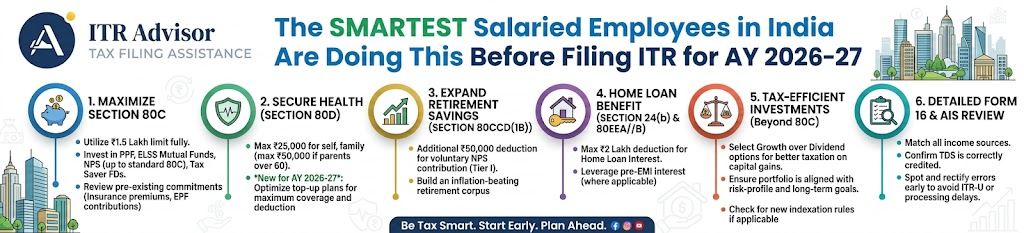
ITR filing for salaried employees today is a sophisticated exercise. At ITR Advisor, our tax professionals work with employees across every sector IT, banking, healthcare, manufacturing, government to ensure their income tax returns are filed with the accuracy, completeness, and professional review that modern compliance demands.
This guide breaks down everything you need to know the risks, the right process, the expert advantage, and how to make sure AY 2026-27 is the year you file without a single worry.
How Income Tax Return Filing for SmartestSalaried Employees Has Changed in AY 2026-27
The Income Tax Department, through guidelines and compliance frameworks published on its official portal www.incometax.gov.in, has steadily built one of the most comprehensive taxpayer surveillance systems in Asia. Today, the department receives financial data from:
All scheduled banks (interest, cash deposits, high-value transfers)
SEBI-registered stock brokers and depositories (equity trades, LTCG, STCG)
Mutual fund registrars (SIP redemptions, fund switches, dividend payouts)
Post offices and NBFCs (recurring deposits, interest income)
Property registrars (real estate purchases and sales)
Every piece of this data is compiled into your Annual Information Statement (AIS) a financial fingerprint of your entire year. The Income Tax Department’s processing systems then compare your AIS against your filed ITR. Any gap between the two is a mismatch and mismatches generate notices.
This is the environment in which ITR filing for salaried employees in AY 2026-27 is happening. The era of filing using only Form 16 is over.
The 8 Costliest Mistakes SmartestSalaried Employees Make in ITR Filing And How to Avoid Them
Understanding the common failure points is the first step toward getting your return right.
1. Treating Form 16 as the Complete Picture
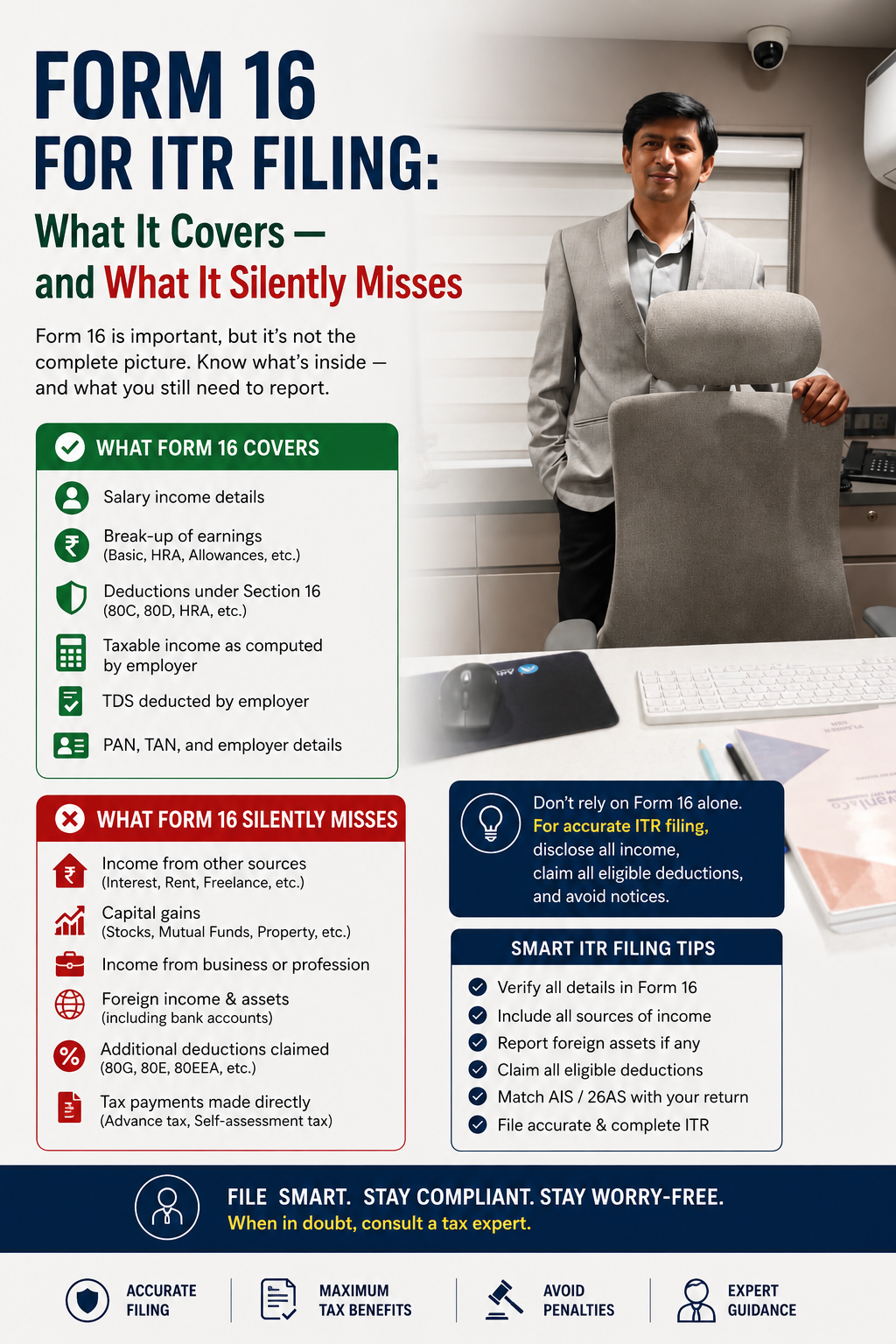
Form 16 is your salary TDS certificate nothing more. It captures what your employer paid you and the tax deducted at source. It does not capture:
Interest income from savings accounts, FDs, or RDs
Dividend received from shares or mutual funds
Capital gains from equity sales or MF redemptions
Rental income
Freelance or consulting income
Foreign salary or perquisites
If these are in your AIS but absent from your ITR, a notice will follow.
2. Filing the Wrong ITR Form
This is more common than most taxpayers realise. Every year, thousands of Smartest salaried employees file ITR-1 when they should have filed ITR-2 simply because they did not account for their capital gains, foreign assets, or multiple income sources.
ITR-1: Salary income below ₹50 lakh, one house property, no capital gains, no foreign assets
ITR-2: Capital gains from any source, two or more house properties, foreign assets or income, NRI status
ITR-3: Business or professional income alongside salary
Filing the wrong form triggers a Section 139(9) defective return notice and requires you to refile. This also delays any pending refund.
3.Skipping the Old vs New Tax Regime Comparision
The tax regime decision is one of the highest-impact choices in your entire return. Yet most salaried employees either stay with what their employer assumed or choose based on incomplete information.
Real Example:
Anil, a 38-year-old banker in Pune earning ₹22 lakh annually, had his employer default him to the new tax regime. His total tax liability under the new regime: ₹2,92,500. When his tax consultant ran the old regime calculation factoring in ₹1.5 lakh under Section 80C, ₹50,000 NPS contribution under 80CCD(1B), ₹25,000 health insurance under 80D, and ₹3.6 lakh HRA exemption his liability dropped to ₹2,24,200. He was unknowingly overpaying ₹68,300 every year. A single professional review corrected this permanently.
4. Not Reporting Capital Gains from SIPs and Stock Trading
India’s investor base has exploded. Millions of salaried employees now have active portfolios on platforms like Zerodha, Groww, Angel One, and Kite many of whom do not realise that every redemption, switch, or sale is a taxable event.
Short-term capital gains (STCG) from equity mutual funds are taxed at 20%. Long-term capital gains (LTCG) above ₹1.25 lakh are taxed at 12.5%. Both must be reported along with your cost of acquisition, date of purchase, and date of sale.
Your AMC or broker provides a capital gains statement. If you are filing without one, your return is almost certainly incomplete.
5.Missing Interest Income from All Bank Accounts
Most salaried professionals have more bank accounts than they actively manage a salary account, a savings account from a previous employer, an old joint account with a parent, an RD opened years ago. Each of these reports interest to the Income Tax Department. Each of these appears in your AIS.
Missing any one of them creates a mismatch.
Pro tip: Before filing, download your AIS from the income tax portal and create a checklist of every interest entry. Cross-check against your actual bank records. If an entry is incorrect, raise feedback on the portal before filing.
6. Incorrect or Undocumented HRA Claims
HRA (House Rent Allowance) is one of the most commonly claimed and most commonly scrutinised exemptions in salary ITR filing. Issues arise when:
Rent is paid to a parent but no proper rent agreement exists
Rent exceeds ₹1 lakh annually but the landlord’s PAN was not furnished to the employer
HRA is claimed in the ITR but the employer’s Form 16 does not reflect it (regime mismatch)
The Income Tax Department has the ability to cross-verify HRA claims through property registration data and landlord PAN records. Claims without documentation are a scrutiny risk.
7. Ignoring Crypto and Digital Asset Transactions
Virtual Digital Assets (VDAs), including cryptocurrency, are taxable at a flat 30% under Section 115BBH. Losses from crypto cannot be set off against any other income. TDS at 1% applies on certain transactions.
If you transacted in crypto during FY 2025-26, it must be disclosed in your ITR regardless of whether you made a profit. Ignoring it when your exchange has reported transactions in AIS is a serious compliance risk.
8 . Selecting the Wrong Bank Account for Refund Credit
A surprisingly common issue: taxpayers enter an old or inactive bank account for refund credit. The refund fails, and the taxpayer does not realise it for months. Always verify that your bank account is pre-validated on the income tax portal and linked to your PAN before submitting your return.
Who Absolutely Must File an Income Tax Return in AY 2026-27
While most salaried employees with income above the basic exemption limit are required to file, the Income Tax Act also mandates ITR filing based on certain activities regardless of taxable income. As per the department’s provisions, you must file even if your income is below the exemption limit if:
You have deposited more than ₹1 crore in bank accounts during the year
You have spent more than ₹2 lakh on foreign travel
You have paid more than ₹1 lakh in electricity bills
You hold foreign assets or have signing authority over foreign accounts
You have received income from property located abroad
Your aggregate TDS and TCS deductions exceed ₹25,000
Additionally, filing ITR even when not strictly required creates a verified income record that is essential for home loans, personal loans, visa applications, and financial planning.
Expert ITR Filing for Special Categories of Salaried Employees
ITR Filing for Government Employees and PSU Staff
Government employees and public sector staff often have additional income sources such as arrears (with relief under Section 89), pension, gratuity, leave encashment, and LTC. Each of these has specific treatment under the Income Tax Act. Incorrect handling of arrear relief, in particular, frequently results in excess tax payment that could have been avoided.
ITR Filing for Doctors, Engineers, and Consultants with Dual Income
Many salaried professionals doctors, architects, engineers also earn consulting or professional fees alongside their primary salary. This dual income profile requires careful handling: the consulting income may need to be reported under “Profits and Gains from Business or Profession,” and the correct ITR form (usually ITR-3) must be selected.
At ITR Advisor, our experts handle combined salary-plus-profession returns with full accuracy and proper schedule completion.
NRI Income Tax Return Filing for Indians Working Abroad
For Non-Resident Indians earning from Indian sources rental income, NRO account interest, Indian equity investments, or salary credited to Indian accounts NRI income tax return filing is mandatory when income exceeds the basic exemption limit.
The residential status determination (NRI vs RNOR vs Resident) is critical and must be based on days of physical presence in India. DTAA benefits, if applicable, must be claimed correctly using Form 67 where foreign taxes have been paid.
The Real Value of Filing Your ITR on Time : Beyond Just Compliance
Timely income tax return filing for salaried employees delivers benefits that go well beyond avoiding penalties:
Financial Documentation: ITR is the most widely accepted income proof for home loans, vehicle loans, and personal finance applications. Most banks require the last 2–3 years’ ITRs for loan processing.
Visa Applications: Several countries including the US, UK, Canada, and Schengen zone nations require ITR documents as part of visa income proof requirements.
Carry Forward of Losses: Capital losses (from equity, MFs, or property) can only be carried forward to offset future gains if the return is filed on time. A belated return forfeits this benefit.
Faster Refund Processing: Returns filed early in the season are typically processed sooner. Late filers often experience longer refund wait times as system loads increase.
Avoiding Compounding Interest: Late filing on a return with tax payable results in interest under Sections 234A, 234B, and 234C which compounds monthly and can add significantly to your total tax cost.
Why ITR Advisor Is the Right Choice for Smartest Salaried Employees Your Income Tax Return Filing in AY 2026-27
At ITR Advisor, we do not just enter numbers into a form. We bring professional tax expertise to every return we handle.
Here is what sets our expert ITR filing service apart:
Complete AIS and Form 26AS Reconciliation : We review every entry in your AIS before filing and ensure your return reflects a fully reconciled picture.
Regime Optimisation : We run a proper old vs new tax regime comparison for your specific income and deduction profile, ensuring you pay the least tax legally possible.
Capital Gains Accuracy : We calculate STCG and LTCG across equity, mutual funds, ESOPs, and property using your actual transaction statements.
Notice Risk Assessment : We proactively identify entries in your AIS that could trigger scrutiny and ensure proper disclosure and documentation before submission.
Post-Filing Support : If a notice or intimation arrives after filing, our team handles the response, revision, and compliance follow-through.Pan-India Digital Service We serve clients across Pune, Mumbai, Delhi, Bengaluru, Hyderabad, Chennai, and every corner of India through a fully secure digital filing process
Frequently Asked Questions
Q1. What is the last date to file salary ITR for AY 2026-27?
The standard due date for salaried employees is 31st July 2026. Belated returns can be filed up to 31st December 2026 with a late fee. Filing before the due date is always advisable to preserve all tax benefits, carry-forward rights, and timely refund processing.
Q2. Can I file ITR for salaried income without a CA?
Yes, but the risk of errors increases significantly when your income involves capital gains, foreign assets, RSUs, crypto, or multiple employers. Expert-assisted filing ensures accuracy, AIS reconciliation, and proper regime selection — reducing notice risk substantially.
Q3. How long does expert ITR filing take with ITR Advisor?
Simple salary returns are typically processed within 1–2 business days of receiving all required documents. Returns with capital gains, RSUs, or foreign income may take 2–4 business days depending on the complexity.
Q4. What if I received two Form 16s from different employers in the same year?
Both employers’ salary and TDS details must be consolidated in a single ITR. Failing to do so results in incomplete disclosure and a likely mismatch notice. This is a common situation for employees who switched jobs and requires careful aggregation of income and TDS credits.
Q5. Is capital gains from selling ancestral property taxable for salaried employees?
Yes. Capital gains from property sale — including inherited or ancestral property — are taxable. The cost of acquisition for inherited property is determined by its fair market value as of April 1, 2001. LTCG from property is taxed at 12.5% without indexation benefit (post-July 2024 amendments). Professional calculation is strongly recommended.
Q6. Do I need to show my PPF maturity amount in ITR?
PPF maturity proceeds are fully exempt from income tax. However, if the amount appears in your AIS, it is good practice to show it in the exempt income schedule of your ITR to prevent any potential mismatch query.
Q7. What is the penalty for filing an incorrect ITR?
Under Section 270A, under-reporting of income can attract a penalty of 50% of the tax on under-reported income. Misreporting (with intent) can result in a penalty of 200% of such tax. Accurate and complete filing is always the safer and smarter path.
Conclusion
Tax compliance in India has entered a new era. The gap between “filing a return” and “filing a correct and complete return” has never been wider and the consequences of that gap have never been more serious.
For Smartest Salaried Employees across India, ITR filing for AY 2026-27 demands a professional, systematic approach: reviewing AIS, comparing tax regimes, reporting every income source, documenting every deduction, and ensuring that what you submit aligns with what the Income Tax Department already knows.
The cost of getting it right the first time in time, money, and professional fees is a fraction of the cost of responding to a notice, revising a return, or managing a tax demand.
About the Author : Prafull Nile
Prafull Nile is a senior taxation and accounting professional associated with Adwani & Co LLP, bringing over 19 years of extensive experience in direct taxation, tax audits, income tax assessments, GST audits, and financial statement finalization. He has successfully managed diverse client engagements across industries, providing strategic guidance on tax compliance, assessments, and regulatory matters. In addition to his technical expertise, Prafull leads and mentors teams, ensuring high standards of service delivery and operational excellence. His practical approach, deep understanding of tax laws, and commitment to client success make him a trusted advisor for businesses and professionals navigating complex financial and compliance requirements.
At ITRAdvisor.in, we help taxpayers with:
✔️ ITR Filing Review
✔️ AIS Reconciliation
✔️ Capital Gains Reporting
✔️ NRI Taxation
✔️ Tax Notice Response
✔️ Revised Returns
✔️ Income Tax Planning
✔️ Refund and Compliance Issues
If you are unsure whether your return has been filed correctly or want a professional review before submission, consulting an experienced tax professional can help avoid costly mistakes.
Visit ITRAdvisor.in for expert assistance with your Income Tax Return and tax compliance requirements.
Disclaimer: ITRAdvisor.in is an educational and informational platform focused on tax awareness and compliance updates. Nothing contained herein should be construed as solicitation or advertisement of professional services. Professional services, where applicable, are rendered in accordance with ICAI guidelines. This article is published on ITRAdvisor.in, a tax and compliance knowledge platform. The content has been reviewed for technical accuracy by professionals associated with Adwani & Co LLP
A prominent “File Your ITR Now” button near the top and again at the end of the article
Need help filing your Income Tax Return? Click the WhatsApp icon and our team will guide you through the process and assist you with your ITR filing.
Have questions about your ITR? Click the WhatsApp icon to connect with our tax experts for quick guidance and personalized assistance.
ITR Advisor is here to make sure you get it right. Connect with our tax experts today for complete, accurate, and worry-free salary ITR filing for AY 2026-27.
A return takes fifteen minutes to file. Fixing one of the wrong ITR filing mistakes hiding inside it can take fifteen months. That gap between speed and consequence is exactly why taxpayers who file “on time” still end up facing an income tax notice they never saw coming.
Why ITR Filing Mistakes Go Unnoticed at First
Filing successfully and filing correctly aren’t the same thing. The portal checks the format of your submission not whether every figure matches what the department already knows. That is why ITR filing mistakes often surface weeks later, not on the day you submit.
A Quick Case: One Missed Entry, Months of Follow-Up
In a case reviewed recently, a taxpayer assumed the return was accurate simply because it had been accepted. The issue was small: income from one source wasn’t reported correctly. A notice followed, interest kept climbing, and the refund was held back while explanations went back and forth for months. In high-value cases, this kind of gap can turn into a tax demand running into lakhs or even crores.
The Five Checks That Prevent Most ITR Filing Mistakes
Before you click “Submit,” run through these checks — they catch the majority of ITR filing mistakes before they become an income tax notice:
Is every source of income reported, not just the obvious ones?
Have you picked the correct ITR form for your income type?
Are your deductions backed by documents you can actually produce?
Does your return match your AIS and Form 26AS, line by line?
Have you disclosed capital gains, foreign assets, or other reportable income, where applicable?
Form 26AS vs AIS: Why This Match Matters Most
Most income tax notices in 2026 trace back to one root cause: a mismatch between your filed return and your Form 26AS vs AIS data already on record. The Income Tax Department’s e-filing portal makes both statements available before filing, so reconciling them isn’t optional it’s the single highest-leverage check you can make.
How Quickly Can an ITR Filing Mistake Become a Notice?
Faster than most taxpayers expect. Once a mismatch is flagged, a notice can follow within the prescribed income tax notice time limit, and interest typically accrues from the point the shortfall existed not from the date the notice was issued.
Key Takeaway
ITR filing mistakes are rarely about dishonesty they’re almost always about a missed reconciliation step. Matching your return against your AIS and Form 26AS before submission remains the single most effective way to avoid an income tax notice altogether.
Getting Expert Eyes on Your Return
As Dr. Haresh Adwani, a Commerce Ph.D. holder and law graduate who frequently reviews such cases, notes most income tax notices are preventable with a thirty-minute reconciliation, not a thirty-day reply after the fact.
Read our detailed guide Salary vs AIS Mismatch in Your ITR : Dangerous, Common & Completely Fixable
Frequently Asked Questions
What is the most common ITR filing mistake?
Unreported income that already appears in your AIS or Form 26AS is the single most common trigger for a notice.
How long does the department have to send an income tax notice?
It depends on the type of notice and assessment year, but reassessment notices can be issued well within the prescribed income tax notice time limit — don’t assume an old return is automatically safe.
Can I fix an ITR filing mistake after submission?
Yes, a revised return is usually possible before the applicable deadline; after a notice is issued, a documented reply becomes necessary instead.
Does choosing the wrong ITR form count as a mistake?
Yes — filing under the wrong form is treated as a defective return and can independently trigger departmental queries.
Conclusion: Review Before You Submit, Not After You’re Notified
Filing fast feels productive, but ITR filing mistakes don’t announce themselves at the time of submission they surface later, as an income tax notice, a frozen refund, or months of correspondence. A few extra minutes of reconciliation today is consistently cheaper than the months it takes to undo a mismatch tomorrow.
About the Author:
Mukesh Chavan is a dedicated indirect taxation and compliance professional associated with Adwani & Co LLP, specializing in GST advisory, GST audits, GST assessments, and RERA compliance services. With extensive experience in handling complex regulatory matters, he assists businesses in ensuring compliance with evolving GST laws and real estate regulations while minimizing risks and enhancing operational efficiency.
Mukesh has successfully guided clients through GST registrations, return compliance, departmental assessments, audits, litigation support, and tax planning strategies. He also possesses significant expertise in RERA compliance, helping real estate developers, promoters, and stakeholders navigate regulatory requirements and maintain seamless project compliance.
Through his articles and professional insights, Mukesh aims to simplify complex GST and RERA provisions, offering practical guidance that empowers businesses to remain compliant, avoid disputes, and make informed decisions in an increasingly dynamic regulatory environment. His approach combines technical expertise with practical business understanding, enabling clients to focus on growth while meeting their statutory obligations with confidence.
Not Sure If Your Return Is Clean? If you’re unsure whether your return has been reported correctly, a quick review today can help avoid a much bigger problem later. If you want expert guidance, connect with itradvisor.in today.
Every June, millions of salaried employees across India receive one document from their employer and immediately assume their tax homework is done. That document is Form 16. And that assumption? It is one of the most common and costliest tax filing mistakes of the year.
Form 16 for ITR filling is important. But it is not the complete picture. For AY 2026-27, filing your Income Tax Return based only on Form 16 can leave out significant taxable income, trigger a mismatch with your Annual Information Statement (AIS), and even invite an income tax notice. This guide breaks down exactly what Form 16 covers, what it misses, and what you must do before hitting ‘Submit’ on the income tax portal.
What Is Form 16 for ITR filling and Why Do Salaried Employees Receive It?
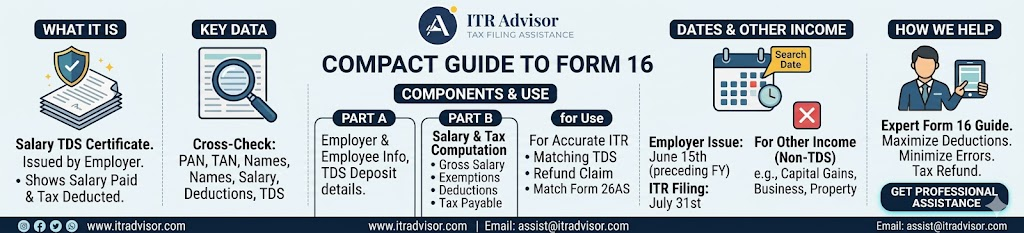
Form 16 is a TDS certificate issued by your employer under Section 203 of the Income Tax Act, 1961. It certifies the amount of tax deducted at source (TDS) from your salary and deposited with the government on your behalf. As per the Income Tax Department, every employer who has deducted TDS from salary payments is required to issue Form 16 to employees by June 15 of the assessment year.
The document has two parts:
Part A : The TDS Summary
Part A Covers:
Employer and employee PAN and TAN details
Quarter-wise TDS deducted and deposited
Certificate number issued by TRACES (the government’s TDS reconciliation portal
Part B : The Salary Breakdown
Part B Covers:
Gross salary and allowances
Exempt allowances (HRA, LTA, etc.)
Deductions claimed under Chapter VIA (80C, 80D, 80G, etc.)
Together, Parts A and B give you a structured view of your salary income and the tax your employer calculated. But and this is critical Form 16 only reflects what your employer knows about your finances.
What Form 16 for ITR filling Does NOT Cover: Income That Belongs in Your ITR
This is where most salaried taxpayers go wrong when filing their ITR for AY 2026-27. Your employer can only deduct TDS on the salary they pay you. Any income earned outside of that employment relationship is completely invisible to them and therefore absent from Form 16.
Here is income that will not appear in your Form 16 but must be disclosed in your ITR:
Interest income from savings accounts, fixed deposits, recurring deposits, and post office schemes often reported by banks to the Income Tax Department via Statement of Financial Transactions (SFT)
Capital gains from the sale of shares, equity mutual funds, debt funds, or property taxed at different rates under LTCG and STCG rules
Rental income from residential or commercial property let out during the year
Freelance, consulting, or professional income earned over and above your salary
Income from previous employers if you changed jobs during the financial year
Dividend income from shares and mutual funds now fully taxable in the hands of the investor
Winnings from online gaming, lottery, or other speculative sources
Practical Example: Ramesh is a salaried IT professional in Pune earning ₹14 lakh annually. His employer deducts TDS and issues Form 16 reflecting zero additional tax liability. However, Ramesh also has ₹85,000 in FD interest and ₹1.2 lakh in STCG from selling equity mutual funds. None of this appears in his Form 16. If he files his ITR based only on Form 16 and ignores these, his AIS (Annual Information Statement) will show the mismatch and the Income Tax Department may send him a notice under Section 143(1)(a) for under-reporting of income.
Form 16 vs AIS: Why a Mismatch Can Trigger an Income Tax Notice
The Income Tax Department’s AIS and Form 26AS now capture a comprehensive view of your financial transactions far beyond what your employer reports. Banks report interest income. Brokers report capital gains. Mutual fund houses report redemptions. Registrars report property transactions.
Before filing your ITR for AY 2026-27, always cross-verify your Form 16 with your AIS and Form 26AS available on the Income Tax e-filing portal. Any mismatch between what you declare and what the department already knows through third-party reporting can result in a defective return notice or tax demand.
If you find a discrepancy, the correct approach is to file an accurate return reflecting your true total income not simply what Form 16 shows.
How to File ITR Using Form 16 Correctly for AY 2026-27
Here is a structured approach for salaried employees to use Form 16 as a starting point not an endpoint for ITR filing:
Step 1: Download and Verify Form 16
Ensure your Form 16 has a valid TRACES watermark and matches the TDS reflected in your Form 26AS. Part A details must be TRACES-generated; do not accept manually typed versions from employers.
Step 2: Collect All Income Sources
Gather interest certificates from all banks and NBFCs, capital gains statements from your broker or mutual fund house (from Consolidated Account Statement), and rent receipts if applicable.
Step 3: Compute Total Income
Add all sources to your salary income from Form 16. This gives you your actual gross total income, which may be significantly higher than what Form 16 reflects.
Step 4: Choose the Right ITR Form
If you only have salary and interest income, ITR-1 applies. If you have capital gains, you need ITR-2. Business or professional income alongside salary means ITR-3 or ITR-4. Read our detailed guide on ITR-1 vs ITR-2 vs ITR-4 for AY 2026-27.
Step 5: File Before the Deadline
The ITR filing deadline for AY 2026-27 for salaried individuals is July 31, 2026. Late filing attracts a penalty under Section 234F of up to ₹5,000, plus interest under Section 234A on any tax due.
Key Takeaways
Form 16 is issued by your employer and covers only your salary income and TDS it is the starting point for your ITR, not the complete picture.
Income from FDs, capital gains, rent, freelancing, and dividends is NOT reflected in Form 16 but must be declared in your ITR.
A mismatch between Form 16 and your AIS/Form 26AS can trigger an income tax notice under Section 143(1)(a).
Always verify your Form 16 against your AIS before filing. The ITR deadline for AY 2026-27 is July 31, 2026.
Choose the right ITR form based on your complete income not just your salary.
As Dr. Haresh Adwani, PhD in Commerce and a practicing law graduate with decades of tax advisory experience, often emphasizes to his clients: “Form 16 tells you what your employer reported. Your ITR must tell the government the complete truth and those two numbers are rarely the same for most urban professionals.”
Frequently Asked Questions
1. Is Form 16 mandatory to file ITR for salaried employees?
Form 16 is not legally mandatory to file ITR, but it is the most reliable document to report salary income accurately. You can file using salary slips and Form 26AS if your employer has not issued Form 16.
2. Can I file ITR using only Form 16 without checking AIS?
Filing without checking your AIS is risky. The Income Tax Department uses AIS data to auto-verify returns, and any mismatch can result in a defective return notice or demand for additional tax.
3. What income is not included in Form 16 for ITR filing?
FD interest, savings account interest, capital gains on shares and mutual funds, rental income, dividend income, and freelance earnings are not included in Form 16 and must be added separately while filing ITR.
4. What happens if I file ITR based only on Form 16 and miss other income?
The Income Tax Department may issue a notice under Section 143(1)(a) for under-reporting. You may also face additional tax demand with interest under Sections 234A, 234B, and 234C.
5. Which ITR form should I use if I have capital gains along with salary income?
If you have capital gains (LTCG or STCG) from shares or mutual funds along with salary, you must file ITR-2. ITR-1 does not allow disclosure of capital gains income.
Conclusion:
Form 16 is one of the most important tax documents an Indian salaried employee receives. But treating it as the only input for your Income Tax Return is a mistake that thousands of taxpayers repeat every year. From capital gains on mutual fund redemptions to bank FD interest quietly accumulating in your accounts your total taxable income is almost always larger than what your employer has captured.
Filing an accurate, complete ITR protects you from notices, demands, and penalties and ensures you claim every refund you legitimately deserve. Take the time this season to check your AIS, gather all income sources, and file a return that truly reflects your financial year.
About the Author:
Mukesh Chavan is a dedicated indirect taxation and compliance professional associated with Adwani & Co LLP, specializing in GST advisory, GST audits, GST assessments, and RERA compliance services. With extensive experience in handling complex regulatory matters, he assists businesses in ensuring compliance with evolving GST laws and real estate regulations while minimizing risks and enhancing operational efficiency.
Mukesh has successfully guided clients through GST registrations, return compliance, departmental assessments, audits, litigation support, and tax planning strategies. He also possesses significant expertise in RERA compliance, helping real estate developers, promoters, and stakeholders navigate regulatory requirements and maintain seamless project compliance.
Through his articles and professional insights, Mukesh aims to simplify complex GST and RERA provisions, offering practical guidance that empowers businesses to remain compliant, avoid disputes, and make informed decisions in an increasingly dynamic regulatory environment. His approach combines technical expertise with practical business understanding, enabling clients to focus on growth while meeting their statutory obligations with confidence.
Need Help with NRE/NRO Taxation?
Whether you are an NRI, OCI holder, overseas employee, or a returning Indian, understanding the tax implications of NRE and NRO accounts is critical.
At ITRAdvisor.in, we help NRIs and returning Indians with:
✔️ NRE and NRO taxation
✔️ Residential status determination
✔️ Returning NRI tax planning
✔️ DTAA advisory
✔️ Foreign asset reporting
✔️ NRI Income Tax Return filing
✔️ Tax notice handling
✔️ Capital gains and property taxation
If you are unsure whether your NRE interest is taxable, whether you need to file an ITR in India, or how to handle NRO income, professional guidance can help avoid costly mistakes.
Visit ITRAdvisor.in to schedule a consultation and get clarity on your NRI tax obligations.
Disclaimer: ITRAdvisor.in is an educational and informational platform focused on tax awareness and compliance updates. Nothing contained herein should be construed as solicitation or advertisement of professional services. Professional services, where applicable, are rendered in accordance with ICAI guidelines. This article is published on ITRAdvisor.in, a tax and compliance knowledge platform. The content has been reviewed for technical accuracy by professionals associated with Adwani & Co LLP.
A prominent “File Your ITR Now” button near the top and again at the end of the article.
Need help filing your Income Tax Return? Click the WhatsApp icon and our team will guide you through the process and assist you with your ITR filing.
Have questions about your ITR? Click the WhatsApp icon to connect with our tax experts for quick guidance and personalized assistance.
One of the most common questions asked by Non Resident Indians (NRIs) is:
“Is interest earned on my NRE account taxable in India?”
Many NRIs also wonder whether they should maintain an NRE account, an NRO account, or both.
Understanding the tax treatment of NRE vs NRO accounts is extremely important because incorrect reporting can result in tax notices, excess TDS deductions, and compliance issues.
In this guide, we explain the taxation of NRE vs NRO accounts, common mistakes made by NRIs, and when professional advice may be required.
NRE vs NRO Account
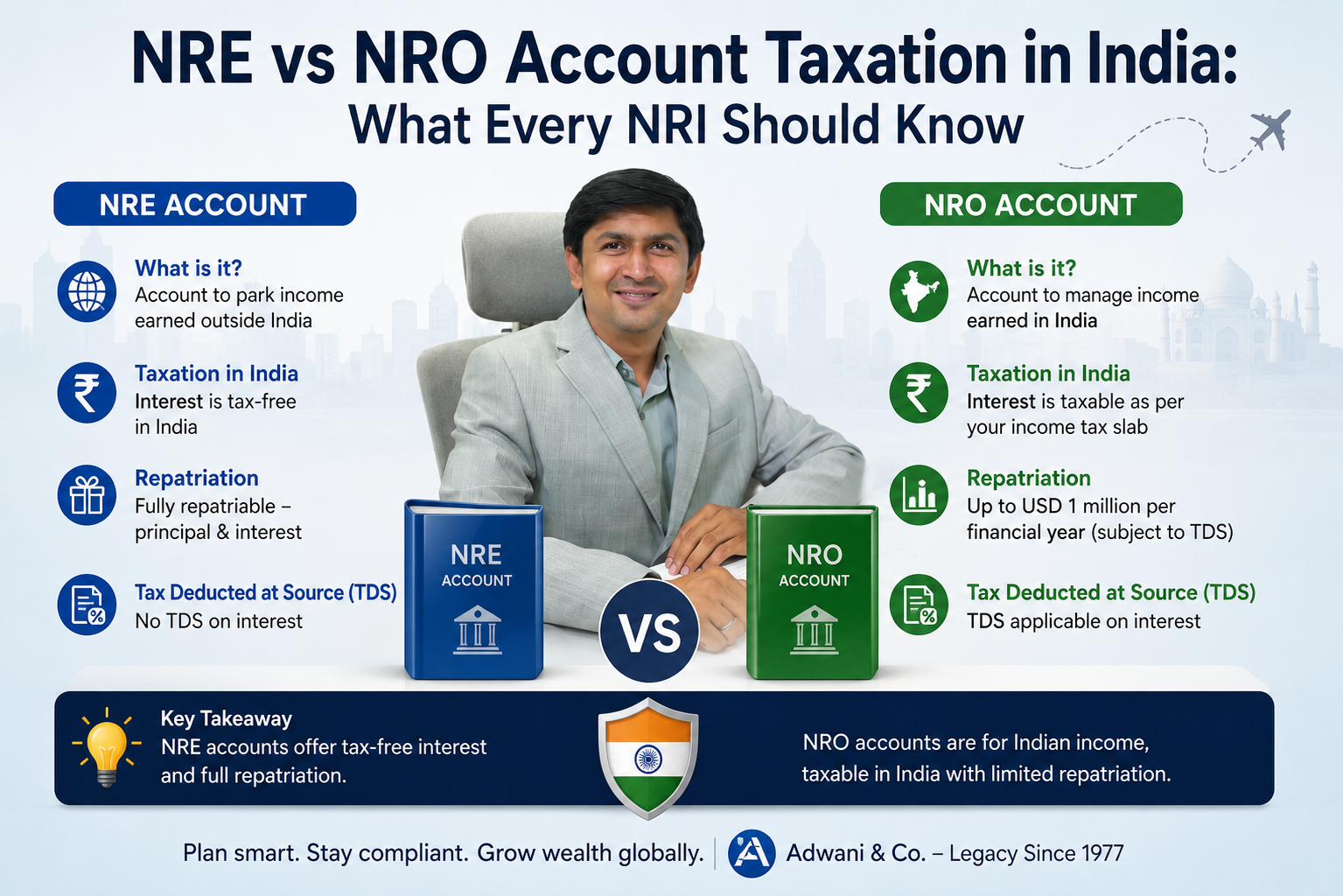
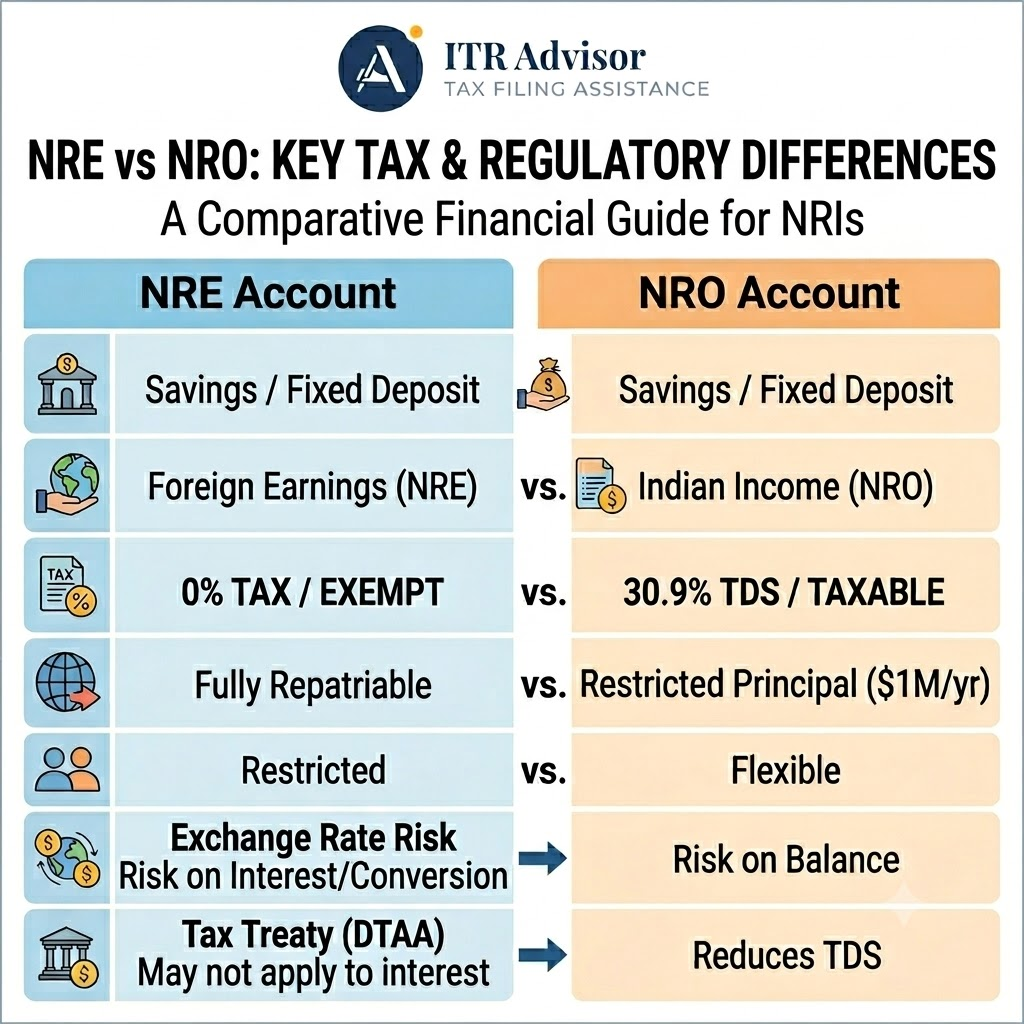
NRE (Non-Resident External) Account is a bank account maintained by an NRI to deposit income earned outside India.
Common examples include:
Salary earned abroad
Overseas business income
Foreign investments
Income received outside India
The funds are maintained in Indian Rupees and are generally fully repatriable.
What is an NRO Account?
An NRO (Non-Resident Ordinary) Account is used to manage income earned in India.
Examples include:
Rental income from property in India
Pension received in India
Dividend income
Interest income from Indian investments
Other Indian-source income
Unlike an NRE account, an NRO account is intended for Indian income.
Is Interest on an NRE Account Taxable?
Generally, interest earned on an NRE account is exempt from tax in India if the account holder qualifies as a Non-Resident under the Income Tax Act.
This is one of the biggest tax benefits available to NRIs.
Example
Mr. Amit works in Dubai and maintains an NRE Fixed Deposit with an Indian bank.
During the financial year, he earns interest of ₹3,50,000 on the NRE Fixed Deposit.
Since Mr. Amit qualifies as a Non-Resident under Indian tax laws, the interest earned on the NRE deposit is generally exempt from tax in India.
In most cases, no tax is payable on such interest income in India.
Is Interest on an NRO Account Taxable?
Yes.
Interest earned on an NRO account is generally taxable in India.
The income must usually be reported in the Income Tax Return and is taxed according to the applicable tax slab rates.
Example
Mrs. Priya lives in Canada and owns a flat in Pune that generates rental income.
The rent is deposited into her NRO account.
During the year, the NRO account earns interest of ₹1,20,000.
Unlike NRE account interest, this ₹1,20,000 is generally taxable in India and must be disclosed in the Income Tax Return.
Why Do Banks Deduct TDS on NRO Interest?
Banks generally deduct Tax Deducted at Source (TDS) on NRO account interest because the interest is taxable in India.
Many NRIs are surprised to see substantial TDS deductions on NRO Fixed Deposits.
However, TDS deducted by the bank does not necessarily represent the final tax liability.
Depending on the taxpayer’s income and available deductions, a refund may be claimable through the Income Tax Return.
What Happens When You Return to India?
This is where many taxpayers make mistakes.
After returning to India, your residential status may change.
Once you cease to qualify as a Non Resident under the Income Tax Act, the tax treatment of NRE interest can change.
Many returning NRIs continue operating NRE accounts without reviewing the tax implications.
This can lead to reporting errors and future tax notices.
Real-Life Example: Returning NRI
Mr. Rohit worked in Singapore for 12 years and maintained multiple NRE Fixed Deposits.
In July 2025, he permanently returned to India.
Since he was focused on settling his family and business affairs, he continued operating his NRE deposits without reviewing his residential status.
During tax planning, it was discovered that his residential status had changed and the tax treatment of interest required careful evaluation.
After obtaining professional advice, his accounts and tax reporting were regularized correctly.
This prevented potential future disputes with the Income Tax Department.
Common Mistakes Made by NRIs
Treating All NRE Interest as Permanently Tax-Free
The tax treatment depends on residential status.
Ignoring NRO Interest Income
Many NRIs fail to disclose NRO interest in their Income Tax Return.
Not Checking Form 26AS and AIS
Interest income reflected in AIS should be reconciled with the return.
Continuing NRE Accounts After Returning to India
Returning Indians should review their banking arrangements and tax position.
Not Claiming DTAA Benefits
In some situations, Double Taxation Avoidance Agreement (DTAA) provisions may help reduce overall tax burden.
Do NRIs Need to File an Income Tax Return?
An NRI may be required to file an Income Tax Return in India depending on:
Generally, NRE FD interest is exempt in India while the account holder qualifies as a Non Resident under the Income Tax Act.
2.Is NRO FD interest taxable?
Yes. NRO interest is generally taxable in India.
3.Can I claim a refund of TDS deducted on NRO interest?
In appropriate cases, a refund may be available through filing an Income Tax Return
What happens to my NRE account after returning to India?
Returning Indians should review their residential status and banking arrangements to ensure proper compliance.
Can I hold both NRE and NRO accounts?
Yes. Many NRIs maintain both accounts for different purposes.
Why Professional Advice Matters
NRE and NRO taxation is closely linked to:
Residential status
DTAA provisions
Foreign income reporting
Returning NRI tax rules
FEMA regulations
Income Tax compliance
A small mistake can result in unnecessary taxes, notices, or reporting issues.
Final Thoughts
NRE vs NRO accounts serve different purposes and are taxed differently. While NRE interest may enjoy tax benefits for eligible NRIs, NRO interest is generally taxable and requires proper reporting.
As tax laws, residential status rules, and reporting obligations can become complex, especially for returning Indians, seeking professional advice before filing your Income Tax Return can help ensure compliance and peace of
About the Author:
Mukesh Chavan is a dedicated indirect taxation and compliance professional associated with Adwani & Co LLP, specializing in GST advisory, GST audits, GST assessments, and RERA compliance services. With extensive experience in handling complex regulatory matters, he assists businesses in ensuring compliance with evolving GST laws and real estate regulations while minimizing risks and enhancing operational efficiency.
Mukesh has successfully guided clients through GST registrations, return compliance, departmental assessments, audits, litigation support, and tax planning strategies. He also possesses significant expertise in RERA compliance, helping real estate developers, promoters, and stakeholders navigate regulatory requirements and maintain seamless project compliance.
Through his articles and professional insights, Mukesh aims to simplify complex GST and RERA provisions, offering practical guidance that empowers businesses to remain compliant, avoid disputes, and make informed decisions in an increasingly dynamic regulatory environment. His approach combines technical expertise with practical business understanding, enabling clients to focus on growth while meeting their statutory obligations with confidence.
Need Help with NRE/NRO Taxation?
Whether you are an NRI, OCI holder, overseas employee, or a returning Indian, understanding the tax implications of NRE and NRO accounts is critical.
At ITRAdvisor.in, we help NRIs and returning Indians with:
✔️ NRE and NRO taxation
✔️ Residential status determination
✔️ Returning NRI tax planning
✔️ DTAA advisory
✔️ Foreign asset reporting
✔️ NRI Income Tax Return filing
✔️ Tax notice handling
✔️ Capital gains and property taxation
If you are unsure whether your NRE interest is taxable, whether you need to file an ITR in India, or how to handle NRO income, professional guidance can help avoid costly mistakes.
Visit ITRAdvisor.in to schedule a consultation and get clarity on your NRI tax obligations.
Disclaimer: ITRAdvisor.in is an educational and informational platform focused on tax awareness and compliance updates. Nothing contained herein should be construed as solicitation or advertisement of professional services. Professional services, where applicable, are rendered in accordance with ICAI guidelines. This article is published on ITRAdvisor.in, a tax and compliance knowledge platform. The content has been reviewed for technical accuracy by professionals associated with Adwani & Co LLP.
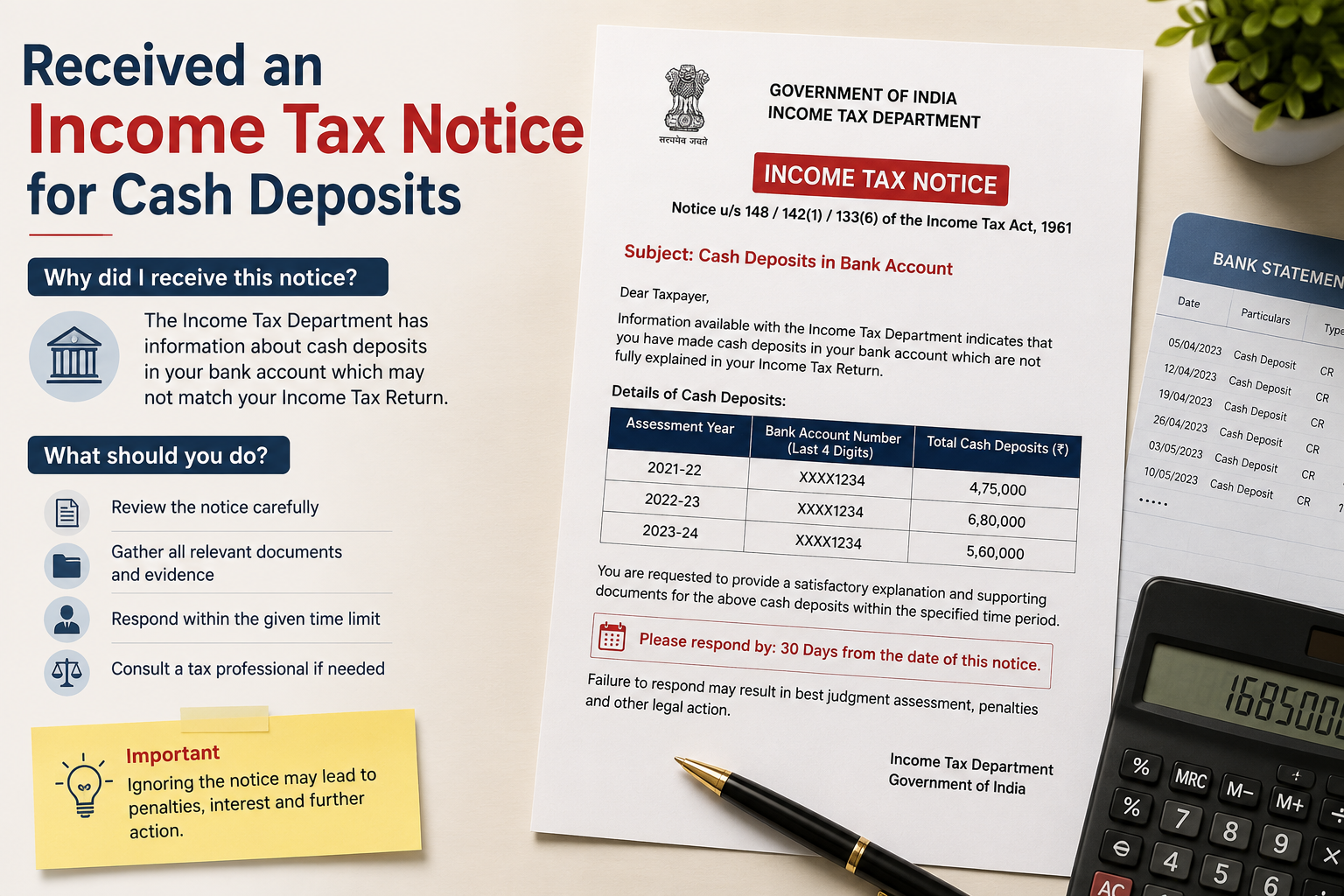
Received an Income Tax Notice for Cash Deposits? Don’t Panic
Have you recently received an Income Tax notice for cash deposits in your bank account?
You’re not alone
Every year, thousands of taxpayers receive notices from the Income Tax Department after depositing substantial amounts of cash in savings accounts, current accounts, or other bank accounts.
In many cases, the deposits are genuine and fully explainable. However, ignoring the notice or providing an incomplete response can lead to scrutiny, reassessment proceedings, additional tax demands, penalties, and prolonged litigation.
This guide explains why you may have received an Income Tax notice for cash deposits, what documents you should collect, how to respond, and how to protect yourself from unnecessary tax disputes in AY 2026-27.
Why Did You Receive an Income Tax Notice for Cash Deposits?
Banks and financial institutions report certain high-value transactions to the Income Tax Department.
The Department uses data analytics, PAN-based reporting, AIS (Annual Information Statement), and other information sources to identify cases where cash deposits appear inconsistent with the income reported in the Income Tax Return (ITR).
Common situations that trigger notices include:
Large cash deposits in savings accounts
Significant cash deposits in current accounts
Cash deposits not matching declared income
Cash deposits during specific monitoring periods
High-value transactions reflected in AIS
Cash deposits where no ITR has been filed
The notice does not automatically mean tax evasion. It simply means the Department requires an explanation.
Common Reasons for Large Cash Deposits
Before responding, identify the actual source of funds.
Legitimate sources may include:
Cash Sales from Business
Businesses dealing in cash may deposit daily collections into bank accounts.
Supporting records should be maintained.
Agricultural Income
Agricultural income may generate substantial cash receipts in certain cases.
Proper evidence should be available.
Withdrawal and Redeployment of Cash
Taxpayers sometimes redeposit cash previously withdrawn from bank accounts.
A clear cash flow trail is important.
Sale of Assets
Cash received from the sale of certain assets may be deposited into a bank account.
Documentation must support the transaction.
Gifts or Family Contributions
In some situations, cash may have been received from family members or relatives.
Proper documentation becomes critical.
Past Savings
Taxpayers may deposit accumulated cash savings.
However, the source and accumulation history should be capable of explanation.
What Types of Notices May Be Issued?
The Income Tax Department may issue different notices depending upon the facts of the case.
Common notices include:
Notice Seeking Information
The Department may ask you to explain the source of cash deposits and provide supporting evidence.
Scrutiny Proceedings
Your return may be selected for detailed examination.
Reassessment Proceedings
In certain circumstances, reassessment proceedings may be initiated if income is believed to have escaped assessment.
Section 148 Notice
A notice under Section 148 may be issued in cases where the Department believes taxable income may not have been properly reported.
A Section 148 notice should never be ignored and requires careful professional review.
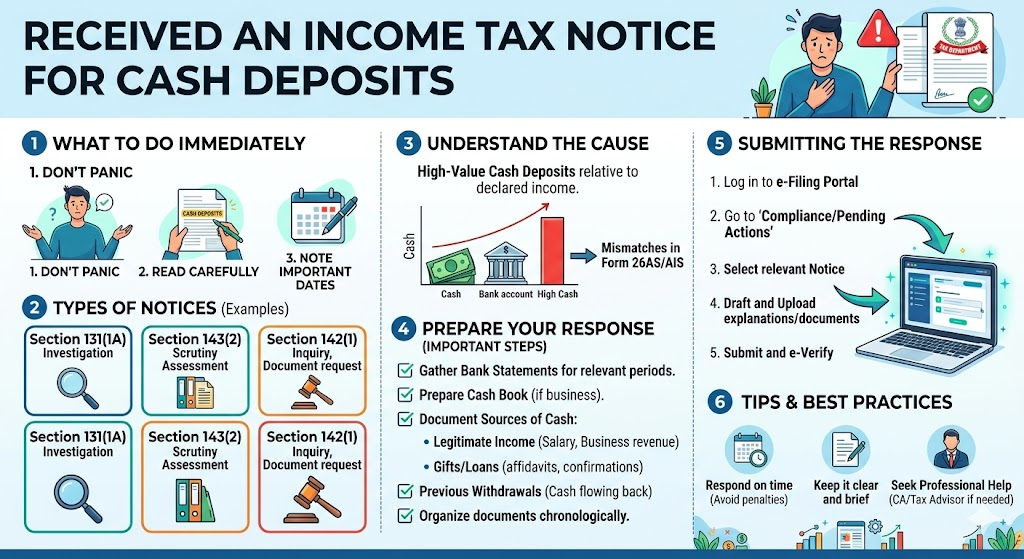
What Should You Do Immediately After Receiving the Notice?
Step 1: Read the Notice Carefully
Identify:
Notice section
Assessment year involved
Response deadline
Information requested
Different notices require different responses.
Step 2: Download AIS and Form 26AS
Review:
Reported cash transactions
Bank information
TDS records
Other financial transactions
TDS records
Other financial transactions
Many notices originate from information reflected in AIS.
Step 3: Gather Supporting Documents
Collect documents relevant to the source of cash deposits.
Examples include:
Bank statements
Cash books
Sale agreements
Agricultural records
Income records
Gift documentation
Business books of accounts
The stronger the documentation, the stronger the response.
Step 4: Prepare a Cash Flow Explanation
The Income Tax Department generally expects a logical explanation supported by evidence.
A proper cash flow statement should explain:
Opening cash balance
Cash receipts
Cash utilization
Cash deposits made
This often becomes the most important document in cash deposit cases.
What Happens If You Ignore the Notice?
Ignoring a notice can create serious problems.
Possible consequences include:
Best judgment assessment
Addition of unexplained income
Additional tax liability
Interest charges
Penalty proceedings
Further notices and litigation
Even when the cash deposits are genuine, failure to respond can result in adverse outcomes.
Can Cash Deposits Be Treated as Unexplained Income?
Yes.
If a taxpayer fails to satisfactorily explain the source of cash deposits, the Department may treat the amount as unexplained income under applicable provisions of the Income Tax Act.
This can lead to:
High tax liability
Interest
Penalties
Extended scrutiny
Therefore, documentation and professional representation are extremely important.
Example:
Cash Deposit Notice Successfully Explained
Mr. Sharma received a notice regarding cash deposits of ₹18 lakh in his savings account.
Initially, he was concerned that the Department would treat the entire amount as unexplained income.
Upon review, it was found that:
Part of the deposits represented business receipts
Part represented redeposit of earlier withdrawals
Supporting records were available
A detailed explanation with documentary evidence was submitted.
As a result, the matter was resolved without adverse additions.
This demonstrates the importance of proper representation and documentation.
Common Mistakes Taxpayers Make
Ignoring the Notice
Many taxpayers assume the issue will disappear automatically.
It will not.
Responding Without Reviewing Documents
Incorrect explanations can weaken the case.
Providing Incomplete Information
Half-complete responses often generate additional queries.
Missing Response Deadlines
Delays can adversely affect the outcome.
Not Seeking Professional Advice
Complex cash deposit cases often require technical tax analysis and structured submissions.
How to Avoid Cash Deposit Notices in Future To reduce future risks:
✅ File your ITR on time
✅ Maintain proper books and records
✅ Reconcile cash transactions regularly
✅ Review AIS before filing returns
✅ Maintain supporting evidence for large cash transactions
✅ Ensure reported income matches actual financial activity
Frequently Asked Questions (FAQs)
1. Why did I receive an income tax notice for cash deposits
The notice is generally issued when cash deposits reported by banks appear inconsistent with the income disclosed in your tax records.
2.Does receiving a notice mean I have done something wrong?
No. A notice simply means the Department wants clarification regarding the transaction.
3.Can cash deposits from past savings be explained?
Yes, provided sufficient evidence and a credible explanation are available.
4.What if I received a Section 148 notice for cash deposits?
A Section 148 notice should be reviewed carefully and responded to within the prescribed time limits after evaluating the facts and supporting records.
5.Should I handle the notice myself?
Simple cases may be manageable. However, substantial cash deposits or reassessment proceedings often require professional assistance.
Author
CA Dipesh Gurubakshani is a Chartered Accountant with Adwani & Co LLP, Pune, specialising in income tax audit, direct taxation, and accounting advisory. He supports clients across statutory compliance, financial reporting, and income tax matters with a focus on accuracy, regulatory adherence, and disciplined execution.Received an Income Tax Notice for Cash Deposits? We Can Help.
If you have received:
An income tax notice for cash deposits
A cash transaction notice
A scrutiny notice
A Section 148 notice
A reassessment notice
our experienced tax professionals can help you prepare a strong response supported by proper documentation and legal analysis.
Contact ITR Advisor Today
Don’t ignore the notice. The right response at the right time can make all the difference.
Disclaimer: ITRAdvisor.in is an educational and informational platform focused on tax awareness and compliance updates. Nothing contained herein should be construed as solicitation or advertisement of professional services. Professional services, where applicable, are rendered in accordance with ICAI guidelines. This article is published on ITRAdvisor.in, a tax and compliance knowledge platform. The content has been reviewed for technical accuracy by professionals associated with Adwani & Co LLP.
AIS Shows More Income Than Your ITR? Don’t Ignore It
Have you checked your Annual Information Statement (AIS) before filing your Income Tax Return (ITR)?
Many taxpayers receive Income Tax notices because the income reported in their ITR does not match the information available with the Income Tax Department through AIS.
If your AIS shows higher income than what you have reported in your ITR, it could trigger scrutiny, notices, or demands from the Income Tax Department.
In this guide, we explain what AIS is, common AIS mismatches, how to correct errors, and what steps you should take before filing your ITR for AY 2026-27.
What is AIS (Annual Information Statement)?
The Annual Information Statement (AIS) is a comprehensive statement available on the Income Tax Portal that contains details of various financial transactions reported to the Income Tax Department.
AIS includes information such as:
Savings bank interest
Fixed deposit interest
Dividend income
Purchase and sale of shares and mutual funds
Salary income
Rent received
Foreign remittances
Credit card payments
High-value transactions
Tax Deducted at Source (TDS)
Tax Collected at Source (TCS)
The Income Tax Department uses AIS to verify whether taxpayers have correctly reported their income in the ITR.
Why AIS is Important Before Filing ITR
Many taxpayers rely only on Form 16, bank statements, or investment records while filing their returns.
However, the Income Tax Department compares your ITR with the data available in AIS.
Even if you unintentionally omit income, the mismatch may result in:
Defective return notices
Scrutiny notices
Tax demands
Penalties
Interest liability
Therefore, checking AIS before filing your return has become essential.
Banks report FD interest to the Income Tax Department even if the interest is not credited to your account.
Many taxpayers miss reporting FD interest, leading to an AIS mismatch.
2. Savings Bank Interest Missing
Interest earned from savings accounts is often overlooked while filing returns.
However, banks report this information in AIS.
3. Dividend Income Not Included
Companies and mutual funds report dividend payments.
Failure to report dividend income may create discrepancies.
4. Capital Gains Not Reported Correctly
Share and mutual fund transactions are reported by brokers and RTAs.
Many taxpayers report only sale proceeds or forget to calculate capital gains accurately.
5.Duplicate Reporting in AIS
Sometimes AIS may show duplicate transactions due to reporting by multiple entities.
Such cases require verification before filing.
6. Incorrect Salary Information
Employers may revise TDS returns, causing differences between Form 16 and AIS.
7. High-Value Transactions
Property purchases, foreign remittances, credit card payments, and other specified financial transactions may appear in AIS.
Ignoring them can invite questions from the tax department.
What Happens If You Ignore AIS Mismatches?
Ignoring AIS discrepancies can lead to serious consequences.
The Income Tax Department may:
Issue notices seeking clarification
Add omitted income during assessment
Levy additional tax
Charge interest under applicable provisions
Impose penalties in certain cases
Many taxpayers receive notices simply because they failed to reconcile AIS before filing their return.
How to Check AIS Online
Follow these steps:
Login to the Income Tax e-Filing Portal.
2. Go to “Services”.
3. Click on “Annual Information Statement (AIS)”.
4. Open AIS and review all reported transactions.
5. Compare AIS data with:
Form 16
Form 26AS
Bank statementsBank statements
Broker statements
Mutual fund statements
Books of accounts
How to Submit Feedback in AIS
If you find incorrect information in AIS, you can submit feedback directly through the portal.
Common feedback options include:
Information is correct
Information is not fully correct
Information relates to another PAN
Duplicate information
Information is denied
Providing feedback helps the Income Tax Department understand discrepancies and may prevent future issues.
Example of an AIS Mismatch
Mr. Sharma filed his ITR showing interest income of ₹12,000.
However, AIS reflected:
Savings account interest: ₹12,000
FD interest: ₹45,000
Total interest as per AIS: ₹57,000
Since FD interest was omitted from the return, the Income Tax Department may issue a notice seeking clarification.
This is one of the most common AIS-related mistakes observed every year.
Best Practices to Avoid AIS-Related Notices
Before filing your ITR:
✅ Download and review AIS
✅ Compare AIS with Form 26AS
✅ Verify bank interest income
✅ Check dividend income
✅ Review share and mutual fund transactions
✅ Verify salary details
✅ Reconcile TDS entries
✅ Submit feedback wherever required
✅ Seek professional assistance for complex transactions
Frequently Asked Questions (FAQs)
1. Is AIS mandatory for filing ITR?
While AIS is not mandatory, checking it before filing your return is strongly recommended to avoid mismatches.
2.Can AIS contain incorrect information?
Yes. AIS may occasionally contain duplicate or incorrect entries. Such errors can be addressed through the feedback mechanism.
3.Can I revise my ITR if AIS shows additional income?
Yes, taxpayers can file a revised return within the prescribed time limit if any income was omitted.
4. Will I definitely receive a notice if AIS and ITR do not match?
Not necessarily. However, significant mismatches increase the likelihood of scrutiny or notices.
Author
CA Dipesh Gurubakshani is a Chartered Accountant with Adwani & Co LLP, Pune, specialising in income tax audit, direct taxation, and accounting advisory. He supports clients across statutory compliance, financial reporting, and income tax matters with a focus on accuracy, regulatory adherence, and disciplined execution.
Disclaimer: ITRAdvisor.in is an educational and informational platform focused on tax awareness and compliance updates. Nothing contained herein should be construed as solicitation or advertisement of professional services. Professional services, where applicable, are rendered in accordance with ICAI guidelines. This article is published on ITRAdvisor.in, a tax and compliance knowledge platform. The content has been reviewed for technical accuracy by professionals associated with Adwani & Co LLP.
Need Help With AIS Mismatch or Income Tax Notice?
If your AIS shows higher income than your ITR, do not ignore it. Our team at ITR Advisor assists taxpayers across India and NRIs worldwide with:
AIS reconciliation
Income Tax Return filing
Revised Return filing
Income Tax Notice replies
Scrutiny and assessment support
Contact us today for professional assistance and ensure your return is filed accurately and compliantly.
The clock is ticking. July 31, 2026, is the ITR filing last date for AY 2026-27, and if you haven’t already taken stock of your tax saving opportunities, you are leaving real money on the table. Whether you’re a salaried professional, freelancer, or a small business owner, the weeks leading up to this deadline are your last genuine window to legally reduce your tax liability for FY 2025-26.
This isn’t just a filing reminder it’s your strategic playbook. Let’s walk through the most impactful tax saving moves you can still make before the deadline hits.
Why the July 31 Deadline for AY 2026-27 Is Critical
Under the Income Tax Act, 1961, the due date for filing an ITR for individuals, HUFs, and non-audit cases is July 31st of the assessment year. For AY 2026-27, this translates to the last date being 31st July 2026. Missing this deadline doesn’t just attract a late filing fee of up to ₹5,000 under Section 234F it also locks you out of several beneficial provisions, including carrying forward certain losses.
The Income Tax Department has made it clear through CBDT guidelines that filing on time is the foundation of good tax compliance. Don’t wait for an extension that may never come.
Step 1 : Choose the Right Tax Regime Before Filing Your ITR
One of the most consequential decisions you’ll make this filing season is: Old Tax Regime or New Tax Regime for FY 2026-27?
The new tax regime for FY 2026-27 offers zero income tax on income up to ₹12 lakh (after rebate under Section 87A), with a simplified slab structure. It also now includes a standard deduction of ₹75,000 for salaried individuals a significant upgrade.
However, if you have substantial deductions particularly Section 80C investments (up to ₹1.5 lakh), HRA, home loan interest (Section 24b), and NPS contributions (Section 80CCD(1B)) the old tax regime may still work out cheaper for you. Read our detailed guide on Old vs New Tax Regime 2026 to run your numbers before you file.
Pro Tip: Use the ITR filing portal’s built-in regime comparison calculator or get a professional assessment before locking in your choice. Once the ITR is filed, switching is not possible for that year.
Step 2 : Maximize Your Deductions Before July 31 (Checklist)
Even if most investments had to be made by March 31, 2026, here’s what you can still do before filing:
Deductions You Must Claim While Filing
Section 80C (up to ₹1.5 lakh): ELSS, PPF, LIC premium, home loan principal, NSC, tuition fees ensure all investments made in FY 2025-26 are accurately declared.
Section 80D Health Insurance Premium: Up to ₹25,000 for self/family; ₹50,000 for senior citizen parents. This deduction is often underclaimed.
Section 80CCD(1B) NPS Contribution: An additional ₹50,000 over and above the 80C limit available only under the old tax regime.
Section 24(b) Home Loan Interest: Up to ₹2 lakh for a self-occupied property. If you have a home loan, this is a powerful deduction to claim.
HRA Exemption: Cross-verify your actual rent paid vs. employer-declared HRA. Discrepancies can trigger notices.
Standard Deduction of ₹75,000 (new regime) or ₹50,000 (old regime for salaried): Automatically available ensure it reflects correctly in your ITR.
Step 3 : Verify Form 26AS, AIS & TIS Before Filing
One of the most overlooked yet critical pre filing steps is reconciling your Form 26AS, AIS (Annual Information Statement), and TIS (Taxpayer Information Summary). These documents reflect what banks, employers, and other third parties have reported to the Income Tax Department against your PAN.
A mismatch between your income and what’s reported in AIS can trigger income tax scrutiny notices something you definitely want to avoid.
If you are a freelancer, consultant, business owner, or have capital gains income, advance tax is your responsibility. The advance tax due dates for FY 2026-27 are:
Installment
Due Date
% of Total Tax
1st
June 15, 2026
15%
2nd
September 15, 2026
45%
3rd
December 15, 2026
75%
4th
March 15, 2027
100%
Failing to pay advance tax leads to interest under Sections 234B and 234C. This year, with capital gains from shares and mutual funds being taxable, many salaried individuals with F&O or equity portfolios fall into the advance tax net without realising it.
Step 5 : File the Correct ITR Form
This may sound basic, but filing the wrong ITR form is a common mistake that results in defective return notices. Here’s a quick guide:
ITR(1) (Sahaj): Salaried income, one house property, other sources income up to ₹50 lakh
ITR(2): Capital gains, multiple properties, foreign income/assets
ITR(4) (Sugam): Presumptive income under Section 44AD, 44ADA, 44AE
According to Dr. Haresh Adwani, a trusted voice in Indian taxation and compliance, many taxpayers lose significant amounts not because of high tax rates, but due to poor documentation, wrong regime selection, and failure to claim legitimate deductions. “Filing early, filing correctly, and filing with complete documentation is the single most powerful tax strategy available to the Indian taxpayer,” he notes.
This view aligns with the Income Tax Department’s consistent push toward voluntary and timely compliance and for good reason. Early filers get faster refunds, fewer notices, and a cleaner compliance record.
Key Takeaways
July 31, 2026 is the last date to file ITR for AY 2026-27 late filing attracts ₹5,000 penalty under Section 234F
Compare old vs new tax regime before filing don’t assume one is better without calculating
Standard deduction of ₹75,000 is available under the new regime for salaried individuals
Always verify Form 26AS, AIS, and TIS for mismatches before filing
Freelancers and business owners must track advance tax due dates for FY 2026-27
Choose the correct ITR form wrong form = defective return notice
Every deduction saved is money back in your pocket claim 80C, 80D, 80CCD(1B), and 24(b) diligently
Fequently Asked Questions (FAQs)
Q1. What is the last date to file ITR for AY 2026-27?
The ITR filing last date for AY 2026-27 is July 31, 2026 for individuals and non audit cases. Filing after this date attracts a late fee of up to ₹5,000 under Section 234F.
Q2. Which tax regime is better for salaried employees in FY 2026-27?
It depends on your total deductions. The new tax regime benefits those with fewer deductions, while the old regime suits those with significant 80C, HRA, and home loan interest claims. Use a regime comparison calculator before deciding.
Q3. What is the standard deduction under the new tax regime in 2026?
The standard deduction under the new tax regime for FY 2025-26 (AY 2026-27) is ₹75,000 for salaried employees and pensioners a significant benefit introduced in the Union Budget
Q4. Can I still save tax if I missed the March 31 investment deadline?
Most investment-based deductions (like 80C) require investments before March 31. However, you can still maximize deductions by claiming HRA, home loan interest, health insurance premiums, and ensuring accurate reporting of all eligible expenses in your ITR.
Q5. What happens if I file the wrong ITR form for AY 2026-27?
Filing an incorrect ITR form results in a defective return notice under Section 139(9). You’ll be given 15 days to rectify it. However, repeated errors can delay refunds and invite scrutiny always verify which form applies to your income profile.
Conclusion
The ITR filing deadline for AY 2026-27 is not just a compliance formality it’s your last call to lock in every tax benefit legally available to you. From choosing the right regime and maximizing deductions to verifying AIS data and filing the correct form, every step matters.
Don’t let procrastination cost you thousands of rupees in avoidable penalties, missed refunds, or compliance complications down the road.
Ready to file smart this July 31? Connect with the experts at itradvisor.in today — because the right guidance now saves far more than the time it takes.
About the Author Dr. Haresh Adwani Ph.D. in Commerce | Law Graduate | Managing Partner, Adwani & Co LLP Dr. Haresh Adwani holds a Ph.D. in Commerce and is a qualified Law graduate with over two decades of hands-on experience in GST advisory, direct taxation, and statutory compliance for businesses across
Disclaimer: ITRAdvisor.in is an educational and informational platform focused on tax awareness and compliance updates. Nothing contained herein should be construed as solicitation or advertisement of professional services. Professional services, where applicable, are rendered in accordance with ICAI guidelines. This article is published on ITRAdvisor.in, a tax and compliance knowledge platform. The content has been reviewed for technical accuracy by professionals associated with Adwani & Co LLP.