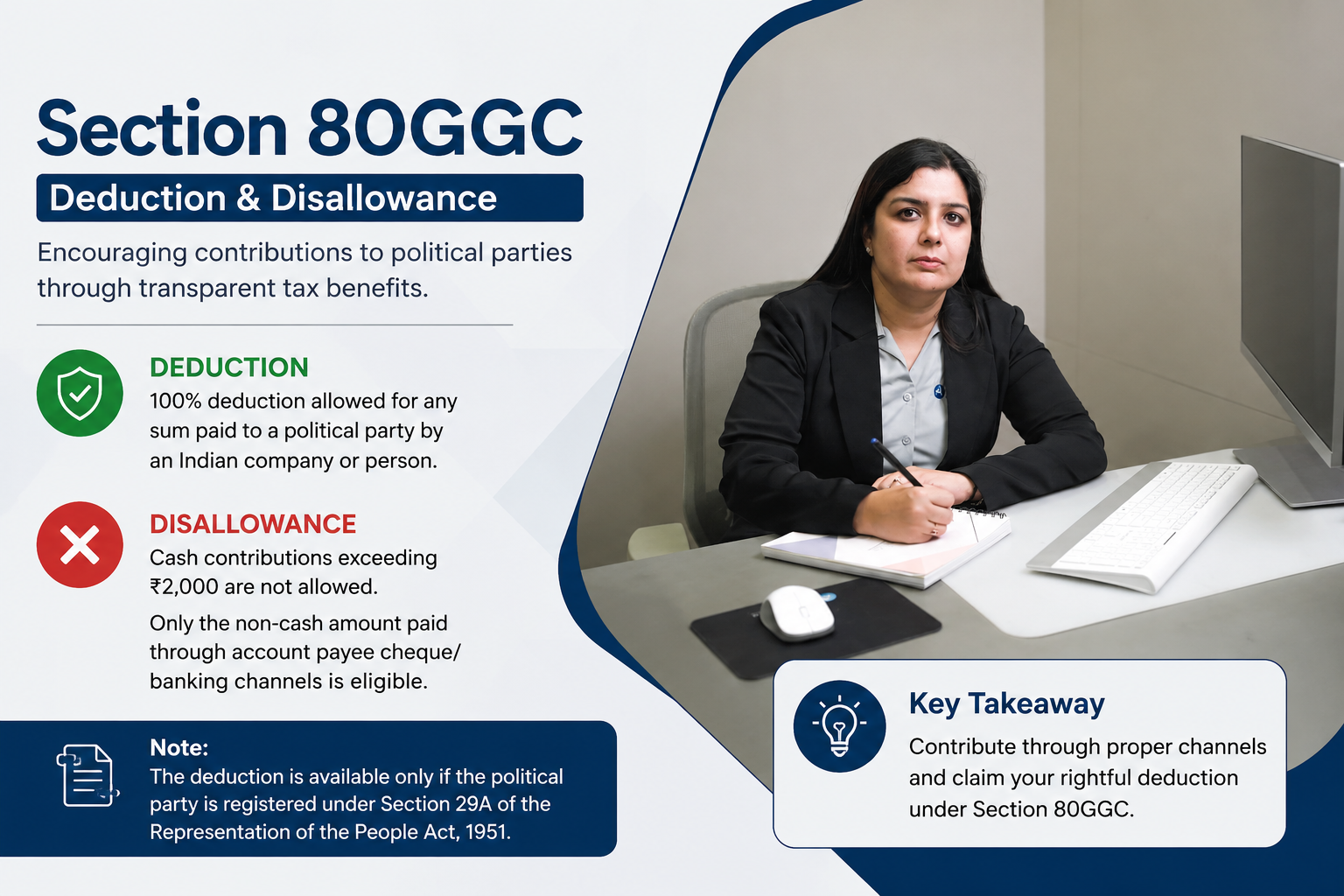
Section 80GGC Deduction & Disallowance
You donated money to a political party, claimed the Section 80GGC deduction in your Income Tax Return, and thought that was the end of it. Then one morning, a message from the Income Tax Department lands in your inbox your deduction has been flagged for scrutiny, and you are now asked to justify a claim worth lakhs of rupees. If this sounds alarming, it should. And it is happening to thousands of Indian taxpayers right now.
The Income Tax Department has significantly intensified scrutiny of Section 80GGC deductions in recent assessment cycles. Salaried professionals, business owners, and HUFs who claimed political donation deductions are receiving SMS alerts, scrutiny notices, and in some cases, full disallowance of their claims — with penalties that can reach 200% of the tax evaded. Yet, Section 80GGC is a completely legitimate, government-sanctioned provision that rewards transparent political funding with meaningful tax benefits.
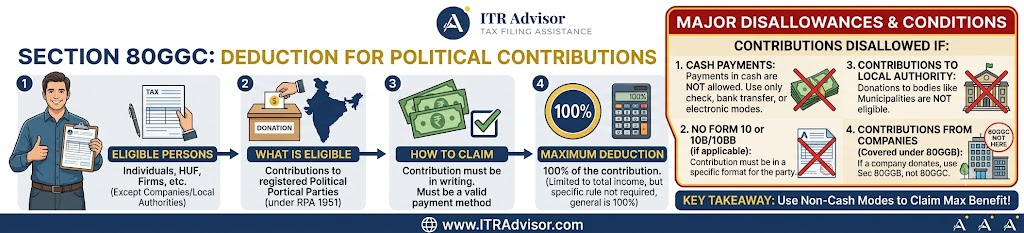
The problem is not the section itself. The problem is how — and whether it has been used correctly. In this comprehensive guide, the expert team at Adwani and Company walks you through everything: what Section 80GGC actually allows, who qualifies, what conditions must be met, why deductions get disallowed, how to protect your claim, and what to do if you have already received a notice under this provision.
Whether you are filing your ITR 2026 for the first time with a political donation or are already facing scrutiny for a past claim, this is the guide you need to read fully, carefully, and right now.
What Is Section 80GGC? The Income Tax Deduction on Political Donations Explained Clearly
Section 80GGC of the Income Tax Act, 1961 now also reflected in the newly enacted Income Tax Act 2025 is a provision under Chapter VI-A that allows eligible taxpayers to claim a deduction for contributions made to registered political parties or approved electoral trusts. The deduction covers 100% of the amount donated, making it one of the most generous deductions available to individuals under Indian tax law.
The purpose of this section is rooted in democratic policy: to encourage transparent, traceable, and formally documented political funding. By providing a tax incentive for political contributions, the government aims to reduce unaccounted cash flowing into political campaigns and push donors toward legitimate, banking-channel-based contributions.
However, the very generosity of this deduction 100% of the donated amount with no fixed upper cap in rupee terms has made it a target for misuse, which is precisely why the Income Tax Department’s scrutiny of Section 80GGC claims has intensified dramatically in 2025 and 2026.
Section 80GGC vs. Section 80GGB : Key Differences You Must Know
| Feature | Section 80GGB | Section 80GGC |
| Who can claim | Indian companies only | Individuals, HUFs, Firms, AOPs — NOT companies |
| Deduction limit | 100% of donation | 100% of donation (max = total taxable income) |
| Cash donations allowed? | No | No — banking channels mandatory |
| Tax regime | Old regime only | Old regime only |
| Mode of payment | Cheque, DD, banking channels | Cheque, DD, UPI, net banking, cards |
As Dr. Haresh Adwani, Managing Partner at Adwani and Company, explains to clients: “Many taxpayers confuse 80GGC with 80GGB or assume companies can use this provision. They cannot. Section 80GGC is exclusively for non-corporate assessees. Allowing a company to claim under 80GGC is an error that will invite immediate disallowance.”
Who Is Eligible to Claim Section 80GGC Deduction? Eligibility Criteria for 2026
Before claiming this deduction in your ITR, verify that you meet each of the following conditions without exception:
Eligible Assessees Under Section 80GGC
- Individual taxpayers : salaried, self-employed, professional, or retired
- Hindu Undivided Families (HUFs)
- Firms : partnership firms and LLPs
- Association of Persons (AOP) and Body of Individuals (BOI)
Artificial juridical persons NOT wholly or partly funded by the government
Who is explicitly NOT eligible:
- Indian companies they must claim under Section 80GGB instead
- Local authorities and government-funded entities
- Foreign entities or non-residents donating to Indian political parties
Eligible Recipients Where Must the Donation Go?
Your contribution must be made to one of the following:
- A political party registered under Section 29A of the Representation of the People Act, 1951 verified by the Election Commission of India at eci.gov.in
- An electoral trust approved under Section 13B of the Income Tax Act and notified by the CBDT
Donations to NGOs, social welfare organisations, independent candidates, or any party not registered with the Election Commission of India do not qualify and this is one of the most common triggers for disallowance.
Mode of Payment : Only Non-Cash Contributions Qualify
This is a hard, non-negotiable statutory rule. Cash donations are completely ineligible for Section 80GGC deduction. Only these modes are accepted:
- Cheque or demand draft
- Internet banking (NEFT / RTGS)
- UPI transfer
- Debit card or credit card
- Wire transfer through legitimate banking channels
“The moment a client tells me they donated in cash or that a party arranged the receipt afterward, I know we have a serious problem. Cash donations are not just disallowed — they can trigger fraud allegations and penalties of up to 200%.” Adwani and Company
How to Claim Section 80GGC Deduction in Your ITR :Step-by-Step Process for 2026
Claiming the Section 80GGC deduction is straightforward if your contribution is genuine and well-documented. Here is the step-by-step process:
Step 1 : Verify party registration: Before making any contribution, confirm on eci.gov.in that the party is duly registered under Section 29A of the Representation of the People Act, 1951. Note the party’s PAN you will need it while filing.
Step 2 : Donate via banking channels only: Transfer the amount via cheque, bank transfer, UPI, or card. Retain your bank statement showing the debit. Never use cash or a middleman.
Step 3 : Obtain the official donation receipt: The political party must issue a formal receipt containing the donor’s name, donation amount, date, mode of payment, party PAN, and party TAN. This receipt is your primary evidence for claiming and defending the deduction.
Step 4 : Choose the old tax regime: Section 80GGC is unavailable under the new tax regime under new income tax rules April 2026. Your regime choice must be made at the time of filing.
Step 5 : Declare in the correct ITR field: Navigate to the Chapter VI-A deductions section of your ITR form and enter the Section 80GGC amount accurately, including party PAN and payment details.
Step 6 : Inform your employer (salaried taxpayers): Submit the donation proof to your employer so they can include it in Form 16 and adjust TDS. Discrepancies between Form 16 and your ITR are a common scrutiny trigger.
Step 7 : Preserve all documentation for 6 years: Receipts are not uploaded while filing but must be retained — the Income Tax Department can open scrutiny for up to 6 prior years.
Section 80GGC Deduction : A Practical Numerical Example
Mr. Arjun Mehta is a salaried professional in Mumbai with an annual gross total income of ₹12,00,000 for Financial Year 2025-26 (Tax Year 2025-26 under the Income Tax Act 2025 / AY 2026-27 under the older terminology). He donates ₹1,50,000 via UPI to a registered political party’s bank account and receives an official receipt with the party’s PAN and TAN.
- Gross Total Income: ₹12,00,000
- Section 80GGC Deduction Claimed: ₹1,50,000 (100% of donation fully deductible)
- Taxable Income after deduction: ₹10,50,000
- Approximate tax saved at 30% slab: ₹45,000
- Effective cost of the donation to Mr. Mehta: ₹1,05,000 after tax benefit
Now contrast this with a problematic scenario: Mr. Vikram Shah donates ₹2,00,000 in cash to a local party that is not registered under Section 29A. He claims ₹2,00,000 under Section 80GGC. During scrutiny, the department finds the donation was cash-based and the party is unregistered. Result: full disallowance, the ₹2,00,000 added back to his income, and a penalty under Section 270A potentially ranging from ₹60,000 to ₹1,20,000 plus interest under Sections 234A, 234B, and 234C.
The difference between Mr. Mehta and Mr. Shah is not the amount donated — it is the process followed. Documentation and compliance are everything.
Section 80GGC Disallowance : Why the Income Tax Department Is Rejecting Claims in 2026
The Income Tax Department has made Section 80GGC one of its top scrutiny priorities. The CBDT and the department’s Investigation Wing have conducted coordinated searches on political parties and related entities, uncovering widespread misuse of this provision. Here are the core reasons deductions are being disallowed:
| Reason for Disallowance | Risk Level | Consequence |
| Cash or kind donation | Very High | 100% disallowance + penalty under Section 270A |
| Donation to unregistered party | Very High | Full disallowance no appellate relief |
| Missing receipt / party PAN | High | Deduction rejected at scrutiny stage |
| Donation exceeds total taxable income | Medium | Excess amount disallowed |
| Accommodation entry / fake donation | Extreme | Disallowance + 200% penalty + prosecution risk |
| Claimed under new tax regime | High | Deduction invalid added back to income |
The Accommodation Entry Problem : What Every Donor Must Understand
In numerous cases across India, certain small or obscure registered political parties have been found operating as accommodation entry conduits. A taxpayer ‘donates’ money via bank transfer to such a party, receives a receipt, and the funds are routed back through intermediaries — minus a commission. The donor claims a 100% tax deduction while effectively retaining the money. This is structured tax fraud.
Courts including multiple ITATs and the CBDT have taken a firm stance: a Section 80GGC disallowance based on accommodation entry findings is legally valid even when the receipt exists and the payment was non-cash if the department can demonstrate that the donation was systematically layered and returned to the donor.
In a documented case, the Ahmedabad ITAT upheld the disallowance of ₹1,13,51,000 claimed as Section 80GGC deduction after establishing that the political parties involved used bank accounts for systematic fund layering and routing through intermediaries. The assessee could not rebut this evidence, and the deduction was denied in full.
What the Income Tax Department Is Actively Doing Right Now
As confirmed by tax practitioners and reported by CNBC-TV18, the Income Tax Department has sent SMS and email alerts to thousands of taxpayers who claimed Section 80GGC deductions in AY 2024-25 and AY 2025-26, asking them to verify and rectify their claims by filing an Updated ITR (ITR-U). The red flags that trigger scrutiny include:
- Donation amounts disproportionately high relative to gross income (such as donating 40–50% of annual earnings)
- Donations to political parties with no visible public activity, elections contested, or verifiable presence
- Multiple taxpayers from the same organisation or locality claiming identical donation amounts to the same obscure party
- Donations made through intermediaries rather than directly to the party’s officially registered bank account
- Receipts lacking the party’s PAN, TAN, or official seal
How to Protect Your Section 80GGC Deduction Claim and Avoid Disallowance
If your claim is genuine, you have every right to defend it and with proper documentation and professional support, most genuine claims can be successfully protected. Here is what Adwani and Company recommend:
Verify party registration before donating: Check eci.gov.in to confirm the party is registered under Section 29A of the Representation of the People Act, 1951. Do this before transferring any money. Take a screenshot as evidence.
Maintain a complete paper trail: Your bank statement must show the exact amount debited on the exact date, to the party’s officially registered bank account. Keep this along with the donation receipt, party PAN, party TAN, and your ITR acknowledgment.
Never route through intermediaries: Make the transfer directly from your personal bank account to the party’s official account. Any middleman creates a legal vulnerability the department will exploit.
File correctly under the old tax regime: Confirm your regime choice before filing. Section 80GGC is unavailable under the new regime — claiming it while under the new tax regime results in automatic disallowance.
Act on ITD SMS alerts promptly: If you receive an SMS or email from the Income Tax Department questioning your Section 80GGC claim, consult a qualified CA immediately. Filing a voluntary Updated ITR (ITR-U) within one year attracts only 25% additional tax on the shortfall far less painful than waiting for a full scrutiny notice.
Read our detailed guide on .Income Tax Notice India 2026: Every Section Explained What It Means and How to Respond
How Adwani and Company Helps Taxpayers Navigate Section 80GGC Claims and Notices
At Adwani and Company, Section 80GGC advisory both pre-filing guidance and post-notice defence is a core part of the firm’s income tax practice. Dr. Haresh Adwani and his specialist team work with individual taxpayers, HUFs, and business owners across India to ensure political donation claims are made correctly, defensibly, and in full compliance with the Income Tax Act 2025 and the latest CBDT guidelines.
If you have received a scrutiny notice, an SMS alert, or a proposed disallowance relating to your Section 80GGC claim, the team at Adwani and Company can:
- Conduct a detailed legal review of your claim, documentation, and the department’s query
- Assess whether the political party you donated to is at risk of accommodation entry classification
- Prepare a comprehensive, legally sound written response to the Income Tax Department or Assessing Officer
- Represent you before the AO, CIT(Appeals), or ITAT as required
- Guide you on whether filing an Updated ITR is appropriate and financially advantageous
- Advise on penalty mitigation strategies under Sections 270A and 271AAC
As Dr. Haresh Adwani notes: “A genuine claim, properly documented and professionally presented, stands up under scrutiny. The clients who face real damage are those who either made the donation incorrectly or responded to the notice without expert guidance. Both problems are entirely avoidable.”
Frequently Asked Questions About Section 80GGC Deduction and Disallowance
1: Is Section 80GGC available under the new tax regime 2026?
No. Section 80GGC is a Chapter VI-A deduction available only under the old tax regime. If you have opted for the new tax regime under the Income Tax Act 2025 or new income tax rules April 2026, you cannot claim this deduction. Claiming it while under the new regime leads to disallowance and interest.
2: What is the maximum deduction limit under Section 80GGC?
Section 80GGC allows a 100% deduction on the amount donated, with no fixed rupee upper cap. However, the total deduction cannot exceed your total taxable income for the year. Contributions beyond that amount will be partly disallowed.
4: What happens if my Section 80GGC deduction is disallowed?
The donated amount is added back to your taxable income, creating a higher tax demand. On top of the additional tax, you face interest under Sections 234A, 234B, and 234C, plus a penalty under Section 270A ranging from 50% to 200% of the under-reported tax. You retain the right to appeal the disallowance before CIT(Appeals) and ITAT.
FAQ 5: Can I claim Section 80GGC if I donate to an electoral trust?
Yes, provided the electoral trust is approved under Section 13B of the Income Tax Act and notified by the CBDT. Verify its approval status before donating. The same conditions apply non-cash payment, proper receipt, and filing under the old tax regime.
7: How is the Section 80GGC deduction different from Section 80C deduction?
Section 80C allows deductions for investments like PPF, ELSS, life insurance premiums, and home loan principal repayment capped at ₹1.5 lakh per year. Section 80GGC allows deductions specifically for political party donations with a 100% deduction and no fixed rupee cap. Both deductions are independent and can be claimed simultaneously under the old tax regime. Read our detailed guide on the Old Tax Regime Deductions List 2026 at itradvisor.in for a full comparison.
Conclusion : Section 80GGC Is Powerful, But Only When Used Correctly
Section 80GGC is not a problematic provision it is a powerful, legitimate tool for tax planning that simultaneously supports transparent political funding in India. The issue arises when it is misused, inadequately documented, or claimed without meeting the statutory conditions. In 2026, with the Income Tax Department actively scrutinising these claims and the CBDT empowered to issue compliance alerts to lakhs of taxpayers, the cost of getting this wrong has never been higher.
If your Section 80GGC claim is genuine made to a registered party, via banking channels, with a proper receipt, and declared under the old tax regime you have nothing to fear. A well-documented, professionally presented claim will withstand scrutiny. But if there are gaps in your process, acting quickly through a voluntary Updated ITR or a strong professional response to any notice received is far better than waiting.
About the Author – Nidhi Adwani
Nidhi Adwani is the Human Resources Manager at Adwani & Co. She is a Law Graduate and holds an MBA in Human Resources. She manages recruitment, employee engagement, team development, workplace culture, and the firm’s social media and content activities. Passionate about people and organizational growth, she also contributes articles for ITRAdvisor and Adwani & Co. Her writing focuses on HR practices, leadership, workplace engagement, and professional development, offering practical insights for professionals and businesses.
At ITRAdvisor.in, we help taxpayers with:
✔️ ITR Filing Review
✔️ AIS Reconciliation
✔️ Capital Gains Reporting
✔️ NRI Taxation
✔️ Tax Notice Response
✔️ Revised Returns
✔️ Income Tax Planning
✔️ Refund and Compliance Issues
Visit ITRAdvisor.in today for professional guidance and consultation.
Early action can often prevent bigger tax problems later.
Disclaimer ITRAdvisor.in is an educational and informational platform focused on tax awareness and compliance updates. Nothing contained herein should be construed as solicitation or advertisement of professional services. Professional services, where applicable, are rendered in accordance with ICAI guidelines. This article is published on ITRAdvisor.in, a tax and compliance knowledge platform. The content has been reviewed for technical accuracy by professionals associated with Adwani & Co LLP.
Leave a Reply