Category: Blog

Your blog category

  • AI ITR Filing 2026: Can a Bot File Your Taxes Better Than a CA?

    AI ITR Filing 2026: Can a Bot File Your Taxes Better Than a CA?

    AI ITR Filing 2026

    Everyone is asking whether AI can prepare income tax returns. Barely anyone is asking the more important question: who will defend the tax position behind them?

    AI ITR filing tools in 2026 are genuinely impressive. They extract data from Form 16 and AIS, pre-populate schedules, flag mismatches with Form 26AS, and generate a draft return faster than any manual process. But here is what they cannot do: determine whether your tax position will hold up if the Income Tax Department sends a notice.

    That gap between a technically filed return and a defensible one is exactly what taxpayers need to understand before trusting AI completely with their compliance.


    What AI ITR Filing Tools Actually Do Well in 2026

    To be fair, AI-assisted tax filing has made meaningful improvements to routine compliance. For straightforward salaried taxpayers with a single employer, Form 16, and standard deductions, AI tools deliver speed and accuracy that was difficult to match manually.

    What AI handles reliably in ITR filing 2026:

    • Auto-fetching pre-filled data from the Income Tax Department’s AIS and Form 26AS
    • Matching TDS credits with Form 26AS entries to reduce demand notices on mismatch
    • Suggesting the correct ITR form based on income type — ITR-1, ITR-2, or ITR-4
    • Computing tax liability under both old and new tax regime and flagging which is lower
    • Identifying obvious gaps such as a missing TDS entry or an unreported interest income item

    These are real productivity gains. For a quick overview of which ITR form applies to your income profile, read our ITR-1 vs ITR-2 vs ITR-4 guide for AY 2026-27.


    Where AI ITR Filing Fails: The Reasoning Problem

    Tax risk in India rarely comes from a data extraction error. It comes from reasoning and reasoning is exactly where AI-generated tax returns have a structural gap.

    Consider a taxpayer who claims a tax benefit. The numbers are correct. Every document is available. The return passes all system validation checks on the Income Tax Department’s e-filing portal. Yet the questions that matter most remain unanswered:


    Questions AI Cannot Answer for Your ITR

    →  Is the taxpayer actually eligible for this exemption or deduction?

    →  Does a restriction, limitation, or anti-avoidance provision apply?

    →  Is there a more advantageous tax position that has not been explored?

    →  If the Income Tax Department issues a notice under Section 143(2) or 148, can the position be defended?

    These are not rare edge cases. They arise in everyday situations F&O loss set-off against business income, HRA claims without proper rent documentation, deductions under Section 80C with incomplete evidence, or capital gains on equity funds where the holding period is borderline.

    The Income Tax Department’s faceless assessment scheme and AI-driven scrutiny systems are specifically designed to catch reasoning inconsistencies not just arithmetic ones. Returns are risk-scored using cross-database matching of ITR data, AIS, GST turnover, MCA filings, and banking transactions. A return that is numerically clean but logically inconsistent across these sources remains a scrutiny risk.


    A Real Example: When AI Filed Correctly but Wrongly

    Practical Scenario

    A freelancer with annual professional receipts of ₹18 lakh used an AI ITR filing tool for AY 2026-27.

    The AI correctly:

      • Selected ITR-4 (presumptive taxation under Section 44ADA)

      • Applied the 50% deemed profit rate declaring ₹9 lakh as income

      • Computed tax liability accurately under the new tax regime

    What the AI did not evaluate:

      • Whether the freelancer had claimed actual expenses exceeding the 50% deemed amount in a prior year, which triggers an obligation to maintain books of account

      • Whether certain receipts were from a source that does not qualify under Section 44ADA

    Result: The return was filed. But when a scrutiny notice arrived under Section 143(2) querying the presumptive scheme eligibility, there was no documentation trail to support the position. A professional review before filing would have flagged both risks in minutes.


    AI ITR Filing 2026 and the Income Tax Notice Risk

    As per guidance available through the Income Tax Department’s portal (incometax.gov.in) and CBDT’s risk management framework, cases are increasingly selected for scrutiny based on risk indicators not just mismatches. These indicators include unusual deduction patterns, turnover inconsistencies between ITR and GST returns, and high value transaction disclosures in AIS that do not align with reported income.

    In that environment, AI ITR filing 2026 tools create a specific risk: they improve the presentation of a return without improving the underlying defensibility of its positions. A well-formatted, AI-generated return is not automatically a safe return.

    This is the reasoning-versus-calculation distinction that tax professionals have been discussing since AI tools entered mainstream compliance and it is the most practically important thing a taxpayer in 2026 needs to understand.

    For a detailed breakdown of what triggers income tax notices and how to respond,

    read our  Explore the Old vs New Tax Regime Comparison 2026


    Key Takeaways

    What Every Taxpayer Should Remember About AI ITR Filing in 2026

    ✔  AI ITR filing tools handle data extraction, form selection, and computation well especially for straightforward salaried returns.

    ✔  The gap is in reasoning: eligibility assessment, deduction defensibility, and position validation.

    ✔  The Income Tax Department’s faceless assessment and AI-driven risk-scoring evaluate logical consistency not just arithmetic.

    ✔  Treating an AI-generated ITR as a first draft subject to professional review is the smart approach.

    ✔  For any non-standard income F&O losses, capital gains, presumptive scheme, foreign income professional review before filing is essential.

    Frequently Asked Questions

    1. Can AI tools file income tax returns accurately in 2026?

    For simple salary-based returns, yes AI tools perform well. For returns involving business income, capital gains, foreign assets, or multiple deduction claims, professional review is strongly recommended before filing.

    2. What is the risk of relying only on AI for ITR filing?

    The main risk is a reasoning gap AI applies rules mechanically without evaluating whether a specific position is eligible, defensible, or optimal for your situation. This can lead to income tax notices that are difficult to respond to without prior documentation.

    3. Does AI ITR filing increase the chance of getting an income tax notice?

    Not directly but an AI-filed return that contains an indefensible position is a scrutiny risk regardless of how cleanly it was prepared. The Income Tax Department’s risk-scoring evaluates logical consistency across AIS, GST, and MCA data, not just the arithmetic of the return.

    4. Which ITR form should I use for AY 2026-27?

    It depends on your income type. ITR-1 is for salaried taxpayers with income up to ₹50 lakh. ITR-2 covers capital gains and multiple properties. ITR-4 applies to presumptive income under Sections 44AD and 44ADA. Read our detailed ITR form selection guide for AY 2026-27 on ITRAdvisor.in.

    5. What will be the most valuable tax skill in an AI-driven compliance world?

    According to tax professionals including those at Adwani & Co LLP, the highest-value skill will be validating conclusions not just preparing returns. The ability to evaluate whether an AI-generated tax position is legally defensible, commercially reasonable, and consistent with regulatory expectations is what separates a capable tax advisor from a filing service.

    Conclusion: AI Is a Tool. Judgment Is the Profession.

    AI ITR filing in 2026 is fast, efficient, and accurate on the mechanical layer of compliance. It reduces data entry errors, speeds up return preparation, and makes basic tax filing accessible to a broader audience.

    But the most expensive mistakes in taxation are rarely calculation errors. They are reasoning errors wrong eligibility assessments, indefensible deduction claims, and positions that cannot withstand scrutiny. That is where a qualified tax professional still makes the difference that cannot be automated.

    The smart approach is not to choose between AI and professional review. It is to use AI for what it does well and ensure a professional reviews what it cannot.

    Author

    CA. Dipesh Gurubakshani. He is a Chartered Accountant with professional experience in audit, direct taxation, and accounting advisory services.

    Whether you have already received a credit card income tax notice or want to ensure you never do Adwani and Company is your trusted partner. Led by Dr. Haresh Adwani and a seasoned team of Chartered Accountants, Adwani and Company provides end-to-end income tax compliance, notice response, and financial planning services.

    Get Expert Tax Guidance

    If you want to file your ITR accurately and defend it confidently visit ITRAdvisor.in today.

    From ITR form selection and tax regime comparison to notice response and professional review, ITRAdvisor.in gives you the tax knowledge you need to stay compliant and avoid costly mistakes

    Visit: ITRAdvisor.in

    Disclaimer

    ITRAdvisor.in is an educational and informational platform focused on tax awareness and compliance updates. Nothing contained herein should be construed as solicitation or advertisement of professional services. Professional services, where applicable, are rendered in accordance with ICAI guidelines. This article is published on ITRAdvisor.in, a tax and compliance knowledge platform.

    The content has been reviewed for technical accuracy by professionals associated with Adwani & Co LLP.

    © 2026 ITRAdvisor.in. All rights reserved.

  • Section 80GGC Deduction Disallowance: ITAT Rules That Suspicion Is Not Enough : A Critical Guide for Indian Taxpayers

    Section 80GGC Deduction Disallowance: ITAT Rules That Suspicion Is Not Enough : A Critical Guide for Indian Taxpayers

    Section 80GGC Deduction Disallowance

    Imagine claiming a perfectly legal tax deduction one that the Income Tax Act explicitly allows and having it disallowed by your Assessing Officer simply because he found it suspicious. No evidence. No proof of wrongdoing. Just suspicion. This is precisely the situation that the Income Tax Appellate Tribunal (ITAT) recently pushed back against in a landmark ruling on Section 80GGC deductions, and it has important implications for every Indian taxpayer who has donated to a registered political party.

    What Is Section 80GGC? Understanding the Deduction for Political Contributions

    Section 80GGC of the Income Tax Act provides a full 100% deduction on contributions made by any person (other than a company or local authority) to a registered political party or an electoral trust. This is one of the few deductions in the Indian tax code that allows complete relief there is no upper ceiling on the deduction amount, subject to the conditions below.

    To claim the Section 80GGC deduction, the contribution must satisfy all of the following conditions:

    • The donor must be an individual, HUF, firm, AOP, or BOI not a company or a local authority.
    • The contribution must be made to a political party registered under Section 29A of the Representation of the People Act, 1951, or to an electoral trust.
    • The payment must be made through any mode other than cash. Contributions made in cash are explicitly excluded from the Section 80GGC deduction benefit.
    • The taxpayer must obtain a receipt from the political party or electoral trust acknowledging the donation.

    When these conditions are satisfied, the Section 80GGC deduction is a legitimate and fully supported claim under the Income Tax Act. Disallowing it requires evidence — not conjecture.


    The ITAT Ruling: Why Suspicion Alone Cannot Disallow a Section 80GGC Deduction

    In a significant ruling that reinforces taxpayer rights, the Income Tax Appellate Tribunal held that mere suspicion on the part of the Assessing Officer (AO) without any concrete, tangible evidence of fraud, bogus payment, or non-compliance with Section 80GGC conditions is legally insufficient to disallow a Section 80GGC deduction claim.

    The facts in the case were straightforward: the taxpayer had made a documented, non-cash contribution to a registered political party, claimed the Section 80GGC deduction in the ITR, and produced the relevant receipt. The AO, however, raised doubts about the genuineness of the transaction and disallowed the deduction without examining the political party’s records, without issuing a summons, and without pointing to any specific defect in the documentation.

    The ITAT found this approach fundamentally flawed. The tribunal emphasised a principle that runs through Indian tax jurisprudence: the burden of proof lies on the tax department to establish that a claimed deduction is fraudulent or ineligible not on the taxpayer to disprove a suspicion. If the AO had genuine doubts, the correct course was to investigate the political party, verify the receipt independently, or conduct enquiries under Sections 131 or 133(6) of the Income Tax Act. None of that happened. Disallowance of the Section 80GGC deduction was accordingly set aside.


    Worked Example: What a Valid Section 80GGC Deduction Looks Like

    ParameterDetail
    TaxpayerSalaried individual, AY 2026-27
    Gross Total Income₹18,00,000
    Donation Made ToRegistered political party (Sec. 29A, RPA 1951)
    Amount Donated₹2,00,000 (via NEFT)
    ReceiptObtained from the political party
    80GGC Deduction₹2,00,000 (100% of donation, no ceiling)
    Net Taxable Income₹16,00,000 after 80GGC deduction
    Outcome If AO Disallows Without EvidenceAppealable at CIT(A) and ITAT — taxpayer likely to succeed per this ruling

    What Indian Taxpayers Must Do to Protect Their Section 80GGC Deduction Claim

    The ITAT ruling is a relief, but it does not mean taxpayers can afford to be careless with documentation. If your Section 80GGC deduction is questioned, your first line of defence is the quality of your paperwork. Here is what you must have:

    Documentation Checklist for Section 80GGC Deduction

    • Receipt from the registered political party or electoral trust specifically acknowledging the donation amount, date, and your PAN.
    • Bank statement or payment proof showing the NEFT/cheque/digital transfer cash donations are entirely ineligible under Section 80GGC.
    • Confirmation that the party is registered under Section 29A of the Representation of the People Act, 1951 you can verify this through the Election Commission of India’s published list.
    • Copy of your ITR showing the Section 80GGC deduction has been correctly entered in Schedule VI-A.

    If your Section 80GGC deduction is disallowed despite clean documentation, you have a strong appellate case, as this ITAT ruling demonstrates.

    Key Takeaways: Section 80GGC Deduction and the ITAT Ruling

    •  Section 80GGC allows a 100% tax deduction on contributions to registered political parties or electoral trusts with no upper limit.

    •  Cash donations are completely ineligible. All 80GGC contributions must be made through banking channels.

    •  The ITAT has ruled that an AO cannot disallow a Section 80GGC deduction based on suspicion alone concrete evidence of non-compliance is required.

    •  The burden of proving that a deduction is bogus lies with the tax department, not the taxpayer.

    •  Maintain a receipt from the political party, bank transfer proof, and ITR Schedule VI-A entry to defend any 80GGC disallowance. •  If your Section 80GGC deduction is wrongly disallowed, you can appeal to CIT(A) and then ITAT, where this ruling significantly strengthens your case.


    Expert Perspective: Proving Legitimacy Is About Documentation, Not Debate

    Dr. Haresh Adwani, a PhD in Commerce and tax practitioner associated with ITRAdvisor.in, puts it plainly: ‘The Section 80GGC deduction is one of the most straightforward claims in the Indian tax code 100% of a non-cash donation to a registered party, fully deductible. The problem arises not from the law but from poor record-keeping. Taxpayers who maintain a clear paper trail receipt, bank proof, PAN linkage rarely face sustained disallowance. The ITAT has now confirmed what we have always advised: suspicion is not a substitute for evidence, and taxpayers need not accept a disallowance that lacks legal foundation.’


    What to Do If Your Assessing Officer Disallows Your Section 80GGC Deduction

    If you receive a draft assessment order or a final order disallowing your Section 80GGC deduction without adequate grounds, your escalation path is clear:

    • File your objections with the Dispute Resolution Panel (DRP) if applicable, or file an appeal before the Commissioner of Income Tax (Appeals) [CIT(A)] within 30 days of receiving the demand order.
    • Cite this ITAT ruling in your appeal submissions to demonstrate that suspicion alone is legally insufficient for Section 80GGC disallowance.
    • Attach all documentation receipt, bank statement, ITR schedule as annexures to your appeal memorandum.
    • If the CIT(A) also rules against you, escalate to the ITAT, where the position on evidence-based disallowance is now well-established.

    Do not simply pay a demand arising from an unjustified Section 80GGC disallowance. The appellate system exists precisely for these situations, and taxpayers who engage it with proper documentation generally prevail.

    Read our detailed guide on ITR 1 vs ITR 2 vs ITR 3 vs ITR 4: The Definitive Guide to Picking the Right Income Tax Return Form for AY 2026-27


    Frequently Asked Questions: Section 80GGC Deduction

    Q1. Who is eligible to claim a Section 80GGC deduction?

    Any individual, HUF, firm, AOP, or BOI can claim the Section 80GGC deduction. Companies and local authorities are explicitly excluded from this provision.

    Q2. Is there a maximum limit on the Section 80GGC deduction?

    No. Section 80GGC allows a 100% deduction with no upper ceiling on the amount contributed to a registered political party or electoral trust, provided the payment is non-cash.

    Q3. Can my Assessing Officer disallow the Section 80GGC deduction without evidence?

    As per the ITAT ruling discussed in this article, a disallowance based purely on suspicion without evidence is not legally tenable. The AO must establish specific non-compliance to disallow the deduction.

    Q4. Where do I enter the Section 80GGC deduction in my ITR?

    The Section 80GGC deduction is entered in Schedule VI-A of ITR-1, ITR-2, ITR-3, or ITR-4 (as applicable), under the heading ‘Deductions under Chapter VI-A’.

    Q5. What happens if I made a cash donation to a political party? Can I still claim Section 80GGC?

    No. Section 80GGC explicitly bars deductions for cash donations. Only contributions made through banking channels (NEFT, cheque, UPI, demand draft) qualify for the deduction.

    Conclusion: Know Your Rights Under Section 80GGC and Claim Them Confidently

    The ITAT’s ruling on Section 80GGC deduction disallowance is a powerful reaffirmation of a fundamental principle: in India’s tax system, as in law more broadly, suspicion is not proof. If you have made a legitimate, documented, non-cash contribution to a registered political party and your Assessing Officer disallows the Section 80GGC deduction on vague grounds, you have both the right and the legal precedent to fight back.

    What protects you is not complicated it is a receipt, a bank statement, and a correctly filed ITR. If you have those, your Section 80GGC deduction stands on solid ground. If it is still challenged, the appellate route is well-established and, as this ITAT ruling shows, increasingly taxpayer-friendly where documentation is clean.

    Claimed a Section 80GGC deduction and received a disallowance notice?

    ITRAdvisor.in provides clear, authoritative guidance on all income tax deductions, ITAT rulings, and notice responses. Whether you need to understand your Section 80GGC eligibility, respond to a scrutiny notice, or appeal an unjust disallowance, our resources will walk you through every step.Visit ITRAdvisor.in today — because a legally correct claim deserves a legally correct outcome.

    About the Author:

    Mukesh Chavan is a dedicated indirect taxation and compliance professional associated with Adwani & Co LLP, specializing in GST advisory, GST audits, GST assessments, and RERA compliance services. With extensive experience in handling complex regulatory matters, he assists businesses in ensuring compliance with evolving GST laws and real estate regulations while minimizing risks and enhancing operational efficiency.

    Mukesh has successfully guided clients through GST registrations, return compliance, departmental assessments, audits, litigation support, and tax planning strategies. He also possesses significant expertise in RERA compliance, helping real estate developers, promoters, and stakeholders navigate regulatory requirements and maintain seamless project compliance.

    Through his articles and professional insights, Mukesh aims to simplify complex GST and RERA provisions, offering practical guidance that empowers businesses to remain compliant, avoid disputes, and make informed decisions in an increasingly dynamic regulatory environment. His approach combines technical expertise with practical business understanding, enabling clients to focus on growth while meeting their statutory obligations with confidence.

    Not Sure If Your Return Is Clean?
    If you’re unsure whether your return has been reported correctly, a quick review today can help avoid a much bigger problem later. If you want expert guidance, connect with itradvisor.in today.
    Need Help Before You File? If you’re a salaried professional, business owner, freelancer, or NRI and want to ensure your ITR matches your AIS and Form 26AS before submission — ITRAdvisor.in is where to start. Visit itradvisor.in for expert tax guidance, AIS reconciliation checklists, and professional support backed by Adwani & Co LLP.

    Disclaimer

    ITRAdvisor.in is an educational and informational platform focused on tax awareness and compliance updates. Nothing contained herein should be construed as solicitation or advertisement of professional services. Professional services, where applicable, are rendered in accordance with ICAI guidelines. This article is published on ITRAdvisor.in, a tax and compliance knowledge platform. The content has been reviewed for technical accuracy by professionals associated with Adwani & Co LLP.

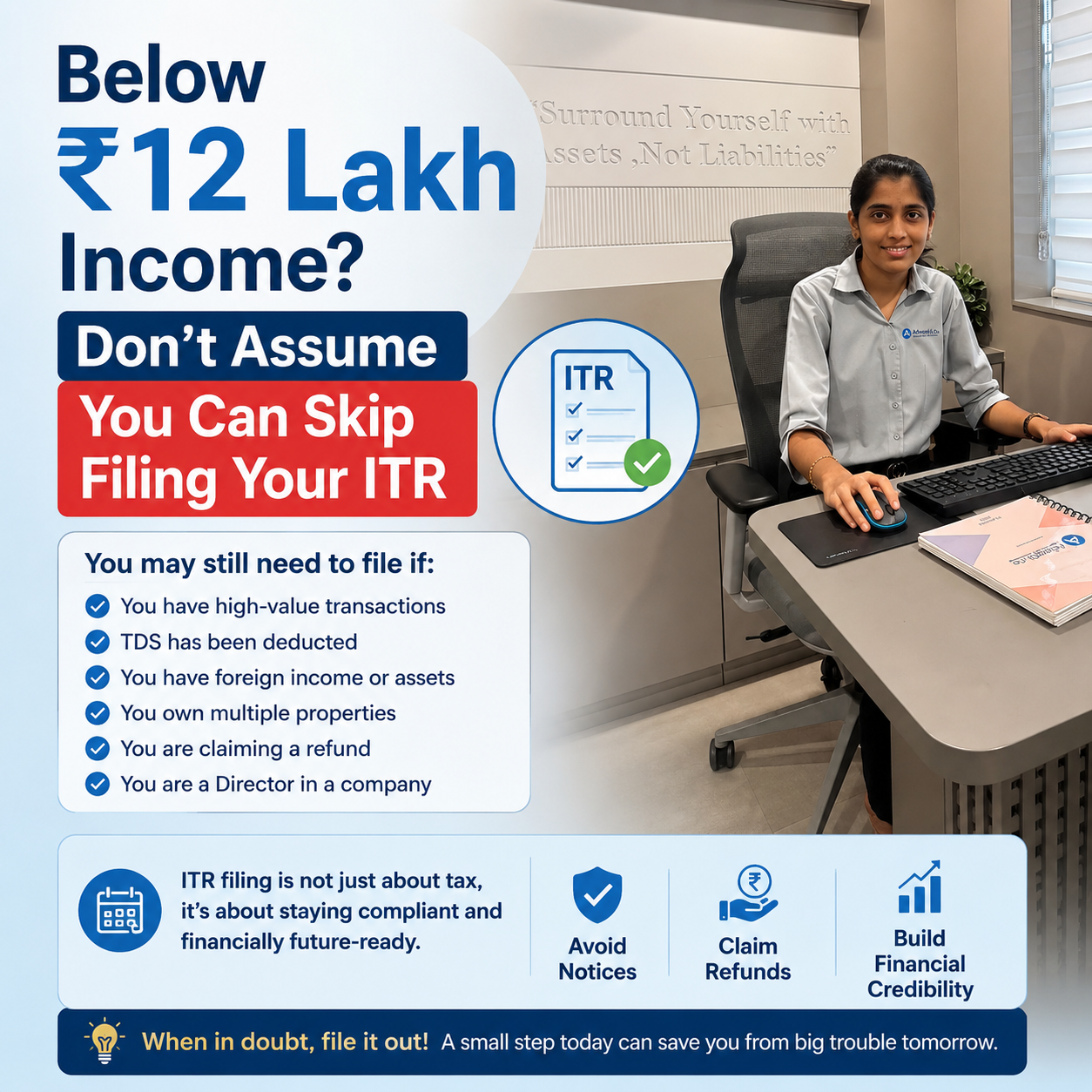
  • ITR Filing Below ₹2.5 Lakh: Is It Really Mandatory? Complete 2026 Guide

    ITR Filing Below ₹2.5 Lakh: Is It Really Mandatory? Complete 2026 Guide

    ITR Filing Below ₹2.5 Lakh: Is It Really Mandatory?

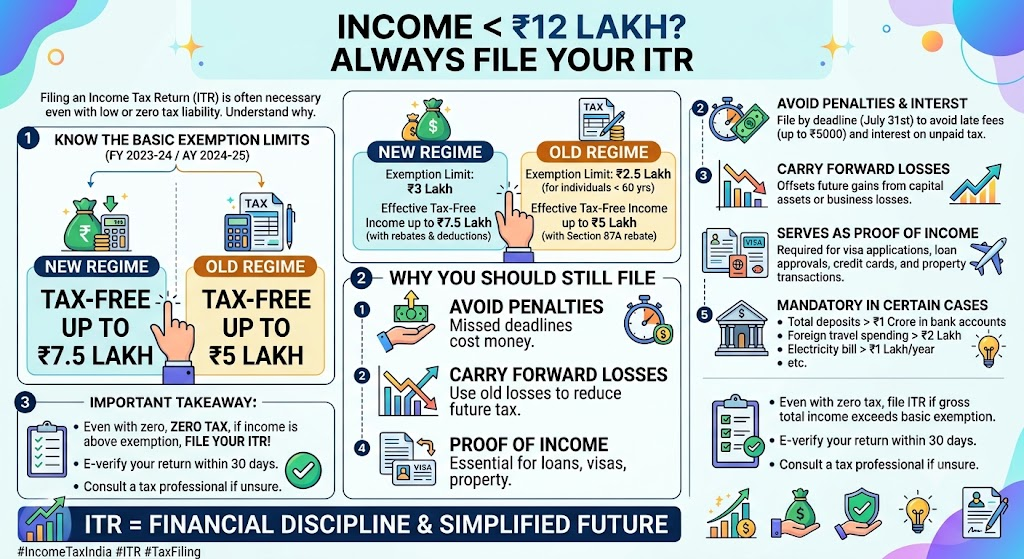
    Many taxpayers assume that if their annual income falls below the basic exemption limit of ₹2.5 lakh, income tax return filing simply doesn’t apply to them. This belief, while common, can be costly. The truth is more nuanced and in several situations, ITR filing below 2.5 lakh income is not just advisable, it is legally mandatory under the Income Tax Act, 1961.

    Understanding the Basic Exemption Limit vs. ITR Filing Obligation

    The ₹2.5 lakh figure represents the basic exemption limit under the old tax regime the income level below which, in most ordinary cases, no tax is payable. However, the obligation to file an income tax return below the taxable limit is governed by a separate set of conditions under Section 139(1) of the Income Tax Act, and these conditions override the simple “no tax, no filing” assumption.

    In other words, having income below 2.5 lakh tells you about your tax liability, not necessarily about your filing requirement. These are two distinct legal questions, and conflating them is one of the most frequent and avoidable mistakes taxpayers make.


    When ITR Filing Becomes Mandatory Despite Low Income

    Under the seventh proviso to Section 139(1), income tax return filing is mandatory for individuals even with income below the taxable limit if any of the following apply during the financial year:

    Mandatory ITR Filing Triggers (regardless of income level)

    • Deposited ₹1 crore or more (cumulatively) in one or more current bank accounts

    • Spent ₹2 lakh or more on foreign travel for self or any other person

    • Paid electricity bills exceeding ₹1 lakh in a year

    • Total sales, turnover, or gross receipts of business exceed ₹60 lakh

    • Gross receipts from a profession exceed ₹10 lakh

    • TDS and TCS during the year is ₹25,000 or more (₹50,000 for senior citizens) • Deposits in one or more savings bank accounts total ₹50 lakh or more

    If any of these conditions are met, ITR filing for income below taxable limit becomes compulsory under law, irrespective of whether actual tax liability is nil. Non-compliance can attract penalties under Section 234F and scrutiny notices from the Income Tax Department.


    Why Voluntary ITR Filing Makes Sense Even When Not Mandatory

    Beyond the legal triggers, there are strong practical reasons to consider voluntary ITR filing below 2.5 lakh income even when none of the above conditions apply:

    Benefits of Filing ITR Even With No Tax Liability

    • Claim TDS refunds deducted on bank interest, fixed deposits, or freelance payments

    • Build a verifiable income record for visa applications, loans, and credit cards

    • Carry forward capital losses or business losses to set off against future income

    • Serve as proof of income for government tenders, scholarships, and subsidies • Avoid last-minute compliance pressure if your income crosses the threshold mid-year


    Practical Guidance from a Tax Professional

    In Dr. Haresh Adwani’s experience advising individual taxpayers across Pune and beyond, the most common red flag is high-value cash deposits or foreign travel spending that taxpayers don’t realise pushes them into mandatory filing territory, even though their taxable income remains nil. A quick review of your AIS (Annual Information Statement) on the income tax portal before the deadline can flag these triggers early and prevent unnecessary notices.

    The Income Tax Department’s e-filing portal and the AIS/TIS framework now cross-verify high-value transactions automatically, making it increasingly difficult to overlook these obligations. Staying proactive, rather than reactive, is the safest approach to ITR filing compliance in 2026.


    Key Takeaways

    • Income below ₹2.5 lakh does not automatically exempt you from filing an ITR

    • High-value transactions (large deposits, foreign travel, high electricity bills) trigger mandatory filing

    • Voluntary filing helps claim refunds, build financial credibility, and carry forward losses

    • Always check your AIS/TIS before assuming no filing is required • When in doubt, consult a qualified tax professional before the ITR filing deadline AY 2026-27

    Read our detailed guide on Income Tax AY 2026-27: The Proven Guide to New ITR Forms, Rules & Avoiding Costly Mistakes


    Frequently Asked Questions

    1.Is ITR filing mandatory below 2.5 lakh income?

    Generally no, but it becomes mandatory if you meet specific high-value transaction conditions like large bank deposits or foreign travel spending.

    2.Can I claim a refund without filing ITR if my income is below the exemption limit?

    No, filing an income tax return is the only way to claim a TDS refund, even when your income is below 2.5 lakh.

    3.What happens if I don’t file ITR despite meeting a mandatory trigger?

    You may face penalties under Section 234F and could receive a scrutiny notice from the Income Tax Department.

    4.Does filing ITR help even with zero tax liability?

    Yes, it builds an income record useful for loans, visas, and carrying forward losses for future tax benefits.

    Conclusion: File Smart, Stay Compliant

    ITR filing below 2.5 lakh income is governed by more than just the basic exemption limit specific transaction-based triggers under Section 139(1) can make filing mandatory regardless of your tax liability. Even where filing isn’t compulsory, doing it voluntarily protects your financial interests and keeps your compliance record clean.

    About the Author – Nidhi Adwani

    Nidhi Adwani is the Human Resources Manager at Adwani & Co. She is a Law Graduate and holds an MBA in Human Resources. She manages recruitment, employee engagement, team development, workplace culture, and the firm’s social media and content activities. Passionate about people and organizational growth, she also contributes articles for ITRAdvisor and Adwani & Co. Her writing focuses on HR practices, leadership, workplace engagement, and professional development, offering practical insights for professionals and businesses.

    At ITRAdvisor.in, we help taxpayers with:

    ✔️ ITR Filing Review

    ✔️ AIS Reconciliation

    ✔️ Capital Gains Reporting

    ✔️ NRI Taxation

    ✔️ Tax Notice Response

    ✔️ Revised Returns

    ✔️ Income Tax Planning

    ✔️ Refund and Compliance Issues

    Visit ITRAdvisor.in today for professional guidance and consultation.

    Early action can often prevent bigger tax problems later.

  • ESOP Valuation in India: What Every Employee and Founder Must Know in 2026

    ESOP Valuation in India: What Every Employee and Founder Must Know in 2026

    ESOP Valuation in India

    An employee is told their ESOPs are worth Rs. 50 lakh. They celebrate. Two years later, at the time of exercise, a very different number appears on their tax statement. What went wrong? Nothing illegal. Just a number that was never properly understood or properly determined.

    This is the quiet danger at the heart of ESOP valuation in India. And in 2026, as start up equity culture matures and the Income Tax Department sharpens its lens on perquisite taxation, getting this right is no longer optional for founders, CFOs, or the employees who accept these grants.


    What Is ESOP Valuation in India and Why Does It Matter?

    An Employee Stock Option Plan (ESOP) gives employees the right to purchase company shares at a pre-decided exercise price, typically lower than the fair market value (FMV). The difference between the FMV on the date of exercise and the exercise price is treated as a perquisite under the Income Tax Act, 1961, and is taxed as part of the employee’s salary income.

    This is where ESOP valuation in India becomes critically important. The FMV on the date of exercise directly determines how much tax the employee pays. If the underlying valuation methodology is weak, arbitrary, or unsupported, it creates problems at multiple levels:

    • The employee faces unexpected ESOP perquisite tax liability in India that they were not prepared for.
    • The company faces questions during investor due diligence or SEBI scrutiny.
    • Regulatory compliance under the Companies Act and FEMA (for ESOPs with foreign participation) becomes difficult to defend.
    • Employee trust erodes when the promised equity value does not align with tax-time reality.

    How Is ESOP Valuation Determined for Unlisted Companies in India?

    For listed companies, the FMV of shares is straightforward it is the market price on the recognised stock exchange. For unlisted start ups, the process is more nuanced and more consequential.

    As per the Income Tax Rules, the FMV of shares of an unlisted company for ESOP purposes is required to be determined by a SEBI-registered Category I Merchant Banker. This is not a valuation that the company can do internally or informally. A formally supported valuation report, applying recognised methodologies such as the Discounted Cash Flow (DCF) method or the Net Asset Value (NAV) approach, is the standard the Income Tax Department expects.

    Common ESOP valuation methods for unlisted companies include:

    1. Discounted Cash Flow (DCF): Projects future cash flows and discounts them to present value, most relevant for growth-stage startups with revenue visibility.
    2. Comparable Company Multiples: Values the company basis revenue or EBITDA multiples of similar listed or recently funded peers.
    3. Net Asset Value (NAV): Based on the company’s book value of assets minus liabilities; typically applied for asset-heavy businesses.

    The choice of methodology and its supporting assumptions must be defensible both to employees asking questions and to tax authorities examining records.


    ESOP Tax Implications in India 2026: Two Points of Taxation

    A frequently misunderstood aspect of ESOP tax implications in India is that employees are potentially taxed twice:

    1: At Exercise Perquisite Tax

    When an employee exercises their options, the spread between FMV and exercise price is treated as salary income (perquisite) and taxed at the employee’s applicable slab rate. For start up employees, where FMV may have grown significantly between the grant date and exercise date, this can result in a substantial tax liability even before a single share has been sold.

    Budget 2020 introduced a deferred tax payment option for employees of eligible startups recognised by DPIIT, allowing this perquisite tax to be deferred up to 48 months from the exercise date, or until the employee leaves, or until the shares are sold whichever is earlier. Eligible employees should verify their employer’s DPIIT recognition status on the government’s startup portal.

    2: At Sale : Capital Gains Tax

    When the employee eventually sells the shares, the gain from sale price minus the FMV at exercise is treated as capital gain. If the shares have been held for more than 24 months (for unlisted company shares), the gains qualify as long-term capital gains, attracting a lower tax rate than short-term capital gains. For listed shares, the holding period threshold is 12 months.


    Why a Well-Supported ESOP Valuation Protects Everyone

    Dr. Haresh Adwani, PhD in Commerce and founding partner of Adwani & Co LLP, has consistently highlighted that in ESOP structuring, the valuation is not just a number it is a document of governance. A credible, independently prepared valuation:

    • Gives employees a transparent, auditable basis for understanding the equity they receive.
    • Helps the company comply with CBDT ESOP valuation rules and withholding tax obligations on perquisites.
    • Strengthens the data room for the next funding round, where investors will scrutinise cap table and ESOP pool integrity.
    • Reduces the risk of tax notices and disallowances arising from valuation disputes.

    Key Takeaways

    • ESOP valuation in India determines the perquisite tax an employee pays at the time of exercising options.
    • For unlisted companies, FMV must be certified by a SEBI-registered Category I Merchant Banker as per Income Tax Rules.
    • Employees of DPIIT-recognised startups may be eligible to defer ESOP perquisite tax by up to 48 months.
    • Tax on ESOP arises at two stages: exercise (as perquisite/salary) and sale (as capital gain).

    A defensible valuation report protects both the employee and the company during due diligence and tax assessments.

    Read our detailed guide on Income Tax Notice India 2026: Every Section Explained What It Means and How to Respond


    Frequently Asked Questions on ESOP Valuation in India

    Q1. What is the meaning of ESOP valuation in India and why does it affect my tax?

    ESOP valuation determines the Fair Market Value (FMV) of your company’s shares at the time you exercise your options. The difference between FMV and your exercise price is taxed as a perquisite (salary income) under the Income Tax Act.

    Q2. Who determines the ESOP valuation for unlisted companies in India? 

    As per Income Tax Rules, the FMV of shares of an unlisted company for ESOP purposes must be determined by a SEBI-registered Category I Merchant Banker. An informal or internally prepared valuation is not sufficient for tax compliance purposes.

    Q3. Can ESOP perquisite tax be deferred for start up employees in India?

    Yes. Employees of eligible startups recognised by DPIIT can defer the perquisite tax on ESOP exercise for up to 48 months from exercise, or until sale or separation whichever comes first. This benefit must be claimed correctly in the ITR.

    Q4. At how many stages are ESOPs taxed in India?

    ESOPs in India are potentially taxed at two stages: at exercise (the FMV-minus-exercise-price spread is taxed as salary/perquisite) and at sale (the profit from sale minus FMV at exercise is taxed as capital gains).

    Q5. What ESOP valuation methods are used for start ups in India?

    The most commonly applied ESOP valuation methods for unlisted Indian startups are the Discounted Cash Flow (DCF) method, Comparable Company Multiples, and the Net Asset Value (NAV) approach, with the choice depending on the company’s stage and business model.

    Conclusion: The Valuation Behind the ESOP Is the Story

    An ESOP is a promise of ownership. But the valuation behind that ESOP is a statement of how seriously a company takes its obligations to its employees, its investors, and the tax authorities who will eventually review the numbers.

    In 2026, as ESOP culture deepens across India’s startup ecosystem, founders and CFOs who treat ESOP valuation as a compliance checkbox are taking an avoidable risk. And employees who accept ESOP grants without asking how the value was determined are leaving important questions unanswered.

    The right question is not: ‘How many shares am I getting?’ It is: ‘How was this value determined, and what are my tax obligations when I exercise?’

    About the Author
    Dr. Haresh Adwani
    Ph.D. in Commerce | Law Graduate | Managing Partner, Adwani & Co LLP

    Dr. Haresh Adwani holds a Ph.D. in Commerce and is a qualified Law graduate with over two decades of hands-on experience in GST advisory, direct taxation, and statutory compliance for businesses across

    Get Expert Clarity on Your ESOP Valuation and Tax Obligations Whether you are a founder structuring an ESOP pool, an employee planning to exercise options, or a CFO managing ESOP compliance, visit itradvisor.in for authoritative, plain-language guidance on ESOP valuation in India, perquisite tax, and capital gains reporting.

    Disclaimer ITRAdvisor.in is an educational and informational platform focused on tax awareness and compliance updates. Nothing contained herein should be construed as solicitation or advertisement of professional services. Professional services, where applicable, are rendered in accordance with ICAI guidelines. This article is published on ITRAdvisor.in, a tax and compliance knowledge platform. The content has been reviewed for technical accuracy by professionals associated with Adwani & Co LLP

    Learn more about our Income Tax Filing Services for Traders & Investors covering ITR-3 filing, tax audit support under Section 44AB, F&O turnover calculation, and capital gains reconciliation with your broker’s statement.

    Visit ITRAdvisor.in today for professional guidance and consultation.

    Early action can often prevent bigger tax problems later

    If you or someone you know has received a Section 148 income tax reassessment notice, do not panic but do act quickly and smartly. The law is on your side, provided you know where to look.

    📞 Take Action Today

    Need help evaluating whether your income tax reassessment notice is valid?

    Connect with the experts at itradvisor.in for a detailed assessment of your notice, legal objection drafting, and end-to-end reply support. Visit: www.itradvisor.in | Powered by Adwani & Co LLP

  • Tax Saving vs Wealth Creation in India: Are You Investing Smart or Just Buying a Deduction?

    Tax Saving vs Wealth Creation in India: Are You Investing Smart or Just Buying a Deduction?

    Tax Saving vs Wealth Creation

    Every year, as March 31 approaches, millions of Indian taxpayers rush to ‘finish off’ their Section 80C limit. Life insurance premiums get paid. Tax-saving Fixed Deposits get booked. ELSS funds get subscribed sometimes at the last minute, without a second thought. But here is the uncomfortable question that very few people ask themselves: If there were no tax benefit attached to this investment, would you still make it? That single question is the difference between tax saving and genuine wealth creation in India and understanding it could be the most financially important thing you do this year.


    The Section 80C Habit: How Tax Saving Became a Financial Reflex in India

    For decades, tax saving and investing were treated as the same activity by most Indian middle-class households. The logic was simple and appealing: invest ₹1.5 lakh under Section 80C, reduce your taxable income, get a tax refund, and feel financially responsible. The products that became staples of this approach included:

    • LIC traditional endowment and money-back policies
    • 5-year tax-saving Fixed Deposits at banks and post offices
    • ELSS (Equity Linked Savings Scheme) mutual funds with a 3-year lock-in
    • Public Provident Fund (PPF) and National Savings Certificates (NSC)
    • Employee Provident Fund (EPF) contributions

    None of these instruments are inherently bad. But the problem arises when tax saving in India becomes the primary or only reason for investment decisions. When you invest because of a tax deadline rather than a financial goal, you are not building wealth. You are buying a deduction.

    Warning: The Hidden Cost of Deadline-Driven Tax Saving

    • You may lock money into products that earn 4–6% returns while inflation runs at 5–6% effectively zero real growth
    • High-premium LIC policies taken for 80C often have poor surrender value if financial needs change
    • Tax-saving FDs are fully taxable on maturity the tax saved upfront may be recovered by the government later

    Investing under pressure in March reduces your ability to select the right product for your actual goals


    How the New Tax Regime Has Changed the Tax Saving vs Wealth Creation Debate in India

    The Income Tax Department’s push toward the New Tax Regime backed by significant structural changes in Budget 2024 and continuing into AY 2026-27 has fundamentally altered the calculus of tax-saving investing in India. Under the new regime, most deductions including Section 80C, 80D, and HRA are not available. In exchange, taxpayers benefit from a zero-tax threshold on income up to ₹12 lakh under Section 87A (as announced in Budget 2025) and a revised standard deduction of ₹75,000 for salaried individuals.

    This means that a large segment of Indian taxpayers — particularly those in the ₹8–15 lakh annual income bracket may already have a lower or even zero tax liability under the new regime, without making a single 80C investment. And yet, many continue to invest in lock-in products simply out of habit or peer pressure, without running the actual numbers.

    According to guidance from the Income Tax Department of India (incometaxindia.gov.in), taxpayers can switch between the old and new tax regimes each year (subject to specific conditions for business income). This flexibility makes it more important than ever to evaluate whether your tax-saving investments are still serving a purpose or simply tying up capital that could be working harder for you.

    Read our detailed guide on Old vs New Tax Regime 2025: Stop Guessing, Start Calculating


    Tax Saving vs Wealth Creation in India: A Side-by-Side Comparison

    Let us be specific. The table below captures the fundamental difference between a tax-saving approach and a wealth creation approach to investing in India:

    DimensionTax Saving FocusWealth Creation Focus
    Primary GoalReduce tax liability this financial yearGrow net worth over 5, 10, 20 years
    Decision DriverMarch 31 deadline pressureLife goals: retirement, home, education
    Typical ProductsLIC endowment, tax-saving FD, NSCEquity mutual funds, NPS, direct equity, index funds
    Risk AwarenessOften low safety prioritised over returnsCalibrated risk taken for inflation-beating returns
    New Regime Impact80C deductions no longer availableInvestment logic holds regardless of tax regime
    Returns Expectation4–6% (often below inflation)10–14% CAGR over long term (equity-linked)
    Real Wealth Built?Moderate tax saved, but corpus modestSignificant compounding works powerfully over time

    The data is clear: wealth creation in India requires a different mindset, a different product selection process, and a different time horizon than tax saving. The two can overlap for example, ELSS mutual funds offer both but they should never be conflated


    A Real Example: How Tax Saving Investments vs Wealth Creation Investments Perform Over 20 Years

    Consider Rajesh, a 35-year-old salaried professional in Pune earning ₹15 lakh per annum. Every year, he invests ₹1.5 lakh under Section 80C in a traditional LIC endowment policy with an effective return of approximately 5% per annum. Over 20 years, his maturity corpus would be approximately ₹49–52 lakh.

    Now consider his colleague Priya. She switches to the new tax regime (where 80C is irrelevant), and instead invests the same ₹1.5 lakh per year in a diversified equity mutual fund SIP averaging 12% CAGR consistent with long-term Nifty 50 returns over 15–20 year periods. After 20 years, Priya’s corpus would be approximately ₹1.37 crore nearly three times Rajesh’s corpus.

    Rajesh saved tax. Priya built wealth. Both invested the same amount. The difference? Rajesh’s investment decision was driven by Section 80C. Priya’s was driven by a financial goal retirement.


    Key Insight:

    • ₹1.5 lakh/year at 5% for 20 years → ~₹50 lakh maturity corpus
    • ₹1.5 lakh/year at 12% for 20 years → ~₹1.37 crore maturity corpus
    • The difference of ₹87 lakh is the cost of investing for a deduction instead of for wealth

    LTCG on equity mutual funds above ₹1.25 lakh per year is taxed at only 12.5% under Section 112A still far more tax-efficient than interest income


    What Wealth Creation in India Actually Looks Like: Smart Investment Alternatives

    The shift in conversations Dr. Haresh Adwani has observed at Adwani and Company during this ITR season is telling. Fewer clients are asking ‘How do I finish my Section 80C?’ and more are asking about mutual funds, equity SIPs, retirement planning, and financial independence. This is not just a trend it reflects a maturing financial culture in India.

    Here are the wealth creation investment strategies that make sense with or without a tax benefit attached:

    1. Equity Mutual Funds and SIPs for Long-Term Wealth Creation

    Index funds and diversified equity mutual funds remain the most accessible and proven vehicle for wealth creation in India. With no lock-in (outside ELSS), full liquidity, and the power of compounding over 10–20 years, equity mutual funds outperform most tax-saving instruments by a significant margin. SEBI’s investor education portal (investor.sebi.gov.in) consistently highlights goal-based SIP investing as the most reliable path to long-term wealth for retail investors.

    2. National Pension System (NPS) for Retirement Planning

    NPS offers an additional deduction of ₹50,000 under Section 80CCD(1B) over and above the ₹1.5 lakh 80C limit and it remains available even under certain corporate tax arrangements. More importantly, it functions as a genuine retirement wealth-building vehicle with equity exposure and annuity options. For taxpayers under the new regime, NPS still has partial tax advantages, making it one of the smartest straddlers of both worlds.

    3. Direct Equity Investing with LTCG Tax Efficiency

    Post-Budget 2024 amendments, long-term capital gains (LTCG) on listed equity shares held for more than 12 months are taxed at 12.5% above ₹1.25 lakh of gains per year. This remains one of the most tax-efficient return profiles available to Indian investors. For individuals with the knowledge and risk appetite, building a portfolio of quality businesses over time is genuine wealth creation in India and it requires zero 80C motivation.

    4. ELSS Mutual Funds: The Best of Both Worlds

    For taxpayers who remain on the old tax regime and want to maximise both tax saving and wealth creation, ELSS mutual funds are still the most intelligent Section 80C instrument. They carry a mandatory 3-year lock-in, but are equity linked, historically return-positive over 5–10 year holding periods, and allow SIP investing. The tax benefit is a bonus not the reason to invest.


    The 3 Questions That Separate Tax Savers from Wealth Creators in India

    Dr. Haresh Adwani, PhD in Commerce and a law graduate with deep expertise in integrated tax and financial planning, advocates a three-question framework before every investment decision. This framework simple but powerful ensures that your investments serve your life goals rather than your tax receipt:

    1. Does this investment fit my financial goals? (Not just ‘Does it qualify for 80C?’)
    2. Do I fully understand the risks, lock-in, liquidity, and real returns of this product?
    3. Would I still invest in this if there was zero tax benefit attached to it?

    If the answer to question three is a clear no, that is a signal worth paying attention to. You may be buying a deduction not building wealth.

    Common Mistake: What Many Indian Investors Get Wrong About Tax Planning

    • Treating tax planning as a year-end activity rather than a year-round financial strategy
    • Confusing tax saving instruments with wealth-creating instruments they are not always the same
    • Not comparing the new vs old tax regime before committing to 80C investments every April
    • Ignoring the impact of inflation on low-return tax-saving products over a 15–20 year period

    Missing the additional ₹50,000 NPS deduction under Section 80CCD(1B) a widely underutilised wealth-and-tax benefit

    Frequently Asked Questions

    Q: Is Section 80C investment still worth it under the new tax regime in India for AY 2026-27?

    A: Under the new tax regime, Section 80C deductions are not available. If you opt for the new regime, focus on investments that deliver the best returns for your goals not tax deductions. Evaluate both regimes with a CA before deciding.

    Q: What is the difference between tax saving and wealth creation in India?

    A: Tax saving reduces your current year’s tax liability through specific investments or deductions. Wealth creation builds your long-term net worth through returns that compound over time ideally in a tax-efficient way.

    Q: Which investments are best for wealth creation in India without depending on Section 80C?

    A: Equity mutual funds, index funds, direct equity, NPS, and goal-based SIPs are the most powerful wealth creation vehicles in India. Their returns typically outperform 80C instruments significantly over a 10–20 year period.

    Q: Can I switch between old and new tax regime every year in India?

    A: Salaried individuals can switch between regimes each financial year. However, those with business or professional income face restrictions. Consulting a CA like the team at Adwani and Company is advisable before switching.

    Q: How is LTCG on equity mutual funds taxed in India after Budget 2024?

    A: Long-term capital gains on equity mutual funds held over 12 months are taxed at 12.5% above ₹1.25 lakh per year under Section 112A. This makes equity investing one of the most tax-efficient wealth creation strategies in India.

    Q: What is the three-question framework for smart investing in India?

    A: Before any investment, ask: Does it fit my financial goal? Do I understand its risk and return profile? Would I still invest in it without a tax benefit? If the last answer is ‘no’, reconsider your investment rationale.

    Conclusion: Good Tax Planning Serves Wealth Creation : Not the Other Way Around

    The conversation around tax saving vs wealth creation in India is evolving and that is a genuinely positive development. The fact that more taxpayers today are asking about mutual funds, retirement planning, equity investing, and financial independence, rather than just ‘how to finish 80C’, reflects a maturing financial consciousness across India’s working population.

    But the shift must be made deliberately and with good information. Not all tax saving instruments are poor wealth creators. Not all wealth creation strategies ignore tax efficiency. The goal is alignment ensuring that every investment serves both your tax situation and your life goals simultaneously.

    That alignment is exactly what Adwani and Company has been delivering to clients across Pune and India for nearly five decades. With Dr. Haresh Adwani’s integrated expertise in commerce, law, and taxation at the helm, the firm is uniquely positioned to help you answer the most important question in personal finance: Are you building wealth or just buying a deduction?

    About the Author
    Dr. Haresh Adwani
    Ph.D. in Commerce | Law Graduate | Managing Partner, Adwani & Co LLP

    Dr. Haresh Adwani holds a Ph.D. in Commerce and is a qualified Law graduate with over two decades of hands-on experience in GST advisory, direct taxation, and statutory compliance for businesses across

    Disclaimer: ITRAdvisor.in is an educational and informational platform focused on tax awareness and compliance updates. Nothing contained herein should be construed as solicitation or advertisement of professional services. Professional services, where applicable, are rendered in accordance with ICAI guidelines. This article is published on ITRAdvisor.in, a tax and compliance knowledge platform. The content has been reviewed for technical accuracy by professionals associated with Adwani & Co LLP. pant, or someone navigating all three simultaneously your tax treatment, ITR form selection, and loss utilisation strategy need to be correct, consistent, and complete.
    Learn more about our Income Tax Filing Services for Traders & Investors covering ITR-3 filing, tax audit support under Section 44AB, F&O turnover calculation, and capital gains reconciliation with your broker’s statement.

    Visit ITRAdvisor.in today for professional guidance and consultation.

    Early action can often prevent bigger tax problems later

    If you or someone you know has received a Section 148 income tax reassessment notice, do not panic but do act quickly and smartly. The law is on your side, provided you know where to look.

    📞 Take Action Today

    Need help evaluating whether your income tax reassessment notice is valid?

    Connect with the experts at itradvisor.in for a detailed assessment of your notice, legal objection drafting, and end-to-end reply support. Visit: www.itradvisor.in | Powered by Adwani & Co LLP

  • Section 44AD & Balance Sheet: The Truth Every Small Business Owner Must Know

    Section 44AD & Balance Sheet: The Truth Every Small Business Owner Must Know

    Section 44AD & Balance Sheet

    A creditor asked a small business client for a Balance Sheet. The client was filing under Section 44AD of the Income Tax Act. Legally, the client was compliant presumptive taxation scheme 44AD does not mandate maintaining traditional books of account for most small businesses. But commercially, the creditor still needed financial clarity before extending credit. This single situation reveals a gap that thousands of small business owners across India face: compliance relief under Section 44AD is not the same as financial awareness.


    What Is Section 44AD and Who Qualifies for Presumptive Taxation in 2026?

    Section 44AD of the Income Tax Act, 1961 provides a presumptive taxation scheme for eligible small businesses with turnover up to ₹3 crore (subject to conditions on digital receipts). Under this scheme, a fixed percentage of gross receipts typically 8% (or 6% for digital transactions) is deemed as net profit, eliminating the need for detailed books and audit under Section 44AB.

    Businesses opting for presumptive taxation 44AD in 2026 file their returns using ITR-4, making compliance significantly lighter compared to regular taxation. According to guidelines available on the Income Tax Department’s portal (incometax.gov.in), taxpayers under 44AD are exempt from the requirement to maintain books of account as prescribed under Section 44AA, provided they declare income at or above the presumptive rate.


    Section 44AD and Balance Sheet: What the Law Says vs. What Reality Demands

    Here is where business owners often misread the law. Section 44AD balance sheet requirement in India is not mandated by the Income Tax Act for compliant taxpayers under the presumptive scheme. However, that legal exemption does not mean a business can afford to operate without financial visibility.

    The law can relax what you are required to maintain.

    It cannot replace what you need to know.

    Tax compliance keeps you on the right side of the law. Financial management helps you build something that lasts.

    Creditors, banks, NBFCs, and even government tender processes routinely ask for a Balance Sheet to assess a business’s financial position regardless of which tax scheme the business uses. A Balance Sheet is, ultimately, a financial mirror of the business.


    How to Address a Creditor’s Request When Filing Under Section 44AD

    When a creditor or lender asks for a Balance Sheet from a Section 44AD taxpayer, there is a practical path forward even without formal accounts. The following documents together paint a coherent financial picture:

    • ITR-4 Acknowledgement: Shows declared income, turnover, and tax paid a credible starting point.
    • Computation of Income: Demonstrates the presumptive income calculation and net profit declared.
    • Bank Statements & Reconciliation: Establishes actual cash flows, receipts, and business activity.
    • GST Returns (GSTR-1 / GSTR-3B): Corroborates turnover independently through the GST portal (gst.gov.in).
    • Outstanding Debtors / Creditors List: Provides a snapshot of working capital position.

    Together, these documents substitute for a traditional Balance Sheet and satisfy most creditor due diligence requirements for small businesses under presumptive taxation 44AD 2026.

    Why Financial Awareness Still Matters Under Section 44AD

    As Dr. Haresh Adwani, PhD in Commerce and legal expert, often emphasizes in his advisory practice: a business owner may not be legally required to maintain books under 44AD, but the absence of records does not eliminate financial risk. Every business regardless of its tax scheme should have clarity on:

    • Total assets and liabilities at any point in time
    • Outstanding loans, dues, and repayment obligations
    • Borrowing capacity and working capital health
    • Cash flow patterns across quarters
    • Whether the business can sustain itself through a lean period

    These are not audit questions. They are survival questions. Businesses that track these numbers even informally are far better positioned to negotiate credit, handle disputes, and scale sustainably.


    Key Takeaways: Section 44AD, Balance Sheet & Financial Management

    1. Section 44AD exempts eligible small businesses from maintaining books of account under Section 44AA.

    2. This exemption applies to Income Tax compliance not to commercial or credit requirements.

    3. Creditors, banks, and NBFCs may still require a Balance Sheet or equivalent financial documentation.

    4. ITR-4, bank statements, GST returns, and income computation can together address creditor queries.

    5. Financial awareness knowing your assets, liabilities, and cash flows is essential regardless of tax scheme. 6. Presumptive taxation 44AD in 2026 is a compliance simplification, not a substitute for sound financial management.

    Read our detailed guide on Presumptive Taxation Scheme: Section 44AD & 44ADA Explained Also read: 10 Common ITR Filing Errors That Can Trigger Income Tax Notices in 2026

    Frequently Asked Questions

    Q1. Is a Balance Sheet mandatory for businesses filing under Section 44AD?

    No, the Income Tax Act does not mandate a formal Balance Sheet for taxpayers complying under Section 44AD. However, creditors, banks, and other third parties may still require financial statements independently of your tax compliance.

    Q2. Can a Section 44AD taxpayer get a bank loan without a Balance Sheet?

    Yes, in many cases. Bank reconciliations, ITR-4, GST returns, and computation of income together can satisfy lender requirements. Some banks have specific assessment frameworks for presumptive taxation filers.

    Q3. What is the turnover limit under Section 44AD in 2026?

    The turnover limit under Section 44AD is ₹3 crore for AY 2026-27, provided at least 95% of receipts and payments are through digital modes. For cash-heavy businesses, the limit is ₹2 crore.

    Q4. What happens if a Section 44AD taxpayer does not declare the presumptive income correctly?

    If declared income falls below the presumptive rate, the taxpayer must maintain books of account and get them audited under Section 44AB. Additionally, they may be barred from re-opting for 44AD for the next five assessment years.

    Q5. Does opting for presumptive taxation 44AD affect a business’s credit eligibility?

    It can, indirectly. Since formal Balance Sheets are not required, lenders may request alternative documents. A well-maintained record of bank statements and GST returns significantly improves credit assessment outcomes for 44AD businesses.

    Conclusion

    Section 44AD is one of the most taxpayer-friendly provisions in Indian tax law and rightly so. It dramatically reduces the compliance burden for small businesses and makes ITR-4 filing accessible to millions who might otherwise struggle with detailed accounts.

    But here is what every small business owner must internalise: compliance is the floor, not the ceiling. Filing under presumptive taxation 44AD in 2026 keeps you legally protected. Understanding your Balance Sheet your assets, your liabilities, your financial position keeps your business commercially strong. The two must coexist.

    About the Author : Shreya Kavitke

    Shreya Kavitke is a CA Finalist and an Article Assistant at Adwani & Co. LLP, where she works across diverse areas of taxation, accounting, and regulatory compliance. With a strong academic foundation in commerce and practical exposure to advisory and compliance engagements, she contributes to research and analysis on evolving tax and business regulations.

    Her areas of interest include direct taxation, Goods and Services Tax (GST), corporate compliance, and financial reporting.

    At ITRadvisor, Shreya contributes articles that combine technical accuracy with practical applicability, helping readers stay informed about key tax developments, compliance obligations, and emerging regulatory trends. She believes that clear, reliable, and timely guidance is essential to navigating today’s dynamic tax environment.

    This version reflects the polished, research oriented tone commonly found in publications by leading professional services firms while remaining authentic to Shreya’s current role and experience.

    Want clarity on Section 44AD, ITR-4 filing, or how to present your financials to creditors? Visit ITRAdvisor.in for expert-reviewed tax guidance, practical tools, and authoritative content designed for small business owners across India. Stay compliant. Stay financially aware.

    At ITRAdvisor.in, we help taxpayers with:

    ✔️ ITR Filing Review

    ✔️ AIS Reconciliation

    ✔️ Capital Gains Reporting

    ✔️ NRI Taxation

    ✔️ Tax Notice Response

    ✔️ Revised Returns

    ✔️ Income Tax Planning

    ✔️ Refund and Compliance Issues

    If you are unsure whether your return has been filed correctly or want a professional review before submission, consulting an experienced tax professional can help avoid costly mistakes.

    Visit ITRAdvisor.in for expert assistance with your Income Tax Return and tax compliance requirements.

    Disclaimer: ITRAdvisor.in is an educational and informational platform focused on tax awareness and compliance updates. Nothing contained herein should be construed as solicitation or advertisement of professional services. Professional services, where applicable, are rendered in accordance with ICAI guidelines. This article is published on ITRAdvisor.in, a tax and compliance knowledge platform. The content has been reviewed for technical accuracy by professionals associated with Adwani & Co LLP

    A prominent “File Your ITR Now” button near the top and again at the end of the article

    Need help filing your Income Tax Return? Click the WhatsApp icon and our team will guide you through the process and assist you with your ITR filing.

    Have questions about your ITR? Click the WhatsApp icon to connect with our tax experts for quick guidance and personalized assistance.

  • Not Every Income Tax Reassessment Notice in India Is Valid : Know Your Legal Rights Before You Panic

    Not Every Income Tax Reassessment Notice in India Is Valid : Know Your Legal Rights Before You Panic

    25 June 2026•Dr. Haresh Adwani

    Not Every Income Tax Reassessment Notice in India Is Valid

    You receive a notice from the Income Tax Department. Your first reaction? Panic. But here’s what most Indian taxpayers don’t know: not every income tax reassessment notice is legally valid. Many are issued outside the permitted time limit, without sufficient reason, or in violation of mandatory procedural safeguards. If you’ve received a Section 148 or Section 148A notice, you have every right and sometimes a strong legal case to challenge it before even responding on merit.

    What Is an Income Tax Reassessment Notice Under Section 148?

    Under the Income Tax Act, 1961 (applicable for AY 2025-26 and earlier; the Income Tax Act 2025 governs from AY 2026-27 onwards), the Assessing Officer (AO) can reopen a previously assessed return if they have “reason to believe” that income has escaped assessment. This is the legal basis for issuing a reassessment notice commonly referred to as a Section 148 notice or income tax reopening notice.

    However, the Income Tax Department cannot simply reopen any year at will. The law imposes strict time limits and procedural conditions that must be satisfied before any valid reassessment notice can be issued. A failure to comply with even one of these conditions renders the income tax reassessment notice legally void.


    Income Tax Reassessment Notice Time Limit: The Law Under Section 149

    The income tax notice time limit for reopening an assessment is one of the most important safeguards available to taxpayers. As per Section 149 of the Income Tax Act, 1961:

    Section 149 : Reassessment Time Limits Up to 3 years from end of relevant Assessment Year: General cases (escaped income up to ₹50 lakh) Up to 10 years from end of relevant AY: Cases where escaped income is ₹50 lakh or more AND the AO has ‘information’ as defined under Section 148 Note: No reassessment can be initiated beyond these limits, even if income has genuinely escaped.

    Any income tax reassessment notice issued beyond the above income tax notice time limit is barred by limitation and is liable to be quashed a position consistently upheld by the Supreme Court and various High Courts across India.


    The Mandatory Section 148A Process: Did the AO Follow It?

    The Finance Act 2021 introduced a critical pre-notice safeguard Section 148A which made the reassessment process significantly more taxpayer-friendly. Before issuing a Section 148 reopening notice, the Assessing Officer is now required to:

    • Provide the taxpayer with a copy of the ‘information’ that triggered the inquiry
    • Issue a show-cause notice under Section 148A(b) and give the taxpayer a minimum 7-day opportunity to respond (extendable to 30 days)
    • Consider the taxpayer’s reply and pass a reasoned order under Section 148A(d) before issuing the Section 148 notice

    If the AO skips or short-circuits this Section 148A process, the subsequent income tax reassessment notice is procedurally defective and legally challengeable. This is not a technicality — it is a statutory mandate enforced by multiple High Court rulings


    3 Grounds on Which an Income Tax Reopening Notice Can Be Challenged

    1. Notice Issued Beyond the Limitation Period

    If the income tax reassessment notice arrives after the income tax notice time limit prescribed under Section 149, you can challenge it on grounds of limitation before the AO, and if rejected, before the ITAT or High Court via writ jurisdiction.

    2. No Tangible Material or ‘Escapement of Income’

    The AO must have concrete, credible information not mere suspicion or a fishing expedition to believe income has escaped assessment. The Supreme Court in landmark rulings has held that ‘reason to believe’ must be based on tangible material. A reassessment notice based on change of opinion about already-disclosed income is invalid.

    3. Non-Compliance with Section 148A Mandatory Procedure

    As discussed, failure to follow the Section 148A show-cause notice procedure before issuing a Section 148 income tax reassessment notice is a fatal procedural error that courts have used to quash such notices.

    Real-World Example

    Scenario: Mr. Ramesh filed his ITR for AY 2019-20. In March 2026, he receives a Section 148 notice for that year, claiming escaped income of ₹8 lakh.

    Issue: AY 2019-20 falls beyond the 3-year general limit from March 2026, and the escaped income is under ₹50 lakh — so the 10-year extended limit does not apply. Result: This income tax reassessment notice is barred by limitation and can be successfully challenged.

    Read our detalied guide on Income Tax Notice India 2026: Every Section Explained What It Means and How to Respond


    What Should You Do If You Receive an Invalid Income Tax Reassessment Notice?

    • Do not ignore the notice file a reply within the stipulated time, even while challenging its validity
    • Raise preliminary legal objections regarding the income tax notice time limit and procedural defects in your written reply
    • Rely on the Supreme Court’s ruling in GKN Driveshafts (India) Ltd. vs. ITO (2003) the AO must dispose of objections before proceeding
    • If the AO overrules your objections without valid reasons, approach the High Court via a writ petition
    • Consult a qualified tax professional to assess the strength of your challenge

    Key Takeaway

    • Not every income tax reassessment notice in India is valid or enforceable.
    • Check the date: Is the notice within the income tax notice time limit under Section 149?
    • Check the process: Did the AO follow the mandatory Section 148A procedure?
    • Check the basis: Is there a tangible, specific reason — not mere suspicion?

    If any of these conditions are not met, the income tax reopening notice may be legally challenged and quashed. Source: Income Tax Department (incometax.gov.in) and CBDT Circulars on Reassessment Guidelines.

    Frequently Asked Questions

    Q1. What is the time limit to receive an income tax reassessment notice under Section 149?

    For escaped income up to ₹50 lakh, the reassessment notice must be issued within 3 years from the end of the relevant Assessment Year. For escaped income of ₹50 lakh or more (with prescribed information), the limit is 10 years.

    Q2. Can I challenge an income tax reassessment notice on legal grounds without replying on merits?

    Yes. You can raise preliminary legal objections such as limitation or procedural defects in your reply. The AO is bound to pass a speaking order on these objections before proceeding with reassessment.

    Q3. Is Section 148A mandatory before every income tax reopening notice?

    Yes. Post-Finance Act 2021, the Section 148A show-cause procedure is mandatory before a Section 148 notice can be validly issued. Skipping it is a fatal procedural defect.

    Q4. What happens if I ignore an income tax reassessment notice?

    Ignoring the notice does not make it go away it can lead to ex-parte assessment and hefty demand. Always respond within time, even if you are challenging its validity.

    Q5. Can a reassessment notice be issued for a year where income was already disclosed?

    No. The Supreme Court has ruled that a reassessment notice based on a mere change of opinion where the income was already disclosed and examined is invalid and liable to be quashed.

    Conclusion:

    An income tax reassessment notice can be intimidating but it is not automatically final or correct. The Income Tax Act provides robust safeguards: a strict income tax notice time limit under Section 149, mandatory procedural steps under Section 148A, and the requirement of tangible material before reopening. As tax expert Dr. Haresh Adwani has consistently emphasized, taxpayers must evaluate every reassessment notice for legal validity before responding on merit because a legally defective notice deserves a legal challenge, not just a compliance reply.

    About the Author
    Dr. Haresh Adwani
    Ph.D. in Commerce | Law Graduate | Managing Partner, Adwani & Co LLP Dr. Haresh Adwani holds a Ph.D. in Commerce and is a qualified Law graduate with over two decades of hands-on experience in GST advisory, direct taxation, and statutory compliance for businesses across

    Disclaimer: ITRAdvisor.in is an educational and informational platform focused on tax awareness and compliance updates. Nothing contained herein should be construed as solicitation or advertisement of professional services. Professional services, where applicable, are rendered in accordance with ICAI guidelines. This article is published on ITRAdvisor.in, a tax and compliance knowledge platform. The content has been reviewed for technical accuracy by professionals associated with Adwani & Co LLP. pant, or someone navigating all three simultaneously — your tax treatment, ITR form selection, and loss utilisation strategy need to be correct, consistent, and complete.

    Learn more about our Income Tax Filing Services for Traders & Investors — covering ITR-3 filing, tax audit support under Section 44AB, F&O turnover calculation, and capital gains reconciliation with your broker’s statement.

    Visit ITRAdvisor.in today for professional guidance and consultation.

    Early action can often prevent bigger tax problems later

    If you or someone you know has received a Section 148 income tax reassessment notice, do not panic but do act quickly and smartly. The law is on your side, provided you know where to look.

    📞 Take Action Today

    Need help evaluating whether your income tax reassessment notice is valid?

    Connect with the experts at itradvisor.in for a detailed assessment of your notice, legal objection drafting, and end-to-end reply support. Visit: www.itradvisor.in | Powered by Adwani & Co LLP

  • F&O Trading Taxation in India (2026): The Complete, Definitive Guide Every Trader Must Read

    F&O Trading Taxation in India (2026): The Complete, Definitive Guide Every Trader Must Read

    24 June 2026•Mukesh Chavhan

    F&O Trading Taxation in India

    Every year, thousands of F&O traders receive income tax notices not because they evaded tax, but because they simply did not know how to report their futures and options income correctly. F&O trading taxation in India is one of the most misunderstood areas of personal finance. Whether you made a profit or suffered a loss in the markets, the Income Tax Department expects you to account for every rupee and the rules have significant implications for your AY 2026-27 ITR filing.

    This comprehensive guide breaks it all down in plain, practical language that a working professional or active trader can actually act on.


    Why F&O Taxation in India Is a Compliance Priority in 2026

    The Income Tax Department receives transaction-level data directly from stock exchanges through Statement of Financial Transactions (SFT). If you traded in F&O even for a single contract it likely reflects in your AIS (Annual Information Statement). Ignoring it during ITR filing invites notices, penalties, and even reassessment.

    As per the Income Tax Act, 1961,F&O transactions are treated as non-speculative business income — a classification that carries specific advantages (and obligations) that most traders are unaware of.


    Is F&O Income Business Income or Speculative Income? The Critical Distinction

    This is perhaps the most important question in F&O trading tax. Many traders incorrectly assume F&O falls under ‘speculative’ income (like intraday equity trading). That assumption can be costly.

    KEY RULE: F&O = Non-Speculative Business Income
    Under Section 43(5) of the Income Tax Act, derivatives trading (including futures and options) is explicitly excluded from the definition of ‘speculative transaction’.
    This means F&O income profit or loss is treated as normal business income under the head ‘Profits and Gains of Business or Profession’ (PGBP).

    This has a powerful practical implication: F&O losses can be set off against almost any other income, unlike speculative losses which can only be set off against other speculative gains.


    F&O Income Tax Treatment: How Profits and Losses Are Taxed in AY 2026-27

    F&O Profit: How It Is Taxed

    F&O trading profit is added to your total income and taxed at the applicable slab rate whether you are salaried, a professional, or a business owner. There is no special flat rate like crypto (30%) or LTCG (12.5%).

    For example: If your salary is ₹8 lakh and your net F&O profit for FY 2025-26 is ₹2 lakh, your total taxable income becomes ₹10 lakh, taxed at applicable slab rates under either the old or new tax regime.

    F&O Loss: The Tax Benefit You Must Not Miss

    F&O loss tax benefit is one of the most underutilised advantages available to traders. Here is exactly how it works:

    ScenarioSet-Off Available AgainstCarry Forward
    F&O Loss (same year)Any income except salary* (house property, business, capital gains, other sources)Yes
    Remaining F&O LossFuture F&O profits (non-speculative business income)Up to 8 assessment years
    ConditionITR must be filed before due date (usually July 31)Mandatory for carry forward

    Important: F&O losses cannot be directly set off against salary income in the same year. However, F&O losses can be set off against business income, house property income, capital gains, and other sources in the same year and carried forward against F&O profits for up to 8 years.


    Which ITR Form for F&O Traders in AY 2026-27?

    ITR Form Selection for F&O Traders
    ITR-3: For individuals and HUFs with income from business/profession, including F&O. This is the correct form if you have F&O activity PLUS salary, capital gains, or any other income.
    ITR-4 (Sugam): NOT applicable for F&O traders. ITR-4 is only for presumptive taxation under Sections 44AD/44ADA — F&O trading cannot be declared under presumptive taxation.

    A critical point: even if you are salaried and traded F&O only occasionally, you must file ITR-3. Filing ITR-1 or ITR-2 when you have F&O transactions is a compliance defect that can lead to notices.

    Read our detailed guide on ITR 1 vs ITR 2 vs ITR 3 vs ITR 4: The Definitive Guide to Picking the Right Income Tax Return Form for AY 2026-27

    Which ITR Form for F&O Traders in AY 2026-27?

    ITR Form Selection for F&O Traders
    ITR-3: For individuals and HUFs with income from business/profession, including F&O. This is the correct form if you have F&O activity PLUS salary, capital gains, or any other income.
    ITR-4 (Sugam): NOT applicable for F&O traders. ITR-4 is only for presumptive taxation under Sections 44AD/44ADA F&O trading cannot be declared under presumptive taxation.

    A critical point: even if you are salaried and traded F&O only occasionally, you must file ITR-3. Filing ITR-1 or ITR-2 when you have F&O transactions is a compliance defect that can lead to notices.


    Is Tax Audit Mandatory for F&O Traders? Understanding the Turnover Threshold

    Tax audit under Section 44AB becomes relevant for F&O traders based on ‘turnover’ and the calculation of F&O turnover is different from regular business turnover.

    How to Calculate F&O Turnover

    • For Futures: Absolute value of settlement profit/loss on each trade (favourable + unfavourable)
    • For Options: Premium received on sale of options + absolute value of any settlement profit/loss on option trades
    Turnover (F&O)Profit/Loss SituationTax Audit Required?
    Up to ₹1 croreProfitNo (if profit > 6% of turnover)
    Up to ₹1 croreLoss or profit < 6%Yes (Section 44AB)
    ₹1 crore to ₹10 croreAny (if 95%+ transactions digital)No (increased threshold)
    Above ₹10 croreAnyYes mandatory

    Key Takeaways:

    1. F&O is non-speculative business income taxed at your slab rate, not a flat rate.

    2. F&O losses can be set off against business, house property, capital gains, and other source income (NOT salary in the same year).

    3. Unabsorbed F&O losses can be carried forward for 8 assessment years.

    4. File ITR-3 (not ITR-4) if you have any F&O transactions, regardless of quantum.

    5. Tax audit under Section 44AB may apply if turnover crosses the threshold with a loss or low profit.

    6. Always reconcile your F&O data with AIS before filing the IT Department has exchange data.


    How to Show F&O Loss and Profit in ITR: Step-by-Step Guide

    • Step 1: Download your F&O ledger/contract notes from your broker. Compile all profits and losses.
    • Step 2: Calculate your F&O turnover as described above.
    • Step 3: Determine if tax audit is applicable. If yes, get it done by a CA before filing.
    • Step 4: In ITR-3, enter F&O income under ‘Schedule BP’ (Business and Profession). Report gross receipts, expenses, and net profit or loss.
    • Step 5: If you have a net loss, fill Schedule CYLA (Current Year Loss Adjustment) and Schedule CFL (Carry Forward Losses) appropriately.
    • Step 6: Cross-check all figures with your AIS on the Income Tax portal (incometax.gov.in) before submitting.

    Expert Insight

    According to Dr. Haresh Adwani, a commerce PhD and legal professional associated with Adwani & Co LLP, one of the most common errors made by F&O traders is failing to file ITR before the due date thereby forfeiting the right to carry forward losses. ‘The carry-forward benefit is automatic under the law, but only if you file on time. Missing the deadline can cost you lakhs in future tax relief,’ he notes.


    Legitimate Business Expenses F&O Traders Can Claim as Deductions

    Since F&O is treated as a business, you can claim genuine business expenses to reduce your taxable income. These may include:

    • Brokerage and transaction charges paid to the broker
    • Internet charges used for trading
    • Subscription to market data feeds or research platforms
    • Depreciation on computer or laptop used for trading
    • Professional fees paid to a CA for ITR or audit
    • Home office expenses (proportionate, if you trade from home)

    Important: All expenses must be genuine, documented, and directly related to the F&O trading business. The Income Tax Department may scrutinise excessive or unrelated expense claims.


    Explore More on ITRAdvisor.in

    If you found this guide useful, you may also want to read:

    • Learn more about ITR-3 filing for traders and professionals
    • Read our detailed guide on LTCG and STCG on shares and mutual funds in 2026
    • Understand how to read your AIS and reconcile it with your ITR before filing
    • Explore old vs new tax regime calculator for FY 2026-27 to decide which is better for you
    • Read our guide on advance tax due dates FY 2026-27 — mandatory if your F&O income creates tax liability

    Frequently Asked Questions:

    Q1. Is F&O income taxable in India even if I made a loss?

    Yes even F&O losses must be reported in your ITR. Filing correctly is mandatory and enables you to carry forward losses for up to 8 years to set off against future F&O profits.

    Q2. Can F&O loss be set off against salary income?

    No — F&O losses cannot be directly set off against salary income in the same year. However, they can be set off against business income, house property income, capital gains, or other source income in the same year.

    Q3. Which ITR form should a salaried person with F&O trading file?

    A salaried individual with F&O transactions must file ITR-3, not ITR-1 or ITR-2. ITR-4 is not applicable for F&O income as it cannot be declared under presumptive taxation.

    Q4. How long can F&O losses be carried forward?

    F&O losses (being non-speculative business losses) can be carried forward for up to 8 assessment years, provided the ITR for the year of loss is filed within the due date.

    Q5. Is a tax audit compulsory if I have F&O losses?

    If your F&O turnover is below ₹1 crore but you have a net loss (or profit less than 6% of turnover), a tax audit under Section 44AB is typically required. Consult a qualified CA to confirm your specific situation.

    Conclusion: F&O Taxation Is Not Optional : But It Does Not Have to Be Overwhelming

    F&O trading taxation in India is governed by clear rules the problem is that most traders either don’t know them or learn them after receiving a notice. The good news is that once you understand the non-speculative business income classification, the set-off and carry-forward benefits, the correct ITR form, and the tax audit thresholds, F&O compliance becomes manageable.

    File on time, report accurately, and claim every deduction you are legally entitled to. The Income Tax Department’s AIS platform ensures they already have your trading data — so your ITR should tell the same story.

    About the Author:

    Mukesh Chavan is a dedicated indirect taxation and compliance professional associated with Adwani & Co LLP, specializing in GST advisory, GST audits, GST assessments, and RERA compliance services. With extensive experience in handling complex regulatory matters, he assists businesses in ensuring compliance with evolving GST laws and real estate regulations while minimizing risks and enhancing operational efficiency.

    Mukesh has successfully guided clients through GST registrations, return compliance, departmental assessments, audits, litigation support, and tax planning strategies. He also possesses significant expertise in RERA compliance, helping real estate developers, promoters, and stakeholders navigate regulatory requirements and maintain seamless project compliance.

    Through his articles and professional insights, Mukesh aims to simplify complex GST and RERA provisions, offering practical guidance that empowers businesses to remain compliant, avoid disputes, and make informed decisions in an increasingly dynamic regulatory environment. His approach combines technical expertise with practical business understanding, enabling clients to focus on growth while meeting their statutory obligations with confidence.

    At ITRAdvisor.in, we help taxpayers with:

    ✔️ ITR Filing Review

    ✔️ AIS Reconciliation

    ✔️ Capital Gains Reporting

    ✔️ NRI Taxation

    ✔️ Tax Notice Response

    ✔️ Revised Returns

    ✔️ Income Tax Planning

    ✔️ Refund and Compliance Issues

    Visit ITRAdvisor.in today for professional guidance and consultation.

    Early action can often prevent bigger tax problems later.

  • Avoid AIS Notices Before Filing Your ITR : Complete Guide for Salaried Taxpayers AY 2026-27

    Avoid AIS Notices Before Filing Your ITR : Complete Guide for Salaried Taxpayers AY 2026-27

    Avoid AIS Notices Before Filing Your ITR

    Opened your inbox to find an Income Tax Department email asking you to “explain a discrepancy” before you have even filed your return? It happens to thousands of salaried taxpayers every season, and it almost always traces back to one document: the Annual Information Statement, or AIS. If the numbers in your AIS do not match what you are about to declare in your ITR, you are not just risking a delayed refund you are inviting a AIS notice. This guide walks you through exactly how AIS notices ITR filing AY 2026-27 cases arise, and the precise steps salaried taxpayers should take to avoid one before they even click submit.


    What Is the AIS and Why It Decides Whether You Get a Notice

    The Annual Information Statement is a consolidated financial profile that the Income Tax Department builds for every PAN, pulling data directly from your employer, banks, mutual fund houses, stock brokers, and registrars. It covers salary, interest income, dividends, securities transactions, and high-value spends essentially everything the department already knows about you before you file a single form.

    Many taxpayers assume AIS is the same as Form 26AS. It is not. Form 26AS captures only TDS and TCS entries, while AIS is far broader and includes the underlying transaction data itself. Understanding the Form 26AS vs AIS difference 2026 is the first step toward a clean filing, because the department’s automated systems cross-check your ITR against both.


    How an AIS Mismatch Turns Into an Income Tax Notice

    When the income you declare in your ITR does not align with what AIS already shows, the system does not wait for a human officer to notice. Risk-based automated matching flags the gap almost instantly, and the most common outcome is a notice under the e-Verification Scheme or a query under Section 143(1)(a), asking you to reconcile the difference or file a revised return.

    For salaried employees, the usual triggers are surprisingly routine: a mid-year salary revision your employer reported differently, interest income from a savings account or fixed deposit you forgot to add, dividend income that slipped through, or capital gains on mutual funds that were not separately declared. None of these are deliberate evasion but to an automated matching engine, unexplained is indistinguishable from undisclosed.

    Read our detailed guide on : AIS vs Form 26AS Mismatch in 2026: The Silent Trigger Behind Most Income Tax Notices


    Step-by-Step: How to Avoid an AIS Notice Before You File

    1. Download and Reconcile, Don’t Skip

    Log in to the income tax e-filing portal, open the AIS module, and download both the AIS and the Taxpayer Information Summary (TIS). Compare every line item against your Form 16, salary slips, bank interest certificates, and capital gains statements before you touch the ITR form.

    2. Submit Feedback on Every Incorrect Entry

    If an entry in AIS is wrong, duplicated, or simply does not belong to you, use the “Add Feedback” option against that specific transaction. This creates a documented trail showing you proactively flagged the discrepancy a detail that matters enormously if a notice does arrive later.

    3. File With the Correct Figures, Not Just the Pre-Filled Ones

    Submitting AIS feedback alone does not change your ITR. You still need to file your return using the figures you believe are accurate, supported by your own documentation, even while the feedback is under review.

    4. Re-Check Closer to the Deadline

    AIS data is dynamic and keeps updating as employers and banks file revised TDS returns. A statement downloaded in April can look materially different by late May or June, so re-verify shortly before you actually file.

    Expert Insight According to Dr. Haresh Adwani, tax advisory expert and a key voice behind Adwani & Co LLP’s compliance practice, the single biggest reason salaried taxpayers receive AIS-driven notices is not concealment it is simply filing too early, before banks and employers have finished updating their reported data for the year.


    What Happens If You Already Filed and Then Spot a Mismatch

    If you have already submitted your return and later notice an AIS discrepancy, a belated or revised return is usually the cleanest fix, provided it is filed within the applicable timelines specified by the Income Tax Department. Acting before a formal notice lands is always preferable to responding after one does.

    Key Takeaways

    AIS is broader than Form 26AS and drives most automated notices. Always reconcile AIS and TIS against your own documents before filing. Submit feedback on incorrect entries and file with verified figures. Re-check AIS closer to your filing date since data updates continuously.

    Frequently Asked Questions

    Q1. What triggers an AIS mismatch notice for salaried employees?

    Unreported interest, dividend, or capital gains income, or salary figures that differ from employer-reported data, are the most common triggers. The system flags any unexplained gap automatically.

    Q2. Is Form 26AS the same as AIS?

    No. Form 26AS shows only TDS/TCS data, while AIS covers a much wider range of income and transaction details reported by third parties.

    Q3. Can I correct a wrong entry in my AIS before filing?

    Yes, you can submit feedback against any incorrect or duplicate entry directly on the AIS portal, which creates a record of your objection.

    Q4. Does submitting AIS feedback automatically update my ITR?

    No. Feedback only flags the entry for review; you must still file your return using the figures you believe are correct.

    Q5. What should I do if I get a notice despite reconciling AIS?

    Respond within the stated timeline with supporting documents such as Form 16, bank certificates, and your AIS feedback trail, or seek professional guidance promptly.

    Conclusion:

    An AIS notice rarely means you did something wrong it usually means a data point somewhere was never reconciled. With AY 2026-27 filings now in motion, the safest strategy for any salaried taxpayer is simple: download your AIS, match it line by line against your real records, fix what is wrong, and only then file. That single habit prevents the vast majority of notices before they are ever issued.

    If you want expert guidance on reconciling your AIS or responding to an AIS notice, connect with itradvisor.in today and file your AY 2026-27 return with complete confidence.

    About the Author – Nidhi Adwani

    Nidhi Adwani is the Human Resources Manager at Adwani & Co. She is a Law Graduate and holds an MBA in Human Resources. She manages recruitment, employee engagement, team development, workplace culture, and the firm’s social media and content activities. Passionate about people and organizational growth, she also contributes articles for ITRAdvisor and Adwani & Co. Her writing focuses on HR practices, leadership, workplace engagement, and professional development, offering practical insights for professionals and businesses.

    At ITRAdvisor.in, we help taxpayers with:

    ✔️ ITR Filing Review

    ✔️ AIS Reconciliation

    ✔️ Capital Gains Reporting

    ✔️ NRI Taxation

    ✔️ Tax Notice Response

    ✔️ Revised Returns

    ✔️ Income Tax Planning

    ✔️ Refund and Compliance Issues

    Visit ITRAdvisor.in today for professional guidance and consultation.

    Early action can often prevent bigger tax problems later.

  • Complete GST Compliance Checklist for Small Businesses in Pune: Essential Guide for FY 2026–27

    Complete GST Compliance Checklist for Small Businesses in Pune: Essential Guide for FY 2026–27

    GST Compliance Checklist for Small Businesses in Pune

    Running a small business in Pune whether it is a trading shop in Chinchwad, a manufacturing unit in Bhosari MIDC, a restaurant in Koregaon Park, or a service firm in Baner means navigating one of the most compliance-dense tax frameworks in India. GST is not a one-time registration event; it is a continuous, monthly, quarterly, and annual cycle of filings, reconciliations, and record-keeping. Miss a deadline and the penalties start adding up. Miss a reconciliation and your Input Tax Credit evaporates. Miss a compliance threshold and you risk GST notices, scrutiny, or worse, cancellation of your GST registration. This checklist exists so that Pune’s small business owners never have to miss a step.

    Step 1: GST Registration Compliance for Small Businesses in Pune

    Before anything else, confirm that your GST registration status is current and accurate. Under the GST Act, registration is mandatory if your annual aggregate turnover exceeds ₹40 lakh (for goods suppliers) or ₹20 lakh (for service providers) in Maharashtra. Businesses making inter-state supplies, e-commerce sellers, and those liable for reverse charge mechanism (RCM) must register regardless of turnover.

    GST compliance checklist for registration:

    • Verify that your GSTIN is active on the GST Portal (gst.gov.in) under the ‘Search Taxpayer’ function.
    • Ensure all business addresses including godowns, branches, or additional Pune locations are declared as additional places of business in your GST registration.
    • Confirm that your principal place of business, HSN/SAC codes, and authorised signatory details are up to date.
    • If your turnover has crossed the mandatory threshold during FY 2026-27, apply for GST registration immediately — delayed voluntary registration is treated as non-compliance.
    • If you opted for the GST Composition Scheme (available for eligible Pune traders and manufacturers with turnover up to ₹1.5 crore), verify you are filing CMP-08 quarterly and GSTR-4 annually.

    Step 2: GST Return Filing Deadlines for FY 2026–27 : Complete Calendar for Pune Businesses

    The most common cause of GST notices for small businesses in Pune is missed or delayed return filings. The GST return compliance calendar for FY 2026-27 is as follows:

    Return / FilingWho Must FileDue Date (FY 2026-27)Penalty for Late Filing
    GSTR-1 (Monthly)Regular taxpayers with turnover > ₹5 crore11th of following month₹50/day (nil return ₹20/day), max ₹10,000
    GSTR-1 (Quarterly/IFF)QRMP scheme taxpayers (turnover ≤ ₹5 crore)13th of month after quarter-end₹50/day, max ₹10,000
    GSTR-3B (Monthly)Regular taxpayers (auto-populated from FY 2025-26)20th/22nd/24th (based on state/zone)₹50/day + 18% interest on tax due
    GSTR-3B (Quarterly)QRMP scheme taxpayers22nd/24th after quarter-end₹50/day + 18% interest on tax due
    GSTR-9 (Annual Return)Turnover > ₹2 crore (FY 2025-26 basis)31st December 2026₹200/day, max 0.25% of turnover
    GSTR-9C (Reconciliation)Turnover > ₹5 crore31st December 2026Same as GSTR-9 penalty structure
    CMP-08 (Composition)Composition scheme taxpayers18th of month after quarter-end₹50/day, max ₹2,000
    GSTR-4 (Composition Annual)Composition scheme taxpayers30th April 2027₹50/day, max ₹2,000

    For Pune businesses on the QRMP (Quarterly Return Monthly Payment) scheme, note that tax must still be paid monthly either through the Fixed Sum Method or Self-Assessment Method even though the return itself is quarterly. QRMP is generally the right choice for Pune MSMEs and small traders with turnover below ₹5 crore.

    Step 3: Input Tax Credit (ITC) Reconciliation: The Most Critical GST Compliance Task

    Input Tax Credit is the primary financial benefit of GST registration for small businesses in Pune. But ITC can be claimed only if the conditions under Section 16 of the CGST Act are satisfied and this is where most Pune small business owners inadvertently lose money.

    ITC GST Compliance Checklist for FY 2026-27

    • Reconcile GSTR-2B (auto-generated ITC statement) with your purchase register and books of accounts every month before filing GSTR-3B.
    • ITC is available only if the supplier has filed GSTR-1 and the invoice appears in your GSTR-2B. Follow up actively with non-compliant suppliers whose invoices are missing.
    • Ensure ITC is claimed within the time limit: for FY 2025-26 invoices, the deadline to claim ITC is the earlier of the due date of September 2026 GSTR-3B or the date of filing the annual return.
    • Do not claim ITC on blocked credits under Section 17(5) of the CGST Act these include motor vehicles (with exceptions), food and beverages, personal use goods, and construction services.
    • If you have both taxable and exempt supplies, calculate and reverse ineligible ITC under the proportionate method as required by the CGST Rules.

    Step 4: E-Invoicing Compliance for Pune Small Businesses

    The GST e-invoicing threshold has been progressively lowered by CBIC. As of FY 2026-27, e-invoicing under the GST framework is mandatory for all registered taxpayers with aggregate annual turnover exceeding ₹5 crore in any preceding financial year. For many growing Pune traders, manufacturers, and service exporters, this threshold is now a near-term reality.

    E-invoicing GST compliance checklist:

    • Verify whether your FY 2024-25 or FY 2025-26 turnover crossed ₹5 crore if yes, e-invoicing is mandatory for all B2B transactions from the applicable date.
    • Ensure your accounting or ERP software is integrated with the Invoice Registration Portal (IRP) at einvoice1.gst.gov.in to generate an IRN (Invoice Reference Number) and QR code for each B2B invoice.
    • E-invoices issued without an IRN are invalid for ITC purposes — your buyer in Pune or elsewhere cannot claim ITC on such invoices, which can damage your business relationships.
    • Retain copies of all e-invoices with IRN for at least six years as required under the GST record-keeping rules.

    Step 5: GST Record-Keeping and Audit Trail Requirements

    Under Section 35 of the CGST Act, every registered taxpayer must maintain a complete set of records at the principal place of business — or at each additional place of business in Pune — for a minimum of six years from the due date of the annual return for that year.

    Records that must be maintained for GST compliance checklist:

    • Purchase invoices, sales invoices, debit notes, and credit notes for all inward and outward supplies.
    • Stock registers showing opening stock, purchases, production/manufacture, sales, and closing stock with HSN classification.
    • Input Tax Credit ledger, Electronic Cash Ledger, and Electronic Liability Register (accessible on the GST Portal).
    • Bank statements reconciled with GST turnover for the year.
    • For exporters and SEZ suppliers: shipping bills, LUTs (Letter of Undertaking), and refund applications filed.

    Key Takeaways:

    •  GST registration is mandatory for Pune businesses with turnover above ₹40L (goods) or ₹20L (services). Verify your GSTIN is active on gst.gov.in.

    •  File GSTR-1 and GSTR-3B on time every month or quarter. Late filing penalties start at ₹50/day and interest at 18% on unpaid tax accrues daily.

    •  Reconcile GSTR-2B with your purchase register monthly before filing GSTR-3B this is the single most important step to protect your ITC.

    •  E-invoicing is mandatory for businesses with turnover above ₹5 crore. Invoices without a valid IRN from the IRP portal are ineligible for ITC.

    •  Composition scheme taxpayers in Pune must file CMP-08 quarterly and GSTR-4 annually by April 30, 2027.

    •  Maintain all GST records for six years. The GST Department conducts audits and scrutiny up to six years from the relevant annual return due date.

    Step 6: Common GST Compliance Mistakes That Pune Small Businesses Must Avoid

    Reconciliation skipped: Filing GSTR-3B without cross-checking GSTR-2B leads to incorrect ITC claims, reversal demands, and scrutiny notices.

    Turnover under-reporting: GST officers increasingly use e-way bill data, e-invoicing records, and bank statement analysis to detect turnover mismatches.

    RCM non-compliance: Reverse Charge Mechanism liability on services like legal fees, GTA freight, and import of services is often missed by small businesses.

    HSN code errors: Incorrect HSN/SAC classification leads to wrong tax rate application and potential demand with interest.

    Debit/Credit note delays: Credit notes for sales returns or rate revisions must be issued and declared within the prescribed time limits to avoid ITC reversal complications for your buyers.

    Read our detailed guide on GST Compliance Checklist India 2026: 7 Essential Rules to Avoid Notices and Penalties


    Expert Insight: GST Compliance Is Not Annual It’s a Monthly Discipline

    Dr. Haresh Adwani, a PhD in Commerce and tax expert associated with ITRAdvisor.in, has a clear message for Pune’s small business community: ‘The biggest GST compliance mistake I see among small businesses in Pune is treating GST as a year-end activity. By the time December comes and the annual return deadline approaches, the reconciliation gaps have compounded for twelve months. GSTR-2B mismatches, missed ITC claims, and overlooked RCM liabilities become expensive to fix retroactively. The businesses that stay clean are the ones that close their GST books monthly, not annually.’

    Frequently Asked Questions

    Q1. What is the GST registration threshold for small businesses in Pune, Maharashtra?

    In Maharashtra, GST registration is mandatory or businesses supplying goods with annual turnover above ₹40 lakh and for service providers above ₹20 lakh. Inter-state suppliers must register regardless of turnover.

    Q2. Which GST return scheme is better for a small Pune business monthly or QRMP?

    For Pune businesses with turnover below ₹5 crore, the QRMP (Quarterly Return Monthly Payment) scheme reduces return filing from 24 to 8 per year while still requiring monthly tax payments. Most small businesses find this significantly simpler.

    Q3. Is e-invoicing mandatory for my Pune small business in FY 2026-27?

    E-invoicing under GST is mandatory if your aggregate turnover in any preceding financial year exceeded ₹5 crore. Check your FY 2024-25 or FY 2025-26 turnover to confirm applicability for the current year.

    Q4. What is the penalty for late GST return filing in India?

    The late fee for delayed GSTR-1 or GSTR-3B filing is ₹50 per day (₹20/day for nil returns), subject to a maximum of ₹10,000. Interest at 18% per annum also accrues on unpaid GST liability from the due date.

    Q5. When is the GSTR-9 annual return due for FY 2025-26?

    The GSTR-9 annual return for FY 2025-26 is due by December 31, 2026. It is mandatory for businesses with turnover above ₹2 crore. GSTR-9C (reconciliation statement) applies to businesses above ₹5 crore.

    Conclusion

    GST compliance checklist for small businesses in Pune is not a checkbox exercise it is a continuous operational discipline that directly protects your cash flow, your Input Tax Credit, and your business reputation. The CBIC and GST Council have progressively tightened enforcement mechanisms: e-invoicing mandates, automated GSTR-2B mismatches, e-way bill data triangulation, and AI-driven scrutiny selection mean that gaps in GST compliance are increasingly difficult to hide and increasingly expensive to fix.

    The good news is that the GST compliance framework, while demanding, is entirely manageable with the right processes. A monthly reconciliation routine, timely GSTR-1 and GSTR-3B filings, clean ITC documentation, and proper e-invoicing integration will keep your Pune business fully compliant and free from notices, penalties, and demand orders.

    Is your Pune small business fully GST compliant for FY 2026-27?

    ITRAdvisor.in provides clear, actionable guidance on GST registration, return filing, ITC reconciliation, e-invoicing, and GST notice responses for small businesses across Pune and Maharashtra. Whether you are a first-time GST registrant or an established business trying to clean up your compliance record, our resources are built for you.

    About the Author : Prafull Nile

    Prafull Nile is a senior taxation and accounting professional associated with Adwani & Co LLP, bringing over 19 years of extensive experience in direct taxation, tax audits, income tax assessments, GST audits, and financial statement finalization. He has successfully managed diverse client engagements across industries, providing strategic guidance on tax compliance, assessments, and regulatory matters. In addition to his technical expertise, Prafull leads and mentors teams, ensuring high standards of service delivery and operational excellence. His practical approach, deep understanding of tax laws, and commitment to client success make him a trusted advisor for businesses and professionals navigating complex financial and compliance requirements.

    At ITRAdvisor.in, we help taxpayers with:

    ✔️ ITR Filing Review

    ✔️ AIS Reconciliation

    ✔️ Capital Gains Reporting

    ✔️ NRI Taxation

    ✔️ Tax Notice Response

    ✔️ Revised Returns

    ✔️ Income Tax Planning

    ✔️ Refund and Compliance Issues

    If you are unsure whether your return has been filed correctly or want a professional review before submission, consulting an experienced tax professional can help avoid costly mistakes.

    Visit ITRAdvisor.in for expert assistance with your Income Tax Return and tax compliance requirements.

    Disclaimer: ITRAdvisor.in is an educational and informational platform focused on tax awareness and compliance updates. Nothing contained herein should be construed as solicitation or advertisement of professional services. Professional services, where applicable, are rendered in accordance with ICAI guidelines. This article is published on ITRAdvisor.in, a tax and compliance knowledge platform. The content has been reviewed for technical accuracy by professionals associated with Adwani & Co LLP

    A prominent “File Your ITR Now” button near the top and again at the end of the article

    Need help filing your Income Tax Return? Click the WhatsApp icon and our team will guide you through the process and assist you with your ITR filing.

    Have questions about your ITR? Click the WhatsApp icon to connect with our tax experts for quick guidance and personalized assistance.