Author: Nidhi Nidhi Adwani

  • The Ultimate Guide to Check Income Tax Refund Status Online for AY 2026-27

    The Ultimate Guide to Check Income Tax Refund Status Online for AY 2026-27

    Nidhi Adwani May 2026 8 min read

    Check Income Tax Refund Status Online AY 2026-27

    Step-by-step method to track your ITR refund, understand delays, escalate stuck refunds and never lose a single rupee that’s rightfully yours.

     Every year, millions of Indian taxpayers successfully file their returns for the Assessment Year 2026-27, only to spend weeks wondering: “Where is my income tax refund?”

    Checking your income tax refund status online takes less than two minutes  if you know exactly where to look. And if there’s a problem, it can often be fixed without stepping into a tax office. This guide walks you through every step, every status code, and every escalation path you need.

    According to the Income Tax Department of India, refunds for electronically filed returns are typically processed within 4 to 16 weeks of ITR verification. AY 2026-27 processing timelines have been significantly improved on the redesigned income tax e-filing portal at incometax.gov.in🔗 incometax.gov.in


    Why Your Income Tax Refund Status for AY 2026-27 Matters More Than Ever

    The Income Tax Department processes crores of ITR filings every season. With the introduction of the Annual Information Statement (AIS) and the Taxpayer Information Summary (TIS) under Form 26AS, the system now cross-verifies your declared income against data from banks, employers, mutual funds, and even credit card companies under Rule 114E SFT.

    Read our detailed guide on ITR Filing for AY 2026-27 — Deadlines, Penalties & Smart Strategies


    Step-by-Step: How to Check Income Tax Refund Status Online

    Method 1: Via the Income Tax e-Filing Portal (Recommended)

    1. Log in to the IT Portal

    Visit incometax.gov.in and log in using your PAN number as your user ID along with your registered password. First-time users must complete registration with Aadhaar-linked mobile OTP.

    1. Navigate to “My Account” → “Refund/Demand Status”

    In the dashboard, go to e-File → Income Tax Returns → View Filed Returns. Select AY 2026-27 and click on the return to view its processing status.

    1. Check Processing Status & Refund Details

    You’ll see the current status of your return : whether it’s under processing, processed with refund due, or processed with demand. The refund amount and the expected credit date (if applicable) will be shown here.

    1. Verify Bank Account Pre-validation

    Refunds are credited only to a pre-validated and ECS-enabled bank account linked to your PAN. Confirm this under Profile → My Bank Account. An unvalidated account is one of the most common causes of ITR refund delay in AY 2026-27.

    1. Download your Intimation Notice

    Once processed, download the intimation u/s 143(1) from the portal. This document confirms the exact refund amount calculated by the department always verify it against your filed return.

    Method 2: Track via TIN-NSDL (Alternative)

    Visit tin.tin.nsdl.com, navigate to “Know Your Refund Status”, and enter your PAN and the relevant Assessment Year to view the refund dispatch status

    Decoding Your Income Tax Refund Status : What Each Message Means

    “Return is Under Processing”

    Your ITR has been received but not yet assessed. Processing can take 4–10 weeks post e-verification.

    “Processed with Refund Due”

    If your refund is processed. It should reach your bank account within 5–7 working days

    “Processed with Demand Due”

    If there is a shortfall : you owe tax. Review the intimation u/s 143(1) immediately and either pay or file a rectification request.

    “Refund Returned / Failed”

    Your bank rejected the refund (wrong IFSC, closed account, unvalidated account). File a refund reissue request on the portal immediately.

    “Adjusted Against Outstanding Demand”

    If your current refund is used  to offset a past tax demand. Check your demand history and raise a grievance if the adjustment was incorrect.

    “No Return Filed for this AY”

    Either your return hasn’t been processed yet or it was filed under a different PAN. Check filing acknowledgement (ITR-V) for confirmation


    Top Reasons for ITR Refund Delay in AY 2026-27

    According to experts at Adwani and Company, these are the most frequently seen causes of refund delays in the current assessment year:

    1. Unverified Bank Account

    2. AIS / Form 26AS Mismatch

    3. Pending e-Verification

    4. Outstanding Tax Demand from Previous AYs

    5. High-Value Credit Card or Cash Transactions

    Learn more about our Income Tax Notice Advisory Services — How We Help Respond

    How to Raise a Refund Reissue Request Online

    1. Log in → Services → Refund Reissue
    2. Update and validate your bank account
    3. Submit Refund Reissue Request

    Once a valid refund reissue request is submitted and processed, refunds are typically credited within 7–14 working days. Track updated status on the portal or via TIN-NSDL.

    How to Escalate a Stuck Income Tax Refund

    • Submit a Grievance on the IT Portal
    • Write to Your Jurisdictional Assessing Officer (AO)
    • Contact the Centralized Processing Centre (CPC), Bengaluru

    Refund Status vs. Form 26AS vs. AIS Know the Difference for AY 2026-27

    Many taxpayers confuse these three documents. Here’s a clear breakdown that every filer should understand before filing ITR for AY 2026-27:

    Form 26AS

    Reflects TDS deducted, TCS collected, and advance tax paid. It’s the foundational tax credit document. Mismatches here directly affect your refund calculation.

    AIS (Annual Information Statement)

    A comprehensive document showing all financial transactions  salary, interest, dividends, mutual funds, property, credit cards, and more  as reported to the IT Dept.

    TIS (Taxpayer Information Summary)

    A simplified, consolidated view derived from AIS. The IT Dept uses TIS to pre-fill ITR forms. Always reconcile TIS with your actual income before filing.


    Key Takeaways

    • Always e-verify your ITR within 30 days of filing  refund processing begins only after verification.
    • Check income tax refund status online on incometax.gov.in or TIN-NSDL after 4–6 weeks of e-verification.
    • Pre-validate your bank account with ECS enabled before filing to avoid refund failure.
    • Reconcile Form 26AS, AIS, and TIS before filing to prevent mismatches that cause ITR refund delay.
    • If your refund is stuck beyond 8 weeks, raise a grievance on the IT portal and track using the ticket number.
    • High-value credit card spends (>₹10L) and cash deposits may trigger scrutiny disclose accurately in your ITR.
    • Outstanding demands from past AYs will be automatically adjusted against your current year refund.

    Frequently Asked Questions

    1.How long does it take to get Income Tax refund after ITR processing?

    Once  your ITR is processed and the intimation u/s 143(1) is issued, refunds are typically credited  within 5to10 working days .If your return was selected for scrutiny or has a mismatched AIS, it may take 4to16 weeks.

    2.Can I claim Income Tax refund interest if my refund is delayed?

    Yes. Under Section 244A of the Income Tax Act, you are entitled to receive simple interest at 0.5% per month (or 6% per annum) on the refund amount if the delay is attributable to the Income Tax Department

    3.How do I check my Income Tax refund status without logging in?

    You can check via the TIN-NSDL portal at tin.tin.nsdl.com  navigate to “Know Your Refund Status”, enter your PAN number and Assessment Year (AY 2026-27), and the platform will display the refund dispatch status.

    4.What does “Refund Returne or “No credit Received” status mean for my Income Tax refund?

    Refund Returned” means the refund amount was dispatched by the IT Department but could not be credited because your bank account was closed, had an incorrect IFSC code, or was not pre-validated/ECS-enabled. You must file a refund reissue request on incometax.gov.in under Services → Refund Reissue. Update your correct bank account, complete pre-validation, and submit with EVC authentication.

    Conclusion:

    Your Income Tax Refund is Rightfully Yours Claim It Smartly

    Checking your income tax refund status online for AY 2026-27 is no longer a complex process  it’s a 2 minute task if your paperwork is in order. The key is proactivity: verify your ITR promptly, ensure your bank account is pre-validated, reconcile your AIS and Form 26AS before filing, and monitor your status regularly. At Adwani and Company, led by Dr. Haresh Adwani, we handle hundreds of complex refund cases, AIS disputes, ITR revisions, and income tax notice responses every season. Our clients across India trust us for one reason: we treat every rupee of your refund as seriously as you

    Visit: www.adwaniandco.com | Call: +91 7620 127 137 | Email: enquiries@adwaniandco.com

    Share:WhatsApp Twitte LinkedIn

  • ITR 1 vs ITR 2 vs ITR 3 vs ITR 4: The Definitive Guide to Picking the Right Income Tax Return Form for AY 2026-27

    ITR 1 vs ITR 2 vs ITR 3 vs ITR 4: The Definitive Guide to Picking the Right Income Tax Return Form for AY 2026-27

    Nidhi Adwani May 2026 13 min read

    ITR 1 vs ITR 2 vs ITR 3 vs ITR 4

    Every year, millions of Indian taxpayers make one seemingly simple but critically consequential mistake: they file the wrong ITR form. A salaried professional with stock market gains chooses ITR 1. A freelancer with multiple income streams files ITR 4. A business owner picks ITR 2. The result? Defective return notices, delayed refunds, and unwanted attention from the Income Tax Department of India.

    If you have ever stared at your screen wondering whether to pick ITR 1 vs ITR 2 vs ITR 3 vs ITR 4 for AY 2026-27 you are not alone. The four forms look deceptively similar but serve very different taxpayer profiles. Filing the correct income tax return form is not just a compliance formality; it is the foundation of a clean, legally sound tax record.

    In this comprehensive guide, the experts at Adwani and Company led by Dr. Haresh Adwani, a seasoned Chartered Accountant with decades of tax advisory experience break down every ITR form, who qualifies, who doesn’t, and what can go wrong if you choose incorrectly.


    Why Choosing the Correct ITR Form for AY 2026-27 Matters

    The Income Tax Department of India issues separate return forms to capture different income profiles accurately. Filing the wrong form does not just inconvenience you it can result in:

    • A defective return notice under Section 139(9) of the Income Tax Act
    • Rejection of your refund claim until the correct form is refiled
    • Enhanced scrutiny and tax audits
    • Penalties and interest under Sections 234A, 234B, and 234C
    • Loss of carry forward benefits for capital losses or business losses

    According to the Income Tax Department’s official guidelines, a return filed under the wrong ITR form is treated as if it was never filed which means you may face consequences of non-filing even if you submitted a form on time.

    Learn more about our Taxation & Compliance Services to understand how professional guidance prevents such costly errors.


    ITR 1 vs ITR 2 vs ITR 3 vs ITR 4 Quick Comparison Chart for AY 2026-27

    Before diving into the details of each form, here is a quick reference table that captures the key differences:

    FeatureITR 1 (Sahaj)ITR 2ITR 3ITR 4 (Sugam)
    Who Can FileSalaried individualsIndividuals & HUFs (no business income)Business owners, professionals, partnersPresumptive taxation taxpayers
    Income LimitUp to ₹50 lakhNo upper limitNo upper limitUp to ₹3 crore (business) / ₹75 lakh (profession)
    Salary Income✓ Yes✓ Yes✓ Yes✓ Yes
    Capital Gains✗ No✓ Yes✓ Yes✗ No
    Business Income✗ No✗ No✓ Yes✓ (Presumptive)
    Foreign Assets/Income✗ No✓ Yes✓ Yes✗ No
    Multiple House PropertiesOnly 1✓ Multiple✓ Multiple✓ Yes
    Applicable SectionGeneralGeneral44AA, 44AB44AD, 44ADA, 44AE

    Every year, millions of Indian taxpayers make one seemingly simple but critically consequential mistake: they file the wrong ITR form. A salaried professional with stock market gains chooses ITR-1. A freelancer with multiple income streams files ITR 4. A business owner picks ITR 2. The result? Defective return notices, delayed refunds, and unwanted attention from the Income Tax Department of India.

    If you have ever stared at your screen wondering whether to pick ITR 1 vs ITR 2 vs ITR 3 vs ITR 4 for AY 2026-27 you are not alone. The four forms look deceptively similar but serve very different taxpayer profiles. Filing the correct income tax return form is not just a compliance formality; it is the foundation of a clean, legally sound tax record.

    In this comprehensive guide, the experts at Adwani and Company led by Dr. Haresh Adwani, a seasoned Chartered Accountant with decades of tax advisory experience break down every ITR form, who qualifies, who doesn’t, and what can go wrong if you choose incorrectly.


    Why Choosing the Correct ITR Form for AY 2026-27 Matters

    The Income Tax Department of India issues separate return forms to capture different income profiles accurately. Filing the wrong form does not just inconvenience you it can result in:

    • A defective return notice under Section 139(9) of the Income Tax Act
    • Rejection of your refund claim until the correct form is refiled
    • Enhanced scrutiny and tax audits
    • Penalties and interest under Sections 234A, 234B, and 234C
    • Loss of carry-forward benefits for capital losses or business losses

    According to the Income Tax Department’s official guidelines, a return filed under the wrong ITR form is treated as if it was never filed which means you may face consequences of non-filing even if you submitted a form on time.

    Learn more about our Taxation & Compliance Services to understand how professional guidance prevents such costly errors.


    ITR 1 vs ITR 2 vs ITR 3 vs ITR 4 :Quick Comparison Chart for AY 2026-27

    Before diving into the details of each form, here is a quick reference table that captures the key differences:

    FeatureITR 1 (Sahaj)ITR 2ITR 3ITR 4 (Sugam)
    Who Can FileSalaried individualsIndividuals & HUFs (no business income)Business owners, professionals, partnersPresumptive taxation taxpayers
    Income LimitUp to ₹50 lakhNo upper limitNo upper limitUp to ₹3 crore (business) / ₹75 lakh (profession)
    Salary Income✓ Yes✓ Yes✓ Yes✓ Yes
    Capital Gains✗ No✓ Yes✓ Yes✗ No
    Business Income✗ No✗ No✓ Yes✓ (Presumptive)
    Foreign Assets/Income✗ No✓ Yes✓ Yes✗ No
    Multiple House PropertiesOnly 1✓ Multiple✓ Multiple✓ Yes
    Applicable SectionGeneralGeneral44AA, 44AB44AD, 44ADA, 44AE

    ITR-1 (Sahaj) : The Simplified Form for Salaried Individuals

    Who Should File ITR-1?

    ITR-1, also known as Sahaj (meaning ‘simple’ in Hindi), is designed for resident individuals with a straightforward income profile. According to the Income Tax Department, ITR 1 applies to:

    • Salaried employees with total income up to ₹50 lakh in AY 2026-27
    • Pensioners receiving pension from a previous employer
    • Individuals with income from one house property only
    • Taxpayers with income from other sources such as savings bank interest, fixed deposit interest, or family pension (up to ₹5,000 agricultural income)

    Who Cannot File ITR 1?

    This is where most taxpayers go wrong. ITR 1 is explicitly not suitable for you if:

    • You have capital gains from equity mutual funds, stocks, cryptocurrency, property, or any other asset
    • You hold a directorship in any company
    • You have unlisted equity shares
    • You have foreign assets or foreign income
    • You have more than one house property
    • You have business or professional income of any kind including freelancing or consulting fees
    • Your total income exceeds ₹50 lakh

    Pro Tip from Dr. Haresh Adwani: Even one rupee of long-term capital gain from equity mutual funds disqualifies you from ITR-1. Many salaried employees who invest through SIPs unknowingly file ITR-1 and receive defective return notices months later.”

    ITR-2 : The Comprehensive Form for Individuals with Multiple Income Sources

    Who Should File ITR-2?

    ITR-2 is applicable to individuals and Hindu Undivided Families (HUFs) who do not carry on any business or profession. This form accommodates a far more complex income structure:

    • Income from salary or pension
    • Capital gains both short term (STCG) and long-term (LTCG) from shares, mutual funds, real estate, and other assets
    • Income from more than one house property (whether let out or self occupied)
    • Foreign income or assets, including NRI-related income
    • Income from other sources including dividends, interest, and winnings from lotteries
    • Taxpayers with income exceeding ₹50 lakh from salary or other non-business sources
    • Directors of companies or shareholders holding unlisted equity shares

    Who Cannot File ITR-2?

    • Any individual or HUF having income from business or profession (even freelancers)
    • Taxpayers opting for presumptive taxation under Section 44AD, 44ADA, or 44AE

    ITR-2 is the right choice for an HNI (High Net-worth Individual) who earns salary, has rental income from multiple properties, and redeems equity mutual funds in the same year but has no business activity.

    ITR-3 : The Form for Business Owners, Professionals, and Freelancers

    Who Should File ITRc3?

    ITR-3 is the most comprehensive of the four forms, designed for individuals and HUFs earning income from any proprietary business or profession. This includes:

    • Self-employed professionals: doctors, lawyers, architects, consultants, designers, content creators
    • Freelancers who receive fees or project payments
    • Stock market traders treating trading activity as business income
    • Crypto investors or traders with business-classified income
    • Partners in a partnership firm (income from firm is included here)
    • Proprietors of any business entity
    • Individuals who must maintain books of accounts under Section 44AA
    • Taxpayers subject to tax audit under Section 44AB

    Key Features of ITR-3

    ITR-3 also allows taxpayers to report:

    • All types of income salary, capital gains, house property, business income, and other sources in a single return
    • Balance sheet and profit & loss account of the business
    • Depreciation schedules and other business-specific deductions

    Expert Insight: As Dr. Haresh Adwani of Adwani and Company frequently advises clients: “If you are a salaried professional who also earns ₹2 lakh as a freelance consultant, you cannot file ITR-1 or ITR-2. Your freelance income categorises you as having ‘business or professional income,’ making ITR-3 the mandatory choice.”

    ITR-4 (Sugam) : The Presumptive Taxation Form for Small Businesses

    Who Should File ITR-4?

    ITR-4, popularly called Sugam, is tailored for small business owners and self-employed professionals who opt for presumptive taxation under the Income Tax Act:

    • Individuals, HUFs, or partnership firms (other than LLPs) opting for Section 44AD applicable to small businesses with turnover up to ₹3 crore (or ₹75 lakh for digital transactions)
    • Professionals opting for Section 44ADA applicable to specified professions with gross receipts up to ₹75 lakh
    • Transporters opting for Section 44AE applicable to those owning up to 10 goods vehicles

    Key Advantage of ITR-4 / Presumptive Taxation

    Under presumptive taxation, the government deems a fixed percentage of turnover as your net income eliminating the need to maintain detailed books of accounts. For example, under Section 44AD, 8% of turnover (or 6% for digital receipts) is presumed as profit. This simplifies filing significantly for small businesses.

    Who Cannot File ITR-4?

    • Individuals with income exceeding ₹50 lakh (apart from business income)
    • Taxpayers having capital gains income
    • Residents with foreign assets or foreign income
    • Individuals with income from more than one house property
    • Any taxpayer whose books were audited under Section 44AB in any of the preceding five years

    Learn more about our ITR Filing & Tax Compliance Services for small business owners and self-employed professionals.


    Real-Life Example: How to Identify the Right ITR Form

    Taxpayer ProfileIncome SourcesCorrect ITR Form
    Rahul : IT Employee, MumbaiSalary ₹40L, FD interest ₹30,000ITR-1 ✓
    Priya : Bank Manager, PuneSalary ₹85L, LTCG from MF ₹4L, 2 flatsITR-2 ✓
    Vikram : Doctor + ConsultantProfessional fees ₹30L, salary ₹10L, shares STCGITR-3 ✓
    Meena : Retail Shop Owner, NashikShop turnover ₹60L, opts for Section 44ADITR-4 ✓

    Common Mistakes That Trigger Income Tax Notices in AY 2026-27

    The Annual Information Statement (AIS) and Tax Information Summary (TIS) available on the Income Tax Portal now capture almost every financial transaction from stock trades to mutual fund redemptions, from rent receipts to foreign remittances. Any mismatch between your ITR and the AIS triggers an automated notice.

    Common errors to avoid:

    • Filing ITR 1 when you have LTCG or STCG from equity or mutual funds even small amounts
    • Ignoring dividend income shown in Form 26AS from shareholding
    • Treating freelance income as ‘other income’ and filing ITR-1 or ITR-2 instead of ITR 3
    • Not reporting crypto gains the Income Tax Department tracks these via PAN linked exchange accounts
    • Choosing ITR 4 despite having capital gains or foreign assets (both disqualify you from Sugam)
    • Not cross-checking Form 26AS, AIS, and TIS before selecting your ITR form

    Professional Tip: Adwani and Company recommends every taxpayer download their AIS from the Income Tax Portal (incometax.gov.in) and reconcile it with their actual income before deciding which ITR form to file for AY 2026-27.

    Read our detailed guide on AIS Reconciliation and Income Tax Notice Management to stay protected.

    Important Deadlines for ITR Filing : AY 2026-27

    • Due date for individuals (non-audit cases): July 31, 2026
    • Due date for taxpayers requiring audit under Section 44AB: October 31, 2026
    • Belated return filing deadline: December 31, 2026
    • Late filing fee: ₹1,000 (if total income ≤ ₹5 lakh) or ₹5,000 (if total income > ₹5 lakh) under Section 234F

    Filing before the due date is crucial to avoid interest under Sections 234A, 234B, and 234C, and to retain the ability to carry forward business and capital losses.

    Frequently Asked Questions (FAQs)

    Q1. Which ITR form should a salaried employee with mutual fund investments file?

    If you have redeemed mutual fund units and earned capital gains (whether LTCG or STCG), you must file ITR 2. ITR 1 does not capture capital gains income and filing it would render your return defective under Section 139(9).

    Q2. Can a freelancer file ITR-4 for AY 2026-27?

    Yes, but only if your profession falls under Section 44ADA (specified professions including legal, medical, engineering, architecture, accountancy, interior decoration, or technical consultancy) and your gross receipts do not exceed ₹75 lakh. If your income crosses this threshold or your profession is not listed under 44ADA, you must file ITR 3.

    Q3. Can an NRI file ITR-1 for AY 2026-27?

    No. ITR 1 (Sahaj) is applicable only to Resident Individuals. Non Resident Indians (NRIs) who earn income in India must file ITR 2 (if no business income) or ITR 3 (if they have business income). Foreign assets or foreign income automatically disqualifies a person from using ITR1.

    Q4. Can I revise my ITR if I filed the wrong form?

    Yes. Under Section 139(5) of the Income Tax Act, you can file a revised return if you filed the original return before the due date. The revised return can be filed up to December 31, 2026 for AY 2026-27. If your original form choice was wrong, Dr. Haresh Adwani recommends acting promptly to refile under the correct form before the defective return deadline lapses.

    Conclusion

    Choosing the correct income tax return form for AY 2026-27 is not a formality it is the foundation of your entire tax compliance structure for the year. Whether you are a salaried professional, a business owner, a freelancer, or an investor, the difference between ITR 1 vs ITR 2 vs ITR 3 vs ITR 4 is significant and consequential.

    As Dr. Haresh Adwani always tells clients at Adwani and Company: “The cost of getting your ITR right is always lower than the cost of getting it wrong.” Accurate filing protects your refunds, preserves your loss carry forwards, and keeps you on the right side of the Income Tax Department.

    📋 Need Expert Help Filing the Right ITR for AY 2026-27? Connect with Adwani and Company today — your trusted CA firm for accurate, penalty-free income tax filing. Dr. Haresh Adwani and his expert team are ready to guide you through every step. 📞 +91 7620 127 137  |  ✉ enquiries@adwaniandco.com  |  🌐 www.adwaniandco.com
  • How a Smart AIS Review Before Filing ITR Can Save Salaried Taxpayers from Costly Income Tax Notices in AY 2026-27

    How a Smart AIS Review Before Filing ITR Can Save Salaried Taxpayers from Costly Income Tax Notices in AY 2026-27

    Nidhi Adwani May 2026 12 min read

    The Wake-Up Call Every Salaried Taxpayer Needs to Read

    You filed your ITR on time. Your employer deducted TDS correctly. Your Form 16 looks perfect.

    And then a notice from the Income Tax Department lands in your inbox.

    This is not a rare story anymore. It is happening to thousands of salaried professionals across India who believed their tax filing was complete and correct. The reality is that the Income Tax Department has introduced one of the most powerful compliance tools in recent years the Annual Information Statement, commonly known as AIS and it sees far more than your Form 16 ever did.

    At ITR Advisor, we work with salaried employees, IT professionals, NRIs, investors, and high-income taxpayers every year. One of the most common patterns we observe is this: taxpayers who skip a proper AIS review before filing ITR are the ones who end up receiving notices, demands, and defective return alerts later.

    If you are filing your Income Tax Return for AY 2026-27 and want to do it right the first time, this guide is exactly what you need.


    What Is the Annual Information Statement (AIS) and Why Does It Matter?

    The Annual Information Statement (AIS) is a comprehensive financial profile that the Income Tax Department maintains for every taxpayer against their PAN. It is available on the official Income Tax e-Filing Portal and captures data reported by multiple financial institutions and reporting entities.

    Unlike Form 16, which only captures salary and TDS from your employer, your AIS contains data from:

    • All banks (savings interest, FD interest, RD interest)
    • Stock brokers and depositories (share trades, LTCG, STCG)
    • Mutual fund houses (SIP redemptions, fund switches)
    • Property registrars (property purchases and sales)
    • Credit card companies (high-value spends)
    • Foreign remittance entities (international transfers)
    • Insurance companies
    • Dividend-paying companies
    • Tax refund records

    This means your AIS is essentially a 360-degree financial mirror of your entire year’s transactions. When your ITR does not match the data in your AIS, the Income Tax Department’s automated reconciliation systems flag it and a notice follows.

    This is precisely why conducting a thorough AIS review before filing ITR is no longer optional. It is a critical step in responsible tax filing.


    Why Salaried Employees Are Receiving Income Tax Notices in AY 2026-27

    Many salaried taxpayers hold a false assumption: “My employer handles everything. I just need to submit the Form 16 details and I’m done.” This thinking may have worked a decade ago. But today, the Income Tax Department cross-verifies your ITR against AIS data automatically.

    Here are the most common reasons salaried employees receive AIS mismatch notices:

    FD and Savings Interest Not Declared

    Banks report all fixed deposit interest and savings account interest directly to the Income Tax Department regardless of whether TDS was deducted. If the interest falls below the TDS threshold, the bank may not deduct tax but will still report it in AIS.

    When this interest does not appear in your ITR under “Income from Other Sources,” it creates a direct mismatch.

    Example: Ravi, a software engineer in Pune, had three bank accounts. His primary salary account showed ₹3,200 in savings interest. His old joint account (with his mother) showed ₹18,500 in FD interest. His dormant account had ₹6,700 in RD maturity interest. Total interest: ₹28,400 none of it was reported in his ITR because he only used his payslip and Form 16. His AIS clearly showed all three amounts. A scrutiny notice followed six months later.

    Stock Market and Mutual Fund Transactions Ignored

    With India’s growing retail investor base, millions of salaried taxpayers now invest through apps like Zerodha, Groww, and Kite. Many redeem SIPs, book profits on equity funds, or trade intraday and then file ITR without reporting any of it.

    AIS captures every securities transaction reported by depositories and registrars. Short-term capital gains (STCG) and long-term capital gains (LTCG) must be declared accurately. Even zero-tax LTCG below ₹1 lakh must be shown for disclosure compliance.

    Multiple Bank Accounts and Joint Accounts

    Every bank account linked to your PAN feeds data into your AIS. Taxpayers who have old accounts they “forgot about” often miss out on reporting interest income sitting quietly in those accounts.

    Joint accounts are especially tricky the primary holder or all holders may receive reporting, depending on how the account is set up.

    Credit Card Spends and Lifestyle Discrepancies

    If your declared annual income is ₹8 lakh and your AIS shows credit card spends of ₹14 lakh in a single year, the Income Tax Department’s analytics system can flag this as a lifestyle-income inconsistency. This is now a common trigger for Section 148A notices where the department suspects income escaping assessment.

    Foreign Remittances and International Income

    For NRIs, returning Indians, and professionals receiving RSUs from foreign employers, overseas income disclosure is critical. AIS often contains foreign remittance data reported under FEMA-linked sources. Failure to disclose RSU vesting income, foreign salary credits, or international freelance payments is one of the fastest ways to attract serious compliance scrutiny.


    AIS vs Form 26AS: Understanding the Key Difference

    Many taxpayers still confuse AIS with Form 26AS. They are related but serve very different purposes.

    Form 26AS primarily captures:

    • TDS deducted on salary, rent, professional fees, etc.
    • TCS collected
    • Advance tax and self-assessment tax payments
    • Tax refunds credited

    AIS captures all of the above and additionally includes:

    • Savings and FD interest income
    • Securities transaction data (equities, MFs)
    • Dividend received
    • Property purchase and sale details
    • Foreign remittance data
    • High-value banking transactions
    • Credit card spends above thresholds

    As per guidelines issued by the Income Tax Department, AIS is considered a more comprehensive and authoritative data source than Form 26AS. This is why the department now uses AIS as the primary benchmark for ITR verification and notice generation.

    For accurate ITR filing in AY 2026-27, reviewing both Form 26AS and AIS is strongly recommended with AIS receiving the greater attention.

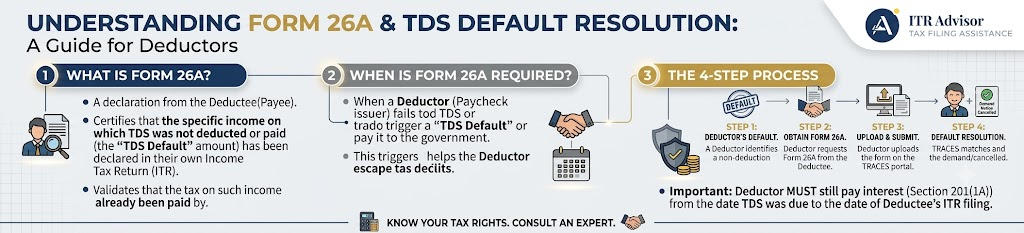
    Read our detailed guide on Form 26A and TDS Default: Relief Under Section 201 and Its Limits


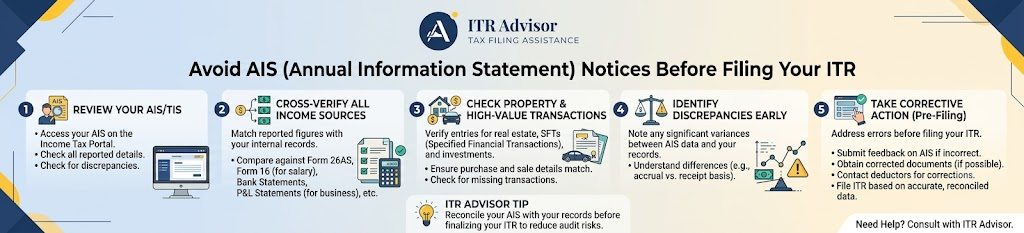
    How to Access and Review Your AIS on the Income Tax Portal

    Accessing AIS is straightforward:

    1. Log in to www.incometax.gov.in using your PAN and password
    2. Navigate to the “Annual Information Statement (AIS)” section under “Services”
    3. Download the AIS in PDF or JSON format
    4. Review each section carefully

    While downloading is easy, reviewing it accurately is where most taxpayers struggle. The AIS contains multiple categories of information and may include entries that are duplicated, incorrect, or attributed to you erroneously.

    A proper AIS review before ITR filing should cover:

    • Personal information accuracy (PAN, name, date of birth)
    • TDS entries (match with Form 16 and salary slips)
    • Interest income (from all banks and accounts)
    • Dividend income (from all stocks and mutual funds)
    • Capital gains (from equities, MFs, and property)
    • Property transaction details
    • Foreign remittance entries
    • High-value banking and credit card transactions

    If you find entries that do not belong to you or are factually wrong, you can submit feedback directly on the portal and you should maintain supporting documents to back up your position.


    What to Do If Your AIS Contains Incorrect Information

    The Income Tax Department’s data collection depends on third-party reporting. Sometimes, banks, brokers, or registrars may report incorrect values, duplicate entries, or transactions that belong to someone else entirely.

    Do not ignore incorrect AIS entries even if they are wrong. Ignoring them and filing without addressing them can lead to a mismatch notice later. The department’s system does not automatically know which entries you dispute.

    Here is the right approach:

    1. Log in to the AIS section on the income tax portal
    2. Click on the specific entry you want to dispute
    3. Select the relevant feedback option (e.g., “Information is incorrect,” “Information relates to other PAN”)
    4. Submit the feedback with supporting documentation
    5. Keep a record of your feedback submission

    After submitting feedback, file your ITR with the correct data and maintain documents that support your disclosures in case clarification is requested later.

    At ITR Advisor, our team helps taxpayers identify incorrect AIS entries, submit proper feedback, and file returns with accurate and defensible disclosures.

    Learn more about our AIS Review and ITR Filing Services.

    The Real Cost of Skipping an AIS Review Before Filing ITR

    Let us be direct: the short-term convenience of filing quickly without reviewing AIS can result in significant long-term costs.

    These costs can include:

    • Mismatch notices requiring detailed written responses
    • Tax demand orders with interest under Section 234A, 234B, and 234C
    • Defective return notices under Section 139(9) if ITR is incomplete
    • Scrutiny assessment under Section 143(3) for serious mismatches
    • Refund delays where the department holds refunds pending reconciliation
    • Penalty proceedings under Section 270A for under-reporting of income
    • Revised return filing costs and professional fees for notice handling

    The financial and emotional cost of dealing with a tax notice far outweighs the time spent on a proper AIS review before filing. Prevention is always more efficient than cure.


    Who Needs to Be Extra Careful About AIS in AY 2026-27?

    While every taxpayer should review AIS, certain profiles face higher scrutiny risk:

    • Salaried employees with investments in stocks, MFs, or real estate
    • IT professionals receiving RSUs, ESOPs, or foreign salary components
    • Senior employees in higher income brackets (₹15 lakh and above)
    • Employees with multiple jobs during the year
    • NRIs and returning Indians with foreign income or assets
    • Freelancers and consultants filing as salaried with additional income
    • High-value banking or credit card users
    • Joint property owners who sold or purchased property during the year

    If you fall into any of these categories, an expert-assisted AIS review before ITR filing is not just advisable it is essential.


    Why ITR Advisor Is the Right Partner for Your AIS Review and ITR Filing

    At ITR Advisor, we understand that modern income tax compliance is no longer simple. The Annual Information Statement has transformed how the Income Tax Department monitors taxpayers and your ITR needs to be filed with equal sophistication.

    Our tax experts bring deep knowledge of income tax law, capital gains taxation, foreign income disclosure requirements, and AIS reconciliation best practices. We have helped hundreds of salaried employees, IT professionals, NRIs, and investors file accurate returns that reduce notice risk and ensure complete compliance.

    Whether your concern is a complex capital gains calculation, an AIS entry you do not recognize, or simply wanting the peace of mind that your return is filed correctly ITR Advisor is here to help.

    Learn more about our Complete ITR Filing Services for Salaried Employees.

    Frequently Asked Questions (FAQs)

    Q1. Is it mandatory to review AIS before filing ITR for AY 2026-27?

    AIS review is not legally mandated, but it is highly recommended by tax professionals and effectively required for accurate filing. Since the Income Tax Department uses AIS for return verification, skipping the review significantly increases the risk of receiving a mismatch notice.

    Q2. Can I receive an income tax notice even if TDS is deducted correctly by my employer?

    Yes. TDS deduction by your employer only covers salary income. AIS captures much broader data including FD interest, dividend income, capital gains, and credit card transactions. Mismatches in any of these areas can trigger notices even if your salary TDS is perfectly correct.

    Q3. What is the difference between AIS and Form 26AS for ITR filing?

    Form 26AS primarily shows TDS, TCS, advance tax, and refund data. AIS is more comprehensive and includes interest income, securities transactions, mutual fund redemptions, dividend data, property transactions, foreign remittances, and high-value spending. For AY 2026-27, AIS is the more critical document to review before filing ITR.

    Q4. How do I check AIS on the income tax portal?

    Log in to www.incometax.gov.in, go to the “Services” section, and select “Annual Information Statement (AIS).” You can view or download your AIS as a PDF or JSON file. Review every section carefully before preparing your ITR.

    Q5. Can AIS data affect my tax refund?

    Yes. If there is a mismatch between your ITR and AIS data, the Income Tax Department may withhold or delay your refund pending reconciliation. A proper AIS review before filing ensures your refund is processed without complications.

    Conclusion: File Smarter, Not Just Faster Your AIS Review Before ITR Filing Matters

    The Annual Information Statement has fundamentally changed the landscape of income tax compliance in India. It is no longer sufficient to file ITR quickly using just Form 16. Every piece of financial information linked to your PAN is now visible to the Income Tax Department and your return needs to reflect all of it accurately.

    A proper AIS review before filing ITR is the single most effective step a salaried taxpayer can take to reduce notice risk, avoid tax demands, ensure accurate disclosure, and get refunds processed without delay.

    For AY 2026-27, take the time to review your Annual Information Statement carefully. If the complexity of the exercise seems overwhelming, that is exactly why professional assistance exists.

    Connect with ITR Advisor today for a complete AIS review and expert ITR filing support. File accurately, file confidently, and file without the fear of a tax notice.

    Visit us at https://itradvisor.in and let our experts handle your AIS review and ITR filing so you can focus on what matters most.