Author: Nidhi Adwani

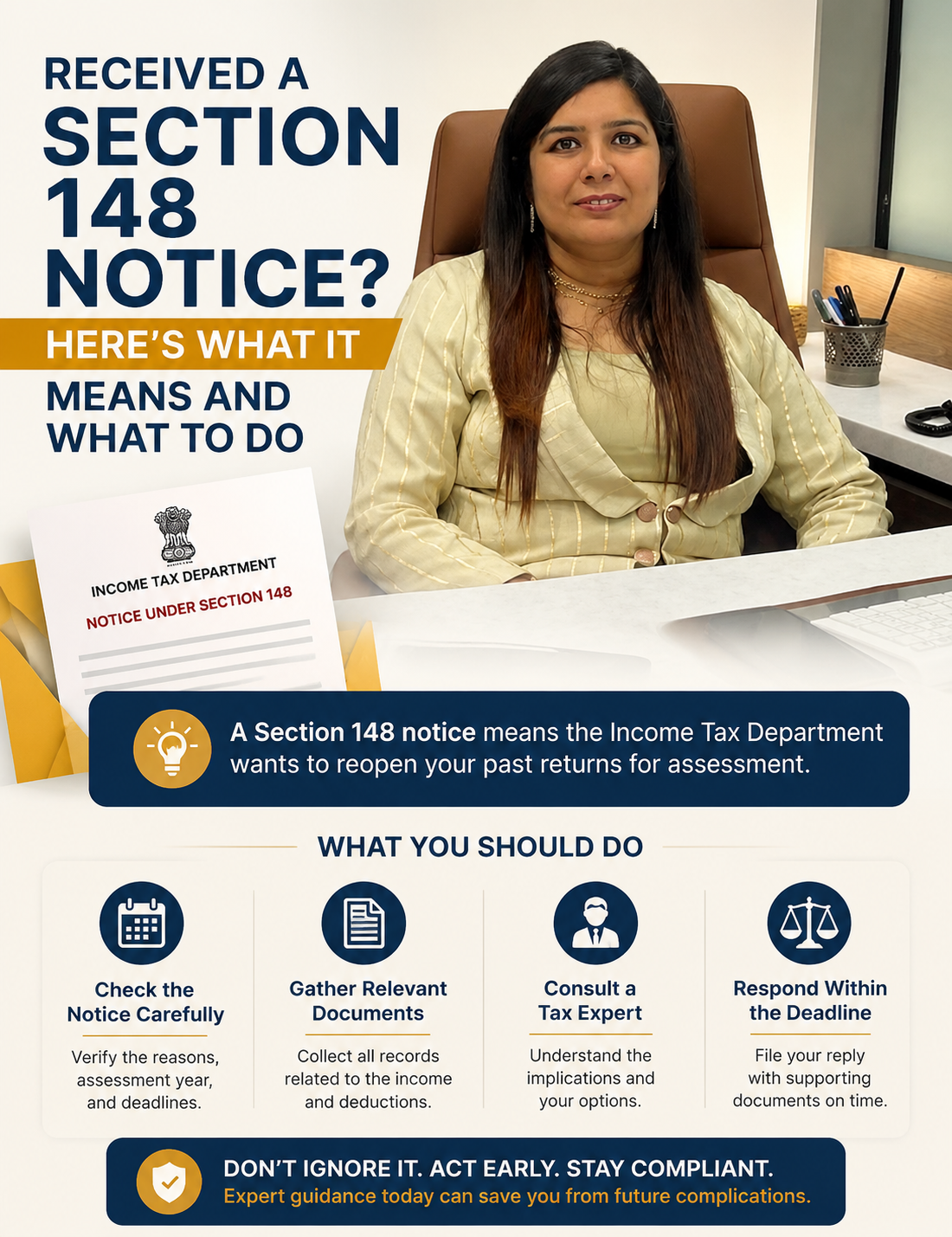
  • Received a Section 148 Notice? Here’s What It Means and What to do

    Received a Section 148 Notice? Here’s What It Means and What to do

    June 2026• Nidhi Adwani

    A Section 148 Notice is one of the most serious notices that a taxpayer can receive from the Income Tax Department.

    Many taxpayers panic when they receive such a notice because it relates to income that the department believes may have escaped assessment in an earlier year.

    However, receiving a Section 148 Notice does not automatically mean that you have committed tax evasion or concealed income. In many cases, notices are issued due to information mismatches, non reporting of transactions, or incomplete disclosures in the Income Tax Return (ITR).

    Understanding the reason for the notice and responding correctly is critical.


    What is a Section 148 Notice?

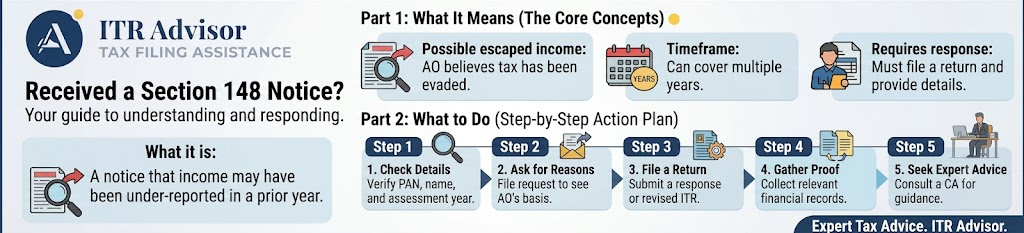
    A Section 148 Notice is issued when the Income Tax Department has information suggesting that taxable income may have escaped assessment.

    In simple words, the department believes that:

    • Certain income was not disclosed in the ITR, or
    • Certain transactions were not properly reported, or
    • Additional tax may be payable.

    The notice gives the taxpayer an opportunity to explain the transaction before reassessment proceedings are completed.

    Why is a Section 148 Notice Issued?

    Today, the Income Tax Department receives information from multiple sources, including:

    • Banks
    • Property Registration Offices
    • Stock Brokers
    • Mutual Fund Companies
    • Credit Card Companies
    • GST Authorities
    • Foreign Tax Authorities
    • Annual Information Statement (AIS)

    If the information available with the department does not match the details disclosed in the ITR, a Section 148 Notice may be issued.

    Common Reasons for Receiving a Section 148 Notice

    1. Property Sale Not Reported

    The taxpayer sold a property but failed to report capital gains in the return.

    1. High-Value Credit Card Spending

    Large spending patterns not matching declared income.

    1. Share Market Transactions Not Disclosed

    Capital gains or trading profits omitted from the ITR.

    1. Foreign Income Not Reported

    Income earned outside India not disclosed where required.

    1. Cash Deposits in Bank Accounts

    Large cash deposits that do not match reported income.

    1. Business Receipts Under-Reported

    Turnover reflected in GST records differs from income declared in the ITR.


    Real-Life Example: Section 148 Notice for Property Sale

    Mr. Rajesh, a salaried employee from Pune, sold a residential plot in 2022 for ₹72 lakh.

    Since tax was deducted by the buyer and the sale proceeds were credited to his bank account, Mr. Rajesh assumed that no further reporting was required.

    While filing his Income Tax Return, he disclosed his salary income but failed to report the capital gains arising from the property sale.

    The property transaction was reported to the Income Tax Department through the registrar’s office and reflected in its database.

    Two years later, Mr. Rajesh received a Section 148 Notice stating that income chargeable to tax appeared to have escaped assessment.

    After consulting a tax professional, he:

    • Obtained the purchase documents.
    • Calculated the indexed cost of acquisition.
    • Computed long-term capital gains.
    • Submitted proof of investment made in another residential property.
    • Claimed exemption under the applicable provisions.

    After reviewing the documents, the Income Tax Department accepted the explanation and completed the reassessment proceedings.

    This is one of the most common reasons for Section 148 Notices in India.


    Real-Life Example: Section 148 Notice for Credit Card Spending

    A taxpayer declared annual income of ₹9 lakh in his Income Tax Return.

    However, information available with the Income Tax Department showed credit card spending exceeding ₹24 lakh during the same financial year.

    The department sought an explanation regarding the source of funds used for such expenditure.

    Upon examination, it was found that a significant portion of the spending was incurred for family members and reimbursed by relatives.

    Supporting documents were submitted and the matter was explained during reassessment proceedings.

    This example highlights how high-value transactions can attract scrutiny even when there is no tax evasion.

    Read our detailed guide on:Got an Income Tax Notice for High Credit Card Spending?


    What Should You Do After Receiving a Section 148 Notice?

    Step 1: Do Not Ignore the Notice

    Ignoring the notice can result in reassessment being completed based on available information.

    Step 2: Understand the Issue

    Identify:

    • Assessment Year involved
    • Transaction questioned by the department
    • Deadline for response

    Step 3: Gather Documents

    Depending on the issue involved, collect:

    • Bank statements
    • Property documents
    • Capital gains calculations
    • Loan documents
    • Investment records
    • Business books of accounts

    Step 4: Verify the Facts

    Many notices arise because the department’s information is incomplete or because a transaction has been misunderstood.

    Step 5: Submit a Proper Response

    A well-documented response supported by evidence can significantly improve the outcome of reassessment proceedings.


    Is Section 148 Notice Serious?

    Yes.

    A Section 148 Notice should always be taken seriously because it involves reopening an earlier assessment.

    However, seriousness does not mean guilt.

    Many genuine taxpayers successfully resolve reassessment proceedings by providing proper explanations and supporting documents.


    What Happens if You Ignore a Section 148 Notice?

    Failure to respond may result in:

    • Reassessment based on available records
    • Additional tax demand
    • Interest liability
    • Penalty proceedings in certain cases

    Therefore, timely action is essential.

    Frequently Asked Questions (FAQs)

    1.Does a Section 148 Notice mean I have concealed income?

    No. The notice only indicates that the department believes income may have escaped assessment and seeks an explanation.

    2.Can salaried employees receive a Section 148 Notice?

    Yes. Property transactions, share trading, foreign assets, and high-value transactions can trigger notices even for salaried taxpayers.

    3.Can a Section 148 Notice be issued years after filing the return?

    Yes. Subject to statutory conditions and timelines prescribed under the Income Tax Act.

    4.Should I seek professional assistance?

    Where the notice involves property transactions, capital gains, business income, foreign assets, or substantial tax demands, professional guidance is strongly advisable.

    About the Author Nidhi Adwani

    Nidhi Adwani is the Human Resources Manager at Adwani & Co., where she plays a key role in people management, team development, organizational culture, and business communications. With a background in Law and MBA (Human Resources), she combines legal understanding with modern HR practices to support a productive and growth-oriented workplace.

    Beyond HR management, Nidhi actively oversees staff engagement initiatives, recruitment, employee development, and internal operations. She also manages the firm’s social media presence and contributes to content strategy, helping communicate valuable insights to clients and professionals through informative articles and digital engagement.

    As a regular contributor to the blogs of ITRAdvisor and Adwani & Co., she writes on topics related to human resources, workplace culture, leadership, employee engagement, professional development, and organizational effectiveness. Her articles aim to simplify practical HR concepts, share industry perspectives, and encourage continuous learning among professionals and business owners.

    Through her writing, Nidhi seeks to bridge the gap between people, processes, and professional growth, helping organizations build stronger teams and healthier work environments.


    Need Help with a Section 148 Notice?

    Receiving a reassessment notice can be stressful, but the right response at the right time can make a significant difference.

    If you have received a Section 148 Notice and need assistance in understanding the notice, preparing a response, calculating capital gains, explaining high-value transactions, or representing your case before the Income Tax Department, professional support can help protect your interests.

    For assistance and consultation, contact ITRAdvisor.in. Our team helps taxpayers across India with ncome Tax Notices, Reassessment Proceedings, AIS Mismatches, Capital Gains Issues, NRI Taxation, and ITR Compliance matters.

    Visit: https://itradvisor.in

    Early action can often prevent unnecessary tax disputes and penalties.

  • Got an Income Tax Notice for High Credit Card Spending?

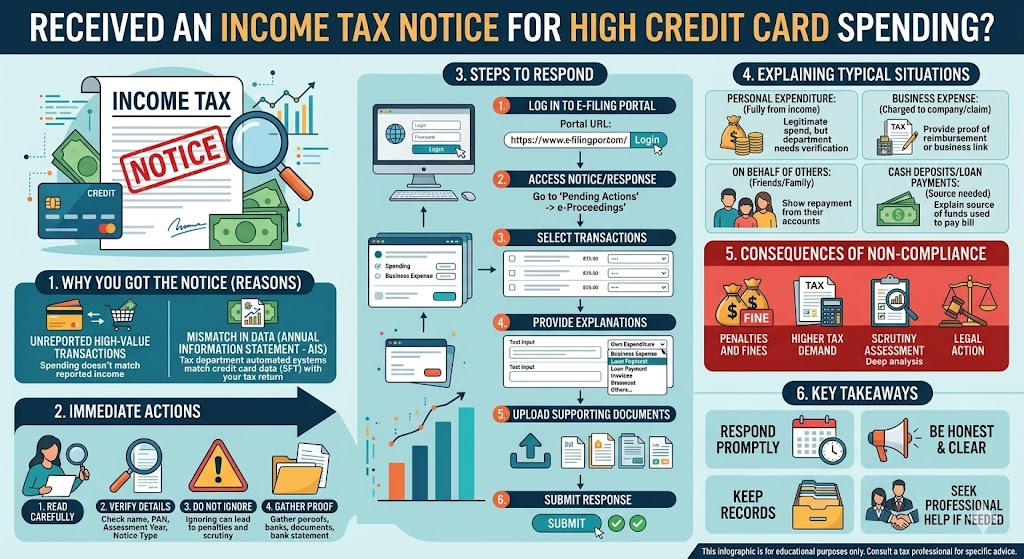
    Got an Income Tax Notice for High Credit Card Spending?

    Here’s Exactly What It Means — and What You Must Do Right Now (2026)

    Nidhi Adwani June 2026 6min Read

    Credit Card Income Tax Notice 2026: Why You Got It and How to Respond

    You swiped your credit card freely for travel, electronics, luxury shopping, or simply to manage monthly expenses and then one day, a notice landed in your inbox from the Income Tax Department. If this sounds familiar, you are not alone. Thousands of Indian taxpayers receive income tax notices on credit card usage every year, and in 2026, the scrutiny has only intensified thanks to AI-powered detection systems.

    Here’s the critical truth: getting a credit card income tax notice does not automatically mean you have done something wrong. It means the Income Tax Department’s systems have flagged a mismatch between your reported income and your spending pattern. What you do next and how fast makes all the difference.

    This guide breaks down exactly why these notices are issued, what Rule 114E really means, and how to craft a factual, legally sound response to protect yourself.


    Why Does the Income Tax Department Send Notices for Credit Card Spending?

    The Income Tax Department does not randomly pick taxpayers. It relies on a structured, data-driven system called the Statement of Financial Transactions (SFT) governed by Rule 114E of the Income Tax Rules, 1962. Under this rule, banks and financial institutions are legally required to report certain high-value transactions directly to the Income Tax Department.

    Credit card spending crosses the reporting radar when:

    • Your total credit card payments in a financial year exceed ₹1 lakh (cash payments toward credit card bills), or
    • Your aggregate credit card expenditure exceeds ₹10 lakh in a financial year (payment by any mode).

    Once this data is uploaded into the Annual Information Statement (AIS) on the income tax portal, the system automatically cross-checks it against the income declared in your ITR. If the spending appears disproportionate to your declared income a mismatch alert is triggered, and a notice follows.

    Read our detailed guide on Received a Credit Card Income Tax Notice? Here’s the Ultimate Guide to Protect Yourself in 2025


    High-Value Transactions Reported Under Rule 114E Quick Reference

    To understand your credit card income tax scrutiny risk, here are the key SFT thresholds you must know:

    Transaction TypeReporting Threshold
    Credit card payment (any mode)₹10 lakh or more in a year
    Credit card payment (cash only)₹1 lakh or more in a year
    Cash deposit – Savings Account₹10 lakh or more in a year
    Cash deposit – Current Account₹50 lakh or more in a year
    Fixed deposit (non-banking)₹10 lakh or more in a year
    Property purchase / sale₹30 lakh or more per transaction
    Share/mutual fund purchase₹10 lakh or more in a year

    Important: All of the above transactions are visible to the IT Department in your AIS. Any unexplained discrepancy between your AIS data and your ITR is a potential trigger for a notice or faceless assessment.


    How AI Is Powering Income Tax Scrutiny for High Credit Card Spends in 2026

    The Income Tax Department has significantly upgraded its compliance infrastructure. As highlighted in CBDT communications, the department now uses advanced data analytics and AI-driven systems to identify taxpayers whose lifestyle expenditure is inconsistent with declared income a process sometimes called the ‘non-filer monitoring system’ (NMS).

    In practical terms, this means:

    • Your credit card spends are now directly visible in your AIS on incometax.gov.in visible to you and the department alike.
    • AI systems flag cases where total spends across categories (travel, electronics, dining, luxury) exceed a reasonable proportion of declared income.
    • Even UPI transactions and digital payments above certain thresholds are increasingly being tracked and correlated.

    Types of Income Tax Notices You May Receive for Credit Card Spending

    Notice Under Section 142(1) : Inquiry Before Assessment

    This is the most common notice for credit card-related scrutiny. The Assessing Officer asks you to furnish documents, bank statements, credit card statements, and explanations for the spending mismatch.

    Notice Under Section 148 : Income Escaping Assessment

    If the department believes income has escaped assessment i.e., your actual income was higher than what you declared they can issue a reassessment notice under Section 148. Read our detailed guide on Income Tax Reassessment Notice Under Section 148: Rights, Timeline & Reply.

    Notice Under Section 139(9) : Defective Return

    If your ITR was filed incorrectly or key schedules were left blank despite high-value transactions appearing in Form 26AS or AIS, your return may be treated as defective.

    Note on time limits: The Income Tax Department generally cannot issue a notice beyond 3 years from the end of the relevant assessment year for income below ₹50 lakh, and up to 10 years for income exceeding ₹50 lakh that has escaped assessment. Read our detailed guide on Income Tax Notice Time Limit 2026 for the full breakdown.

    Also Read :Credit Card Income Tax Notice: Essential Guide to Avoid Penalties


    How to Respond to an Income Tax Notice on Credit Card Usage : Step by Step

    Dr. Haresh Adwani, a senior chartered accountant and co-founder of Adwani & Co LLP, consistently advises clients: a timely, document-backed response is infinitely better than ignoring or delaying a notice. Here’s the structured approach:

    1. Do Not Panic : Read the Notice Carefully

    Identify the section under which it is issued, the assessment year it pertains to, and the specific query. Each notice has a due date for response note it immediately.

    2.Verify Your AIS and Form 26AS

    Log in to incometax.gov.in, download your AIS, and cross-check every credit card transaction flagged. Errors in AIS can be disputed online through the ‘Feedback’ feature on the portal itself.

    3.Gather Source-of-Fund Evidence

    For every high-value credit card spend, document the source: salary slips, bank statements, gift deeds, inheritance documents, savings withdrawals, or business income proof. The department wants to know WHERE the money came from not just that you spent it.

    4.File a Factual, Measured Written Response

    Submit your response on the Income Tax portal under ‘e-Proceedings’. Attach all supporting documents. Keep the language factual and professional. Avoid admissions that go beyond what the notice actually asks.

    5.Respond Before the Deadline

    Missing a notice deadline converts a manageable inquiry into an ex-parte assessment where the department passes an order based only on its data, potentially adding significant demand and penalties.

    Learn more about our ITR Filing & Notice Response Service for expert-assisted notice handling.

    Common Mistakes That Escalate a Credit Card Notice into a Full Tax Demand

    • Ignoring the notice entirely : silence is treated as admission
    • Responding after the deadline : the department can proceed ex-parte
    • Submitting a vague or generic response without supporting documents
    • Not verifying your AIS for errors before responding
    • Filing a revised ITR hastily without professional guidance

    Key Takeaways:

    What Every Credit Card User Must Know About Income Tax Notices

    • Credit card payments of ₹10 lakh or more in a year are reported to the Income Tax Department under Rule 114E via the SFT mechanism.
    • Your Annual Information Statement (AIS) on incometax.gov.in shows every flagged transaction check it before filing your ITR.
    • A credit card income tax notice is a query, not a conviction a well-documented, timely response resolves most cases.
    • AI-driven scrutiny by the IT Department has intensified in 2026 lifestyle spending is now actively cross-checked against declared income.

    Never ignore a notice. Always respond via the e-Proceedings portal with supporting documents before the deadline.

    Frequently Asked Questions

    Q1. What is the credit card spending limit to avoid an income tax notice in India?

    Credit card payments aggregating ₹10 lakh or more in a financial year are reported to the Income Tax Department under Rule 114E by your bank. However, a notice is issued only when spending appears disproportionate to your declared income, so filing an accurate ITR is the real safeguard.

    Q2. How does the Income Tax Department know about my credit card spending?

    Banks are mandated under Rule 114E to submit a Statement of Financial Transactions (SFT) to the Income Tax Department reporting high-value credit card transactions. This data is directly reflected in your Annual Information Statement (AIS) on incometax.gov.in.

    Q3. How should I reply to an income tax notice on credit card usage?

    Log in to incometax.gov.in, navigate to ‘e-Proceedings’, and submit a written response with supporting documents (bank statements, income proof, source-of-fund evidence) before the deadline mentioned in the notice. Engaging a tax professional is strongly advised for complex cases.

    Q4. Can the Income Tax Department send a notice for past credit card spending?

    Yes. For incomes below ₹50 lakh, the department can issue a notice up to 3 years from the end of the relevant assessment year. For cases involving income exceeding ₹50 lakh that has escaped assessment, this window extends up to 10 years.

    Q5. Will high UPI or digital payments also trigger an income tax notice in 2026?

    UPI and digital payments are increasingly being monitored by the Income Tax Department, and large patterns of cash equivalents or high-frequency high-value transactions may attract scrutiny. Read our detailed guide on Will Income Tax Track Your UPI & WhatsApp Payments for complete clarity.

    Conclusion:

    Receiving a credit card income tax notice in 2026 is not the end of the world but treating it casually can make it one. India’s tax enforcement has become smarter, faster, and more data-driven than ever before. The Income Tax Department knows what you spend; the question is whether your declared income justifies it.

    The solution is straightforward: file accurate ITRs every year, verify your AIS before filing, keep documentation of large expenditures, and respond to every notice promptly with facts and evidence. A well-prepared taxpayer has nothing to fear from any notice.

    About the Author
    Dr. Haresh Adwani
    Ph.D. in Commerce | Law Graduate | Managing Partner, Adwani & Co LLP Dr. Haresh Adwani holds a Ph.D. in Commerce and is a qualified Law graduate with over two decades of hands-on experience in GST advisory, direct taxation, and statutory compliance for businesses across

    Disclaimer

    ITRAdvisor.in is an educational and informational platform focused on tax awareness and compliance updates. Nothing contained herein should be construed as solicitation or advertisement of professional services. Professional services, where applicable, are rendered in accordance with ICAI guidelines. This article is published on ITRAdvisor.in, a tax and compliance knowledge platform.

    The content has been reviewed for technical accuracy by professionals associated with Adwani & Co LLP.

  • Received a Notice for High-Value Transactions? Here’s How to File Your ITR Correctly and Avoid Costly Mistakes for AY 2026-27

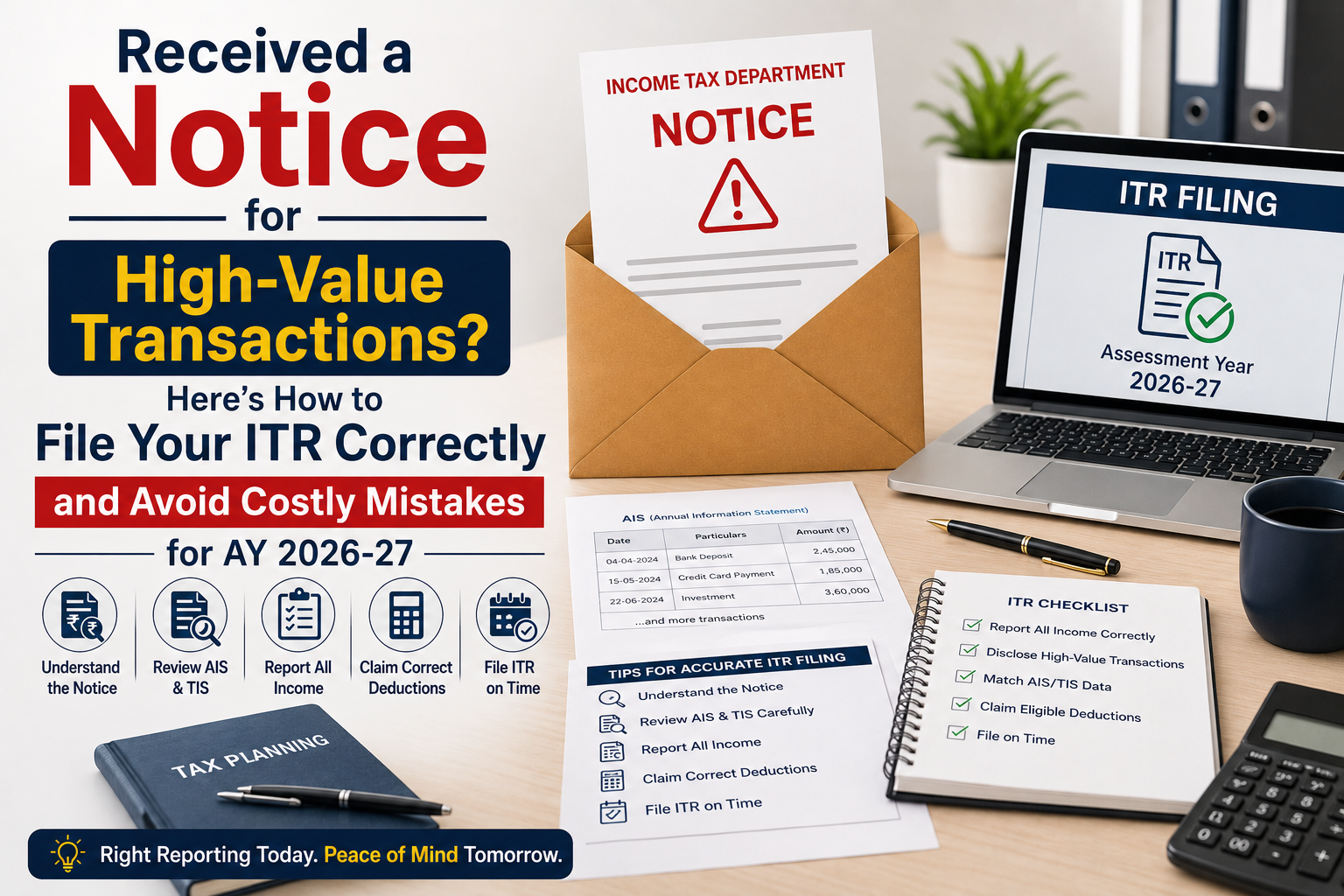
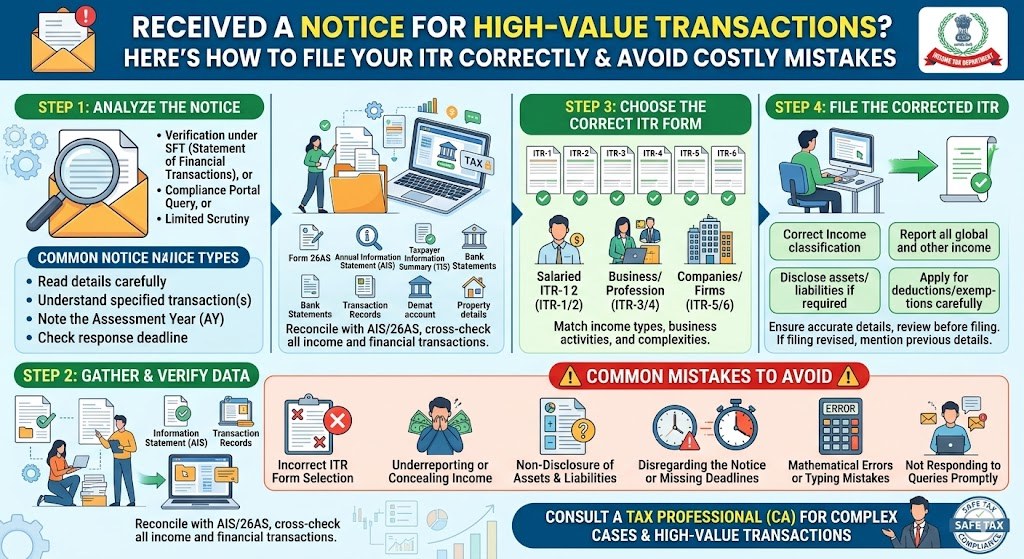
    Received a Notice for High-Value Transactions? Here’s How to File Your ITR Correctly and Avoid Costly Mistakes for AY 2026-27

    Nidhi Adwani April 2026 7 min read

    Received a Notice for High-Value Transactions? Don’t Ignore It.

    Many taxpayers are shocked when they receive a compliance notice from the Income Tax Department despite believing they have done nothing wrong.

    A common reaction is:

    I paid tax on my salary. Why am I getting a notice for my bank transactions?”

    The answer often lies in high-value transactions reported to the Income Tax Department through various financial institutions.

    Today, banks, mutual funds, registrars, property authorities, and financial institutions report specified transactions directly to the department.

    If your Income Tax Return (ITR) does not adequately explain these high value transactions, you may receive a notice seeking clarification.

    The good news?

    A notice does not automatically mean tax evasion or wrongdoing.

    However, incorrect reporting can lead to tax demands, scrutiny, penalties, and prolonged compliance issues.

    Let’s understand what triggers these notices and how to file your return correctly.


    What Are High-Value Transactions?

    High-value transactions are significant financial activities that are reported to the Income Tax Department through various reporting mechanisms.

    These high value transactions become visible in:

    • Annual Information Statement (AIS)
    • Taxpayer Information Summary (TIS)
    • Specified Financial Transaction (SFT) reports

    The department compares this information with the income reported in your ITR.

    Any inconsistency can trigger automated compliance checks.


    Common High-Value Transactions That Can Trigger Notices

    1.Large Cash Deposits in Bank Accounts

    Large cash deposits frequently attract scrutiny, especially when the declared income does not support the deposited amount.

    Common situations include:

    • Business cash deposits
    • Sale proceeds received in cash
    • Agricultural income claims
    • Cash savings accumulated over time

    If the source is not properly explained, notices may follow.

    2.High Credit Card Spending

    Many taxpayers are surprised to learn that significant credit card expenditure may be reported.

    The department may seek clarification when spending appears inconsistent with reported income.

    For example:

    • Salary income of ₹8 lakh
    • Credit card expenditure of ₹18 lakh

    Such mismatches can trigger questions.

    3. Property Purchases

    Real estate transactions are closely monitored.

    The department may compare:

    • Purchase value
    • Source of funds
    • Loan information
    • Reported income

    Property transactions often trigger scrutiny when funding sources are unclear.

    4. Mutual Fund Investments

    Large mutual fund investments are frequently reported through financial institutions.

    Common issues include:

    • Investments not matching declared income
    • Redemption transactions omitted from ITR
    • Capital gains not reported

    Many taxpayers mistakenly believe only profits need reporting.

    5.Share Market Transactions

    With increasing participation in stock markets, this has become one of the most common reasons for notices.

    Typical mistakes include:

    • Not reporting capital gains
    • Ignoring loss transactions
    • Missing dividend income
    • Incorrect tax calculations

    6.Foreign Travel and Overseas Spending

    High overseas expenditure may sometimes attract attention if the reported income appears insufficient to support the expenses incurred.

    7. Fixed Deposits and Interest Income

    Many taxpayers invest substantial sums in fixed deposits but forget to disclose the resulting interest income.

    Since banks report information directly, such mismatches are easily identified.


    What Is AIS and Why Is It So Important?

    AIS (Annual Information Statement) has become one of the most important documents for taxpayers.

    It contains information relating to:

    • Bank interest
    • Dividend income
    • Securities transactions
    • Mutual fund transactions
    • Property transactions
    • Tax deducted at source (TDS)
    • Foreign remittances
    • High-value financial activities

    Many notices today arise because taxpayers file returns without reviewing AIS.

    Also Read: How a Smart AIS Review Before Filing ITR Can Save Salaried Taxpayers from Costly Income Tax Notices in AY 2026-27https://itradvisor.in/blog/smart-ais-review-before-filing-itr


    What Is SFT Reporting?

    SFT stands for Specified Financial Transaction.

    Various institutions are required to report certain transactions to the Income Tax Department.

    These reports help the department verify whether financial activities align with declared income.

    SFT reporting has significantly increased transparency and reduced the possibility of undisclosed transactions remaining unnoticed.


    The Biggest Mistake Taxpayers Make

    The most common mistake is filing an ITR based only on:

    • Form 16
    • Salary details
    • TDS certificates

    Without checking:

    • AIS
    • Form 26AS
    • Capital gains reports
    • Mutual fund statements
    • Bank interest income

    This often leads to avoidable notices.


    How to File Your ITR Correctly If You Have High-Value Transactions

    Step 1: Download and Review AIS

    Before filing:

    ✔️ Review all transactions appearing in AIS

    ✔️ Verify accuracy

    ✔️ Check whether any transaction appears unfamiliar

    Step 2: Reconcile Income Sources

    Match:

    • Salary income
    • Interest income
    • Dividend income
    • Capital gains
    • Rental income
    • Business income

    with AIS and Form 26AS.

    Step 3: Report Capital Gains Properly

    Many taxpayers report only profits and ignore losses.

    This is a mistake.

    All relevant transactions should be reported appropriately.

    Step 4: Maintain Documentation

    Keep records of:

    • Property purchases
    • Loan statements
    • Mutual fund investments
    • Bank transactions
    • Gift deeds
    • Sale agreements

    Proper documentation helps support explanations if required.

    Step 5: Choose the Correct ITR Form

    Selecting the wrong ITR form can create compliance issues.

    A professional review is particularly important where multiple income sources exist.


    Real-Life Example

    A salaried employee earning ₹16 lakh annually filed his own return.

    He reported:

    ✔️ Salary income

    But forgot to report:

    ❌ Mutual fund redemption

    ❌ Dividend income

    ❌ Fixed deposit interest

    All these transactions appeared in AIS.

    A compliance notice was subsequently issued seeking clarification.

    The matter was resolved, but only after additional effort, documentation, and correspondence.

    Most importantly, the notice could have been avoided through proper review before filing.


    Frequently Asked Questions

    1.Does a high-value transaction always lead to a notice?

    No. However, transactions that are inconsistent with reported income may attract scrutiny.

    2.What should I do if a transaction in AIS is incorrect?

    The discrepancy should be reviewed carefully and appropriate action should be taken before filing the return.

    3.Can cash deposits trigger an income tax notice?

    Yes. Large cash deposits are among the most common reasons for notices

    4.Are mutual fund transactions reported to the Income Tax Department?

    Yes. Certain investment and redemption transactions may appear in AIS and related reporting systems.

    5. Should I file my return based only on Form 16?

    No. AIS, Form 26AS, capital gains statements, and other relevant information should also be reviewed.

    Warning Signs You Should Not Ignore

    Consider professional assistance if:

    ⚠️ Your AIS contains unfamiliar entries

    ⚠️ You purchased property during the year

    ⚠️ You redeemed mutual funds

    ⚠️ You traded in shares

    ⚠️ You made substantial cash deposits

    ⚠️ Your credit card expenditure is significantly high

    ⚠️ You received an income tax notice

    ⚠️ You have multiple income sources


    Need Help Understanding Your AIS or High-Value Transactions?

    Every year, thousands of taxpayers receive notices because they file returns without understanding what the Income Tax Department already knows through AIS and SFT reporting.

    At Adwani & Co. | ITR Advisor, we help taxpayers:

    ✅ Review AIS and TIS

    ✅ Analyze high-value transactions

    ✅ Report capital gains correctly

    ✅ File accurate ITRs

    ✅ Respond to notices

    ✅ Reduce the risk of future scrutiny

    ✅ Reconcile AIS with income disclosures


    Book an AIS & ITR Review Before Filing

    If your AIS shows transactions you don’t understand, don’t guess.

    A single reporting mistake can lead to notices, delays, additional tax demands, and unnecessary stress.

    Our experts can review your AIS, explain the transactions, identify potential issues, and help you file your return correctly.

    📞 Contact Adwani & Co. today for a professional AIS review and error-free ITR filing

  • Salary Above ₹10 Lakh? Don’t File Your ITR Until You Check These 12 Tax-Saving Opportunities

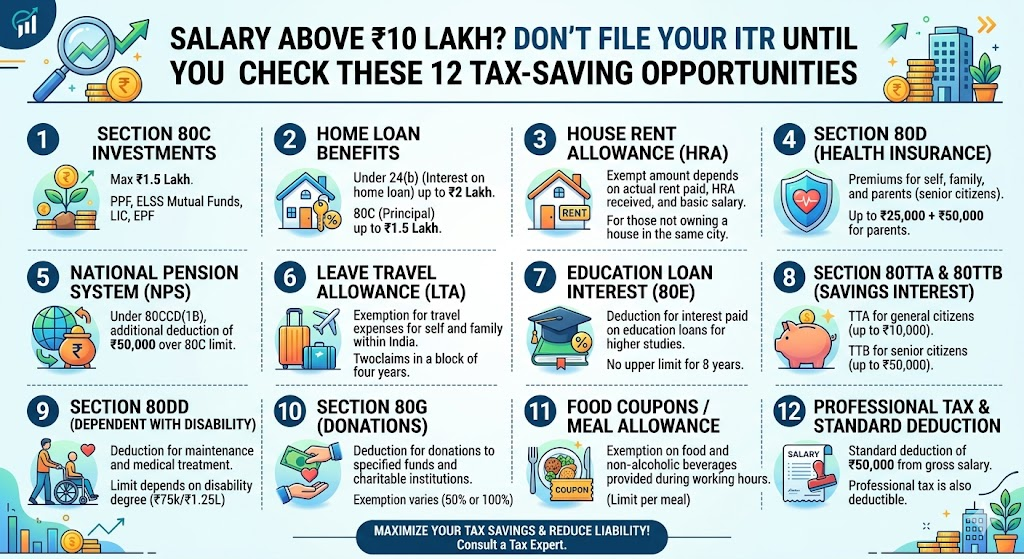
    Salary Above ₹10 Lakh? Don’t File Your ITR Until You Check These 12 Tax-Saving Opportunities

    Nidhi Adwani June 2026 6min Read

    Many salaried employees assume that once TDS has been deducted by their employer, there is little they can do to save tax.

    That assumption often results in taxpayers paying more tax than legally required.

    Every year, we meet salaried professionals earning ₹10 lakh, ₹20 lakh, ₹30 lakh or even higher salaries who miss important deductions, exemptions, and disclosures while filing their Income Tax Return (ITR).

    The result?

    • Higher tax outgo
    • Reduced refunds
    • Incorrect return filing
    • Future notices due to reporting mistakes

    Before filing your ITR for AY 2026-27, review these 12 important tax-saving opportunities.

    1.Section 80C Investments : Up to ₹1.5 Lakh Deduction

    Under the Old Tax Regime, Section 80C remains one of the most popular deductions.

    Eligible investments include:

    • Employee Provident Fund (EPF)
    • Public Provident Fund (PPF)
    • ELSS Mutual Funds
    • Life Insurance Premium
    • Tax Saving Fixed Deposits
    • Principal Repayment of Home Loan
    • Sukanya Samriddhi Yojana

    Many taxpayers invest throughout the year but forget to claim the full deduction while filing.

    2.Health Insurance Premium : Section 80D

    Health insurance can provide valuable tax benefits.

    Deduction limits generally include:

    • Self and family
    • Parents
    • Senior citizen parents

    Many salaried individuals fail to claim premiums paid for parents.

    This often results in avoidable tax payments.

    3.Home Loan Interest Deduction

    If you have a housing loan for a self-occupied property, interest paid may qualify for deduction under applicable provisions of the Income Tax Act.

    Common mistakes include:

    • Claiming incorrect amounts
    • Ignoring co-borrower benefits
    • Not collecting annual interest certificates

    4. House Rent Allowance (HRA)

    Even high-income salaried employees frequently make HRA mistakes.

    Common issues include:

    • Incorrect rent calculations
    • Missing landlord PAN details
    • Not maintaining rent receipts

    A properly computed HRA claim can significantly reduce taxable income.

    5.National Pension System (NPS) Benefits

    NPS offers additional tax-saving opportunities beyond Section 80C.

    Many salaried taxpayers overlook employer contributions and available deductions while filing their return.

    A review of salary structure often reveals missed tax benefits.

    6. Interest Income Deductions

    Interest earned from:

    • Savings accounts
    • Fixed deposits
    • Recurring deposits

    must be reported correctly.

    While reporting is mandatory, certain deductions may be available under applicable provisions.

    Many taxpayers either forget to disclose interest income or fail to claim eligible deductions.

    7.Education Loan Interest

    Interest paid on education loans may qualify for deduction subject to conditions.

    This benefit is often missed by:

    • Young professionals
    • Working executives
    • Parents servicing eligible education loans

    8.Donations Under Section 80G

    Donations made to eligible institutions may qualify for tax deductions.

    Before claiming:

    ✔️ Verify registration details

    ✔️ Maintain donation receipts

    ✔️ Ensure compliance with applicable rules

    Incorrect claims can trigger scrutiny.

    9.Leave Travel Allowance (LTA)

    Employees receiving LTA often forget to claim eligible exemptions.

    Important considerations include:

    • Travel documentation
    • Eligible family members
    • Conditions prescribed under tax laws

    Review your salary structure before filing your return.

    10.Additional Benefits for Homeowners

    Apart from standard housing loan benefits, taxpayers may be eligible for additional deductions depending on circumstances and applicable provisions.

    Professional review can help identify opportunities often missed in self-filed returns.

    11. Choosing the Right Tax Regime

    One of the biggest mistakes today is selecting the wrong tax regime.

    Many taxpayers automatically accept the regime chosen by their employer without performing a proper comparison.

    A detailed tax computation can determine whether:

    12. Reviewing AIS Before Filing ITR

    This is perhaps the most overlooked step.

    Before filing:

    • ✔️ Download AIS
    • ✔️ Review interest income
    • ✔️ Verify dividend income
    • ✔️ Check mutual fund transactions
    • ✔️ Confirm share transactions
    • ✔️ Match TDS details

    Also Read: How a Smart AIS Review Before Filing ITR Can Save Salaried Taxpayers from Costly Income Tax Notices in AY 2026-27https://itradvisor.in/blog/smart-ais-review-before-filing-itr

    Many notices issued by the Income Tax Department arise due to AIS mismatches.

    • Common Mistakes Salaried Taxpayers Make
    • Every filing season, we frequently see taxpayers making these errors:
    • ❌ Selecting the wrong ITR form
    • ❌ Missing interest income
    • ❌ Ignoring capital gains from shares or mutual funds
    • ❌ Choosing the wrong tax regime
    • ❌ Claiming incorrect deductions
    • ❌ Not reviewing AIS and Form 26AS
    • ❌ Filing returns based solely on Form 16

    These mistakes can lead to:

    • Reduced refunds
    • Additional tax demands
    • Income tax notices
    • Delayed processing

    Case Study:

    How a Salaried Employee Saved Tax Through Proper Review

    A salaried employee earning ₹18 lakh annually approached us after preparing his return independently.

    He believed there was no further tax planning possible because TDS had already been deducted.

    During our review, we identified:

    • Unclaimed health insurance deduction
    • Missed NPS benefits
    • Incorrect tax regime selection
    • Reporting gaps in investment disclosures The result was a significantly improved tax position and a correctly filed return. This is why professional review becomes increasingly valuable as income levels rise. Why High-Income Salaried Employees Should Not Depend Only on Form 16 Form 16 is important, but it is not a complete tax filing document.

    Your return may also need to account for:

    • Bank interest
    • Dividend income
    • Capital gains
    • Foreign assets
    • Rental income
    • Multiple employers
    • ESOP transactions
    • Freelance income
    • Relying only on Form 16 can lead to incomplete reporting.

    Frequently Asked Questions

    1.Is Form 16 sufficient for filing ITR?

    Not always. Additional income and disclosures may also need to be reported

    2.Can incorrect deduction claims trigger a notice?

    Yes. Unsupported or incorrect claims can attract scrutiny from the Income Tax Department.

    3.Is salary above ₹10 lakh taxable under the new regime?

    Yes. Taxability depends on total income, deductions, rebates, and applicable tax provisions.

    4.Should salaried employees choose the old or new tax regime?

    The answer varies from person to person. A tax comparison should be performed before filing.

    5.Can I claim deductions after my employer has deducted TDS?

    In many cases, eligible deductions can still be claimed while filing your return, subject to applicable provisions.

    Need Help Filing Your ITR?

    If your salary income exceeds ₹10 lakh, a professional review can help ensure:

    ✅ Correct tax regime selection

    ✅ Maximum eligible tax benefits

    ✅ Proper AIS reconciliation

    ✅ Accurate reporting of all income

    ✅ Error-free ITR filing

    ✅ Reduced risk of notices

    At Adwani & Co. ITR Advisor, we assist salaried professionals across India with accurate, compliant, and tax-efficient return filing.

    Our Services

    • Salaried ITR Filing
    • Tax Regime Comparison
    • AIS & Form 26AS Review
    • Capital Gains Reporting
    • ESOP Taxation
    • NRI Taxation
    • Notice Assistance
    • Refund Optimization

    Book Your ITR Review Today

    Don’t assume your employer has taken care of everything.

    A professional review before filing can help you avoid costly mistakes and identify tax-saving opportunities that are often overlooked.

    Contact Adwani & Co. today and file your return with confidence.

  • The Ultimate Guide to Check Income Tax Refund Status Online for AY 2026-27

    The Ultimate Guide to Check Income Tax Refund Status Online for AY 2026-27

    Nidhi Adwani May 2026 8 min read

    Check Income Tax Refund Status Online AY 2026-27

    Step-by-step method to track your ITR refund, understand delays, escalate stuck refunds and never lose a single rupee that’s rightfully yours.

     Every year, millions of Indian taxpayers successfully file their returns for the Assessment Year 2026-27, only to spend weeks wondering: “Where is my income tax refund?”

    Checking your income tax refund status online takes less than two minutes  if you know exactly where to look. And if there’s a problem, it can often be fixed without stepping into a tax office. This guide walks you through every step, every status code, and every escalation path you need.

    According to the Income Tax Department of India, refunds for electronically filed returns are typically processed within 4 to 16 weeks of ITR verification. AY 2026-27 processing timelines have been significantly improved on the redesigned income tax e-filing portal at incometax.gov.in🔗 incometax.gov.in


    Why Your Income Tax Refund Status for AY 2026-27 Matters More Than Ever

    The Income Tax Department processes crores of ITR filings every season. With the introduction of the Annual Information Statement (AIS) and the Taxpayer Information Summary (TIS) under Form 26AS, the system now cross-verifies your declared income against data from banks, employers, mutual funds, and even credit card companies under Rule 114E SFT.

    Read our detailed guide on ITR Filing for AY 2026-27 — Deadlines, Penalties & Smart Strategies


    Step-by-Step: How to Check Income Tax Refund Status Online

    Method 1: Via the Income Tax e-Filing Portal (Recommended)

    1. Log in to the IT Portal

    Visit incometax.gov.in and log in using your PAN number as your user ID along with your registered password. First-time users must complete registration with Aadhaar-linked mobile OTP.

    1. Navigate to “My Account” → “Refund/Demand Status”

    In the dashboard, go to e-File → Income Tax Returns → View Filed Returns. Select AY 2026-27 and click on the return to view its processing status.

    1. Check Processing Status & Refund Details

    You’ll see the current status of your return : whether it’s under processing, processed with refund due, or processed with demand. The refund amount and the expected credit date (if applicable) will be shown here.

    1. Verify Bank Account Pre-validation

    Refunds are credited only to a pre-validated and ECS-enabled bank account linked to your PAN. Confirm this under Profile → My Bank Account. An unvalidated account is one of the most common causes of ITR refund delay in AY 2026-27.

    1. Download your Intimation Notice

    Once processed, download the intimation u/s 143(1) from the portal. This document confirms the exact refund amount calculated by the department always verify it against your filed return.

    Method 2: Track via TIN-NSDL (Alternative)

    Visit tin.tin.nsdl.com, navigate to “Know Your Refund Status”, and enter your PAN and the relevant Assessment Year to view the refund dispatch status

    Decoding Your Income Tax Refund Status : What Each Message Means

    “Return is Under Processing”

    Your ITR has been received but not yet assessed. Processing can take 4–10 weeks post e-verification.

    “Processed with Refund Due”

    If your refund is processed. It should reach your bank account within 5–7 working days

    “Processed with Demand Due”

    If there is a shortfall : you owe tax. Review the intimation u/s 143(1) immediately and either pay or file a rectification request.

    “Refund Returned / Failed”

    Your bank rejected the refund (wrong IFSC, closed account, unvalidated account). File a refund reissue request on the portal immediately.

    “Adjusted Against Outstanding Demand”

    If your current refund is used  to offset a past tax demand. Check your demand history and raise a grievance if the adjustment was incorrect.

    “No Return Filed for this AY”

    Either your return hasn’t been processed yet or it was filed under a different PAN. Check filing acknowledgement (ITR-V) for confirmation


    Top Reasons for ITR Refund Delay in AY 2026-27

    According to experts at Adwani and Company, these are the most frequently seen causes of refund delays in the current assessment year:

    1. Unverified Bank Account

    2. AIS / Form 26AS Mismatch

    3. Pending e-Verification

    4. Outstanding Tax Demand from Previous AYs

    5. High-Value Credit Card or Cash Transactions

    Learn more about our Income Tax Notice Advisory Services — How We Help Respond

    How to Raise a Refund Reissue Request Online

    1. Log in → Services → Refund Reissue
    2. Update and validate your bank account
    3. Submit Refund Reissue Request

    Once a valid refund reissue request is submitted and processed, refunds are typically credited within 7–14 working days. Track updated status on the portal or via TIN-NSDL.

    How to Escalate a Stuck Income Tax Refund

    • Submit a Grievance on the IT Portal
    • Write to Your Jurisdictional Assessing Officer (AO)
    • Contact the Centralized Processing Centre (CPC), Bengaluru

    Refund Status vs. Form 26AS vs. AIS Know the Difference for AY 2026-27

    Many taxpayers confuse these three documents. Here’s a clear breakdown that every filer should understand before filing ITR for AY 2026-27:

    Form 26AS

    Reflects TDS deducted, TCS collected, and advance tax paid. It’s the foundational tax credit document. Mismatches here directly affect your refund calculation.

    AIS (Annual Information Statement)

    A comprehensive document showing all financial transactions  salary, interest, dividends, mutual funds, property, credit cards, and more  as reported to the IT Dept.

    TIS (Taxpayer Information Summary)

    A simplified, consolidated view derived from AIS. The IT Dept uses TIS to pre-fill ITR forms. Always reconcile TIS with your actual income before filing.


    Key Takeaways

    • Always e-verify your ITR within 30 days of filing  refund processing begins only after verification.
    • Check income tax refund status online on incometax.gov.in or TIN-NSDL after 4–6 weeks of e-verification.
    • Pre-validate your bank account with ECS enabled before filing to avoid refund failure.
    • Reconcile Form 26AS, AIS, and TIS before filing to prevent mismatches that cause ITR refund delay.
    • If your refund is stuck beyond 8 weeks, raise a grievance on the IT portal and track using the ticket number.
    • High-value credit card spends (>₹10L) and cash deposits may trigger scrutiny disclose accurately in your ITR.
    • Outstanding demands from past AYs will be automatically adjusted against your current year refund.

    Frequently Asked Questions

    1.How long does it take to get Income Tax refund after ITR processing?

    Once  your ITR is processed and the intimation u/s 143(1) is issued, refunds are typically credited  within 5to10 working days .If your return was selected for scrutiny or has a mismatched AIS, it may take 4to16 weeks.

    2.Can I claim Income Tax refund interest if my refund is delayed?

    Yes. Under Section 244A of the Income Tax Act, you are entitled to receive simple interest at 0.5% per month (or 6% per annum) on the refund amount if the delay is attributable to the Income Tax Department

    3.How do I check my Income Tax refund status without logging in?

    You can check via the TIN-NSDL portal at tin.tin.nsdl.com  navigate to “Know Your Refund Status”, enter your PAN number and Assessment Year (AY 2026-27), and the platform will display the refund dispatch status.

    4.What does “Refund Returne or “No credit Received” status mean for my Income Tax refund?

    Refund Returned” means the refund amount was dispatched by the IT Department but could not be credited because your bank account was closed, had an incorrect IFSC code, or was not pre-validated/ECS-enabled. You must file a refund reissue request on incometax.gov.in under Services → Refund Reissue. Update your correct bank account, complete pre-validation, and submit with EVC authentication.

    Conclusion:

    Your Income Tax Refund is Rightfully Yours Claim It Smartly

    Checking your income tax refund status online for AY 2026-27 is no longer a complex process  it’s a 2 minute task if your paperwork is in order. The key is proactivity: verify your ITR promptly, ensure your bank account is pre-validated, reconcile your AIS and Form 26AS before filing, and monitor your status regularly. At Adwani and Company, led by Dr. Haresh Adwani, we handle hundreds of complex refund cases, AIS disputes, ITR revisions, and income tax notice responses every season. Our clients across India trust us for one reason: we treat every rupee of your refund as seriously as you

    Visit: www.adwaniandco.com | Call: +91 7620 127 137 | Email: enquiries@adwaniandco.com

    Share:WhatsApp Twitte LinkedIn

  • ITR 1 vs ITR 2 vs ITR 3 vs ITR 4: The Definitive Guide to Picking the Right Income Tax Return Form for AY 2026-27

    ITR 1 vs ITR 2 vs ITR 3 vs ITR 4: The Definitive Guide to Picking the Right Income Tax Return Form for AY 2026-27

    Nidhi Adwani May 2026 13 min read

    ITR 1 vs ITR 2 vs ITR 3 vs ITR 4

    Every year, millions of Indian taxpayers make one seemingly simple but critically consequential mistake: they file the wrong ITR form. A salaried professional with stock market gains chooses ITR 1. A freelancer with multiple income streams files ITR 4. A business owner picks ITR 2. The result? Defective return notices, delayed refunds, and unwanted attention from the Income Tax Department of India.

    If you have ever stared at your screen wondering whether to pick ITR 1 vs ITR 2 vs ITR 3 vs ITR 4 for AY 2026-27 you are not alone. The four forms look deceptively similar but serve very different taxpayer profiles. Filing the correct income tax return form is not just a compliance formality; it is the foundation of a clean, legally sound tax record.

    In this comprehensive guide, the experts at Adwani and Company led by Dr. Haresh Adwani, a seasoned Chartered Accountant with decades of tax advisory experience break down every ITR form, who qualifies, who doesn’t, and what can go wrong if you choose incorrectly.


    Why Choosing the Correct ITR Form for AY 2026-27 Matters

    The Income Tax Department of India issues separate return forms to capture different income profiles accurately. Filing the wrong form does not just inconvenience you it can result in:

    • A defective return notice under Section 139(9) of the Income Tax Act
    • Rejection of your refund claim until the correct form is refiled
    • Enhanced scrutiny and tax audits
    • Penalties and interest under Sections 234A, 234B, and 234C
    • Loss of carry forward benefits for capital losses or business losses

    According to the Income Tax Department’s official guidelines, a return filed under the wrong ITR form is treated as if it was never filed which means you may face consequences of non-filing even if you submitted a form on time.

    Learn more about our Taxation & Compliance Services to understand how professional guidance prevents such costly errors.


    ITR 1 vs ITR 2 vs ITR 3 vs ITR 4 Quick Comparison Chart for AY 2026-27

    Before diving into the details of each form, here is a quick reference table that captures the key differences:

    FeatureITR 1 (Sahaj)ITR 2ITR 3ITR 4 (Sugam)
    Who Can FileSalaried individualsIndividuals & HUFs (no business income)Business owners, professionals, partnersPresumptive taxation taxpayers
    Income LimitUp to ₹50 lakhNo upper limitNo upper limitUp to ₹3 crore (business) / ₹75 lakh (profession)
    Salary Income✓ Yes✓ Yes✓ Yes✓ Yes
    Capital Gains✗ No✓ Yes✓ Yes✗ No
    Business Income✗ No✗ No✓ Yes✓ (Presumptive)
    Foreign Assets/Income✗ No✓ Yes✓ Yes✗ No
    Multiple House PropertiesOnly 1✓ Multiple✓ Multiple✓ Yes
    Applicable SectionGeneralGeneral44AA, 44AB44AD, 44ADA, 44AE

    Every year, millions of Indian taxpayers make one seemingly simple but critically consequential mistake: they file the wrong ITR form. A salaried professional with stock market gains chooses ITR-1. A freelancer with multiple income streams files ITR 4. A business owner picks ITR 2. The result? Defective return notices, delayed refunds, and unwanted attention from the Income Tax Department of India.

    If you have ever stared at your screen wondering whether to pick ITR 1 vs ITR 2 vs ITR 3 vs ITR 4 for AY 2026-27 you are not alone. The four forms look deceptively similar but serve very different taxpayer profiles. Filing the correct income tax return form is not just a compliance formality; it is the foundation of a clean, legally sound tax record.

    In this comprehensive guide, the experts at Adwani and Company led by Dr. Haresh Adwani, a seasoned Chartered Accountant with decades of tax advisory experience break down every ITR form, who qualifies, who doesn’t, and what can go wrong if you choose incorrectly.


    Why Choosing the Correct ITR Form for AY 2026-27 Matters

    The Income Tax Department of India issues separate return forms to capture different income profiles accurately. Filing the wrong form does not just inconvenience you it can result in:

    • A defective return notice under Section 139(9) of the Income Tax Act
    • Rejection of your refund claim until the correct form is refiled
    • Enhanced scrutiny and tax audits
    • Penalties and interest under Sections 234A, 234B, and 234C
    • Loss of carry-forward benefits for capital losses or business losses

    According to the Income Tax Department’s official guidelines, a return filed under the wrong ITR form is treated as if it was never filed which means you may face consequences of non-filing even if you submitted a form on time.

    Learn more about our Taxation & Compliance Services to understand how professional guidance prevents such costly errors.


    ITR 1 vs ITR 2 vs ITR 3 vs ITR 4 :Quick Comparison Chart for AY 2026-27

    Before diving into the details of each form, here is a quick reference table that captures the key differences:

    FeatureITR 1 (Sahaj)ITR 2ITR 3ITR 4 (Sugam)
    Who Can FileSalaried individualsIndividuals & HUFs (no business income)Business owners, professionals, partnersPresumptive taxation taxpayers
    Income LimitUp to ₹50 lakhNo upper limitNo upper limitUp to ₹3 crore (business) / ₹75 lakh (profession)
    Salary Income✓ Yes✓ Yes✓ Yes✓ Yes
    Capital Gains✗ No✓ Yes✓ Yes✗ No
    Business Income✗ No✗ No✓ Yes✓ (Presumptive)
    Foreign Assets/Income✗ No✓ Yes✓ Yes✗ No
    Multiple House PropertiesOnly 1✓ Multiple✓ Multiple✓ Yes
    Applicable SectionGeneralGeneral44AA, 44AB44AD, 44ADA, 44AE

    ITR-1 (Sahaj) : The Simplified Form for Salaried Individuals

    Who Should File ITR-1?

    ITR-1, also known as Sahaj (meaning ‘simple’ in Hindi), is designed for resident individuals with a straightforward income profile. According to the Income Tax Department, ITR 1 applies to:

    • Salaried employees with total income up to ₹50 lakh in AY 2026-27
    • Pensioners receiving pension from a previous employer
    • Individuals with income from one house property only
    • Taxpayers with income from other sources such as savings bank interest, fixed deposit interest, or family pension (up to ₹5,000 agricultural income)

    Who Cannot File ITR 1?

    This is where most taxpayers go wrong. ITR 1 is explicitly not suitable for you if:

    • You have capital gains from equity mutual funds, stocks, cryptocurrency, property, or any other asset
    • You hold a directorship in any company
    • You have unlisted equity shares
    • You have foreign assets or foreign income
    • You have more than one house property
    • You have business or professional income of any kind including freelancing or consulting fees
    • Your total income exceeds ₹50 lakh

    Pro Tip from Dr. Haresh Adwani: Even one rupee of long-term capital gain from equity mutual funds disqualifies you from ITR-1. Many salaried employees who invest through SIPs unknowingly file ITR-1 and receive defective return notices months later.”

    ITR-2 : The Comprehensive Form for Individuals with Multiple Income Sources

    Who Should File ITR-2?

    ITR-2 is applicable to individuals and Hindu Undivided Families (HUFs) who do not carry on any business or profession. This form accommodates a far more complex income structure:

    • Income from salary or pension
    • Capital gains both short term (STCG) and long-term (LTCG) from shares, mutual funds, real estate, and other assets
    • Income from more than one house property (whether let out or self occupied)
    • Foreign income or assets, including NRI-related income
    • Income from other sources including dividends, interest, and winnings from lotteries
    • Taxpayers with income exceeding ₹50 lakh from salary or other non-business sources
    • Directors of companies or shareholders holding unlisted equity shares

    Who Cannot File ITR-2?

    • Any individual or HUF having income from business or profession (even freelancers)
    • Taxpayers opting for presumptive taxation under Section 44AD, 44ADA, or 44AE

    ITR-2 is the right choice for an HNI (High Net-worth Individual) who earns salary, has rental income from multiple properties, and redeems equity mutual funds in the same year but has no business activity.

    ITR-3 : The Form for Business Owners, Professionals, and Freelancers

    Who Should File ITRc3?

    ITR-3 is the most comprehensive of the four forms, designed for individuals and HUFs earning income from any proprietary business or profession. This includes:

    • Self-employed professionals: doctors, lawyers, architects, consultants, designers, content creators
    • Freelancers who receive fees or project payments
    • Stock market traders treating trading activity as business income
    • Crypto investors or traders with business-classified income
    • Partners in a partnership firm (income from firm is included here)
    • Proprietors of any business entity
    • Individuals who must maintain books of accounts under Section 44AA
    • Taxpayers subject to tax audit under Section 44AB

    Key Features of ITR-3

    ITR-3 also allows taxpayers to report:

    • All types of income salary, capital gains, house property, business income, and other sources in a single return
    • Balance sheet and profit & loss account of the business
    • Depreciation schedules and other business-specific deductions

    Expert Insight: As Dr. Haresh Adwani of Adwani and Company frequently advises clients: “If you are a salaried professional who also earns ₹2 lakh as a freelance consultant, you cannot file ITR-1 or ITR-2. Your freelance income categorises you as having ‘business or professional income,’ making ITR-3 the mandatory choice.”

    ITR-4 (Sugam) : The Presumptive Taxation Form for Small Businesses

    Who Should File ITR-4?

    ITR-4, popularly called Sugam, is tailored for small business owners and self-employed professionals who opt for presumptive taxation under the Income Tax Act:

    • Individuals, HUFs, or partnership firms (other than LLPs) opting for Section 44AD applicable to small businesses with turnover up to ₹3 crore (or ₹75 lakh for digital transactions)
    • Professionals opting for Section 44ADA applicable to specified professions with gross receipts up to ₹75 lakh
    • Transporters opting for Section 44AE applicable to those owning up to 10 goods vehicles

    Key Advantage of ITR-4 / Presumptive Taxation

    Under presumptive taxation, the government deems a fixed percentage of turnover as your net income eliminating the need to maintain detailed books of accounts. For example, under Section 44AD, 8% of turnover (or 6% for digital receipts) is presumed as profit. This simplifies filing significantly for small businesses.

    Who Cannot File ITR-4?

    • Individuals with income exceeding ₹50 lakh (apart from business income)
    • Taxpayers having capital gains income
    • Residents with foreign assets or foreign income
    • Individuals with income from more than one house property
    • Any taxpayer whose books were audited under Section 44AB in any of the preceding five years

    Learn more about our ITR Filing & Tax Compliance Services for small business owners and self-employed professionals.


    Real-Life Example: How to Identify the Right ITR Form

    Taxpayer ProfileIncome SourcesCorrect ITR Form
    Rahul : IT Employee, MumbaiSalary ₹40L, FD interest ₹30,000ITR-1 ✓
    Priya : Bank Manager, PuneSalary ₹85L, LTCG from MF ₹4L, 2 flatsITR-2 ✓
    Vikram : Doctor + ConsultantProfessional fees ₹30L, salary ₹10L, shares STCGITR-3 ✓
    Meena : Retail Shop Owner, NashikShop turnover ₹60L, opts for Section 44ADITR-4 ✓

    Common Mistakes That Trigger Income Tax Notices in AY 2026-27

    The Annual Information Statement (AIS) and Tax Information Summary (TIS) available on the Income Tax Portal now capture almost every financial transaction from stock trades to mutual fund redemptions, from rent receipts to foreign remittances. Any mismatch between your ITR and the AIS triggers an automated notice.

    Common errors to avoid:

    • Filing ITR 1 when you have LTCG or STCG from equity or mutual funds even small amounts
    • Ignoring dividend income shown in Form 26AS from shareholding
    • Treating freelance income as ‘other income’ and filing ITR-1 or ITR-2 instead of ITR 3
    • Not reporting crypto gains the Income Tax Department tracks these via PAN linked exchange accounts
    • Choosing ITR 4 despite having capital gains or foreign assets (both disqualify you from Sugam)
    • Not cross-checking Form 26AS, AIS, and TIS before selecting your ITR form

    Professional Tip: Adwani and Company recommends every taxpayer download their AIS from the Income Tax Portal (incometax.gov.in) and reconcile it with their actual income before deciding which ITR form to file for AY 2026-27.

    Read our detailed guide on AIS Reconciliation and Income Tax Notice Management to stay protected.

    Important Deadlines for ITR Filing : AY 2026-27

    • Due date for individuals (non-audit cases): July 31, 2026
    • Due date for taxpayers requiring audit under Section 44AB: October 31, 2026
    • Belated return filing deadline: December 31, 2026
    • Late filing fee: ₹1,000 (if total income ≤ ₹5 lakh) or ₹5,000 (if total income > ₹5 lakh) under Section 234F

    Filing before the due date is crucial to avoid interest under Sections 234A, 234B, and 234C, and to retain the ability to carry forward business and capital losses.

    Frequently Asked Questions (FAQs)

    Q1. Which ITR form should a salaried employee with mutual fund investments file?

    If you have redeemed mutual fund units and earned capital gains (whether LTCG or STCG), you must file ITR 2. ITR 1 does not capture capital gains income and filing it would render your return defective under Section 139(9).

    Q2. Can a freelancer file ITR-4 for AY 2026-27?

    Yes, but only if your profession falls under Section 44ADA (specified professions including legal, medical, engineering, architecture, accountancy, interior decoration, or technical consultancy) and your gross receipts do not exceed ₹75 lakh. If your income crosses this threshold or your profession is not listed under 44ADA, you must file ITR 3.

    Q3. Can an NRI file ITR-1 for AY 2026-27?

    No. ITR 1 (Sahaj) is applicable only to Resident Individuals. Non Resident Indians (NRIs) who earn income in India must file ITR 2 (if no business income) or ITR 3 (if they have business income). Foreign assets or foreign income automatically disqualifies a person from using ITR1.

    Q4. Can I revise my ITR if I filed the wrong form?

    Yes. Under Section 139(5) of the Income Tax Act, you can file a revised return if you filed the original return before the due date. The revised return can be filed up to December 31, 2026 for AY 2026-27. If your original form choice was wrong, Dr. Haresh Adwani recommends acting promptly to refile under the correct form before the defective return deadline lapses.

    Conclusion

    Choosing the correct income tax return form for AY 2026-27 is not a formality it is the foundation of your entire tax compliance structure for the year. Whether you are a salaried professional, a business owner, a freelancer, or an investor, the difference between ITR 1 vs ITR 2 vs ITR 3 vs ITR 4 is significant and consequential.

    As Dr. Haresh Adwani always tells clients at Adwani and Company: “The cost of getting your ITR right is always lower than the cost of getting it wrong.” Accurate filing protects your refunds, preserves your loss carry forwards, and keeps you on the right side of the Income Tax Department.

    📋 Need Expert Help Filing the Right ITR for AY 2026-27? Connect with Adwani and Company today — your trusted CA firm for accurate, penalty-free income tax filing. Dr. Haresh Adwani and his expert team are ready to guide you through every step. 📞 +91 7620 127 137  |  ✉ enquiries@adwaniandco.com  |  🌐 www.adwaniandco.com
  • How a Smart AIS Review Before Filing ITR Can Save Salaried Taxpayers from Costly Income Tax Notices in AY 2026-27

    How a Smart AIS Review Before Filing ITR Can Save Salaried Taxpayers from Costly Income Tax Notices in AY 2026-27

    Nidhi Adwani May 2026 12 min read

    The Wake-Up Call Every Salaried Taxpayer Needs to Read

    You filed your ITR on time. Your employer deducted TDS correctly. Your Form 16 looks perfect.

    And then a notice from the Income Tax Department lands in your inbox.

    This is not a rare story anymore. It is happening to thousands of salaried professionals across India who believed their tax filing was complete and correct. The reality is that the Income Tax Department has introduced one of the most powerful compliance tools in recent years the Annual Information Statement, commonly known as AIS and it sees far more than your Form 16 ever did.

    At ITR Advisor, we work with salaried employees, IT professionals, NRIs, investors, and high-income taxpayers every year. One of the most common patterns we observe is this: taxpayers who skip a proper AIS review before filing ITR are the ones who end up receiving notices, demands, and defective return alerts later.

    If you are filing your Income Tax Return for AY 2026-27 and want to do it right the first time, this guide is exactly what you need.


    What Is the Annual Information Statement (AIS) and Why Does It Matter?

    The Annual Information Statement (AIS) is a comprehensive financial profile that the Income Tax Department maintains for every taxpayer against their PAN. It is available on the official Income Tax e-Filing Portal and captures data reported by multiple financial institutions and reporting entities.

    Unlike Form 16, which only captures salary and TDS from your employer, your AIS contains data from:

    • All banks (savings interest, FD interest, RD interest)
    • Stock brokers and depositories (share trades, LTCG, STCG)
    • Mutual fund houses (SIP redemptions, fund switches)
    • Property registrars (property purchases and sales)
    • Credit card companies (high-value spends)
    • Foreign remittance entities (international transfers)
    • Insurance companies
    • Dividend-paying companies
    • Tax refund records

    This means your AIS is essentially a 360-degree financial mirror of your entire year’s transactions. When your ITR does not match the data in your AIS, the Income Tax Department’s automated reconciliation systems flag it and a notice follows.

    This is precisely why conducting a thorough AIS review before filing ITR is no longer optional. It is a critical step in responsible tax filing.


    Why Salaried Employees Are Receiving Income Tax Notices in AY 2026-27

    Many salaried taxpayers hold a false assumption: “My employer handles everything. I just need to submit the Form 16 details and I’m done.” This thinking may have worked a decade ago. But today, the Income Tax Department cross-verifies your ITR against AIS data automatically.

    Here are the most common reasons salaried employees receive AIS mismatch notices:

    FD and Savings Interest Not Declared

    Banks report all fixed deposit interest and savings account interest directly to the Income Tax Department regardless of whether TDS was deducted. If the interest falls below the TDS threshold, the bank may not deduct tax but will still report it in AIS.

    When this interest does not appear in your ITR under “Income from Other Sources,” it creates a direct mismatch.

    Example: Ravi, a software engineer in Pune, had three bank accounts. His primary salary account showed ₹3,200 in savings interest. His old joint account (with his mother) showed ₹18,500 in FD interest. His dormant account had ₹6,700 in RD maturity interest. Total interest: ₹28,400 none of it was reported in his ITR because he only used his payslip and Form 16. His AIS clearly showed all three amounts. A scrutiny notice followed six months later.

    Stock Market and Mutual Fund Transactions Ignored

    With India’s growing retail investor base, millions of salaried taxpayers now invest through apps like Zerodha, Groww, and Kite. Many redeem SIPs, book profits on equity funds, or trade intraday and then file ITR without reporting any of it.

    AIS captures every securities transaction reported by depositories and registrars. Short-term capital gains (STCG) and long-term capital gains (LTCG) must be declared accurately. Even zero-tax LTCG below ₹1 lakh must be shown for disclosure compliance.

    Multiple Bank Accounts and Joint Accounts

    Every bank account linked to your PAN feeds data into your AIS. Taxpayers who have old accounts they “forgot about” often miss out on reporting interest income sitting quietly in those accounts.

    Joint accounts are especially tricky the primary holder or all holders may receive reporting, depending on how the account is set up.

    Credit Card Spends and Lifestyle Discrepancies

    If your declared annual income is ₹8 lakh and your AIS shows credit card spends of ₹14 lakh in a single year, the Income Tax Department’s analytics system can flag this as a lifestyle-income inconsistency. This is now a common trigger for Section 148A notices where the department suspects income escaping assessment.

    Foreign Remittances and International Income

    For NRIs, returning Indians, and professionals receiving RSUs from foreign employers, overseas income disclosure is critical. AIS often contains foreign remittance data reported under FEMA-linked sources. Failure to disclose RSU vesting income, foreign salary credits, or international freelance payments is one of the fastest ways to attract serious compliance scrutiny.


    AIS vs Form 26AS: Understanding the Key Difference

    Many taxpayers still confuse AIS with Form 26AS. They are related but serve very different purposes.

    Form 26AS primarily captures:

    • TDS deducted on salary, rent, professional fees, etc.
    • TCS collected
    • Advance tax and self-assessment tax payments
    • Tax refunds credited

    AIS captures all of the above and additionally includes:

    • Savings and FD interest income
    • Securities transaction data (equities, MFs)
    • Dividend received
    • Property purchase and sale details
    • Foreign remittance data
    • High-value banking transactions
    • Credit card spends above thresholds

    As per guidelines issued by the Income Tax Department, AIS is considered a more comprehensive and authoritative data source than Form 26AS. This is why the department now uses AIS as the primary benchmark for ITR verification and notice generation.

    For accurate ITR filing in AY 2026-27, reviewing both Form 26AS and AIS is strongly recommended with AIS receiving the greater attention.

    Read our detailed guide on Form 26A and TDS Default: Relief Under Section 201 and Its Limits


    How to Access and Review Your AIS on the Income Tax Portal

    Accessing AIS is straightforward:

    1. Log in to www.incometax.gov.in using your PAN and password
    2. Navigate to the “Annual Information Statement (AIS)” section under “Services”
    3. Download the AIS in PDF or JSON format
    4. Review each section carefully

    While downloading is easy, reviewing it accurately is where most taxpayers struggle. The AIS contains multiple categories of information and may include entries that are duplicated, incorrect, or attributed to you erroneously.

    A proper AIS review before ITR filing should cover:

    • Personal information accuracy (PAN, name, date of birth)
    • TDS entries (match with Form 16 and salary slips)
    • Interest income (from all banks and accounts)
    • Dividend income (from all stocks and mutual funds)
    • Capital gains (from equities, MFs, and property)
    • Property transaction details
    • Foreign remittance entries
    • High-value banking and credit card transactions

    If you find entries that do not belong to you or are factually wrong, you can submit feedback directly on the portal and you should maintain supporting documents to back up your position.


    What to Do If Your AIS Contains Incorrect Information

    The Income Tax Department’s data collection depends on third-party reporting. Sometimes, banks, brokers, or registrars may report incorrect values, duplicate entries, or transactions that belong to someone else entirely.

    Do not ignore incorrect AIS entries even if they are wrong. Ignoring them and filing without addressing them can lead to a mismatch notice later. The department’s system does not automatically know which entries you dispute.

    Here is the right approach:

    1. Log in to the AIS section on the income tax portal
    2. Click on the specific entry you want to dispute
    3. Select the relevant feedback option (e.g., “Information is incorrect,” “Information relates to other PAN”)
    4. Submit the feedback with supporting documentation
    5. Keep a record of your feedback submission

    After submitting feedback, file your ITR with the correct data and maintain documents that support your disclosures in case clarification is requested later.

    At ITR Advisor, our team helps taxpayers identify incorrect AIS entries, submit proper feedback, and file returns with accurate and defensible disclosures.

    Learn more about our AIS Review and ITR Filing Services.

    The Real Cost of Skipping an AIS Review Before Filing ITR

    Let us be direct: the short-term convenience of filing quickly without reviewing AIS can result in significant long-term costs.

    These costs can include:

    • Mismatch notices requiring detailed written responses
    • Tax demand orders with interest under Section 234A, 234B, and 234C
    • Defective return notices under Section 139(9) if ITR is incomplete
    • Scrutiny assessment under Section 143(3) for serious mismatches
    • Refund delays where the department holds refunds pending reconciliation
    • Penalty proceedings under Section 270A for under-reporting of income
    • Revised return filing costs and professional fees for notice handling

    The financial and emotional cost of dealing with a tax notice far outweighs the time spent on a proper AIS review before filing. Prevention is always more efficient than cure.


    Who Needs to Be Extra Careful About AIS in AY 2026-27?

    While every taxpayer should review AIS, certain profiles face higher scrutiny risk:

    • Salaried employees with investments in stocks, MFs, or real estate
    • IT professionals receiving RSUs, ESOPs, or foreign salary components
    • Senior employees in higher income brackets (₹15 lakh and above)
    • Employees with multiple jobs during the year
    • NRIs and returning Indians with foreign income or assets
    • Freelancers and consultants filing as salaried with additional income
    • High-value banking or credit card users
    • Joint property owners who sold or purchased property during the year

    If you fall into any of these categories, an expert-assisted AIS review before ITR filing is not just advisable it is essential.


    Why ITR Advisor Is the Right Partner for Your AIS Review and ITR Filing

    At ITR Advisor, we understand that modern income tax compliance is no longer simple. The Annual Information Statement has transformed how the Income Tax Department monitors taxpayers and your ITR needs to be filed with equal sophistication.

    Our tax experts bring deep knowledge of income tax law, capital gains taxation, foreign income disclosure requirements, and AIS reconciliation best practices. We have helped hundreds of salaried employees, IT professionals, NRIs, and investors file accurate returns that reduce notice risk and ensure complete compliance.

    Whether your concern is a complex capital gains calculation, an AIS entry you do not recognize, or simply wanting the peace of mind that your return is filed correctly ITR Advisor is here to help.

    Learn more about our Complete ITR Filing Services for Salaried Employees.

    Frequently Asked Questions (FAQs)

    Q1. Is it mandatory to review AIS before filing ITR for AY 2026-27?

    AIS review is not legally mandated, but it is highly recommended by tax professionals and effectively required for accurate filing. Since the Income Tax Department uses AIS for return verification, skipping the review significantly increases the risk of receiving a mismatch notice.

    Q2. Can I receive an income tax notice even if TDS is deducted correctly by my employer?

    Yes. TDS deduction by your employer only covers salary income. AIS captures much broader data including FD interest, dividend income, capital gains, and credit card transactions. Mismatches in any of these areas can trigger notices even if your salary TDS is perfectly correct.

    Q3. What is the difference between AIS and Form 26AS for ITR filing?

    Form 26AS primarily shows TDS, TCS, advance tax, and refund data. AIS is more comprehensive and includes interest income, securities transactions, mutual fund redemptions, dividend data, property transactions, foreign remittances, and high-value spending. For AY 2026-27, AIS is the more critical document to review before filing ITR.

    Q4. How do I check AIS on the income tax portal?

    Log in to www.incometax.gov.in, go to the “Services” section, and select “Annual Information Statement (AIS).” You can view or download your AIS as a PDF or JSON file. Review every section carefully before preparing your ITR.

    Q5. Can AIS data affect my tax refund?

    Yes. If there is a mismatch between your ITR and AIS data, the Income Tax Department may withhold or delay your refund pending reconciliation. A proper AIS review before filing ensures your refund is processed without complications.

    Conclusion: File Smarter, Not Just Faster Your AIS Review Before ITR Filing Matters

    The Annual Information Statement has fundamentally changed the landscape of income tax compliance in India. It is no longer sufficient to file ITR quickly using just Form 16. Every piece of financial information linked to your PAN is now visible to the Income Tax Department and your return needs to reflect all of it accurately.

    A proper AIS review before filing ITR is the single most effective step a salaried taxpayer can take to reduce notice risk, avoid tax demands, ensure accurate disclosure, and get refunds processed without delay.

    For AY 2026-27, take the time to review your Annual Information Statement carefully. If the complexity of the exercise seems overwhelming, that is exactly why professional assistance exists.

    Connect with ITR Advisor today for a complete AIS review and expert ITR filing support. File accurately, file confidently, and file without the fear of a tax notice.

    Visit us at https://itradvisor.in and let our experts handle your AIS review and ITR filing so you can focus on what matters most.