₹36 lakh moved through his UPI ID in a single year. Only ₹8 lakh showed up in his income tax return. He assumed nobody would ever connect the two until a notice landed in his inbox.
How a UPI Payments Income Tax Notice Catches Small Business Owners Off Guard
A small business owner in a mid-sized Indian city ran his shop the way thousands of others do. Customers paid him through UPI — ₹500 for a quick sale, ₹2,000 from a walk-in, ₹10,000 from a regular client who ordered in bulk. To keep life simple, every payment landed in his personal savings account. There was no separate business account, no bookkeeping habit, nothing formal.
By the end of the financial year, the totals told a very different story than the one on his tax return.
The Numbers Behind This UPI Payments Income Tax Notice
Monthly UPI credits: approximately ₹3 lakh
Annual UPI credits: close to ₹36 lakh
Income reported in ITR: ₹8 lakh Unexplained difference: ₹28 lakh
That gap of ₹28 lakh is exactly the kind of mismatch that invites a UPI payments income tax notice from the department not because UPI transactions are inherently suspicious, but because the numbers don’t add up.
Why a UPI Payments Income Tax Notice Can Follow Any UPI Transaction
Many taxpayers still believe scrutiny is reserved for cash. In reality, every digital rupee leaves a trail. UPI payments carry bank records, transaction timestamps, counterparty details, and — through PAN-linked KYC a direct connection back to the account holder.
Under Rule 114E, banks and payment platforms file Statement of Financial Transactions (SFT) data with the Income Tax Department, and this quietly populates a taxpayer’s Annual Information Statement (AIS) on the department’s e-filing portal. No human needs to “notice” anything; the reconciliation happens systemically, in the background, long before any notice is drafted.
The real question was never whether UPI transactions are taxable by default. It is whether the credits in your bank account are consistent with the income you have declared.
Personal Account, Business Income: Where a UPI Payments Income Tax Notice Risk Begins
When business receipts are routed through a personal account and don’t match the return filed, the department doesn’t assume wrongdoing automatically but it does ask questions, often through a notice under Section 133(6) or a scrutiny reference, and the burden of explaining each credit falls on the taxpayer.
Dr. Haresh Adwani, a Chartered Accountant with a PhD in Commerce and a law degree who has guided numerous small business owners through exactly this kind of situation, often points out that a UPI payments income tax notice rarely arises from one bad transaction it arises from a pattern nobody was tracking.
What to Do Before You Get a UPI Payments Income Tax Notice
Open a dedicated business account for all UPI and digital receipts, separate from personal savings.
Reconcile bank credits against declared turnover monthly, not just at year-end.
Choose the correct ITR form and evaluate presumptive taxation under Section 44AD or 44ADA where eligible, so declared income realistically reflects turnover.
Maintain basic records invoices, a simple sales register, or even a spreadsheet so that if AIS data and your return ever diverge, the explanation is already ready.
UPI transactions are not invisible they are reported to the Income Tax Department under Rule 114E and reflected in your AIS.
A large gap between UPI credits and declared income is the single biggest trigger for a UPI payments income tax notice.
Mixing business receipts with a personal account makes it harder to explain credits if questioned.
Reconciling records monthly and choosing the right ITR form is the simplest way to stay audit-ready.
FAQs About UPI Payments Income Tax Notice
1.Does the Income Tax Department track UPI transactions?
Yes. Banks and payment platforms report high-value transactions under Rule 114E (SFT), which feeds directly into your Annual Information Statement.
2.Can I get a UPI payments income tax notice for using a personal account for business?
Yes, if the credits in your personal account far exceed the income declared in your ITR, mismatches like this commonly trigger a notice or scrutiny reference.
3.What should I do if I receive a UPI payments income tax notice?
Gather supporting records for each credit, avoid ignoring the deadline, and consult a qualified Chartered Accountant to draft an accurate, well-documented reply.
4.Is every UPI transaction taxable?
No. Only income is taxable, not every transfer. The concern is whether declared income matches the actual receipts reflected in your bank and UPI records.
Final Word: Don’t Wait for a UPI Payments Income Tax Notice
Digital payments were never the enemy they simply removed the illusion of invisibility. The businesses that sleep easy aren’t avoiding the trail; they’re the ones who can explain it. If your UPI credits and your ITR don’t tell the same story, it’s worth fixing that before the department asks. If you want expert guidance, connect with itradvisor.in today.
About the Author : Prafull Nile
Prafull Nile is a senior taxation and accounting professional associated with Adwani & Co LLP, bringing over 19 years of extensive experience in direct taxation, tax audits, income tax assessments, GST audits, and financial statement finalization. He has successfully managed diverse client engagements across industries, providing strategic guidance on tax compliance, assessments, and regulatory matters. In addition to his technical expertise, Prafull leads and mentors teams, ensuring high standards of service delivery and operational excellence. His practical approach, deep understanding of tax laws, and commitment to client success make him a trusted advisor for businesses and professionals navigating complex financial and compliance requirements.
At ITRAdvisor.in, we help taxpayers with:
✔️ ITR Filing Review
✔️ AIS Reconciliation
✔️ Capital Gains Reporting
✔️ NRI Taxation
✔️ Tax Notice Response
✔️ Revised Returns
✔️ Income Tax Planning
✔️ Refund and Compliance Issues
If you are unsure whether your return has been filed correctly or want a professional review before submission, consulting an experienced tax professional can help avoid costly mistakes.
Visit ITRAdvisor.in for expert assistance with your Income Tax Return and tax compliance requirements.
Disclaimer: ITRAdvisor.in is an educational and informational platform focused on tax awareness and compliance updates. Nothing contained herein should be construed as solicitation or advertisement of professional services. Professional services, where applicable, are rendered in accordance with ICAI guidelines. This article is published on ITRAdvisor.in, a tax and compliance knowledge platform. The content has been reviewed for technical accuracy by professionals associated with Adwani & Co LLP
A prominent “File Your ITR Now” button near the top and again at the end of the article
Need help filing your Income Tax Return? Click the WhatsApp icon and our team will guide you through the process and assist you with your ITR filing.
Have questions about your ITR? Click the WhatsApp icon to connect with our tax experts for quick guidance and personalized assistance.
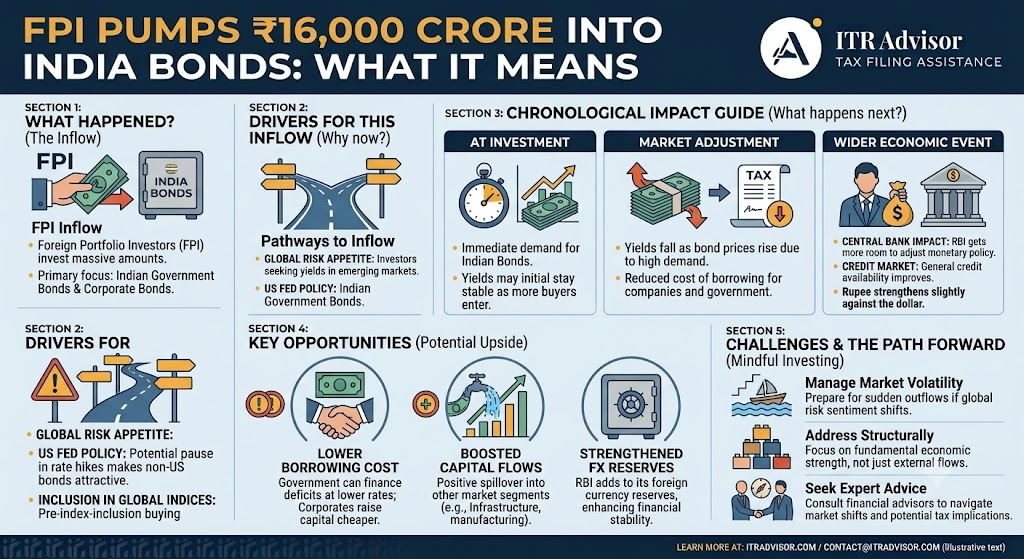
₹16,000 crore. One month. From foreign investors. That’s the scale of FPI investment flowing into Indian government bonds in June 2026 and it’s not noise. It’s a signal worth decoding.
If you’ve been tracking stock markets while ignoring the bond market, you may be missing the bigger story. FPI investment in India government bonds has surged to approximately US$1.84 billion in June 2026 alone making this one of the strongest monthly debt market inflows India has seen in over a year.
April and May together saw relatively modest foreign participation. June changed the conversation. The question every informed investor and taxpayer should be asking: why now, and what does it mean for you?
FPI Investment in India Government Bonds: What the Data Says
The India bond market inflows for June 2026 tell a compelling story. Foreign portfolio investors including global pension funds, sovereign wealth funds, and asset managers have collectively committed US$1.84 billion to Indian government securities (G-Secs) in the first half of June alone.
This isn’t reactive trading. Institutional investors of this scale make decisions months in advance, based on macroeconomic fundamentals, policy signals, and long-term return expectations.
June 2026 FPI Bond Inflow Snapshot
Total inflow: ~₹16,000 crore (US$1.84 billion)
Period: First half of June 2026
Context: One of the highest monthly inflows in 12+ months Comparison: Exceeds combined April + May 2026 inflows
Why FPI Investment in India Government Bonds Is Rising
Three structural forces are working together to drive this surge and understanding them helps you read the broader economic picture.
1. India’s Entry Into the JPMorgan EM Bond Index
India’s phased inclusion in JPMorgan’s Emerging Market Government Bond Index has been the single biggest catalyst for sustained FPI investment in Indian G-Secs. Index-tracking funds globally are now obligated to hold a proportion of Indian government bonds. This creates structural, non-discretionary demand not sentiment-driven flows that reverse with headlines.
2. RBI’s Fully Accessible Route (FAR)
The Reserve Bank of India introduced the Fully Accessible Route (FAR), allowing foreign investors to purchase specified Indian government securities without any investment ceiling. According to the RBI’s official FAR framework, this route significantly simplifies foreign access to India’s sovereign debt market removing the friction that previously deterred large institutional allocations.
3. India’s Macroeconomic Stability in a Volatile World
In 2026, global markets are navigating uncertainty elevated debt levels in developed economies, sticky inflation in parts of Europe, and geopolitical tensions. Against this backdrop, India’s macroeconomic stability is a genuine differentiator. Controlled inflation, robust forex reserves, and consistent GDP growth projections make India bond market inflows a rational, not just sentimental, choice for global capital.
As noted in frameworks aligned with India’s Ministry of Finance economic assessments, sustained foreign participation in the debt market supports efficient government borrowing, strengthens rupee stability, and improves India’s standing in global capital markets.
FPI Investment in India Bonds: What It Means for Indian Taxpayers
This isn’t just a market story. FPI bond inflows have direct downstream effects on Indian taxpayers and investors effects that rarely make the financial headlines but matter enormously for planning.
Lower bond yields over time → lower interest rates across the economy → cheaper home loans and business credit
Rupee support from FPI inflows → lower imported inflation → moderate impact on your cost of living
Positive sentiment spill-over → often precedes equity market confidence → relevant for your LTCG & STCG on mutual funds and shares
Improved government fiscal position → greater scope for tax relief or infrastructure spending in future budgets
For investors holding government bonds or bond mutual funds: the tax treatment remains unchanged. Interest income from G-Secs is taxable at your applicable slab rate. Capital gains on selling before maturity attract STCG (at slab rate) or LTCG (12.5% without indexation), depending on whether the holding period exceeds 24 months.
The Real Opportunity: Understanding Capital Flows, Not Just Markets
As Dr. Haresh Adwani PhD in Commerce and law graduate puts it: major financial decisions are shaped by economic fundamentals and long-term policy expectations, not daily market noise. The ₹16,000 crore in FPI investment in India government bonds is not a reaction to a single headline. It is the result of months of macroeconomic analysis by some of the world’s most sophisticated institutional investors.
For Indian taxpayers, business owners, and individual investors, the real opportunity lies in understanding the ‘why’ behind capital flows and calibrating your financial decisions accordingly. Is your fixed-income allocation positioned for a potentially declining yield environment? Is your advance tax planning aligned with the broader economic cycle? These are the questions that compound over time. For NRI investors navigating India’s debt market, there are additional FEMA compliance considerations.
Key Takeaways
Foreign investors invested ~₹16,000 crore (US$1.84B) in India government bonds in June 2026 alone among the highest monthly inflows in over a year.
India’s inclusion in JPMorgan’s EM Bond Index is creating structural, recurring demand for Indian G-Secs from global index funds.
The RBI’s Fully Accessible Route (FAR) removes investment ceilings for FPIs on specified government securities.
For Indian taxpayers, rising FPI bond inflows can signal lower future interest rates affecting home loans, business credit, and fixed-income returns. Understanding capital flows is as strategically important as tracking daily stock market indices.
Frequently Asked Questions
Q1: What is FPI investment in India government bonds?
FPI (Foreign Portfolio Investment) in India government bonds refers to overseas institutional investors pension funds, sovereign wealth funds, asset managers buying Indian government securities (G-Secs). These flows affect bond yields, borrowing costs, and the Indian rupee.
Q2: Why are foreign investors buying Indian government bonds in 2026?
Key drivers include India’s inclusion in JPMorgan’s EM Bond Index, the RBI’s Fully Accessible Route (FAR) removing investment caps, attractive yield premium over US Treasuries, and India’s macroeconomic stability with controlled inflation and strong forex reserves.
Q3: How does FPI bond investment affect Indian taxpayers?
Large FPI inflows into bonds can gradually lower yields reducing borrowing costs on home loans and business credit. Stable bond markets also support a stronger rupee, which affects import costs and inflation factors that indirectly influence your tax planning.
Q4: Is interest or gain from Indian government bonds taxable?
Yes. Interest income from G-Secs is taxable as income from other sources per your income tax slab. Capital gains on selling government bonds before maturity attract STCG (at slab rate) or LTCG (12.5% post-Budget 2024) depending on the holding period
Q5: Where can I track FPI investment flows in India bonds?
SEBI’s official FPI data dashboard and NSDL’s FPI tracker publish weekly and monthly debt/equity inflow data. The Reserve Bank of India’s monthly bulletin also reports capital flow trends in India’s debt market.
Conclusion: FPI Bond Inflows Are a Macro Signal : Know What to Do
The ₹16,000 crore FPI investment in India government bonds in June 2026 is more than a market statistic. It reflects a structural shift in global investor confidence toward India’s debt market — driven by index inclusion, improved market access, and macroeconomic credibility.
For Indian taxpayers and investors, it’s a reminder that the bond market is not a sideshow. Understanding capital flows is as strategically important as tracking your portfolio. And when FPI sentiment improves, it often creates downstream benefits — in interest rates, rupee stability, and fiscal space — that eventually reach your EMI, your returns, and your tax planning.
Stay informed. Stay ahead.
About the Author : Prafull Nile
Prafull Nile is a senior taxation and accounting professional associated with Adwani & Co LLP, bringing over 19 years of extensive experience in direct taxation, tax audits, income tax assessments, GST audits, and financial statement finalization. He has successfully managed diverse client engagements across industries, providing strategic guidance on tax compliance, assessments, and regulatory matters. In addition to his technical expertise, Prafull leads and mentors teams, ensuring high standards of service delivery and operational excellence. His practical approach, deep understanding of tax laws, and commitment to client success make him a trusted advisor for businesses and professionals navigating complex financial and compliance requirements.
At ITRAdvisor.in, we help taxpayers with:
✔️ ITR Filing Review
✔️ AIS Reconciliation
✔️ Capital Gains Reporting
✔️ NRI Taxation
✔️ Tax Notice Response
✔️ Revised Returns
✔️ Income Tax Planning
✔️ Refund and Compliance Issues
If you are unsure whether your return has been filed correctly or want a professional review before submission, consulting an experienced tax professional can help avoid costly mistakes.
Visit ITRAdvisor.in for expert assistance with your Income Tax Return and tax compliance requirements.
Disclaimer: ITRAdvisor.in is an educational and informational platform focused on tax awareness and compliance updates. Nothing contained herein should be construed as solicitation or advertisement of professional services. Professional services, where applicable, are rendered in accordance with ICAI guidelines. This article is published on ITRAdvisor.in, a tax and compliance knowledge platform. The content has been reviewed for technical accuracy by professionals associated with Adwani & Co LLP
A prominent “File Your ITR Now” button near the top and again at the end of the article
Need help filing your Income Tax Return? Click the WhatsApp icon and our team will guide you through the process and assist you with your ITR filing.
Have questions about your ITR? Click the WhatsApp icon to connect with our tax experts for quick guidance and personalized assistance.
GST Compliance Checklist for Small Businesses in Pune
Running a small business in Pune whether it is a trading shop in Chinchwad, a manufacturing unit in Bhosari MIDC, a restaurant in Koregaon Park, or a service firm in Baner means navigating one of the most compliance-dense tax frameworks in India. GST is not a one-time registration event; it is a continuous, monthly, quarterly, and annual cycle of filings, reconciliations, and record-keeping. Miss a deadline and the penalties start adding up. Miss a reconciliation and your Input Tax Credit evaporates. Miss a compliance threshold and you risk GST notices, scrutiny, or worse, cancellation of your GST registration. This checklist exists so that Pune’s small business owners never have to miss a step.
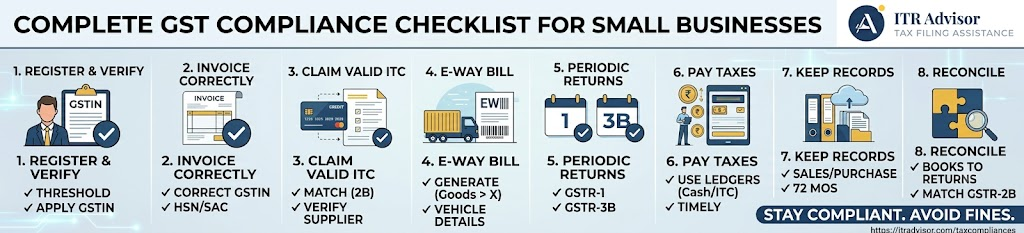
Step 1: GST Registration Compliance for Small Businesses in Pune
Before anything else, confirm that your GST registration status is current and accurate. Under the GST Act, registration is mandatory if your annual aggregate turnover exceeds ₹40 lakh (for goods suppliers) or ₹20 lakh (for service providers) in Maharashtra. Businesses making inter-state supplies, e-commerce sellers, and those liable for reverse charge mechanism (RCM) must register regardless of turnover.
GST compliance checklist for registration:
Verify that your GSTIN is active on the GST Portal (gst.gov.in) under the ‘Search Taxpayer’ function.
Ensure all business addresses including godowns, branches, or additional Pune locations are declared as additional places of business in your GST registration.
Confirm that your principal place of business, HSN/SAC codes, and authorised signatory details are up to date.
If your turnover has crossed the mandatory threshold during FY 2026-27, apply for GST registration immediately — delayed voluntary registration is treated as non-compliance.
If you opted for the GST Composition Scheme (available for eligible Pune traders and manufacturers with turnover up to ₹1.5 crore), verify you are filing CMP-08 quarterly and GSTR-4 annually.
Step 2: GST Return Filing Deadlines for FY 2026–27 : Complete Calendar for Pune Businesses
The most common cause of GST notices for small businesses in Pune is missed or delayed return filings. The GST return compliance calendar for FY 2026-27 is as follows:
Return / Filing
Who Must File
Due Date (FY 2026-27)
Penalty for Late Filing
GSTR-1 (Monthly)
Regular taxpayers with turnover > ₹5 crore
11th of following month
₹50/day (nil return ₹20/day), max ₹10,000
GSTR-1 (Quarterly/IFF)
QRMP scheme taxpayers (turnover ≤ ₹5 crore)
13th of month after quarter-end
₹50/day, max ₹10,000
GSTR-3B (Monthly)
Regular taxpayers (auto-populated from FY 2025-26)
20th/22nd/24th (based on state/zone)
₹50/day + 18% interest on tax due
GSTR-3B (Quarterly)
QRMP scheme taxpayers
22nd/24th after quarter-end
₹50/day + 18% interest on tax due
GSTR-9 (Annual Return)
Turnover > ₹2 crore (FY 2025-26 basis)
31st December 2026
₹200/day, max 0.25% of turnover
GSTR-9C (Reconciliation)
Turnover > ₹5 crore
31st December 2026
Same as GSTR-9 penalty structure
CMP-08 (Composition)
Composition scheme taxpayers
18th of month after quarter-end
₹50/day, max ₹2,000
GSTR-4 (Composition Annual)
Composition scheme taxpayers
30th April 2027
₹50/day, max ₹2,000
For Pune businesses on the QRMP (Quarterly Return Monthly Payment) scheme, note that tax must still be paid monthly either through the Fixed Sum Method or Self-Assessment Method even though the return itself is quarterly. QRMP is generally the right choice for Pune MSMEs and small traders with turnover below ₹5 crore.
Step 3: Input Tax Credit (ITC) Reconciliation: The Most Critical GST Compliance Task
Input Tax Credit is the primary financial benefit of GST registration for small businesses in Pune. But ITC can be claimed only if the conditions under Section 16 of the CGST Act are satisfied and this is where most Pune small business owners inadvertently lose money.
ITC GST Compliance Checklist for FY 2026-27
Reconcile GSTR-2B (auto-generated ITC statement) with your purchase register and books of accounts every month before filing GSTR-3B.
ITC is available only if the supplier has filed GSTR-1 and the invoice appears in your GSTR-2B. Follow up actively with non-compliant suppliers whose invoices are missing.
Ensure ITC is claimed within the time limit: for FY 2025-26 invoices, the deadline to claim ITC is the earlier of the due date of September 2026 GSTR-3B or the date of filing the annual return.
Do not claim ITC on blocked credits under Section 17(5) of the CGST Act these include motor vehicles (with exceptions), food and beverages, personal use goods, and construction services.
If you have both taxable and exempt supplies, calculate and reverse ineligible ITC under the proportionate method as required by the CGST Rules.
Step 4: E-Invoicing Compliance for Pune Small Businesses
The GST e-invoicing threshold has been progressively lowered by CBIC. As of FY 2026-27, e-invoicing under the GST framework is mandatory for all registered taxpayers with aggregate annual turnover exceeding ₹5 crore in any preceding financial year. For many growing Pune traders, manufacturers, and service exporters, this threshold is now a near-term reality.
E-invoicing GST compliance checklist:
Verify whether your FY 2024-25 or FY 2025-26 turnover crossed ₹5 crore if yes, e-invoicing is mandatory for all B2B transactions from the applicable date.
Ensure your accounting or ERP software is integrated with the Invoice Registration Portal (IRP) at einvoice1.gst.gov.in to generate an IRN (Invoice Reference Number) and QR code for each B2B invoice.
E-invoices issued without an IRN are invalid for ITC purposes — your buyer in Pune or elsewhere cannot claim ITC on such invoices, which can damage your business relationships.
Retain copies of all e-invoices with IRN for at least six years as required under the GST record-keeping rules.
Step 5: GST Record-Keeping and Audit Trail Requirements
Under Section 35 of the CGST Act, every registered taxpayer must maintain a complete set of records at the principal place of business — or at each additional place of business in Pune — for a minimum of six years from the due date of the annual return for that year.
Records that must be maintained for GST compliance checklist:
Purchase invoices, sales invoices, debit notes, and credit notes for all inward and outward supplies.
Stock registers showing opening stock, purchases, production/manufacture, sales, and closing stock with HSN classification.
Input Tax Credit ledger, Electronic Cash Ledger, and Electronic Liability Register (accessible on the GST Portal).
Bank statements reconciled with GST turnover for the year.
For exporters and SEZ suppliers: shipping bills, LUTs (Letter of Undertaking), and refund applications filed.
Key Takeaways:
• GST registration is mandatory for Pune businesses with turnover above ₹40L (goods) or ₹20L (services). Verify your GSTIN is active on gst.gov.in.
• File GSTR-1 and GSTR-3B on time every month or quarter. Late filing penalties start at ₹50/day and interest at 18% on unpaid tax accrues daily.
• Reconcile GSTR-2B with your purchase register monthly before filing GSTR-3B this is the single most important step to protect your ITC.
• E-invoicing is mandatory for businesses with turnover above ₹5 crore. Invoices without a valid IRN from the IRP portal are ineligible for ITC.
• Composition scheme taxpayers in Pune must file CMP-08 quarterly and GSTR-4 annually by April 30, 2027.
• Maintain all GST records for six years. The GST Department conducts audits and scrutiny up to six years from the relevant annual return due date.
Step 6: Common GST Compliance Mistakes That Pune Small Businesses Must Avoid
Reconciliation skipped: Filing GSTR-3B without cross-checking GSTR-2B leads to incorrect ITC claims, reversal demands, and scrutiny notices.
Turnover under-reporting: GST officers increasingly use e-way bill data, e-invoicing records, and bank statement analysis to detect turnover mismatches.
RCM non-compliance: Reverse Charge Mechanism liability on services like legal fees, GTA freight, and import of services is often missed by small businesses.
HSN code errors: Incorrect HSN/SAC classification leads to wrong tax rate application and potential demand with interest.
Debit/Credit note delays: Credit notes for sales returns or rate revisions must be issued and declared within the prescribed time limits to avoid ITC reversal complications for your buyers.
Expert Insight: GST Compliance Is Not Annual It’s a Monthly Discipline
Dr. Haresh Adwani, a PhD in Commerce and tax expert associated with ITRAdvisor.in, has a clear message for Pune’s small business community: ‘The biggest GST compliance mistake I see among small businesses in Pune is treating GST as a year-end activity. By the time December comes and the annual return deadline approaches, the reconciliation gaps have compounded for twelve months. GSTR-2B mismatches, missed ITC claims, and overlooked RCM liabilities become expensive to fix retroactively. The businesses that stay clean are the ones that close their GST books monthly, not annually.’
Frequently Asked Questions
Q1. What is the GST registration threshold for small businesses in Pune, Maharashtra?
In Maharashtra, GST registration is mandatory or businesses supplying goods with annual turnover above ₹40 lakh and for service providers above ₹20 lakh. Inter-state suppliers must register regardless of turnover.
Q2. Which GST return scheme is better for a small Pune business monthly or QRMP?
For Pune businesses with turnover below ₹5 crore, the QRMP (Quarterly Return Monthly Payment) scheme reduces return filing from 24 to 8 per year while still requiring monthly tax payments. Most small businesses find this significantly simpler.
Q3. Is e-invoicing mandatory for my Pune small business in FY 2026-27?
E-invoicing under GST is mandatory if your aggregate turnover in any preceding financial year exceeded ₹5 crore. Check your FY 2024-25 or FY 2025-26 turnover to confirm applicability for the current year.
Q4. What is the penalty for late GST return filing in India?
The late fee for delayed GSTR-1 or GSTR-3B filing is ₹50 per day (₹20/day for nil returns), subject to a maximum of ₹10,000. Interest at 18% per annum also accrues on unpaid GST liability from the due date.
Q5. When is the GSTR-9 annual return due for FY 2025-26?
The GSTR-9 annual return for FY 2025-26 is due by December 31, 2026. It is mandatory for businesses with turnover above ₹2 crore. GSTR-9C (reconciliation statement) applies to businesses above ₹5 crore.
Conclusion
GST compliance checklist for small businesses in Pune is not a checkbox exercise it is a continuous operational discipline that directly protects your cash flow, your Input Tax Credit, and your business reputation. The CBIC and GST Council have progressively tightened enforcement mechanisms: e-invoicing mandates, automated GSTR-2B mismatches, e-way bill data triangulation, and AI-driven scrutiny selection mean that gaps in GST compliance are increasingly difficult to hide and increasingly expensive to fix.
The good news is that the GST compliance framework, while demanding, is entirely manageable with the right processes. A monthly reconciliation routine, timely GSTR-1 and GSTR-3B filings, clean ITC documentation, and proper e-invoicing integration will keep your Pune business fully compliant and free from notices, penalties, and demand orders.
Is your Pune small business fully GST compliant for FY 2026-27?
ITRAdvisor.in provides clear, actionable guidance on GST registration, return filing, ITC reconciliation, e-invoicing, and GST notice responses for small businesses across Pune and Maharashtra. Whether you are a first-time GST registrant or an established business trying to clean up your compliance record, our resources are built for you.
About the Author : Prafull Nile
Prafull Nile is a senior taxation and accounting professional associated with Adwani & Co LLP, bringing over 19 years of extensive experience in direct taxation, tax audits, income tax assessments, GST audits, and financial statement finalization. He has successfully managed diverse client engagements across industries, providing strategic guidance on tax compliance, assessments, and regulatory matters. In addition to his technical expertise, Prafull leads and mentors teams, ensuring high standards of service delivery and operational excellence. His practical approach, deep understanding of tax laws, and commitment to client success make him a trusted advisor for businesses and professionals navigating complex financial and compliance requirements.
At ITRAdvisor.in, we help taxpayers with:
✔️ ITR Filing Review
✔️ AIS Reconciliation
✔️ Capital Gains Reporting
✔️ NRI Taxation
✔️ Tax Notice Response
✔️ Revised Returns
✔️ Income Tax Planning
✔️ Refund and Compliance Issues
If you are unsure whether your return has been filed correctly or want a professional review before submission, consulting an experienced tax professional can help avoid costly mistakes.
Visit ITRAdvisor.in for expert assistance with your Income Tax Return and tax compliance requirements.
Disclaimer: ITRAdvisor.in is an educational and informational platform focused on tax awareness and compliance updates. Nothing contained herein should be construed as solicitation or advertisement of professional services. Professional services, where applicable, are rendered in accordance with ICAI guidelines. This article is published on ITRAdvisor.in, a tax and compliance knowledge platform. The content has been reviewed for technical accuracy by professionals associated with Adwani & Co LLP
A prominent “File Your ITR Now” button near the top and again at the end of the article
Need help filing your Income Tax Return? Click the WhatsApp icon and our team will guide you through the process and assist you with your ITR filing.
Have questions about your ITR? Click the WhatsApp icon to connect with our tax experts for quick guidance and personalized assistance.
If You Think Filing a Salary ITR Is Still Simple, This Will Change Your Mind
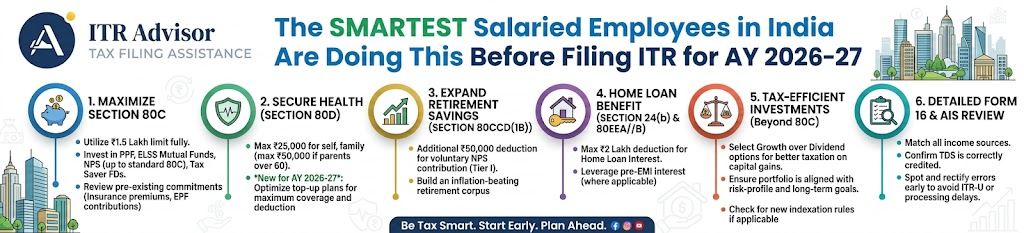
Picture this: You are a salaried professional. You earn well. Your company’s payroll team handles your TDS every month. You get your Form 16 in June, hand it to a local accountant or plug it into an online portal, file your return in twenty minutes, and go on with your life.
Two months later, you receive an Income Tax Department notice asking why your ITR does not match your Annual Information Statement.
You had no idea your FD interest was being reported. You forgot about the mutual funds you redeemed last October. You did not realise your credit card spend pattern was flagged for inconsistency with your declared income.
This scenario is playing out across India for AY 2026-27 and it is happening to careful, responsible, tax-compliant salaried professionals who simply did not know how much the system had changed.
ITR filing for salaried employees today is a sophisticated exercise. At ITR Advisor, our tax professionals work with employees across every sector IT, banking, healthcare, manufacturing, government to ensure their income tax returns are filed with the accuracy, completeness, and professional review that modern compliance demands.
This guide breaks down everything you need to know the risks, the right process, the expert advantage, and how to make sure AY 2026-27 is the year you file without a single worry.
How Income Tax Return Filing for SmartestSalaried Employees Has Changed in AY 2026-27
The Income Tax Department, through guidelines and compliance frameworks published on its official portal www.incometax.gov.in, has steadily built one of the most comprehensive taxpayer surveillance systems in Asia. Today, the department receives financial data from:
All scheduled banks (interest, cash deposits, high-value transfers)
SEBI-registered stock brokers and depositories (equity trades, LTCG, STCG)
Mutual fund registrars (SIP redemptions, fund switches, dividend payouts)
Post offices and NBFCs (recurring deposits, interest income)
Property registrars (real estate purchases and sales)
Every piece of this data is compiled into your Annual Information Statement (AIS) a financial fingerprint of your entire year. The Income Tax Department’s processing systems then compare your AIS against your filed ITR. Any gap between the two is a mismatch and mismatches generate notices.
This is the environment in which ITR filing for salaried employees in AY 2026-27 is happening. The era of filing using only Form 16 is over.
The 8 Costliest Mistakes SmartestSalaried Employees Make in ITR Filing And How to Avoid Them
Understanding the common failure points is the first step toward getting your return right.
1. Treating Form 16 as the Complete Picture
Form 16 is your salary TDS certificate nothing more. It captures what your employer paid you and the tax deducted at source. It does not capture:
Interest income from savings accounts, FDs, or RDs
Dividend received from shares or mutual funds
Capital gains from equity sales or MF redemptions
Rental income
Freelance or consulting income
Foreign salary or perquisites
If these are in your AIS but absent from your ITR, a notice will follow.
2. Filing the Wrong ITR Form
This is more common than most taxpayers realise. Every year, thousands of Smartest salaried employees file ITR-1 when they should have filed ITR-2 simply because they did not account for their capital gains, foreign assets, or multiple income sources.
ITR-1: Salary income below ₹50 lakh, one house property, no capital gains, no foreign assets
ITR-2: Capital gains from any source, two or more house properties, foreign assets or income, NRI status
ITR-3: Business or professional income alongside salary
Filing the wrong form triggers a Section 139(9) defective return notice and requires you to refile. This also delays any pending refund.
3.Skipping the Old vs New Tax Regime Comparision
The tax regime decision is one of the highest-impact choices in your entire return. Yet most salaried employees either stay with what their employer assumed or choose based on incomplete information.
Real Example:
Anil, a 38-year-old banker in Pune earning ₹22 lakh annually, had his employer default him to the new tax regime. His total tax liability under the new regime: ₹2,92,500. When his tax consultant ran the old regime calculation factoring in ₹1.5 lakh under Section 80C, ₹50,000 NPS contribution under 80CCD(1B), ₹25,000 health insurance under 80D, and ₹3.6 lakh HRA exemption his liability dropped to ₹2,24,200. He was unknowingly overpaying ₹68,300 every year. A single professional review corrected this permanently.
4. Not Reporting Capital Gains from SIPs and Stock Trading
India’s investor base has exploded. Millions of salaried employees now have active portfolios on platforms like Zerodha, Groww, Angel One, and Kite many of whom do not realise that every redemption, switch, or sale is a taxable event.
Short-term capital gains (STCG) from equity mutual funds are taxed at 20%. Long-term capital gains (LTCG) above ₹1.25 lakh are taxed at 12.5%. Both must be reported along with your cost of acquisition, date of purchase, and date of sale.
Your AMC or broker provides a capital gains statement. If you are filing without one, your return is almost certainly incomplete.
5.Missing Interest Income from All Bank Accounts
Most salaried professionals have more bank accounts than they actively manage a salary account, a savings account from a previous employer, an old joint account with a parent, an RD opened years ago. Each of these reports interest to the Income Tax Department. Each of these appears in your AIS.
Missing any one of them creates a mismatch.
Pro tip: Before filing, download your AIS from the income tax portal and create a checklist of every interest entry. Cross-check against your actual bank records. If an entry is incorrect, raise feedback on the portal before filing.
6. Incorrect or Undocumented HRA Claims
HRA (House Rent Allowance) is one of the most commonly claimed and most commonly scrutinised exemptions in salary ITR filing. Issues arise when:
Rent is paid to a parent but no proper rent agreement exists
Rent exceeds ₹1 lakh annually but the landlord’s PAN was not furnished to the employer
HRA is claimed in the ITR but the employer’s Form 16 does not reflect it (regime mismatch)
The Income Tax Department has the ability to cross-verify HRA claims through property registration data and landlord PAN records. Claims without documentation are a scrutiny risk.
7. Ignoring Crypto and Digital Asset Transactions
Virtual Digital Assets (VDAs), including cryptocurrency, are taxable at a flat 30% under Section 115BBH. Losses from crypto cannot be set off against any other income. TDS at 1% applies on certain transactions.
If you transacted in crypto during FY 2025-26, it must be disclosed in your ITR regardless of whether you made a profit. Ignoring it when your exchange has reported transactions in AIS is a serious compliance risk.
8 . Selecting the Wrong Bank Account for Refund Credit
A surprisingly common issue: taxpayers enter an old or inactive bank account for refund credit. The refund fails, and the taxpayer does not realise it for months. Always verify that your bank account is pre-validated on the income tax portal and linked to your PAN before submitting your return.
Who Absolutely Must File an Income Tax Return in AY 2026-27
While most salaried employees with income above the basic exemption limit are required to file, the Income Tax Act also mandates ITR filing based on certain activities regardless of taxable income. As per the department’s provisions, you must file even if your income is below the exemption limit if:
You have deposited more than ₹1 crore in bank accounts during the year
You have spent more than ₹2 lakh on foreign travel
You have paid more than ₹1 lakh in electricity bills
You hold foreign assets or have signing authority over foreign accounts
You have received income from property located abroad
Your aggregate TDS and TCS deductions exceed ₹25,000
Additionally, filing ITR even when not strictly required creates a verified income record that is essential for home loans, personal loans, visa applications, and financial planning.
Expert ITR Filing for Special Categories of Salaried Employees
ITR Filing for Government Employees and PSU Staff
Government employees and public sector staff often have additional income sources such as arrears (with relief under Section 89), pension, gratuity, leave encashment, and LTC. Each of these has specific treatment under the Income Tax Act. Incorrect handling of arrear relief, in particular, frequently results in excess tax payment that could have been avoided.
ITR Filing for Doctors, Engineers, and Consultants with Dual Income
Many salaried professionals doctors, architects, engineers also earn consulting or professional fees alongside their primary salary. This dual income profile requires careful handling: the consulting income may need to be reported under “Profits and Gains from Business or Profession,” and the correct ITR form (usually ITR-3) must be selected.
At ITR Advisor, our experts handle combined salary-plus-profession returns with full accuracy and proper schedule completion.
NRI Income Tax Return Filing for Indians Working Abroad
For Non-Resident Indians earning from Indian sources rental income, NRO account interest, Indian equity investments, or salary credited to Indian accounts NRI income tax return filing is mandatory when income exceeds the basic exemption limit.
The residential status determination (NRI vs RNOR vs Resident) is critical and must be based on days of physical presence in India. DTAA benefits, if applicable, must be claimed correctly using Form 67 where foreign taxes have been paid.
The Real Value of Filing Your ITR on Time : Beyond Just Compliance
Timely income tax return filing for salaried employees delivers benefits that go well beyond avoiding penalties:
Financial Documentation: ITR is the most widely accepted income proof for home loans, vehicle loans, and personal finance applications. Most banks require the last 2–3 years’ ITRs for loan processing.
Visa Applications: Several countries including the US, UK, Canada, and Schengen zone nations require ITR documents as part of visa income proof requirements.
Carry Forward of Losses: Capital losses (from equity, MFs, or property) can only be carried forward to offset future gains if the return is filed on time. A belated return forfeits this benefit.
Faster Refund Processing: Returns filed early in the season are typically processed sooner. Late filers often experience longer refund wait times as system loads increase.
Avoiding Compounding Interest: Late filing on a return with tax payable results in interest under Sections 234A, 234B, and 234C which compounds monthly and can add significantly to your total tax cost.
Why ITR Advisor Is the Right Choice for Smartest Salaried Employees Your Income Tax Return Filing in AY 2026-27
At ITR Advisor, we do not just enter numbers into a form. We bring professional tax expertise to every return we handle.
Here is what sets our expert ITR filing service apart:
Complete AIS and Form 26AS Reconciliation : We review every entry in your AIS before filing and ensure your return reflects a fully reconciled picture.
Regime Optimisation : We run a proper old vs new tax regime comparison for your specific income and deduction profile, ensuring you pay the least tax legally possible.
Capital Gains Accuracy : We calculate STCG and LTCG across equity, mutual funds, ESOPs, and property using your actual transaction statements.
Notice Risk Assessment : We proactively identify entries in your AIS that could trigger scrutiny and ensure proper disclosure and documentation before submission.
Post-Filing Support : If a notice or intimation arrives after filing, our team handles the response, revision, and compliance follow-through.Pan-India Digital Service We serve clients across Pune, Mumbai, Delhi, Bengaluru, Hyderabad, Chennai, and every corner of India through a fully secure digital filing process
Frequently Asked Questions
Q1. What is the last date to file salary ITR for AY 2026-27?
The standard due date for salaried employees is 31st July 2026. Belated returns can be filed up to 31st December 2026 with a late fee. Filing before the due date is always advisable to preserve all tax benefits, carry-forward rights, and timely refund processing.
Q2. Can I file ITR for salaried income without a CA?
Yes, but the risk of errors increases significantly when your income involves capital gains, foreign assets, RSUs, crypto, or multiple employers. Expert-assisted filing ensures accuracy, AIS reconciliation, and proper regime selection — reducing notice risk substantially.
Q3. How long does expert ITR filing take with ITR Advisor?
Simple salary returns are typically processed within 1–2 business days of receiving all required documents. Returns with capital gains, RSUs, or foreign income may take 2–4 business days depending on the complexity.
Q4. What if I received two Form 16s from different employers in the same year?
Both employers’ salary and TDS details must be consolidated in a single ITR. Failing to do so results in incomplete disclosure and a likely mismatch notice. This is a common situation for employees who switched jobs and requires careful aggregation of income and TDS credits.
Q5. Is capital gains from selling ancestral property taxable for salaried employees?
Yes. Capital gains from property sale — including inherited or ancestral property — are taxable. The cost of acquisition for inherited property is determined by its fair market value as of April 1, 2001. LTCG from property is taxed at 12.5% without indexation benefit (post-July 2024 amendments). Professional calculation is strongly recommended.
Q6. Do I need to show my PPF maturity amount in ITR?
PPF maturity proceeds are fully exempt from income tax. However, if the amount appears in your AIS, it is good practice to show it in the exempt income schedule of your ITR to prevent any potential mismatch query.
Q7. What is the penalty for filing an incorrect ITR?
Under Section 270A, under-reporting of income can attract a penalty of 50% of the tax on under-reported income. Misreporting (with intent) can result in a penalty of 200% of such tax. Accurate and complete filing is always the safer and smarter path.
Conclusion
Tax compliance in India has entered a new era. The gap between “filing a return” and “filing a correct and complete return” has never been wider and the consequences of that gap have never been more serious.
For Smartest Salaried Employees across India, ITR filing for AY 2026-27 demands a professional, systematic approach: reviewing AIS, comparing tax regimes, reporting every income source, documenting every deduction, and ensuring that what you submit aligns with what the Income Tax Department already knows.
The cost of getting it right the first time in time, money, and professional fees is a fraction of the cost of responding to a notice, revising a return, or managing a tax demand.
About the Author : Prafull Nile
Prafull Nile is a senior taxation and accounting professional associated with Adwani & Co LLP, bringing over 19 years of extensive experience in direct taxation, tax audits, income tax assessments, GST audits, and financial statement finalization. He has successfully managed diverse client engagements across industries, providing strategic guidance on tax compliance, assessments, and regulatory matters. In addition to his technical expertise, Prafull leads and mentors teams, ensuring high standards of service delivery and operational excellence. His practical approach, deep understanding of tax laws, and commitment to client success make him a trusted advisor for businesses and professionals navigating complex financial and compliance requirements.
At ITRAdvisor.in, we help taxpayers with:
✔️ ITR Filing Review
✔️ AIS Reconciliation
✔️ Capital Gains Reporting
✔️ NRI Taxation
✔️ Tax Notice Response
✔️ Revised Returns
✔️ Income Tax Planning
✔️ Refund and Compliance Issues
If you are unsure whether your return has been filed correctly or want a professional review before submission, consulting an experienced tax professional can help avoid costly mistakes.
Visit ITRAdvisor.in for expert assistance with your Income Tax Return and tax compliance requirements.
Disclaimer: ITRAdvisor.in is an educational and informational platform focused on tax awareness and compliance updates. Nothing contained herein should be construed as solicitation or advertisement of professional services. Professional services, where applicable, are rendered in accordance with ICAI guidelines. This article is published on ITRAdvisor.in, a tax and compliance knowledge platform. The content has been reviewed for technical accuracy by professionals associated with Adwani & Co LLP
A prominent “File Your ITR Now” button near the top and again at the end of the article
Need help filing your Income Tax Return? Click the WhatsApp icon and our team will guide you through the process and assist you with your ITR filing.
Have questions about your ITR? Click the WhatsApp icon to connect with our tax experts for quick guidance and personalized assistance.
ITR Advisor is here to make sure you get it right. Connect with our tax experts today for complete, accurate, and worry-free salary ITR filing for AY 2026-27.
Here Is Your Definitive 2026 Survival Guide: Know Your Rights, Protect Your Wealth
Imagine this: The Income Tax Department raids a business associate, a vendor, or even a distant acquaintance and days later, a notice lands on your doorstep under Section 153C of the Income Tax Act. You were never searched. No officer stepped into your office. Yet suddenly, you are under the scanner for six years of your income and assets. This is not a hypothetical situation. Across India in 2025 and 2026, thousands of taxpayers salaried professionals, business owners, real estate investors, and even silent partners have received notices under Section 153C without any warning whatsoever.
If you have received such a notice or if you want to protect yourself before one arrives this guide by Dr. Haresh Adwani, of Adwani and Company, is exactly what you need. Read every section carefully, because what you learn here could save you from penalties reaching up to 200% of your tax liability.
What Is Section 153C of the Income Tax Act?
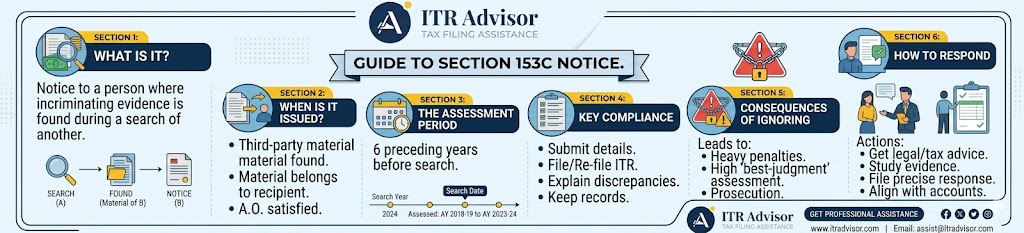
Section 153C of the Income Tax Act, 1961, is a powerful provision that empowers the Assessing Officer (AO) to issue a tax notice and initiate assessment proceedings against a person who was NOT the original subject of an income tax search or seizure. In simpler terms, if the Income Tax Department raids someone else and finds documents, books of account, digital data, jewellery, or any other asset that belongs to or pertains to you you can be assessed under Section 153C, even though your premises were never raided.
This section sits within the broader framework of search and seizure assessments under Indian tax law, alongside its companion provision, Section 153A which governs assessments of the person who was actually searched. The Income Tax Department uses Section 153C to extend its reach beyond the person searched, ensuring that any connected third party with undisclosed income does not escape scrutiny.
As Dr. Haresh Adwaniof Adwani and Company always advises clients: “Section 153C is not a minor notice. It is a full-scale tax assessment that can reopen six years of your financial history. Treating it lightly is the most expensive mistake a taxpayer can make.”
Learn more about our Income Tax Assessment Services at Adwani and Company, where our team of expert CAs handles Section 153C notices with precision and strategy.
Section 153C vs Section 153A: Understanding the Critical Difference
Many taxpayers confuse Section 153A with Section 153C, and that confusion can lead to wrong responses and serious legal consequences. Here is the clearest distinction:
Section 153A : Notice to the Person Searched
When the Income Tax Department conducts a search under Section 132 or a requisition under Section 132A, the person who was searched receives a notice under Section 153A. This notice requires filing of income tax returns for the six assessment years immediately preceding the year of search, plus the current year.
Section 153C : Notice to a Third Party (You)
When documents, assets, digital records, or books of account found during a search on someone else are determined to belong to or pertain to you, the AO of the searched person hands over those materials to your Assessing Officer. Your AO then issues you a Section 153C notice and initiates the same assessment procedure as under Section 153A.
The critical phrase here is “belongs to or pertains to.” Indian courts including the Delhi High Court in the landmark Kabul Chawla case (2015) have clarified that the material found must genuinely belong to you or contain information directly relating to your income. Without this clear ownership link, the Section 153C notice can be legally challenged and quashed.
How Is a Section 153C Income Tax Notice Triggered? Step-by-Step Process
Understanding the procedural chain that leads to a Section 153C notice helps you evaluate whether the notice issued to you is legally valid a key part of your defence strategy.
The Income Tax Department conducts a search under Section 132 or a requisition under Section 132A at the premises of a person (let us call them Person A).
During the search on Person A’s premises, the investigating officers discover documents, books of account, hard drives, cash, jewellery, or other assets that appear to belong to or relate to you (Person B).
The AO in charge of Person A’s case reviews the seized material and records a Satisfaction Note a written document explaining in detail why he is satisfied that the material belongs to or pertains to Person B (you).
The seized material is formally handed over to the AO having jurisdiction over Person B (you).
Your AO reviews the material and issues a notice under Section 153C, requiring you to file income tax returns for the six assessment years preceding the year of search.
Assessment or reassessment of your income for those six years begins in accordance with the provisions of Section 153A.
According to the Income Tax Department’s guidelines and confirmed by multiple High Court rulings, the Satisfaction Note at Step 3 is non-negotiable. If it is absent, vague, or not recorded in writing before the notice is issued, the entire Section 153C proceeding is legally invalid.
Real-World Example: How a Section 153C Notice Can Arrive at Your Door
Practical Example: The Income Tax Department conducts a search in FY 2023-24 at the premises of a real estate developer in Pune. During the search, investigators discover a set of financial documents referencing a private investor who had made an unrecorded cash payment of ₹45 lakhs for a commercial property. The investor was never searched. However, the documents clearly link the payment to the investor’s PAN.
The AO records a Satisfaction Note and hands over the documents to the investor’s AO. A Section 153C notice is then issued to the investor for Assessment Years 2018-19 to 2023-24 six full years. The investor now faces potential tax demand on ₹45 lakhs, plus interest under Sections 234A, 234B, and 234C, plus a penalty that can reach up to 200% of the tax evaded under Section 270A.
This example is not extraordinary. It plays out in hundreds of cases every year, and this is precisely why proactive tax planning and clean documentation matter as much as filing returns on time.
Critical Time Limits Under Section 153C That Every Taxpayer Must Know
The Income Tax Act imposes strict time limits on assessments under Section 153C, and missing these deadlines can itself invalidate a notice. Here is what the law says:
Assessment Years Covered
Normally, a Section 153C notice covers the six assessment years immediately preceding the year in which the search was conducted. After amendments introduced in 2021, the timeline has been aligned with Section 132 and Section 132A provisions, providing greater clarity on which years can be reopened.
Extended Period of 10 Years
As amended by the Finance Act 2017, if the AO has credible evidence that undisclosed income exceeding ₹50 lakh has escaped assessment, the assessment window under Section 153C can be extended to cover up to ten years preceding the year of search. This extended period is not automatic it requires specific evidence and cannot be used as a blanket tool.
Time Limit for Completing Assessment
The Assessing Officer must complete the assessment within 12 months from the end of the financial year in which the evidence was handed over. This is a hard deadline under Section 153B, and failure to complete the assessment within this window renders the order invalid.
Dr. Haresh Adwani emphasises that checking these time limits carefully is the first defence a taxpayer should mount: “I have seen cases where the AO issued a Section 153C notice for years that were clearly outside the permissible window. A well-informed taxpayer, guided by the right CA, can get such proceedings quashed entirely based on this ground alone.”
The Satisfaction Note: Your Most Powerful Legal Shield Against a Section 153C Notice
The Satisfaction Note is arguably the most important procedural requirement in a Section 153C proceeding. Without it, the entire assessment collapses. Here is what you must know about it:
What Is the Satisfaction Note?
The Satisfaction Note is a written document prepared by the Assessing Officer of the searched person (Person A), in which he records his reasons for believing that the seized material belongs to or pertains to a third party (you, Person B). The Supreme Court and multiple High Courts have repeatedly held that this note must be prepared before the notice is issued not after.
What Happens If the Satisfaction Note Is Missing or Defective?
Indian courts have consistently quashed Section 153C assessments where the Satisfaction Note was absent, vague, or prepared mechanically. In the RRJ Securities Ltd. vs. CIT case decided by the Delhi High Court, the court held that for invoking Section 153C, the evidence must actually belong to the other person not merely refer to or relate to them. A defective Satisfaction Note is one of the strongest grounds for legally challenging a Section 153C notice.
At Adwani and Company, one of the first steps Dr. Haresh Adwani takes when reviewing a Section 153C notice is to request and examine the Satisfaction Note. A carefully prepared legal challenge based on procedural deficiencies has resulted in numerous assessments being set aside before they even begin.
Documents You Must Prepare When You Receive a Section 153C Income Tax Notice
Receiving a Section 153C notice is stressful, but a methodical, document-driven response is your most effective defence. Based on the guidelines issued by the Income Tax Department and practical experience, here is the complete list of documents you should gather immediately:
Income Tax Returns (ITR) for all 6 relevant assessment years
Books of account, ledgers, and financial statements for those years
Bank statements for all accounts (savings, current, FD, OD)
Details of all assets and liabilities during the relevant period
Complete source of funds documentation for all major transactions
Property purchase and sale documents (sale deeds, agreements)
Loan agreements and repayment records
Gift deeds or documentation for any assets received as gifts
TDS certificates and Form 26AS for all relevant years
PAN card, Aadhaar, and identity proof
Any correspondence with the searched person (Person A)
Investment records (shares, mutual funds, capital gains statements)
The Income Tax Department’s TRACES portal and the AIS (Annual Information Statement) available on the income tax e-filing portal (incometax.gov.in) provide a comprehensive picture of all transactions linked to your PAN. Reviewing your AIS before responding to any notice is a non-negotiable step recommended by Adwani and Company.
How to Respond to a Section 153C Tax Notice: A 6-Step Action Plan
Every Section 153C notice carries a response deadline. Missing that deadline can escalate the situation dramatically. Here is the structured action plan recommended by Dr. Haresh Adwani:
Do not panic, but act immediately. Every day that passes without action reduces your options.
Consult a qualified Chartered Accountant with proven experience in search and seizure assessments. This is not the time for general tax advice.
Request the Satisfaction Note and review it carefully with your CA to determine if it is procedurally valid.
Gather all the documents listed above and prepare a detailed reconciliation of your income, assets, and major transactions for the relevant years.
File the required income tax returns for past years if they were not previously filed, and ensure all disclosures are complete and accurate.
Respond to the notice within the stipulated deadline with a professionally prepared, legally sound reply that addresses each point raised by the AO.
If the Satisfaction Note is defective or the notice is issued for years beyond the permissible period, your CA may advise filing a writ petition before the appropriate High Court to get the proceedings stayed or quashed.
The team at Adwani and Company led by Dr. Haresh Adwani has successfully represented hundreds of clients before Assessing Officers, CIT(Appeals), and the Income Tax Appellate Tribunal (ITAT) in cases arising from Section 153C notices. A professionally drafted response, backed by clean documentation and sound legal arguments, resolves the majority of these cases at the earliest stage.
Consequences of Ignoring or Mishandling a Section 153C Income Tax Notice
The Income Tax Act provides for serious consequences when a taxpayer ignores a Section 153C notice or fails to respond adequately. Understanding these consequences reinforces why expert guidance is non-negotiable:
Tax demands on undisclosed income discovered during assessment
Interest under Section 234A (delay in filing), Section 234B (advance tax shortfall), and Section 234C (installment default)
Penalty under Section 270A of up to 200% of the tax amount in cases of misreporting or under-reporting of income
Best judgment assessment under Section 144 if the taxpayer fails to comply with notices or produce required documents
Potential prosecution proceedings in cases involving deliberate concealment of income
None of these consequences are inevitable if you respond correctly and promptly. The Income Tax Department’s own circulars emphasise that taxpayers who cooperate fully and disclose income honestly are treated more favourably during assessment proceedings.
Official Government References and Authority Signals
The legal basis for Section 153C proceedings is firmly established in the Income Tax Act, 1961, as administered by the Central Board of Direct Taxes (CBDT). The CBDT has issued multiple circulars and instructions clarifying procedural requirements for Assessing Officers conducting assessments under Sections 153A and 153C. Taxpayers who receive Section 153C notices have the right to access these circulars and rely on them in their defence.
The Ministry of Finance, through the Income Tax Department, has also introduced the Faceless Assessment Scheme to reduce physical interaction and improve transparency in assessment proceedings. While Section 153C cases may have specific exemptions from full faceless assessment, the principles of natural justice including the right to be heard and the right to challenge procedural deficiencies remain fully applicable.
For the most current information on income tax assessments, the official Income Tax Department website at incometax.gov.in and the CBDT’s circulars available on the website of the Ministry of Finance are the authoritative sources.
Frequently Asked Questions
Q1. Can I receive a Section 153C notice even if the Income Tax Department never searched my premises?
Yes. Section 153C specifically applies to persons who were NOT the subject of the original search. If documents or assets belonging to you are found during a search at someone else’s premises, you can receive a Section 153C notice.
Q2. How many years of income can be reassessed under Section 153C?
Normally, the six assessment years immediately preceding the year of search. In cases where undisclosed income exceeding ₹50 lakh is discovered, the assessment window can be extended to ten years. The exact years depend on when the search was conducted and when the material was handed over to your AO.
Q3. What is the Satisfaction Note in Section 153C, and why does it matter?
The Satisfaction Note is a mandatory written document prepared by the AO of the searched person, recording the reasons why seized material belongs to or pertains to a third party. Without this note, a Section 153C notice is legally invalid and can be challenged in court.
Q4. What documents should I keep ready when I receive a Section 153C notice?
You should immediately gather income tax returns for the past six years, bank statements, books of account, asset and liability details, property documents, loan agreements, Form 26AS, and source of funds documentation for all major transactions. Consulting an experienced CA
Q5. Can a Section 153C notice be challenged or quashed?
Yes. If the Satisfaction Note is absent or defective, if the notice covers years beyond the permissible period, or if the seized material does not genuinely belong to the taxpayer, the Section 153C notice can be legally challenged before the High Court through a writ petition or before the CIT(Appeals) or ITAT in appeal proceedings.
Q6. How can Adwani and Company help me respond to a Section 153C tax notice?
Dr. Haresh Adwani and the expert team at Adwani and Company provide end-to-end assistance: reviewing the Satisfaction Note, identifying legal deficiencies, gathering and organising documents, preparing professionally drafted responses, representing clients before the AO, CIT(Appeals), and ITAT, and if necessary, pursuing High Court relief. Connect with Adwani and Company today at www.adwaniandco.com.
Conclusion:
A Section 153C income tax notice is not the end of the road. It is a beginning a beginning of a legal process that, with the right expertise and preparation, can be navigated successfully. The law provides clear procedural safeguards including the mandatory Satisfaction Note requirement, strict time limits for assessment, and the right to appeal and these safeguards exist precisely to protect taxpayers from arbitrary or unlawful proceedings.
The two most important actions you can take right now are: first, understand the provisions of Section 153C thoroughly so that you know your rights; and second, engage a qualified and experienced Chartered Accountant who has handled income tax search assessment cases before. Do not attempt to respond to a Section 153C notice without professional guidance. The stakes are too high.
Dr. Haresh Adwani has built Adwani and Company on the principle that every taxpayer deserves expert, transparent, and accessible professional guidance especially in high-stakes situations like a Section 153C notice. With a team of experienced CAs, tax lawyers, and assessment specialists, Adwani and Company has successfully resolved Section 153C and Section 153A cases across India.
Read our detailed guide on Income Tax Appeals and Assessment Proceedings to understand your complete rights as a taxpayer under Indian tax law.
About the Author : Prafull Nile
Prafull Nile is a senior taxation and accounting professional associated with Adwani & Co LLP, bringing over 19 years of extensive experience in direct taxation, tax audits, income tax assessments, GST audits, and financial statement finalization. He has successfully managed diverse client engagements across industries, providing strategic guidance on tax compliance, assessments, and regulatory matters. In addition to his technical expertise, Prafull leads and mentors teams, ensuring high standards of service delivery and operational excellence. His practical approach, deep understanding of tax laws, and commitment to client success make him a trusted advisor for businesses and professionals navigating complex financial and compliance requirements.
At ITRAdvisor.in, we help taxpayers with:
✔️ ITR Filing Review
✔️ AIS Reconciliation
✔️ Capital Gains Reporting
✔️ NRI Taxation
✔️ Tax Notice Response
✔️ Revised Returns
✔️ Income Tax Planning
✔️ Refund and Compliance Issues
If you are unsure whether your return has been filed correctly or want a professional review before submission, consulting an experienced tax professional can help avoid costly mistakes.
Visit ITRAdvisor.in for expert assistance with your Income Tax Return and tax compliance requirements.
Disclaimer: ITRAdvisor.in is an educational and informational platform focused on tax awareness and compliance updates. Nothing contained herein should be construed as solicitation or advertisement of professional services. Professional services, where applicable, are rendered in accordance with ICAI guidelines. This article is published on ITRAdvisor.in, a tax and compliance knowledge platform. The content has been reviewed for technical accuracy by professionals associated with Adwani & Co LLP
A prominent “File Your ITR Now” button near the top and again at the end of the article.
Need help filing your Income Tax Return? Click the WhatsApp icon and our team will guide you through the process and assist you with your ITR filing.
Have questions about your ITR? Click the WhatsApp icon to connect with our tax experts for quick guidance and personalized assistance.
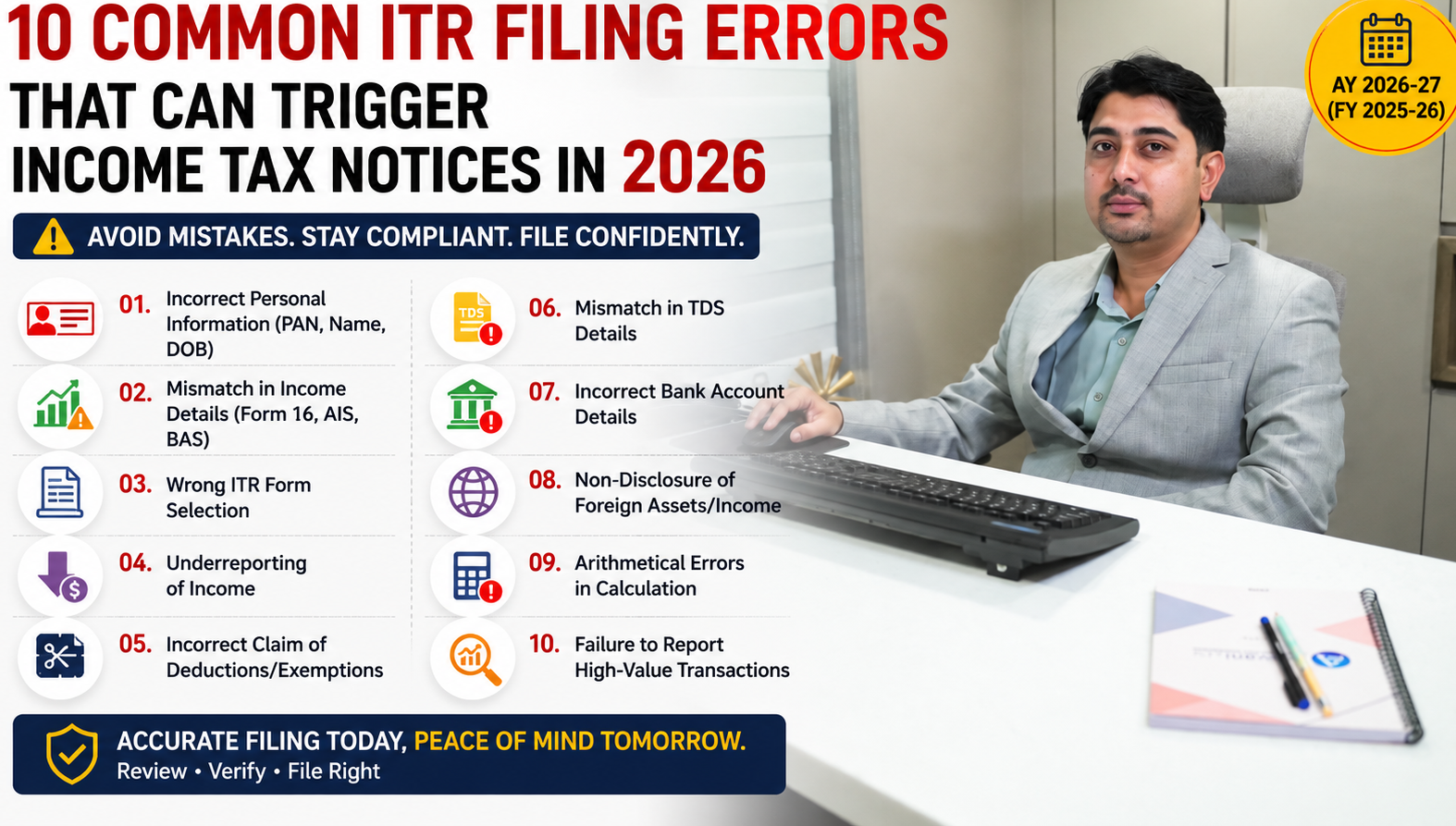
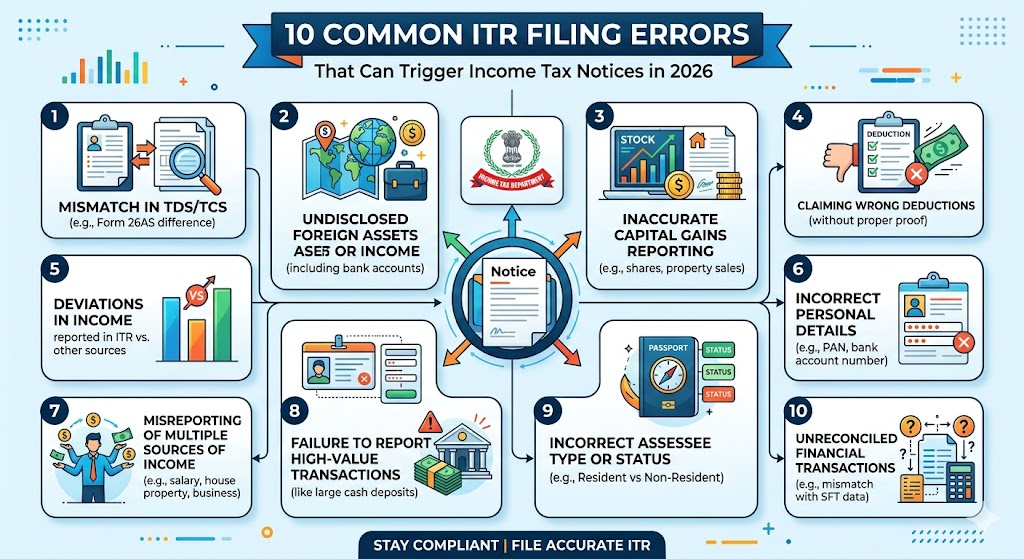
Filing your Income Tax Return (ITR) may appear simple, especially with pre-filled data available on the Income Tax Portal. However, thousands of taxpayers receive notices every year due to avoidable mistakes while filing their returns.
Many taxpayers believe that if tax has been deducted or Form 16 has been issued, there is no possibility of receiving a notice. Unfortunately, this is not always true.
The Income Tax Department now uses data from:
Annual Information Statement (AIS)
Form 26AS
Banks
Mutual Funds
Stock Brokers
Property Registrars
Credit Card Companies
As a result, even small filing errors can result in tax demands, refund delays, scrutiny, or notices.
Let’s look at the most common ITR filing mistakes and how to avoid them.
Not Checking AIS Before Filing
This is currently one of the biggest mistakes taxpayers make.
Many individuals file their returns using only Form 16 without reviewing the Annual Information Statement (AIS).
AIS may contain:
FD interest
Dividend income
Share transactions
Mutual fund redemptions
Property transactions
Foreign remittances
If income reflected in AIS is not reported in the ITR, the department may issue a notice.
Example
A salaried employee reported salary income based on Form 16 but forgot to include ₹38,000 FD interest reflected in AIS.
The mismatch was later identified during return processing.
Many taxpayers assume that because TDS has been deducted, interest income need not be reported.
This is incorrect.
Commonly missed income includes:
Savings account interest
Fixed Deposit interest
Recurring Deposit interest
The income must generally be disclosed in the return.
Ignoring Dividend Income
Dividend income received from shares and mutual funds is often forgotten during filing.
Since this information is generally available to the department, non-reporting can create mismatches.
Incorrect Capital Gains Reporting
This is one of the most frequent reasons for notices.
Taxpayers often:
Forget to report share transactions
Ignore mutual fund redemptions
Miscalculate capital gains
Fail to report property sales
Example
A taxpayer sold mutual funds worth ₹12 lakh and assumed there was no taxable gain because the amount was reinvested.
The transaction appeared in AIS but was omitted from the ITR.
A notice was later received seeking clarification.
Claiming Deductions Without Proper Documentation
Many taxpayers claim deductions under:
Section 80C
Section 80D
Section 80G
without maintaining supporting records.
If questioned by the department, documentary evidence may be required.
Not Reporting Foreign Assets
This mistake is particularly common among NRIs returning to India.
Foreign bank accounts, investments, and other reportable assets may require disclosure depending on residential status and applicable provisions.
Failure to disclose can have serious consequences.
Not Reconciling Form 26AS
Before filing, taxpayers should compare:
Form 16
Form 26AS
AIS
Bank records
Differences should be investigated before submission.
Incorrect Bank Account Details
A simple mistake in bank account information can result in:
Refund failure
Delayed processing
Additional compliance issues
Always verify account details carefully.
Filing in a Hurry Before the Deadline
Many taxpayers wait until the last few days before the due date.
As a result, important items are overlooked, including:
AIS mismatches
Capital gains
Interest income
Foreign assets
TDS discrepancies
Rushed filing often leads to mistakes that could have been avoided.
Real-Life Example: Notice Due to AIS Mismatch
Mr. Sharma filed his Income Tax Return based solely on Form 16 provided by his employer.
A few months later, he received a communication from the Income Tax Department.
Upon review, it was found that:
FD interest of ₹62,000 reflected in AIS was not reported.
Dividend income of ₹14,000 was omitted.
Mutual fund redemption transactions were not disclosed.
Although the omissions were unintentional, additional compliance was required to resolve the matter.
This situation is becoming increasingly common as the department relies heavily on AIS data.
Can I Correct an ITR Filing Mistake?
In many situations, taxpayers may be able to rectify mistakes by filing a revised return within the applicable timelines.
However, early identification of errors is important.
The longer a mistake remains uncorrected, the greater the risk of notices, demands, or penalties.
How to Avoid ITR Filing Errors:
Before filing your return:
✔️ Verify Form 16
✔️ Check AIS thoroughly
✔️ Review Form 26AS
✔️ Reconcile bank interest
✔️ Verify dividend income
✔️ Check capital gains statements
✔️ Confirm bank account details
✔️ Select the correct ITR form
✔️ Review foreign asset disclosures
✔️ Seek professional advice for complex transactions
Frequently Asked Questions
1.Can a small mistake in ITR trigger a notice?
Yes. Even small mismatches between the ITR and AIS can result in communications from the Income Tax Department.
2.Can I revise my ITR after filing?
In many cases, taxpayers can file a revised return within the prescribed timelines.
3.Is AIS more important than Form 16?
Both are important. However, AIS often contains additional information that may not appear in Form 16.
What is the most common ITR filing mistake
Currently, failure to reconcile AIS before filing is among the most common errors.
Final Thoughts
Most Income Tax notices are not issued because taxpayers intentionally hide income. They are often the result of simple mistakes, omissions, or mismatches.
A careful review of AIS, Form 26AS, interest income, capital gains, and deductions before filing can significantly reduce the risk of future notices and tax disputes.
Taking a few extra minutes before filing can save months of stress later.
Many taxpayers file their returns themselves and later discover mistakes that result in notices, refund delays, or additional tax demands.
About the Author : Prafull Nile
Prafull Nile is a senior taxation and accounting professional associated with Adwani & Co LLP, bringing over 19 years of extensive experience in direct taxation, tax audits, income tax assessments, GST audits, and financial statement finalization. He has successfully managed diverse client engagements across industries, providing strategic guidance on tax compliance, assessments, and regulatory matters. In addition to his technical expertise, Prafull leads and mentors teams, ensuring high standards of service delivery and operational excellence. His practical approach, deep understanding of tax laws, and commitment to client success make him a trusted advisor for businesses and professionals navigating complex financial and compliance requirements.
At ITRAdvisor.in, we help taxpayers with:
✔️ ITR Filing Review
✔️ AIS Reconciliation
✔️ Capital Gains Reporting
✔️ NRI Taxation
✔️ Tax Notice Response
✔️ Revised Returns
✔️ Income Tax Planning
✔️ Refund and Compliance Issues
If you are unsure whether your return has been filed correctly or want a professional review before submission, consulting an experienced tax professional can help avoid costly mistakes.
Visit ITRAdvisor.in for expert assistance with your Income Tax Return and tax compliance requirements.
Disclaimer: ITRAdvisor.in is an educational and informational platform focused on tax awareness and compliance updates. Nothing contained herein should be construed as solicitation or advertisement of professional services. Professional services, where applicable, are rendered in accordance with ICAI guidelines. This article is published on ITRAdvisor.in, a tax and compliance knowledge platform. The content has been reviewed for technical accuracy by professionals associated with Adwani & Co LLP.