Category: Blog

Your blog category

  • NRI ITR Filing in India 2026: Stop Overpaying Tax You Don’t Owe

    NRI ITR Filing in India 2026: Stop Overpaying Tax You Don’t Owe

    NRI ITR Filing in India

    Thousands of NRIs pay more tax than they legally need to, and most don’t find out until a refund gets stuck, a notice lands, or a property sale turns complicated. If you live abroad but still earn even a rupee of income in India, NRI ITR filing isn’t a formality you can skip. It’s the one step that decides whether you overpay the taxman or claim back what’s rightfully yours.

    Do NRIs Really Need NRI ITR Filing While Living Abroad?

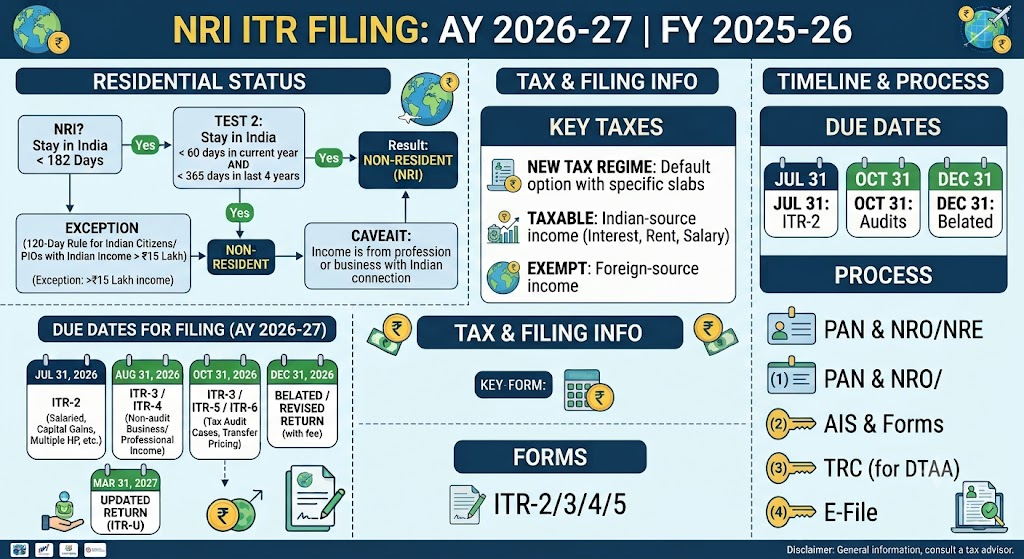
    This is the single biggest myth in NRI taxation. Living outside India does not exempt you from Indian tax law the moment income actually arises here. NRI ITR filing becomes mandatory whenever you have rental income from an Indian property, capital gains, or interest income, regardless of how small the amount seems. And here’s the part most NRIs miss: TDS being deducted at source does not close the matter. If the flat TDS rate is higher than your actual tax liability, skipping NRI ITR filing means walking away from a refund you’re legally entitled to.

    The NRI ITR Filing Questions We Hear Every Season

    Every filing season, the questions from NRI clients follow a familiar pattern:

    • Do I need to file an ITR if I only earn rental income from India?
    • TDS has already been deducted on my income. Do I still need to file a return?
    • I sold a property in India. Can I claim a refund of excess TDS?
    • My NRO account earned interest. Is it taxable?
    • I transferred money between my NRE and NRO accounts. Is there any tax implication?
    • Can I claim deductions under Section 80C or 80D as an NRI?
    • What documents do I need to keep ready before filing?
    • Will NRI ITR filing help me in future property transactions, loans, or repatriation of funds?

    Each of these has a concrete, individual answer, and getting it wrong is exactly what leads to overpaid tax or a delayed refund.

    Read our detailed guides on NRE vs NRO Account Taxation in India: What Every NRI Should Know

    Also Read:NRI International Tax India 2026: DTAA, FEMA & Residency Rules You Must Know

    NRI ITR Filing After a Property Sale: Claiming Your TDS Refund

    When an NRI sells property in India, the buyer typically deducts TDS at a much higher rate than the actual capital gains tax owed. Without NRI ITR filing, that excess amount simply sits with the government. Filing a return lets you compute the real capital gains, apply eligible exemptions, and claim back the difference as a refund, often a meaningful sum on a mid-sized property transaction.

    NRO Interest, NRE-NRO Transfers, and NRI ITR Filing

    Interest earned on an NRO account is fully taxable in India and usually carries TDS close to 30%. NRE account interest, by contrast, is exempt for a genuine non-resident. A common point of confusion is transferring funds between your own NRE and NRO accounts. This movement, by itself, is not a fresh taxable event, but it should be documented carefully since it can surface during AIS or Form 26AS reconciliation, and accurate NRI ITR filing keeps that record clean and defensible.

    Deductions and Documents for Smooth NRI ITR Filing

    NRIs remain eligible for several deductions under the Income Tax Act, including Section 80C (life insurance, ELSS, children’s tuition fees) and Section 80D (health insurance premiums), subject to certain conditions. Before NRI ITR filing, keep the following ready: PAN, passport copy confirming residential status, NRE and NRO bank statements, Form 26AS and AIS, TDS certificates, and the sale deed if a property transaction is involved. Proper NRI ITR filing today also strengthens your position for future loans, property purchases, and smooth repatriation of funds through proper banking channels.

    Key Takeaway

    • NRI ITR filing is mandatory once taxable Indian income exists, TDS deduction alone does not end the obligation.

    • Property sales, NRO interest, and rental income are the most common triggers for NRI ITR filing.

    • Timely NRI ITR filing is the only route to recovering excess TDS as a refund. • Good documentation today prevents AIS/Form 26AS mismatch notices tomorrow.

    For nearly five decades, Adwani & Co LLP has guided NRI clients through exactly these questions, under the stewardship of Dr. Haresh Adwani, who holds a PhD in Commerce and is also a law graduate. That depth of experience is precisely why a few weeks of planning ahead of the filing season routinely saves NRIs from unnecessary tax outflow and months of avoidable follow-up with the Income Tax Department.

    Frequently Asked Questions

    1.Can I claim a TDS refund through NRI ITR filing after selling property?

    Yes. If TDS deducted exceeds your actual capital gains tax, NRI ITR filing is how you claim that excess amount back.

    2.Is interest on an NRO account taxable for NRIs?

    Yes, NRO interest is fully taxable in India, unlike NRE account interest, which is generally exempt.

    3.Do NRE to NRO fund transfers attract tax?

    Not by themselves, but they should be documented properly to avoid mismatches during NRI ITR filing and AIS reconciliation.

    4.Can NRIs claim deductions under Section 80C and 80D?

    Yes, subject to certain conditions, making accurate NRI ITR filing essential to actually claim

    Conclusion: Make NRI ITR Filing Work in Your Favour

    NRI ITR filing isn’t just about compliance, it’s about not leaving your own money on the table. Rental income, property sales, NRO interest, and fund transfers all carry tax implications that only proper filing can resolve in your favour. If you’re an NRI with income, investments, or property in India, review your tax position before the filing rush begins.

    Author

    Dr. Haresh Adwani

    PhD (Commerce) · Adwani & Company, Pune

    Dr. Haresh Adwani is a PhD holder in Commerce with over 20 years of experience in NRI taxation, FEMA compliance, international financial advisory, and tax notice resolution. He is one of Pune’s most trusted NRI tax advisors, specialising in residential status assessment, DTAA planning, and cross-border compliance for professionals returning from the US, UK, UAE, Canada, and Australia.

    Disclaimer:

    ITRAdvisor.in is an educational and informational platform focused on tax awareness and compliance updates. Nothing contained herein should be construed as solicitation or advertisement of professional services. Professional services, where applicable, are rendered in accordance with ICAI guidelines. This article is published on ITRAdvisor.in, a tax and compliance knowledge platform. The content has been reviewed for technical accuracy by professionals associated with Adwani & Co LLP.

    If you want expert guidance on NRI ITR filing, connect with itradvisor.in today, and take the guesswork out of your Indian tax compliance.

  • New Income Tax Act 2025: The AIS Truth Revealed

    New Income Tax Act 2025: The AIS Truth Revealed

    AIS Truth Revealed : New Income Tax Act 2025

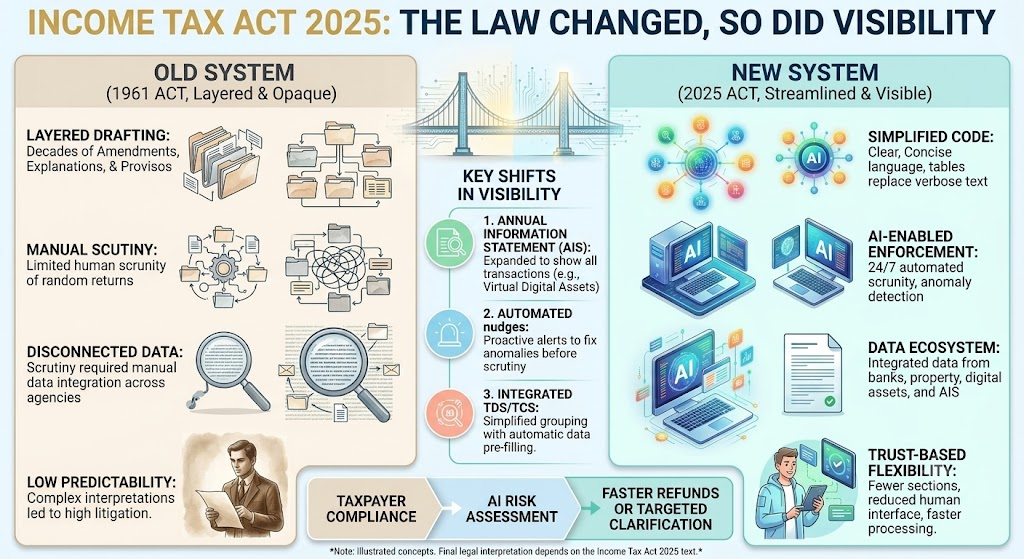
    My CA mentioned something about a new Income Tax Act does it actually change anything for me?” A colleague asked me that on 1st April 2026, and the honest answer surprised him. That day, India quietly retired a 60-year-old law. The Income Tax Act, 1961, which governed every return, notice, and assessment for six decades, was replaced by the Income Tax Act 2025. Most taxpayers didn’t even notice but here’s exactly what the Income Tax Act 2025 means for how closely the department is already watching your money.

    What the Income Tax Act 2025 Actually Changes

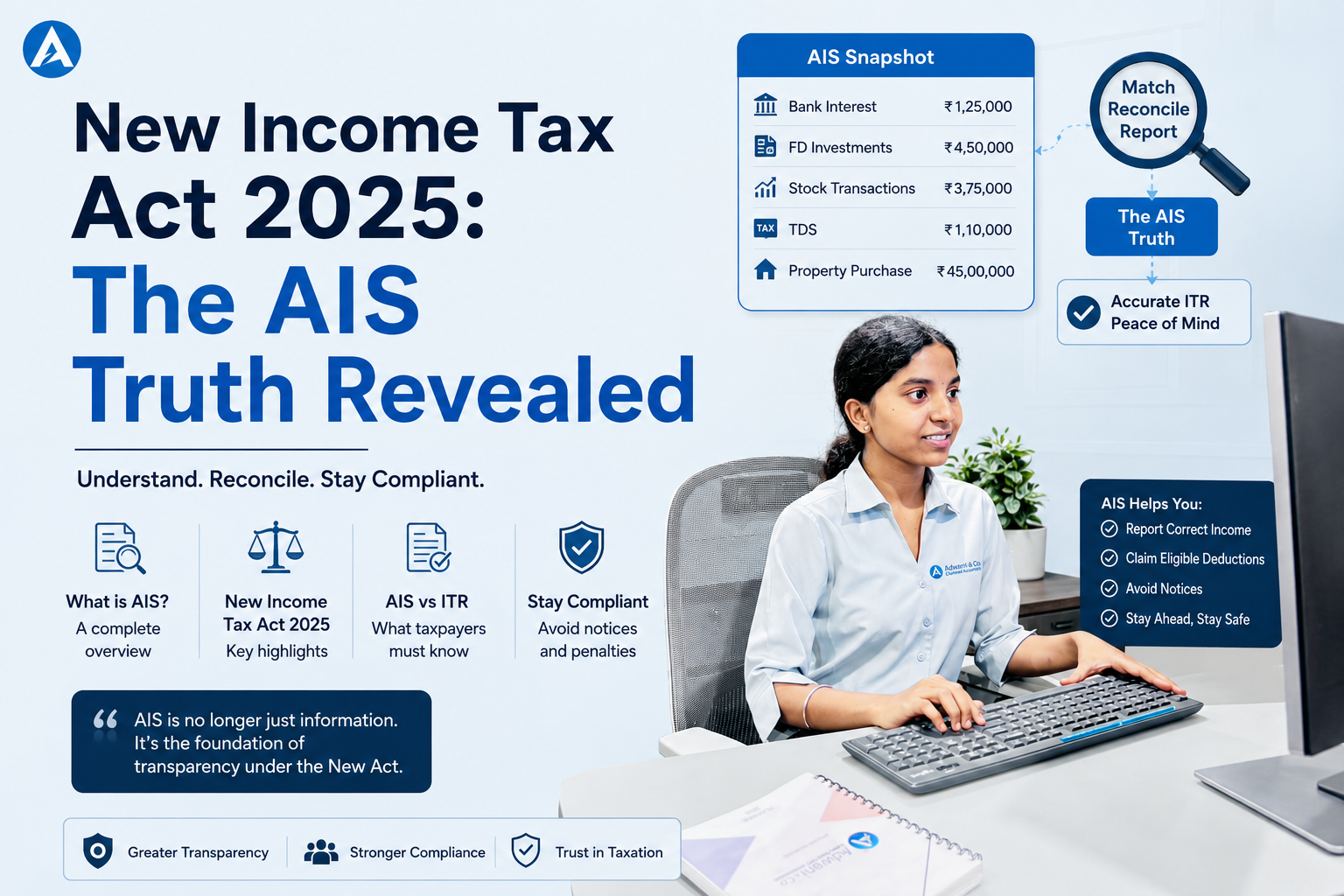
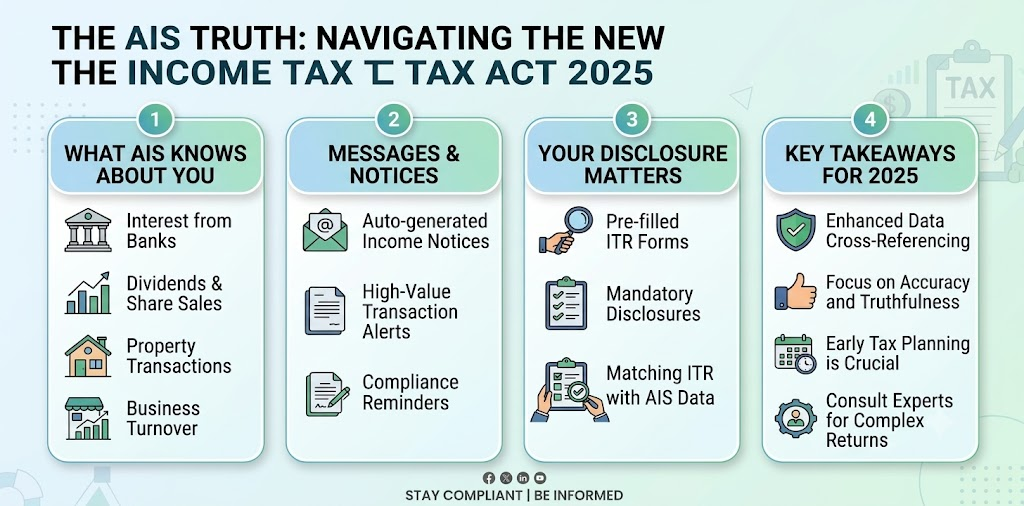
    The Income Tax Act 2025 isn’t just a rename of the old statute. It’s built around a system that already knows more about your finances than most taxpayers realise. Banks report specified high-value transactions large cash deposits, big fixed deposits, and high-value credit card spends directly to the tax department. Mutual funds, registrars, and sub-registrars report your investments and property purchases, often before you even sit down to file. TDS and TCS data from employers, banks, and buyers gets matched automatically against your PAN.


    How AIS Under the Income Tax Act 2025 Tracks Every Rupee

    Your Annual Information Statement Is the Real Story

    All of this data lands in one place: your Annual Information Statement, or AIS a financial mirror the department sees before you do. Under the Income Tax Act 2025, this matching is only getting tighter, with the compliance framework designed to be more automated, more digital, and less dependent on taxpayers disclosing things manually. You can review your own statement directly on the Income Tax Department’s e-filing portal before filing.

    Why AIS Mismatches Trigger Notices

    Your ITR isn’t the only document telling the government about your finances it’s simply the summary. The real story is already being written, transaction by transaction, long before you file. Mismatches between your AIS and your return are the single biggest reason ordinary taxpayers receive notices under the Income Tax Act 2025 not deliberate under-reporting, just unawareness of what’s already on record.

    Staying Compliant Under the Income Tax Act 2025

    Dr. Haresh Adwani, a PhD holder in Commerce and a law graduate associated with Adwani & Co LLP, notes that most Income Tax Act 2025 notices are entirely avoidable with one simple habit: checking your AIS and Form 26AS before filing, not after.

    Learn more about our ITR Filing guidance

    read our detailed guide on Form 26AS vs AIS differences to understand exactly what the department already knows.


    Key Takeaways

    • The Income Tax Act 2025 has replaced the 1961 law with a more automated, digital-first compliance framework.
    • Banks, mutual funds, registrars, and employers already report your high-value transactions to the tax department.
    • Your AIS is a financial mirror that exists before you file check it against your ITR every time.

    Most notices under the Income Tax Act 2025 stem from AIS mismatches, not intentional under-reporting.


    Frequently Asked Questions

    1. What is the Income Tax Act 2025?

    It’s the new law that replaced the Income Tax Act, 1961, effective from 1st April 2026, restructuring provisions around a more automated compliance and reporting framework.

    2. How does AIS relate to the Income Tax Act 2025?

    AIS consolidates bank, investment, TDS, and property data reported to the department, giving it visibility into your finances before you file your return.

    3. Why did I get a notice even though I filed my return correctly?

    Most such notices arise from a mismatch between your AIS/Form 26AS and your ITR figures, not from actual under-reporting of income.

    4. How can I avoid a mismatch notice under the Income Tax Act 2025?

    Download and review your AIS on the Income Tax Department portal and reconcile it against your return before submission.

    Final Word: Visibility Hasn’t Gone Anywhere

    My colleague’s question wasn’t really about the law it was about visibility, and whether the system sees him before he even speaks. It does. Under the Income Tax Act 2025, that visibility is only getting sharper. Check your AIS, match it against what you’re about to file, and file with confidence

    About Author

    Archana Dahibhate is a finance professional at Adwani & Co LLP, specializing in taxation, accounting, and regulatory compliance. She is passionate about simplifying complex tax and business concepts into practical insights that help businesses and individuals make informed decisions. Through her articles, she shares reliable, up-to-date guidance on taxation, GST, and financial compliance.

    At ITRAdvisor.in, we help taxpayers with:

    ✔️ ITR Filing Review

    ✔️ AIS Reconciliation

    ✔️ Capital Gains Reporting

    ✔️ NRI Taxation

    ✔️ Tax Notice Response

    ✔️ Revised Returns

    ✔️ Income Tax Planning

    ✔️ Refund and Compliance Issues

    If you are unsure whether your return has been filed correctly or want a professional review before submission, consulting an experienced tax professional can help avoid costly mistakes.

    Visit ITRAdvisor.in for expert assistance with your Income Tax Return and tax compliance requirements.

    Disclaimer: ITRAdvisor.in is an educational and informational platform focused on tax awareness and compliance updates. Nothing contained herein should be construed as solicitation or advertisement of professional services. Professional services, where applicable, are rendered in accordance with ICAI guidelines. This article is published on ITRAdvisor.in, a tax and compliance knowledge platform. The content has been reviewed for technical accuracy by professionals associated with Adwani & Co LLP

    A prominent “File Your ITR Now” button near the top and again at the end of the article

    Need help filing your Income Tax Return? Click the WhatsApp icon and our team will guide you through the process and assist you with your ITR filing.

    Have questions about your ITR? Click the WhatsApp icon to connect with our tax experts for quick guidance and personalized assistance.
  • AI Hallucination in Finance: Why Confident Isn’t Correct

    AI Hallucination in Finance: Why Confident Isn’t Correct

    AI Hallucination in Finance

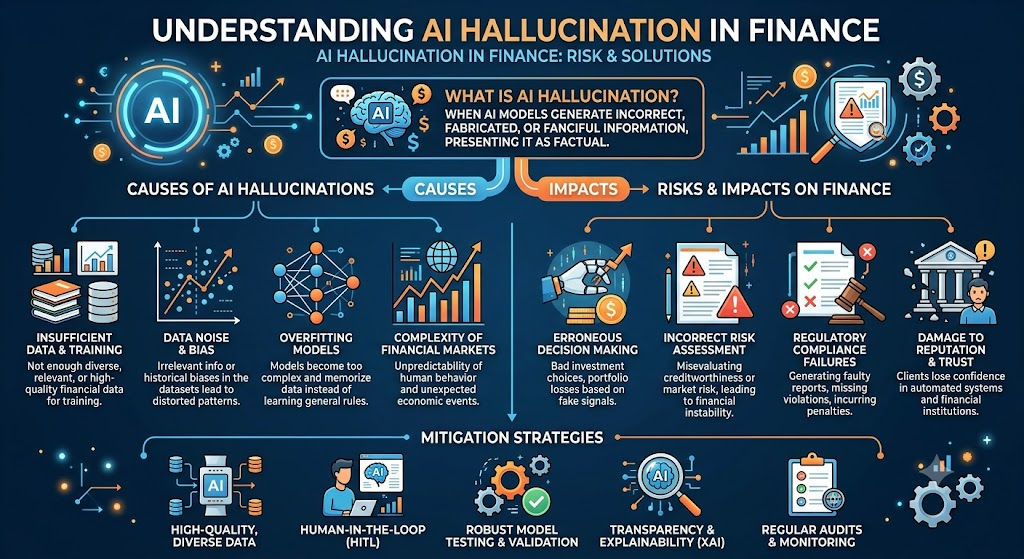
    Can AI be confidently wrong? If you have spent any time evaluating finance-focused AI tools, you already know the answer is yes and that is exactly the problem worth unpacking. AI hallucination in finance is not a rare glitch. It is a structural risk that shows up quietly, dressed up as a well-written, professional-sounding answer.

    What Is AI Hallucination in Finance, Really?

    In simple terms, AI hallucination in finance happens when a model produces a response that reads as polished and authoritative, but is factually incorrect, unsupported by reliable sources, based on outdated rules, or missing important context. The danger is not that the answer sounds wrong it is that it sounds exactly right, which is what makes it easy to trust and hard to catch.

    Having spent time evaluating and training finance-focused Large Language Models after years in finance, taxation, and audit, this is one of the clearest lessons that keeps surfacing: training AI is not only about generating better answers. It is equally about teaching a model when to answer, and more importantly, when to be careful.

    Three Everyday Examples of AI Hallucination in Finance

    The Investment Scenario

    An AI tool states that a particular stock will “definitely” deliver a 15% return. No one human advisor or algorithm can guarantee market performance. A genuinely useful financial response would instead walk through assumptions, historical data, risk factors, and the uncertainty inherent in any projection.

    The Tax Scenario

    An AI model applies a tax provision that has since been amended or withdrawn. Tax law changes constantly a rule that was accurate last year, or even last quarter, may no longer hold. Regulatory bodies such as the IRS regularly update guidance, which is precisely why static, memorized answers are risky in a domain that moves this fast.

    The Financial Planning Scenario

    An AI tool recommends aggressive investment options without accounting for a person’s risk profile, financial goals, time horizon, or personal circumstances. The suggestion may be technically defensible in isolation, yet entirely unsuitable once real-world context is added back in.

    Why AI Hallucination in Finance Carries Bigger Stakes Than It Looks

    In most everyday applications, a hallucinated answer is a minor inconvenience. In finance, taxation, and accounting, the same failure can translate into missed compliance deadlines, incorrect filings, mispriced risk, or advice that quietly steers a business or individual in the wrong direction. This is exactly where human expertise becomes non-negotiable not as a formality, but as the layer that catches what a fluent, confident-sounding model may miss.

    What Responsible AI Model Evaluation Looks Like in Finance

    Evaluating a finance-focused AI model is not simply a language-quality exercise. It requires validating accuracy against current rules, the soundness of the underlying reasoning, whether relevant context has been captured, practical applicability to a real business situation, and the real-world consequences of getting it wrong. A confident answer is not the bar. A responsible answer is.

    This is the perspective CA Manish, Head Consultant – International Accounting, Financial Modeling & US Taxation at Adwani & Co LLP, brings from his recent work evaluating and training finance-focused LLMs a vantage point shaped by years of practical experience across financial modeling, valuation, FP&A, and cross-border accounting engagements.


    What This Means for Businesses and Finance Professionals Today

    As AI tools become more embedded in accounting, tax research, and financial planning workflows, the more useful question is rarely whether AI can produce an answer. It is whether that answer has been checked against current rules, real context, and professional judgment before anyone acts on it. Businesses and accounting professionals adopting AI-assisted tools benefit from pairing them with structured review the same discipline applied to bookkeeping cleanups, MIS reporting, and financial statement review.

    Firms exploring how AI fits into their reporting and advisory workflows can learn more about our Virtual CFO Services for a structured, human-reviewed approach to financial decision-making.

    Key Takeaways

    • AI hallucination in finance means a confident-sounding answer that may be inaccurate, outdated, or missing context.
    • Investment, tax, and financial planning scenarios each show how a technically fluent answer can still be wrong or unsuitable.
    • Tax and regulatory rules change frequently, so static AI answers carry real risk in finance.
    • Responsible AI model evaluation checks accuracy, reasoning, context, and real-world consequences not just language quality.

    Human expertise remains essential to validate AI-generated financial and tax guidance before it is acted upon.

    Read our detailed guide on Why Financial Model

    Frequently Asked Questions

    1.What is AI hallucination in finance?

    It is when an AI tool gives a confident, professional-sounding financial or tax response that is factually incorrect, outdated, or missing important context.

    2.Can AI give wrong financial advice?

    Yes. AI can produce technically fluent recommendations such as aggressive investment suggestions that are unsuitable once a person’s risk profile, goals, and circumstances are factored in.

    3.Why is AI hallucination riskier in tax matters?

    Tax law changes frequently, so an AI response based on an outdated provision may be confidently wrong, leading to compliance errors if not verified against current rules.

    4.How is AI evaluated for financial accuracy?

    Proper evaluation checks accuracy, reasoning, context, practical applicability, and real-world consequences not just whether the language sounds polished

    Conclusion

    AI hallucination in finance is less about AI being unreliable and more about understanding where its confidence outpaces its correctness. As finance-focused AI tools continue to evolve, the professionals and firms who benefit most will be the ones who pair these tools with structured, expert-led review rather than treating a fluent answer as a final one.

    Author
    CA. Manish R. Mata Practising In India (Ex – PwC),  At Adwani & Co LLP leads the International Accounting & Tax Support vertical, delivering structured execution assistance to US CPA firms and overseas businesses.

    Disclaimer

    Adwani & Co LLP is a multi-disciplinary professional services platform. The blogs shared are for educational and informational purposes only and are intended to promote awareness around finance, accounting, taxation, reporting, and business advisory topics. Nothing contained herein should be construed as solicitation or advertisement of professional services. Where professional services are required under applicable laws or regulations, such services are rendered in accordance with relevant professional and regulatory requirements. The content has been reviewed for technical accuracy by professionals associated with Adwani & Co LLP.

  • Form 26A and TDS Default: What Section 201 Relief Actually Covers  and Where It Falls Short

    Form 26A and TDS Default: What Section 201 Relief Actually Covers and Where It Falls Short

    Form 26A and TDS Default

    You deducted TDS. Or at least, you thought you did. Then comes the notice Section 201(1) of the Income Tax Act, 1961 declares you a ‘defaulter.’ The Income Tax Department now wants the tax you missed deducting, plus interest under Section 201(1A), and potentially a penalty. It’s a situation that thousands of Indian businesses, employers, and contractors face every year. But there’s a lesser-known relief mechanism that can shield a deductor from the tax demand Form 26A for TDS default under Section 201. The catch? It has real limits. Understanding both the relief and its boundaries is critical before you assume you’re protected.


    What Is a TDS Default Under Section 201?

    Under the Income Tax Act, any person responsible for deducting tax at source (TDS) and failing to do so or deducting but not depositing it with the government is treated as an assessee-in-default under Section 201(1). This triggers a dual liability:

    • Payment of the tax that was not deducted or short-deducted
    • Interest under Section 201(1A) at 1% per month (or part of month) for non-deduction, and 1.5% per month for non-deposit

    In practice, this means even a minor lapse in TDS compliance say, missing TDS on a contractor payment under Section 194C, or on rent under Section 194I can result in a substantial demand from the Income Tax Department, often years later during scrutiny or survey.


    Form 26A: The TDS Default Relief Certificate That Can Save You

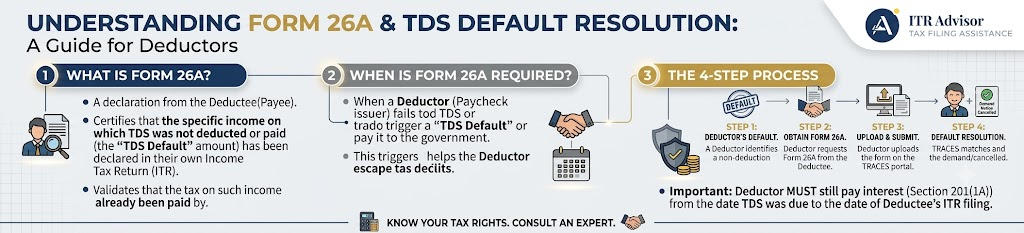
    This is where Form 26A for TDS default relief becomes pivotal. Introduced to provide genuine relief to deductors who missed TDS but the payee still paid the tax on the income received, Form 26A is a certificate furnished by the payee’s chartered accountant confirming that:

    • The payee has disclosed the income in their return
    • Tax on that income has been duly paid by the payee
    • No double demand should be raised on the deductor for the same income

    Once Form 26A is accepted by the Income Tax Department through the TRACES portal (traces.gov.in), the deductor cannot be treated as an assessee-in-default under Section 201(1) for the tax demand portion. This is a critical and often misunderstood protection.

    Important Note

    • Form 26A must be filed on the TRACES portal by a Chartered Accountant on behalf of the payee.
    • It is only available for non-salary payments it cannot be used for TDS defaults on salary (Section 192).

    The Acknowledgement Number from Form 26A filing must be submitted during proceedings.

    The Critical Limits of Section 201 Relief: What It Does NOT Protect You From

    This is where many deductors make a costly mistake: they assume Form 26A wipes the slate clean. It does not.

    1. Interest Under Section 201(1A) Is NOT Waived

    Even if Form 26A is accepted and the deductor is relieved from the principal tax demand under Section 201(1), the interest liability under Section 201(1A) remains fully payable. This interest runs from the date of payment to the payee until the date the payee actually pays the tax — and it is charged at 1% per month for the period of non-deduction. The Supreme Court and multiple High Courts have consistently upheld this position.

    2. Section 271C Penalty for Non-Deduction Remains Possible

    The Assessing Officer retains discretion to levy penalty under Section 271C equal to the amount of TDS not deducted. Form 26A provides no automatic shield against this penalty. Whether penalty is levied depends on facts, intention, and the AO’s assessment.

    3. Time Limit for Proceedings Under Section 201

    The Income Tax Department can initiate TDS default proceedings within 7 years from the end of the financial year in which the payment was made, as per Section 201(3). If you receive a notice after several years, Form 26A still needs to be arranged a practical challenge if the payee is no longer traceable.

    Key Risk Alert

    Even with Form 26A in hand, your exposure to interest under Section 201(1A) is real. For a Rs. 50 lakh payment where TDS was not deducted for 3 years, the interest alone can exceed Rs. 1.8 lakh. Do not treat Form 26A as a ‘full escape’ it is a partial relief

    Illustrative Example

    Scenario: ABC Pvt. Ltd. paid Rs. 20,00,000 to a contractor in April 2022 without deducting TDS under Section 194C (applicable rate: 2%). The contractor paid the full income tax in their AY 2023-24 ITR. ABC obtains Form 26A in June 2024.

    TDS that should have been deducted: Rs. 40,000

    Period of default: April 2022 to June 2024 (approx. 26 months)

    Interest under Section 201(1A): Rs. 40,000 x 1% x 26 = Rs. 10,400

    Tax demand under Section 201(1): NIL (waived by Form 26A)Conclusion: Form 26A removes the Rs. 40,000 demand — but Rs. 10,400 interest is still payable. The earlier you file Form 26A, the lower the interest exposure


    How to File Form 26A for TDS Default Relief: Step-by-Step

    The process for obtaining Form 26A is managed through the TRACES portal of the Income Tax Department:

    • Step 1: The payee (recipient of income) engages their Chartered Accountant to certify the income disclosure and tax payment.
    • Step 2: The CA logs into the TRACES portal and files Form 26A with details of the payee’s income, TAN of the deductor, and confirmation of tax payment.
    • Step 3: An acknowledgement number is generated, which the deductor must quote in any Section 201 proceedings.
    • Step 4: The Assessing Officer verifies the certificate and, if satisfied, drops the principal demand under Section 201(1).

    According to the Income Tax Department’s guidelines on TRACES, Form 26A is a valid defence mechanism available to deductors but the certificate must be genuine, and the underlying tax payment by the payee must be verified through the payee’s AIS (Annual Information Statement) and Form 26AS.

    Key Takeaways: Form 26A & Section 201 TDS Default

    • Section 201(1) makes a deductor liable for TDS not deducted or not deposited, plus interest.
    • Form 26A, filed through TRACES by the payee’s CA, can remove the principal tax demand under Section 201(1).
    • Interest under Section 201(1A) is NOT waived even with Form 26A this is the most common misconception.
    • Penalty under Section 271C may still apply at the Assessing Officer’s discretion.
    • Section 201 proceedings have a 7-year limitation window early resolution saves more interest.

    Read our detailed guide on AIS Shows Higher Income Than Your ITR? Complete Guide to Avoid Income Tax Notice in AY 2026-27

    Form 26A is not available for salary TDS defaults under Section 192


    Frequently Asked Questions: Form 26A, TDS Default & Section 201 Relief

    Q1. Can Form 26A completely save me from a TDS default notice?

    Form 26A can eliminate the principal tax demand under Section 201(1). However, interest under Section 201(1A) remains payable and is not waived under any provision.

    Q2. What is the time limit to receive a TDS default notice under Section 201?

    Under Section 201(3), the Assessing Officer can issue a TDS default order within 7 years from the end of the financial year in which the payment was made to the payee.

    Q3. Is Form 26A applicable for salary TDS defaults?

    No. Form 26A is not available for non-deduction of TDS on salary payments under Section 192. It applies only to non-salary payments to resident payees.

    Q4. Who files Form 26A the deductor or the payee?

    Form 26A is filed by the payee’s Chartered Accountant on the TRACES portal. The deductor must coordinate with the payee and their CA to initiate the process.

    Q5. Can TDS default under Section 201 attract criminal prosecution?

    In extreme cases, willful non-deduction or non-deposit of TDS can attract prosecution under Section 276B of the Income Tax Act. Form 26A does not protect against criminal proceedings only against the civil tax demand.

    Conclusion: Know the Full Picture Before Relying on Section 201 Relief

    Form 26A is a genuinely useful and powerful relief mechanism for TDS defaulters but it is not a magic eraser. The Section 201 TDS default relief through Form 26A removes the principal tax demand when the payee has paid the tax, but the deductor continues to face interest under Section 201(1A) and the risk of penalty under Section 271C. Understanding this distinction is the difference between smart compliance and a costly assumption.

    If you have received a Section 201 notice, are unsure about your TDS compliance position, or need help coordinating Form 26A through the TRACES portal, visit itradvisor.in for expert guidance and step-by-step resources designed for Indian taxpayers and businesses.

    About the Author – Nidhi Adwani

    Nidhi Adwani is the Human Resources Manager at Adwani & Co. She is a Law Graduate and holds an MBA in Human Resources. She manages recruitment, employee engagement, team development, workplace culture, and the firm’s social media and content activities. Passionate about people and organizational growth, she also contributes articles for ITRAdvisor and Adwani & Co. Her writing focuses on HR practices, leadership, workplace engagement, and professional development, offering practical insights for professionals and businesses.

    At ITRAdvisor.in, we help taxpayers with:

    ✔️ ITR Filing Review

    ✔️ AIS Reconciliation

    ✔️ Capital Gains Reporting

    ✔️ NRI Taxation

    ✔️ Tax Notice Response

    ✔️ Revised Returns

    ✔️ Income Tax Planning

    ✔️ Refund and Compliance Issues

    Visit ITRAdvisor.in today for professional guidance and consultation.

    Early action can often prevent bigger tax problems later.

    Disclaimer ITRAdvisor.in is an educational and informational platform focused on tax awareness and compliance updates. Nothing contained herein should be construed as solicitation or advertisement of professional services. Professional services, where applicable, are rendered in accordance with ICAI guidelines. This article is published on ITRAdvisor.in, a tax and compliance knowledge platform. The content has been reviewed for technical accuracy by professionals associated with Adwani & Co LLP.

  • Section 143(2) Notice After ITR-U: Beware the Costly Mistake of Filing Too Late

    Section 143(2) Notice After ITR-U: Beware the Costly Mistake of Filing Too Late

    Section 143(2) Notice After ITR-U

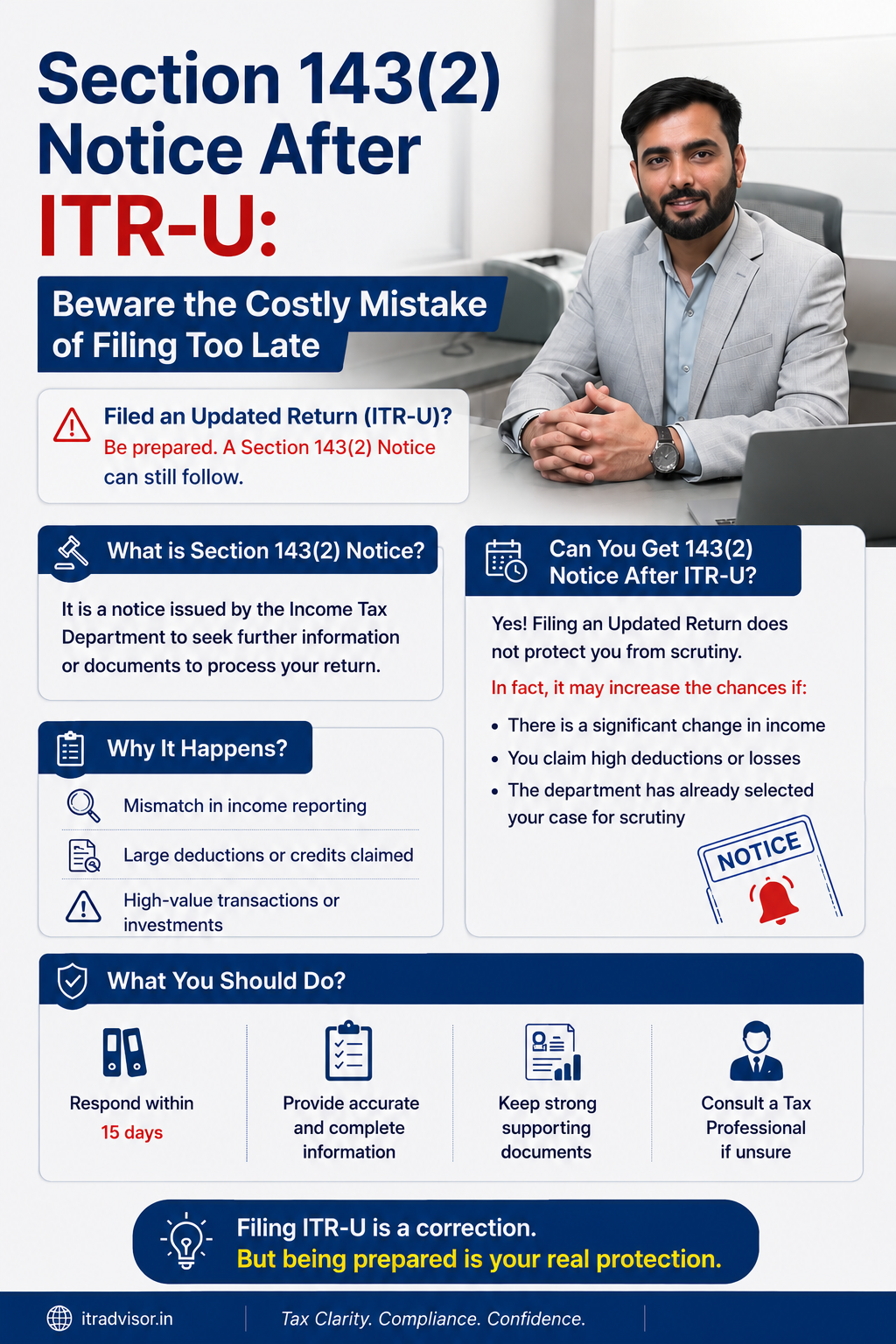
    You filed an ITR-U an Updated Return under Section 139(8A) thinking you had corrected your earlier mistake. You breathed easy. Then, a few weeks later, a notice arrived: Section 143(2). Your stomach dropped. If this sounds familiar, you are not alone. Thousands of taxpayers across India are receiving income tax scrutiny notices after filing updated returns, and most of them made one simple but costly mistake they filed too late, or without fully understanding what triggers a 143(2) notice in this context.

    What Is Section 143(2) and Why Does It Follow Your ITR-U?

    Section 143(2) of the Income Tax Act, 1961 empowers the Assessing Officer (AO) to issue a scrutiny notice when the department believes a return needs closer examination. This is not a penalty it is an invitation to prove that the income you declared is correct and supported by evidence.

    When a taxpayer files an ITR-U (Updated Return) under Section 139(8A), the Income Tax Department does not automatically accept the revised figures. In fact, according to the Income Tax Department’s procedural guidelines, updated returns are subject to a higher level of automated and manual scrutiny precisely because they represent a change from the originally filed return.

    In plain terms: filing an ITR-U places your return under a magnifying glass. And if the department finds discrepancies in income, deductions, or timing a 143(2) scrutiny notice is almost inevitable.


    The Costly Mistake: Filing Your ITR-U Too Late

    Section 139(8A) allows a taxpayer to file an updated return within 24 months from the end of the relevant assessment year but each passing year comes with a higher additional tax burden:

    When ITR-U is FiledAdditional Tax PayableScrutiny Risk Level
    Within 12 months from end of AY25% of additional tax + interestModerate
    Between 12–24 months from end of AY50% of additional tax + interestHigh
    After 24 months (not permitted)Not allowed under lawReturn Invalid

    This table tells a clear story: the later you file, the more you pay and the greater the chance of receiving a Section 143(2) notice after filing the ITR-U. The Income Tax Department’s systems are calibrated to flag late updated returns for scrutiny because they often indicate suppression of income in the original filing.

    Important Warning

    A Section 143(2) notice after filing ITR-U must be responded to within the time specified in the notice typically 15 to 30 days. Failure to respond can lead to ex-parte assessment under Section 144, which can result in a best-judgment assessment with significantly higher tax demand.


    Income Tax Notice Time Limit: What the Law Says for 143(2)

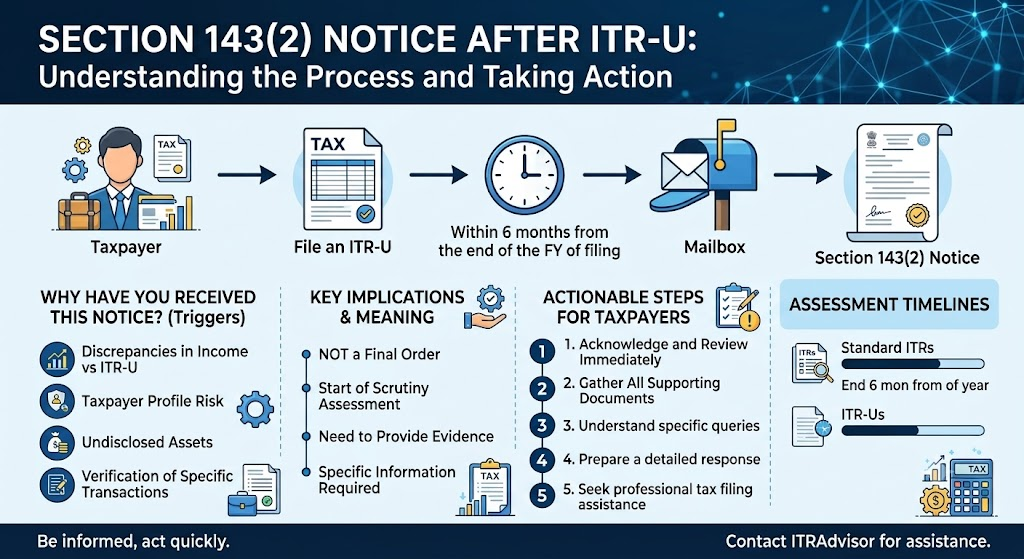
    Under the Income Tax Act, the Assessing Officer must issue a Section 143(2) notice within six months from the end of the financial year in which the return was filed. This time limit applies to ITR-U as well. So if you filed your updated return in August 2024 (FY 2024-25), the department has time until 30 September 2025 to issue the 143(2) notice.

    This income tax notice time limit is a critical legal protection for taxpayers. If a notice is issued beyond this window, it can be challenged. However, this requires prompt action ideally with professional guidance as courts have strict timelines for such objections.

    Read our detailed guide on Income Tax Notice Time Limit to understand exactly when the department’s power to scrutinise expires.


    How to Respond to a Section 143(2) Notice After Filing ITR-U

    Receiving this notice does not mean you are in trouble — but ignoring it certainly will put you in trouble. Here is the step-by-step response process:

    Step 1: Read the Notice Carefully

    The notice will specify the assessment year under scrutiny, the issues flagged (income mismatch, deduction claims, etc.), and the deadline to respond. Identify whether the notice relates to your original ITR or the ITR-U specifically.

    Step 2: Gather Supporting Documents

    Compile Form 16, Form 26AS, AIS (Annual Information Statement), bank statements, investment proofs, and any other documents supporting the income and deductions declared in your updated return. Cross-check your ITR-U with these documents before submitting anything.

    Step 3: Respond Through the E-Proceedings Portal

    All responses to 143(2) scrutiny notices must be submitted through the Income Tax e-Filing portal (incometax.gov.in) under the ‘Pending Actions’ section. Physical responses are not accepted. Upload all documents clearly labelled and respond to each query point-by-point.

    Step 4: Seek Professional Guidance

    Income tax scrutiny proceedings can be complex, especially where they involve an updated return. According to Dr. Haresh Adwani, a seasoned tax professional with decades of experience in Indian tax compliance, “taxpayers who respond to 143(2) notices without professional support often provide more information than required, inadvertently opening new lines of inquiry for the Assessing Officer.”

      Expert Tip

    When responding to a Section 143(2) notice after ITR-U filing, always submit documents that directly address the query nothing more. Over-disclosure is a common mistake that extends scrutiny timelines unnecessarily. Learn more about our Tax Notice Response Service at ITRAdvisor.in.


    Can You Avoid a 143(2) Notice After Filing ITR-U?

    Not entirely the department has the right to scrutinise any return. But you can reduce the risk significantly by following these practices:

    • File the ITR-U as early as possible within 12 months of the assessment year end if you can, when the additional tax burden is lower and scrutiny flags are fewer.
    • Ensure full consistency between the ITR-U and your AIS/Form 26AS. Any mismatch between the two is a primary trigger for income tax scrutiny after an updated return.
    • Disclose all income correctly partial disclosure in an ITR-U is treated very seriously by the department and can lead to income tax reassessment notice under Section 148 as well.
    • Keep documentary evidence ready before you file, not after.
    • Do not use the ITR-U to claim additional refunds the provision is specifically for taxpayers who have under-reported income or missed declaring income, not for claiming higher refunds.

    READ OUR deTAILED GUIDE ON Income Tax Notice India 2026: Every Section Explained What It Means and How to Respond

    Key Takeaways

    • ITR-U (Updated Return) under Section 139(8A) can be filed within 24 months from the end of the assessment year but later filing means higher tax burden and greater scrutiny risk.

    • A Section 143(2) notice after ITR-U is issued when the department needs to verify the accuracy of your updated return.

    • The income tax notice time limit for issuing 143(2) is six months from the end of the financial year in which the ITR-U was filed.

    • Always respond through the Income Tax e-Filing portal (incometax.gov.in) within the deadline specified in the notice.

    • Seek professional guidance before responding over-disclosure can create new problems in scrutiny proceedings.

    • Filing ITR-U within 12 months is always preferred to minimise both cost and scrutiny risk.

    Frequently Asked Questions (FAQs)

    Q1. Can I get a Section 143(2) notice after filing ITR-U even if my return was complete?

    Yes. Filing an ITR-U automatically flags your return for enhanced scrutiny. The department issues 143(2) notices based on automated and manual risk parameters, regardless of whether your updated return appears complete.

    Q2. What is the income tax notice time limit for Section 143(2) after ITR-U?

    The Assessing Officer must issue the 143(2) notice within six months from the end of the financial year in which the updated return was filed. Any notice issued beyond this period can be legally challenged.

    Q3. What happens if I do not respond to the income tax scrutiny notice after ITR-U?

    Non-response can result in an ex-parte assessment under Section 144, where the AO makes a best-judgment assessment often resulting in a much higher tax demand than what you actually owe.

    Q4. Can filing ITR-U trigger an income tax reassessment notice under Section 148 as well?

    Yes. If the department believes that income has been under-disclosed even in the ITR-U, they can initiate reassessment proceedings under Section 148. This is why accurate and complete disclosure in the ITR-U is essential.

    Q5. Is it better to file ITR-U within 12 months or wait for 24 months?

    Always file within 12 months if possible. The additional tax is lower (25% vs 50%), and earlier filing generally attracts less scrutiny compared to returns filed closer to the 24-month deadline.

    Conclusion: Don’t Let Timing Become Your Tax Trap

    The ITR-U provision was introduced to give taxpayers a second chance — to correct errors and come clean with the Income Tax Department. But this second chance comes with strings attached. A Section 143(2) notice after filing an updated return is not a punishment; it is the department doing its job. What matters is how prepared and professional your response is.

    The single most important lesson here: do not delay your ITR-U. The longer you wait, the more you pay, and the greater the scrutiny you face. If you have already received a 143(2) notice, do not panic — but do not delay your response either.

    📞  Get Expert Help Today

    Confused by a Section 143(2) notice after filing ITR-U? Not sure how to respond without triggering further scrutiny?

    Connect with the experts at ITRAdvisor.in today. Our professionals bring deep experience in income tax notice resolution, updated return compliance, and scrutiny proceedings — so you can respond with confidence. Visit: www.itradvisor.in | Expert tax guidance, simplified.

    Author

    CA. Dipesh Gurubakshani. He is a Chartered Accountant with professional experience in audit, direct taxation, and accounting advisory services.

    Whether you have already received a credit card income tax notice or want to ensure you never do Adwani and Company is your trusted partner. Led by Dr. Haresh Adwani and a seasoned team of Chartered Accountants, Adwani and Company provides end-to-end income tax compliance, notice response, and financial planning services.

    Disclaimer

    ITRAdvisor.in is an educational and informational platform focused on tax awareness and compliance updates. Nothing contained herein should be construed as solicitation or advertisement of professional services. Professional services, where applicable, are rendered in accordance with ICAI guidelines. This article is published on ITRAdvisor.in, a tax and compliance knowledge platform.The content has been reviewed for technical accuracy by professionals associated with Adwani & Co LLP

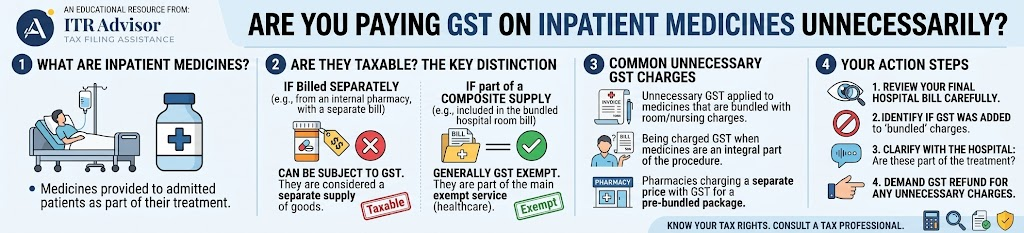
  • Are You Paying GST on Inpatient Medicines Unnecessarily? Know Your Rights Now

    Are You Paying GST on Inpatient Medicines Unnecessarily? Know Your Rights Now

    GST on Inpatient Medicines

    You’ve just been discharged from the hospital after a week-long inpatient stay. The final bill arrives and buried inside it is a line item: ‘GST on medicines.’ You pay it without question because, honestly, who challenges a hospital bill? But here’s the truth that most patients in India never find out: you may have been charged GST on inpatient medicines that is completely illegal under Indian GST law.

    What Does Indian GST Law Actually Say About Inpatient Medicines?

    Under the Central Goods and Services Tax (CGST) Act, 2017, health care services provided by a clinical establishment are fully exempt from GST. The key provision is Notification No. 12/2017 – Central Tax (Rate), which specifically exempts ‘services by a clinical establishment, an authorised medical practitioner or para-medics’ from the GST net.

    More importantly, the CBIC (Central Board of Indirect Taxes and Customs) has consistently clarified that when medicines and consumables are supplied to an inpatient as part of a composite healthcare service meaning the supply of medicine is bundled with the treatment the entire package is treated as a healthcare service and is therefore exempt from GST. The medicines do not attract GST separately in such cases.

    Illustrative Example
    Mr. Ramesh is admitted to a private hospital in Pune for a knee surgery. The hospital administers anaesthesia, antibiotics, and post-operative medications during his stay. Since these medicines are part of his inpatient treatment package, the entire composite supply qualifies as a healthcare service and should be billed without GST on the medicines component.

    When Is GST Actually Applicable on Hospital Medicines?

    The exemption applies specifically to inpatient (IPD) settings. The scenario changes when:

    • You visit a hospital pharmacy as an outpatient (OPD) and buy medicines to take home GST at applicable slab rates (5%, 12%, or 18%) applies here.
    • A hospital sells medicines over the counter without any linked treatment.
    • Cosmetic or elective procedures that don’t qualify as ‘healthcare services’ are involved.

    The critical legal distinction is composite supply vs. independent supply. When medicines are consumed as part of IPD care, they form a composite healthcare service. When sold independently at a retail pharmacy counter, they are a separate supply and GST applies normally.


    Why Do Some Hospitals Still Charge GST on Inpatient Medicines?

    This remains one of the most common GST compliance errors in the Indian healthcare sector. Several hospitals particularly smaller nursing homes and non-corporate setups either misunderstand the composite supply rule or bifurcate their inpatient invoices to show medicines as a separate line item, creating a false impression of taxability.

    In some cases, hospitals may be incorrectly availing Input Tax Credit (ITC) on medicines they procure and passing on a GST charge to patients to offset their books. This practice is not legally tenable and has been flagged in multiple CBIC clarifications.

    What the GST Portal and CBIC Say

    As per guidance available on gst.gov.in and CBIC circulars, healthcare services rendered by hospitals, including all composite supplies such as medicines, diagnostics, and room charges during inpatient stay, are exempted under Entry 74 of Notification No. 12/2017 Central Tax (Rate). Patients are well within their rights to question any GST line item on their inpatient bill and request a corrected invoice.


    How to Identify If You Have Been Wrongly Charged GST on Inpatient Medicines

    Check your hospital discharge bill carefully. Look for:

    • A separate GST charge applied specifically to medicines or consumables.
    • GST percentages of 5%, 12%, or 18% on items administered during your IPD stay.
    • Any line item labelled ‘pharmacy charges’ with GST added on top.

    If you notice any of these, you are entitled to raise a formal objection with the hospital’s billing department. You can also file a complaint with the GST helpdesk or the relevant State GST authority if the hospital refuses to correct the bill.

    Read our detailed guide on GST Compliance Checklist India 2026: 7 Essential Rules to Avoid Notices and Penalties

    Key Takeaways

    • Medicines administered during inpatient (IPD) stays are part of a composite healthcare service and are fully exempt from GST under Indian law.
    • The exemption is governed by Notification No. 12/2017 – Central Tax (Rate) under the CGST Act, 2017.
    • Outpatient pharmacy purchases do attract GST the exemption is specific to inpatient composite supplies.
    • Patients have the right to question and dispute incorrect GST charges on their hospital bills.

    When in doubt, consult a qualified GST professional or visit gst.gov.in for official guidance.

    Frequently Asked Questions (FAQs) on GST on Inpatient Medicines

    1.Is GST charged on medicines during hospitalization in India?

    No. Medicines administered as part of an inpatient hospital stay form a composite healthcare service, which is exempt from GST under Notification No. 12/2017 Central Tax (Rate). GST should not be charged on such medicines.

    2.What is the GST rate on medicines at a hospital pharmacy for outpatients?

    Outpatient purchases from a hospital pharmacy attract GST at standard slab rates typically 5% on most formulations, 12% on certain drugs, and 18% on some items. The exemption applies only to inpatient composite supplies.

    3.Can I dispute a GST charge on my inpatient hospital bill?

    Yes. You can formally raise the issue with the hospital’s billing department, citing CBIC circulars and Notification No. 12/2017. If unresolved, a complaint can be filed with the State GST authority or the GST helpdesk on gst.gov.in.

    4.Does the GST exemption on inpatient medicines apply to all hospitals?

    The exemption applies to all clinical establishments recognized under applicable law including private hospitals, nursing homes, and clinics provided the medicines are supplied as part of composite inpatient care and not sold separately.

    5.What if the hospital shows GST on medicines as a separate line item in the IPD bill?

    A separate billing line does not change the legal character of the supply. If those medicines were administered during your inpatient treatment, the composite supply rule still applies and GST should not be payable. Request a revised invoice.

    Conclusion: Don’t Pay GST on Inpatient Medicines Without Questioning It

    The Indian GST law is clear healthcare services, including medicines consumed during inpatient hospital stays, are exempt from GST. The confusion arises because of billing practices, lack of awareness, and occasional non-compliance by healthcare providers. As a patient, you have every legal right to scrutinize your hospital bill and challenge unjust GST charges.

    Tax and compliance expert Dr. Haresh Adwani emphasizes that awareness of GST exemptions in healthcare can save families significant amounts especially during extended or critical hospitalizations where medicine costs are high. Knowing the law is your first line of defence.

    Learn more about our Tax Advisory Services to get expert support on GST compliance, dispute resolution, and tax plan

    Author

    Dr. Haresh Adwani

    PhD (Commerce) · Adwani & Company, Pune

    Dr. Haresh Adwani is a PhD holder in Commerce with over 20 years of experience in NRI taxation, FEMA compliance, international financial advisory, and tax notice resolution. He is one of Pune’s most trusted NRI tax advisors, specialising in residential status assessment, DTAA planning, and cross-border compliance for professionals returning from the US, UK, UAE, Canada, and Australia.

  • Capital Gains Exemption 2026: Asset View vs Gain View Explained

    Capital Gains Exemption 2026: Asset View vs Gain View Explained

    Capital Gains Exemption

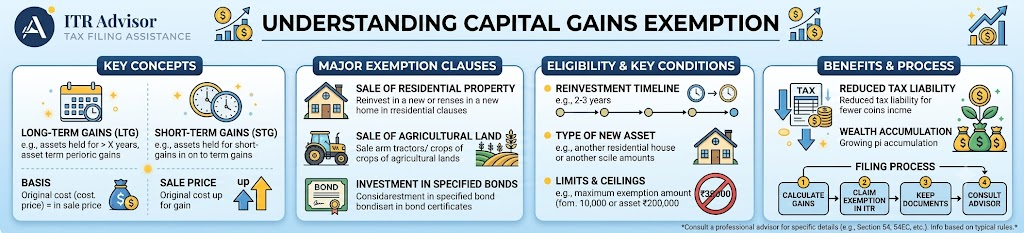
    Sold a house or a bundle of long-held shares this year and now staring at a capital gains figure that makes your stomach drop? You probably don’t have to pay tax on the full amount. Most taxpayers overpay not because they picked the wrong section, but because they never understood whether their capital gains exemption is judged by the asset they buy or the gain they invest.

    What Is Capital Gains Exemption?

    Capital gains exemption lets a taxpayer reduce or avoid tax on profit from selling property, land, gold, or securities, provided the proceeds or gains are reinvested in a specified manner within a prescribed time. The Income Tax Department recognises several such provisions commonly Sections 54, 54F and 54EC each built around a different combination of asset sold and asset purchased. The confusion begins when taxpayers assume all these sections work the same way. They don’t.


    Asset View vs Gain View: The Real Difference

    The Asset View : Sections 54 and 54F

    Sections 54 and 54F anchor the capital gains exemption to the new asset you acquire a residential house in India. Section 54 applies when you sell a house and buy another; Section 54F applies when you sell any other long-term asset and reinvest the net consideration into a house. The exemption is proportionate to how much you reinvest.

    The Gain View : Section 54EC

    Section 54EC exempts gains from selling land or building when the gain amount, not the full sale proceeds, is invested in specified bonds (REC, NHAI, PFC, IRFC, or HUDCO) within six months, capped at ₹50 lakh a year. No particular asset needs to be purchased — only the gain needs a home.


    Choosing the Right Capital Gains Exemption Route

    Most taxpayers can combine both views reinvesting part of the gain in a house under Section 54 or 54F, and the remainder in Section 54EC bonds within six months, subject to each provision’s caps.

    • Sold a house? Compare Section 54 (asset view) against 54EC (gain view).
    • Sold land, gold, or shares? Section 54F is your asset-view option.
    • Can’t decide immediately? A Capital Gains Account Scheme deposit protects your window.

    Key Takeaways

    • Capital gains exemption is either asset-based (Sections 54, 54F) or gain-based (Section 54EC).
    • Section 54EC is capped at ₹50 lakh a year with a strict six-month window.

    Combining both views, where eligible, can maximise your exemption.

    Read our detailed guide on Tax Saving vs Wealth Creation in India: Are You Investing Smart or Just Buying a Deduction?


    Why Professional Guidance Matters

    According to Dr. Haresh Adwani of Adwani & Co LLP, most capital gains exemption claims fail scrutiny not from picking the wrong section, but from missing the reinvestment timeline or the CGAS deposit deadline a risk that grows as the Income Tax Act, 2025 renumbers these provisions from April 2026. The Income Tax Department’s official guidance and notified Section 54EC bond lists are a useful starting point, though joint ownership and NRI cases need individual review.


    Frequently Asked Questions on Capital Gains Exemption

    1.Can I combine Section 54 and Section 54EC?

    Yes. You can split your capital gains exemption between a new house under Section 54 and bonds under Section 54EC.

    2.What if I can’t reinvest before filing my return?

    Deposit the gain in a Capital Gains Account Scheme before the filing due date to preserve the exemption.

    3.Does capital gains exemption apply to short-term gains?

    No. Sections 54, 54F and 54EC apply only to long-term capital gains

    Conclusion: Plan Your Capital Gains Exemption the Smart Way

    Capital gains exemption rewards taxpayers who understand whether their provision watches the asset bought or the gain invested. Get this right before your reinvestment deadline, and connect with itradvisor.in today for guidance on your capital gains exemption claim for AY 2026-27.

    About the Author:

    Mukesh Chavan is a dedicated indirect taxation and compliance professional associated with Adwani & Co LLP, specializing in GST advisory, GST audits, GST assessments, and RERA compliance services. With extensive experience in handling complex regulatory matters, he assists businesses in ensuring compliance with evolving GST laws and real estate regulations while minimizing risks and enhancing operational efficiency.

    Mukesh has successfully guided clients through GST registrations, return compliance, departmental assessments, audits, litigation support, and tax planning strategies. He also possesses significant expertise in RERA compliance, helping real estate developers, promoters, and stakeholders navigate regulatory requirements and maintain seamless project compliance.

    Through his articles and professional insights, Mukesh aims to simplify complex GST and RERA provisions, offering practical guidance that empowers businesses to remain compliant, avoid disputes, and make informed decisions in an increasingly dynamic regulatory environment. His approach combines technical expertise with practical business understanding, enabling clients to focus on growth while meeting their statutory obligations with confidence.

    At ITRAdvisor.in, we help NRIs and returning Indians with:

    ✔️ NRE and NRO taxation

    ✔️ Residential status determination

    ✔️ Returning NRI tax planning

    ✔️ DTAA advisory

    ✔️ Foreign asset reporting

    ✔️ NRI Income Tax Return filing

    ✔️ Tax notice handling

    ✔️ Capital gains and property taxation

    If you are unsure whether your NRE interest is taxable, whether you need to file an ITR in India, or how to handle NRO income, professional guidance can help avoid costly mistakes.

    Visit ITRAdvisor.in to schedule a consultation and get clarity on your NRI tax obligations.

    Disclaimer: ITRAdvisor.in is an educational and informational platform focused on tax awareness and compliance updates. Nothing contained herein should be construed as solicitation or advertisement of professional services. Professional services, where applicable, are rendered in accordance with ICAI guidelines. This article is published on ITRAdvisor.in, a tax and compliance knowledge platform. The content has been reviewed for technical accuracy by professionals associated with Adwani & Co LLP.

  • GST Appeal Pre-Deposit in APL-01: The Critical Field Is Finally Editable After April 2026 Portal Fix

    GST Appeal Pre-Deposit in APL-01: The Critical Field Is Finally Editable After April 2026 Portal Fix

    GST Appeal Pre-Deposit in APL-01

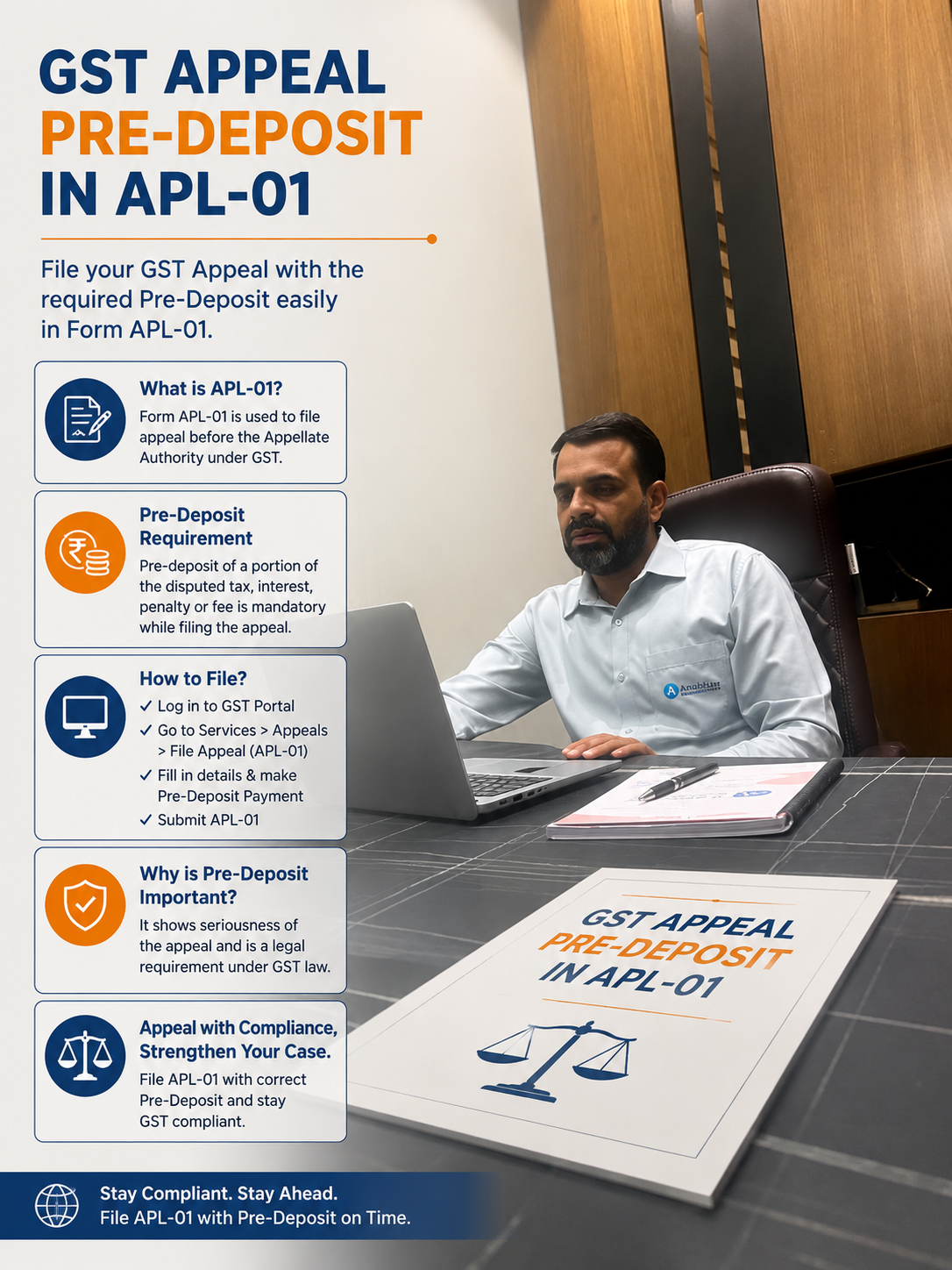
    If you’ve ever tried to file a GST appeal after receiving a demand order, you know how unforgiving the GSTN portal can be. A single locked field, an uneditable pre-deposit amount, and your entire GST show cause notice reply appeal collapses before it even begins. For months, taxpayers and tax professionals across India were struggling silently with exactly this problem the pre-deposit field in Form APL-01 was simply not accepting inputs. That nightmare is over. After a long-awaited GST portal fix in April 2026, the APL-01 pre-deposit field is now editable, and here’s everything you need to know to file your GST appeal correctly.

    What Is GST Appeal Pre-Deposit and Why Does It Matter?

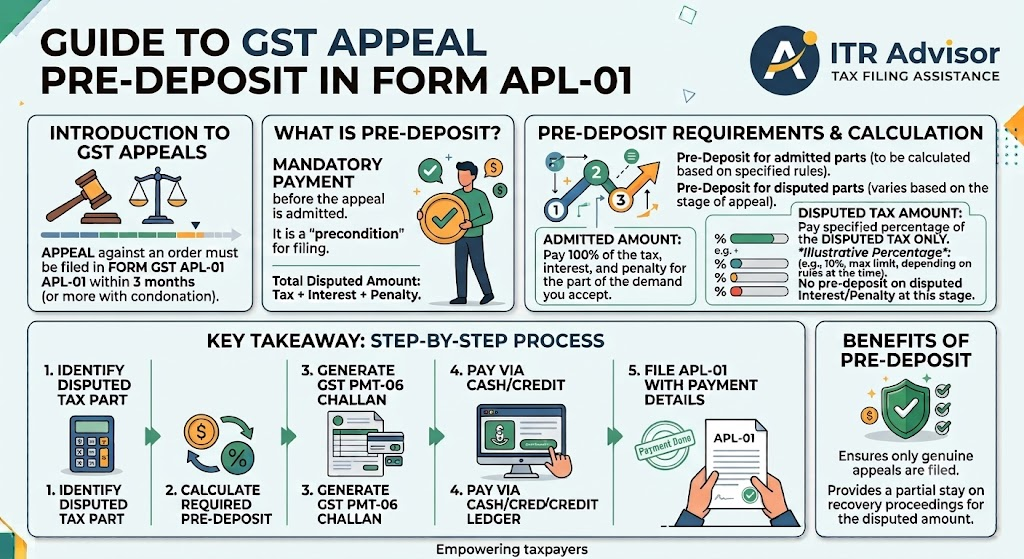
    Under Section 107 of the CGST Act, 2017, a taxpayer who wishes to appeal against a GST demand order before the Appellate Authority is required to deposit a portion of the disputed tax amount upfront. This mandatory pre-deposit for GST appeal is not optional without it, the appeal is not even admitted. The Income Tax Department’s analogy here is instructive: just as you cannot contest an assessment without meeting procedural requirements, the GST law demands that appellants demonstrate financial seriousness before the dispute is heard.

    Specifically, the GST appeal pre-deposit requirement is:

    • 10% of the disputed tax, interest, and penalty for a first appeal before the Appellate Authority (Section 107(6))
    • 20% of the disputed tax for a second appeal before the GST Appellate Tribunal (Section 112(8))
    • This amount must be paid through the Electronic Cash Ledger or Electronic Credit Ledger, and the ARN (Acknowledgment Reference Number) of the payment must be correctly entered in Form APL-01

    The APL-01 Pre-Deposit Field Problem: What Was Going Wrong?

    Between late 2024 and early 2026, a critical technical bug on the GSTN portal made it impossible for many taxpayers to enter or edit the pre-deposit amount in the APL-01 form. The field appeared greyed out, or the entered value would reset to zero upon submission. This was not a user error it was a confirmed portal-level glitch that impacted a large number of GST appeal pre-deposit 2026 filings.

    The consequences were severe:

    • Appeals were filed without the mandatory pre-deposit amount being captured
    • Several Appellate Authorities dismissed appeals on technical grounds, citing non-compliance with pre-deposit conditions
    • Taxpayers who had already paid the 10% pre-deposit could not link it to their appeal due to the locked field
    • CA firms had to resort to offline submissions and hardcopy representations to circumvent the portal issue

    April 2026 GST Portal Fix: What Has Changed in APL-01?

    The GST Network (GSTN) rolled out a backend portal update in April 2026 that specifically addressed the APL-01 pre-deposit field freeze issue. As of this update, the following improvements are live on the portal:

    1. Pre-Deposit Amount Field Is Now Fully Editable

    Taxpayers can now directly enter the pre-deposit amount paid under the Electronic Cash Ledger (ECL) or Electronic Credit Ledger (ECRL) while filing Form APL-01. The amount auto-validates against the challan details on record.

    2. ARN / CIN Linkage Is Seamless

    The portal now correctly links the Challan Identification Number (CIN) or ARN of the pre-deposit payment to the appeal form. This eliminates the need for manual reconciliation, which was the biggest pain point in the earlier GST portal version.

    3. Split Pre-Deposit Across Tax Heads Now Supported

    A known limitation was that the portal did not support split pre-deposits across CGST, SGST/UTGST, and IGST heads in one filing. The April 2026 fix allows taxpayers to enter pre-deposit amounts separately for each tax head, making it far easier to handle appeals involving interstate supplies or disputed ITC mismatches.

    4. Real-Time Pre-Deposit Validation

    After entering the pre-deposit details, the form now runs a real-time check against the demand order amount and flags mismatches before final submission. This proactive validation is a significant improvement over the earlier system where errors surfaced only post-submission.

    GST Appeal Pre-Deposit: Quick Reference Table

    Appeal LevelPre-Deposit %FormTime Limit
    First Appeal (GST Officer → Appellate Authority)10% of disputed taxAPL-01 (GSTN Portal)3 months from order date
    Second Appeal (Appellate Authority → Tribunal)20% of disputed taxAPL-05 (Tribunal)3 months from order
    High Court / Supreme CourtAs directed by CourtWP / SLPNo fixed limit

    Step-by-Step: How to File GST Appeal in APL-01 After the Portal Fix

    Now that the APL-01 pre-deposit field is editable, here is the correct process to file a GST demand order appeal on the GSTN portal as of April 2026:

    Step 1: Pay the Pre-Deposit First

    Log in to the GST portal (gst.gov.in). Navigate to Services → Payments → Create Challan. Pay the required 10% of disputed tax under the applicable tax head (CGST/SGST/IGST). Note the CIN carefully.

    Step 2: Open Form APL-01

    Go to Services → User Services → My Applications → New Application → Appeal to Appellate Authority. Select the correct order against which you are appealing (DRC-07, OIO, or equivalent demand order).

    Step 3: Enter Pre-Deposit Details

    In the ‘Pre-Deposit Details’ section, which is now fully editable after the April 2026 fix, enter the CIN and the amount deposited for each tax head. The system will validate the amount against 10% of the demand.

    Step 4: Upload Supporting Documents

    Attach the demand order, your reply to the GST show cause notice, any hearing notices, and the payment challan. File size limits apply compress PDFs where necessary.

    Step 5: Submit & Track

    Submit the form. You will receive an ARN for the appeal. Track the status under My Applications. A hearing notice is typically issued by the Appellate Authority within 30–60 days.


    Expert Perspective: Why Correct Pre-Deposit Entry Is Non-Negotiable

    According to Dr. Haresh Adwani, a PhD in Commerce and law graduate associated with Adwani & Co LLP, the pre-deposit is not merely a procedural formality it is a jurisdictional requirement. The Appellate Authority does not have the power to condone non-compliance with Section 107(6). Even if the non-compliance was due to the portal’s technical bug, the burden of proving that the pre-deposit was indeed paid falls on the taxpayer.

    This is why it is critically important to:

    • Always pay the pre-deposit before initiating the APL-01 filing, never simultaneously
    • Retain the original challan and CIN as primary evidence
    • Cross-verify the pre-deposit amount entered in APL-01 with the actual demand order figure
    • If the appeal period is expiring, file immediately and supplement with a condonation application if needed

    Read our detailed guide on Complete GST Compliance Checklist for Small Businesses in Pune: Essential Guide for FY 2026–27


    Key Takeaways

    The APL-01 pre-deposit field is now editable on the GSTN portal after the April 2026 fix.

    ✅ A 10% pre-deposit of disputed tax is mandatory for a first appeal under Section 107 of the CGST Act.

    ✅ Pay the pre-deposit via challan first, then enter the CIN in the APL-01 form never enter blank.

    ✅ The April 2026 update supports split pre-deposit across CGST, SGST, and IGST heads.

    ✅ If your earlier appeal was dismissed due to this portal bug, consult a GST professional immediately for remedial options. ✅ Always file within the 3-month limit from the date of the demand order condonation is discretionary, not guaranteed.


    Frequently Asked Questions

    Q1. What is the GST appeal pre-deposit amount required for filing APL-01?

    For a first appeal before the Appellate Authority under Section 107(6), you must deposit 10% of the disputed tax, interest, and penalty. This amount must be paid before submitting Form APL-01 on the GSTN portal.

    Q2. Is the APL-01 pre-deposit field editable now on the GST portal in 2026?

    Yes. The GSTN rolled out a fix in April 2026 that makes the pre-deposit field in APL-01 fully editable. You can now enter the CIN, payment date, and tax-head-wise split correctly.

    Q3. What happens if I filed a GST appeal without entering the pre-deposit amount due to the portal bug?

    Your appeal may have been dismissed on technical grounds. You should immediately consult a GST professional and explore filing a fresh appeal with condonation of delay, or a writ petition before the High Court if the appeal period has expired.

    Q4. Can I use the Electronic Credit Ledger (ITC balance) for the GST appeal pre-deposit?

    Yes, the pre-deposit can be paid through both the Electronic Cash Ledger and the Electronic Credit Ledger. However, it must be from the same GSTIN under appeal, and the CIN or ARN must be linked in APL-01.

    Q5. What is the time limit to file a GST appeal in Form APL-01 after a demand order?

    The appeal must be filed within 3 months from the date of the demand order or OIO. The Appellate Authority can condone delays of up to 1 month for sufficient cause, but condonation beyond that is not permitted under the statute.

    Conclusion: Don’t Let a Portal Glitch Cost You Your GST Appeal

    The April 2026 GST portal fix is a much-needed correction that restores the integrity of the GST appeal process. But knowing that the pre-deposit field is editable is only the first step. Filing a GST appeal correctly with accurate pre-deposit entry, proper document attachment, and strict adherence to time limits requires both technical knowledge and practical experience. A wrongly filed APL-01 can result in your appeal being dismissed or the pre-deposit being forfeited, leaving you with no recourse against an unjust demand order.

    The GST framework, as administered through gst.gov.in and supported by circulars from the Central Board of Indirect Taxes and Customs (CBIC), is complex but navigable with the right guidance.

    Whether you are responding to a GST show cause notice, planning a Section 107 appeal, or recovering from a dismissed filing, expert support can make all the difference.

    About the Author
    Dr. Haresh Adwani
    Ph.D. in Commerce | Law Graduate | Managing Partner, Adwani & Co LLP

    Dr. Haresh Adwani holds a Ph.D. in Commerce and is a qualified Law graduate with over two decades of hands-on experience in GST advisory, direct taxation, and statutory compliance for businesses across

    Disclaimer ITRAdvisor.in is an educational and informational platform focused on tax awareness and compliance updates. Nothing contained herein should be construed as solicitation or advertisement of professional services. Professional services, where applicable, are rendered in accordance with ICAI guidelines. This article is published on ITRAdvisor.in, a tax and compliance knowledge platform. The content has been reviewed for technical accuracy by professionals associated with Adwani & Co LLP

    Visit ITRAdvisor.in today for professional guidance and consultation.

    Early action can often prevent bigger tax problems later

    If you or someone you know has received a Section 148 income tax reassessment notice, do not panic but do act quickly and smartly. The law is on your side, provided you know where to look.

    📞 Take Action Today

    Need help evaluating whether your income tax reassessment notice is valid?

    Connect with the experts at itradvisor.in for a detailed assessment of your notice, legal objection drafting, and end-to-end reply support. Visit: www.itradvisor.in | Powered by Adwani & Co LLP

  • Switched Jobs This Year? The Hidden Job Switch Tax Notice Trap You Need to Know

    Switched Jobs This Year? The Hidden Job Switch Tax Notice Trap You Need to Know

    Job Switch Tax Notice

    Got a big hike when you switched jobs last year? Before you celebrate, here’s a warning: many salaried employees who changed jobs mid-year are now facing an unexpected income tax notice this July even though both employers deducted TDS correctly. If you’re wondering why your tax liability suddenly jumped despite “perfect” TDS on both Form 16s, the answer lies in a quiet payroll mechanism most employees never hear about.

    Why a Job Switch Can Suddenly Increase Your Tax Bill

    We recently reviewed a case where the client had no income beyond salary and a small savings bank interest. Both Form 16s showed accurate TDS, with no hidden income or red flags anywhere. Yet at the time of filing, a significant tax demand appeared out of nowhere a textbook example of a job switch tax notice that catches even careful, fully compliant taxpayers off guard.

    The Real Reason: Dual Slab Benefit Duplication

    When you join a new employer mid-year, their payroll software typically starts your tax calculation fresh, based only on the salary they pay you from your joining date onward. The new employer unknowingly applies the basic exemption limit and the lower income tax slabs all over again even though your previous employer had already applied those exact benefits on your earlier salary.

    How Payroll Systems Calculate TDS Independently

    Each employer’s payroll engine works in isolation, with no visibility into what you earned before joining unless you inform it. Both employers, acting in good faith, apply slab benefits independently a “dual slab benefit” duplication that looks fine on paper during the year but unravels the moment your total income is aggregated at ITR filing. Your consolidated income then falls into a higher bracket, and the shortfall becomes a tax demand.

    3 Rules to Avoid an Income Tax Notice After Changing Jobs

    Key Takeaways: Preventing a Job Switch Tax Notice

    • TDS is only an estimate your final tax is computed on your global, consolidated income, not on a single employer’s payment.
    • Submit Form 12B to your new employer, declaring your previous salary and TDS, so tax is calculated on your correct combined income.

    The math is rarely wrong the tax base often is. Verify Form 26AS and AIS before you file.

    Learn more about our Income Tax Return Filing Services,

    Read our detailed guide on Form 26AS and AIS Reconciliation for a deeper walkthrough of pre-filing checks.

    What to Do If You’ve Already Received a Tax Demand

    Already received a demand? Don’t panic it’s correctable. Recompute your liability on the combined salary from both employers, pay the balance as self-assessment tax before filing, and keep both Form 16s handy. The Income Tax Department‘s e-filing portal lets you verify TDS credits through Form 26AS and the Annual Information Statement before you submit your return, reducing the chance of a mismatch notice.

    As Dr. Haresh Adwani, a senior tax practitioner advising salaried professionals for decades, often notes that most “surprise” tax demands are not compliance failures at all they are structural gaps created by how independent payroll systems calculate tax in isolation.

    Frequently Asked Questions

    1.Why did I get a tax notice after switching jobs?

    This usually happens due to dual slab benefit duplication, where two employers each apply the basic exemption and lower slabs independently. Aggregating both incomes at filing removes this duplication and raises your final tax.

    2.What is Form 12B and why does it matter for a job switch tax notice?

    Form 12B is a declaration of your previous employer’s salary and TDS, submitted to your new employer. It allows accurate, consolidated TDS deduction and helps prevent a mismatch-driven tax demand.

    3.Can TDS deducted by both employers still result in a tax demand?

    Yes. TDS is only an estimate based on each employer’s own payroll data. Your actual liability is computed on your total consolidated income once your ITR is filed.

    Conclusion

    A job switch tax notice is rarely about hidden income — it’s almost always about overlapping slab benefits from two payroll systems. Submitting Form 12B on time and reconciling your Form 26AS before filing can save you from an unpleasant surprise this tax season.

    If you’ve changed jobs this year and want expert guidance on avoiding a tax demand, connect with itradvisor.in today for a professional review of your income and TDS position.

    About the Author : Shreya Kavitke

    Shreya Kavitke is a CA Finalist and an Article Assistant at Adwani & Co. LLP, where she works across diverse areas of taxation, accounting, and regulatory compliance. With a strong academic foundation in commerce and practical exposure to advisory and compliance engagements, she contributes to research and analysis on evolving tax and business regulations.

    Her areas of interest include direct taxation, Goods and Services Tax (GST), corporate compliance, and financial reporting.

    At ITRadvisor, Shreya contributes articles that combine technical accuracy with practical applicability, helping readers stay informed about key tax developments, compliance obligations, and emerging regulatory trends. She believes that clear, reliable, and timely guidance is essential to navigating today’s dynamic tax environment.

    This version reflects the polished, research oriented tone commonly found in publications by leading professional services firms while remaining authentic to Shreya’s current role and experience.

    Want clarity on Section 44AD, ITR-4 filing, or how to present your financials to creditors? Visit ITRAdvisor.in for expert-reviewed tax guidance, practical tools, and authoritative content designed for small business owners across India. Stay compliant. Stay financially aware.

    At ITRAdvisor.in, we help taxpayers with:

    ✔️ ITR Filing Review

    ✔️ AIS Reconciliation

    ✔️ Capital Gains Reporting

    ✔️ NRI Taxation

    ✔️ Tax Notice Response

    ✔️ Revised Returns

    ✔️ Income Tax Planning

    ✔️ Refund and Compliance Issues

    If you are unsure whether your return has been filed correctly or want a professional review before submission, consulting an experienced tax professional can help avoid costly mistakes.

    Visit ITRAdvisor.in for expert assistance with your Income Tax Return and tax compliance requirements.

    Disclaimer: ITRAdvisor.in is an educational and informational platform focused on tax awareness and compliance updates. Nothing contained herein should be construed as solicitation or advertisement of professional services. Professional services, where applicable, are rendered in accordance with ICAI guidelines. This article is published on ITRAdvisor.in, a tax and compliance knowledge platform. The content has been reviewed for technical accuracy by professionals associated with Adwani & Co LLP

    A prominent “File Your ITR Now” button near the top and again at the end of the article

    Need help filing your Income Tax Return? Click the WhatsApp icon and our team will guide you through the process and assist you with your ITR filing.

    Have questions about your ITR? Click the WhatsApp icon to connect with our tax experts for quick guidance and personalized assistance.
  • Section 80GGC Deduction & Disallowance: The Powerful Complete Guide Every Taxpayer Must Read Before Filing ITR 2026

    Section 80GGC Deduction & Disallowance: The Powerful Complete Guide Every Taxpayer Must Read Before Filing ITR 2026

    Section 80GGC Deduction & Disallowance

    You donated money to a political party, claimed the Section 80GGC deduction in your Income Tax Return, and thought that was the end of it. Then one morning, a message from the Income Tax Department lands in your inbox your deduction has been flagged for scrutiny, and you are now asked to justify a claim worth lakhs of rupees. If this sounds alarming, it should. And it is happening to thousands of Indian taxpayers right now.

    The Income Tax Department has significantly intensified scrutiny of Section 80GGC deductions in recent assessment cycles. Salaried professionals, business owners, and HUFs who claimed political donation deductions are receiving SMS alerts, scrutiny notices, and in some cases, full disallowance of their claims — with penalties that can reach 200% of the tax evaded. Yet, Section 80GGC is a completely legitimate, government-sanctioned provision that rewards transparent political funding with meaningful tax benefits.

    The problem is not the section itself. The problem is how — and whether it has been used correctly. In this comprehensive guide, the expert team at Adwani and Company walks you through everything: what Section 80GGC actually allows, who qualifies, what conditions must be met, why deductions get disallowed, how to protect your claim, and what to do if you have already received a notice under this provision.

    Whether you are filing your ITR 2026 for the first time with a political donation or are already facing scrutiny for a past claim, this is the guide you need to read fully, carefully, and right now.


    What Is Section 80GGC? The Income Tax Deduction on Political Donations Explained Clearly

    Section 80GGC of the Income Tax Act, 1961 now also reflected in the newly enacted Income Tax Act 2025 is a provision under Chapter VI-A that allows eligible taxpayers to claim a deduction for contributions made to registered political parties or approved electoral trusts. The deduction covers 100% of the amount donated, making it one of the most generous deductions available to individuals under Indian tax law.

    The purpose of this section is rooted in democratic policy: to encourage transparent, traceable, and formally documented political funding. By providing a tax incentive for political contributions, the government aims to reduce unaccounted cash flowing into political campaigns and push donors toward legitimate, banking-channel-based contributions.

    However, the very generosity of this deduction 100% of the donated amount with no fixed upper cap in rupee terms has made it a target for misuse, which is precisely why the Income Tax Department’s scrutiny of Section 80GGC claims has intensified dramatically in 2025 and 2026.


    Section 80GGC vs. Section 80GGB : Key Differences You Must Know

    FeatureSection 80GGBSection 80GGC
    Who can claimIndian companies onlyIndividuals, HUFs, Firms, AOPs — NOT companies
    Deduction limit100% of donation100% of donation (max = total taxable income)
    Cash donations allowed?NoNo — banking channels mandatory
    Tax regimeOld regime onlyOld regime only
    Mode of paymentCheque, DD, banking channelsCheque, DD, UPI, net banking, cards

    As Dr. Haresh Adwani, Managing Partner at Adwani and Company, explains to clients: “Many taxpayers confuse 80GGC with 80GGB or assume companies can use this provision. They cannot. Section 80GGC is exclusively for non-corporate assessees. Allowing a company to claim under 80GGC is an error that will invite immediate disallowance.”

    Who Is Eligible to Claim Section 80GGC Deduction? Eligibility Criteria for 2026

    Before claiming this deduction in your ITR, verify that you meet each of the following conditions without exception:

    Eligible Assessees Under Section 80GGC

    • Individual taxpayers : salaried, self-employed, professional, or retired
    • Hindu Undivided Families (HUFs)
    • Firms : partnership firms and LLPs
    • Association of Persons (AOP) and Body of Individuals (BOI)

    Artificial juridical persons NOT wholly or partly funded by the government

    Who is explicitly NOT eligible:

    • Indian companies they must claim under Section 80GGB instead
    • Local authorities and government-funded entities
    • Foreign entities or non-residents donating to Indian political parties

    Eligible Recipients Where Must the Donation Go?

    Your contribution must be made to one of the following:

    • A political party registered under Section 29A of the Representation of the People Act, 1951 verified by the Election Commission of India at eci.gov.in
    • An electoral trust approved under Section 13B of the Income Tax Act and notified by the CBDT

    Donations to NGOs, social welfare organisations, independent candidates, or any party not registered with the Election Commission of India do not qualify and this is one of the most common triggers for disallowance.

    Mode of Payment : Only Non-Cash Contributions Qualify

    This is a hard, non-negotiable statutory rule. Cash donations are completely ineligible for Section 80GGC deduction. Only these modes are accepted:

    • Cheque or demand draft
    • Internet banking (NEFT / RTGS)
    • UPI transfer
    • Debit card or credit card
    • Wire transfer through legitimate banking channels

    “The moment a client tells me they donated in cash or that a party arranged the receipt afterward, I know we have a serious problem. Cash donations are not just disallowed — they can trigger fraud allegations and penalties of up to 200%.” Adwani and Company

    How to Claim Section 80GGC Deduction in Your ITR :Step-by-Step Process for 2026

    Claiming the Section 80GGC deduction is straightforward if your contribution is genuine and well-documented. Here is the step-by-step process:

    Step 1 : Verify party registration: Before making any contribution, confirm on eci.gov.in that the party is duly registered under Section 29A of the Representation of the People Act, 1951. Note the party’s PAN you will need it while filing.

    Step 2 : Donate via banking channels only: Transfer the amount via cheque, bank transfer, UPI, or card. Retain your bank statement showing the debit. Never use cash or a middleman.

    Step 3 : Obtain the official donation receipt: The political party must issue a formal receipt containing the donor’s name, donation amount, date, mode of payment, party PAN, and party TAN. This receipt is your primary evidence for claiming and defending the deduction.

    Step 4 : Choose the old tax regime: Section 80GGC is unavailable under the new tax regime under new income tax rules April 2026. Your regime choice must be made at the time of filing.

    Step 5 : Declare in the correct ITR field: Navigate to the Chapter VI-A deductions section of your ITR form and enter the Section 80GGC amount accurately, including party PAN and payment details.

    Step 6 : Inform your employer (salaried taxpayers): Submit the donation proof to your employer so they can include it in Form 16 and adjust TDS. Discrepancies between Form 16 and your ITR are a common scrutiny trigger.

    Step 7 : Preserve all documentation for 6 years: Receipts are not uploaded while filing but must be retained — the Income Tax Department can open scrutiny for up to 6 prior years.

    Section 80GGC Deduction : A Practical Numerical Example

    Mr. Arjun Mehta is a salaried professional in Mumbai with an annual gross total income of ₹12,00,000 for Financial Year 2025-26 (Tax Year 2025-26 under the Income Tax Act 2025 / AY 2026-27 under the older terminology). He donates ₹1,50,000 via UPI to a registered political party’s bank account and receives an official receipt with the party’s PAN and TAN.

    • Gross Total Income: ₹12,00,000
    • Section 80GGC Deduction Claimed: ₹1,50,000 (100% of donation fully deductible)
    • Taxable Income after deduction: ₹10,50,000
    • Approximate tax saved at 30% slab: ₹45,000
    • Effective cost of the donation to Mr. Mehta: ₹1,05,000 after tax benefit

    Now contrast this with a problematic scenario: Mr. Vikram Shah donates ₹2,00,000 in cash to a local party that is not registered under Section 29A. He claims ₹2,00,000 under Section 80GGC. During scrutiny, the department finds the donation was cash-based and the party is unregistered. Result: full disallowance, the ₹2,00,000 added back to his income, and a penalty under Section 270A potentially ranging from ₹60,000 to ₹1,20,000 plus interest under Sections 234A, 234B, and 234C.

    The difference between Mr. Mehta and Mr. Shah is not the amount donated — it is the process followed. Documentation and compliance are everything.

    Section 80GGC Disallowance : Why the Income Tax Department Is Rejecting Claims in 2026

    The Income Tax Department has made Section 80GGC one of its top scrutiny priorities. The CBDT and the department’s Investigation Wing have conducted coordinated searches on political parties and related entities, uncovering widespread misuse of this provision. Here are the core reasons deductions are being disallowed:

    Reason for DisallowanceRisk LevelConsequence
    Cash or kind donationVery High100% disallowance + penalty under Section 270A
    Donation to unregistered partyVery HighFull disallowance no appellate relief
    Missing receipt / party PANHighDeduction rejected at scrutiny stage
    Donation exceeds total taxable incomeMediumExcess amount disallowed
    Accommodation entry / fake donationExtremeDisallowance + 200% penalty + prosecution risk
    Claimed under new tax regimeHighDeduction invalid added back to income

    The Accommodation Entry Problem : What Every Donor Must Understand

    In numerous cases across India, certain small or obscure registered political parties have been found operating as accommodation entry conduits. A taxpayer ‘donates’ money via bank transfer to such a party, receives a receipt, and the funds are routed back through intermediaries — minus a commission. The donor claims a 100% tax deduction while effectively retaining the money. This is structured tax fraud.

    Courts including multiple ITATs and the CBDT have taken a firm stance: a Section 80GGC disallowance based on accommodation entry findings is legally valid even when the receipt exists and the payment was non-cash if the department can demonstrate that the donation was systematically layered and returned to the donor.

    In a documented case, the Ahmedabad ITAT upheld the disallowance of ₹1,13,51,000 claimed as Section 80GGC deduction after establishing that the political parties involved used bank accounts for systematic fund layering and routing through intermediaries. The assessee could not rebut this evidence, and the deduction was denied in full.

    What the Income Tax Department Is Actively Doing Right Now

    As confirmed by tax practitioners and reported by CNBC-TV18, the Income Tax Department has sent SMS and email alerts to thousands of taxpayers who claimed Section 80GGC deductions in AY 2024-25 and AY 2025-26, asking them to verify and rectify their claims by filing an Updated ITR (ITR-U). The red flags that trigger scrutiny include:

    • Donation amounts disproportionately high relative to gross income (such as donating 40–50% of annual earnings)
    • Donations to political parties with no visible public activity, elections contested, or verifiable presence
    • Multiple taxpayers from the same organisation or locality claiming identical donation amounts to the same obscure party
    • Donations made through intermediaries rather than directly to the party’s officially registered bank account
    • Receipts lacking the party’s PAN, TAN, or official seal

    How to Protect Your Section 80GGC Deduction Claim and Avoid Disallowance

    If your claim is genuine, you have every right to defend it and with proper documentation and professional support, most genuine claims can be successfully protected. Here is what Adwani and Company recommend:

    Verify party registration before donating: Check eci.gov.in to confirm the party is registered under Section 29A of the Representation of the People Act, 1951. Do this before transferring any money. Take a screenshot as evidence.

    Maintain a complete paper trail: Your bank statement must show the exact amount debited on the exact date, to the party’s officially registered bank account. Keep this along with the donation receipt, party PAN, party TAN, and your ITR acknowledgment.

    Never route through intermediaries: Make the transfer directly from your personal bank account to the party’s official account. Any middleman creates a legal vulnerability the department will exploit.

    File correctly under the old tax regime: Confirm your regime choice before filing. Section 80GGC is unavailable under the new regime — claiming it while under the new tax regime results in automatic disallowance.

    Act on ITD SMS alerts promptly: If you receive an SMS or email from the Income Tax Department questioning your Section 80GGC claim, consult a qualified CA immediately. Filing a voluntary Updated ITR (ITR-U) within one year attracts only 25% additional tax on the shortfall far less painful than waiting for a full scrutiny notice.

    Read our detailed guide on .Income Tax Notice India 2026: Every Section Explained What It Means and How to Respond

    How Adwani and Company Helps Taxpayers Navigate Section 80GGC Claims and Notices

    At Adwani and Company, Section 80GGC advisory both pre-filing guidance and post-notice defence is a core part of the firm’s income tax practice. Dr. Haresh Adwani and his specialist team work with individual taxpayers, HUFs, and business owners across India to ensure political donation claims are made correctly, defensibly, and in full compliance with the Income Tax Act 2025 and the latest CBDT guidelines.

    If you have received a scrutiny notice, an SMS alert, or a proposed disallowance relating to your Section 80GGC claim, the team at Adwani and Company can:

    • Conduct a detailed legal review of your claim, documentation, and the department’s query
    • Assess whether the political party you donated to is at risk of accommodation entry classification
    • Prepare a comprehensive, legally sound written response to the Income Tax Department or Assessing Officer
    • Represent you before the AO, CIT(Appeals), or ITAT as required
    • Guide you on whether filing an Updated ITR is appropriate and financially advantageous
    • Advise on penalty mitigation strategies under Sections 270A and 271AAC

    As Dr. Haresh Adwani notes: “A genuine claim, properly documented and professionally presented, stands up under scrutiny. The clients who face real damage are those who either made the donation incorrectly or responded to the notice without expert guidance. Both problems are entirely avoidable.”


    Frequently Asked Questions About Section 80GGC Deduction and Disallowance

    1: Is Section 80GGC available under the new tax regime 2026?

    No. Section 80GGC is a Chapter VI-A deduction available only under the old tax regime. If you have opted for the new tax regime under the Income Tax Act 2025 or new income tax rules April 2026, you cannot claim this deduction. Claiming it while under the new regime leads to disallowance and interest.

    2: What is the maximum deduction limit under Section 80GGC?

    Section 80GGC allows a 100% deduction on the amount donated, with no fixed rupee upper cap. However, the total deduction cannot exceed your total taxable income for the year. Contributions beyond that amount will be partly disallowed.

    4: What happens if my Section 80GGC deduction is disallowed?

    The donated amount is added back to your taxable income, creating a higher tax demand. On top of the additional tax, you face interest under Sections 234A, 234B, and 234C, plus a penalty under Section 270A ranging from 50% to 200% of the under-reported tax. You retain the right to appeal the disallowance before CIT(Appeals) and ITAT.

    FAQ 5: Can I claim Section 80GGC if I donate to an electoral trust?

    Yes, provided the electoral trust is approved under Section 13B of the Income Tax Act and notified by the CBDT. Verify its approval status before donating. The same conditions apply non-cash payment, proper receipt, and filing under the old tax regime.

    7: How is the Section 80GGC deduction different from Section 80C deduction?

    Section 80C allows deductions for investments like PPF, ELSS, life insurance premiums, and home loan principal repayment capped at ₹1.5 lakh per year. Section 80GGC allows deductions specifically for political party donations with a 100% deduction and no fixed rupee cap. Both deductions are independent and can be claimed simultaneously under the old tax regime. Read our detailed guide on the Old Tax Regime Deductions List 2026 at itradvisor.in for a full comparison.

    Conclusion : Section 80GGC Is Powerful, But Only When Used Correctly

    Section 80GGC is not a problematic provision it is a powerful, legitimate tool for tax planning that simultaneously supports transparent political funding in India. The issue arises when it is misused, inadequately documented, or claimed without meeting the statutory conditions. In 2026, with the Income Tax Department actively scrutinising these claims and the CBDT empowered to issue compliance alerts to lakhs of taxpayers, the cost of getting this wrong has never been higher.

    If your Section 80GGC claim is genuine made to a registered party, via banking channels, with a proper receipt, and declared under the old tax regime you have nothing to fear. A well-documented, professionally presented claim will withstand scrutiny. But if there are gaps in your process, acting quickly through a voluntary Updated ITR or a strong professional response to any notice received is far better than waiting.

    About the Author – Nidhi Adwani

    Nidhi Adwani is the Human Resources Manager at Adwani & Co. She is a Law Graduate and holds an MBA in Human Resources. She manages recruitment, employee engagement, team development, workplace culture, and the firm’s social media and content activities. Passionate about people and organizational growth, she also contributes articles for ITRAdvisor and Adwani & Co. Her writing focuses on HR practices, leadership, workplace engagement, and professional development, offering practical insights for professionals and businesses.

    At ITRAdvisor.in, we help taxpayers with:

    ✔️ ITR Filing Review

    ✔️ AIS Reconciliation

    ✔️ Capital Gains Reporting

    ✔️ NRI Taxation

    ✔️ Tax Notice Response

    ✔️ Revised Returns

    ✔️ Income Tax Planning

    ✔️ Refund and Compliance Issues

    Visit ITRAdvisor.in today for professional guidance and consultation.

    Early action can often prevent bigger tax problems later.

    Disclaimer ITRAdvisor.in is an educational and informational platform focused on tax awareness and compliance updates. Nothing contained herein should be construed as solicitation or advertisement of professional services. Professional services, where applicable, are rendered in accordance with ICAI guidelines. This article is published on ITRAdvisor.in, a tax and compliance knowledge platform. The content has been reviewed for technical accuracy by professionals associated with Adwani & Co LLP.