ITR Filing Below ₹2.5 Lakh: Is It Really Mandatory?
Many taxpayers assume that if their annual income falls below the basic exemption limit of ₹2.5 lakh, income tax return filing simply doesn’t apply to them. This belief, while common, can be costly. The truth is more nuanced and in several situations, ITR filing below 2.5 lakh income is not just advisable, it is legally mandatory under the Income Tax Act, 1961.
Understanding the Basic Exemption Limit vs. ITR Filing Obligation
The ₹2.5 lakh figure represents the basic exemption limit under the old tax regime the income level below which, in most ordinary cases, no tax is payable. However, the obligation to file an income tax return below the taxable limit is governed by a separate set of conditions under Section 139(1) of the Income Tax Act, and these conditions override the simple “no tax, no filing” assumption.
In other words, having income below 2.5 lakh tells you about your tax liability, not necessarily about your filing requirement. These are two distinct legal questions, and conflating them is one of the most frequent and avoidable mistakes taxpayers make.
When ITR Filing Becomes Mandatory Despite Low Income
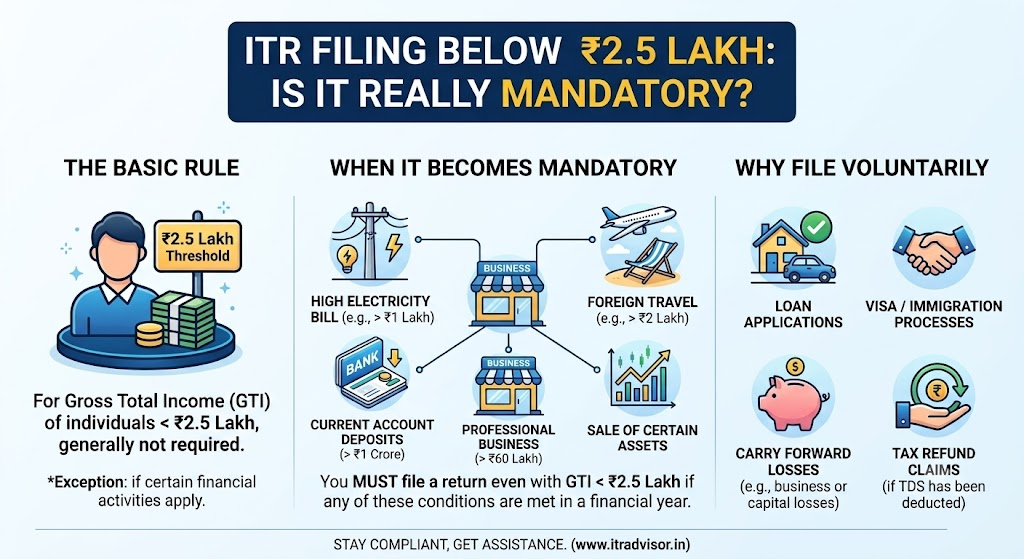
Under the seventh proviso to Section 139(1), income tax return filing is mandatory for individuals even with income below the taxable limit if any of the following apply during the financial year:
Mandatory ITR Filing Triggers (regardless of income level)
• Deposited ₹1 crore or more (cumulatively) in one or more current bank accounts
• Spent ₹2 lakh or more on foreign travel for self or any other person
• Paid electricity bills exceeding ₹1 lakh in a year
• Total sales, turnover, or gross receipts of business exceed ₹60 lakh
• Gross receipts from a profession exceed ₹10 lakh
• TDS and TCS during the year is ₹25,000 or more (₹50,000 for senior citizens) • Deposits in one or more savings bank accounts total ₹50 lakh or more
If any of these conditions are met, ITR filing for income below taxable limit becomes compulsory under law, irrespective of whether actual tax liability is nil. Non-compliance can attract penalties under Section 234F and scrutiny notices from the Income Tax Department.
Why Voluntary ITR Filing Makes Sense Even When Not Mandatory
Beyond the legal triggers, there are strong practical reasons to consider voluntary ITR filing below 2.5 lakh income even when none of the above conditions apply:
Benefits of Filing ITR Even With No Tax Liability
• Claim TDS refunds deducted on bank interest, fixed deposits, or freelance payments
• Build a verifiable income record for visa applications, loans, and credit cards
• Carry forward capital losses or business losses to set off against future income
• Serve as proof of income for government tenders, scholarships, and subsidies • Avoid last-minute compliance pressure if your income crosses the threshold mid-year
Practical Guidance from a Tax Professional
In Dr. Haresh Adwani’s experience advising individual taxpayers across Pune and beyond, the most common red flag is high-value cash deposits or foreign travel spending that taxpayers don’t realise pushes them into mandatory filing territory, even though their taxable income remains nil. A quick review of your AIS (Annual Information Statement) on the income tax portal before the deadline can flag these triggers early and prevent unnecessary notices.
The Income Tax Department’s e-filing portal and the AIS/TIS framework now cross-verify high-value transactions automatically, making it increasingly difficult to overlook these obligations. Staying proactive, rather than reactive, is the safest approach to ITR filing compliance in 2026.
Key Takeaways
• Income below ₹2.5 lakh does not automatically exempt you from filing an ITR
• High-value transactions (large deposits, foreign travel, high electricity bills) trigger mandatory filing
• Voluntary filing helps claim refunds, build financial credibility, and carry forward losses
• Always check your AIS/TIS before assuming no filing is required • When in doubt, consult a qualified tax professional before the ITR filing deadline AY 2026-27
Read our detailed guide on Income Tax AY 2026-27: The Proven Guide to New ITR Forms, Rules & Avoiding Costly Mistakes
Frequently Asked Questions
1.Is ITR filing mandatory below 2.5 lakh income?
Generally no, but it becomes mandatory if you meet specific high-value transaction conditions like large bank deposits or foreign travel spending.
2.Can I claim a refund without filing ITR if my income is below the exemption limit?
No, filing an income tax return is the only way to claim a TDS refund, even when your income is below 2.5 lakh.
3.What happens if I don’t file ITR despite meeting a mandatory trigger?
You may face penalties under Section 234F and could receive a scrutiny notice from the Income Tax Department.
4.Does filing ITR help even with zero tax liability?
Yes, it builds an income record useful for loans, visas, and carrying forward losses for future tax benefits.
Conclusion: File Smart, Stay Compliant
ITR filing below 2.5 lakh income is governed by more than just the basic exemption limit specific transaction-based triggers under Section 139(1) can make filing mandatory regardless of your tax liability. Even where filing isn’t compulsory, doing it voluntarily protects your financial interests and keeps your compliance record clean.
About the Author – Nidhi Adwani
Nidhi Adwani is the Human Resources Manager at Adwani & Co. She is a Law Graduate and holds an MBA in Human Resources. She manages recruitment, employee engagement, team development, workplace culture, and the firm’s social media and content activities. Passionate about people and organizational growth, she also contributes articles for ITRAdvisor and Adwani & Co. Her writing focuses on HR practices, leadership, workplace engagement, and professional development, offering practical insights for professionals and businesses.
At ITRAdvisor.in, we help taxpayers with:
✔️ ITR Filing Review
✔️ AIS Reconciliation
✔️ Capital Gains Reporting
✔️ NRI Taxation
✔️ Tax Notice Response
✔️ Revised Returns
✔️ Income Tax Planning
✔️ Refund and Compliance Issues
Visit ITRAdvisor.in today for professional guidance and consultation.
Early action can often prevent bigger tax problems later.
Leave a Reply