Blog

  • Income Tax Notice India 2026: Every Section Explained What It Means and How to Respond

    Income Tax Notice India 2026: Every Section Explained What It Means and How to Respond

    Dr. Haresh Adwani April 2026 11 min read

    Income Tax Notice

    Introduction: Why Income Tax Notices Are Increasing in 2026

    The Income Tax Department’s Annual Information Statement (AIS) now aggregates data from over 30 reporting entities banks, mutual funds, stock exchanges, property registrars, foreign remittance handlers, insurance companies, and employers against every PAN in India. In AY 2026-27, mismatches between ITR disclosures and AIS data are the primary automated notice trigger.

    The result: the volume of income tax notices issued has risen significantly, and the majority of them are not accusations of wrongdoing they are requests for information, automated processing results, or procedural communications. The problem is never the notice itself; it is an uninformed, delayed, or incomplete response.


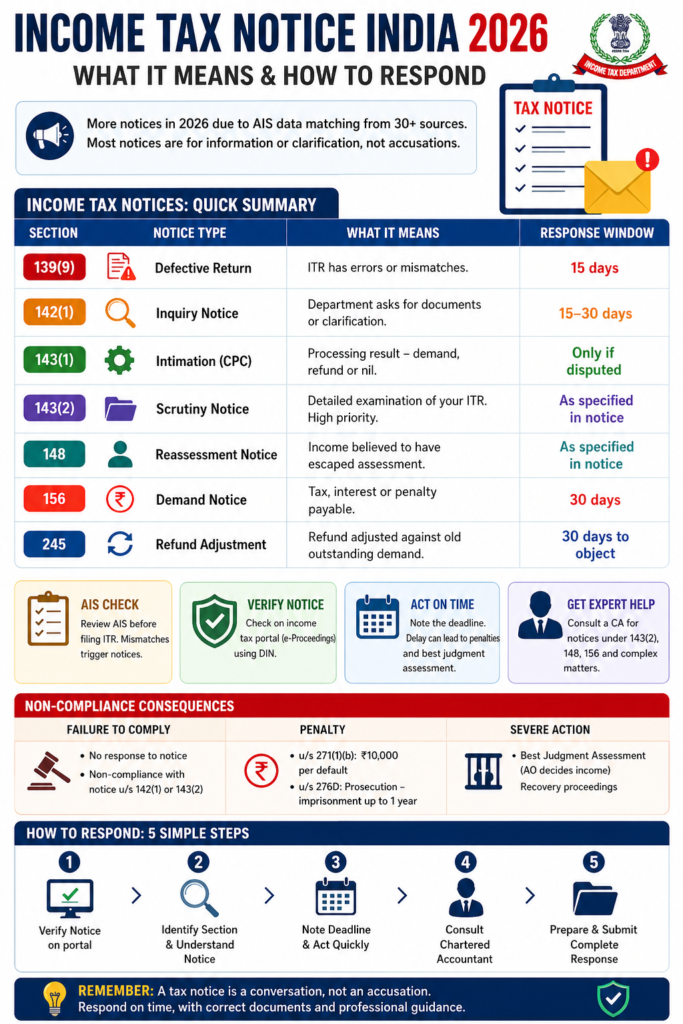
    All Income Tax Notices: Quick Reference Table 2026

    SectionNotice TypeWhat It MeansResponse Window
    139(9)Defective ReturnITR has errors, wrong form, or data mismatches15 days
    142(1)Inquiry NoticeDepartment seeks documents or clarifications15–30 days
    143(1)Automated Intimation (CPC)Processing result demand, refund, or nilOnly if disputed
    143(2)Scrutiny NoticeDetailed examination of your ITR high priorityAs specified in notice
    148Reassessment NoticeIncome believed to have escaped assessmentAs specified in notice
    156Demand NoticeTax, interest, or penalty confirmed payable30 days
    245Refund AdjustmentRefund adjusted against old outstanding demand30 days to object

    Every Income Tax Notice Explained in Detail

    Section 139(9): Defective Return Notice

    Issued when your filed ITR is considered defective incorrect form selection, incomplete mandatory fields, or data mismatches between the ITR and Form 26AS or AIS. You must rectify and refile within 15 days. Failure results in the return being treated as never filed, attracting late filing penalties and permanent loss of loss carry-forward benefits.

    Section 142(1): Inquiry Notice Before Assessment

    One of the most frequently received notices. Issued to request production of specific documents, clarification on income items, or to ask you to file a return if you have not. Respond within the timeframe specified typically 15 to 30 days. This is usually manageable if your books are accurate and your ITR is correctly filed. Non-compliance attracts penalties under Section 271(1)(b) and, in wilful cases, criminal prosecution under Section 276D.

    Section 143(1): Automated Intimation from CPC

    This is an automated, system-generated intimation not a traditional assessment notice. It communicates the result of the CPC’s processing of your ITR: a demand, a refund, or no change. You need to respond only if you believe the department’s calculation is incorrect. In that case, file a rectification request under Section 154 on the e-filing portal. Most 143(1) demands arise from TDS credit mismatches or arithmetic differences.

    Section 143(2): Scrutiny Notice High Priority

    This is a high-priority notice. It signals that the Assessing Officer (AO) intends to examine your ITR in full detail requiring production of books of accounts, vouchers, contracts, and financial statements. The AO must issue this notice within 3 months from the end of the financial year in which the return was filed. Engage a qualified CA immediately. Do not attempt to respond to a Section 143(2) notice without professional representation.

    Section 148: Reassessment Notice

    Issued when the AO has “reason to believe” that income chargeable to tax has escaped assessment in a past year. The Finance Act 2021 fundamentally overhauled the reassessment framework a mandatory pre-notice procedure under Section 148A must now be followed before any Section 148 notice can be validly issued. A significant proportion of Section 148 notices are legally challengeable. The limitation period is 3 years from the end of the relevant assessment year for escaped income below Rs. 50 lakh; up to 10 years for escaped income of Rs. 50 lakh or more with specific documentary evidence.

    Section 156: Notice of Demand

    Issued after assessment is completed, confirming that tax, interest, or penalty is payable. You must pay within 30 days. If you disagree for example, because the demand does not account for TDS credits or because an appeal has been filed respond immediately with a rectification under Section 154 or an appeal under Section 246A. Failure to pay or contest results in recovery proceedings.

    Section 245: Refund Adjusted Against Arrear Demand


    Penalty Reference Table: Non-Compliance with Income Tax Notices

    SectionViolationConsequence
    271(1)(b)Failure to comply with notice under Section 142(1) or 143(2)Rs. 10,000 penalty per default each failure is a separate default
    276DWilful failure to comply with Section 142(1) noticeCriminal prosecution imprisonment up to 1 year
    144No response to any notice AO proceeds ex-parteBest Judgment Assessment AO determines income arbitrarily, typically adversely

    The AIS Cross-Matching Effect: Why More Notices Are Being Issued in 2026

    The Annual Information Statement (AIS) captures data from banks (savings account credits, fixed deposits), mutual fund transactions, stock market trades (including F&O and ESOP vesting), property purchases and sales, foreign remittances, insurance policy payouts, and employer salary data. Every significant financial transaction is reported against your PAN.

    Before filing your ITR for AY 2026-27, always download and review your AIS on www.incometax.gov.in. Unexplained entries in AIS should be addressed in the ITR itself not left to explain in a notice response. Discrepancies between AIS and ITR figures trigger automated notices within weeks of filing.

    Also Read ;

    https://itradvisor.in/blog/gst-show-cause-notice-2026


    How to Respond to an Income Tax Notice: Step-by-Step

    Step 1: Verify the Notice Is Genuine

    Log into www.incometax.gov.in, go to the “e-Proceedings” tab, and verify the notice against your PAN. Every valid notice carries a Document Identification Number (DIN) use “Verify Service Request” to validate it. A notice without a DIN, or one not appearing in e-Proceedings, is legally invalid and need not be acted upon. Verify first, then respond.

    Step 2: Identify the Section and Urgency Level

    The notice specifies the section under which it is issued. This tells you the nature of proceedings and urgency. Section 143(2) and Section 148 require immediate professional engagement. Section 143(1) intimations are typically straightforward to resolve online using the rectification mechanism.

    Step 3: Note Your Exact Response Deadline

    Every notice carries a specific response deadline. Missing it risks: an ex-parte assessment done entirely on the AO’s judgment, adverse income additions, and Section 271(1)(b) penalties for each default. Your response deadline is your most critical resource time lost cannot be recovered.

    Step 4: Engage a Chartered Accountant

    Section 143(1) intimations can often be addressed directly via the e-filing portal. All other notices particularly 143(2), 148, and 156 require professional analysis, documentation assembly, and representation.

    Frequently Asked Questions

    Q1. Is every income tax notice cause for serious concern?

    No. Many notices particularly Section 143(1) intimations and 139(9) defective return notices are routine and readily resolved. Identify the section first: that tells you precisely how serious the notice is and what action to take. Timely, informed action always produces the best outcome

    Q2. What is the response timeline for a Section 143(2) scrutiny notice?

    The notice specifies the exact response date typically 30 days from service. Extensions can be requested from the AO, but are not automatic and must be applied for before the deadline, not after.

    Q3. Can a Section 148 reassessment notice be challenged?

    Yes. If the notice was issued without the mandatory Section 148A procedure, beyond the limitation period, or without adequate “reason to believe,” it can be challenged by writ petition in the High Court. Adwani & Company has successfully quashed multiple invalid reassessment notices.

    4. How do I verify that an income tax notice is genuine?

    Log into www.incometax.gov.in → “e-Proceedings” tab → verify the notice appears against your PAN → use “Verify Service Request” to validate the DIN. If the notice does not appear in e-Proceedings, treat it as suspicious and consult a CA before taking any action.

    Conclusion: An Income Tax Notice Is a Conversation Respond with Confidence

    An income tax notice is the government’s mechanism for verifying your tax affairs not an automatic accusation of wrongdoing. The correct response is always timely, well documented, legally grounded, and professionally represented. Avoidance and delay are your two most damaging choices.

    Adwani & Company’s income tax notice practice covers the complete dispute lifecycle: notice analysis, written submissions, AO representation, appeals before CIT(A), ITAT, and High Court writ petitions. Contact Dr. Haresh Adwani at www.itradvisor.in.

    About the Author
    Dr. Haresh Adwani
    Ph.D. in Commerce | Law Graduate | Managing Partner, Adwani & Co LLP Dr. Haresh Adwani holds a Ph.D. in Commerce and is a qualified Law graduate with over two decades of hands-on experience in GST advisory, direct taxation, and statutory compliance for businesses across Pune and Maharashtra. As Managing Partner of Adwani & Co LLP a firm established in 1977 has guided hundreds of SMEs, startups, and corporates through India’s evolving tax landscape. He is a recognised advisor on GST compliance, company formation, and Virtual CFO services, and regularlycontributes to professional seminars and industry forums in Pune.

  • GST Show Cause Notice 2026: A Complete Legal Guide to Understanding and Responding

    GST Show Cause Notice 2026: A Complete Legal Guide to Understanding and Responding

    Dr. Haresh Adwani April 2026 8 min read

    GST Show Cause Notice
    GST Show Cause Notice 2026

    What Is a GST Show Cause Notice (SCN)?

    A GST Show Cause Notice (SCN) is a formal legal communication issued by a GST officer under the CGST/SGST Act 2017. It requires the recipient to explain “show cause” why a specified action (typically a tax demand, interest levy, or penalty confirmation) should not proceed.

    A GST Show Cause Notice is the beginning of a legal process, not its conclusion. You have every right to present your case with evidence. The danger is not the notice itself it is an uninformed, delayed, or undocumented response.

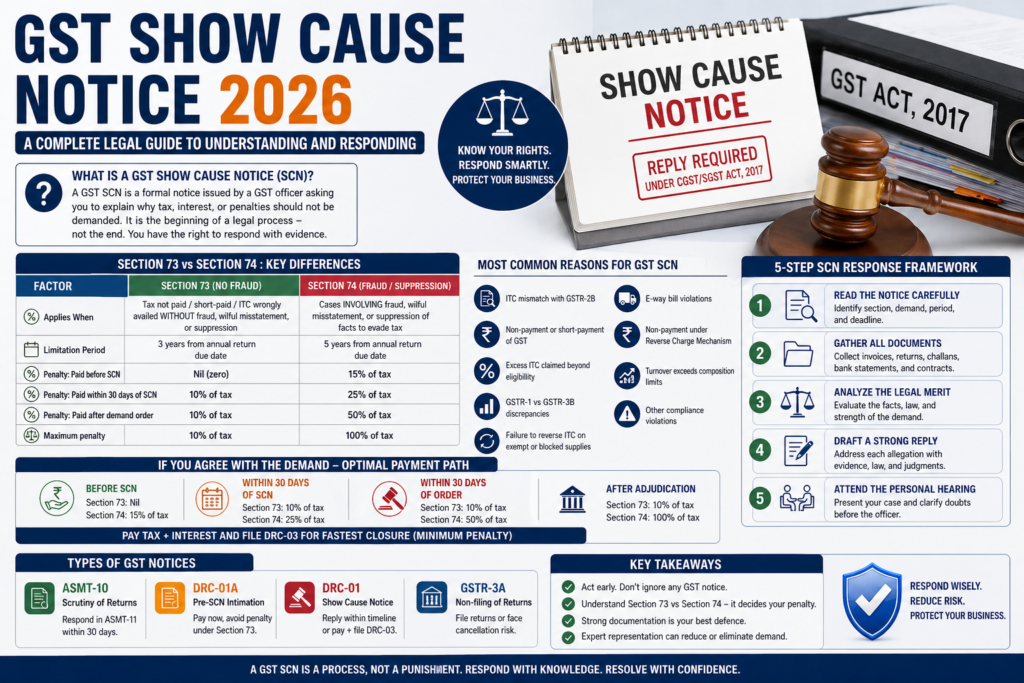
    The Two Critical GST SCN Provisions: Section 73 vs Section 74

    Every GST Show Cause Notice is issued under one of two provisions and this distinction is the most important piece of information in the notice. It determines your penalty exposure, response urgency, and the cost of resolution at every stage.

    FactorSection 73 (No Fraud)Section 74 (Fraud / Suppression)
    Applies whenTax not paid / short-paid / ITC wrongly availed WITHOUT fraud, wilful misstatement, or suppressionCases INVOLVING fraud, wilful misstatement, or suppression of facts to evade tax
    Penalty: Paid before SCNNil (zero)15% of tax
    Penalty: Paid within 30 days of SCN10% of tax25% of tax
    Penalty: Paid after demand order10% of tax50% of tax
    Maximum penalty (contested and confirmed)10% of tax100% of tax
    Limitation period for SCN3 years from annual return due date5 years from annual return due date

    Most Common Reasons for a GST Show Cause Notice in 2026

    • ITC mismatch: ITC claimed in GSTR-3B does not reconcile with auto-populated GSTR 2B data.
    • Non-payment or short payment of GST on taxable supplies.
    • Excess ITC claimed beyond Section 16 eligibility conditions.
    • Discrepancy between GSTR 1 outward supply data and GSTR-3B tax payment.
    • Failure to reverse ITC on exempt supplies or blocked credits under Section 17(5).
    • E-way bill violations goods transported without valid documentation.
    • Non-payment of GST under Reverse Charge Mechanism on applicable services.
    • Turnover exceeding composition scheme limits without transitioning to regular registration.

    Types of GST Show Cause Notice Notices: A Complete Reference

    ASMT-10: Scrutiny of Filed Returns

    Issued under Section 61 when a GST officer identifies discrepancies in your filed returns (typically between GSTR-1, GSTR-3B, and GSTR-2B). Respond in Form ASMT-11 within 30 days with a documented reconciliation. A well-drafted ASMT-11 response prevents escalation to a formal SCN in most cases.

    DRC-01A: Pre-SCN Intimation Your Zero-Penalty Opportunity

    DRC-01A is a pre-notice intimation that gives you the opportunity to voluntarily accept the demand and pay the tax with interest before formal proceedings begin. Proactive payment at DRC-01A stage under Section 73 results in zero penalty. This is the most cost-effective resolution point for any GST dispute. Treat DRC-01A with the same urgency as a formal SCN.

    DRC-01: The Formal Show Cause Notice

    DRC-01 is the primary show cause notice under Section 73 or 74. Upon receipt, you must either pay the demand with interest and file DRC-03 (voluntary payment challan), or file a detailed written reply within the prescribed deadline typically 30 days. This is the most consequential notice to respond to correctly.

    GSTR-3A: Notice for Non-Filing of Returns

    Issued under Section 46 when returns have not been filed for two or more consecutive tax periods. Continued non-filing after GSTR-3A can result in GSTIN cancellation, creating severe business continuity risks.

    Also Read:

    https://itradvisor.in/blog/gst-composition-scheme

    The 5-Step GST Show Cause Notice Response Framework

    Step 1: Read the Notice Carefully and Identify the Section

    Identify: (1) Section 73 or 74, (2) the exact demand tax, interest, and proposed penalty, (3) the specific transactions or return periods in question, and (4) your response deadline. Section 73 vs 74 is the single most important data point.

    Step 2: Gather Every Relevant Document

    Assemble: tax invoices, e-way bills, filed GSTR-1 and GSTR-3B returns, purchase invoices, GSTR-2B statements, DRC-03 challans, bank statements, and supplier contracts. Strong, organised documentation is your most powerful defence.

    Step 3: Analyse the Legal Merit of the Demand

    Not every GST SCN represents genuine tax liability. Many notices are generated by automated system mismatches ITC gaps that have valid explanations such as late supplier filings. Expert analysis can identify grounds to contest the demand entirely or substantially reduce admitted liability. Do not assume the department’s position is correct without review.

    Step 4: Draft and File a Legally Complete Written Response

    Your reply must address each allegation individually with supporting evidence, cite the relevant legal provisions and CBIC circulars, reference favourable High Court and Tribunal judgments, and where genuine liability is admitted quantify it separately from contested amounts.

    Step 5: Attend the Personal Hearing

    You have a statutory right to a personal hearing before the adjudicating authority. Always request it. The hearing is frequently the turning point in a GST SCN case additional context, documentation, and direct clarification often resolve the matter before any demand order is passed.

    If You Agree with the GST Demand: The Optimal Payment Path

    Payment TimingSection 73 PenaltySection 74 Penalty
    Before SCN is issuedNIL (zero)15% of tax
    Within 30 days of SCN10% of tax25% of tax
    Within 30 days of demand order10% of tax50% of tax
    After adjudication (contested and confirmed)10% of tax100% of tax

    To pay and close proceedings: File DRC-03 on the GST portal recording the voluntary payment of tax and interest. This is the standard mechanism to close Section 73 proceedings with minimum (or zero) penalty.

    GST Show Cause Notice Timelines and Limitation Periods (2026)

    • Section 73 SCN limitation: Must be issued within 3 years from the due date of the annual return for the relevant year (5 years if no return was filed).
    • Section 74 SCN limitation: Must be issued within 5 years from the due date of the annual return.
    • ASMT-10 response deadline: 30 days from notice date (extendable on application to the adjudicating officer).
    • DRC-01 response deadline: As specified in the notice typically 30 days.

    Conclusion: A GST Show Cause Notice Is a Process Respond Wisely

    A GST Show Cause Notice is the opening of a legal conversation, not a final verdict. With the right approach timely response, strong documentation, correct legal citations, and expert representation most GST SCNs are resolved in the taxpayer’s favour or with substantially reduced liability.

    Adwani & Company’s dedicated GST litigation team manages every stage of a GST dispute: SCN analysis, Section 73/74 determination, ITC reconciliation, response drafting, personal hearing representation, and appeals. Contact Dr. Haresh Adwani at www.itradvisor.in typically within 24 hours.

    Frequently Asked Questions

    Q1. How long do I have to respond to a GST SCN?

    The notice specifies the deadline typically 30 days from the date of issue. You can apply to the adjudicating officer for an extension before the deadline expires. Never wait until the last day; response preparation requires time.

    Q2. Can a GST SCN be challenged directly in court?

    Courts generally require exhaustion of statutory remedies first. However, if the SCN is issued beyond the limitation period, lacks proper jurisdiction, or has procedural defects, a writ petition in the High Court may be maintainable. Adwani & Company has successfully pursued such writs where appropriate.

    Q3. What happens if I ignore a GST SCN?

    The GST officer issues an ex-parte demand order confirming the full tax, interest, and penalty on a best-judgment basis. Your GSTIN may also be suspended. Ignoring a GST SCN eliminates all legal defence and is always the worst possible course of action.

    Q4. What is the difference between a GST SCN and a Demand Order?

    A GST SCN is your opportunity to respond before any decision is made. A Demand Order (Form DRC-07) is the adjudicating officer’s final decision confirming the liability. A Demand Order can be appealed before the Appellate Authority within three months.

    About the Author
    Dr. Haresh Adwani
    Ph.D. in Commerce | 20+ years in Tax, FEMA & Financial Advisory Expert in: GST advisory · Income tax litigation · FEMA compliance · NRI taxation · F&O taxation · Corporate structuring
    Website: www.itradvisor.in

  • GST Composition Scheme 2026: The Complete Small Business Guide Eligibility, Rates, and Compliance

    GST Composition Scheme 2026: The Complete Small Business Guide Eligibility, Rates, and Compliance

    Dr. Haresh Adwani April 2026 10 min read

    GST Composition Scheme
    GST Composition Scheme 2026

    What Is the GST Composition Scheme?

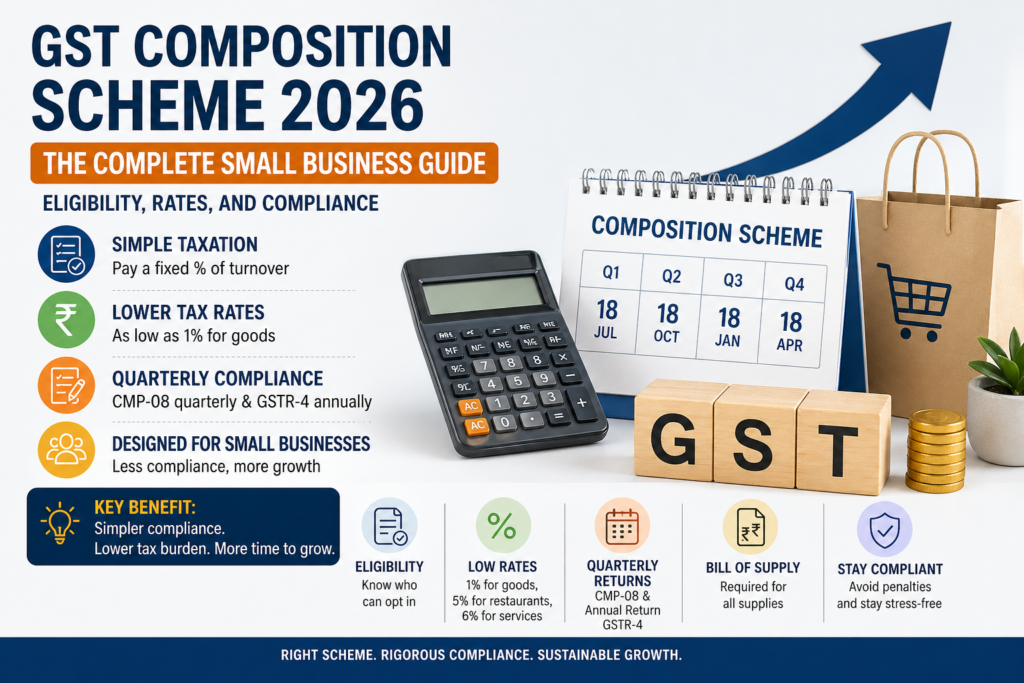
    The GST Composition Scheme, governed by Section 10 of the Central Goods and Services Tax (CGST) Act 2017, is a simplified taxation option for small businesses. Instead of calculating GST on every individual invoice, tracking ITC, filing monthly returns, and reconciling supplier data, eligible businesses pay a single flat percentage of their total quarterly turnover as GST.


    GST Composition Scheme Eligibility 2026: Who Can and Cannot Opt In

    Turnover Thresholds (FY 2026-27)

    Business CategoryTurnover Limit (All-India PAN)Special Category States
    Manufacturers and traders of goodsRs. 1.5 croreRs. 75 lakh
    Restaurants (not serving alcohol)Rs. 1.5 croreRs. 75 lakh
    Service providersRs. 50 lakhRs. 50 lakh

    Who Cannot Opt for the GST Composition Scheme (Statutory Exclusions)

    • Manufacturers of ice cream, pan masala, aerated beverages, or tobacco and tobacco products.
    • Businesses making inter-state outward supplies of goods (you may purchase from other states, but not sell).
    • E-commerce operators required to collect Tax Collected at Source (TCS) under Section 52 of the CGST Act.
    • Non-resident taxable persons and casual taxable persons.
    • Businesses supplying goods through an e-commerce operator (sellers on Amazon, Flipkart, Meesho, etc.).

    GST Rates Under the GST Composition Scheme 2026

    Business TypeTotal GST RateCGST ComponentSGST ComponentReturns Required
    Manufacturers of goods1%0.5%0.5%CMP-08 + GSTR-4
    Traders and retailers of goods1%0.5%0.5%CMP-08 + GSTR-4
    Restaurants (not serving alcohol)5%2.5%2.5%CMP-08 + GSTR-4
    Service providers6%3%3%CMP-08 + GSTR-4

    Should Your Business Choose the GST Composition Scheme? A Decision Framework

    Choose the GST Composition Scheme If…

    • All or most of your customers are end consumers (B2C) who do not need GST tax invoices to claim ITC.
    • Your business is localised you do not supply goods to customers in other states.
    • Input costs are low relative to sales you would not benefit significantly from ITC claims.
    • You want to reduce monthly compliance costs and professional fees.
    • Your turnover is comfortably below the threshold with no expectation of crossing it mid-year.

    Do NOT Choose the GST Composition Scheme If...

    • You sell primarily to other GST registered businesses (B2B) composition dealer status prevents buyers from claiming ITC, making you commercially less competitive.
    • You have high input purchases where ITC claims would significantly reduce your net tax burden.
    • You sell goods to buyers in other states inter-state outward supply disqualifies you entirely.
    • Your turnover is close to the threshold and growing mid-year disqualification creates significant compliance complications.
    • You sell goods through e-commerce platforms such as Flipkart, Amazon, or Meesho.

    Also Read:

    https://itradvisor.in/blog/gst-compliance-checklist-india-2026

    GST Compliance Requirements Under the Composition Scheme

    CMP-08: Quarterly Statement-Cum-Challan

    QuarterPeriodCMP-08 Due Date
    Q1April to June18th July
    Q2July to September18th October
    Q3October to December18th January
    Q4January to March18th April

    Late payment penalty: Interest at 18% per annum from due date + late filing fee of Rs. 50 per day (Rs. 25 CGST + Rs. 25 SGST), subject to a maximum of Rs. 2,000 per return.

    GSTR-4: Annual Return

    GSTR4 is the annual return consolidating all CMP-08 filings. Due date: 30th April of the following financial year. For FY 2025-26, the due date is 30 April 2026. Late fee: Rs. 200 per day (Rs. 100 CGST + Rs. 100 SGST), maximum Rs. 5,000. The GST portal auto-populates CMP-08 data, making this return straightforward.

    Bill of Supply: The Mandatory Billing Document

    Composition dealers cannot issue a GST tax invoice. Every sale must be recorded on a Bill of Supply that prominently displays: “Composition Taxable Person, not eligible to collect tax on supplies.” Issuing a regular tax invoice or showing GST as a separate charge on the bill is a direct violation of Section 10(4) of the CGST Act and attracts penalty proceedings.


    How to Opt Into the Composition Scheme for FY 2026-27

    1. Log in to www.gst.gov.in using your GSTIN credentials.
    2. Navigate to: Services → Registration → Application to Opt for Composition Levy.
    3. File Form GST CMP 02 and select your business category.
    4. Accept the eligibility declaration and submit using DSC (companies/LLPs) or EVC/OTP (proprietors/partnerships).
    5. Within 60 days of opting in, file Form ITC-03 to reverse any ITC balance held under the regular scheme.

    The 5 Costliest Composition Scheme Compliance Mistakes

    Mistake 1: Not Tracking Aggregate Turnover Across All GST Registrations

    The Rs. 1.5 crore (or Rs. 50 lakh for services) threshold applies to combined turnover under your PAN not per GSTIN. Business owners with multiple businesses frequently discover they are ineligible only after an audit. Implement a monthly consolidated turnover tracking system.

    Mistake 2: Collecting GST Separately From Customers

    Composition dealers bear the GST from their own margin it cannot be charged separately to customers. Collecting GST on composition dealer bills violates Section 10(4), exposes you to penalty proceedings, and means buyers cannot claim ITC on those amounts.

    Mistake 3: Missing Reverse Charge Mechanism (RCM) Obligations

    Even though composition dealers cannot claim ITC, they remain liable for GST under the Reverse Charge Mechanism on specified inward supplies such as services from unregistered vendors or notified categories. RCM tax must be paid in cash at regular GST rates and declared in CMP 08.

    Mistake 4: Missing the CMP 08 Deadline

    Interest at 18% per annum starts accumulating the day after the due date. Beyond the financial cost, repeated late filings are a compliance risk signal that increases the probability of audit selection.

    Mistake 5: Continuing in the Scheme After Crossing the Turnover Limit

    If your aggregate turnover crosses Rs. 1.5 crore (or Rs. 50 lakh for services) and you do not switch to the regular scheme within 7 days by filing Form CMP 04, every invoice issued after the threshold date is treated as irregular. GST demand, interest at 18% p.a., and penalty on the entire excess period turnover applies. This is the single most consequential composition scheme mistake.

    Frequently Asked Questions

    Q1. When must a business switch from the Composition Scheme to regular GST?

    Immediately when aggregate annual turnover crosses Rs. 1.5 crore (Rs. 50 lakh for services) during the financial year, or when the business begins making inter-state outward supplies of goods. File Form CMP04 within 7 days of crossing the threshold.

    Q2. Can a composition dealer issue an e-invoice?

    No. Composition dealers issue Bills of Supply not tax invoices or e invoices. There is no GST to report to the Invoice Registration Portal (IRP) because composition dealers do not collect GST from customers.

    Q3. Is GST payable under the Reverse Charge Mechanism for composition taxpayers?

    Yes. RCM obligations apply to composition taxpayers on specified inward supplies. This tax must be paid in cash at regular GST rates and declared in CMP08. ITC cannot be claimed against this RCM liability.

    Q4. Is the composition scheme beneficial for service based businesses?

    It depends on the profile. If your service business is B2C (retail clients who do not need ITC), has annual turnover comfortably below Rs. 50 lakh, and carries low input costs, the composition scheme reduces compliance burden significantly. If you serve businesses that need to claim ITC on your invoices, the regular scheme is commercially necessary.

    Conclusion:

    The GST Composition Scheme is a powerful compliance simplification tool for eligible small businesses but only if chosen correctly and administered rigorously. The five mistakes outlined in this guide can collectively result in demands, penalties, and forced switch to the regular scheme under adverse conditions.

    Adwani & Company assists small businesses in evaluating scheme eligibility, filing CMP02, managing CMP08 and GSTR4 filings, and switching to the regular scheme when necessary. Visit www.itradvisor.in for a consultation.

    About the Author
    Dr. Haresh Adwani | Founder, Adwani & Company Ph.D. in Commerce | 20+ years in Tax, FEMA & Financial Advisory Expert in: GST advisory · Income tax litigation · FEMA compliance · NRI taxation · F&O taxation · Corporate structuring .

    Website: www.itradvisor.in

    For consultations, schedule via the website.

  • Medical Tourism in India 2026: The Ultimate FEMA & GST Compliance Guide

    Medical Tourism in India 2026: The Ultimate FEMA & GST Compliance Guide

    Dr. Haresh Adwani April 2026 13 min read

    Medical Tourism In India

    Medical Tourism in India Demands Regulatory Expertise

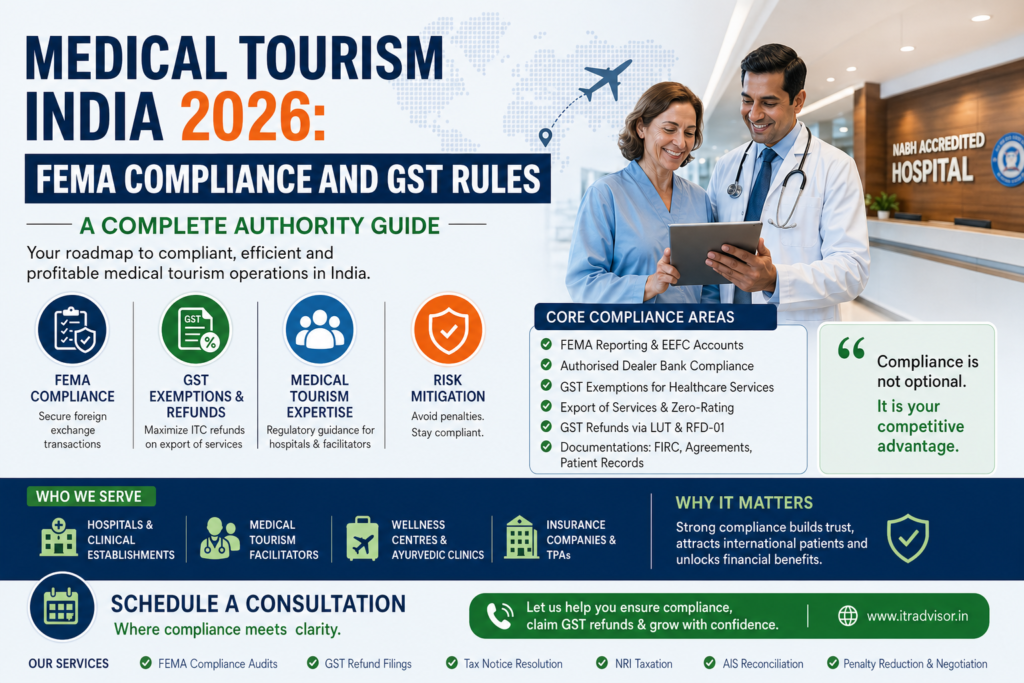
    India’s medical tourism sector was valued at over USD 9 billion and is growing at double-digit rates, driven by 60–80% lower treatment costs than Western nations, NABH accredited hospitals, and an internationally trained medical workforce. Yet this growth story carries a compliance warning: hospitals, medical facilitators, and intermediaries operating in this space face a layered regulatory environment that intersects FEMA 1999, GST law, and RBI master directions.

    This guide authored by , with over two decades of advisory experience in healthcare taxation and FEMA compliance provides a comprehensive, legally authoritative reference for every stakeholder in the medical tourism value chain.

    Also Read:

    https://itradvisor.in/blog/itr-filing-2026-smart-strategieshttps://itradvisor.in/blog/itr-filing-2026-smart-strategies


    Why Foreign Patients Choose India for Medical Tourism

    India’s medical tourism proposition rests on four pillars recognized by the Ministry of Tourism, Government of India:

    • Cost advantage: A cardiac bypass costing USD 1,30,000 in the United States is performed in India for USD 7,000–10,000 with equivalent outcomes.
    • Clinical accreditation: NABH and JCI accredited hospitals in Mumbai, Chennai, Delhi, Hyderabad, and Bengaluru meet international quality standards.
    • Specialisation: Cardiac surgery, oncology, orthopaedics, IVF, and Ayurvedic wellness are India’s strongest medical tourism draws.
    • Visa facilitation: The Medical Visa (M-Visa) and Medical Attendant Visa (MX-Visa) provide structured legal entry for foreign patients and up to two attendants.

    The Regulatory Framework: FEMA 1999 and Medical Tourism

    For every hospital and facilitator handling foreign patients, the Foreign Exchange Management Act (FEMA) 1999 governs the receipt, reporting, and use of foreign currency. This is the most frequently overlooked compliance area and the one with the heaviest penalties.

    Classification as Service Exporters

    Hospitals and medical tourism facilitators receiving foreign currency payments are classified as service exporters under FEMA. This classification triggers a specific set of reporting and banking obligations:

    • All foreign currency receipts must be deposited in an Exchange Earners’ Foreign Currency (EEFC) account or converted within RBI-prescribed timelines.
    • Medical services provided to foreign patients qualify as ‘export of services’ under FEMA, making them eligible for Advance Authorisation and, where applicable, duty drawback benefits.
    • Every foreign currency transaction must be processed through an Authorised Dealer (AD) bank direct offshore receipts held outside the Indian banking system are a FEMA violation.
    • Medical facilitators earning commission from overseas principals must receive those commissions in accordance with RBI guidelines on payment for services.

    FEMA Compliance Obligations: Quick Reference

    RequirementDetail
    Foreign currency receiptMust be deposited in EEFC account or converted within prescribed timelines
    Authorized Dealer BankAll forex transactions routed through AD bank only
    FIRC (Foreign Inward Remittance Certificate)Must be obtained for every foreign currency receipt critical for GST refund claims
    RBI ReportingTransactions reported per RBI Master Directions; AD bank assists in compliance
    Compounding for violationsFEMA violations can be compounded voluntarily under Section 15 preferable to ED proceedings

    GST Framework for Medical Tourism: What Is Exempt and What Is Not

    The GST treatment of medical tourism services is nuanced. Getting it wrong either by incorrectly charging GST on exempt services or by failing to claim legitimate export-of-service refunds has direct financial consequences.

    Core Healthcare Exemption (Notification No. 12/2017-Central Tax (Rate)

    Healthcare services provided by a clinical establishment, an authorized medical practitioner, or a paramedic are comprehensively exempt from GST. This exemption covers diagnosis, treatment, and care for illness, injury, deformity, abnormality, or pregnancy and applies equally to Indian and foreign patients.

    Practical Example:

    A foreign patient undergoing a kidney transplant at a Mumbai hospital pays Rs. 8,00,000 covering surgery, anaesthesia, nursing, medicines, and room rent. The entire amount is GST exempt. No GST should appear on the hospital invoice.

    Services That Attract GST in the Medical Tourism Context

    Service TypeGST RateNotes
    Core healthcare services (inpatient/outpatient)Exempt (0%)Notification 12/2017-CT(Rate)
    Medical facilitation / coordination services18%Third-party agent services to foreign patients
    Cosmetic / aesthetic surgery (non-medical)18%Not covered by healthcare exemption
    Spa, wellness, yoga packages (non-clinical)18%Unless part of clinical treatment protocol
    Hotel accommodation for patients12%–18%Depends on daily tariff
    Air ambulance services5%Specific pharmaceutical/medical rate

    Export of Services and Zero-Rating: Unlocking GST Refunds

    When a hospital provides healthcare to a foreign patient and receives payment in foreign currency, the supply qualifies as ‘export of services’ under Section 2(6) of the IGST Act if four conditions are met: (1) the supplier is in India, (2) the recipient is outside India, (3) the place of supply is outside India, and (4) payment is received in foreign exchange.

    Zero-rating entitles the hospital to claim a refund of all Input Tax Credit (ITC) paid on inputs and input services a significant financial benefit that the majority of hospitals currently fail to leverage. The refund mechanism requires filing Form GST RFD-01 along with the FIRC, a Letter of Undertaking (LUT filed annually in Form GST RFD-11), and patient admission records.


    Compliance Checklist: Medical Tourism Stakeholders 2026

    For Hospitals and Clinical Establishments

    • Maintain current NABH or JCI accreditation as required by the government’s medical tourism empanelment policy.
    • Register as a service exporter with your Authorised Dealer bank and update FEMA compliance documentation annually.
    • Obtain and archive FIRC for every foreign currency receipt this is mandatory for both FEMA compliance and GST export-of-service refunds.
    • File LUT annually on the GST portal before raising invoices in foreign currency to avoid IGST on exports.
    • File GSTR-1, GSTR-3B, and GST RFD-01 correctly for all zero-rated supply periods.
    • Never charge GST on core healthcare services verify each billing line item against the exemption notification.

    For Medical Tourism Facilitators and Agents

    • Register under GST if annual turnover from facilitation services exceeds Rs. 20 lakh (Rs. 10 lakh for special category states).
    • Charge 18% GST on all coordination and facilitation fees this is mandatory and non-negotiable.
    • Ensure all commission income from foreign principals is received through AD bank channels and documented.
    • Maintain written patient referral agreements with overseas principals essential for FEMA and GST documentation.

    The Three Most Costly Compliance Mistakes in Medical Tourism

    Mistake 1: Charging GST on Exempt Healthcare Services

    Adding GST to inpatient hospital bills is both legally incorrect and creates patient dissatisfaction. Every billing line item must be verified against the healthcare exemption notification before any GST is applied.

    Mistake 2: Failing to Claim Export-of-Service GST Refunds

    Hospitals that treat foreign patients and receive foreign currency are entitled to ITC refunds on all inputs. Failing to file RFD-01 means forfeiting substantial refunds often running into lakhs per financial year.

    Mistake 3: Non-Compliance with FEMA Reporting Timelines

    Delayed conversion of foreign currency or failure to report receipts to the AD bank are FEMA violations. The Enforcement Directorate can levy penalties and initiate adjudication proceedings. Voluntary compounding under Section 15 of FEMA before the ED initiates action is always the preferred path.


    Conclusion: Compliance Is Not Optional It Is Competitive Advantage

    Medical tourism is one of India’s most promising growth sectors, but it operates in a tightly regulated environment. Hospitals and facilitators that build robust FEMA and GST compliance frameworks not only protect themselves from enforcement action they build the institutional credibility that attracts international patients and overseas referral partnerships.

    For specialised guidance on FEMA compliance audits, GST refund filings, and structuring agreements with overseas medical facilitators, consult Adwani & Company. Visit www.itradvisor.in to schedule a consultation.

    Frequently Asked Questions

    1. Is GST applicable on hospital charges paid by a foreign patient in India?

    No, core healthcare services provided by clinical establishments are exempt from GST, irrespective of whether the patient is Indian or foreign.

    2. Can a hospital claim GST refund when treating foreign patients?

    Yes. If payment is received in foreign exchange and the conditions for ‘export of services’ under IGST are satisfied, the hospital can claim a refund of ITC paid on inputs.

    3. What FEMA compliance is required for receiving payment from foreign medical tourists?

    Payments must be routed through authorised dealer banks, deposited within prescribed timelines, and reported correctly. A FIRC must be obtained for each foreign currency receipt..

    4. Is cosmetic surgery for foreign patients subject to GST?

    Yes. Cosmetic or aesthetic surgeries not performed to treat illness or deformity attract 18% GST. Only medically necessary procedures fall within the healthcare exemption.

    5. What is a Letter of Undertaking (LUT) in the context of medical tourism GST?

    An LUT (filed in Form GST RFD-11) allows a registered taxpayer to export services without paying IGST upfront. Hospitals serving foreign patients should file the LUT annually on the GST portal before raising invoices in foreign currency.

    6. Do medical tourism agents or facilitators need to register under GST?

    Yes. If a facilitator’s annual turnover from facilitation services exceeds Rs. 20 lakh (Rs. 10 lakh for special category states), GST registration is mandatory and 18% GST must be charged on coordination and facilitation fees.7

    7.Can FEMA violations in medical tourism be compounded?

    Yes. Under Section 15 of FEMA, violations can be compounded by the RBI’s Compounding Authority on application. It is strongly advisable to seek voluntary compounding before the Enforcement Directorate initiates proceedings..

    Dr. Haresh Adwani is a PHD Holder In commerce with  20 years of experience in income tax compliance, NRI taxation, international financial advisory, and tax notice resolution.  Medical tourism Tax advisor Pune,

    Services: ITR filing • Tax notice resolution • AIS reconciliation • NRI taxation • Financial footprint analysis • Penalty reduction & negotiation

    Schedule a consultation: Adwani & Company  Where compliance meets clarity.

  • GST Compliance Checklist India 2026: 7 Essential Rules to Avoid Notices and Penalties

    GST Compliance Checklist India 2026: 7 Essential Rules to Avoid Notices and Penalties

    GST Compliance Checklist India 2026
    GST Compliance Checklist India 2026

    Introduction: GST Compliance Is Not a Once a Year Exercise

    India’s GST system governed by the CGST Act 2017, IGST Act 2017, and SGST laws operates on a multi-rate structure (5%, 12%, 18%, 28%) with mandatory monthly and quarterly filings, automated data matching, and increasing use of AI-powered scrutiny tools by the GSTN. In 2026, a compliance gap that might have gone unnoticed three years ago now triggers an automated show cause notice within weeks.

    This guide authored by Dr. Haresh Adwani, a GST practitioner with over 20 years of advisory experience provides the 7 compliance rules every GST registered business must follow, a complete filing schedule, and a practical framework for staying penalty free in FY 2026-27.


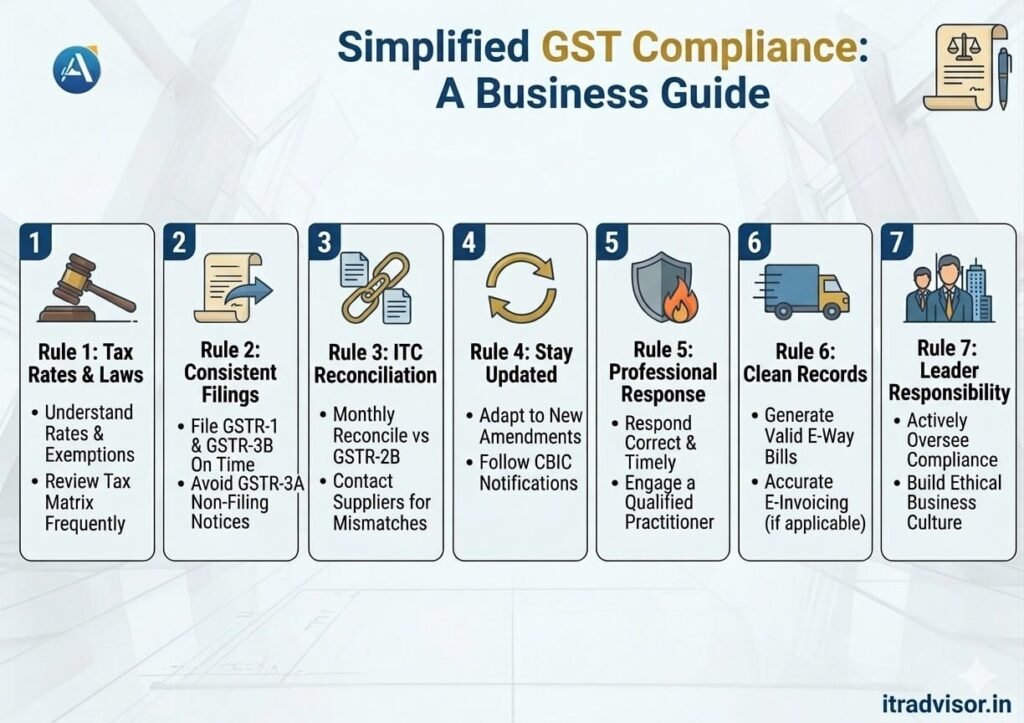
    Rule 1: Know the Law Understand GST Rates, Exemptions, and ITC Rules

    The most powerful defence against a GST Show Cause Notice (SCN) is understanding the law better than the notice that arrives. Businesses must correctly identify which GST rate applies to their specific goods or services, which exemptions under CGST notifications apply, and what Input Tax Credit (ITC) conditions must be satisfied under Sections 16 and 17.

    Incorrect rate application for example, charging 12% on a service that should attract 18%, or incorrectly claiming the healthcare exemption on a taxable service is one of the most common automated notice triggers in 2026. Build a product/service tax matrix for your business and review it every time the GST Council issues notifications.

    Rule 2: Consistency File Returns on Time, Every Filing Period Without Exception

    GST compliance is built on consistent, on-time filing of GSTR-1, GSTR3B, GSTR9, and GSTR9C. A single missed filing cascades into data mismatches, ITC blocks for your buyers, automated GSTR-3A non-filing notices, and GSTIN suspension risk.

    Practical Example On-Time Filing Value
    A Mumbai textile trader with Rs. 25 lakh monthly turnover pays approximately Rs. 4.5 lakh in GST per month. Consistent on-time filing avoids: late fees of Rs. 50 per day per return (Rs. 20 for Nil returns), 18% p.a. interest on unpaid tax, GSTIN suspension, and downstream ITC denial for buyers. One missed GSTR-3B can cascade into mismatches, demand notices, and interest liability. Consistency is your lowest-cost compliance strategy.

    Rule 3: Team Coordination Reconcile Your ITC Against GSTR-2B Every Month

    Your ITC claims in GSTR3B must reconcile with the auto-populated GSTR-2B data on the GST portal. Any gap whether because a supplier has not filed GSTR1, filed it late, or reported an incorrect invoice triggers automated discrepancy notices under Section 61 of the CGST Act.

    Monthly reconciliation between your purchase register, GSTR-2B data, and GSTR3B filings is the single most effective habit to prevent ITC-related demand notices before they are issued. Where a supplier has consistently not filed, consider reversing provisional ITC under Section 16(2) to eliminate the mismatch risk.

    Rule 4: Adapt Stay Current with GST Amendments, Notifications, and Circulars

    Since GST’s implementation in July 2017, the legal landscape has evolved continuously rate changes, new notifications, CBIC circulars, Advance Ruling Authority (AAR) decisions, and Supreme Court judgments all affect your GST liability. Businesses that apply outdated rates or expired exemptions face demand notices for the differential tax plus interest.

    Subscribe to CBIC notification alerts, track GST Council recommendations, and review your tax matrix every time a major notification is issued. Adwani & Company maintains a live amendment tracker for all advisory clients.

    Rule 5: Perform Under Pressure Respond to GST Notices Correctly and on Time

    Receiving a GST Show Cause Notice is a high-pressure moment for any business. The correct response requires: filing within the stipulated timeline, addressing each allegation individually with documentary evidence, citing the applicable legal provisions and CBIC circulars, referencing favourable High Court and Tribunal judgments, and where genuine liability exists opting for voluntary payment with interest to reduce penalty exposure under Section 73.

    Ignoring a GST notice results in an ex-parte demand order. Panic driven incomplete responses worsen your position. Engage a qualified GST practitioner immediately upon receiving any show cause notice or DRC-01A pre-notice intimation.

    Rule 6: Build Infrastructure E Way Bills, E Invoicing, and Clean Audit Trails

    GST compliance infrastructure the systems that generate and archive e way bills, e invoices, and accounting records is not optional. The stakes are high:

    • E-way bill violations (goods movement above Rs. 50,000 without a valid e-way bill) attract a penalty equal to 100% of the tax due on the consignment.
    • E-invoicing is mandatory for all registered taxpayers with aggregate turnover above Rs. 5 crore in any financial year from FY 2017-18 onwards. Lapses lead to ITC denial for your buyers damaging your commercial relationships.
    • A clean, reconcilable accounting system that generates audit trails matching your GST returns is your primary defence in any scrutiny or audit.

    Rule 7: Leadership GST Accountability Starts at the Top

    Under Section 89 of the CGST Act, every person in charge of the conduct of business directors, partners, and the karta of HUFs can be held personally liable for the entity’s GST dues in cases of non-compliance. GST compliance is not solely the accountant’s responsibility; it begins with the business owner and promoter.

    Businesses where leadership treats GST compliance as an operational priority not an annual afterthought consistently avoid notices, penalties, and business disruption.

    Also Read:

    https://itradvisor.in/blog/gst-show-cause-notice-2026https://itradvisor.in/blog/gst-show-cause-notice-2026


    GST Filing Mistakes Businesses Must Eliminate in 2026

    Common MistakeConsequencePrevention
    Incorrect GST rate applicationTax demand + interest + penaltyBuild and maintain a product/service tax matrix
    GSTR-1 vs GSTR-3B mismatchSection 61 scrutiny noticeReconcile before filing each return
    Excess or unsupported ITC claimITC reversal demand + 18% interestVerify against GSTR-2B before claiming
    Late filing of GSTR-1 / GSTR-3BLate fees + GSTIN suspension riskAutomate reminders; use a GST compliance calendar
    Ignoring GST noticesEx-parte demand orderEngage a GST practitioner within 48 hours of receipt
    Not reconciling ITC monthlyMismatches trigger automated noticesMonthly purchase register vs GSTR-2B reconciliation
    Errors in e-invoicing / e-way billsPenalties + ITC denial for buyersUse GSTN-approved software with auto-validation

    GST Compliance Checklist India 2026: Complete Filing Schedule

    Return / ObligationFrequencyDue Date
    GSTR-1 (Outward Supplies)Monthly / Quarterly (QRMP)11th of following month / Quarterly
    GSTR-3B (Tax Payment Return)Monthly20th / 22nd / 24th (category-based)
    GSTR-9 (Annual Return)Annual31st December of following FY
    GSTR-9C (Reconciliation Statement)Annual (turnover >Rs. 5 crore)31st December of following FY
    E-way BillsPer consignmentBefore goods movement commences
    E-invoicingPer transaction (turnover >Rs. 5 crore)Real-time reporting to IRP
    LUT (Letter of Undertaking)Annual (exporters)Before first export invoice of the FY

    Frequently Asked Questions

    Q1. What is the late fee for filing GSTR-3B after the due date?

    Late fee is Rs. 50 per day (Rs. 25 CGST + Rs. 25 SGST), subject to a maximum of Rs. 10,000 per return. For Nil returns, the fee is Rs. 20 per day. Interest at 18% per annum is charged separately on any unpaid tax amount.

    Q2. How do I resolve an ITC mismatch between my records and GSTR-2B?

    Compare your purchase register against GSTR-2B. Contact suppliers who have not filed their GSTR1. Where suppliers remain non-compliant, reverse the provisional ITC under Section 16(2) and re-claim once the supplier files maintaining contemporaneous documentation of all follow-ups.

    Q3. Is e-invoicing mandatory for all businesses?

    As of 2024-25, e-invoicing is mandatory for all GST-registered businesses with aggregate turnover exceeding Rs. 5 crore in any financial year from FY 2017-18 onwards. This threshold has progressively reduced since 2020 and may be reduced further in future GST Council meetings.

    Q4. Can a GST show cause notice be withdrawn after a satisfactory response?

    Yes. If the adjudicating officer accepts the taxpayer’s response as satisfactory and complete, proceedings can be dropped without any demand or penalty being confirmed. This outcome is most reliably achieved with a professionally drafted, fully documented reply.

    Q5. What is the QRMP scheme?

    The Quarterly Return Monthly Payment (QRMP) scheme allows taxpayers with aggregate turnover up to Rs. 5 crore to file GSTR-1 and GSTR-3B quarterly, while making monthly tax deposits through a fixed-sum challan or self-assessed payment. Available since FY 2021-22.

    Conclusion: Compliance Is the Foundation of Business Continuity

    GST compliance in 2026 is not just about avoiding penalties it is about protecting your business’s operational continuity, commercial relationships, and credit standing. Businesses that build systematic, technology-supported compliance processes experience fewer notices, lower professional costs, and stronger buyer relationships.

    About the AuthorAbout the Author
    Dr. Haresh Adwani
    Ph.D. in Commerce | Law Graduate | Managing Partner, Adwani & Co LLP Dr. Haresh Adwani holds a Ph.D. in Commerce and is a qualified Law graduate with over two decades of hands-on experience in GST advisory, direct taxation, and statutory compliance for businesses across Pune and Maharashtra. As Managing Partner of Adwani & Co LLP a firm established in 1977has guided hundreds of SMEs, startups, and corporates through India’s evolving tax landscape. He is a recognised advisor on GST compliance, company formation, and Virtual CFO services, and regularly
    contributes to professional seminars and industry forums in Pune.