08 June 2026• Mukesh Chavan
NRE vs NRO Account
One of the most common questions asked by Non Resident Indians (NRIs) is:
“Is interest earned on my NRE account taxable in India?”
Many NRIs also wonder whether they should maintain an NRE account, an NRO account, or both.
Understanding the tax treatment of NRE vs NRO accounts is extremely important because incorrect reporting can result in tax notices, excess TDS deductions, and compliance issues.
In this guide, we explain the taxation of NRE vs NRO accounts, common mistakes made by NRIs, and when professional advice may be required.
NRE vs NRO Account
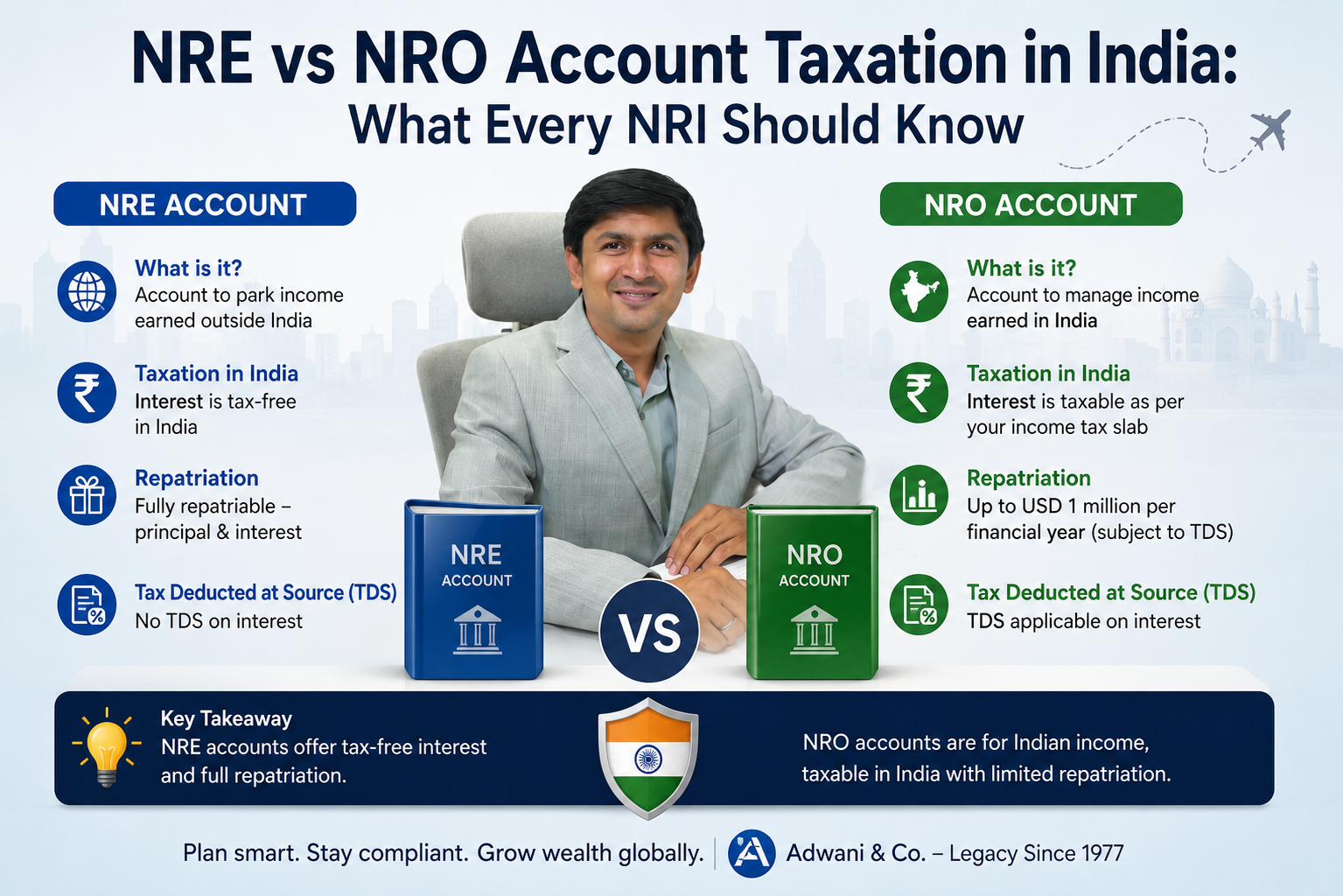
NRE (Non-Resident External) Account is a bank account maintained by an NRI to deposit income earned outside India.
Common examples include:
- Salary earned abroad
- Overseas business income
- Foreign investments
- Income received outside India
The funds are maintained in Indian Rupees and are generally fully repatriable.
What is an NRO Account?
An NRO (Non-Resident Ordinary) Account is used to manage income earned in India.
Examples include:
- Rental income from property in India
- Pension received in India
- Dividend income
- Interest income from Indian investments
- Other Indian-source income
Unlike an NRE account, an NRO account is intended for Indian income.
Is Interest on an NRE Account Taxable?
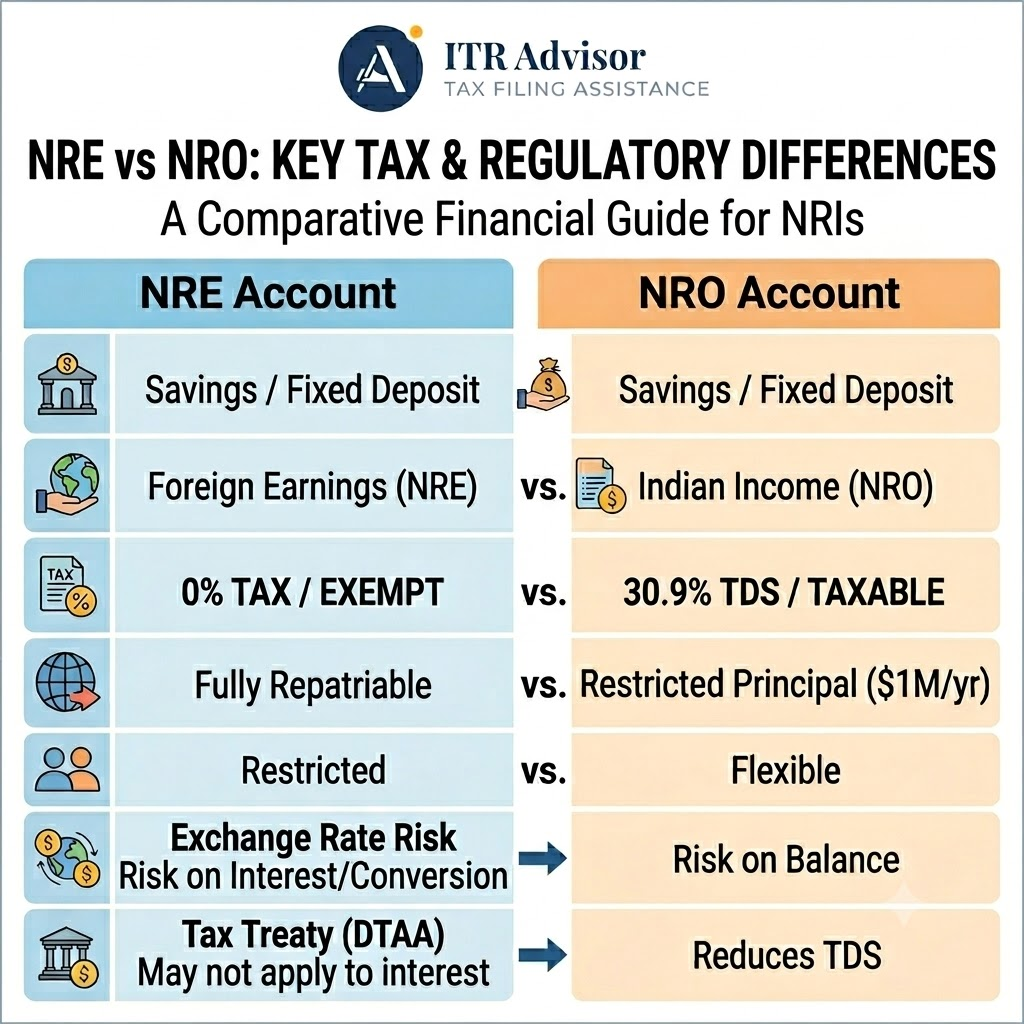
Generally, interest earned on an NRE account is exempt from tax in India if the account holder qualifies as a Non-Resident under the Income Tax Act.
This is one of the biggest tax benefits available to NRIs.
Example
Mr. Amit works in Dubai and maintains an NRE Fixed Deposit with an Indian bank.
During the financial year, he earns interest of ₹3,50,000 on the NRE Fixed Deposit.
Since Mr. Amit qualifies as a Non-Resident under Indian tax laws, the interest earned on the NRE deposit is generally exempt from tax in India.
In most cases, no tax is payable on such interest income in India.
Is Interest on an NRO Account Taxable?
Yes.
Interest earned on an NRO account is generally taxable in India.
The income must usually be reported in the Income Tax Return and is taxed according to the applicable tax slab rates.
Example
Mrs. Priya lives in Canada and owns a flat in Pune that generates rental income.
The rent is deposited into her NRO account.
During the year, the NRO account earns interest of ₹1,20,000.
Unlike NRE account interest, this ₹1,20,000 is generally taxable in India and must be disclosed in the Income Tax Return.
Why Do Banks Deduct TDS on NRO Interest?
Banks generally deduct Tax Deducted at Source (TDS) on NRO account interest because the interest is taxable in India.
Many NRIs are surprised to see substantial TDS deductions on NRO Fixed Deposits.
However, TDS deducted by the bank does not necessarily represent the final tax liability.
Depending on the taxpayer’s income and available deductions, a refund may be claimable through the Income Tax Return.
What Happens When You Return to India?
This is where many taxpayers make mistakes.
After returning to India, your residential status may change.
Once you cease to qualify as a Non Resident under the Income Tax Act, the tax treatment of NRE interest can change.
Many returning NRIs continue operating NRE accounts without reviewing the tax implications.
This can lead to reporting errors and future tax notices.
Real-Life Example: Returning NRI
Mr. Rohit worked in Singapore for 12 years and maintained multiple NRE Fixed Deposits.
In July 2025, he permanently returned to India.
Since he was focused on settling his family and business affairs, he continued operating his NRE deposits without reviewing his residential status.
During tax planning, it was discovered that his residential status had changed and the tax treatment of interest required careful evaluation.
After obtaining professional advice, his accounts and tax reporting were regularized correctly.
This prevented potential future disputes with the Income Tax Department.
Common Mistakes Made by NRIs
- Treating All NRE Interest as Permanently Tax-Free
The tax treatment depends on residential status.
- Ignoring NRO Interest Income
Many NRIs fail to disclose NRO interest in their Income Tax Return.
- Not Checking Form 26AS and AIS
Interest income reflected in AIS should be reconciled with the return.
- Continuing NRE Accounts After Returning to India
Returning Indians should review their banking arrangements and tax position.
- Not Claiming DTAA Benefits
In some situations, Double Taxation Avoidance Agreement (DTAA) provisions may help reduce overall tax burden.
Do NRIs Need to File an Income Tax Return?
An NRI may be required to file an Income Tax Return in India depending on:
- Total income
- Nature of income
- TDS deductions
- Capital gains transactions
- Refund claims
Each case should be evaluated individually.
Also Read our guide on :The 120 Day Rule That Is Silently Taxing Thousands of NRIs in India
Frequently Asked Questions (FAQs)
1.Is NRE FD interest taxable in India?
Generally, NRE FD interest is exempt in India while the account holder qualifies as a Non Resident under the Income Tax Act.
2.Is NRO FD interest taxable?
Yes. NRO interest is generally taxable in India.
3.Can I claim a refund of TDS deducted on NRO interest?
In appropriate cases, a refund may be available through filing an Income Tax Return
What happens to my NRE account after returning to India?
Returning Indians should review their residential status and banking arrangements to ensure proper compliance.
Can I hold both NRE and NRO accounts?
Yes. Many NRIs maintain both accounts for different purposes.
Why Professional Advice Matters
NRE and NRO taxation is closely linked to:
- Residential status
- DTAA provisions
- Foreign income reporting
- Returning NRI tax rules
- FEMA regulations
- Income Tax compliance
A small mistake can result in unnecessary taxes, notices, or reporting issues.
Final Thoughts
NRE vs NRO accounts serve different purposes and are taxed differently. While NRE interest may enjoy tax benefits for eligible NRIs, NRO interest is generally taxable and requires proper reporting.
As tax laws, residential status rules, and reporting obligations can become complex, especially for returning Indians, seeking professional advice before filing your Income Tax Return can help ensure compliance and peace of
About the Author:
Mukesh Chavan is a dedicated indirect taxation and compliance professional associated with Adwani & Co LLP, specializing in GST advisory, GST audits, GST assessments, and RERA compliance services. With extensive experience in handling complex regulatory matters, he assists businesses in ensuring compliance with evolving GST laws and real estate regulations while minimizing risks and enhancing operational efficiency.
Mukesh has successfully guided clients through GST registrations, return compliance, departmental assessments, audits, litigation support, and tax planning strategies. He also possesses significant expertise in RERA compliance, helping real estate developers, promoters, and stakeholders navigate regulatory requirements and maintain seamless project compliance.
Through his articles and professional insights, Mukesh aims to simplify complex GST and RERA provisions, offering practical guidance that empowers businesses to remain compliant, avoid disputes, and make informed decisions in an increasingly dynamic regulatory environment. His approach combines technical expertise with practical business understanding, enabling clients to focus on growth while meeting their statutory obligations with confidence.
Need Help with NRE/NRO Taxation?
Whether you are an NRI, OCI holder, overseas employee, or a returning Indian, understanding the tax implications of NRE and NRO accounts is critical.
At ITRAdvisor.in, we help NRIs and returning Indians with:
✔️ NRE and NRO taxation
✔️ Residential status determination
✔️ Returning NRI tax planning
✔️ DTAA advisory
✔️ Foreign asset reporting
✔️ NRI Income Tax Return filing
✔️ Tax notice handling
✔️ Capital gains and property taxation
If you are unsure whether your NRE interest is taxable, whether you need to file an ITR in India, or how to handle NRO income, professional guidance can help avoid costly mistakes.
Visit ITRAdvisor.in to schedule a consultation and get clarity on your NRI tax obligations.
Disclaimer: ITRAdvisor.in is an educational and informational platform focused on tax awareness and compliance updates. Nothing contained herein should be construed as solicitation or advertisement of professional services. Professional services, where applicable, are rendered in accordance with ICAI guidelines. This article is published on ITRAdvisor.in, a tax and compliance knowledge platform. The content has been reviewed for technical accuracy by professionals associated with Adwani & Co LLP.
Leave a Reply