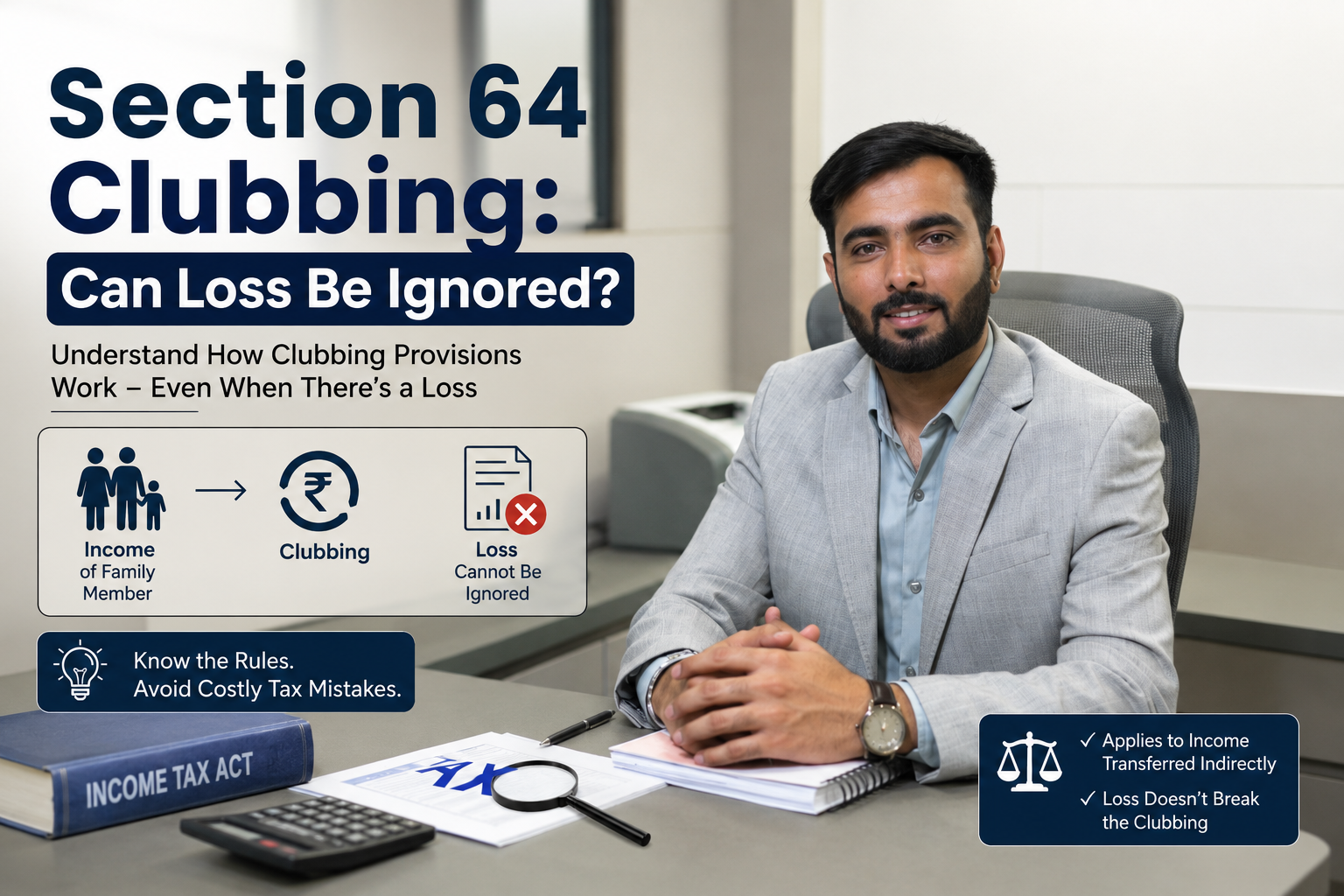
Section 64(1)(iv)
The Income Tax Department is quick to tax profits earned on money gifted within a family. But what happens when those same gifted funds end up in a loss instead of a gain? A recent ruling from the Income Tax Appellate Tribunal, Lucknow Bench, answers this question, and it matters to every household that moves money between spouses for investment.

What Is Clubbing of Income Under Section 64(1)(iv)?
Under Section 64(1)(iv) of the Income Tax Act, 1961, income arising from an asset transferred without adequate consideration to a spouse is added back to the income of the person who made the transfer. If a husband gifts money to his wife and she earns interest, dividends, or capital gains on it, that income is taxed in the husband’s hands, not hers. This clubbing of income rule exists to stop families from splitting income purely to reduce tax, and it is enforced consistently by the Income Tax Department during scrutiny of family investment transfers.
The Case: A Gift, an F&O Trade, and a Tax Dispute
In Vipin Yadav vs. ITO, a husband transferred funds to his wife as a gift. She used the money to trade in equity and futures and options, and the trades resulted in a loss. The taxpayer argued that since profits from gifted funds are taxable in the donor’s hands, losses from the same funds should logically be allowed in the donor’s hands too. The Assessing Officer disagreed, and the matter reached the ITAT.
ITAT’s View: Profit and Loss Cannot Be Treated Differently
The Tribunal examined a core question: can tax law follow the gain but disown the loss arising from the same source? The ITAT held that where income from a gifted asset is liable to be clubbed, a loss from that source cannot be ignored merely because it is a loss. The taxpayer, however, must establish a clear, documented link between the gifted funds and the loss claimed.
A Practical Example
Suppose a husband gifts ₹10 lakh to his wife, who trades it in F&O and incurs a loss of ₹1.5 lakh. Under this clubbing of income and loss principle, that loss may be considered in the husband’s hands rather than the wife’s, provided he can prove the funds traded were the gifted amount. The loss then follows the normal set-off and carry-forward rules for F&O losses.
Tax professionals, including Dr. Haresh Adwani, often note that clubbing disputes turn less on legal principle and more on documentation discipline, since the burden of proving the nexus between a gift and the resulting income or loss always rests with the taxpayer.
Key Takeaways on Clubbing of Losses Under Section 64(1)(iv)
At a Glance
- Clubbing under Section 64(1)(iv) is not a one-way street that only catches profits.
- Losses arising from gifted funds may also be clubbed in the donor’s hands, subject to proof.
- A clear trail of the gift deed, bank transfer, and trading statement is essential.
F&O losses, once clubbed, follow standard set-off and carry-forward rules.
Read our detailed guide on Urgent & Powerful Tax Saving Tips Before July 31 for AY 2026-27 : Don’t Miss the Deadline!
Frequently Asked Questions on Clubbing of Losses Under Section 64(1)(iv)
1.Can losses on money gifted to a spouse be clubbed under Section 64(1)(iv)?
Yes. Per the ITAT Lucknow ruling, if income from gifted funds is clubbable, losses from the same source may also be considered in the donor’s hands, subject to proof.
2.What evidence is needed to claim clubbing of a loss?
Taxpayers must show a clear link between the gifted funds and the loss, typically through a gift deed, bank records, and trading statements.
3.Does clubbing of income apply only to F&O and equity losses?
No. Section 64(1)(iv) covers income or loss from any asset gifted to a spouse without adequate consideration, not trading alone.
4.Can clubbed F&O losses still be set off against other income?
Yes, once clubbed, F&O losses follow the normal set-off and carry-forward provisions, including the eight-year carry-forward for non-speculative losses.3.
Conclusion
Clubbing of Losses Under Section 64(1)(iv)
This ruling is a reminder that clubbing of income provisions cut both ways. If gains from gifted funds are taxed in the donor’s hands, fairness and tribunal precedent now demand that losses from the same funds be treated consistently. The real lesson is record-keeping: gift deeds, bank trails, and trading statements can decide whether a clubbing claim succeeds or fails.
Author
CA. Dipesh Gurubakshani. He is a Chartered Accountant with professional experience in audit, direct taxation, and accounting advisory services.
Whether you have already received a credit card income tax notice or want to ensure you never do Adwani and Company is your trusted partner. Led by Dr. Haresh Adwani and a seasoned team of Chartered Accountants, Adwani and Company provides end-to-end income tax compliance, notice response, and financial planning services.
Disclaimer
ITRAdvisor.in is an educational and informational platform focused on tax awareness and compliance updates. Nothing contained herein should be construed as solicitation or advertisement of professional services. Professional services, where applicable, are rendered in accordance with ICAI guidelines. This article is published on ITRAdvisor.in, a tax and compliance knowledge platform.The content has been reviewed for technical accuracy by professionals associated with Adwani & Co LLP
| If you have gifted funds to your spouse for investment and are unsure how clubbing of income or loss provisions apply to you, connect with itradvisor.in today for expert guidance. |
Leave a Reply