Income Tax Notice
A tax notice arrived. But the biggest mistake happened before anyone even read it. The business owner saw the notice and immediately thought, “We have done something wrong.” The worry started before the actual matter was even understood.
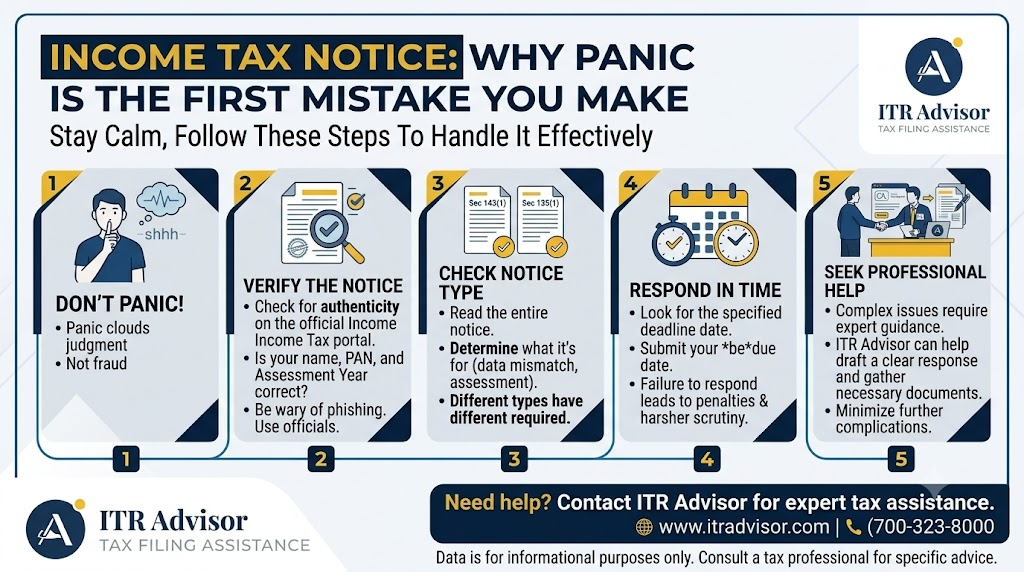
This reaction plays out again and again in scrutiny assessments and tax litigation matters. The moment an income tax notice lands in the inbox, fear takes over before facts do. People start imagining penalties, disputes, and consequences when in reality, an income tax notice is simply a communication from the department, seeking information, clarification, or verification about a specific matter.
What an Income Tax Notice Actually Means
An income tax notice is not a judgment. It is not proof of wrongdoing. As per the framework laid out by the Income Tax Department, notices are routinely issued to verify information already available with the department, request missing documents, or seek an explanation for a transaction that doesn’t immediately reconcile with reported income.
In most cases, the underlying issue is far less serious than the panic suggests. It could be:
- A missing document
- A delayed response to an earlier communication
- A difference in interpretation of a provision
- A transaction that simply needs more explanation
Common Reasons Behind an Income Tax Notice
Many income tax notices today are triggered by data mismatches rather than deliberate concealment a mismatch between AIS/Form 26AS and the return filed, high-value transactions flagged under Rule 114E, or a reassessment query under Section 148. With faceless assessment now driving much of the department’s scrutiny process, notices are increasingly system-generated, which makes an informed, timely reply even more important.
Read our detailed guide on Not Every Income Tax Reassessment Notice in India Is Valid : Know Your Legal Rights Before You Panic
The Right Way to Respond to an Income Tax Notice
The biggest mistake businesses make is treating an income tax notice as a problem before understanding the reason behind it. A calmer, more structured approach works far better.
1. Understand What Is Being Asked
Read the notice carefully to identify the exact section, assessment year, and query involved before reacting.
2. Review the Facts and Supporting Documents
Match the notice against your records, invoices, bank statements, and filed returns before drafting any reply.
3. Analyse the Applicable Provisions
Check which section of the Income Tax Act the notice falls under, since the response strategy differs for each.
4. Decide the Right Response : Don’t Rush It
Tax matters are rarely resolved through panic. They are resolved through clarity, documentation, and the right strategy submitted within the given timeline.
Dr. Haresh Adwani, PhD in Commerce and is a law graduate with decades of experience handling scrutiny assessments and tax litigation, often notes that many tax issues become complicated not because of the original matter, but because of delayed action and incorrect assumptions. An income tax notice is not the end of the road it is a situation that needs careful evaluation.
Key Takeaway
An income tax notice is a request for information, not a penalty.
Most notices stem from missing documents, mismatches, or interpretation gaps.
Understand, review, analyse, then respond never react out of fear. Delayed or incorrect responses cause more damage than the original notice.
Frequently Asked Questions
1.What should I do first after receiving an income tax notice?
Read it carefully to identify the section and query, then gather the relevant documents before replying.
2.Does an income tax notice always mean a penalty is coming?
No. Most notices seek clarification or verification and do not automatically imply a penalty.
3.What is the usual time limit to reply to an income tax notice?
Time limits vary by section and are mentioned in the notice itself; missing them can lead to avoidable complications.
4.Can a minor income tax notice be ignored?
No notice should be ignored, even a minor one, since unanswered notices can escalate into larger compliance issues.
Final Word on Handling an Income Tax Notice
An income tax notice is a moment that calls for clarity, not panic. Understanding the query, checking your documents, and responding within the given provisions turns a stressful moment into a manageable compliance step.
Author
Dr. Haresh Adwani
PhD (Commerce) · Adwani & Company, Pune
Dr. Haresh Adwani is a PhD holder in Commerce with over 20 years of experience in NRI taxation, FEMA compliance, international financial advisory, and tax notice resolution. He is one of Pune’s most trusted NRI tax advisors, specialising in residential status assessment, DTAA planning, and cross-border compliance for professionals returning from the US, UK, UAE, Canada, and Australia.
Disclaimer
ITRAdvisor.in is an educational and informational platform focused on tax awareness and compliance updates. Nothing contained herein should be construed as solicitation or advertisement of professional services. Professional services, where applicable, are rendered in accordance with ICAI guidelines. This article is published on ITRAdvisor.in, a tax and compliance knowledge platform. The content has been reviewed for technical accuracy by professionals associated with Adwani & Co LLP.
Leave a Reply