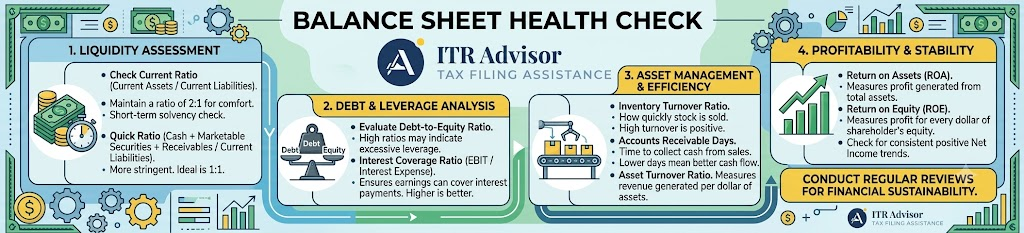
Every year, profitable businesses quietly slide into financial stress not because sales dried up, but because nobody read the balance sheet as anything more than a compliance formality. If your only question this tax season is “how much profit did we make?”, you’re missing the real story your business is trying to tell you.
Tax season is here. Accountants and finance teams are finalising books, reconciling GST and TDS, and preparing balance sheets for filing. But a genuine balance sheet health check asks a bigger question than compliance: are you using this exercise to understand your business’s financial health, or just to satisfy the Income Tax Department?
Why a Balance Sheet Health Check Matters More Than the Profit Number
A company can report a healthy profit and still face real financial stress. Revenue may be growing, but customers may be paying late. Profits may look impressive on paper, while actual cash flow stays weak. Sales may have increased, yet inventory may be quietly consuming working capital, and borrowings may be rising faster than the business itself.
This is exactly why a disciplined balance sheet health check matters: it exposes the gap between reported profit and the underlying financial strength of the business a gap the profit and loss statement alone will never show you.
Five Questions Every Balance Sheet Health Check Should Answer
Where is the cash actually sitting, and how much of it is genuinely available?
How much money is stuck with customers as overdue receivables?
How efficiently is working capital being used to generate revenue?
Are borrowings funding growth, or are they quietly funding inefficiency?
Is the business financially stronger today than it was 12 months ago?
These questions turn a routine balance sheet health check from a year-end formality into an early-warning system one that flags problems while they are still fixable, not after they’ve become a cash crunch.
Example:
Profit-Rich, Cash-Poor A manufacturing business showed 18% profit growth for the year, yet struggled to pay statutory dues on time. A closer balance sheet health check revealed receivables had ballooned by 40%, and short-term borrowings were funding the gap a classic profit-rich, cash-poor pattern that the P&L never revealed.
GST, TDS, and Statutory Mismatches Hiding in Plain Sight
A balance sheet health check should also cover statutory exposure, not just financial ratios. GST input tax credit mismatches, delayed TDS deposits, or unreconciled AIS and Form 26AS entries quietly build future liability even while a business looks compliant on the surface. Regular reconciliation, in line with the framework maintained on the GST portal and reporting norms under the Ministry of Corporate Affairs, is what keeps books and balance sheets genuinely accurate.
Turning the Balance Sheet Into a Leadership Dashboard
Don’t treat the balance sheet as a document prepared once a year for auditors, bankers, or the Income Tax Department. Treat it as a leadership dashboard. Profit tells you how the business performed. A proper balance sheet health check tells you what the business has actually become its liquidity, its debt discipline, and its true staying power.
This is a distinction Dr. Haresh Adwani, founder of Adwani & Co LLP and a PhD in Commerce with a law background, has long emphasised with business owners: compliance and financial health are related, but they are not the same exercise, and confusing the two is where most businesses first go wrong.
A balance sheet health check is not an annual formality it is a leadership tool. Track cash position, receivables ageing, working capital efficiency, and borrowing trends alongside profit, and use every tax season as a checkpoint for your business’s true financial health, not just its statutory compliance.
Balance Sheet Health Check: Frequently Asked Questions
1.What is a balance sheet health check for a business?
It is a structured review of assets, liabilities, receivables, and borrowings to assess real financial strength, not just profitability.
2.Can a profitable business still face financial stress?
Yes. Strong profit can mask weak cash flow, rising receivables, or growing debt all visible only through a balance sheet health check.
3.What is the difference between cash flow and profit?
Profit is an accounting figure; cash flow is the actual money available. A business can be profitable yet cash-starved.
4.How often should business owners review their balance sheet?
Ideally quarterly, not just at year end frequent reviews catch working capital or borrowing issues while they’re still manageable.
5.Does GST or TDS mismatch affect balance sheet health?
Yes. Unreconciled GST credits or delayed TDS deposits create hidden liabilities that a balance sheet health check should always flag.
Conclusion: Make Your Balance Sheet Work for You
This tax season, don’t stop at reconciling ledgers and filing returns. Run a genuine balance sheet health check — one that weighs cash, receivables, working capital, and borrowings as seriously as profit. Business owners, what is one number you review regularly to understand your business’s health?
About the Author:
Mukesh Chavan is a dedicated indirect taxation and compliance professional associated with Adwani & Co LLP, specializing in GST advisory, GST audits, GST assessments, and RERA compliance services. With extensive experience in handling complex regulatory matters, he assists businesses in ensuring compliance with evolving GST laws and real estate regulations while minimizing risks and enhancing operational efficiency.
Mukesh has successfully guided clients through GST registrations, return compliance, departmental assessments, audits, litigation support, and tax planning strategies. He also possesses significant expertise in RERA compliance, helping real estate developers, promoters, and stakeholders navigate regulatory requirements and maintain seamless project compliance.
Through his articles and professional insights, Mukesh aims to simplify complex GST and RERA provisions, offering practical guidance that empowers businesses to remain compliant, avoid disputes, and make informed decisions in an increasingly dynamic regulatory environment. His approach combines technical expertise with practical business understanding, enabling clients to focus on growth while meeting their statutory obligations with confidence.
Not Sure If Your Return Is Clean? If you’re unsure whether your return has been reported correctly, a quick review today can help avoid a much bigger problem later. If you want expert guidance, connect with itradvisor.in today.
Need Help Before You File? If you’re a salaried professional, business owner, freelancer, or NRI and want to ensure your ITR matches your AIS and Form 26AS before submission — ITRAdvisor.in is where to start. Visit itradvisor.in for expert tax guidance, AIS reconciliation checklists, and professional support backed by Adwani & Co LLP.
Disclaimer:
ITRAdvisor.in is an educational and informational platform focused on tax awareness and compliance updates. Nothing contained herein should be construed as solicitation or advertisement of professional services. Professional services, where applicable, are rendered in accordance with ICAI guidelines. This article is published on ITRAdvisor.in, a tax and compliance knowledge platform.
The content has been reviewed for technical accuracy by professionals associated with Adwani & Co LLP.
The Income Tax Department is quick to tax profits earned on money gifted within a family. But what happens when those same gifted funds end up in a loss instead of a gain? A recent ruling from the Income Tax Appellate Tribunal, Lucknow Bench, answers this question, and it matters to every household that moves money between spouses for investment.
What Is Clubbing of Income Under Section 64(1)(iv)?
Under Section 64(1)(iv) of the Income Tax Act, 1961, income arising from an asset transferred without adequate consideration to a spouse is added back to the income of the person who made the transfer. If a husband gifts money to his wife and she earns interest, dividends, or capital gains on it, that income is taxed in the husband’s hands, not hers. This clubbing of income rule exists to stop families from splitting income purely to reduce tax, and it is enforced consistently by the Income Tax Department during scrutiny of family investment transfers.
The Case: A Gift, an F&O Trade, and a Tax Dispute
In Vipin Yadav vs. ITO, a husband transferred funds to his wife as a gift. She used the money to trade in equity and futures and options, and the trades resulted in a loss. The taxpayer argued that since profits from gifted funds are taxable in the donor’s hands, losses from the same funds should logically be allowed in the donor’s hands too. The Assessing Officer disagreed, and the matter reached the ITAT.
ITAT’s View: Profit and Loss Cannot Be Treated Differently
The Tribunal examined a core question: can tax law follow the gain but disown the loss arising from the same source? The ITAT held that where income from a gifted asset is liable to be clubbed, a loss from that source cannot be ignored merely because it is a loss. The taxpayer, however, must establish a clear, documented link between the gifted funds and the loss claimed.
A Practical Example
Suppose a husband gifts ₹10 lakh to his wife, who trades it in F&O and incurs a loss of ₹1.5 lakh. Under this clubbing of income and loss principle, that loss may be considered in the husband’s hands rather than the wife’s, provided he can prove the funds traded were the gifted amount. The loss then follows the normal set-off and carry-forward rules for F&O losses.
Tax professionals, including Dr. Haresh Adwani, often note that clubbing disputes turn less on legal principle and more on documentation discipline, since the burden of proving the nexus between a gift and the resulting income or loss always rests with the taxpayer.
Key Takeaways onClubbing of Losses Under Section 64(1)(iv)
At a Glance
Clubbing under Section 64(1)(iv) is not a one-way street that only catches profits.
Losses arising from gifted funds may also be clubbed in the donor’s hands, subject to proof.
A clear trail of the gift deed, bank transfer, and trading statement is essential.
F&O losses, once clubbed, follow standard set-off and carry-forward rules.
Frequently Asked Questions on Clubbing of Losses Under Section 64(1)(iv)
1.Can losses on money gifted to a spouse be clubbed under Section 64(1)(iv)?
Yes. Per the ITAT Lucknow ruling, if income from gifted funds is clubbable, losses from the same source may also be considered in the donor’s hands, subject to proof.
2.What evidence is needed to claim clubbing of a loss?
Taxpayers must show a clear link between the gifted funds and the loss, typically through a gift deed, bank records, and trading statements.
3.Does clubbing of income apply only to F&O and equity losses?
No. Section 64(1)(iv) covers income or loss from any asset gifted to a spouse without adequate consideration, not trading alone.
4.Can clubbed F&O losses still be set off against other income?
Yes, once clubbed, F&O losses follow the normal set-off and carry-forward provisions, including the eight-year carry-forward for non-speculative losses.3.
Conclusion
Clubbing of Losses Under Section 64(1)(iv)
This ruling is a reminder that clubbing of income provisions cut both ways. If gains from gifted funds are taxed in the donor’s hands, fairness and tribunal precedent now demand that losses from the same funds be treated consistently. The real lesson is record-keeping: gift deeds, bank trails, and trading statements can decide whether a clubbing claim succeeds or fails.
Author
CA. Dipesh Gurubakshani. He is a Chartered Accountant with professional experience in audit, direct taxation, and accounting advisory services.
Whether you have already received a credit card income tax notice or want to ensure you never do Adwani and Company is your trusted partner. Led by Dr. Haresh Adwani and a seasoned team of Chartered Accountants, Adwani and Company provides end-to-end income tax compliance, notice response, and financial planning services.
Disclaimer
ITRAdvisor.in is an educational and informational platform focused on tax awareness and compliance updates. Nothing contained herein should be construed as solicitation or advertisement of professional services. Professional services, where applicable, are rendered in accordance with ICAI guidelines. This article is published on ITRAdvisor.in, a tax and compliance knowledge platform.The content has been reviewed for technical accuracy by professionals associated with Adwani & Co LLP
If you have gifted funds to your spouse for investment and are unsure how clubbing of income or loss provisions apply to you, connect with itradvisor.in today for expert guidance.
When the Income Tax Department Knocks Without Warning
Imagine it is early morning. You hear a firm knock at your door, and a group of officials identifies themselves as officers from the Income Tax Department. They carry a warrant. They are here to search your premises under Section 132 of the Income Tax Act. Your heart races. You do not know what to say, what to hand over, or what rights you have.
This scenario commonly called an income tax raid is one of the most stressful financial events a taxpayer can face. Yet, for thousands of individuals and businesses across India, it is a very real possibility. The Income Tax Department’s Investigation Wing has intensified search and seizure operations in recent years, leveraging advanced data analytics, the Annual Information Statement (AIS), and cross-referencing between GST returns and ITR filings to identify discrepancies worth pursuing.
Here is the critical point: an income tax search and seizure operation does not automatically mean you are guilty of anything. It means the department has reason to believe that undisclosed income or assets may exist on your premises. You have legal rights, procedural safeguards protect you, and expert representation can make an enormous difference to the outcome.
This comprehensive guide prepared by the expert team at Adwani and Company, led byDr. Haresh Adwani, PhD in Commerce and law graduate walks you through the complete income tax search and seizure process: what triggers it, what officers can and cannot do, what your rights are, how penalties work, and most importantly, how to protect yourself before one ever happens.
What Is Income Tax Search and Seizure Under Section 132?
The income tax search and seizure power flows directly from Section 132 of the Income Tax Act, 1961. It is one of the most significant and most feared enforcement tools available to the Income Tax Department.
Legally speaking, Income Tax search and seizure operation allows authorized Income Tax officers to enter and inspect any premises residential, commercial, or otherwise seize books of accounts, documents, cash, jewellery, and other valuables believed to represent undisclosed income, and record statements from persons present at the scene.
The Income Tax Department’s official position, as reflected in its operational guidelines, is clear: search and seizure is a measure of last resort, reserved for situations where normal assessment channels cannot adequately unearth concealed income.
Search vs. Survey : An Important Distinction
Many taxpayers confuse a search with a survey. They are legally distinct operations with very different powers.
A survey under Section 133A is comparatively mild. It can only be conducted at business premises during normal working hours. Officers can inspect books of account and records but cannot seize assets during a survey.
An Income tax search and seizure is far more intrusive. It can happen at any hour, at any premises home, office, bank locker, or any other location. Officers can seize physical assets including cash, gold, jewellery, and digital records. Statements recorded during a search carry evidentiary value in subsequent assessment proceedings.
Understanding this distinction matters deeply because the two operations require different responses, and the consequences of each are fundamentally different.
What Triggers an Income Tax Search and Seizure?
The Income Tax Department does not conduct searches randomly. Before any search warrant is issued under Section 132, the authorized officer must have documented “reason to believe” a legal standard that requires credible, concrete information rather than mere suspicion.
Common triggers that lead to an income tax search and seizure include:
1. Credible Intelligence Reports
The department’s Investigation Wing collects intelligence from multiple sources informants, government data systems, financial intelligence units about individuals or businesses holding substantial undisclosed income or assets.
2. Significant Mismatch in Financial Data
India’s tax infrastructure now cross-references GST returns, ITR data, AIS (Annual Information Statement), banking transactions, property registrations, and foreign remittances. A business declaring ₹40 lakh turnover while showing GST credits for ₹1.8 crore worth of input purchases is an obvious red flag.
3. Lavish Expenditure Inconsistent With Declared Income
High-value wedding expenditure, luxury real estate purchases, or acquisition of expensive vehicles that are not commensurate with declared income routinely trigger investigation wing activity.
4. Tip-Offs From Associated Parties
Former employees, business partners, or related parties sometimes provide information to the Income Tax Department. Such information, when independently verified, can form the basis of a search warrant.
5. Duplicate Books or Manipulated Accounts
Evidence of double accounting maintaining one set of books for tax purposes and another for actual business is a direct trigger for an income tax search and seizure under Section 132.
As Dr. Haresh Adwani explains: “The vast majority of search operations today are data-driven. With AIS, GSTN data, and property registry data all feeding into one analytical system, discrepancies that once went unnoticed for years now surface within months. Clean books are your best protection.”
The Step-by-Step Income Tax Search and Seizure Process
Understanding exactly what happens during an income tax search helps you respond calmly, correctly, and in a legally sound manner.
Step 1 : Authorization and Warrant
No search can begin without a valid written warrant of authorization issued by a senior authority typically the Principal Director General, Director General, Principal Commissioner, or Commissioner of Income Tax. This authorization must be based on documented reasons that meet the legal standard of “reason to believe.”
The Supreme Court of India, in landmark decisions including Pooran Mal v. Director of Inspection [1974] 93 ITR 505, upheld the constitutional validity of Section 132, holding that search powers directed at persons who have evaded tax on solid grounds are a reasonable restriction on fundamental rights.
Step 2 : Arrival at Premises and Identification
Officers must identify themselves and present the search warrant. You have the right to examine this warrant carefully. The search team must be accompanied by at least two independent local witnesses (panchas).
Step 3 : The Search Operation
During the search, officers may:
1.Enter and inspect every room, locker, safe, cupboard, or storage area
2. Break open any locked containers if keys are not provided
3. Examine all books of account, ledgers, digital files, and correspondence
4. Seize cash, jewelry, documents, electronic devices, and any other valuables believed to represent undisclosed income
5.Record statements from persons present
The entire process is documented through a formal
Panchnamaa contemporaneous record of proceedings that lists every item seized, every statement recorded, and all actions taken. A copy of the Panchnama must be provided to you at the conclusion of the search.
Step 4 : Post-Search Assessment
An income tax search and seizure triggers a special assessment process under Section 153A of the Income Tax Act. The Assessing Officer will issue notices requiring you to file returns for the current year plus the preceding six assessment years or up to ten years in cases involving serious undisclosed foreign assets or assets exceeding a prescribed threshold.
This is where the financial impact of a search operation becomes concrete. Every year in the six-year window can be reopened, reassessed, and subjected to additions, penalties, and interest.
Tax Rates and Penalties After an Income Tax Search
This is the section that taxpayers fear most and rightfully so. The tax treatment of undisclosed income discovered during a search is significantly harsher than regular income.
Section 115BBE: Flat Tax on Unexplained Income
Any income discovered during a search that cannot be explained — undisclosed cash, unexplained jewellery, unaccounted business receipts is taxed at a flat rate of 60% under Section 115BBE. With applicable surcharge and cess, the effective tax rate rises to approximately 77% to 83%. No deductions or exemptions are available against this income.
Section 271AAC: Additional Penalty
A penalty of 10% of the tax payable under Section 115BBE is levied under Section 271AAC, in addition to the tax already assessed.
Section 276C: Prosecution
Where willful tax evasion is established and the evaded amount exceeds ₹25 lakh, prosecution proceedings under Section 276C can be initiated. Conviction can lead to imprisonment of six months to seven years along with fines.
Practical Example:
Mr. Arvind Mehta runs a retail business in Mumbai. During an income tax search and seizure operation, officers discover ₹45 lakh in unaccounted cash kept in a safe, along with records of off-book sales totaling ₹1.2 crore over four years. Here is how his exposure is computed:
Item Amount
Undisclosed cash seized ₹45,00,000
Undisclosed income from books ₹1,20,00,000
Total Undisclosed Income ₹1,65,00,000
Tax @ 60% under Section 115BBE ₹99,00,000
Surcharge + Cess (approx.) ₹18,00,000
Penalty under Section 271AAC (10%) ₹9,90,000
Total Liability ₹1,26,90,000**
In other words, Mr. Mehta faces a liability of approximately ₹1.27 crore on undisclosed income of ₹1.65 crore effectively losing over 77% of the undisclosed amount to taxes and penalties, without accounting for interest under Section 234A or potential prosecution proceedings.
This example illustrates precisely why proactive compliance declaring all income, reconciling books correctly, and filing accurate ITRs is infinitely less costly than facing an income tax search and seizure
Your Legal Rights During an Income Tax Search and Seizur
Here is what most taxpayers do not know
you have significant legal rights during a search operation. Exercising them correctly, without obstruction, can materially affect the outcome of the subsequent assessment
1.Verify the Warrant
You have the right to examine the search warrant and verify the identity of every officer present. Ask to see identity cards. Note the warrant number and the name of the authorizing officer.
2.Call Your Chartered Accountant or Legal Advisor
You have the right to inform your CA or legal advisor about the search. At Adwani and Company, Dr. Haresh Adwani and the team are available to advise clients through search operations, helping them respond to statements and requests in a legally sound manner.
3.Receive a Copy of the Panchnama
At the conclusion of the search, officers must provide you with a signed copy of the Panchnama, listing every item seized and every statement recorded. Retain this document carefully it forms the foundation of your entire post-search legal strategy.
4.Retract Statements Made Under Coercion
Statements recorded during a search carry evidentiary weight. However, the law provides that statements extracted under coercion or undue influence can be retracted within a reasonable time. If you believe a statement was recorded under pressure, consult a qualified tax expert immediately.
5.Object to Retention Beyond 180 Days
The Income Tax Department cannot retain seized books of account or documents for more than 180 days without a valid extension order. If retention is extended, you have the right to make a formal application objecting to the extension.
6. Seek Judicial Review
If you believe the search was conducted without valid authorization, without meeting the legal standard of “reason to believe,” or with procedural lapses, you have the right to challenge the search in the appropriate High Court. Courts have the power to quash unlawful searches, and a significant percentage of additions made during search assessments are reversed in appeals on evidentiary grounds.
How to Prevent an Income Tax Search and Seizure
The most effective legal strategy is one that ensures a search never happens in the first place. The Income Tax Department’s own advisories consistently emphasize that voluntary, accurate, and timely compliance is the clearest protection against enforcement action.
Here are the key preventive practices recommended by Adwani and Company:
1. File accurate ITRs every year: Ensure all sources of income, including interest, dividends, capital gains, freelance income, and rental income, are properly declared.
2. Reconcile GST and ITR data: Your GST turnover and your ITR income must be consistent. Large, unexplained gaps are automatic red flags in the department’s analytical systems.
3. Maintain proper books of account: Preserve vouchers, invoices, bank statements, and supporting documents for at least seven years.
4. Explain large cash transactions: Any cash deposits above ₹10 lakh or large withdrawals should have documented explanations. The Annual Information Statement (AIS) on incometax.gov.in shows exactly what data the department has about your financial transactions.
5. Declare all assets in the ITR: The ITR Schedule AL (Assets and Liabilities) is compulsory for taxpayers with income above ₹50 lakh. Correct disclosure here is critical.
6. Respond promptly to notices: An ignored income tax notice escalates. A prompt, documented response demonstrates good faith and prevents matters from reaching search stage. *[Learn more about our Tax Compliance and Risk Management Services]*
Frequently Asked Questions
Q1. What is the difference between an income tax search and an income tax survey?
A search under Section 132 can be conducted at any time, at any premises, and includes the power to seize assets. A survey under Section 133A is conducted at business premises during business hours and does not include the power to seize assets.
Q2. Can income tax officers arrest me during a search and seizure?
No. Unlike customs, excise, or enforcement directorate operations, income tax officers do not have the power of arrest during a search and seizure operation. No person can be detained or arrested solely on the basis of an income tax search under Section 132.
Q3. What tax rate applies to undisclosed income found during a search?
Unexplained income discovered during an income tax search is taxed at a flat rate of 60% under Section 115BBE, plus surcharge and cess — bringing the effective rate to approximately 77% to 83%. No deductions or exemptions apply.
Q4. How many years can be reassessed after an income tax search?
The Income Tax Department can reopen and reassess the current assessment year plus the preceding six years — a total of seven years. In cases involving significant undisclosed foreign assets or income above a prescribed threshold, the window can extend to ten years
05.How can Adwani and Company help if I receive a post-search assessment notice
Adwani and Company, under the leadership of Dr. Haresh Adwani, provides end-to-end support for taxpayers facing post-search assessments — from reviewing the Panchnama and preparing explanations for seized items, to representing clients at assessment hearings, Commissioner of Income Tax (Appeals), and the Income Tax Appellate Tribunal (ITAT).
Conclusion
An income tax search and seizure is a powerful legal tool but it is not beyond challenge, and facing one does not mean the end of the road. The Income Tax Act provides significant procedural safeguards precisely because the legislature recognized that such a drastic power must be exercised responsibly.
What determines the outcome of a search and its aftermath is not just what happens during the search itself, but the quality of your documentation, the accuracy of your prior filings, and the expertise of the professionals who represent you in the months that follow.
“Compliance is not just about paying taxes. It is about building a financial record so clean, so consistent, and so well-documented that an income tax search would yield nothing because there is nothing to find. That is the standard every taxpayer should aspire to.”
If you are facing an income tax search, have received a post-search assessment notice, or simply want to ensure your tax affairs are structured to minimize enforcement risk connect with Adwani and Company today.
Our team, brings together decades of experience in income tax representation, search assessment defense, ITAT appeals, and proactive tax risk management. Whether you are an individual, a family business, or a growing company, we ensure you face the Income Tax Department from a position of strength, compliance, and confidence.
Author
Pavan Adwani – Corporate Advisory, Tax Compliance & Regulatory Management.He is actively involved in advising business entities on corporate compliance, tax management, and regulatory frameworks, with a structured and process-oriented approach.
Disclaimer
ITRAdvisor.in is an educational and informational platform focused on tax awareness and compliance updates. Nothing contained herein should be construed as solicitation or advertisement of professional services. Professional services, where applicable, are rendered in accordance with ICAI guidelines. This article is published on ITRAdvisor.in, a tax and compliance knowledge platform. The content has been reviewed for technical accuracy by professionals associated with Adwani & Co LLP.
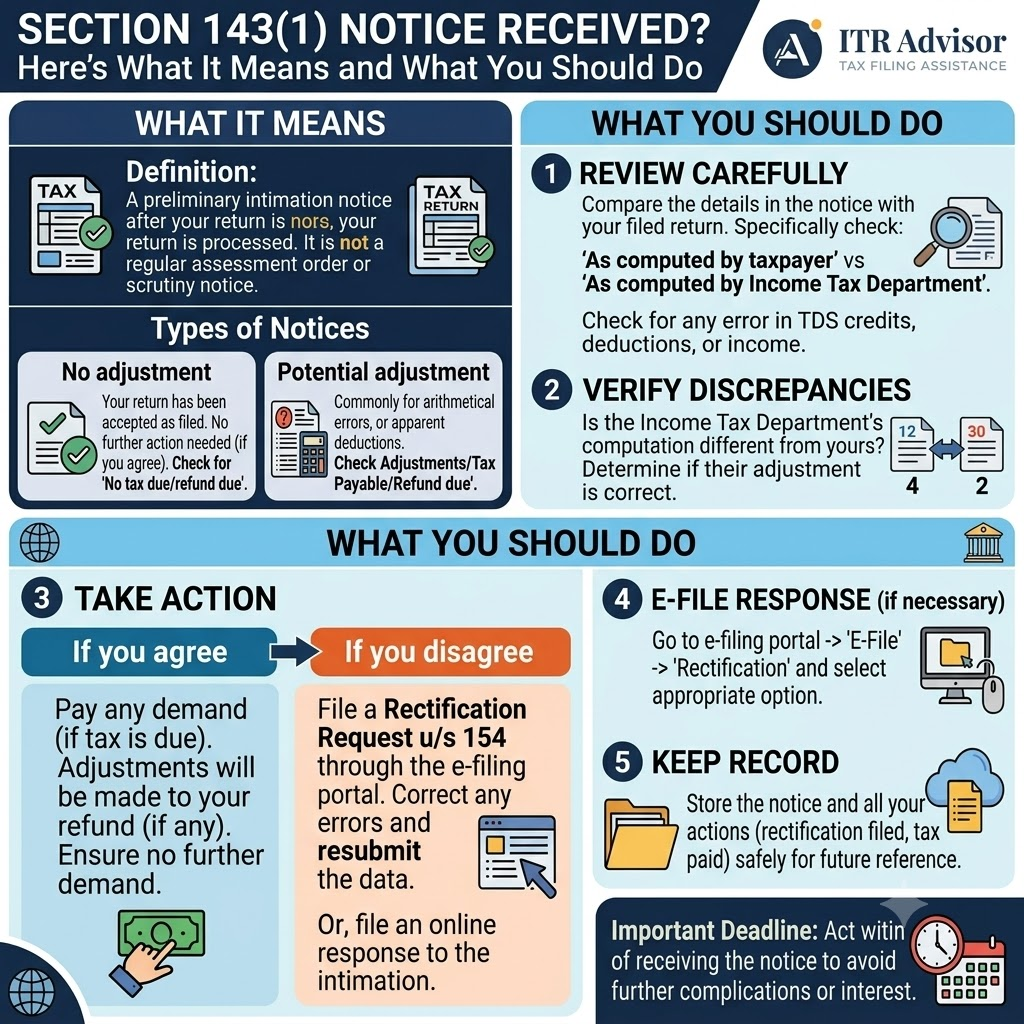
Receiving an Income Tax Notice can be stressful, especially when you see “Section 143(1)” mentioned in the communication from the Income Tax Department. Many taxpayers panic, assuming they are under scrutiny or facing a tax investigation.
The good news is that a Section 143(1) Notice is usually not a tax raid, assessment, or investigation. In most cases, it is simply an intimation sent after the Income Tax Department processes your Income Tax Return (ITR).
In this article, we explain what a Section 143(1) Notice means, why you received it, and what actions you should take.
What is a Section 143(1) Notice?
A Section 143(1) Notice, commonly known as an Intimation under Section 143(1), is issued after the Income Tax Department processes your Income Tax Return.
The department compares:
Income reported in your ITR
Information available in Form 26AS
Annual Information Statement (AIS)
Tax Deducted at Source (TDS) records
Other financial information available with the department
After processing, the department may:
Accept your return as filed
Determine additional tax payable
Grant a refund
Adjust the refund against existing tax demand
The result is communicated through an Intimation under Section 143(1).
Is Section 143(1) Notice a Serious Notice?
In most cases, .
NO
A Section 143(1) Notice is generally a routine communication and does not necessarily indicate any wrongdoing.
However, taxpayers should carefully review the notice because it may contain:
Tax demand
Reduction in refund
Disallowance of deductions
Mismatch in income reporting
Ignoring the notice can create future complication
Why Did I Receive a Section 143(1) Notice?
Some common reasons include:
Mismatch in TDS
The TDS claimed in your ITR may not match the TDS reported by deductors.
Interest Income Not Reported
Banks report FD interest to the Income Tax Department.
If the interest reflected in AIS is not reported in the ITR, the department may make adjustments.
Incorrect Deduction Claims
Deductions claimed under sections such as:
80C
80D
80G
may be disallowed if discrepancies are identified.
Mathematical Errors
Simple calculation mistakes can also result in adjustments during processing.
Income Mismatch with AIS
The department increasingly relies on AIS data.
Differences between AIS and the ITR can trigger adjustments under Section 143(1).
Types of Intimations Under Section 143(1)
Return Accepted
The department accepts the return without any changes.
No further action is generally required.
Refund Determined
The department confirms that a refund is due and initiates the refund process.
Tax Demand Raised
The department determines that additional tax is payable.
Taxpayers should verify the reasons before making payment.
How to Check Section 143(1) Notice Online
You can check the notice by logging into the Income Tax e-Filing Portal.
Steps:
Login to your account.
Go to “e-Proceedings” or “View Filed Returns.”
Download the Intimation under Section 143(1).
Review the comparison between the filed return and processed return.
What Should You Do After Receiving a Section 143(1) Notice?
Step 1: Read the Notice Carefully
Identify whether:
No demand exists
Refund is granted
Additional tax demand is raised
Step 2: Compare with Your ITR
Review:
Form 26AS
AIS
Form 16
Bank interest records
Capital gains statements
Step 3: Verify the Adjustment
Determine whether the department’s adjustment is correct.
Step 4: Respond Appropriately
If you agree with the demand:
Pay the tax
Update records
If you disagree:
File a rectification request under Section 154 if applicable
Seek professional advice
Can You Ignore a Section 143(1) Notice?
Ignoring the notice is not advisable.
Failure to address a valid demand may result in:
Interest liability
Future refund adjustments
Recovery proceedings in certain cases
Always review and understand the notice before deciding on the next step.
Section 143(1) Notice vs Section 143(2) Notice
Many taxpayers confuse these notices.
Section 143(1)
Automated processing
Routine communication
No detailed scrutiny
Section 143(2)
Scrutiny assessment
Detailed examination of income and deductions
Additional documents may be requested
A Section 143(2) notice is generally more significant than a Section 143(1) intimation.
No. It is generally an intimation issued after processing the return.
2.Can I receive a refund after a Section 143(1) Notice?
Yes. Many taxpayers receive refunds through the Section 143(1) intimation process.
3.What if the demand raised is incorrect?
You should review the notice and consider filing a rectification request if the adjustment is incorrect.
4.How long does it take to receive a Section 143(1) Intimation?
The timeline varies depending on return processing by the Income Tax Department.
Conclusion
Receiving a Section 143(1) Notice is common and should not automatically cause concern. However, taxpayers should carefully review the notice to ensure that income, deductions, TDS credits, and other information have been correctly considered.
If you have received a Section 143(1) Notice and are unsure how to interpret the tax demand, refund adjustment, or income mismatch, professional guidance can help avoid future disputes and unnecessary tax liabilities.
About the Author Dr. Haresh Adwani Ph.D. in Commerce | Law Graduate | Managing Partner, Adwani & Co LLP Dr. Haresh Adwani holds a Ph.D. in Commerce and is a qualified Law graduate with over two decades of hands-on experience in GST advisory, direct taxation, and statutory compliance for businesses across
Disclaimer: ITRAdvisor.in is an educational and informational platform focused on tax awareness and compliance updates. Nothing contained herein should be construed as solicitation or advertisement of professional services. Professional services, where applicable, are rendered in accordance with ICAI guidelines. This article is published on ITRAdvisor.in, a tax and compliance knowledge platform. The content has been reviewed for technical accuracy by professionals associated with Adwani & Co LLP.
AIS Shows More Income Than Your ITR? Don’t Ignore It
Have you checked your Annual Information Statement (AIS) before filing your Income Tax Return (ITR)?
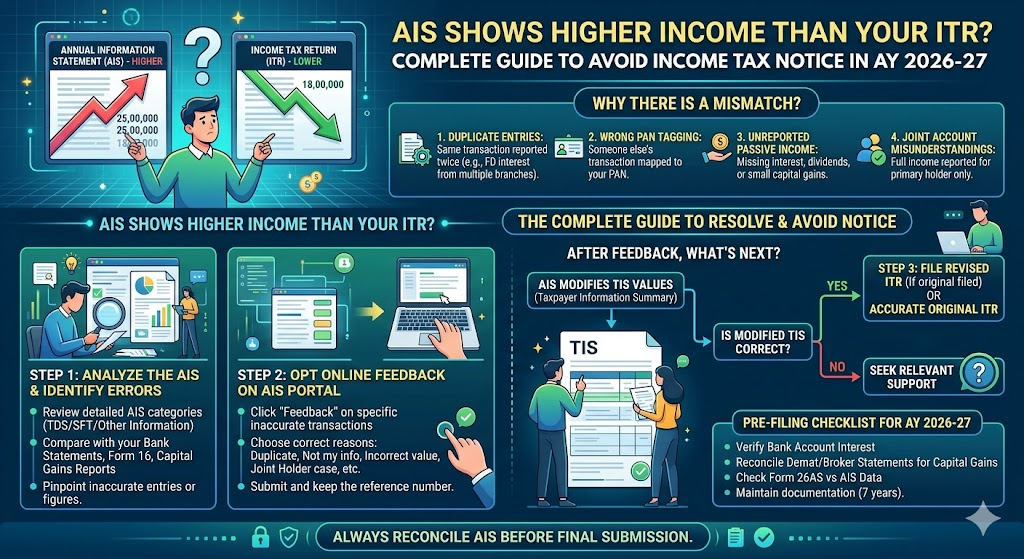
Many taxpayers receive Income Tax notices because the income reported in their ITR does not match the information available with the Income Tax Department through AIS.
If your AIS shows higher income than what you have reported in your ITR, it could trigger scrutiny, notices, or demands from the Income Tax Department.
In this guide, we explain what AIS is, common AIS mismatches, how to correct errors, and what steps you should take before filing your ITR for AY 2026-27.
What is AIS (Annual Information Statement)?
The Annual Information Statement (AIS) is a comprehensive statement available on the Income Tax Portal that contains details of various financial transactions reported to the Income Tax Department.
AIS includes information such as:
Savings bank interest
Fixed deposit interest
Dividend income
Purchase and sale of shares and mutual funds
Salary income
Rent received
Foreign remittances
Credit card payments
High-value transactions
Tax Deducted at Source (TDS)
Tax Collected at Source (TCS)
The Income Tax Department uses AIS to verify whether taxpayers have correctly reported their income in the ITR.
Why AIS is Important Before Filing ITR
Many taxpayers rely only on Form 16, bank statements, or investment records while filing their returns.
However, the Income Tax Department compares your ITR with the data available in AIS.
Even if you unintentionally omit income, the mismatch may result in:
Defective return notices
Scrutiny notices
Tax demands
Penalties
Interest liability
Therefore, checking AIS before filing your return has become essential.
Banks report FD interest to the Income Tax Department even if the interest is not credited to your account.
Many taxpayers miss reporting FD interest, leading to an AIS mismatch.
2. Savings Bank Interest Missing
Interest earned from savings accounts is often overlooked while filing returns.
However, banks report this information in AIS.
3. Dividend Income Not Included
Companies and mutual funds report dividend payments.
Failure to report dividend income may create discrepancies.
4. Capital Gains Not Reported Correctly
Share and mutual fund transactions are reported by brokers and RTAs.
Many taxpayers report only sale proceeds or forget to calculate capital gains accurately.
5.Duplicate Reporting in AIS
Sometimes AIS may show duplicate transactions due to reporting by multiple entities.
Such cases require verification before filing.
6. Incorrect Salary Information
Employers may revise TDS returns, causing differences between Form 16 and AIS.
7. High-Value Transactions
Property purchases, foreign remittances, credit card payments, and other specified financial transactions may appear in AIS.
Ignoring them can invite questions from the tax department.
What Happens If You Ignore AIS Mismatches?
Ignoring AIS discrepancies can lead to serious consequences.
The Income Tax Department may:
Issue notices seeking clarification
Add omitted income during assessment
Levy additional tax
Charge interest under applicable provisions
Impose penalties in certain cases
Many taxpayers receive notices simply because they failed to reconcile AIS before filing their return.
How to Check AIS Online
Follow these steps:
Login to the Income Tax e-Filing Portal.
2. Go to “Services”.
3. Click on “Annual Information Statement (AIS)”.
4. Open AIS and review all reported transactions.
5. Compare AIS data with:
Form 16
Form 26AS
Bank statementsBank statements
Broker statements
Mutual fund statements
Books of accounts
How to Submit Feedback in AIS
If you find incorrect information in AIS, you can submit feedback directly through the portal.
Common feedback options include:
Information is correct
Information is not fully correct
Information relates to another PAN
Duplicate information
Information is denied
Providing feedback helps the Income Tax Department understand discrepancies and may prevent future issues.
Example of an AIS Mismatch
Mr. Sharma filed his ITR showing interest income of ₹12,000.
However, AIS reflected:
Savings account interest: ₹12,000
FD interest: ₹45,000
Total interest as per AIS: ₹57,000
Since FD interest was omitted from the return, the Income Tax Department may issue a notice seeking clarification.
This is one of the most common AIS-related mistakes observed every year.
Best Practices to Avoid AIS-Related Notices
Before filing your ITR:
✅ Download and review AIS
✅ Compare AIS with Form 26AS
✅ Verify bank interest income
✅ Check dividend income
✅ Review share and mutual fund transactions
✅ Verify salary details
✅ Reconcile TDS entries
✅ Submit feedback wherever required
✅ Seek professional assistance for complex transactions
Frequently Asked Questions (FAQs)
1. Is AIS mandatory for filing ITR?
While AIS is not mandatory, checking it before filing your return is strongly recommended to avoid mismatches.
2.Can AIS contain incorrect information?
Yes. AIS may occasionally contain duplicate or incorrect entries. Such errors can be addressed through the feedback mechanism.
3.Can I revise my ITR if AIS shows additional income?
Yes, taxpayers can file a revised return within the prescribed time limit if any income was omitted.
4. Will I definitely receive a notice if AIS and ITR do not match?
Not necessarily. However, significant mismatches increase the likelihood of scrutiny or notices.
Author
CA Dipesh Gurubakshani is a Chartered Accountant with Adwani & Co LLP, Pune, specialising in income tax audit, direct taxation, and accounting advisory. He supports clients across statutory compliance, financial reporting, and income tax matters with a focus on accuracy, regulatory adherence, and disciplined execution.
Disclaimer: ITRAdvisor.in is an educational and informational platform focused on tax awareness and compliance updates. Nothing contained herein should be construed as solicitation or advertisement of professional services. Professional services, where applicable, are rendered in accordance with ICAI guidelines. This article is published on ITRAdvisor.in, a tax and compliance knowledge platform. The content has been reviewed for technical accuracy by professionals associated with Adwani & Co LLP.
Need Help With AIS Mismatch or Income Tax Notice?
If your AIS shows higher income than your ITR, do not ignore it. Our team at ITR Advisor assists taxpayers across India and NRIs worldwide with:
AIS reconciliation
Income Tax Return filing
Revised Return filing
Income Tax Notice replies
Scrutiny and assessment support
Contact us today for professional assistance and ensure your return is filed accurately and compliantly.
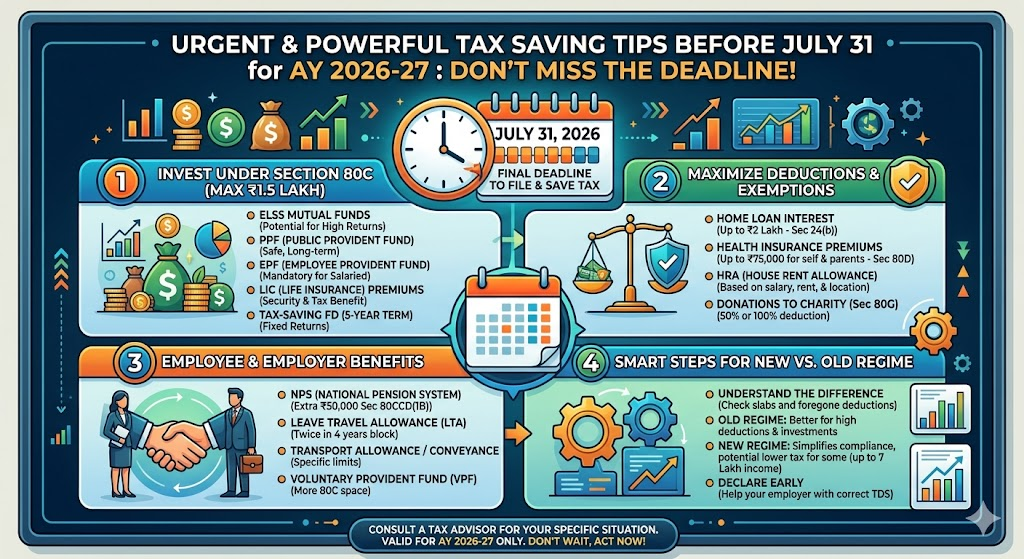
The clock is ticking. July 31, 2026, is the ITR filing last date for AY 2026-27, and if you haven’t already taken stock of your tax saving opportunities, you are leaving real money on the table. Whether you’re a salaried professional, freelancer, or a small business owner, the weeks leading up to this deadline are your last genuine window to legally reduce your tax liability for FY 2025-26.
This isn’t just a filing reminder it’s your strategic playbook. Let’s walk through the most impactful tax saving moves you can still make before the deadline hits.
Why the July 31 Deadline for AY 2026-27 Is Critical
Under the Income Tax Act, 1961, the due date for filing an ITR for individuals, HUFs, and non-audit cases is July 31st of the assessment year. For AY 2026-27, this translates to the last date being 31st July 2026. Missing this deadline doesn’t just attract a late filing fee of up to ₹5,000 under Section 234F it also locks you out of several beneficial provisions, including carrying forward certain losses.
The Income Tax Department has made it clear through CBDT guidelines that filing on time is the foundation of good tax compliance. Don’t wait for an extension that may never come.
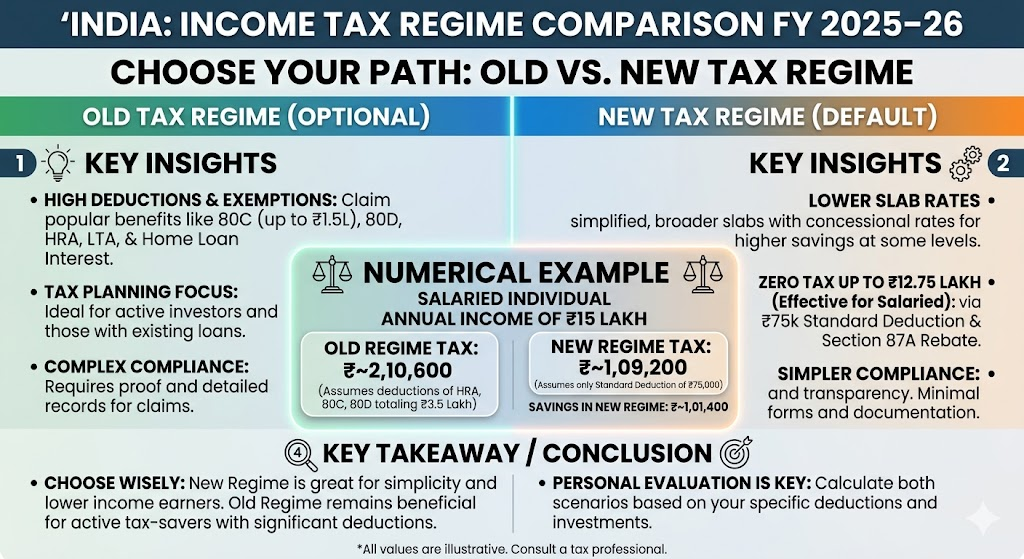
Step 1 : Choose the Right Tax Regime Before Filing Your ITR
One of the most consequential decisions you’ll make this filing season is: Old Tax Regime or New Tax Regime for FY 2026-27?
The new tax regime for FY 2026-27 offers zero income tax on income up to ₹12 lakh (after rebate under Section 87A), with a simplified slab structure. It also now includes a standard deduction of ₹75,000 for salaried individuals a significant upgrade.
However, if you have substantial deductions particularly Section 80C investments (up to ₹1.5 lakh), HRA, home loan interest (Section 24b), and NPS contributions (Section 80CCD(1B)) the old tax regime may still work out cheaper for you. Read our detailed guide on Old vs New Tax Regime 2026 to run your numbers before you file.
Pro Tip: Use the ITR filing portal’s built-in regime comparison calculator or get a professional assessment before locking in your choice. Once the ITR is filed, switching is not possible for that year.
Step 2 : Maximize Your Deductions Before July 31 (Checklist)
Even if most investments had to be made by March 31, 2026, here’s what you can still do before filing:
Deductions You Must Claim While Filing
Section 80C (up to ₹1.5 lakh): ELSS, PPF, LIC premium, home loan principal, NSC, tuition fees ensure all investments made in FY 2025-26 are accurately declared.
Section 80D Health Insurance Premium: Up to ₹25,000 for self/family; ₹50,000 for senior citizen parents. This deduction is often underclaimed.
Section 80CCD(1B) NPS Contribution: An additional ₹50,000 over and above the 80C limit available only under the old tax regime.
Section 24(b) Home Loan Interest: Up to ₹2 lakh for a self-occupied property. If you have a home loan, this is a powerful deduction to claim.
HRA Exemption: Cross-verify your actual rent paid vs. employer-declared HRA. Discrepancies can trigger notices.
Standard Deduction of ₹75,000 (new regime) or ₹50,000 (old regime for salaried): Automatically available ensure it reflects correctly in your ITR.
Step 3 : Verify Form 26AS, AIS & TIS Before Filing
One of the most overlooked yet critical pre filing steps is reconciling your Form 26AS, AIS (Annual Information Statement), and TIS (Taxpayer Information Summary). These documents reflect what banks, employers, and other third parties have reported to the Income Tax Department against your PAN.
A mismatch between your income and what’s reported in AIS can trigger income tax scrutiny notices something you definitely want to avoid.
If you are a freelancer, consultant, business owner, or have capital gains income, advance tax is your responsibility. The advance tax due dates for FY 2026-27 are:
Installment
Due Date
% of Total Tax
1st
June 15, 2026
15%
2nd
September 15, 2026
45%
3rd
December 15, 2026
75%
4th
March 15, 2027
100%
Failing to pay advance tax leads to interest under Sections 234B and 234C. This year, with capital gains from shares and mutual funds being taxable, many salaried individuals with F&O or equity portfolios fall into the advance tax net without realising it.
Step 5 : File the Correct ITR Form
This may sound basic, but filing the wrong ITR form is a common mistake that results in defective return notices. Here’s a quick guide:
ITR(1) (Sahaj): Salaried income, one house property, other sources income up to ₹50 lakh
ITR(2): Capital gains, multiple properties, foreign income/assets
ITR(4) (Sugam): Presumptive income under Section 44AD, 44ADA, 44AE
According to Dr. Haresh Adwani, a trusted voice in Indian taxation and compliance, many taxpayers lose significant amounts not because of high tax rates, but due to poor documentation, wrong regime selection, and failure to claim legitimate deductions. “Filing early, filing correctly, and filing with complete documentation is the single most powerful tax strategy available to the Indian taxpayer,” he notes.
This view aligns with the Income Tax Department’s consistent push toward voluntary and timely compliance and for good reason. Early filers get faster refunds, fewer notices, and a cleaner compliance record.
Key Takeaways
July 31, 2026 is the last date to file ITR for AY 2026-27 late filing attracts ₹5,000 penalty under Section 234F
Compare old vs new tax regime before filing don’t assume one is better without calculating
Standard deduction of ₹75,000 is available under the new regime for salaried individuals
Always verify Form 26AS, AIS, and TIS for mismatches before filing
Freelancers and business owners must track advance tax due dates for FY 2026-27
Choose the correct ITR form wrong form = defective return notice
Every deduction saved is money back in your pocket claim 80C, 80D, 80CCD(1B), and 24(b) diligently
Fequently Asked Questions (FAQs)
Q1. What is the last date to file ITR for AY 2026-27?
The ITR filing last date for AY 2026-27 is July 31, 2026 for individuals and non audit cases. Filing after this date attracts a late fee of up to ₹5,000 under Section 234F.
Q2. Which tax regime is better for salaried employees in FY 2026-27?
It depends on your total deductions. The new tax regime benefits those with fewer deductions, while the old regime suits those with significant 80C, HRA, and home loan interest claims. Use a regime comparison calculator before deciding.
Q3. What is the standard deduction under the new tax regime in 2026?
The standard deduction under the new tax regime for FY 2025-26 (AY 2026-27) is ₹75,000 for salaried employees and pensioners a significant benefit introduced in the Union Budget
Q4. Can I still save tax if I missed the March 31 investment deadline?
Most investment-based deductions (like 80C) require investments before March 31. However, you can still maximize deductions by claiming HRA, home loan interest, health insurance premiums, and ensuring accurate reporting of all eligible expenses in your ITR.
Q5. What happens if I file the wrong ITR form for AY 2026-27?
Filing an incorrect ITR form results in a defective return notice under Section 139(9). You’ll be given 15 days to rectify it. However, repeated errors can delay refunds and invite scrutiny always verify which form applies to your income profile.
Conclusion
The ITR filing deadline for AY 2026-27 is not just a compliance formality it’s your last call to lock in every tax benefit legally available to you. From choosing the right regime and maximizing deductions to verifying AIS data and filing the correct form, every step matters.
Don’t let procrastination cost you thousands of rupees in avoidable penalties, missed refunds, or compliance complications down the road.
Ready to file smart this July 31? Connect with the experts at itradvisor.in today — because the right guidance now saves far more than the time it takes.
About the Author Dr. Haresh Adwani Ph.D. in Commerce | Law Graduate | Managing Partner, Adwani & Co LLP Dr. Haresh Adwani holds a Ph.D. in Commerce and is a qualified Law graduate with over two decades of hands-on experience in GST advisory, direct taxation, and statutory compliance for businesses across
Disclaimer: ITRAdvisor.in is an educational and informational platform focused on tax awareness and compliance updates. Nothing contained herein should be construed as solicitation or advertisement of professional services. Professional services, where applicable, are rendered in accordance with ICAI guidelines. This article is published on ITRAdvisor.in, a tax and compliance knowledge platform. The content has been reviewed for technical accuracy by professionals associated with Adwani & Co LLP.
Here’s Exactly What It Means — and What You Must Do Right Now (2026)
Nidhi Adwani June 2026 6min Read
Credit Card Income Tax Notice 2026: Why You Got It and How to Respond
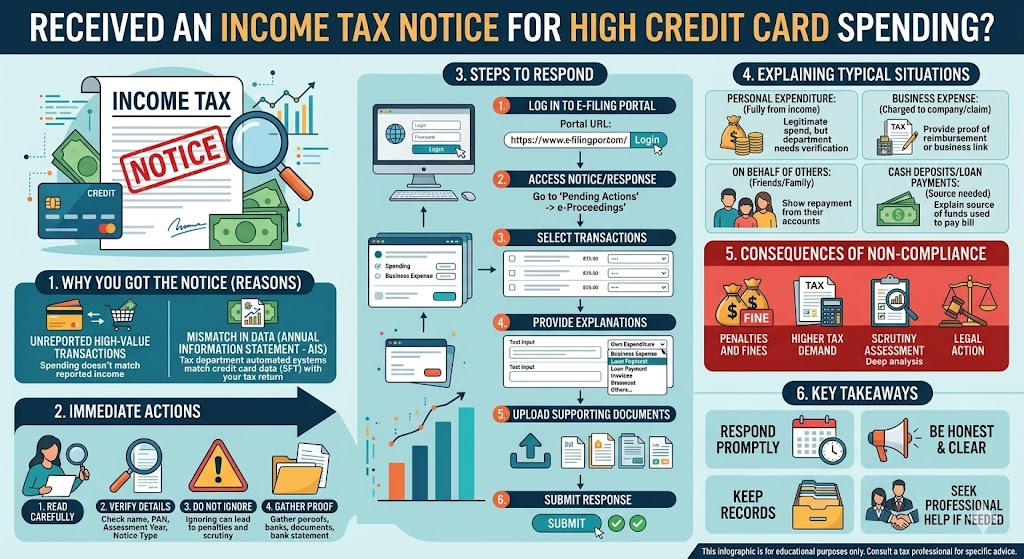
You swiped your credit card freely for travel, electronics, luxury shopping, or simply to manage monthly expenses and then one day, a notice landed in your inbox from the Income Tax Department. If this sounds familiar, you are not alone. Thousands of Indian taxpayers receive income tax notices on credit card usage every year, and in 2026, the scrutiny has only intensified thanks to AI-powered detection systems.
Here’s the critical truth: getting a credit card income tax notice does not automatically mean you have done something wrong. It means the Income Tax Department’s systems have flagged a mismatch between your reported income and your spending pattern. What you do next and how fast makes all the difference.
This guide breaks down exactly why these notices are issued, what Rule 114E really means, and how to craft a factual, legally sound response to protect yourself.
Why Does the Income Tax Department Send Notices for Credit Card Spending?
The Income Tax Department does not randomly pick taxpayers. It relies on a structured, data-driven system called the Statement of Financial Transactions (SFT) governed by Rule 114E of the Income Tax Rules, 1962. Under this rule, banks and financial institutions are legally required to report certain high-value transactions directly to the Income Tax Department.
Credit card spending crosses the reporting radar when:
Your total credit card payments in a financial year exceed ₹1 lakh (cash payments toward credit card bills), or
Your aggregate credit card expenditure exceeds ₹10 lakh in a financial year (payment by any mode).
Once this data is uploaded into the Annual Information Statement (AIS) on the income tax portal, the system automatically cross-checks it against the income declared in your ITR. If the spending appears disproportionate to your declared income a mismatch alert is triggered, and a notice follows.
High-Value Transactions Reported Under Rule 114E Quick Reference
To understand your credit card income tax scrutiny risk, here are the key SFT thresholds you must know:
Transaction Type
Reporting Threshold
Credit card payment (any mode)
₹10 lakh or more in a year
Credit card payment (cash only)
₹1 lakh or more in a year
Cash deposit – Savings Account
₹10 lakh or more in a year
Cash deposit – Current Account
₹50 lakh or more in a year
Fixed deposit (non-banking)
₹10 lakh or more in a year
Property purchase / sale
₹30 lakh or more per transaction
Share/mutual fund purchase
₹10 lakh or more in a year
Important: All of the above transactions are visible to the IT Department in your AIS. Any unexplained discrepancy between your AIS data and your ITR is a potential trigger for a notice or faceless assessment.
How AI Is Powering Income Tax Scrutiny for High Credit Card Spends in 2026
The Income Tax Department has significantly upgraded its compliance infrastructure. As highlighted in CBDT communications, the department now uses advanced data analytics and AI-driven systems to identify taxpayers whose lifestyle expenditure is inconsistent with declared income a process sometimes called the ‘non-filer monitoring system’ (NMS).
In practical terms, this means:
Your credit card spends are now directly visible in your AIS on incometax.gov.in visible to you and the department alike.
AI systems flag cases where total spends across categories (travel, electronics, dining, luxury) exceed a reasonable proportion of declared income.
Even UPI transactions and digital payments above certain thresholds are increasingly being tracked and correlated.
Types of Income Tax Notices You May Receive for Credit Card Spending
Notice Under Section 142(1) : Inquiry Before Assessment
This is the most common notice for credit card-related scrutiny. The Assessing Officer asks you to furnish documents, bank statements, credit card statements, and explanations for the spending mismatch.
Notice Under Section 148 :Income Escaping Assessment
If the department believes income has escaped assessment i.e., your actual income was higher than what you declared they can issue a reassessment notice under Section 148. Read our detailed guide on Income Tax Reassessment Notice Under Section 148: Rights, Timeline & Reply.
Notice Under Section 139(9) : Defective Return
If your ITR was filed incorrectly or key schedules were left blank despite high-value transactions appearing in Form 26AS or AIS, your return may be treated as defective.
Note on time limits: The Income Tax Department generally cannot issue a notice beyond 3 years from the end of the relevant assessment year for income below ₹50 lakh, and up to 10 years for income exceeding ₹50 lakh that has escaped assessment. Read our detailed guide on Income Tax Notice Time Limit 2026 for the full breakdown.
How to Respond to an Income Tax Notice on Credit Card Usage : Step by Step
Dr. Haresh Adwani, a senior chartered accountant and co-founder of Adwani & Co LLP, consistently advises clients: a timely, document-backed response is infinitely better than ignoring or delaying a notice. Here’s the structured approach:
Do Not Panic : Read the Notice Carefully
Identify the section under which it is issued, the assessment year it pertains to, and the specific query. Each notice has a due date for response note it immediately.
2.Verify Your AIS and Form 26AS
Log in to incometax.gov.in, download your AIS, and cross-check every credit card transaction flagged. Errors in AIS can be disputed online through the ‘Feedback’ feature on the portal itself.
3.Gather Source-of-Fund Evidence
For every high-value credit card spend, document the source: salary slips, bank statements, gift deeds, inheritance documents, savings withdrawals, or business income proof. The department wants to know WHERE the money came from not just that you spent it.
4.File a Factual, Measured Written Response
Submit your response on the Income Tax portal under ‘e-Proceedings’. Attach all supporting documents. Keep the language factual and professional. Avoid admissions that go beyond what the notice actually asks.
5.Respond Before the Deadline
Missing a notice deadline converts a manageable inquiry into an ex-parte assessment where the department passes an order based only on its data, potentially adding significant demand and penalties.
Common Mistakes That Escalate a Credit Card Notice into a Full Tax Demand
Ignoring the notice entirely : silence is treated as admission
Responding after the deadline : the department can proceed ex-parte
Submitting a vague or generic response without supporting documents
Not verifying your AIS for errors before responding
Filing a revised ITR hastily without professional guidance
Key Takeaways:
What Every Credit Card User Must Know About Income Tax Notices
Credit card payments of ₹10 lakh or more in a year are reported to the Income Tax Department under Rule 114E via the SFT mechanism.
Your Annual Information Statement (AIS) on incometax.gov.in shows every flagged transaction check it before filing your ITR.
A credit card income tax notice is a query, not a conviction a well-documented, timely response resolves most cases.
AI-driven scrutiny by the IT Department has intensified in 2026 lifestyle spending is now actively cross-checked against declared income.
Never ignore a notice. Always respond via the e-Proceedings portal with supporting documents before the deadline.
Frequently Asked Questions
Q1. What is the credit card spending limit to avoid an income tax notice in India?
Credit card payments aggregating ₹10 lakh or more in a financial year are reported to the Income Tax Department under Rule 114E by your bank. However, a notice is issued only when spending appears disproportionate to your declared income, so filing an accurate ITR is the real safeguard.
Q2. How does the Income Tax Department know about my credit card spending?
Banks are mandated under Rule 114E to submit a Statement of Financial Transactions (SFT) to the Income Tax Department reporting high-value credit card transactions. This data is directly reflected in your Annual Information Statement (AIS) on incometax.gov.in.
Q3. How should I reply to an income tax notice on credit card usage?
Log in to incometax.gov.in, navigate to ‘e-Proceedings’, and submit a written response with supporting documents (bank statements, income proof, source-of-fund evidence) before the deadline mentioned in the notice. Engaging a tax professional is strongly advised for complex cases.
Q4. Can the Income Tax Department send a notice for past credit card spending?
Yes. For incomes below ₹50 lakh, the department can issue a notice up to 3 years from the end of the relevant assessment year. For cases involving income exceeding ₹50 lakh that has escaped assessment, this window extends up to 10 years.
Q5. Will high UPI or digital payments also trigger an income tax notice in 2026?
UPI and digital payments are increasingly being monitored by the Income Tax Department, and large patterns of cash equivalents or high-frequency high-value transactions may attract scrutiny. Read our detailed guide on Will Income Tax Track Your UPI & WhatsApp Payments for complete clarity.
Conclusion:
Receiving a credit card income tax notice in 2026 is not the end of the world but treating it casually can make it one. India’s tax enforcement has become smarter, faster, and more data-driven than ever before. The Income Tax Department knows what you spend; the question is whether your declared income justifies it.
The solution is straightforward: file accurate ITRs every year, verify your AIS before filing, keep documentation of large expenditures, and respond to every notice promptly with facts and evidence. A well-prepared taxpayer has nothing to fear from any notice.
About the Author Dr. Haresh Adwani Ph.D. in Commerce | Law Graduate | Managing Partner, Adwani & Co LLP Dr. Haresh Adwani holds a Ph.D. in Commerce and is a qualified Law graduate with over two decades of hands-on experience in GST advisory, direct taxation, and statutory compliance for businesses across
Disclaimer
ITRAdvisor.in is an educational and informational platform focused on tax awareness and compliance updates. Nothing contained herein should be construed as solicitation or advertisement of professional services. Professional services, where applicable, are rendered in accordance with ICAI guidelines. This article is published on ITRAdvisor.in, a tax and compliance knowledge platform.
The content has been reviewed for technical accuracy by professionals associated with Adwani & Co LLP.
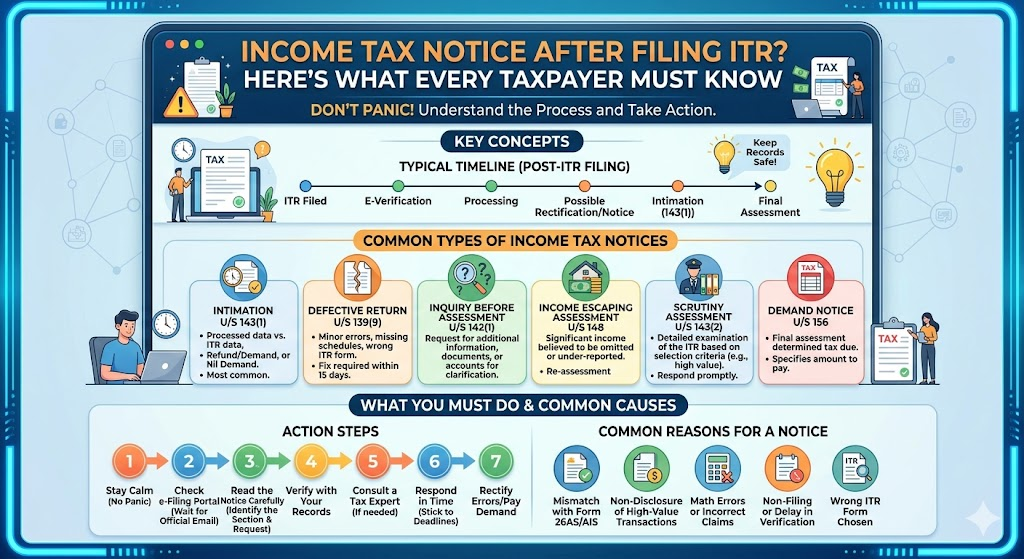
One of the most common questions taxpayers ask after filing their Income Tax Return (ITR) is
“I have already filed my return. Why did I receive an Income Tax Notice?”
Receiving a notice from the Income Tax Department can be stressful. However, a notice does not automatically mean you have done something wrong. In many cases, the notice is simply a request for clarification, additional information, or correction of a mismatch.
Understanding the reason behind the notice and responding appropriately can help avoid unnecessary penalties, interest, and prolonged scrutiny.
In this guide, we explain the most common reasons for receiving an income tax notice after filing your ITR and the steps you should take.
Can You Receive an Income Tax Notice Even After Filing Your Return?
Yes.
Filing your return does not guarantee that the Income Tax Department will not seek further clarification.
The department now uses advanced data analytics, AIS (Annual Information Statement), TIS (Taxpayer Information Summary), SFT reporting, bank transaction data, and employer reporting to verify the accuracy of returns.
Any mismatch or omission can trigger a notice.
Top 7 Reasons Why Taxpayers Receive Income Tax Notices
1. Income Reported in AIS Is Missing in ITR
One of the most common reasons for notices is a mismatch between income reported in AIS and income declared in your return.
Examples:
* Interest income from savings accounts
* Fixed deposit interest
* Dividend income
* Capital gains from shares or mutual funds
* Foreign remittances
Even small omissions can trigger automated compliance checks.
2. High-Value Transactions Reported to the Department
Banks, mutual funds, registrars, and other institutions report specified financial transactions to the Income Tax Department.
Examples include:
* Large cash deposits
* Property purchases
* Significant mutual fund investments
* High credit card spending
* Foreign travel expenses
If your declared income does not support these transactions, the department may seek clarification.
3. Claiming Excess Deductions
Incorrect deduction claims frequently lead to notices.
Common areas include:
* Section 80C
* Section 80D
* Home loan interest
* HRA exemption
* Donations under Section 80G
Taxpayers should retain documentary evidence supporting every deduction claimed.
should be reviewed by a qualified tax professional.
How to Avoid Income Tax Notices in Future
Before filing your return:
✅ Review AIS thoroughly
✅ Match Form 26AS with Form 16
✅ Report all bank interest
✅ Disclose capital gains
✅ Verify deductions
✅ Report foreign assets where applicable
✅ Maintain proper documentation
A careful review before filing can significantly reduce the risk of future notices.
Real-Life Example
A salaried employee earning ₹18 lakh annually filed his return independently.
He reported salary income correctly but forgot to disclose:
* Savings account interest
* Fixed deposit interest
* Dividend income
These entries appeared in AIS but not in the return.
The department later issued a compliance notice seeking clarification.
The issue was resolved through revised reporting, but the taxpayer experienced avoidable stress and delays.
Frequently Asked Questions (FAQs)
1.Is an income tax notice always bad news?
No. Many notices are routine communications seeking clarification or correction.
2.Can I ignore an income tax notice?
No. Every notice should be reviewed and responded to appropriately.
3.How long do I have to respond?
The deadline depends on the specific notice. Always check the notice carefully.
4.Can I revise my return after receiving a notice?
In many situations, corrective action or revised filing may be possible, subject to applicable provisions.
5.Can a CA help me respond to a notice?
Yes. Professional guidance can help ensure accurate and timely compliance.
About Author
Dr. Haresh Adwani holds a PhD in Commerce and brings over 20 years of expertise in GST compliance, income tax advisory, FEMA, and corporate law. Services include GST audit, ITR filing, GST appeal representation, notice response, NRI taxation, and FEMA compliance.
Need Help With an Income Tax Notice?
Received an Income Tax Notice after filing your ITR?
Our team at Adwani & Co. / ITR Advisor assists taxpayers across India with:
* Income Tax Notice Replies
* AIS & TIS Mismatch Review
* Defective Return Notices
* Scrutiny Assessments
* Capital Gains Reporting
* NRI Taxation Issues
* Revised Return Filing
Get your notice reviewed by our experts before responding.
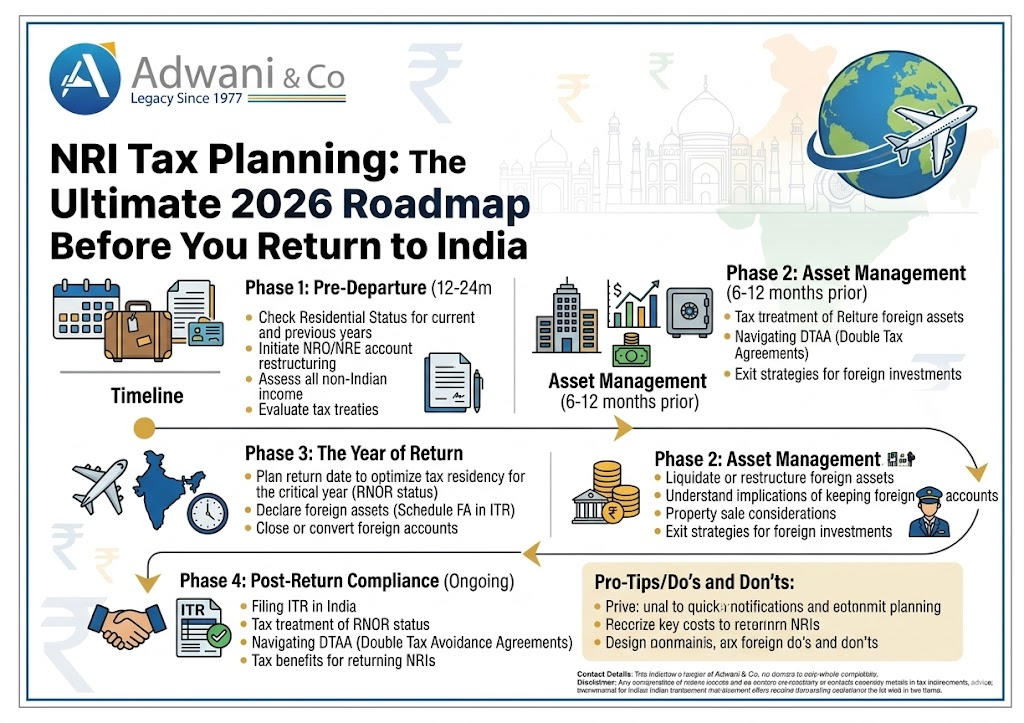
NRI Tax Rules India 2026: The Essential Roadmap Every Returning NRI Must Follow
The flight is booked. The resignation letter is written. After ten, fifteen, sometimes twenty years abroad, you are finally coming home. But somewhere between the excitement of reunion dinners and the relief of leaving behind bitter winters, one question sits quietly at the back of your mind what happens to my money?
It is the question most returning NRIs either ask too late or never ask at all until the Income Tax Department sends them a notice that arrives long after they have settled back in. The uncomfortable truth is this: the moment your residential status shifts from NRI to Resident Indian, India’s tax net expands dramatically. Your US brokerage account, your UK pension, your Dubai rental income, your Singapore investments all of it can suddenly fall within India’s taxing jurisdiction.
This is not a scare tactic. It is the straightforward application of NRI tax rules in India, as laid out by the Income Tax Department at incometax.gov.in. And the good news is that with proper planning ideally six to twelve months before you board that return flight you can navigate this transition intelligently, legally, and with far less tax outgo than you might fear.
This comprehensive guide, prepared with insights from Adwani and Company and its lead expert Dr. Haresh Adwani, covers every critical dimension of NRI tax planning for 2026: residential status transitions, RNOR benefits, NRI capital gains tax implications, FEMA compliance, DTAA relief, and ITR filing obligations. Consider this your complete pre-departure tax checklist.
Understanding NRI Tax Rules in India : It All Starts With Residential Status
Before any investment strategy, account restructuring, or tax planning can begin, one thing must be determined with precision: your exact residential status under Indian tax law for each financial year during and after your return.
The Income Tax Act, 1961 classifies individuals into three categories and each carries dramatically different NRI tax rules:
The Three Residential Status Categories
NRI : Non-Resident Indian An individual qualifies as an NRI if they stay in India for fewer than 182 days in a financial year (general rule). As an NRI, India taxes you only on income earned or received within India your foreign income is completely outside India’s reach.
RNOR : Resident but Not Ordinarily Resident This is the transitional status that returning NRIs enter before becoming full residents. It is the single most valuable planning window in NRI tax rules. During RNOR status, you are technically a resident, but foreign income that is not derived from a business controlled in India or a profession set up in India remains outside India’s tax net. This status typically lasts two to three financial years after returning, depending on how many years you spent as an NRI.
ROR : Resident and Ordinarily Resident This is full residency. Every rupee of global income salary, interest, dividends, capital gains, rental income is taxable in India, regardless of where it is earned or held. Once you become ROR, the NRI tax rules that protected your foreign income no longer apply.
The transition looks like this: NRI → RNOR (planning window) → ROR (full global taxation).
The RNOR window is your golden opportunity. Squander it, and you pay taxes you did not need to pay. Use it wisely, and you can restructure investments, liquidate foreign assets, and repatriate funds in a way that is both legal and dramatically more tax-efficient.
“Most NRIs think they have all the time in the world after they land. The reality is the clock starts the moment the financial year begins. We always recommend calculating the RNOR window at least a year in advance , it is the foundation of the entire planning exercise.”
The 120-Day Trap — NRI Tax Rules That Catch People Off Guard
Here is a provision in India’s NRI income tax rules that most people including many financial advisors still underestimate. Introduced via the Finance Act 2020, it can reclassify an NRI as a tax resident even when they continue to physically live abroad.
When Does the 120-Day Rule Apply?
Three conditions must all be satisfied simultaneously:
Your Indian income exceeds ₹15 lakh in the financial year (this includes salary from Indian employers, rent from Indian property, dividends from Indian stocks, or interest from NRO accounts)
You stayed in India for 120 days or more in that financial year
Your cumulative India stays over the preceding four financial years total 365 days or more
If all three conditions apply, you are classified as a resident for that financial year and your global income becomes taxable in India.
The dangerous part is how easily 120 days accumulates without deliberate tracking. A summer visit for a family wedding (30 days), a Diwali trip (3 weeks), a medical emergency in March (2 weeks), and a business trip to Mumbai (10 days) that alone is 87 days. Add a few more trips and you have crossed the threshold without ever intending to.
The solution is simple but requires discipline: maintain a precise record of every India entry and exit date, verified against your passport stamps. If your Indian income from any source NRI capital gains tax on property, NRO interest, rental income exceeds ₹15 lakh, this is not optional. It is essential risk management.
NRI Capital Gains Tax in India 2026 — What Changes When You Return
One of the most financially significant areas within NRI tax rules concerns capital gains on investments both Indian and foreign. The rules shift substantially depending on your residential status at the time of the transaction.
Capital Gains on Indian Assets (Shares, Mutual Funds, Property)
For investments held in India listed shares, equity mutual funds, real estate NRI capital gains tax rules are broadly similar to those for resident Indians under the Income Tax Act, as updated for AY 2026-27
Asset Type
Holding Period
Tax Rate (NRI & Resident)
Listed equity shares / equity MFs
> 1 year (LTCG)
12.5% on gains above ₹1.25 lakh
Listed equity shares / equity MFs
≤ 1 year (STCG)
20% flat
Debt mutual funds
Any period
Taxable at slab rates
Real estate (property)
> 2 years (LTCG)
12.5% (indexation removed for post-July 2024 sales)
Real estate (property)
≤ 2 years (STCG)
Taxable at slab rates
As an NRI selling Indian property, TDS at 12.5% (LTCG) or 30% (STCG) is deducted at source by the buyer — even before you see the proceeds. Obtaining a lower TDS certificate from the Income Tax Department (Form 13) beforehand can reduce this deduction to the actual tax liability, significantly improving your cash flow.
:Capital Gains on Foreign Assets After Returning
This is where the RNOR window becomes enormously valuable. Consider the difference:
Sold while still NRI: India has no right to tax gains on foreign assets — taxed only in the country where the asset is held (subject to DTAA)
Sold during RNOR period: Foreign sourced capital gains are generally not taxable in India during RNOR status — a significant relief
Sold after becoming ROR: Full Indian capital gains tax applies on the global appreciation, with DTAA credit available only if foreign tax was actually paid
For a returning professional with, say, USD 200,000 in a US brokerage account (stocks bought at USD 80,000 cost — a gain of USD 120,000, approximately ₹1 crore), the difference between selling during the RNOR window versus after becoming ROR could easily amount to ₹12–15 lakh in Indian tax.
Real-World Example How Smart NRI Tax Planning Saved ₹18.5 Lakh
Case: Priya R., Senior Engineer Seattle to Hyderabad, Return Year FY 2025-26
Priya spent 12 years in the United States and decided to return to India permanently in November 2025. Her financial profile at the time of return:
Indian apartment generating ₹14.4 lakh annual rental income
NRE fixed deposits: ₹32 lakh
Without Planning : Estimated Tax Exposure
After becoming ROR (which would have happened in FY 2027-28 without planning), if Priya sold her US portfolio, the entire ₹97 lakh gain would be taxable in India as long-term capital gains at 12.5% — a tax liability of approximately ₹12.1 lakh, with no foreign tax offset since the US levies 0% LTCG on this income bracket for her filing status.
Additionally, her NRE accounts, not re-designated in time, would constitute a FEMA violation penalties of up to 3x the value of the violation apply under FEMA, 1999.
With Planning via Adwani and Company:
Dr. Haresh Adwani’s team calculated Priya’s RNOR window as covering FY 2025-26 and FY 2026-27 two full financial years during which foreign income would not be taxable in India. By selling the US portfolio during this RNOR window, the ₹97 lakh capital gain attracted zero Indian tax.
Her NRE accounts were timely re-designated to RFC accounts. Rental income was correctly declared in her ITR filing 2026 (ITR-2 for AY 2026-27). Form 67 was filed for foreign tax credits on US dividend income.
Total Tax Saved Through Planning: ₹18.5 lakh (approximately)
This is not exceptional it is the standard outcome when NRI tax rules are applied correctly and proactively.
FEMA Compliance for Returning NRIs :Non-Negotiable Steps
The Foreign Exchange Management Act (FEMA), 1999, governs how Indian residents hold, operate, and transact in foreign currency assets. Returning NRIs must take specific mandatory steps under FEMA and the consequences of non-compliance are enforced by the Enforcement Directorate, not the Income Tax Department, making them distinct and sometimes more severe.
Mandatory Account Re-Designations
As per Reserve Bank of India (RBI) guidelines, the following must be done immediately upon change of residential status:
Account Type
Required Action
Consequence of Inaction
NRE Account (Non-Resident External)
Re-designate to RFC or regular resident savings account
FEMA violation — penalty up to 3x transaction value
FCNR Account (Foreign Currency Non-Resident)
Re-designate to RFC account at maturity
FEMA violation
NRO Account (Non-Resident Ordinary)
Re-designate to ordinary resident savings account
FEMA violation
Foreign bank accounts abroad
Permitted to retain; must declare in ITR Schedule FA
Penalty under Black Money Act for non-disclosure
The RFC (Resident Foreign Currency) account is specifically designed for returning residents and allows you to hold foreign currency assets legally after returning. Interest earned on RFC accounts is fully taxable in India under the Income Tax Act unlike NRE accounts, which were tax-free.
Foreign Asset Disclosure in ITR : Schedule FA
Once you attain ROR status, the annual Income Tax Return (ITR filing for AY 2026-27 and beyond) must include Schedule FA Foreign Assets. This covers:
Foreign bank accounts and their year-end balances
Foreign equity and debt holdings
Foreign immovable property
Foreign trusts, beneficial interests, or signing authority
Accounts held as beneficial owner or beneficiary in foreign entities
Non-disclosure of foreign assets is prosecuted under the Black Money (Undisclosed Foreign Income and Assets) and Imposition of Tax Act, 2015 which prescribes a flat 30% tax plus a 90% penalty on undisclosed amounts. The penalties are not proportional to undisclosed income they are absolute.
DTAA Benefits : How Returning NRIs Avoid Double Taxation
India’s Double Taxation Avoidance Agreements (DTAA) with over 90 countries are among the most powerful tools in any NRI’s tax planning toolkit. These treaties ensure that income earned in one country is not taxed twice once where it is earned and again in India.
However, DTAA benefits are not automatic. To claim relief, you must:
Obtain a Tax Residency Certificate (TRC) from the foreign country confirming your tax residency there during the relevant period
File Form 10F on the Indian income tax e-filing portal along with TRC details
File Form 67 to claim Foreign Tax Credit (FTC) for taxes already paid abroad this must be filed before the ITR due date or credit is forfeited permanently
Key DTAA provisions relevant to returning NRIs in 2026:
India-USA DTAA: Covers salary, dividends, interest, royalties, and capital gains — with specific conditions for each. 401(k) and IRA distributions have specific treatment under the agreement.
India-UAE DTAA: Recently renegotiated. The updated provisions affect salary income and investment gains — obtain current treaty text or consult a specialist.
India-UK DTAA: Pension income provisions are particularly relevant for UK returnees — UK state pension and occupational pension taxability in India is treaty-governed.
India-Canada, India-Australia, India-Singapore DTAAs: Each has distinct provisions for employment income, dividends, and capital gains.
As Dr. Haresh Adwani notes: “The DTAA is like a legal shield. But it only protects you if you know how to invoke it correctly — the right forms, the right timing, the right documentation. A missed Form 67 deadline means you lose the credit entirely, even if the law gives you the right to it.”
NRI ITR Filing 2026 : Which Form, What to Declare, When to File
NRI ITR filing is one of the most commonly mishandled aspects of NRI tax compliance in India. Many NRIs believe they do not need to file an ITR if TDS has already been deducted. This is incorrect in most situations.
When Is ITR Filing Mandatory for NRIs?
You must file an ITR if:
Your India-sourced income exceeds the basic exemption limit (₹3 lakh under new regime, ₹2.5 lakh under old regime)
You want to claim a refund of excess TDS deducted on NRI capital gains tax or rental income
You want to carry forward capital losses for set-off in future years
Your Indian income includes capital gains from sale of property or shares
You have foreign assets to declare after becoming ROR
Which ITR Form for NRIs and Returning Residents?
Status & Income Type
Correct ITR Form
NRI with salary + one property + interest
ITR-2
NRI with capital gains from shares / property
ITR-2
RNOR or ROR with foreign assets to declare
ITR-2 (Schedule FA mandatory)
Returning NRI with business income in India
ITR-3
ITR filing last date 2026: July 31, 2026 for individuals not requiring audit (ITR-1 and ITR-2). Missing this date triggers a late filing fee under Section 234F (₹5,000 for income above ₹5 lakh) plus interest under Section 234A.
: NRI Tax Planning Pre-Return Checklist :12 Months Before You Land
Use this checklist as your action plan. Work backward from your expected return date.
12 Months Before Return:
Calculate your exact RNOR window this single calculation shapes every decision that follows
List every foreign asset: equity portfolio, retirement accounts (401k, IRA, pension), real estate, mutual funds, bank balances
Map which assets carry significant unrealised gains and create a disposal strategy
6 Months Before Return:
Evaluate whether to sell high-gain foreign assets before return (while still NRI) or during the RNOR window
Obtain Tax Residency Certificate from the foreign country for DTAA purposes
Begin preparing documentation for Form 67 (foreign tax credit)
Consult your Indian bank about re-designating NRE/FCNR accounts to RFC accounts
Before or Immediately Upon Return:
Re-designate NRE and FCNR accounts do not delay this even by one day
File NRI status change intimation with your Indian bank(s)
Ensure your ITR for the year of return includes both Indian and foreign income correctly bifurcated by RNOR rules
After Return (Ongoing):
File annual ITR with Schedule FA for all foreign assets once ROR status is attained
Track India stay days carefully every financial year if Indian income exceeds ₹15 lakh
Renew Tax Residency Certificates annually as long as DTAA claims are being made
Frequently Asked Questions
1. What is the most important thing an NRI must do before returning to India for tax purposes?
The single most important step is calculating your RNOR window the period after returning during which foreign income remains outside India’s tax net. This window, typically two to three financial years, is the foundation of all NRI tax planning. Calculating it in advance allows you to time investment liquidations, account restructuring, and fund repatriation for maximum tax efficiency. Adwani and Company recommends doing this calculation at least 12 months before the planned return date.
2. Do I have to pay tax in India on money already sitting in my foreign bank account when I return?
The principal amount in your foreign bank account money already earned and saved — is generally not taxed again in India. However, interest earned on that account after you become ROR is taxable as income in India. Additionally, any investment gains on assets funded by that account will be subject to Indian NRI capital gains tax rules once you are ROR. The account itself must be declared in Schedule FA of your ITR once ROR status is attained.
3. Can I keep my foreign brokerage account (US, UK, Singapore) after returning to India?
Yes, you are permitted to retain foreign investment accounts after returning to India, under FEMA’s Overseas Investment (OI) regulations. However, once you attain ROR status, all income (dividends, interest) and gains from these accounts must be declared in your Indian ITR, including Schedule FA. Additionally, any gains on sale of foreign securities are taxable as NRI capital gains tax in India subject to DTAA relief if foreign taxes were paid.
4.Is NRI ITR filing mandatory if TDS has already been deducted on my Indian income?
Yes, NRI ITR filing is mandatory if your total Indian income exceeds the basic exemption limit, even if TDS has been fully deducted. Filing the ITR is the only way to claim a refund if excess TDS was deducted, to carry forward capital losses, and critically to comply with foreign asset disclosure requirements under Schedule FA once you become ROR. Non-filing when mandatory can attract notices, penalties, and assessments from the Income Tax Department.
5. What penalties apply if I fail to disclose foreign assets after becoming a Resident Indian?
Under the Black Money (Undisclosed Foreign Income and Assets) and Imposition of Tax Act, 2015, failure to disclose foreign assets in your ITR attracts a flat 30% tax on the asset’s fair market value plus a 90% penalty effectively 120% of the asset’s value in taxes and penalties. Additionally, prosecution for wilful non-disclosure can result in imprisonment of three to ten years. This is one of the most severe penalty regimes in Indian tax law and leaves absolutely no room for casual non-compliance.
Conclusion
Returning home after years abroad is one of life’s most meaningful transitions. The last thing you want is to discover —six months after landing that you owe the Income Tax Department a sum that proper planning could have legally eliminated.
The NRI tax rules India 2026 framework is neither punitive nor impossible to navigate. The RNOR window is a legitimate, statutory protection. The DTAA regime provides genuine relief from double taxation. FEMA compliance, handled proactively, is straightforward. The 120-day rule, once understood, is entirely manageable with basic travel tracking.
What makes the difference is timing and expertise. Every month of delay between the decision to return and the implementation of a proper tax plan costs you options. Assets that could have been sold tax-free during the RNOR window become taxable. NRE accounts that should have been re-designated continue in violation. Foreign tax credits that could have been claimed are forfeited because Form 67 was not filed on time.
If you want expert, end-to-end GST compliance support for your business in FY 2026-27, connect with Adwani and Company today. Our team handles everything monthly filings, ITC reconciliation, annual returns, and notice management so you can focus entirely on growing your business.
About the Author Dr. Haresh Adwani Ph.D. in Commerce | Law Graduate | Managing Partner, Adwani & Co LLP Dr. Haresh Adwani holds a Ph.D. in Commerce and is a qualified Law graduate with over two decades of hands-on experience in GST advisory, direct taxation, and statutory compliance for businesses across Pune and Maharashtra.
Every April, millions of Indian taxpayers face a question that could determine whether they save ₹50,000 or silently lose it: Should I choose the old vs new tax regime? Most people answer it the wrong way by asking colleagues, following guesswork, or simply doing nothing and letting the default kick in. That ‘nothing’ decision alone costs thousands of taxpayers lakhs of rupees every year.
The truth is, there is no universally correct answer. Whether the old vs new tax regime works better for you depends entirely on your income level, your deductions, your lifestyle, and your financial discipline. What this guide does is cut through the confusion and give you a clear, number-backed, expert-driven framework to make the right call for your life, not someone else’s.
With the Income Tax Act, 2025 now fully in effect and the new regime established as the default option, the stakes have never been higher. Let’s break it down completely.
Understanding the Old vs New Tax Regime : What Actually Changed
India’s personal income tax system today operates with two distinct parallel structures, each with its own slab rates, deduction rules, and strategic advantages. Every individual taxpayer whether salaried, self-employed, or running a business must choose one at the time of filing returns.
What is the Old Tax Regime?
The old tax regime has been the backbone of Indian income taxation for decades. It allows taxpayers to legally reduce their taxable income by claiming a wide range of deductions and exemptions. The Income Tax Department of India permits deductions such as:
House Rent Allowance (HRA) under Section 10(13A)
Standard Deduction of ₹50,000 for salaried individuals
Section 80C deductions up to ₹1.5 lakh (PPF, ELSS, EPF, LIC, home loan principal)
Section 80D for health insurance premiums (up to ₹25,000–₹50,000 depending on age)
Home loan interest deduction under Section 24(b) up to ₹2 lakh for self-occupied property
Leave Travel Allowance (LTA) and other specific exemptions
The key benefit: these deductions shrink your taxable income before slab rates are applied, meaning your effective tax rate can be significantly lower than what the published rates suggest.
What is the New Tax Regime?
Introduced in Budget 2020 and significantly restructured in Budget 2023, the new tax regime offers lower headline slab rates in exchange for giving up most deductions. Under the Income Tax Act, 2025, the new regime is now the default meaning taxpayers who do not actively opt out will be assessed under this regime.
The new regime is designed to simplify tax compliance, reduce paperwork, and appeal to those who prefer lower rates over complex deduction planning. It still allows the standard deduction of ₹75,000 (revised upward in 2024) and the employer’s NPS contribution under Section 80CCD(2) two benefits that are frequently overlooked.
Old Tax vs New Tax Regime : Slab Rate Comparison for FY 2025–26
Income Slab
Old Regime Rate
New Regime (FY 2025–26)
Up to ₹3,00,000
Nil
Nil
₹3,00,001 – ₹7,00,000
5%
5%
₹7,00,001 – ₹10,00,000
20%
10%
₹10,00,001 – ₹12,00,000
30%
15%
₹12,00,001 – ₹15,00,000
30%
20%
Above ₹15,00,000
30%
30%
On paper, the new regime’s lower rates between ₹7 lakh and ₹15 lakh look very attractive. But slab rates only tell half the story. Your effective tax rate the percentage of income you actually pay after deductions can be dramatically different. This is the calculation that Dr. Haresh Adwani, of Adwani and Company, insists every taxpayer must do before making their regime choice.
Key Deductions You Lose in the New Tax Regime : And Why It Matters for Tax Saving
Understanding the deduction gap is central to the old vs new tax regime comparison. Here are the most impactful deductions that are not available in the new regime:
HRA (House Rent Allowance): For salaried employees in metro and Tier-1 cities, HRA exemption often ranges from ₹1 lakh to ₹3 lakh annually. This is one of the most powerful salary components from a tax perspective and it simply does not exist in the new regime.
Section 80C (₹1.5 lakh limit): Covers PPF, ELSS mutual funds, home loan principal repayment, life insurance premiums, NSC, and children’s tuition fees. For any disciplined investor, this deduction is almost automatic and it saves up to ₹46,800 in taxes at the highest slab.
Section 80D (Health Insurance): Premiums paid for self and family can be deducted up to ₹25,000 (or ₹50,000 for senior citizens). In the new regime, this benefit disappears entirely.
Home Loan Interest Section 24(b): Up to ₹2 lakh annually on interest for a self-occupied property. For taxpayers with an ongoing home loan, this single deduction can be decisive in regime selection.
LTA (Leave Travel Allowance): Tax-exempt travel allowance available in the old regime for domestic travel twice in a four-year block. Not available in the new regime.
Real-World Numerical Example: Old vs New Tax Regime at ₹16 Lakh Income
Let’s apply real numbers to understand the difference between Old vs New Tax Regime . Consider Priya, a salaried software professional in Pune earning ₹16 lakh gross annually, with HRA, active 80C investments, a health insurance policy, and a home loan.
Item
Old Regime
New Regime
Gross Salary Income
₹16,00,000
₹16,00,000
Standard Deduction
−₹50,000
−₹75,000
HRA Exemption
−₹1,80,000
Not Applicable
Section 80C (PPF + ELSS)
−₹1,50,000
Not Applicable
Section 80D (Health Ins.)
−₹25,000
Not Applicable
Home Loan Interest (24b)
−₹1,20,000
Not Applicable
Net Taxable Income
₹10,75,000
₹15,25,000
Approx. Tax (incl. cess)
~₹1,45,000
~₹2,05,000
CASESTUDY
In this case, Priya saves approximately ₹60,000 more by choosing the old regime. This calculation assumes actual deduction claims and is illustrative individual results will vary based on specific figures.
This is the calculation that most taxpayers never run. As Dr. Haresh Adwani, founder of Adwani and Company, consistently guides clients: the regime that appears more generous at the slab level is frequently more expensive once your actual deductions are factored in.
Which Income Band Benefits More : A Practical Old vs New Tax Regime Breakdown
Income Up to ₹12.75 Lakh
Under the new tax regime for FY 2025–26, taxpayers with income up to ₹12 lakh may have zero tax liability due to the revised Section 87A rebate (up to ₹60,000). Combined with the ₹75,000 standard deduction for salaried individuals, effective tax-free income rises to ₹12.75 lakh. For this income band especially those with minimal investments the new regime is a clear winner. This is one of the most significant improvements the government has introduced, as clearly outlined in the Finance Bill 2025 notified by the Ministry of Finance.
Income Between ₹12.75 Lakh and ₹18 Lakh
This is the battleground zone. If you have HRA, 80C investments, and a home loan, the old regime almost certainly wins. If your deductions are limited to just the standard deduction, the new regime may be comparable or marginally better. Running the actual calculation is non-negotiable at this income level.
Income Above ₹18–20 Lakh
For higher income brackets, the new regime’s lower slab rates begin to overpower the benefit of deductions but only if your total deductions are below a certain threshold. The break-even point varies depending on your HRA amount and home loan outstanding. Adwani and Company, has observed that even at ₹20 lakh+ income, taxpayers with substantial home loans and maximum 80C investments often fare better in the old regime.
Critical Mistakes to Avoid When Choosing Your Tax Regime
Mistake 1: Not Informing Your Employer Before April 1
The new tax regime is the default. If you want the old regime, you must proactively inform your employer before the start of the financial year. Failure to do so means TDS will be deducted under the new regime throughout the year potentially resulting in either a year-end tax demand or the hassle of claiming a refund.
Mistake 2: Deciding Based on Slab Rates Alone
Comparing tax regimes using published slab tables without running your actual income and deductions is like comparing cars by looking only at the price tag. Always calculate your net taxable income under both regimes before deciding.
Our tax advisory team offers this comparison service as part of every annual tax planning engagement.
Mistake 3: Ignoring the NPS Employer Contribution in the New Regime
Section 80CCD(2) allows a deduction for your employer’s NPS contribution up to 14% of your basic salary even in the new regime (versus 10% for private sector in the old regime). Many employees overlook this during CTC negotiation. Restructuring your salary to maximize this benefit is one of the smartest tax moves available under the new regime, and one that Adwani and Company actively helps clients implement.
Mistake 4: Forgetting the Business Income Switching Rule
Taxpayers with business or professional income who file under ITR3 or ITR4 face a critical restriction: they can switch from the new regime back to the old regime only once in their lifetime. After reverting to the new regime, they cannot switch back to old. This rule under Section 115BAC is frequently misunderstood and can result in irreversible tax decisions. Salaried individuals have no such restriction they can switch every year freely.
Mistake 5: Assuming the Same Answer as Last Year Still Applies
Your income changes. Your deductions change. Interest rates change. The regime that was optimal in FY 2024–25 may not be optimal in FY 2025–26. Annual reassessment ideally before April is essential. The Income Tax Department’s official calculator at incometax.gov.in is updated for each assessment year and provides a reliable starting point.
Old vs New Tax Regime for Freelancers and Business Owners
Self-employed individuals, consultants, and business owners operate under a different set of rules. The ability to claim business expenses rent, travel, depreciation, professional fees, and utilities as deductions against income makes tax planning more nuanced for this group.
For businesses with turnover up to ₹3 crore, the presumptive taxation scheme under Section 44AD is compatible with the new regime and offers simplicity without the burden of maintaining detailed books purely for deduction purposes. Similarly, professionals with receipts up to ₹75 lakh can opt for Section 44ADA presumptive taxation.
Importantly, your business structure whether you operate as a proprietorship, LLP (registered under the Ministry of Corporate Affairs), or private limited company significantly affects how income is taxed. The regime choice applies to individual promoters on their personal income; companies and LLPs are taxed under separate corporate rates and are not directly subject to the old vs new regime choice. Read our detailed guide on Company Formation and Tax Structuring for a complete breakdown.
A 5-Step Framework to Choose the Right Tax Regime Recommended by Dr. Haresh Adwani
Dr. Haresh Adwanirecommends the following structured approach for every individual taxpayer before each financial year begins:
Step 1 : Project your total income: Include salary, rental income, business income, capital gains, and any other sources for the year.
Step 2 : List every deduction you will legitimately claim: HRA, 80C investments, 80D premiums, home loan interest, NPS, LTA, and any other applicable items.
Step 3 : Compute net taxable income under both regimes: Subtract your applicable deductions from gross income under the old regime; subtract only the standard deduction and eligible items under the new regime.
Step 4 : Apply slab rates to each and calculate total tax: Include surcharge (if applicable) and the 4% health and education cess as specified by theIncome Tax Department.
Step 5 : Choose the lower outcome and communicate it: Inform your employer before April 1 if you are salaried, or record your regime choice in your ITR filing.
This entire process, with a CA’s guidance, can be completed in under 30 minutes yet it directly determines how many thousands of rupees stay in your pocket every year.
Conclusion: Old vs New Tax Regime : Make a Decision, Not a Guess
The old vs new tax regime debate is not a philosophical discussion it is a mathematical calculation. And yet, year after year, lakhs of Indian taxpayers make this choice on instinct, peer advice, or sheer inertia.
Your tax planning is deeply personal. The deductions you claim, the salary structure you have, the investments you maintain these are unique to you. The regime that saves your colleague ₹45,000 could cost you ₹70,000, and vice versa. With the Income Tax Act, 2025 and the new default regime now in play, the consequences of an uninformed choice are larger than ever before. The framework is simple: project your income, list your deductions, calculate tax under both regimes, and choose the lower number. Do this before April 1 every year, communicate it to your employer, and revisit it annually as your income and life situation evolve
1: Which is better old vs new tax regime for a ₹10 lakh salary?
At ₹10 lakh gross salary, the answer depends on your deductions. If you claim HRA, 80C, and 80D, the old regime typically results in lower tax. If your deductions are minimal, the new regime’s lower rates may be beneficial. Always calculate both before deciding one size does not fit all.
2: Can I switch between old and new tax regime every year?
Yes, if you are a salaried employee. You can switch your regime preference every financial year by informing your employer or selecting the regime at the time of ITR filing. Taxpayers with business or professional income, however, can switch from the new regime to the old regime only once after reverting to the new regime, they cannot switch back.
3: Is HRA exempt in the new tax regime?
No. House Rent Allowance exemption under Section 10(13A) is not available in the new tax regime. For employees renting homes in metro cities where HRA forms a significant part of CTC, this is often the single biggest reason the old regime turns out cheaper.
4: What deductions are actually allowed in the new tax regime?
The new regime permits the standard deduction of ₹75,000 for salaried employees, employer NPS contributions under Section 80CCD(2) up to 14% of basic salary, and a few other specific allowances like transport and conveyance. Most other major deductions 80C, 80D, HRA, LTA, 24(b) home loan interest are not available.
5: Is income up to ₹12 lakh completely tax-free in 2025?
Under the new tax regime for FY 2025–26, taxpayers with income up to ₹12 lakh may enjoy zero tax liability due to the Section 87A rebate (rebate of up to ₹60,000). For salaried individuals, the ₹75,000 standard deduction additionally pushes the effective zero-tax threshold to ₹12.75 lakh. Eligibility depends on the specific nature of income consult a CA to confirm your individual situation.
6: What happens if I forget to inform my employer about regime choice?
Your employer will default to deducting TDS under the new regime. If the old regime would have resulted in lower tax for you, you may have excess TDS deducted throughout the year which you can claim as a refund when filing your return. Conversely, if the old regime results in higher tax and TDS has been deducted at new regime rates, you may face a tax demand at filing time. Informing your employer before the financial year begins avoids both scenarios.
7: Should I consult a CA to choose my tax regime?
Absolutely especially if your annual income exceeds ₹10 lakh, if you have business income, a home loan, HRA, NPS, or investment income. A qualified Chartered Accountant like those at Adwani and Company can conduct a precise, personalized comparison across both regimes and help you legally structure your income for maximum savings year after year.
About the Author
CA Dipesh Gurubakshani is a Chartered Accountant with Adwani & Co LLP, Pune, specialising in income tax audit, direct taxation, and accounting advisory. He supports clients across statutory compliance, financial reporting, and income tax matters with a focus on accuracy, regulatory adherence, and disciplined execution.
Don’t leave money on the table. Don’t assume. Don’t defer. Run the calculation today and if you need expert guidance, Adwani and Company is ready to help.
Get Expert Tax Guidance
If you want to file your ITR accurately and defend it confidently visit ITRAdvisor.in today.
From ITR form selection and tax regime comparison to notice response and professional review, ITRAdvisor.in gives you the tax knowledge you need to stay compliant and avoid costly mistakes
ITRAdvisor.in is an educational and informational platform focused on tax awareness and compliance updates. Nothing contained herein should be construed as solicitation or advertisement of professional services. Professional services, where applicable, are rendered in accordance with ICAI guidelines. This article is published on ITRAdvisor.in, a tax and compliance knowledge platform.
The content has been reviewed for technical accuracy by professionals associated with Adwani & Co LLP.