Category: Blog

Your blog category

  • Got an Income Tax Notice for High Credit Card Spending?

    Got an Income Tax Notice for High Credit Card Spending?

    Here’s Exactly What It Means — and What You Must Do Right Now (2026)

    Nidhi Adwani June 2026 6min Read

    Credit Card Income Tax Notice 2026: Why You Got It and How to Respond

    You swiped your credit card freely for travel, electronics, luxury shopping, or simply to manage monthly expenses and then one day, a notice landed in your inbox from the Income Tax Department. If this sounds familiar, you are not alone. Thousands of Indian taxpayers receive income tax notices on credit card usage every year, and in 2026, the scrutiny has only intensified thanks to AI-powered detection systems.

    Here’s the critical truth: getting a credit card income tax notice does not automatically mean you have done something wrong. It means the Income Tax Department’s systems have flagged a mismatch between your reported income and your spending pattern. What you do next and how fast makes all the difference.

    This guide breaks down exactly why these notices are issued, what Rule 114E really means, and how to craft a factual, legally sound response to protect yourself.


    Why Does the Income Tax Department Send Notices for Credit Card Spending?

    The Income Tax Department does not randomly pick taxpayers. It relies on a structured, data-driven system called the Statement of Financial Transactions (SFT) governed by Rule 114E of the Income Tax Rules, 1962. Under this rule, banks and financial institutions are legally required to report certain high-value transactions directly to the Income Tax Department.

    Credit card spending crosses the reporting radar when:

    • Your total credit card payments in a financial year exceed ₹1 lakh (cash payments toward credit card bills), or
    • Your aggregate credit card expenditure exceeds ₹10 lakh in a financial year (payment by any mode).

    Once this data is uploaded into the Annual Information Statement (AIS) on the income tax portal, the system automatically cross-checks it against the income declared in your ITR. If the spending appears disproportionate to your declared income a mismatch alert is triggered, and a notice follows.

    Read our detailed guide on Received a Credit Card Income Tax Notice? Here’s the Ultimate Guide to Protect Yourself in 2025


    High-Value Transactions Reported Under Rule 114E Quick Reference

    To understand your credit card income tax scrutiny risk, here are the key SFT thresholds you must know:

    Transaction TypeReporting Threshold
    Credit card payment (any mode)₹10 lakh or more in a year
    Credit card payment (cash only)₹1 lakh or more in a year
    Cash deposit – Savings Account₹10 lakh or more in a year
    Cash deposit – Current Account₹50 lakh or more in a year
    Fixed deposit (non-banking)₹10 lakh or more in a year
    Property purchase / sale₹30 lakh or more per transaction
    Share/mutual fund purchase₹10 lakh or more in a year

    Important: All of the above transactions are visible to the IT Department in your AIS. Any unexplained discrepancy between your AIS data and your ITR is a potential trigger for a notice or faceless assessment.


    How AI Is Powering Income Tax Scrutiny for High Credit Card Spends in 2026

    The Income Tax Department has significantly upgraded its compliance infrastructure. As highlighted in CBDT communications, the department now uses advanced data analytics and AI-driven systems to identify taxpayers whose lifestyle expenditure is inconsistent with declared income a process sometimes called the ‘non-filer monitoring system’ (NMS).

    In practical terms, this means:

    • Your credit card spends are now directly visible in your AIS on incometax.gov.in visible to you and the department alike.
    • AI systems flag cases where total spends across categories (travel, electronics, dining, luxury) exceed a reasonable proportion of declared income.
    • Even UPI transactions and digital payments above certain thresholds are increasingly being tracked and correlated.

    Types of Income Tax Notices You May Receive for Credit Card Spending

    Notice Under Section 142(1) : Inquiry Before Assessment

    This is the most common notice for credit card-related scrutiny. The Assessing Officer asks you to furnish documents, bank statements, credit card statements, and explanations for the spending mismatch.

    Notice Under Section 148 : Income Escaping Assessment

    If the department believes income has escaped assessment i.e., your actual income was higher than what you declared they can issue a reassessment notice under Section 148. Read our detailed guide on Income Tax Reassessment Notice Under Section 148: Rights, Timeline & Reply.

    Notice Under Section 139(9) : Defective Return

    If your ITR was filed incorrectly or key schedules were left blank despite high-value transactions appearing in Form 26AS or AIS, your return may be treated as defective.

    Note on time limits: The Income Tax Department generally cannot issue a notice beyond 3 years from the end of the relevant assessment year for income below ₹50 lakh, and up to 10 years for income exceeding ₹50 lakh that has escaped assessment. Read our detailed guide on Income Tax Notice Time Limit 2026 for the full breakdown.

    Also Read :Credit Card Income Tax Notice: Essential Guide to Avoid Penalties


    How to Respond to an Income Tax Notice on Credit Card Usage : Step by Step

    Dr. Haresh Adwani, a senior chartered accountant and co-founder of Adwani & Co LLP, consistently advises clients: a timely, document-backed response is infinitely better than ignoring or delaying a notice. Here’s the structured approach:

    1. Do Not Panic : Read the Notice Carefully

    Identify the section under which it is issued, the assessment year it pertains to, and the specific query. Each notice has a due date for response note it immediately.

    2.Verify Your AIS and Form 26AS

    Log in to incometax.gov.in, download your AIS, and cross-check every credit card transaction flagged. Errors in AIS can be disputed online through the ‘Feedback’ feature on the portal itself.

    3.Gather Source-of-Fund Evidence

    For every high-value credit card spend, document the source: salary slips, bank statements, gift deeds, inheritance documents, savings withdrawals, or business income proof. The department wants to know WHERE the money came from not just that you spent it.

    4.File a Factual, Measured Written Response

    Submit your response on the Income Tax portal under ‘e-Proceedings’. Attach all supporting documents. Keep the language factual and professional. Avoid admissions that go beyond what the notice actually asks.

    5.Respond Before the Deadline

    Missing a notice deadline converts a manageable inquiry into an ex-parte assessment where the department passes an order based only on its data, potentially adding significant demand and penalties.

    Learn more about our ITR Filing & Notice Response Service for expert-assisted notice handling.

    Common Mistakes That Escalate a Credit Card Notice into a Full Tax Demand

    • Ignoring the notice entirely : silence is treated as admission
    • Responding after the deadline : the department can proceed ex-parte
    • Submitting a vague or generic response without supporting documents
    • Not verifying your AIS for errors before responding
    • Filing a revised ITR hastily without professional guidance

    Key Takeaways:

    What Every Credit Card User Must Know About Income Tax Notices

    • Credit card payments of ₹10 lakh or more in a year are reported to the Income Tax Department under Rule 114E via the SFT mechanism.
    • Your Annual Information Statement (AIS) on incometax.gov.in shows every flagged transaction check it before filing your ITR.
    • A credit card income tax notice is a query, not a conviction a well-documented, timely response resolves most cases.
    • AI-driven scrutiny by the IT Department has intensified in 2026 lifestyle spending is now actively cross-checked against declared income.

    Never ignore a notice. Always respond via the e-Proceedings portal with supporting documents before the deadline.

    Frequently Asked Questions

    Q1. What is the credit card spending limit to avoid an income tax notice in India?

    Credit card payments aggregating ₹10 lakh or more in a financial year are reported to the Income Tax Department under Rule 114E by your bank. However, a notice is issued only when spending appears disproportionate to your declared income, so filing an accurate ITR is the real safeguard.

    Q2. How does the Income Tax Department know about my credit card spending?

    Banks are mandated under Rule 114E to submit a Statement of Financial Transactions (SFT) to the Income Tax Department reporting high-value credit card transactions. This data is directly reflected in your Annual Information Statement (AIS) on incometax.gov.in.

    Q3. How should I reply to an income tax notice on credit card usage?

    Log in to incometax.gov.in, navigate to ‘e-Proceedings’, and submit a written response with supporting documents (bank statements, income proof, source-of-fund evidence) before the deadline mentioned in the notice. Engaging a tax professional is strongly advised for complex cases.

    Q4. Can the Income Tax Department send a notice for past credit card spending?

    Yes. For incomes below ₹50 lakh, the department can issue a notice up to 3 years from the end of the relevant assessment year. For cases involving income exceeding ₹50 lakh that has escaped assessment, this window extends up to 10 years.

    Q5. Will high UPI or digital payments also trigger an income tax notice in 2026?

    UPI and digital payments are increasingly being monitored by the Income Tax Department, and large patterns of cash equivalents or high-frequency high-value transactions may attract scrutiny. Read our detailed guide on Will Income Tax Track Your UPI & WhatsApp Payments for complete clarity.

    Conclusion:

    Receiving a credit card income tax notice in 2026 is not the end of the world but treating it casually can make it one. India’s tax enforcement has become smarter, faster, and more data-driven than ever before. The Income Tax Department knows what you spend; the question is whether your declared income justifies it.

    The solution is straightforward: file accurate ITRs every year, verify your AIS before filing, keep documentation of large expenditures, and respond to every notice promptly with facts and evidence. A well-prepared taxpayer has nothing to fear from any notice.

    About the Author
    Dr. Haresh Adwani
    Ph.D. in Commerce | Law Graduate | Managing Partner, Adwani & Co LLP Dr. Haresh Adwani holds a Ph.D. in Commerce and is a qualified Law graduate with over two decades of hands-on experience in GST advisory, direct taxation, and statutory compliance for businesses across

    Disclaimer

    ITRAdvisor.in is an educational and informational platform focused on tax awareness and compliance updates. Nothing contained herein should be construed as solicitation or advertisement of professional services. Professional services, where applicable, are rendered in accordance with ICAI guidelines. This article is published on ITRAdvisor.in, a tax and compliance knowledge platform.

    The content has been reviewed for technical accuracy by professionals associated with Adwani & Co LLP.

  • The Ultimate Freelancer ITR Filing Guide for AY 2026-27

    The Ultimate Freelancer ITR Filing Guide for AY 2026-27

    File Smart. Claim More. Pay Only What You Owe.

    Dr. Haresh Adwani June 2026 9 min Read

    Freelancer ITR Filing AY 2026-27: Everything You Need to Know

    You deliver world-class work design, code, content, consulting and then comes the one thing that trips up almost every freelancer in India: tax filing. If you’ve been Googling ‘how to file ITR for freelancer’ or wondering which ITR form freelancers must use for AY 2026-27, you’re not alone. And you’ve landed in exactly the right place.

    Freelancers, independent consultants, and self-employed professionals face a unique tax situation. Unlike salaried individuals whose employer handles TDS and Form 16, freelancers must manage their own advance tax, deductions, GST obligations, and ITR filing. The good news? India’s tax law has a powerful provision Section 44ADA that makes freelancer tax compliance far simpler and more tax-efficient than most people realize.

    This guide walks you through every critical step of freelancer ITR filing for AY 2026-27 from selecting the right form to claiming deductions and filing before the deadline without stress.


    Which ITR Form Should a Freelancer File for AY 2026-27?

    This is the most common question and getting it wrong can lead to a defective return notice from the Income Tax Department. Here’s what you need to know:

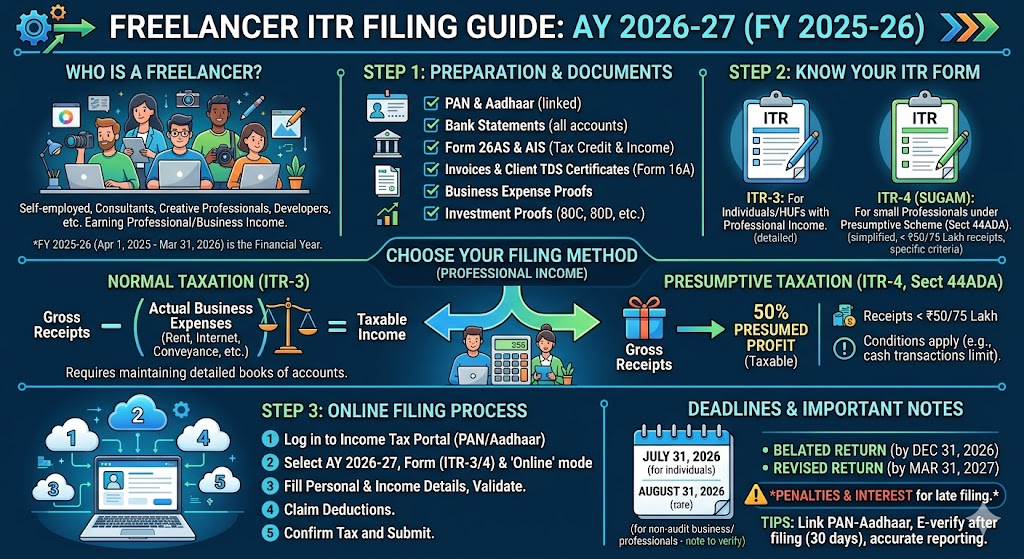
    • ITR-4 (Sugam): This is the correct form for most freelancers and self-employed professionals who opt for the Presumptive Taxation Scheme under Section 44ADA. If your gross professional receipts are up to ₹75 lakh in FY 2025-26, ITR-4 is your go-to form.
    • ITR-3: If you maintain books of accounts, have multiple income sources (business + capital gains + house property), or your receipts exceed ₹75 lakh, you must file ITR-3.
    • ITR-1 (Sahaj): Not applicable for freelancers. Do not make this common mistake.

    Read our detailed guide on :ITR-1 vs ITR-2 vs ITR-4: Which Form to Fill Based on Your Income Type 2026 to avoid form mismatch errors.


    Understanding Section 44ADA: The Freelancer’s Best Tax Friend

    Section 44ADA of the Income Tax Act is a game changer for freelance professionals such as doctors, lawyers, architects, engineers, designers, content writers, software consultants, and other notified professionals. Under this presumptive taxation scheme for AY 2026-27:

    • 50% of your gross professional receipts is deemed as your net taxable income (profit).
    • You do not need to maintain detailed books of accounts.
    • No requirement for a tax audit (unless you declare profit lower than 50% and your income exceeds the basic exemption limit).
    • The gross receipt limit for Section 44ADA is ₹75 lakh for FY 2025-26.

    Example: If a freelance graphic designer earned ₹12 lakh in FY 2025-26, only ₹6 lakh (50%) is treated as taxable income. After applying the standard deduction of ₹75,000 under the new tax regime, the effective taxable income drops further, making Section 44ADA an exceptionally tax-efficient route.


    Advance Tax for Freelancers: Deadlines You Cannot Miss in FY 2026-27

    One of the most overlooked compliance areas for freelancers is advance tax. Since no TDS is deducted on most freelance payments (or TDS is deducted at a lower rate), you are required to pay advance tax if your total tax liability exceeds ₹10,000 in a year.


    Advance Tax Due Dates FY 2026-27 for Freelancers:

    • 15th June 2026: Pay at least 15% of total estimated tax
    • 15th September 2026: Cumulative 45% of total estimated tax
    • 15th December 2026: Cumulative 75% of total estimated tax
    • 15th March 2027: 100% of total estimated tax

    Important: Freelancers opting for Section 44ADA can pay 100% advance tax in one installment by 15th March a significant compliance relief compared to regular businesspersons.

    Missing advance tax deadlines attracts interest under Sections 234B and 234C of the Income Tax Act. Read our detailed guide on Advance Tax Due Dates FY 2026-27 for complete installment schedules and penalty calculations.


    Smart Tax Deductions Every Freelancer Must Claim in AY 2026-27

    Even if you opt for Section 44ADA, certain deductions are still available to freelancers that can significantly reduce your final tax liability. According to guidelines from the Income Tax Department, the following deductions apply:

    • Standard Deduction of ₹75,000 under the new tax regime (from FY 2025-26 onwards)
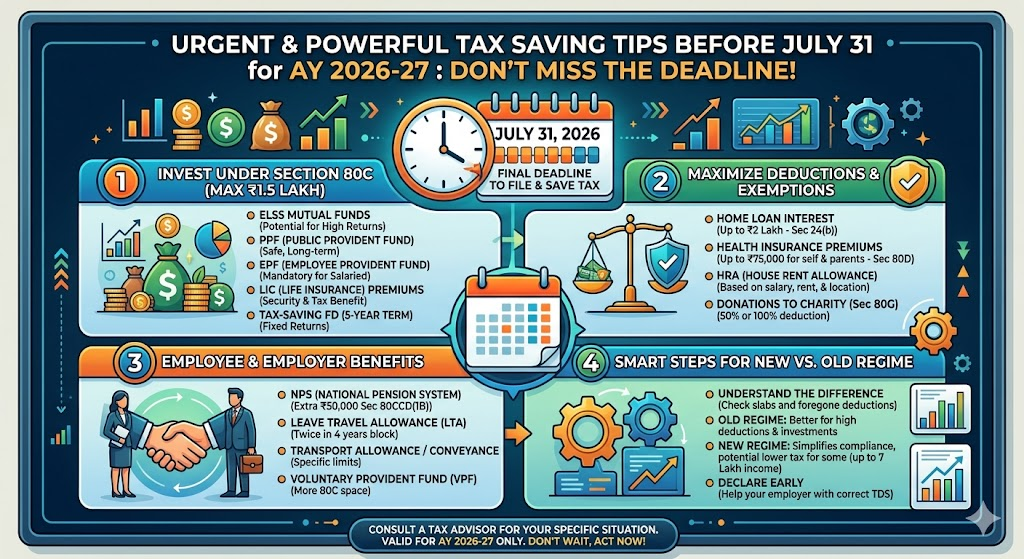
    • Section 80C: Up to ₹1.5 lakh via PPF, ELSS, LIC, NSC applicable only under the old regime
    • Section 80D: Health insurance premium for self and family
    • Section 80CCD(1B): Additional ₹50,000 via NPS contribution available under old regime
    • Home loan interest under Section 24(b) if applicable

    If you are under the old tax regime: Learn more about our Tax Planning Service to identify the most beneficial deductions for your specific income profile.

    Dr. Haresh Adwani, a practising chartered accountant and founder of Adwani & Co LLP, advises freelancers to carefully model both old and new tax regimes before AY 2026-27 filing, especially given the enhanced standard deduction under the new regime.

    Read our detailed guide on Old vs New Tax Regime 2026 for a personalised calculation.


    Step-by-Step: How to File Freelancers ITR for Online for AY 2026-27

    Here’s a simplified step-by-step filing process for freelancers ITR in India following the workflow outlined on incometax.gov.in:

    Step 1 : Collect Your Financial Records: Gather all invoices raised, payments received, TDS certificates (Form 16A), and your bank statements for FY 2025-26.

    Step 2 : Download and Verify Form 26AS & AIS: Log in to the Income Tax portal. Match your TDS credits, high-value transactions, and income details. Any mismatch here is a red flag. Read our detailed guide on Form 26AS vs AIS vs TIS: Key Differences & How to Match Them Before Filing ITR.

    Step 3 : Choose Your Tax Regime: Decide between old and new tax regime. For most freelancers earning under ₹15 lakh without major deductions, the new regime is now more favourable.

    Step 4 : Select ITR-4 (If Section 44ADA Applies): Login to incometax.gov.in → e-File → Income Tax Returns → File Income Tax Return → Select AY 2026-27 → ITR-4.

    Step 5 : Fill in Income Details: Under the ‘Business/Profession’ schedule in ITR-4, enter your gross receipts and declare 50% as profit under 44ADA.

    Step 6 : Claim Deductions & Compute Tax: Enter eligible deductions and let the system compute your final tax payable.

    Step 7 : Pay Self-Assessment Tax (If Any): If tax is payable after TDS and advance tax, pay it via Challan 280 before filing.

    Step 8 : Verify and Submit: e-Verify via Aadhaar OTP, net banking, or DSC. Your ITR is filed!

    Read our detailed guide on How to File ITR Online 2026: Step-by-Step Guide for Salaried & Freelancers for a more detailed walkthrough with screenshots.


    GST Registration for Freelancers: Do You Need It?

    A frequently misunderstood area for freelancers is GST compliance. Under current GST rules:

    • GST registration is mandatory if your aggregate turnover exceeds ₹20 lakh (₹10 lakh for special category states) in a financial year.
    • If you provide services to clients outside India (export of services), you are exempt from GST but registration may still be beneficial for claiming refunds on input tax credits.
    • Freelancers registered under GST must file GSTR-1 and GSTR-3B returns regularly.

    Non-compliance with GST obligations can attract notices under the GST portal (gstn.gov.in). Learn more about our GST Compliance Service to stay audit-proof.

    Key Takeaways


    What Every Freelancer Must Remember for AY 2026-27

    • File ITR-4 if your gross professional receipts are up to ₹75 lakh Section 44ADA makes it simple.
    • Only 50% of your gross receipts is taxable under Section 44ADA a powerful built-in deduction.
    • Pay advance tax on time to avoid interest under Sections 234B and 234C.
    • Verify Form 26AS and AIS before filing mismatches can trigger scrutiny notices.
    • The ITR filing last date for AY 2026-27 (non-audit cases) is 31st July 2026 file on time to avoid penalties.
    • GST registration is mandatory once your annual receipts cross ₹20 lakh.

    Frequently Asked Questions (FAQs)

    Q1. Which ITR form should a freelancer file for AY 2026-27?

    Most freelancers should file ITR-4 (Sugam) if their gross receipts are up to ₹75 lakh and they opt for the presumptive taxation scheme under Section 44ADA. ITR-3 applies if receipts exceed this limit or if books of accounts are maintained.

    Q2. What is Section 44ADA and who is eligible in AY 2026-27?

    Section 44ADA allows notified professionals (doctors, lawyers, engineers, consultants, designers, etc.) to declare 50% of gross receipts as taxable income without maintaining books. Eligibility requires gross professional receipts of up to ₹75 lakh in FY 2025-26.

    Q3. Do freelancers need to pay advance tax for FY 2026-27?

    Yes, if total tax liability exceeds ₹10,000 in the year. Freelancers under Section 44ADA enjoy the benefit of paying 100% of advance tax in a single installment by 15th March 2027, unlike regular taxpayers who pay in four installments.

    Q4. Is GST registration mandatory for all freelancers in India?

    GST registration is mandatory only if your aggregate annual turnover exceeds ₹20 lakh (₹10 lakh in special category states). Freelancers providing export services to foreign clients are generally exempt but may benefit from voluntary GST registration for ITC refunds.

    Q5. What is the last date for freelancer ITR filing for AY 2026-27?

    The due date for ITR filing AY 2026-27 for non-audit cases (including most freelancers under Section 44ADA) is 31st July 2026. A late filing fee of up to ₹5,000 under Section 234F applies if you miss this deadline.

    Conclusion: File Right, Save More, Stay Compliant

    Freelancing gives you freedom and with the right tax knowledge, it also gives you the freedom to keep more of what you earn. The ITR filing process for freelancers in India for AY 2026-27 is far more streamlined than most people think, especially with the powerful benefits of Section 44ADA and the new tax regime.

    The key is to start early: reconcile your Form 26AS and AIS now, decide your tax regime, calculate your advance tax liability, and file before the 31st July 2026 deadline. Don’t let procrastination convert a simple filing into a panic-driven exercise with penalties.

    🚀 Need Expert Help with Your Freelancer ITR? Stop second-guessing your taxes. Connect with the experts at itradvisor.in today for personalised guidance on freelancer ITR filing, Section 44ADA, advance tax planning, and GST compliance — all in one place. 👉 Visit itradvisor.in | Expert Tax Guidance. Zero Confusion.

  • Received a Notice for High-Value Transactions? Here’s How to File Your ITR Correctly and Avoid Costly Mistakes for AY 2026-27

    Received a Notice for High-Value Transactions? Here’s How to File Your ITR Correctly and Avoid Costly Mistakes for AY 2026-27

    Nidhi Adwani April 2026 7 min read

    Received a Notice for High-Value Transactions? Don’t Ignore It.

    Many taxpayers are shocked when they receive a compliance notice from the Income Tax Department despite believing they have done nothing wrong.

    A common reaction is:

    I paid tax on my salary. Why am I getting a notice for my bank transactions?”

    The answer often lies in high-value transactions reported to the Income Tax Department through various financial institutions.

    Today, banks, mutual funds, registrars, property authorities, and financial institutions report specified transactions directly to the department.

    If your Income Tax Return (ITR) does not adequately explain these high value transactions, you may receive a notice seeking clarification.

    The good news?

    A notice does not automatically mean tax evasion or wrongdoing.

    However, incorrect reporting can lead to tax demands, scrutiny, penalties, and prolonged compliance issues.

    Let’s understand what triggers these notices and how to file your return correctly.


    What Are High-Value Transactions?

    High-value transactions are significant financial activities that are reported to the Income Tax Department through various reporting mechanisms.

    These high value transactions become visible in:

    • Annual Information Statement (AIS)
    • Taxpayer Information Summary (TIS)
    • Specified Financial Transaction (SFT) reports

    The department compares this information with the income reported in your ITR.

    Any inconsistency can trigger automated compliance checks.


    Common High-Value Transactions That Can Trigger Notices

    1.Large Cash Deposits in Bank Accounts

    Large cash deposits frequently attract scrutiny, especially when the declared income does not support the deposited amount.

    Common situations include:

    • Business cash deposits
    • Sale proceeds received in cash
    • Agricultural income claims
    • Cash savings accumulated over time

    If the source is not properly explained, notices may follow.

    2.High Credit Card Spending

    Many taxpayers are surprised to learn that significant credit card expenditure may be reported.

    The department may seek clarification when spending appears inconsistent with reported income.

    For example:

    • Salary income of ₹8 lakh
    • Credit card expenditure of ₹18 lakh

    Such mismatches can trigger questions.

    3. Property Purchases

    Real estate transactions are closely monitored.

    The department may compare:

    • Purchase value
    • Source of funds
    • Loan information
    • Reported income

    Property transactions often trigger scrutiny when funding sources are unclear.

    4. Mutual Fund Investments

    Large mutual fund investments are frequently reported through financial institutions.

    Common issues include:

    • Investments not matching declared income
    • Redemption transactions omitted from ITR
    • Capital gains not reported

    Many taxpayers mistakenly believe only profits need reporting.

    5.Share Market Transactions

    With increasing participation in stock markets, this has become one of the most common reasons for notices.

    Typical mistakes include:

    • Not reporting capital gains
    • Ignoring loss transactions
    • Missing dividend income
    • Incorrect tax calculations

    6.Foreign Travel and Overseas Spending

    High overseas expenditure may sometimes attract attention if the reported income appears insufficient to support the expenses incurred.

    7. Fixed Deposits and Interest Income

    Many taxpayers invest substantial sums in fixed deposits but forget to disclose the resulting interest income.

    Since banks report information directly, such mismatches are easily identified.


    What Is AIS and Why Is It So Important?

    AIS (Annual Information Statement) has become one of the most important documents for taxpayers.

    It contains information relating to:

    • Bank interest
    • Dividend income
    • Securities transactions
    • Mutual fund transactions
    • Property transactions
    • Tax deducted at source (TDS)
    • Foreign remittances
    • High-value financial activities

    Many notices today arise because taxpayers file returns without reviewing AIS.

    Also Read: How a Smart AIS Review Before Filing ITR Can Save Salaried Taxpayers from Costly Income Tax Notices in AY 2026-27https://itradvisor.in/blog/smart-ais-review-before-filing-itr


    What Is SFT Reporting?

    SFT stands for Specified Financial Transaction.

    Various institutions are required to report certain transactions to the Income Tax Department.

    These reports help the department verify whether financial activities align with declared income.

    SFT reporting has significantly increased transparency and reduced the possibility of undisclosed transactions remaining unnoticed.


    The Biggest Mistake Taxpayers Make

    The most common mistake is filing an ITR based only on:

    • Form 16
    • Salary details
    • TDS certificates

    Without checking:

    • AIS
    • Form 26AS
    • Capital gains reports
    • Mutual fund statements
    • Bank interest income

    This often leads to avoidable notices.


    How to File Your ITR Correctly If You Have High-Value Transactions

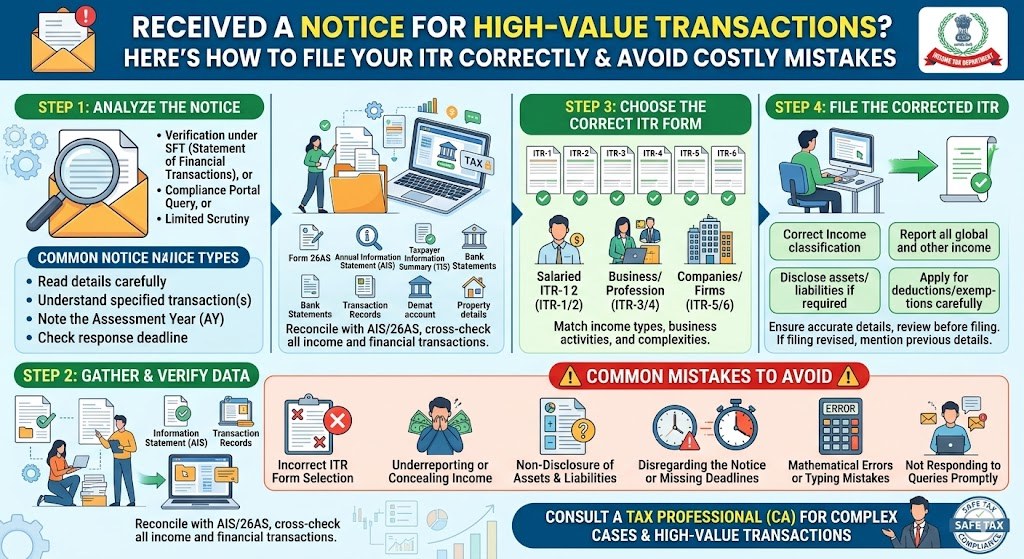
    Step 1: Download and Review AIS

    Before filing:

    ✔️ Review all transactions appearing in AIS

    ✔️ Verify accuracy

    ✔️ Check whether any transaction appears unfamiliar

    Step 2: Reconcile Income Sources

    Match:

    • Salary income
    • Interest income
    • Dividend income
    • Capital gains
    • Rental income
    • Business income

    with AIS and Form 26AS.

    Step 3: Report Capital Gains Properly

    Many taxpayers report only profits and ignore losses.

    This is a mistake.

    All relevant transactions should be reported appropriately.

    Step 4: Maintain Documentation

    Keep records of:

    • Property purchases
    • Loan statements
    • Mutual fund investments
    • Bank transactions
    • Gift deeds
    • Sale agreements

    Proper documentation helps support explanations if required.

    Step 5: Choose the Correct ITR Form

    Selecting the wrong ITR form can create compliance issues.

    A professional review is particularly important where multiple income sources exist.


    Real-Life Example

    A salaried employee earning ₹16 lakh annually filed his own return.

    He reported:

    ✔️ Salary income

    But forgot to report:

    ❌ Mutual fund redemption

    ❌ Dividend income

    ❌ Fixed deposit interest

    All these transactions appeared in AIS.

    A compliance notice was subsequently issued seeking clarification.

    The matter was resolved, but only after additional effort, documentation, and correspondence.

    Most importantly, the notice could have been avoided through proper review before filing.


    Frequently Asked Questions

    1.Does a high-value transaction always lead to a notice?

    No. However, transactions that are inconsistent with reported income may attract scrutiny.

    2.What should I do if a transaction in AIS is incorrect?

    The discrepancy should be reviewed carefully and appropriate action should be taken before filing the return.

    3.Can cash deposits trigger an income tax notice?

    Yes. Large cash deposits are among the most common reasons for notices

    4.Are mutual fund transactions reported to the Income Tax Department?

    Yes. Certain investment and redemption transactions may appear in AIS and related reporting systems.

    5. Should I file my return based only on Form 16?

    No. AIS, Form 26AS, capital gains statements, and other relevant information should also be reviewed.

    Warning Signs You Should Not Ignore

    Consider professional assistance if:

    ⚠️ Your AIS contains unfamiliar entries

    ⚠️ You purchased property during the year

    ⚠️ You redeemed mutual funds

    ⚠️ You traded in shares

    ⚠️ You made substantial cash deposits

    ⚠️ Your credit card expenditure is significantly high

    ⚠️ You received an income tax notice

    ⚠️ You have multiple income sources


    Need Help Understanding Your AIS or High-Value Transactions?

    Every year, thousands of taxpayers receive notices because they file returns without understanding what the Income Tax Department already knows through AIS and SFT reporting.

    At Adwani & Co. | ITR Advisor, we help taxpayers:

    ✅ Review AIS and TIS

    ✅ Analyze high-value transactions

    ✅ Report capital gains correctly

    ✅ File accurate ITRs

    ✅ Respond to notices

    ✅ Reduce the risk of future scrutiny

    ✅ Reconcile AIS with income disclosures


    Book an AIS & ITR Review Before Filing

    If your AIS shows transactions you don’t understand, don’t guess.

    A single reporting mistake can lead to notices, delays, additional tax demands, and unnecessary stress.

    Our experts can review your AIS, explain the transactions, identify potential issues, and help you file your return correctly.

    📞 Contact Adwani & Co. today for a professional AIS review and error-free ITR filing

  • Salary Above ₹10 Lakh? Don’t File Your ITR Until You Check These 12 Tax-Saving Opportunities

    Salary Above ₹10 Lakh? Don’t File Your ITR Until You Check These 12 Tax-Saving Opportunities

    Nidhi Adwani June 2026 6min Read

    Many salaried employees assume that once TDS has been deducted by their employer, there is little they can do to save tax.

    That assumption often results in taxpayers paying more tax than legally required.

    Every year, we meet salaried professionals earning ₹10 lakh, ₹20 lakh, ₹30 lakh or even higher salaries who miss important deductions, exemptions, and disclosures while filing their Income Tax Return (ITR).

    The result?

    • Higher tax outgo
    • Reduced refunds
    • Incorrect return filing
    • Future notices due to reporting mistakes

    Before filing your ITR for AY 2026-27, review these 12 important tax-saving opportunities.

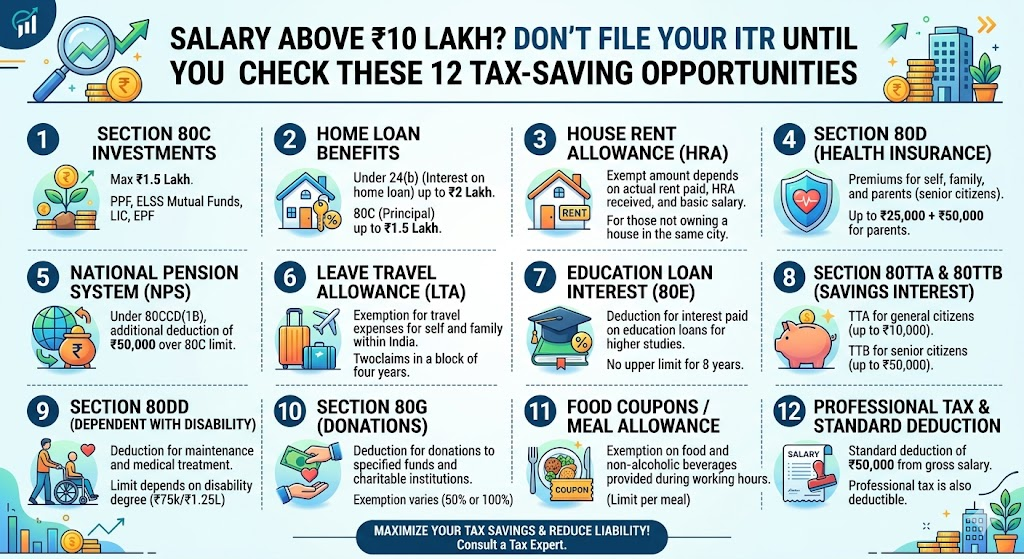
    1.Section 80C Investments : Up to ₹1.5 Lakh Deduction

    Under the Old Tax Regime, Section 80C remains one of the most popular deductions.

    Eligible investments include:

    • Employee Provident Fund (EPF)
    • Public Provident Fund (PPF)
    • ELSS Mutual Funds
    • Life Insurance Premium
    • Tax Saving Fixed Deposits
    • Principal Repayment of Home Loan
    • Sukanya Samriddhi Yojana

    Many taxpayers invest throughout the year but forget to claim the full deduction while filing.

    2.Health Insurance Premium : Section 80D

    Health insurance can provide valuable tax benefits.

    Deduction limits generally include:

    • Self and family
    • Parents
    • Senior citizen parents

    Many salaried individuals fail to claim premiums paid for parents.

    This often results in avoidable tax payments.

    3.Home Loan Interest Deduction

    If you have a housing loan for a self-occupied property, interest paid may qualify for deduction under applicable provisions of the Income Tax Act.

    Common mistakes include:

    • Claiming incorrect amounts
    • Ignoring co-borrower benefits
    • Not collecting annual interest certificates

    4. House Rent Allowance (HRA)

    Even high-income salaried employees frequently make HRA mistakes.

    Common issues include:

    • Incorrect rent calculations
    • Missing landlord PAN details
    • Not maintaining rent receipts

    A properly computed HRA claim can significantly reduce taxable income.

    5.National Pension System (NPS) Benefits

    NPS offers additional tax-saving opportunities beyond Section 80C.

    Many salaried taxpayers overlook employer contributions and available deductions while filing their return.

    A review of salary structure often reveals missed tax benefits.

    6. Interest Income Deductions

    Interest earned from:

    • Savings accounts
    • Fixed deposits
    • Recurring deposits

    must be reported correctly.

    While reporting is mandatory, certain deductions may be available under applicable provisions.

    Many taxpayers either forget to disclose interest income or fail to claim eligible deductions.

    7.Education Loan Interest

    Interest paid on education loans may qualify for deduction subject to conditions.

    This benefit is often missed by:

    • Young professionals
    • Working executives
    • Parents servicing eligible education loans

    8.Donations Under Section 80G

    Donations made to eligible institutions may qualify for tax deductions.

    Before claiming:

    ✔️ Verify registration details

    ✔️ Maintain donation receipts

    ✔️ Ensure compliance with applicable rules

    Incorrect claims can trigger scrutiny.

    9.Leave Travel Allowance (LTA)

    Employees receiving LTA often forget to claim eligible exemptions.

    Important considerations include:

    • Travel documentation
    • Eligible family members
    • Conditions prescribed under tax laws

    Review your salary structure before filing your return.

    10.Additional Benefits for Homeowners

    Apart from standard housing loan benefits, taxpayers may be eligible for additional deductions depending on circumstances and applicable provisions.

    Professional review can help identify opportunities often missed in self-filed returns.

    11. Choosing the Right Tax Regime

    One of the biggest mistakes today is selecting the wrong tax regime.

    Many taxpayers automatically accept the regime chosen by their employer without performing a proper comparison.

    A detailed tax computation can determine whether:

    12. Reviewing AIS Before Filing ITR

    This is perhaps the most overlooked step.

    Before filing:

    • ✔️ Download AIS
    • ✔️ Review interest income
    • ✔️ Verify dividend income
    • ✔️ Check mutual fund transactions
    • ✔️ Confirm share transactions
    • ✔️ Match TDS details

    Also Read: How a Smart AIS Review Before Filing ITR Can Save Salaried Taxpayers from Costly Income Tax Notices in AY 2026-27https://itradvisor.in/blog/smart-ais-review-before-filing-itr

    Many notices issued by the Income Tax Department arise due to AIS mismatches.

    • Common Mistakes Salaried Taxpayers Make
    • Every filing season, we frequently see taxpayers making these errors:
    • ❌ Selecting the wrong ITR form
    • ❌ Missing interest income
    • ❌ Ignoring capital gains from shares or mutual funds
    • ❌ Choosing the wrong tax regime
    • ❌ Claiming incorrect deductions
    • ❌ Not reviewing AIS and Form 26AS
    • ❌ Filing returns based solely on Form 16

    These mistakes can lead to:

    • Reduced refunds
    • Additional tax demands
    • Income tax notices
    • Delayed processing

    Case Study:

    How a Salaried Employee Saved Tax Through Proper Review

    A salaried employee earning ₹18 lakh annually approached us after preparing his return independently.

    He believed there was no further tax planning possible because TDS had already been deducted.

    During our review, we identified:

    • Unclaimed health insurance deduction
    • Missed NPS benefits
    • Incorrect tax regime selection
    • Reporting gaps in investment disclosures The result was a significantly improved tax position and a correctly filed return. This is why professional review becomes increasingly valuable as income levels rise. Why High-Income Salaried Employees Should Not Depend Only on Form 16 Form 16 is important, but it is not a complete tax filing document.

    Your return may also need to account for:

    • Bank interest
    • Dividend income
    • Capital gains
    • Foreign assets
    • Rental income
    • Multiple employers
    • ESOP transactions
    • Freelance income
    • Relying only on Form 16 can lead to incomplete reporting.

    Frequently Asked Questions

    1.Is Form 16 sufficient for filing ITR?

    Not always. Additional income and disclosures may also need to be reported

    2.Can incorrect deduction claims trigger a notice?

    Yes. Unsupported or incorrect claims can attract scrutiny from the Income Tax Department.

    3.Is salary above ₹10 lakh taxable under the new regime?

    Yes. Taxability depends on total income, deductions, rebates, and applicable tax provisions.

    4.Should salaried employees choose the old or new tax regime?

    The answer varies from person to person. A tax comparison should be performed before filing.

    5.Can I claim deductions after my employer has deducted TDS?

    In many cases, eligible deductions can still be claimed while filing your return, subject to applicable provisions.

    Need Help Filing Your ITR?

    If your salary income exceeds ₹10 lakh, a professional review can help ensure:

    ✅ Correct tax regime selection

    ✅ Maximum eligible tax benefits

    ✅ Proper AIS reconciliation

    ✅ Accurate reporting of all income

    ✅ Error-free ITR filing

    ✅ Reduced risk of notices

    At Adwani & Co. ITR Advisor, we assist salaried professionals across India with accurate, compliant, and tax-efficient return filing.

    Our Services

    • Salaried ITR Filing
    • Tax Regime Comparison
    • AIS & Form 26AS Review
    • Capital Gains Reporting
    • ESOP Taxation
    • NRI Taxation
    • Notice Assistance
    • Refund Optimization

    Book Your ITR Review Today

    Don’t assume your employer has taken care of everything.

    A professional review before filing can help you avoid costly mistakes and identify tax-saving opportunities that are often overlooked.

    Contact Adwani & Co. today and file your return with confidence.

  • Income Tax Notice After Filing ITR? Here’s What Every Taxpayer Must Know

    Income Tax Notice After Filing ITR? Here’s What Every Taxpayer Must Know

    One of the most common questions taxpayers ask after filing their Income Tax Return (ITR) is

    I have already filed my return. Why did I receive an Income Tax Notice?”

    Receiving a notice from the Income Tax Department can be stressful. However, a notice does not automatically mean you have done something wrong. In many cases, the notice is simply a request for clarification, additional information, or correction of a mismatch.

    Understanding the reason behind the notice and responding appropriately can help avoid unnecessary penalties, interest, and prolonged scrutiny.

    In this guide, we explain the most common reasons for receiving an income tax notice after filing your ITR and the steps you should take.


    Can You Receive an Income Tax Notice Even After Filing Your Return?

    Yes.

    Filing your return does not guarantee that the Income Tax Department will not seek further clarification.

    The department now uses advanced data analytics, AIS (Annual Information Statement), TIS (Taxpayer Information Summary), SFT reporting, bank transaction data, and employer reporting to verify the accuracy of returns.

    Any mismatch or omission can trigger a notice.

    Top 7 Reasons Why Taxpayers Receive Income Tax Notices

    1. Income Reported in AIS Is Missing in ITR

    One of the most common reasons for notices is a mismatch between income reported in AIS and income declared in your return.

    Examples:

    * Interest income from savings accounts

    * Fixed deposit interest

    * Dividend income

    * Capital gains from shares or mutual funds

    * Foreign remittances

    Even small omissions can trigger automated compliance checks.

    2. High-Value Transactions Reported to the Department

    Banks, mutual funds, registrars, and other institutions report specified financial transactions to the Income Tax Department.

    Examples include:

    * Large cash deposits

    * Property purchases

    * Significant mutual fund investments

    * High credit card spending

    * Foreign travel expenses

    If your declared income does not support these transactions, the department may seek clarification.

    3. Claiming Excess Deductions

    Incorrect deduction claims frequently lead to notices.

    Common areas include:

    * Section 80C

    * Section 80D

    * Home loan interest

    * HRA exemption

    * Donations under Section 80G

    Taxpayers should retain documentary evidence supporting every deduction claimed.

    Also Read :Section 80GGC Deduction Disallowance: ITAT Rules That Suspicion Is Not Enough, A Guide for Indian Taxpayers

    4. Mismatch in TDS Details

    Your return should match the information available in:

    * Form 26AS

    * AIS

    * TDS certificates

    Common issues include:

    * Missing TDS credits

    * Incorrect TAN details

    * Employer reporting errors

    * Duplicate TDS claims

    5. Non-Disclosure of Capital Gains

    Many taxpayers assume that no tax liability means no reporting requirement.

    This is incorrect.

    Capital gains arising from:

    * Shares

    * Mutual funds

    * Property sales

    * Gold investments

    must generally be reported even if the tax payable is nil.

    6. Foreign Income or Foreign Assets Not Disclosed

    Residents holding foreign assets or earning foreign income have specific disclosure requirements.

    Examples include:

    * Foreign bank accounts

    * Overseas shares

    * Foreign ESOPs

    * Rental income from foreign properties

    Non-disclosure can attract serious consequences.

    7. Return Selected for Scrutiny

    Sometimes a return is selected for scrutiny based on risk parameters determined by the department.

    Selection does not necessarily imply wrongdoing.

    The department may simply require supportingThe department may simply require supporting documents and explanations.


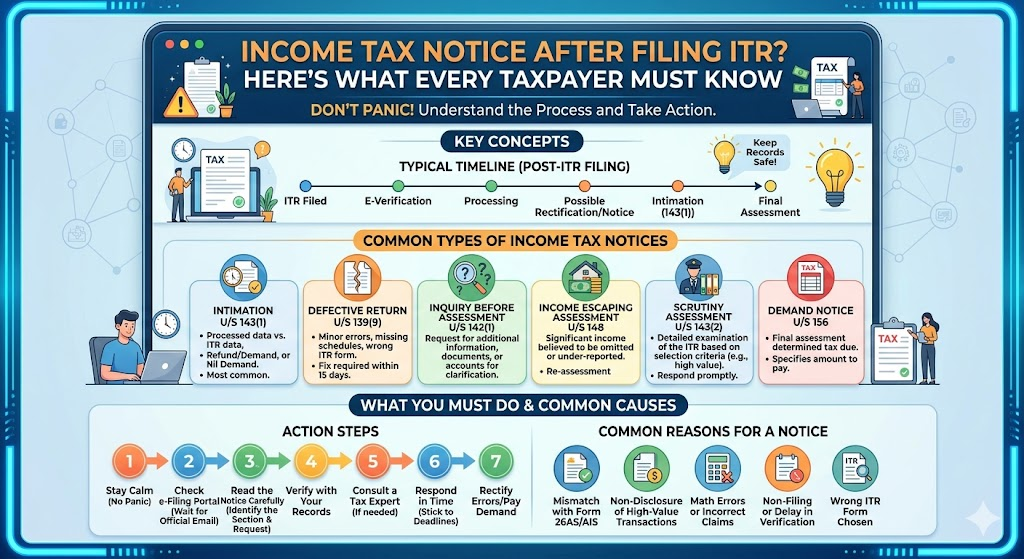
    Types of Income Tax Notices After Filing ITR

    Notice Under Section 143(1)

    This is an intimation generated after processing the return.

    It may indicate:

    * No demand and no refund

    * Refund due

    * Additional tax payable

    This is not necessarily a scrutiny notice.

    Notice Under Section  139(9)

    This is issued when the return is considered defective.

    Examples:

    * Missing schedules

    * Incorrect reporting

    * Incomplete information

    Timely correction can resolve the issue.

    Notice Under Section 143(2)

    This indicates that the return has been selected for detailed scrutiny.

    Taxpayers may be required to provide:

    * Bank statements

    * Investment proofs

    * Income records

    * Supporting documents

    Notice Under Section 148

    Issued when the department believes income may have escaped assessment.

    Such notices should be handled carefully and preferably with professional assistance.

    Read our Article: Income Tax Notice India 2026: Every Section Explained What It Means and How to Respond


    What Should You Do If You Receive an Income Tax Notice?

    Step 1: Read the Notice Carefully

    Do not panic.

    Identify:

    * Notice section

    * Assessment year

    * Response deadline

    * Information requested

    Step 2: Verify the Notice

    Check the notice through your Income Tax portal account.

    Ensure it is genuine and not a phishing attempt.

    Step 3: Gather Supporting Documents

    Depending on the notice, collect:

    * Form 16

    * Form 26AS

    * AIS

    * Bank statements

    * Investment proofs

    * Capital gain statements

    * Property documents

    Step 4: Respond Before the Deadline

    Ignoring notices can result in:

    * Additional tax demands

    * Penalties

    * Prosecution in serious cases

    Timely response is critical.

    Step 5: Seek Professional Advice

    Complex notices involving:

    * Capital gains

    * Foreign assets

    * High-value transactions

    * Reassessment proceedings

    should be reviewed by a qualified tax professional.


    How to Avoid Income Tax Notices in Future

    Before filing your return:

    ✅ Review AIS thoroughly

    ✅ Match Form 26AS with Form 16

    ✅ Report all bank interest

    ✅ Disclose capital gains

    ✅ Verify deductions

    ✅ Report foreign assets where applicable

    ✅ Maintain proper documentation

    A careful review before filing can significantly reduce the risk of future notices.


    Real-Life Example

    A salaried employee earning ₹18 lakh annually filed his return independently.

    He reported salary income correctly but forgot to disclose:

    * Savings account interest

    * Fixed deposit interest

    * Dividend income

    These entries appeared in AIS but not in the return.

    The department later issued a compliance notice seeking clarification.

    The issue was resolved through revised reporting, but the taxpayer experienced avoidable stress and delays.

    Frequently Asked Questions (FAQs)

     1.Is an income tax notice always bad news?

    No. Many notices are routine communications seeking clarification or correction.

    2.Can I ignore an income tax notice?

    No. Every notice should be reviewed and responded to appropriately.

    3.How long do I have to respond?

    The deadline depends on the specific notice. Always check the notice carefully.

    4.Can I revise my return after receiving a notice?

    In many situations, corrective action or revised filing may be possible, subject to applicable provisions.
     

    5.Can a CA help me respond to a notice?

    Yes. Professional guidance can help ensure accurate and timely compliance.

    About Author

    Dr. Haresh Adwani holds a PhD in Commerce and brings over 20 years of expertise in GST compliance, income tax advisory, FEMA, and corporate law. Services include GST audit, ITR filing, GST appeal representation, notice response, NRI taxation, and FEMA compliance.

    Need Help With an Income Tax Notice?

    Received an Income Tax Notice after filing your ITR?

    Our team at Adwani & Co. / ITR Advisor assists taxpayers across India with:

    * Income Tax Notice Replies

    * AIS & TIS Mismatch Review

    * Defective Return Notices

    * Scrutiny Assessments

    * Capital Gains Reporting

    * NRI Taxation Issues

    * Revised Return Filing

    Get your notice reviewed by our experts before responding.

  • Capital Gain Tax on Mutual Funds : Complete Guide for AY 2026-27

    Capital Gain Tax on Mutual Funds : Complete Guide for AY 2026-27

    If you have invested in mutual funds and redeemed or switched units during FY 2025-26, capital gains taxation is something you cannot afford to ignore at ITR filing time.

    The rules around mutual fund capital gains tax in India have changed significantly over the last two years. The Finance Act 2023 removed the indexation benefit for debt mutual funds. The Finance Act 2024 revised LTCG and STCG rates for equity funds. For AY 2026-27, understanding these updated rules is critical to accurate filing and avoiding income tax notices.

    This guide explains the complete taxation framework for mutual fund capital gains covering equity funds, debt funds, hybrid funds, international funds, tax harvesting strategies, ITR reporting, and AIS compliance in plain, practical terms.


    What Are Capital Gains on Mutual Funds?

    When you redeem, switch, or sell mutual fund units, any profit you earn over your purchase cost (cost of acquisition) is called a capital gain. This gain is taxable under the head ‘Capital Gains’ as per the Income Tax Act, 1961.

    Capital gains from mutual funds are classified based on two factors:

    • Type of fund : equity-oriented or non-equity (debt, international, hybrid)
    • Holding period : duration from purchase date to redemption date

    Importantly, switching between schemes even within the same fund house is treated as a redemption and triggers capital gains. Similarly, receiving units via dividend reinvestment can have cost and holding period implications.

    Common misconception: Many investors believe that switching from a growth plan to a direct plan, or from regular to direct, is not taxable. It is. Any switch or transfer of units is a redemption in the eyes of the Income Tax Department and generates capital gains or losses.


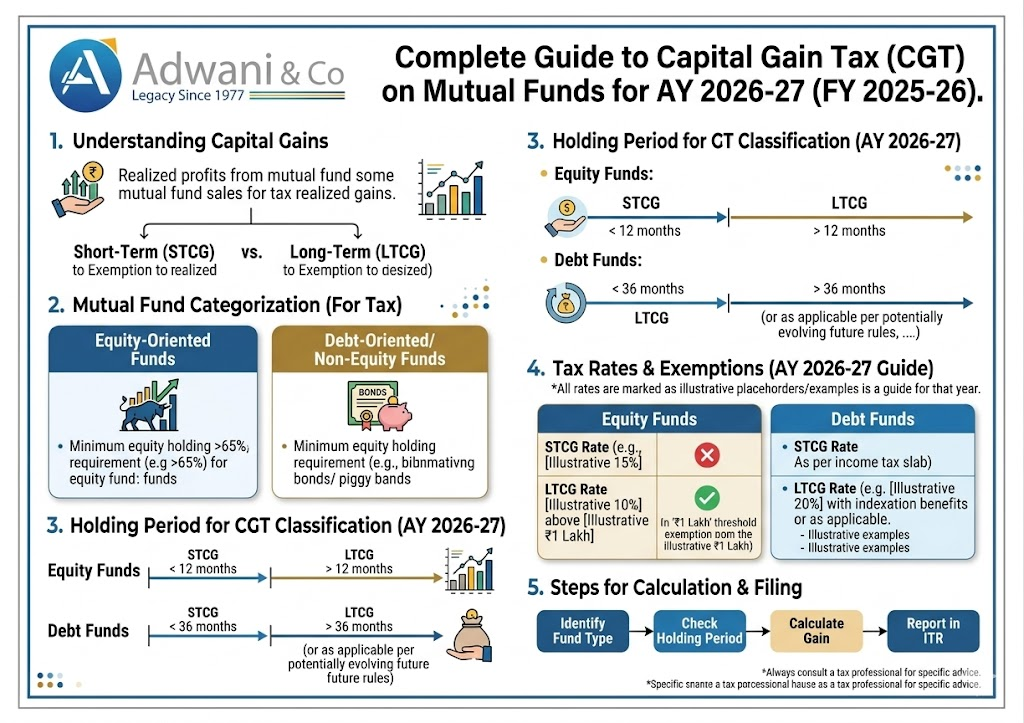
    Short-Term vs Long-Term Capital Gains: Holding Period Rules

    The boundary between short-term capital gains (STCG) and long-term capital gains (LTCG) depends on the type of mutual fund.

    Fund TypeShort-Term Holding PeriodLong-Term Holding Period
    Equity Mutual Funds (equity exposure ≥65%)12 months or lessMore than 12 months
    Debt Mutual Funds (equity exposure <35%)36 months or less (old rule) All periods post Apr 2023More than 36 months (old rule) No LTCG benefit post Apr 2023
    Hybrid / Balanced Advantage Funds (equity 35%-65%)24 months or lessMore than 24 months
    International / Overseas Funds (equity <35%)24 months or less (old rule) All periods post Apr 2023More than 24 months (old rule) No LTCG benefit post Apr 2023
    Fund of Funds (domestic equity)12 months or lessMore than 12 months
    Gold ETFs / Gold Funds24 months or lessMore than 24 months

    Note: Post Finance Act 2023: For debt mutual funds and overseas funds purchased on or after 1 April 2023, there is no distinction between STCG and LTCG all gains are taxed at income tax slab rates regardless of holding period.

    Capital Gain Tax Rates on Mutual Funds for AY 2026-27

    The Finance Act 2024 revised the capital gains tax rates applicable from 23 July 2024 onwards. These revised rates apply fully to FY 2025-26 returns filed as AY 2026-27.

    Equity Mutual Funds (Equity Exposure ≥ 65%)

    Gain TypeHolding PeriodTax Rate (AY 2026-27)Exemption Limit
    Short-Term Capital Gain (STCG)Up to 12 months20% (flat) + surcharge + cessNil
    Long-Term Capital Gain (LTCG)More than 12 months12.5% (flat) + surcharge + cessRs. 1.25 lakh per year (aggregate)

    Budget 2024 Change: STCG rate on equity was raised from 15% to 20%. LTCG rate was raised from 10% to 12.5%. The exemption limit was raised from Rs. 1 lakh to Rs. 1.25 lakh. These changes apply to transactions on or after 23 July 2024.

    Debt Mutual Funds (Post 1 April 2023 Purchases)

    Purchase DateTax TreatmentApplicable Rate
    Purchased before 1 April 2023 (held >36 months)LTCG with indexation20% with indexation benefit
    Purchased before 1 April 2023 (held ≤36 months)STCGIncome tax slab rate
    Purchased on or after 1 April 2023 (any holding period)Taxed as ordinary incomeIncome tax slab rate (no indexation, no LTCG benefit)

    Note: The Finance Act 2023 removed the LTCG benefit and indexation for debt mutual funds purchased on or after 1 April 2023. This fundamentally changed debt fund tax efficiency versus fixed deposits.

    Hybrid & Other Fund Categories

    Fund CategoryEquity ExposureSTCG RateLTCG RateIndexation
    Aggressive Hybrid (≥65% equity)≥65%20%12.5% above Rs. 1.25LNo
    Conservative Hybrid / Debt-oriented Hybrid<35% equitySlab rateSlab rate (post Apr 2023)No (post Apr 2023)
    Balanced Advantage Fund (35-65% equity)35-65%20% or slab12.5% or slabDepends on equity exposure
    International / Overseas FundsForeign equitySlab rateSlab rate (post Apr 2023)No (post Apr 2023)
    Gold ETF / Gold FundNo equitySlab rate (≤24 months)12.5% (>24 months, no indexation post 2024)No (post 2024)
    Fund of Funds – Domestic Equity≥90% in equity MFs20%12.5% above Rs. 1.25LNo

    What Is Indexation Benefit and Who Can Still Claim It?

    Indexation allows you to inflate your purchase cost using the Cost Inflation Index (CII) notified by the Income Tax Department each year. This reduces your effective capital gain and therefore your tax liability.

    Post the Finance Act 2024 amendments, indexation for most asset classes has been modified. For mutual funds specifically:

    • Equity mutual funds: Never had indexation benefit tax at flat rates
    • Debt mutual funds purchased before 1 April 2023 and held for more than 36 months: LTCG with indexation at 20% still applies grandfathered treatment
    • Debt mutual funds purchased on or after 1 April 2023: No indexation, taxed at slab rates regardless of holding
    • Gold funds and FoFs: Post Finance Act 2024, the 20% with indexation benefit for long-term gains has been replaced with 12.5% without indexation
    Asset ClassPre-1 April 2023 Purchases (Long-term)Post-1 April 2023 Purchases
    Debt Mutual Funds20% with indexation (LTCG >36 months)Slab rate, no indexation
    International Funds20% with indexation (LTCG >36 months)Slab rate, no indexation
    Gold ETF / Gold Funds20% with indexation (LTCG >24 months)12.5% without indexation (LTCG >24 months)
    Equity Mutual Funds12.5% without indexation (LTCG >12 months)12.5% without indexation (LTCG >12 months)

    Exemptions Available on Mutual Fund Capital Gains

    Rs. 1.25 Lakh LTCG Exemption on Equity Funds

    Under Section 112A of the Income Tax Act, 1961, long-term capital gains from equity-oriented mutual funds are exempt up to Rs. 1.25 lakh per financial year (aggregate across all equity assets including equity MFs, equity shares, equity ETFs, and units of business trusts).

    Only gains exceeding Rs. 1.25 lakh are taxed at 12.5% (without indexation).

    Example: If your total LTCG from equity mutual funds and direct equity shares combined is Rs. 2 lakh in FY 2025-26, your taxable LTCG is Rs. 75,000 (Rs. 2L minus Rs. 1.25L), taxed at 12.5% = Rs. 9,375.

    Section 54F: Capital Gain Exemption on Reinvestment in Residential Property

    If you redeem any long-term capital asset (including mutual fund units classified as long-term, other than a residential house) and reinvest the net consideration in purchasing or constructing a residential house property, you may claim exemption under Section 54F.

    This is particularly useful for investors planning to deploy mutual fund redemption proceeds into real estate.

    Section 54EE and 54EC: Bonds

    Long-term capital gains from mutual funds may also qualify for exemption under Section 54EC by reinvesting up to Rs. 50 lakh in specified NHAI or REC bonds within 6 months of the sale.


    Tax Loss Harvesting: A Practical Strategy for Mutual Fund Investors

    Tax loss harvesting is a strategy where investors intentionally redeem loss-making mutual fund units before the financial year end (March 31) to book losses, which can then be set off against existing capital gains to reduce tax liability.

    How Set-Off Rules Work Under the Income Tax Act

    Type of LossCan Be Set Off AgainstCarry Forward Period
    Short-Term Capital Loss (STCL)STCG or LTCG (any asset)8 years
    Long-Term Capital Loss (LTCL)LTCG only (same or different asset)8 years
    Business LossBusiness income only (not capital gains)8 years
    Speculative LossSpeculative income only4 years

    Key Insight: You can set off your short-term capital losses from poorly performing debt funds against long-term capital gains from equity funds. This cross-asset, cross-category set-off is allowed under the Income Tax Act and is a powerful planning tool.


    Tax Harvesting in Practice: Example

    Situation: Aditya has LTCG of Rs. 3 lakh from equity mutual funds in FY 2025-26. He also has STCL of Rs. 1.5 lakh from an international fund that has underperformed.

    • Taxable LTCG before set-off = Rs. 3 lakh
    • Less: LTCG exemption = Rs. 1.25 lakh
    • Taxable LTCG after exemption = Rs. 1.75 lakh
    • Less: STCL set-off = Rs. 1.5 lakh
    • Net taxable LTCG = Rs. 25,000
    • Tax at 12.5% = Rs. 3,125 (versus Rs. 21,875 without harvesting)

    AIS, Form 26AS and Mutual Fund Capital Gains: Reporting Obligations

    The Annual Information Statement (AIS) on the Income Tax portal now captures all mutual fund transactions reported by RTAs (Registrar and Transfer Agents) such as CAMS and KFintech. This includes purchases, redemptions, switches, SIP and SWP transactions, and dividend payouts.

    Why AIS Mismatches in Mutual Funds Are a Common Notice Trigger

    If your ITR does not reflect the capital gains shown in your AIS, the Income Tax Department’s automated system flags this discrepancy. This is one of the most common reasons salaried individuals who also have mutual fund investments receive notices under Section 143(1)(a) or Section 142(1).

    Common causes of AIS mismatch for mutual fund investors:

    • Not reporting gains from old folio numbers or dormant accounts
    • Switching between direct and regular plans without reporting the resulting gain
    • Not accounting for reinvested dividends (growth option vs IDCW option confusion)
    • Not including gains from ELSS fund redemptions after 3-year lock-in
    • Joint holding gains reported under the first holder’s PAN in AIS

    How to Download Your Capital Gain Statement

    1. Log in to CAMS (camsonline.com) or KFintech (kfintech.com) with your PAN and email
    2. Navigate to ‘Capital Gain Statement’ under the Reports section
    3. Select the financial year FY 2025-26 (1 April 2025 to 31 March 2026)
    4. Download the statement and verify it matches your AIS on incometax.gov.in
    5. For SIPs, each SIP instalment has a different purchase date and cost ensure all are captured

    Which ITR Form to Use for Mutual Fund Capital Gains in AY 2026-27?

    Taxpayer ProfileCorrect ITR Form
    Salaried with only equity MF LTCG (no other capital assets, LTCG ≤Rs. 1.25L)ITR-1 (Sahaj) — if total income ≤Rs. 50L
    Salaried with any capital gains (STCG or LTCG exceeding basic limits)ITR-2
    Business income + capital gains from MFsITR-3
    Presumptive taxation professionals (44ADA) + capital gains from MFsITR-3 (not ITR-4, since ITR-4 cannot report capital gains)
    NRI with Indian mutual fund redemptionsITR-2
    Company or LLPITR-6 or ITR-5 as applicable

    How to Report Mutual Fund Capital Gains in ITR-2

    • Go to Schedule CG (Capital Gains) in ITR-2
    • Equity MF LTCG report under ‘Section 112A’ in Schedule 112A (scrip-wise details required)
    • Equity MF STCG report under ‘Section 111A’
    • Debt MF / other MF gains report under ‘Short-Term Capital Gains taxable at applicable rate’ or LTCG under Section 112
    • Set-off and carry forward report in Schedule CYLA, BFLA, and CFL
    • Use the pre-filled data but always verify against your capital gain statement

    TDS on Mutual Fund Redemptions and Dividends

    TDS on Mutual Fund Dividends (IDCW)

    Under Section 194K of the Income Tax Act, mutual fund houses deduct TDS at 10% on dividend (IDCW) income paid to resident individuals if the aggregate dividend in a financial year exceeds Rs. 5,000. This TDS is reflected in Form 26AS and AIS.

    TDS on Redemptions by NRIs

    For NRI investors, mutual fund redemptions attract TDS as follows:

    Fund TypeSTCG TDS Rate for NRILTCG TDS Rate for NRI
    Equity Mutual Funds20% (was 15% pre-Budget 2024)12.5% (above Rs. 1.25L exemption)
    Debt Mutual Funds (post Apr 2023)Slab rate / 30% for NRIsNo separate LTCG — slab rate
    Other Non-Equity FundsApplicable slab rate / 30%20% with indexation (pre-Apr 2023 purchases)

    The Grandfathering Rule: Equity Mutual Funds Held Before 31 January 2018

    When the government reintroduced LTCG tax on equity mutual funds through the Finance Act 2018, it provided a grandfathering benefit. Gains accrued in equity mutual funds up to 31 January 2018 were protected from taxation.

    If you are still holding equity mutual fund units purchased before 31 January 2018, your cost of acquisition for tax purposes is the higher of:

    • Your actual purchase price
    • The NAV (Net Asset Value) of the fund on 31 January 2018

    This effectively means that all gains up to 31 January 2018 are tax-free under LTCG. Only gains post that date are taxable at 12.5%.

    If you have very old mutual fund folios with units purchased before 2018, your capital gain statement will reflect this grandfathering cost automatically. Ensure your ITR filing uses the correct grandfathered cost basis.


    ELSS Mutual Funds: Tax Deduction + Capital Gains Taxation

    Equity Linked Savings Schemes (ELSS) offer a dual tax benefit deduction under Section 80C (up to Rs. 1.5 lakh) on investment, and long-term capital gains treatment on redemption after the mandatory 3 year lock in.

    AspectELSS Details
    Lock-in period3 years from each SIP instalment date
    Section 80C deductionUp to Rs. 1.5 lakh per year (under old tax regime only)
    LTCG tax rate on redemption12.5% above Rs. 1.25 lakh (same as equity funds)
    STCG possibilityNo lock-in ensures minimum 3-year holding (>12 months = LTCG)
    Reporting in ITRSchedule 112A under Capital Gains scrip-wise detail needed
    Applicable ITR formITR-2 or ITR-3 (not ITR-1 or ITR-4)
    80C deduction new regimeNot available Section 80C deductions not applicable under new tax regime

    Common Mistakes Mutual Fund Investors Make in ITR Filing

    • Filing ITR-1 or ITR-4 despite having capital gains from mutual funds leads to defective return notice
    • Not reporting ELSS redemptions treated as income not disclosed, can trigger scrutiny
    • Not matching AIS with capital gain statement before filing AIS mismatches trigger Section 143(1)(a) notices
    • Missing gains from SWP (Systematic Withdrawal Plans) each SWP withdrawal is a partial redemption taxable as capital gain
    • Ignoring dividend (IDCW) income taxable at slab rate, must be reported under ‘Income from Other Sources’
    • Not reporting losses losses eligible for carry forward are forfeited if not claimed in ITR
    • Treating all mutual fund gains as LTCG STCG from equity funds held under 12 months is taxed at 20%, not 12.5%
    • Not accounting for SIP-wise holding period each SIP instalment has its own purchase date; gains from instalments held <12 months are STCG

    Also Read : ITR 1 vs ITR 2 vs ITR 3 vs ITR 4: The Definitive Guide to Picking the Right Income Tax Return Form for AY 2026-27


    Practical Examples: Calculating Mutual Fund Capital Gains Tax for AY 2026-27

    Example 1 : Salaried Investor with Equity MF Redemption

    Ramesh is a salaried individual earning Rs. 10 lakh per year. In FY 2025-26, he redeemed equity mutual fund units with total LTCG of Rs. 2 lakh and STCG of Rs. 30,000.

    Capital Gain ComponentAmountTax RateTax Payable
    LTCG from equity MFsRs. 2,00,00012.5% above Rs. 1.25L exemptionRs. 9,375 on Rs. 75,000
    STCG from equity MFsRs. 30,00020%Rs. 6,000
    Total MF Capital Gain Tax  Rs. 15,375

    Example 2 : Debt Fund Investor (Post April 2023 Purchase)

    Sunaina purchased debt mutual fund units in June 2023 for Rs. 5 lakh. She redeemed them in December 2025 for Rs. 5.8 lakh (gain of Rs. 80,000). She falls in the 30% tax bracket.

    • No LTCG benefit purchased after 1 April 2023
    • No indexation benefit
    • Rs. 80,000 added to total income and taxed at 30% slab = Rs. 24,000
    • Had she purchased this before 1 April 2023 and held for >36 months LTCG with indexation at 20% could have been applicable

    Example 3 : SIP with Mixed LTCG and STCG

    Priya runs a monthly SIP of Rs. 10,000 in an aggressive hybrid fund (equity ≥65%) since April 2023. She redeemed all units in May 2025.

    • SIP instalments from April 2023 to April 2024 (13 months or more by May 2025): LTCG at 12.5%
    • SIP instalments from May 2024 to April 2025 (held <12 months by May 2025): STCG at 20%
    • Her capital gain statement from CAMS will split this automatically she should not manually aggregate

    Key Takeaways

    • Equity mutual funds: LTCG at 12.5% above Rs. 1.25 lakh (>12 months); STCG at 20% (≤12 months) Finance Act 2024 rates
    • Debt mutual funds purchased after 1 April 2023: taxed at slab rates no LTCG, no indexation benefit
    • Debt funds purchased before 1 April 2023: LTCG with indexation at 20% still applicable if held >36 months
    • Switch, SWP, and plan change transactions are taxable redemption events often missed by investors
    • Tax loss harvesting before 31 March can significantly reduce net capital gains tax liability
    • Short-term losses from any capital asset can be set off against both STCG and LTCG
    • AIS on the Income Tax Portal captures all MF transactions mismatches trigger notices
    • File ITR-2 or ITR-3 for capital gains not ITR-1 or ITR-4
    • NRIs face TDS at source on MF redemptions and must file ITR to claim excess TDS refunds
    • For SIP investments, each instalment has its own holding period and cost use the capital gain statement from CAMS/KFintech

    Frequently Asked Questions (FAQs)

    Q1. What is the LTCG tax rate on equity mutual funds for AY 2026-27?

    Long-term capital gains from equity mutual funds for AY 2026-27 are taxed at 12.5% (without indexation) on gains exceeding Rs. 1.25 lakh in a financial year. This rate was revised upward from 10% by the Finance Act 2024, effective from 23 July 2024. LTCG up to Rs. 1.25 lakh is fully exempt.

    Q2. What is the STCG tax rate on equity mutual funds for AY 2026-27?

    Short-term capital gains from equity mutual funds where units are held for 12 months or less are taxed at a flat rate of 20% under Section 111A of the Income Tax Act. The Finance Act 2024 revised this rate from 15% to 20%, applicable from 23 July 2024.

    Q3. Is there any exemption on capital gains from equity mutual funds?

    Yes. Under Section 112A, LTCG from equity-oriented mutual funds is exempt up to Rs. 1.25 lakh per financial year in aggregate (including gains from equity shares, equity mutual funds, and equity ETFs). Only the amount exceeding Rs. 1.25 lakh is taxed at 12.5%. There is no exemption for STCG from equity mutual funds.

    Q4. Is dividend (IDCW) from mutual funds taxable?

    Yes. Dividend income from mutual funds now called IDCW (Income Distribution cum Capital Withdrawal) is taxable in the hands of the investor at their applicable income tax slab rate under ‘Income from Other Sources’. Mutual fund houses deduct TDS at 10% under Section 194K if aggregate dividend in a financial year exceeds Rs. 5,000 for resident individuals. This TDS appears in Form 26AS.
     

    Q5. How are NRI investments in Indian mutual funds taxed?

    NRIs with investments in Indian mutual funds are subject to the same capital gains tax rates as resident investors, but TDS is deducted at source by the mutual fund house. For equity funds, TDS on STCG is 20% and on LTCG is 12.5%. For debt funds, TDS is at applicable rates. NRIs should file their Indian ITR to reconcile actual tax liability against TDS deducted and claim refunds if excess TDS has been deducted.

    Conclusion:

    Mutual fund capital gains taxation in India has gone through some of its most significant changes in recent memory the Finance Act 2023 and Finance Act 2024 together rewrote the rules for both equity and debt funds. For AY 2026-27, investors need to be particularly careful about the revised LTCG and STCG rates for equity funds, the slab-rate treatment of new debt fund investments, and the correct ITR form to use.

    The good news is that with proper planning tax loss harvesting, use of the Rs. 1.25 lakh LTCG exemption, set-off of losses, and timely filing the overall tax outgo from mutual fund investments can be optimised legally.

    The starting point is always the capital gain statement from your RTA (CAMS or KFintech), reconciled carefully against your AIS. Do this before your ITR filing, not after a notice arrives.

    File on time, report accurately, and claim every benefit you are entitled to. If your portfolio has multiple fund types, SIPs, and switches, professional guidance ensures you don’t leave money on the table — or face unnecessary scrutiny.

    Disclaimer

    ITRAdvisor.in is an educational and informational platform focused on tax awareness and compliance updates. Nothing contained herein should be construed as solicitation or advertisement of professional services. Professional services, where applicable, are rendered in accordance with ICAI guidelines. This article is published on ITRAdvisor.in, a tax and compliance knowledge platform. The content has been reviewed for technical accuracy by professionals associated with Adwani & Co LLP.

    bout the Author
    Dr. Haresh Adwani
    Ph.D. in Commerce | Law Graduate | Managing Partner, Adwani & Co LLP Dr. Haresh Adwani holds a Ph.D. in Commerce and is a qualified Law graduate with over two decades of hands-on experience in GST advisory, direct taxation, and statutory compliance for businesses across Pune and Maharashtra.

  • Late Filing Penalty for AY 2026-27 : Fees, Interest & Consequences

    Late Filing Penalty for AY 2026-27 : Fees, Interest & Consequences

    Every year, lakhs of Indian taxpayers scramble to file their Income Tax Returns just before the deadline. Some miss it. And that’s when things get complicated.

    Missing the ITR filing deadline for AY 2026-27 isn’t just an administrative lapse it has real financial consequences. From a late filing fee under Section 234F to interest under Section 234A, the cost of delay adds up quickly. There’s also the risk of income tax notices, loss of refunds, and the permanent loss of certain tax benefits.

    Whether you’re a salaried employee, freelancer, business owner, or NRI, this guide covers everything you need to know about the late filing penalty for AY 2026-27.


    What Is the ITR Filing Due Date for AY 2026-27?

    The Assessment Year (AY) 2026-27 corresponds to income earned during the Financial Year (FY) 2025-26 from 1 April 2025 to 31 March 2026.

    For most individual taxpayers including salaried employees, freelancers, and small businesses not subject to tax audit the standard due date for filing an ITR is 31 July of the assessment year.

    So for AY 2026-27, the general due date is 31 July 2026.

    Taxpayer CategoryITR Filing Due Date (AY 2026-27)
    Salaried Individuals & HUFs (no audit)31 July 2026
    Businesses requiring tax audit (Section 44AB)31 October 2026
    Companies requiring audit31 October 2026
    Transfer pricing cases (Section 92E)30 November 2026
    Revised Return31 December 2026
    Belated / Late Return (Section 139(4))31 December 2026

    Important: Due dates are subject to CBDT notifications and extensions. Always verify the latest notification on the Income Tax India portal or ITRAdvisor.in before filing.


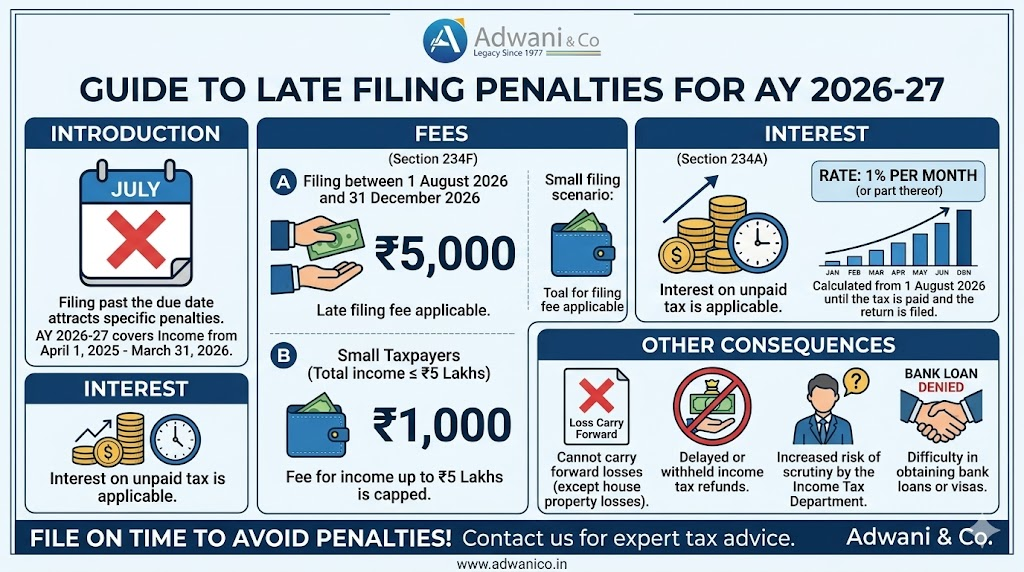
    What Is Section 234F? Late Filing Fee Explained

    Section 234F was inserted into the Income Tax Act, 1961, with effect from AY 2018-19. It introduced a mandatory late filing fee for taxpayers who miss the due date but still want to file a belated return.

    Before Section 234F, there was no direct fee for late filing only interest. The section was introduced to encourage timely compliance.


    Section 234F Late Filing Fee Structure for AY 2026-27

    Filing DateTotal Income Above Rs. 5 LakhTotal Income Up to Rs. 5 Lakh
    On or before 31 July 2026 (due date)NILNIL
    After 31 July 2026 up to 31 Dec 2026Rs. 5,000Rs. 1,000
    After 31 December 2026 (if extended)Rs. 5,000Rs. 1,000

    Key Point: Even if your tax liability is zero or you are eligible for a full refund, the late filing fee under Section 234F still applies unless your total income is below the basic exemption limit (i.e., below Rs. 3 lakh under the new regime for FY 2025-26).


    Who Is Exempt from Section 234F Late Filing Fee?

    • Individuals whose total income is below the basic exemption limit
    • Individuals not required to file ITR under the law (though voluntary filing is advisable)
    • Returns filed within the prescribed due date

    Section 234A : Interest on Late Filing When Tax Is Due

    Section 234F is a fee. But if you also have unpaid tax liability at the time of filing, you will additionally be charged interest under Section 234A of the Income Tax Act.

    How Is Section 234A Interest Calculated?

    • Rate: 1% simple interest per month or part of a month
    • Calculated on the outstanding tax payable (i.e., tax due minus TDS, advance tax, and self-assessment tax paid)
    • Period: From the day after the due date till the date of actual filing or payment

    Example: If you file your ITR on 30 September 2026 (due date 31 July 2026) with Rs. 50,000 outstanding tax, you will pay 2 months of 234A interest = Rs. 1,000. Plus Rs. 5,000 under Section 234F. Total additional outgo: Rs. 6,000.

    Section 234B and 234C: Additional Interest Traps

    If you are required to pay advance tax but haven’t paid it correctly, you may also face:

    • Section 234B –:Interest for default in payment of advance tax (if advance tax paid is less than 90% of the total tax liability)
    • Section 234C Interest for deferment of advance tax instalments
    SectionNature of DefaultInterest RateCalculation Period
    234ALate ITR filing with outstanding tax1% per monthDue date to actual filing date
    234BAdvance tax less than 90% of tax due1% per month1 April to date of filing
    234CUnderestimated advance tax instalments1% per monthPer each instalment default

    Beyond Penalty: Other Consequences of Late ITR Filing

    1. Loss of Carry Forward of Losses

    2. Delay in Income Tax Refund

    3. Inability to Revise the Return

    4. Difficulty in Loan Approvals and Visa Applications

    5. Income Tax Notices for Non-Filing


    What Is a Belated Return? Can You Still File After the Deadline?

    Yes. If you miss the 31 July 2026 due date, you can still file a belated return under Section 139(4) of the Income Tax Act, 1961 up to 31 December 2026.

    A belated return carries the Section 234F fee and applicable interest. However, it is far better to file a belated return than not to file at all.

    What You Can and Cannot Do in a Belated Return

    FeatureOriginal Return (by 31 Jul 2026)Belated Return (by 31 Dec 2026)
    Filing allowedYesYes
    Late filing fee (Section 234F)NilRs. 1,000 or Rs. 5,000
    Carry forward of capital/business lossesAllowedNOT Allowed
    Claim deductions u/s 80C, 80D, etc.AllowedAllowed
    Revision of return u/s 139(5)Allowed (up to 31 Dec 2026)Allowed (up to 31 Dec 2026)
    Refund claimAllowedAllowed (but may be delayed)

    Practical Examples: How the Penalty Adds Up

    Example 1 : Salaried Employee, No Outstanding Tax

    Rajan is a salaried employee with total income of Rs. 8 lakh. His full tax has been deducted at source by his employer. He forgets to file his ITR and files it on 15 September 2026.

    • Section 234F fee: Rs. 5,000 (income above Rs. 5 lakh, filed after 31 July 2026)
    • Section 234A interest: Nil (no outstanding tax payable)
    • Total additional payment: Rs. 5,000

    Example 2 : Freelancer with Outstanding Tax

    Priya is a freelancer with total income of Rs. 12 lakh and advance tax of Rs. 40,000 paid. Total tax liability is Rs. 1,20,000. She files her return on 1 October 2026.

    • Outstanding tax = Rs. 80,000
    • Section 234F fee = Rs. 5,000
    • Section 234A interest = 2 months x 1% x Rs. 80,000 = Rs. 1,600
    • Total additional payment = Rs. 6,600
    • Plus: she cannot carry forward any capital losses (if applicable)

    Example 3 – Low Income Taxpayer

    Sunita is a retired individual with pension income of Rs. 4.5 lakh. She files her return on 20 August 2026.

    • Section 234F fee: Rs. 1,000 (income below Rs. 5 lakh)
    • Section 234A interest: Nil (no outstanding tax after standard deduction)
    • Total additional payment: Rs. 1,000

    Common Mistakes That Lead to Late Filing

    • Waiting for Form 16 to arrive before starting the process
    • Assuming no tax liability means no need to file
    • Not reconciling AIS and Form 26AS before filing, causing last-minute corrections
    • Forgetting to include income from fixed deposits, rental income, or freelance work
    • NRIs not tracking their Indian income sources properly
    • Not updating bank account details, causing failure to receive refunds even after filing
    • Misunderstanding the ITR form applicable to their income type (ITR1 vs ITR2 vs ITR4)
    • Also Read : ITR 1 vs ITR 2 vs ITR 3 vs ITR 4: The Definitive Guide to Picking the Right Income Tax Return Form for AY 2026-27

    How to Avoid Late Filing Penalties: A Practical Checklist

    1. Collect all income documents : Form 16, Form 16A, rental agreements, freelance invoices
    2. Download and reconcile your AIS (Annual Information Statement) from the Income Tax Portal
    3. Verify TDS credit in Form 26AS matches your actual tax deductions
    4. Calculate advance tax liability if you have income beyond salary (freelance, rent, capital gains)
    5. Identify the correct ITR form for your income type
    6. File on or before 31 July 2026 to avoid Section 234F fee
    7. If you discover any errors post-filing, file a revised return by 31 December 2026
    8. If you have capital losses or business losses, timely filing is non-negotiable

    NRI Taxpayers: Special Note on Late Filing

    Non-Resident Indians (NRIs) with income arising in India rent, capital gains from sale of property or securities, interest from NRO accounts are also required to file ITR if their Indian income exceeds the basic exemption limit.

    For NRIs, the same Section 234F fee applies if the return is filed late. Additionally, NRIs dealing with property transactions often receive TDS at higher rates (such as 20%+ on LTCG). If they fail to file returns, excess TDS deducted cannot be claimed as refund.

    If you are an NRI who sold property in India in FY 2025-26, filing your ITR on time is critical to reclaiming excess TDS. A late return not only delays the refund but also attracts Section 234F fee.

    NRIs should also be aware of the 120day rule those who visit India for 120 days or more and whose Indian income exceeds Rs. 15 lakh may be classified as Resident but Not Ordinarily Resident (RNOR), which has separate filing obligations.

    Read our Guide on The 120-Day Rule That Is Silently Taxing Thousands of NRIs in India :Are You at Risk?https://itradvisor.in/blog/the-120-day-rule-silently-taxing-nris

    Key Takeaways

    • File your ITR for AY 2026-27 by 31 July 2026 to avoid late filing fee under Section 234F
    • Late filing fee is Rs. 5,000 for income above Rs. 5 lakh and Rs. 1,000 for income up to Rs. 5 lakh
    • Section 234A interest applies at 1% per month on unpaid taxes from the due date to the filing date
    • Capital losses and business losses cannot be carried forward if the return is filed late
    • Belated returns (up to 31 December 2026) are better than no return at all
    • NRIs must also file returns on time to avoid penalties and claim excess TDS refunds
    • Even nil-tax returns should be filed on time for compliance, refund claims, and loan documentation

    Frequently Asked Questions (FAQs)

    Q1. What is the last date to file ITR for AY 2026-27?

    The last date for filing the original ITR for most individuals (salaried, freelancers, non-audit cases) is 31 July 2026. For belated returns, the deadline is 31 December 2026. Dates may be extended by CBDT via official notification.

    Q2. Is Section 234F applicable if there is no tax liability?

    Yes. Section 234F applies based on whether the return is filed after the due date it is not linked to tax liability. However, if your total income is below the basic exemption limit no fee applies.

    Q3. Can I carry forward capital losses if I file the return late?

    No. If you file your return after the due date, capital losses (both STCG and LTCG losses) and business losses cannot be carried forward to future years. This is one of the most significant financial consequences of late filing. 

    Q4. Is there any penalty for non-filing of ITR (not even a belated return)?

    Yes. Under Section 276CC of the Income Tax Act, willful failure to file an ITR is a criminal offence result ing in imprisonment ranging from 3 months to 2 years, with possible extension to 7 years in cases of significant tax evasion. Additionally, the Assessing Officer can also impose a penalty, which can result in a higher tax demand.

    Q5. Can I file an ITR after 31 December 2026?

    After 31 December 2026, the window for filing a belated return for AY 2026-27 generally closes. However, in certain circumstances may be required or permitted to file a late return. For updating income post-assessment, you may use an Updated Return within two years from the end of the relevant assessment year.

    Conclusion: File On Time — There Is No Good Reason to Delay

    The late filing penalty for AY 2026-27 is not just about the Rs. 5,000 fee. It’s about losing carry-forward benefits that could save you thousands of rupees in future taxes. It’s about delayed refunds that you are rightfully entitled to. It’s about the risk of notices that create unnecessary stress and professional fees.

    The income tax system in India is increasingly data-driven. With AIS capturing your bank transactions, mutual fund purchases, property deals, and more — there is very little that the Income Tax Department does not know. Filing your return accurately and on time is no longer just an option. It’s the only sensible financial decision.

    If you are unsure about which ITR form to use, how to reconcile your AIS, or whether you have any outstanding tax liability — seek professional guidance well before 31 July 2026. The cost of advice is always less than the cost of a penalty.

    Timely ITR filing = Avoided penalties + Protected benefits + Peace of mind.

    Conclusion: File On Time

    The late filing penalty for AY 2026-27 is not just about the Rs. 5,000 fee. It’s about losing carry-forward benefits that could save you thousands of rupees in future taxes. It’s about delayed refunds that you are rightfully entitled to. It’s about the risk of notices that create unnecessary stress and professional fees.

    The income tax system in India is increasingly data driven. With AIS capturing your bank transactions, mutual fund purchases, property deals, and more there is very little that the Income Tax Department does not know. Filing your return accurately and on time is no longer just an option. It’s the only sensible financial decision.

    ITR filing = Avoided penalties + Protected benefits + Peace of mind.

    About the Author
    Dr. Haresh Adwani
    Ph.D. in Commerce | Law Graduate | Managing Partner, Adwani & Co LLP Dr. Haresh Adwani holds a Ph.D. in Commerce and is a qualified Law graduate with over two decades of hands-on experience in GST advisory, direct taxation, and statutory compliance for businesses across

    Disclaimer

    ITRAdvisor.in is an educational and informational platform focused on tax awareness and compliance updates. Nothing contained herein should be construed as solicitation or advertisement of professional services. Professional services, where applicable, are rendered in accordance with ICAI guidelines. This article is published on ITRAdvisor.in, a tax and compliance knowledge platform. The content has been reviewed for technical accuracy by professionals associated with Adwani & Co LLP.
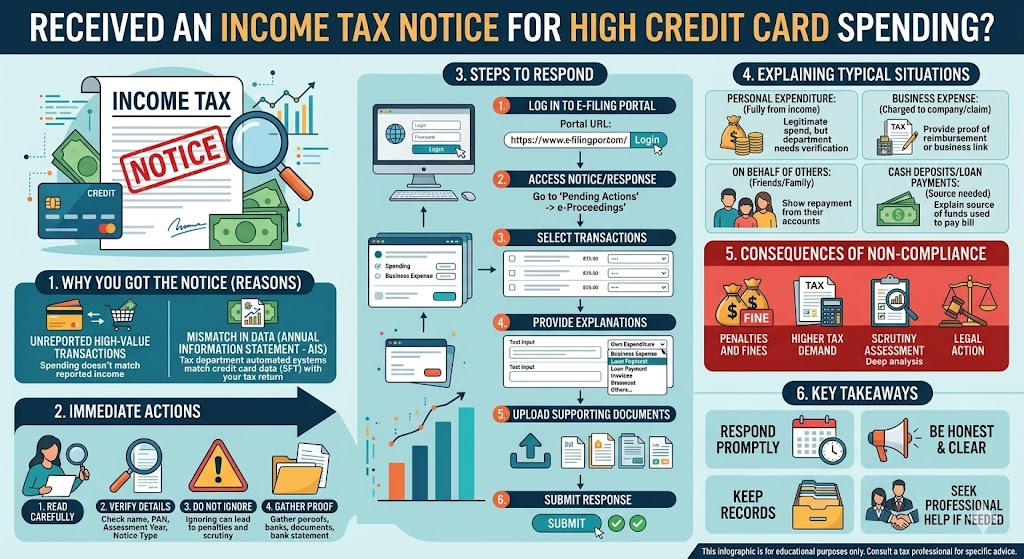
  • Income Tax AY 2026-27: The Proven Guide to New ITR Forms, Rules & Avoiding Costly Mistakes

    Income Tax AY 2026-27: The Proven Guide to New ITR Forms, Rules & Avoiding Costly Mistakes

    Why AY 2026-27 Could Be the Most Important Tax Year of Your Life

    Income tax AY 2026-27 is here and it brings the most sweeping changes to India’s tax filing system in over six decades. If you file the wrong ITR form, miss a renamed document, or skip the new Aadhaar validation rule, your return will be flagged as defective. The penalties are real, the deadlines are firm, and the window to prepare is shrinking fast.

    This is your proven, step-by-step guide to everything that has changed and exactly what you must do to file correctly, confidently, and on time.

    Income Tax AY 2026-27
    Income Tax AY 2026-27

    What Has Changed in Income Tax AY 2026-27? (Key Highlights)

    Before we go deep, here is a rapid summary of every major change under the new Income Tax Act, 2025 and Income Tax Rules, 2026, both effective from 1 April 2026:

    • ✅ All ITR forms (ITR-1 to ITR-7) have been fully revamped
    • ITR-1 now permits up to two house properties a landmark change for salaried taxpayers
    • LTCG up to ₹1.25 lakh under Section 112A is now reportable directly in ITR-1
    • ✅ Deductions under Sections 80C–80U must now be selected via a precise sub-section drop-down
    • ✅ The 28-digit Aadhaar Enrolment ID is no longer accepted — only the 12-digit Aadhaar Number is valid
    • Dual contact details (two emails + two mobile numbers) are now mandatory for every filer
    • Form 16 has been renamed Form 130 and Form 26AS is now Form 168
    • ✅ Both AY 2026-27 and TY 2026-27 now coexist on the e-filing portal choosing the wrong one is a critical and costly mistake

    Each of these is explained in full below.

    The Legal Foundation: Income Tax Act 2025 & Income Tax Rules 2026

    The Income Tax Act, 1961 served Indian taxpayers for 65 years. From 1 April 2026, it has been replaced procedurally by the Income Tax Act, 2025, supported by the freshly issued Income Tax Rules, 2026.

    What this means in practice:

    • Tax slabs and rates remain broadly similar for most taxpayers
    • But the reporting procedures, form structures, document names, and validation rules have been comprehensively redesigned
    • All ITR forms have been rebuilt from scratch under the new legal framework
    • Dozens of statutory documents that employers and professionals have used for years now carry entirely new names and form numbers

    According to the Income Tax Department of India at incometax.gov.in, the restructuring aims to reduce ambiguity in declarations, improve accuracy of TDS credit reconciliation, and tighten alignment between taxpayer-reported income and the government’s own Annual Information Statement (AIS) data.

    The message for every taxpayer is simple: last year’s approach will not work in income tax AY 2026-27. The rules have changed and those who adapt early will have a smooth season while those who don’t will face notices, defective return orders, and delays.

    Learn more about our Taxation & Compliance Services at ITR Advisor we help individuals, businesses, and professionals navigate every update with confidence.

    Critical ITR Filing Due Dates for AY 2026-27 Do Not Miss These

    Missing a deadline costs money. Under Section 234F, late filing attracts a fee of up to ₹5,000. Beyond the fee, late filers may lose the right to carry forward capital losses and face delays in TDS refund processing.

    Mark these dates in your calendar right now:

    Taxpayer CategoryApplicable FormsLast Date
    Salaried, pensioners, non-audit individualsITR-1 & ITR-231 July 2026
    Non-audit businesses & professionalsITR-3 & ITR-431 August 2026
    Tax audit cases (businesses & firms)ITR-3, ITR-5 & ITR-631 October 2026
    Transfer pricing casesAs applicable30 November 2026

    Each of these changes is explained in detail below.

    Expert advice from Pavan Adwani: “Do not wait until July. The new forms demand far more granular data than before reconciled AIS, precise sub-section deduction mapping, and verified Aadhaar details. Taxpayers who start in June file better returns and get refunds faster.”

    🔗 Read our detailed guide on ITR Filing Deadlines and Late Filing Penalties


    Which ITR Form Should You File for AY 2026-27? Complete Guide

    Filing the wrong ITR form results in a defective return notice from the department. Here is the definitive breakdown of all seven forms:

    ITR-1 (SAHAJ) – Massively Expanded for AY 2026-27

    Who can use it: Resident individuals earning salary or pension income, with up to two house properties (NEW), income from other sources, and LTCG under Section 112A of up to ₹1.25 lakh with no brought-forward losses (NEW).

    This is the biggest practical change in the income tax AY 2026-27 filing season. Millions of salaried taxpayers who were previously forced to file the more complex ITR-2 solely because of two house properties or small capital gains can now use the simpler SAHAJ form.

    ITR-2 – Capital Gains, Foreign Assets, Multiple Properties

    Who must use it: Individuals and HUFs with LTCG exceeding ₹1.25 lakh, more than two house properties, foreign assets or foreign income, or those who are directors in a company or hold unlisted shares.

    ITR-3 – Business or Profession Income

    Who must use it: Individuals and HUFs with income from a business or profession – including F&O traders, intraday stock traders, and all proprietorship businesses not opting for presumptive taxation.

    ITR-4 (SUGAM) – Presumptive Taxation Made Simple

    Who can use it: Individuals, HUFs, and firms that opt for the presumptive income scheme under:

    • Section 44AD – businesses with gross turnover up to ₹2 crore
    • Section 44ADA – professionals (doctors, CAs, lawyers, engineers) with receipts up to ₹50 lakh
    • Section 44AE – goods transport operators

    If you are eligible, this form eliminates the need for detailed bookkeeping and dramatically simplifies your compliance burden.

    ITR-5, ITR-6, ITR-7

    • ITR-5: Firms, LLPs, AOPs, and BOIs
    • ITR-6: All companies not claiming Section 11 exemptions
    • ITR-7: Trusts, research institutions, political parties, and specified entities under Sections 139(4A)–139(4D)

    🔗 Not sure which ITR form applies to you? Read our detailed ITR-1 vs ITR-2 vs ITR-3 vs ITR-4 comparison guide

    5 Game-Changing Updates Inside the New ITR Forms for AY 2026-27

    1. Two House Properties Now Allowed in ITR-1 A Game-Changer for the Middle Class

    Previously, owning two houses automatically disqualified you from filing ITR-1. You had no option but to use ITR-2, with all its additional complexity. This year that wall has come down. Under the new Income Tax Rules, 2026, individuals with up to two residential properties whether self-occupied, rented, or deemed let-out can continue using ITR-1, provided the rest of their income qualifies.

    This single change benefits tens of millions of taxpayers across India.

    2. Small Investors Get LTCG Relief in ITR-1

    If you redeemed equity mutual funds or sold listed shares during FY 2025-26 and earned Long-Term Capital Gains under Section 112A of ₹1.25 lakh or less, and you have no capital losses brought forward from earlier years, you no longer need to file ITR-2. You can report these gains directly in ITR-1.

    This is enormous relief for retail SIP investors who had small gains but were burdened with ITR-2 filings simply because of them.

    3. Mandatory Drop-Down for Every Deduction No More Lump-Sum Entry

    This is the change most likely to trip people up. The new forms no longer allow you to enter a single combined figure under Section 80C. You must now select the exact sub-section for each investment from a mandatory drop-down menu:

    • 80C(a) → EPF contributions
    • 80C(b) → PPF deposits
    • 80C(c) → Life insurance premiums
    • 80C(d) → ELSS mutual fund investments
    • 80C(e) → Tuition fees
    • 80D → Health insurance premiums
    • And so on across 80C to 80U

    What to do now: Collect every investment proof and map each one to the correct sub-section before you open the e-filing portal. Getting this wrong even with the right total amount can result in a defective return.

    4. Aadhaar Enrolment ID Is Dead Only 12-Digit Aadhaar Accepted

    The 28-digit Aadhaar Enrolment ID that many taxpayers used in previous years is no longer accepted on the e-filing portal under any circumstances. Only your 12-digit Aadhaar Number is valid for income tax AY 2026-27 filing.

    Additionally, your Aadhaar must be actively linked to your PAN. If it is not, your return will be declared invalid and your TDS refunds will be withheld. Check your PAN-Aadhaar linking status at incometax.gov.in today.

    5. Two Contact Details Are Now Compulsory

    The new ITR forms require every filer to provide two separate email addresses and two separate mobile numbers. The department uses these for OTP verification, refund intimation, and official notices. If either contact becomes inactive, the department may be unable to reach you and that creates compliance risk.

    Update your contact details before filing to ensure both sets are active and accessible.


    Renamed Forms Under Income Tax Rules 2026 The Complete List

    This is the change that is catching even experienced professionals off-guard. Under the Income Tax Rules, 2026, the names and numbers of almost every major statutory form have changed. Referencing old form names in tax proceedings or correspondence can cause serious complications.

    Here is the complete renaming reference table:

    Old NameNew Form NumberWhat It Is
    Form 16Form 130Employer’s TDS certificate for salary income
    Form 26ASForm 168Tax Credit Statement (TDS, TCS, advance tax)
    Form 15G / 15HForm 121Self-declaration for non-deduction of TDS on interest
    Form 3CA / 3CB / 3CDForm 26Unified Tax Audit Report
    Forms 26QB / 26QC / 26QD / 26QEForm 141Property purchase & rent TDS challan/return

    For HR teams and employers: Update your payroll software templates, TDS certificate formats, and employee communication templates immediately. Issuing a document labelled “Form 16” instead of “Form 130” during the income tax AY 2026-27 season may create confusion during employee tax filing and in any departmental proceedings.


    AY 2026-27 vs TY 2026-27 The Costly Portal Confusion You Must Avoid

    The e-filing portal at incometax.gov.in now simultaneously supports two compliance frameworks, and this is creating genuine confusion:

    AY 2026-27 (Assessment Year 2026-27) Select this to file your regular annual return reporting income earned in FY 2025-26 (1 April 2025 to 31 March 2026). This is what almost every individual taxpayer needs to select.

    TY 2026-27 (Tax Year 2026-27) This is for ongoing compliance obligations under the new Income Tax Act, 2025, tracking transactions from 1 April 2026 onward. This is NOT your annual return for past income.

    Selecting TY 2026-27 when you intend to file your regular annual return is a critical and costly mistake your submission will be misclassified and you may face a notice for non-filing of the actual return.

    Always choose AY 2026-27 for your standard annual income tax return. When in doubt, consult a professional.


    Real-World Example: Choosing the Right ITR Form for AY 2026-27

    Here is a practical scenario from the advisory files of Pavan Adwani that illustrates how the new rules work:

    Case Study: Priya Senior Analyst, Pune

    Priya earns ₹13.8 lakh annually from her job. She owns two flats one self-occupied, one rented at ₹15,000/month. In December 2025, she redeemed equity mutual funds she had held for over two years, earning LTCG of ₹78,000 under Section 112A. She has no carried-forward capital losses.

    Income ComponentAmount
    Salary Income₹13,80,000
    Rental Income (after 30% standard deduction)₹1,26,000
    LTCG under Section 112A₹78,000
    Less: Section 80C (EPF + LIC)₹1,50,000
    Less: Standard Deduction₹75,000

    Which form should Priya use?

    Under the old rules, Priya would have been compelled to file ITR-2 due to two house properties and capital gains.

    Under the income tax AY 2026-27 rules: Priya’s LTCG is below ₹1.25 lakh, she has no brought-forward losses, and the new rules permit two house properties in ITR-1. She now qualifies for the simpler ITR-1 (SAHAJ) saving time, reducing complexity, and lowering her risk of filing errors.


    Proven 5-Step Action Plan for Filing Income Tax AY 2026-27 Without Stress

    Step 1: Download Your AIS and Reconcile Every Entry

    Log in to incometax.gov.in, navigate to the AIS section, and download your Annual Information Statement. Cross-check every transaction salary, dividends, mutual fund redemptions, interest income, property transactions against your own records. Raise objections on the portal for any incorrect entries before you file.

    Step 2: Gather Capital Gain Statements from Every AMC and Broker

    Get your Consolidated Account Statement (CAS) from CAMS or KFintech. Download individual capital gain statements from every mutual fund house where you redeemed units in FY 2025-26. Know your LTCG and STCG separately, by asset class and holding period.

    Step 3: Map Every Deduction to the Correct Sub-Section

    Create a simple table listing each investment/expenditure, the amount, the supporting document, and the exact sub-section it falls under. This preparation prevents errors in the new mandatory drop-down system.

    Step 4: Verify PAN-Aadhaar Linkage Right Now

    Do not wait until the day you file. Verifying and completing PAN-Aadhaar linkage takes a few days to reflect in the system. Check your status today at the official portal.

    Step 5: Update Both Sets of Contact Details

    Log into the e-filing portal and ensure your primary and secondary email and mobile number are both active. This is now a mandatory field in the new ITR forms a missing or inactive contact can block your return from being processed.

    🔗 Want us to handle all of this for you? Book an ITR Filing Consultation with ITR Advisor

    Conclusion: Income Tax AY 2026-27 Demands Preparation — Start Today

    The income tax AY 2026-27 season is the most consequential filing season Indian taxpayers have faced in a generation. The transition to the Income Tax Act, 2025 and Income Tax Rules, 2026 has changed how you select your ITR form, how you claim deductions, what documents your employer must give you, and how the e-filing portal validates your identity.

    The good news: every single one of these changes is manageable provided you start now, not in the last week of July.

    Reconcile your AIS. Map your deductions. Verify your Aadhaar-PAN linkage. Know your correct ITR form. And if any part of this feels overwhelming, work with a qualified professional who already knows the new rules inside out.

    As Pavan Adwani says: “The biggest tax mistakes are never made because someone didn’t know the rules. They are made because someone didn’t start early enough to apply them correctly. In AY 2026-27, that margin for error is smaller than ever.”

    Frequently Asked Questions About Income Tax Filing AY 2026-27

    Q1. What are the biggest income tax changes for AY 2026-27?

    The major changes include: revamped ITR forms under the Income Tax Act, 2025 and Rules, 2026; expanded eligibility for ITR-1 (now allows two house properties and LTCG up to ₹1.25 lakh); mandatory sub-section-level reporting of deductions; rejection of Aadhaar Enrolment IDs; dual contact details requirement; and comprehensive renaming of statutory forms such as Form 16 (now Form 130) and Form 26AS (now Form 168).

    Q2. What is the last date to file ITR for AY 2026-27 for salaried individuals?

    For salaried individuals and non-audit cases filing ITR-1 or ITR-2, the due date is 31 July 2026. Filing after this date attracts a late filing fee under Section 234F and may result in loss of certain deductions.

    Q3. Can I report capital gains in ITR-1 for AY 2026-27?

    Yes, but with conditions. You can report LTCG under Section 112A up to ₹1.25 lakh in ITR-1, provided there are no brought-forward or carry-forward capital losses from previous years. If your LTCG exceeds ₹1.25 lakh or you have any capital losses, you must use ITR-2.

    Q4. What is the difference between AY 2026-27 and TY 2026-27 on the e-filing portal?

    AY 2026-27 is used for reporting income earned in FY 2025-26 this is your regular annual return. TY 2026-27 relates to current-year compliance under the new Income Tax Act, 2025 for transactions from April 2026. Most taxpayers filing their standard return should select AY 2026-27. Choosing TY 2026-27 by mistake will result in a misclassified filing.

    Q5. What happens if my Aadhaar is not linked to my PAN when I file?

    Your return will be treated as invalid by the department. You may also face withholding of TDS refunds and be unable to complete the OTP-based verification process. Link your Aadhaar to PAN at incometax.gov.in before attempting to file.

    Ready to File Your Income Tax Return for AY 2026-27?

    Don’t navigate the most complex tax season in years on your own.

    Connect with ITR Advisor today powered by the expertise of Pavan Adwani and a team of seasoned tax and compliance professionals. Whether you are a salaried individual, a business owner, or a company navigating the new audit framework, we are here to make AY 2026-27 your smoothest filing year yet.

    👉 Get Expert ITR Filing Assistance at ITR Advisor

    Author

    Pavan Adwani – Corporate Advisory, Tax Compliance & Regulatory Management.He is actively involved in advising business entities on corporate compliance, tax management, and regulatory frameworks, with a structured and process-oriented approach.

  • How to Download AIS from the Income Tax Portal : The Ultimate Step by Step Guide for AY 2026-27

    How to Download AIS from the Income Tax Portal : The Ultimate Step by Step Guide for AY 2026-27

    Dr. Haresh Adwani May 2026 14 min read

    Imagine filing your income tax return confidently only to receive a notice three months later saying your reported income does not match what the Income Tax Department already knows. This is exactly what happens when taxpayers skip reviewing their Annual Information Statement (AIS) before filing ITR.

    The AIS is not just another document on the Income Tax e-filing portal. It is the government’s comprehensive financial dossier on you capturing every significant transaction linked to your PAN,

    In this complete guide, the tax professionals at Adwani and Company led by Dr. Haresh Adwani, PhD in Commerce and a qualified law graduate walk you through exactly how to download AIS from the Income Tax portal, how to open the password protected AIS PDF, how to interpret it, and why reconciling AIS before filing your ITR for AY 2026-27 could save you from costly income tax notices.


    What Is the Annual Information Statement (AIS) and Why Does It Matter for ITR Filing?

    The Annual Information Statement, commonly referred to as AIS, was introduced by the Income Tax Department of India to give taxpayers a consolidated, transparent view of all financial information that the department has collected about them from various reporting entities banks, brokers, mutual fund houses, registrars, employers, GST authorities, and more.

    Before the introduction of AIS, taxpayers relied primarily on Form 26AS for TDS-related data. AIS goes several steps further it is a far more expansive document that captures the full spectrum of your financial activity throughout the financial year.

    What Information Does AIS Contain?

    AIS captures the following key categories of information:

    • Salary income as reported by your employer
    • Interest income from savings accounts, fixed deposits, recurring deposits, and bonds
    • Dividend income from shares and mutual funds
    • Capital gains from sale of equity shares, mutual fund units, debt instruments, and real estate
    • Purchase and sale transactions of immovable property
    • Mutual fund purchase and redemption details
    • Foreign remittances sent or received under LRS (Liberalised Remittance Scheme)
    • GST turnover figures for registered businesses
    • High-value cash deposits or withdrawals
    • TDS and TCS data (which also appears in Form 26AS)
    • Rent paid or received above prescribed thresholds
    • Cryptocurrency and virtual digital asset (VDA) transactions

    Expert Insight: The AIS has transformed how the Income Tax Department tracks compliance. Every mismatch between your filed return and your AIS is a potential trigger for a Section 143(1)(a) intimation or a full scrutiny notice. Reviewing AIS before filing ITR is no longer optional — it is essential,” says Dr. Haresh Adwani, Founder of Adwani and Company.

    AIS vs Form 26AS vs TIS Key Differences Every Taxpayer Must Know Before Downloading

    Many taxpayers confuse AIS with Form 26AS or are unsure about the Tax Information Summary (TIS). Here is a clear breakdown:

    FeatureForm 26ASAIS (Annual Information Statement)TIS (Tax Information Summary)
    ScopeTDS, TCS, and advance tax onlyFull financial transactions across all sourcesDerived summary from AIS with taxpayer feedback
    Introduced200220212021
    Capital Gains❌ Not included✅ Included✅ Included
    Crypto / VDA❌ Not included✅ Included✅ Included
    GST Turnover❌ Not included✅ Included✅ Included
    Who Should UseBasic TDS verificationComplete pre-ITR reconciliationFinal verified income summary

    In short: for AY 2026-27, always start with AIS, cross-check it against Form 26AS, review the TIS for any feedback you may have submitted, and only then proceed to file your income tax return.

    Read our detailed guide on AIS Reconciliation and Income Tax Notice Management for a complete walkthrough.


    How to Download AIS from the Income Tax Portal – Complete Step-by-Step Process

    Downloading your Annual Information Statement from the Income Tax e-filing portal takes under five minutes if you know the right steps. Follow this exact process:

    #ActionWhat to Do / Where to Click
    1Visit the PortalOpen your browser and go to the official Income Tax e-filing portal: incometax.gov.in
    2Log In with PANClick ‘Login’ at the top right. Enter your PAN as your User ID, along with your password and the captcha code.
    3Navigate to ServicesOn the dashboard, click on the ‘Services’ tab in the top navigation menu.
    4Click on AISFrom the dropdown under Services, select ‘Annual Information Statement (AIS)’. You will be redirected to the AIS portal (compliance.insight.gov.in).
    5Select Financial YearOn the AIS portal, select the relevant Financial Year — FY 2025-26 for AY 2026-27 — from the dropdown menu.
    6Choose Your FormatYou can download AIS in two formats: PDF (for easy reading) or JSON (for data processing). For individual review, select PDF.
    7Download and OpenClick Download. Once downloaded, open the PDF. It will prompt you for a password.
    8Enter the PasswordThe AIS PDF password is: [PAN in lowercase] + [Date of Birth in DDMMYYYY format]. Example: if PAN is ABCDE1234F and DOB is 15-August-1985, the password is abcde1234f15081985.

    How to Download TIS (Tax Information Summary) from the AIS Portal

    1. On the AIS portal, go to the ‘TIS’ tab (next to ‘AIS’).
    2. Select the Financial Year.
    3. Click Download → select PDF or JSON.
    4. The TIS PDF uses the same password format as AIS: PAN (lowercase) + DOB (DDMMYYYY).

    The TIS is particularly useful when the department processes your ITR and computes pre-filled data it uses TIS figures as the reference point for any automated intimations.

    Why Reviewing AIS Is Critical Before Filing Your ITR for AY 2026-27

    1. Catch Income the Department Already Knows About

    Every bank, mutual fund house, stock broker, property registrar, and company that deducts TDS from your payments is required to report this information to the Income Tax Department. If they have reported income linked to your PAN and you do not include it in your ITR the department’s automated system will flag the mismatch immediately.

    2. Identify Errors in Reported Data

    AIS data is not always correct. Banks sometimes report interest income for the wrong PAN. Brokers may report capital gains figures that differ from your actual gains due to corporate actions. If you find incorrect entries in your AIS, you can submit feedback directly on the AIS portal, marking the entry as ‘Incorrect’ or ‘Not relating to me’. This feedback is reflected in your TIS.

    3. Avoid Defective Return Notices and Scrutiny

    The Income Tax Department’s automated processing system compares your filed ITR with your AIS/TIS data. Any significant discrepancy whether it is unreported mutual fund redemptions, omitted interest income, or missing property sale consideration — may result in an intimation under Section 143(1)(a) or even a scrutiny notice under Section 143(2), explains Dr. Haresh Adwani of Adwani and Company.

    4. Claim Accurate TDS Credit

    AIS also reflects TDS entries from multiple sources — salary TDS (Form 16), bank TDS on FD interest, TDS on professional fees, rent TDS, and more. Cross-checking AIS with your Form 26AS ensures you claim all available TDS credit and do not leave money on the table.

    Learn more about our Income Tax Filing and TDS Compliance Services for salaried professionals and business owners.

    Real-Life Example: How an AIS Mismatch Triggered an Income Tax Notice

    Case Study: Ravi, IT Professional, Pune
    • Salary: ₹14 lakh per annum
    • SIP investments in 3 equity mutual funds since 2021 (redeemed in FY 2025-26)
    • Fixed deposit interest: ₹42,000 (bank deducted TDS at 10%)
    • Ravi filed ITR-1 reporting only salary income and FD interest omitting LTCG of ₹1.18 lakh from mutual fund redemptions
    What Happened: The mutual fund house had already reported Ravi’s redemption and LTCG to the Income Tax Department via AIS. The ITR-1 Ravi filed (which cannot accommodate capital gains) was also the wrong form.
    Result: Defective return notice under Section 139(9) + intimation under Section 143(1)(a) for unreported capital gains. He had to refile using ITR-2, pay additional tax, and clear the notice — all of which could have been avoided with a 10-minute AIS review.

    Most Common AIS Mismatches That Trigger Income Tax Notices in AY 2026-27

    • Mutual fund redemptions reported in AIS but not declared in ITR especially SIP redemptions or systematic withdrawal plans
    • FD and savings account interest income under-reported or omitted entirely
    • Dividend income from shares or mutual funds not included (dividends are now taxable in the hands of the investor)
    • Property sale consideration shown in AIS at the registered value, while taxpayer reports lower consideration in ITR
    • Cryptocurrency or VDA transactions reported by exchanges but omitted from ITR
    • GST turnover in AIS not matching income declared in ITR (common for freelancers and small business owners)
    • Foreign remittances or LRS transactions in AIS not reflected in ITR
    • Employer reporting perquisites or ESOPs in AIS that the taxpayer was unaware of

    Learn more about our AIS Reconciliation and Pre-ITR Compliance Review Services at Adwani and Company.


    Who Must Absolutely Review AIS Before Filing ITR for AY 2026-27?

    While every taxpayer benefits from an AIS review, certain profiles face the highest risk from AIS mismatches:

    • Salaried professionals who invest in mutual funds, stocks, or have fixed deposits
    • Freelancers and consultants who receive professional fees and may have GST registration
    • Business owners whose GST turnover is captured in AIS and must match income tax declarations
    • Doctors, architects, lawyers, and other self-employed professionals with TDS on professional fees
    • NRIs with Indian income sources rental income, interest, dividends, or capital gains
    • Stock market investors and traders particularly those with F&O trading activity
    • Real estate investors who sold property during FY 2025-26
    • Crypto investors whose exchange transactions are now reported to the Income Tax Department

    Critical ITR Filing Deadlines and AIS Review Timeline for AY 2026-27

    Managing your AIS review within the right timeline is essential for penalty-free ITR filing:

    Deadline / ActionDetails
    ITR Filing Due Date (Non-Audit)July 31, 2026 — File before this date to avoid late filing fee under Section 234F
    Audit Cases ITR Due DateOctober 31, 2026
    Belated Return DeadlineDecember 31, 2026 (with late fee of ₹1,000–₹5,000)
    Ideal AIS Review WindowJune 1 to July 15, 2026 — reconcile and file well before the deadline
    AIS Feedback SubmissionSubmit corrections on the AIS portal before filing ITR to avoid mismatch notices

    Frequently Asked Questions

    Q1. What is the AIS password to open the downloaded PDF?

    The AIS PDF password is your PAN number in lowercase letters followed by your date of birth in DDMMYYYY format with no spaces or special characters. For example, if your PAN is ABCPQ9876R and your date of birth is 22nd January 1988, the password is abcpq9876r22011988.

    Q2. Can an AIS mismatch trigger an income tax notice?

    Yes absolutely. The Income Tax Department’s automated systems compare your filed ITR data against your AIS and TIS figures. Even minor discrepancies in interest income, capital gains, dividend income, or GST turnover can result in an automated intimation under Section 143(1)(a) or a scrutiny notice under Section 143(2). This is why AIS reconciliation before ITR filing is non-negotiable.

    Q4. What should I do if I find incorrect information in my AIS?

    You can submit feedback directly on the AIS portal against any entry. Options include marking it as ‘Information is correct’, ‘Information is not fully correct’, ‘Information relates to other person / year’, ‘Information is duplicate / included in other information’, or ‘Information is denied’. This feedback updates your TIS, which is then used as a reference for ITR pre-fill and automated processing.

    Q6. Is there a late filing penalty even if my tax payable is nil after TDS?

    Yes. Under Section 234F of the Income Tax Act, a late filing fee of ₹1,000 applies if your total income exceeds ₹2.5 lakh but does not exceed ₹5 lakh, and ₹5,000 if your income exceeds ₹5 lakh regardless of whether your tax liability after TDS credit is nil. Filing before July 31, 2026 avoids this penalty entirely.

    Q7. Can I download AIS for previous financial years?

    Yes. The AIS portal at compliance.insight.gov.in allows taxpayers to access AIS data for multiple financial years. You can select FY 2024-25, FY 2023-24, or earlier years from the financial year dropdown. This is particularly useful when responding to income tax notices for past years or filing belated/revised returns.

    Conclusion:

    The Annual Information Statement is the Income Tax Department’s most powerful transparency tool and it should be your most important pre-filing checklist. Before you file a single digit in your ITR for AY 2026-27, download your AIS, open it with the correct password, reconcile every entry against your own records, and submit feedback for any incorrect data.

    As Dr. Haresh Adwani of Adwani and Company emphasises: “Taxpayers who review their AIS carefully before filing rarely face income tax notices. Those who skip it often spend weeks dealing with the consequences. The ten minutes spent on AIS review today saves ten hours of notice management tomorrow.”

    About the Author
    Dr. Haresh Adwani
    Ph.D. in Commerce | Law Graduate | Managing Partner, Adwani & Co LLP Dr. Haresh Adwani holds a Ph.D. in Commerce and is a qualified Law graduate with over two decades of hands-on experience in GST advisory, direct taxation, and statutory compliance for businesses across Pune and Maharashtra. He has guided hundreds of SMEs, startups, and corporates through India’s evolving tax landscape. He is a recognised advisor on GST compliance, company formation, and Virtual CFO services, and regularly contributes to professional seminars and industry forums in Pune.

  • The Ultimate Guide to Check Income Tax Refund Status Online for AY 2026-27

    The Ultimate Guide to Check Income Tax Refund Status Online for AY 2026-27

    Nidhi Adwani May 2026 8 min read

    Check Income Tax Refund Status Online AY 2026-27

    Step-by-step method to track your ITR refund, understand delays, escalate stuck refunds and never lose a single rupee that’s rightfully yours.

     Every year, millions of Indian taxpayers successfully file their returns for the Assessment Year 2026-27, only to spend weeks wondering: “Where is my income tax refund?”

    Checking your income tax refund status online takes less than two minutes  if you know exactly where to look. And if there’s a problem, it can often be fixed without stepping into a tax office. This guide walks you through every step, every status code, and every escalation path you need.

    According to the Income Tax Department of India, refunds for electronically filed returns are typically processed within 4 to 16 weeks of ITR verification. AY 2026-27 processing timelines have been significantly improved on the redesigned income tax e-filing portal at incometax.gov.in🔗 incometax.gov.in


    Why Your Income Tax Refund Status for AY 2026-27 Matters More Than Ever

    The Income Tax Department processes crores of ITR filings every season. With the introduction of the Annual Information Statement (AIS) and the Taxpayer Information Summary (TIS) under Form 26AS, the system now cross-verifies your declared income against data from banks, employers, mutual funds, and even credit card companies under Rule 114E SFT.

    Read our detailed guide on ITR Filing for AY 2026-27 — Deadlines, Penalties & Smart Strategies


    Step-by-Step: How to Check Income Tax Refund Status Online

    Method 1: Via the Income Tax e-Filing Portal (Recommended)

    1. Log in to the IT Portal

    Visit incometax.gov.in and log in using your PAN number as your user ID along with your registered password. First-time users must complete registration with Aadhaar-linked mobile OTP.

    1. Navigate to “My Account” → “Refund/Demand Status”

    In the dashboard, go to e-File → Income Tax Returns → View Filed Returns. Select AY 2026-27 and click on the return to view its processing status.

    1. Check Processing Status & Refund Details

    You’ll see the current status of your return : whether it’s under processing, processed with refund due, or processed with demand. The refund amount and the expected credit date (if applicable) will be shown here.

    1. Verify Bank Account Pre-validation

    Refunds are credited only to a pre-validated and ECS-enabled bank account linked to your PAN. Confirm this under Profile → My Bank Account. An unvalidated account is one of the most common causes of ITR refund delay in AY 2026-27.

    1. Download your Intimation Notice

    Once processed, download the intimation u/s 143(1) from the portal. This document confirms the exact refund amount calculated by the department always verify it against your filed return.

    Method 2: Track via TIN-NSDL (Alternative)

    Visit tin.tin.nsdl.com, navigate to “Know Your Refund Status”, and enter your PAN and the relevant Assessment Year to view the refund dispatch status

    Decoding Your Income Tax Refund Status : What Each Message Means

    “Return is Under Processing”

    Your ITR has been received but not yet assessed. Processing can take 4–10 weeks post e-verification.

    “Processed with Refund Due”

    If your refund is processed. It should reach your bank account within 5–7 working days

    “Processed with Demand Due”

    If there is a shortfall : you owe tax. Review the intimation u/s 143(1) immediately and either pay or file a rectification request.

    “Refund Returned / Failed”

    Your bank rejected the refund (wrong IFSC, closed account, unvalidated account). File a refund reissue request on the portal immediately.

    “Adjusted Against Outstanding Demand”

    If your current refund is used  to offset a past tax demand. Check your demand history and raise a grievance if the adjustment was incorrect.

    “No Return Filed for this AY”

    Either your return hasn’t been processed yet or it was filed under a different PAN. Check filing acknowledgement (ITR-V) for confirmation


    Top Reasons for ITR Refund Delay in AY 2026-27

    According to experts at Adwani and Company, these are the most frequently seen causes of refund delays in the current assessment year:

    1. Unverified Bank Account

    2. AIS / Form 26AS Mismatch

    3. Pending e-Verification

    4. Outstanding Tax Demand from Previous AYs

    5. High-Value Credit Card or Cash Transactions

    Learn more about our Income Tax Notice Advisory Services — How We Help Respond

    How to Raise a Refund Reissue Request Online

    1. Log in → Services → Refund Reissue
    2. Update and validate your bank account
    3. Submit Refund Reissue Request

    Once a valid refund reissue request is submitted and processed, refunds are typically credited within 7–14 working days. Track updated status on the portal or via TIN-NSDL.

    How to Escalate a Stuck Income Tax Refund

    • Submit a Grievance on the IT Portal
    • Write to Your Jurisdictional Assessing Officer (AO)
    • Contact the Centralized Processing Centre (CPC), Bengaluru

    Refund Status vs. Form 26AS vs. AIS Know the Difference for AY 2026-27

    Many taxpayers confuse these three documents. Here’s a clear breakdown that every filer should understand before filing ITR for AY 2026-27:

    Form 26AS

    Reflects TDS deducted, TCS collected, and advance tax paid. It’s the foundational tax credit document. Mismatches here directly affect your refund calculation.

    AIS (Annual Information Statement)

    A comprehensive document showing all financial transactions  salary, interest, dividends, mutual funds, property, credit cards, and more  as reported to the IT Dept.

    TIS (Taxpayer Information Summary)

    A simplified, consolidated view derived from AIS. The IT Dept uses TIS to pre-fill ITR forms. Always reconcile TIS with your actual income before filing.


    Key Takeaways

    • Always e-verify your ITR within 30 days of filing  refund processing begins only after verification.
    • Check income tax refund status online on incometax.gov.in or TIN-NSDL after 4–6 weeks of e-verification.
    • Pre-validate your bank account with ECS enabled before filing to avoid refund failure.
    • Reconcile Form 26AS, AIS, and TIS before filing to prevent mismatches that cause ITR refund delay.
    • If your refund is stuck beyond 8 weeks, raise a grievance on the IT portal and track using the ticket number.
    • High-value credit card spends (>₹10L) and cash deposits may trigger scrutiny disclose accurately in your ITR.
    • Outstanding demands from past AYs will be automatically adjusted against your current year refund.

    Frequently Asked Questions

    1.How long does it take to get Income Tax refund after ITR processing?

    Once  your ITR is processed and the intimation u/s 143(1) is issued, refunds are typically credited  within 5to10 working days .If your return was selected for scrutiny or has a mismatched AIS, it may take 4to16 weeks.

    2.Can I claim Income Tax refund interest if my refund is delayed?

    Yes. Under Section 244A of the Income Tax Act, you are entitled to receive simple interest at 0.5% per month (or 6% per annum) on the refund amount if the delay is attributable to the Income Tax Department

    3.How do I check my Income Tax refund status without logging in?

    You can check via the TIN-NSDL portal at tin.tin.nsdl.com  navigate to “Know Your Refund Status”, enter your PAN number and Assessment Year (AY 2026-27), and the platform will display the refund dispatch status.

    4.What does “Refund Returne or “No credit Received” status mean for my Income Tax refund?

    Refund Returned” means the refund amount was dispatched by the IT Department but could not be credited because your bank account was closed, had an incorrect IFSC code, or was not pre-validated/ECS-enabled. You must file a refund reissue request on incometax.gov.in under Services → Refund Reissue. Update your correct bank account, complete pre-validation, and submit with EVC authentication.

    Conclusion:

    Your Income Tax Refund is Rightfully Yours Claim It Smartly

    Checking your income tax refund status online for AY 2026-27 is no longer a complex process  it’s a 2 minute task if your paperwork is in order. The key is proactivity: verify your ITR promptly, ensure your bank account is pre-validated, reconcile your AIS and Form 26AS before filing, and monitor your status regularly. At Adwani and Company, led by Dr. Haresh Adwani, we handle hundreds of complex refund cases, AIS disputes, ITR revisions, and income tax notice responses every season. Our clients across India trust us for one reason: we treat every rupee of your refund as seriously as you

    Visit: www.adwaniandco.com | Call: +91 7620 127 137 | Email: enquiries@adwaniandco.com

    Share:WhatsApp Twitte LinkedIn