Blog

  • Section 139(9) Defective Return Notice Received? Meaning, Reasons & How to Respond

    Section 139(9) Defective Return Notice Received? Meaning, Reasons & How to Respond

    10 June 2026• Nidhi Adwani

    Section 139(9) Defective Return Notice Received?

    Have you received an email or SMS from the Income Tax Department stating that your Income Tax Return (ITR) is “Defective” under Section 139(9) of the Income Tax Act?

    Don’t panic.

    A Section 139(9) Notice does not automatically mean that you have concealed income or committed tax evasion. However, it is a notice that requires immediate attention because failure to respond within the prescribed time may result in your Income Tax Return being treated as invalid.

    In simple terms, it may be as if you never filed your return at all.

    In this article, we explain what a Section 139(9) Defective Return Notice means, why it is issued, common reasons, real-life examples, and how to respond correctly.


    What is a Section 139(9) Defective Return Notice?

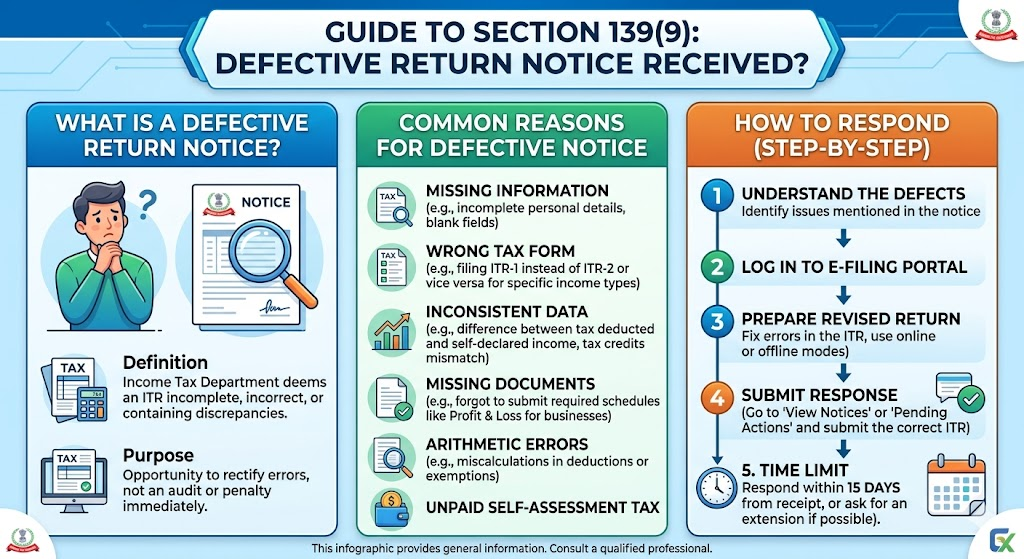
    A Section 139(9) Notice is issued when the Income Tax Department finds defects, inconsistencies, omissions, or incomplete information in the Income Tax Return filed by a taxpayer.

    The department provides an opportunity to correct the defect within the prescribed period.

    Once the defect is corrected and submitted, the return continues to be treated as a valid return.

    However, if the defect is not corrected, the return may become invalid.


    Why is a Section 139(9) Defective Return Notice Issued?

    The Income Tax Department processes millions of returns every year using automated systems.

    If certain information is missing or inconsistent, a defective return notice may be generated.

    Common Reasons for Section 139(9) Notice

    1. Wrong ITR Form Selected

    This is one of the most common mistakes.

    Example:

    A taxpayer sold mutual funds and earned capital gains but filed ITR-1 instead of the appropriate ITR form.

    The department may issue a defective return notice.

    1. Business Income Not Properly Reported

    Taxpayers declaring business or professional income may fail to provide mandatory financial details.

    Example:

    A consultant reports professional income but does not provide the required Profit & Loss Account information.

    1. Mismatch Between Income and TDS

    Income reported in the return may not match TDS information available in Form 26AS.

    1. Missing Balance Sheet Details

    In some cases, taxpayers are required to disclose balance sheet information but fail to do so.

    1. Incomplete Capital Gains Reporting

    Sale transactions may be reported without proper capital gains computation.

    1. Incorrect Claim of Losses

    Business losses or capital losses may be claimed without furnishing required details.

    1. Incomplete Foreign Asset Reporting

    Taxpayers required to disclose foreign assets may fail to provide complete information.

    Also Read :Income Tax Notice India 2026: Every Section Explained What It Means and How to Respond


    Real-Life Example of a Section 139(9) Notice

    Case Study:

    Salaried Employee with Mutual Fund Transactions

    Mr. Rahul, a software engineer from Pune, filed his Income Tax Return using ITR-1 because he believed he only had salary income.

    However, during the financial year he had redeemed mutual funds worth ₹8 lakh.

    Although the actual capital gain was small, the transaction itself required reporting under the appropriate ITR form.

    A few weeks after filing, he received a Section 139(9) Defective Return Notice stating that the return was defective due to the use of an incorrect ITR form.

    After reviewing the notice, the return was corrected and re-submitted using the correct form within the prescribed time.

    The matter was resolved without penalty.


    What Happens if You Ignore a Section 139(9) Notice?

    Ignoring a defective return notice can create serious consequences.

    The Income Tax Department may treat the return as invalid.

    This can lead to:

    • Loss of refund claims
    • Late filing consequences
    • Interest liability
    • Loss of carry-forward of losses
    • Additional compliance issues

    In simple words, it may be treated as if no valid return was filed


    How to Respond to a Section 139(9) Notice?

    Step 1: Read the Notice Carefully

    Identify the exact defect mentioned by the department.

    Step 2: Download the Notice

    Review all instructions and defect codes.

    Step 3: Gather Required Information

    Depending on the defect, you may need:

    • Form 16
    • AIS
    • Form 26AS
    • Capital gains statements
    • Business records
    • Foreign asset information

    Step 4: Correct the Defect

    Update the return and provide the information requested by the department.

    Step 5: Submit Response Within Time

    Always ensure that the response is submitted within the specified timeline.


    Most Common Defective Return Mistakes in 2026

    Based on practical experience, the following mistakes are increasingly common:

    ✔️ Filing ITR-1 despite having capital gains

    ✔️ Ignoring AIS information

    ✔️ Not reporting FD interest

    ✔️ Not reporting dividend income

    ✔️ Incorrect business income disclosures

    ✔️ Missing foreign asset information

    ✔️ Wrong selection of ITR form

    ✔️ Incomplete capital gains schedules


    Can a Defective Return Notice Be Resolved?

    Yes.

    Most Section 139(9) notices can be resolved successfully if the defect is identified and corrected promptly.

    The key is understanding the issue and taking timely action.

    Frequently Asked Questions

    Is a Section 139(9) Notice serious?

    It should not be ignored. While it is generally a compliance-related notice, failure to respond can invalidate the return.

    Does a defective return notice mean scrutiny assessment?

    No.
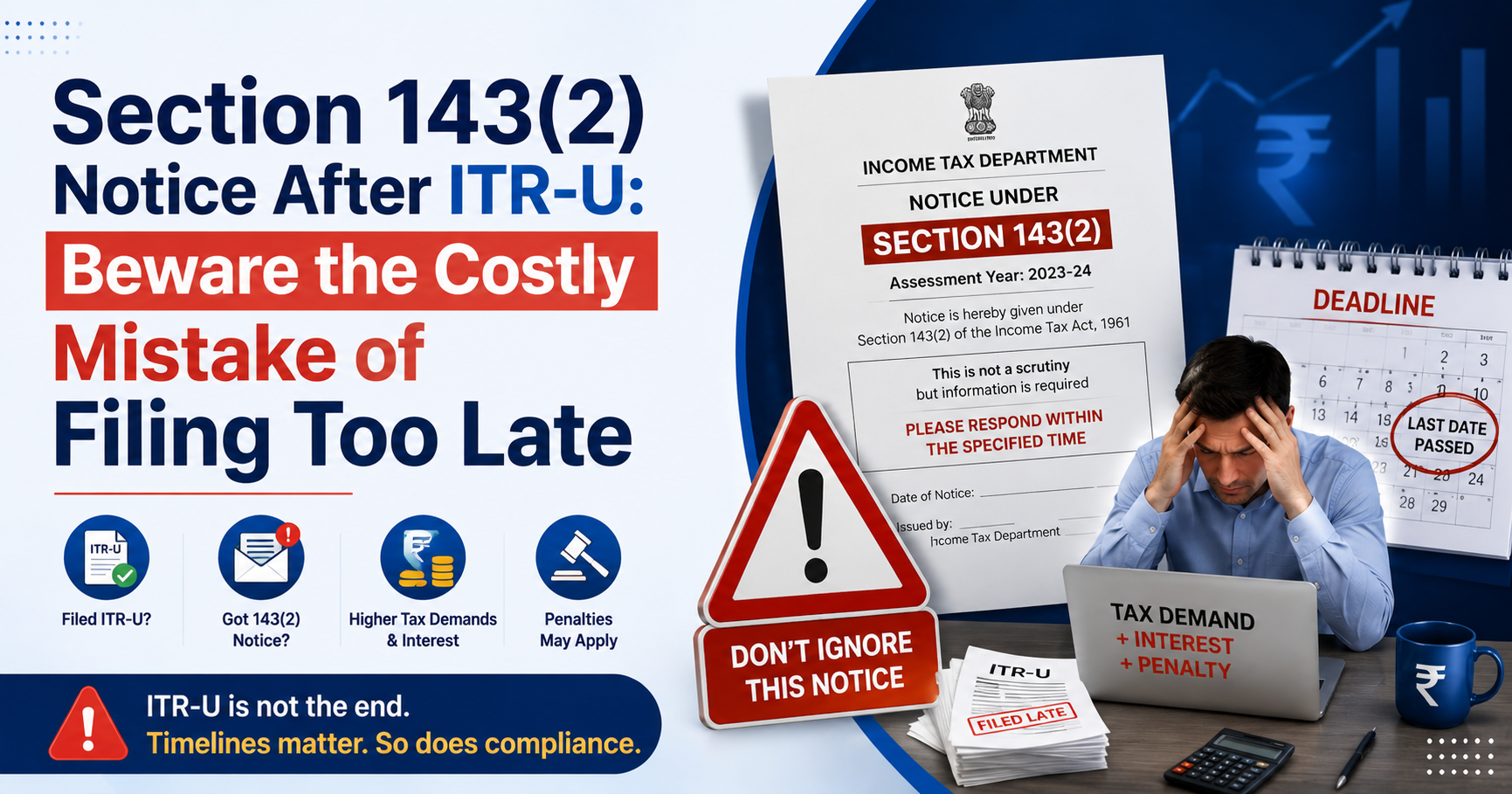
    A Section 139(9) Notice is different from a scrutiny notice under Section 143(2).

    Can I get a refund if my return is defective?

    The defect usually needs to be resolved before processing can continue.

    Can I handle the notice myself?

    Simple defects may be corrected independently. However, where capital gains, business income, foreign assets, or multiple issues are involved, professional guidance can be beneficial.

    Why Taxpayers Should Seek Professional Help

    Many taxpayers attempt to resolve defective return notices without understanding the underlying issue.

    A wrong response can result in:

    • Invalid return status
    • Delayed refunds
    • Additional notices
    • Loss of tax benefits

    Professional review can help identify the actual defect and ensure that the return is corrected properly.

    Final Thoughts

    A Section 139(9) Notice is one of the most common notices issued by the Income Tax Department. In most cases, it is not an allegation of tax evasion but an opportunity to correct errors in the return.

    The sooner the defect is identified and corrected, the smoother the resolution process will be.

    If you are unsure about the notice, seeking expert advice can help protect your refund, maintain compliance, and avoid unnecessary complications.

    About the Author – Nidhi Adwani

    Nidhi Adwani is the Human Resources Manager at Adwani & Co. She is a Law Graduate and holds an MBA in Human Resources. She manages recruitment, employee engagement, team development, workplace culture, and the firm’s social media and content activities. Passionate about people and organizational growth, she also contributes articles for ITRAdvisor and Adwani & Co. Her writing focuses on HR practices, leadership, workplace engagement, and professional development, offering practical insights for professionals and businesses.

    Received a Section 139(9) Notice? Consult ITRAdvisor.in

    If you have received a Section 139(9) Defective Return Notice, do not ignore it.

    At ITRAdvisor.in, we regularly assist taxpayers with:

    ✔️ Defective Return Notices

    ✔️ AIS Mismatch Issues

    ✔️ Capital Gains Reporting

    ✔️ Wrong ITR Form Selection

    ✔️ Revised Returns

    ✔️ NRI Taxation

    ✔️ Income Tax Notices

    ✔️ Return Rectification and Compliance

    Whether your notice relates to capital gains, business income, foreign assets, AIS mismatches, or an incorrect ITR form, our team can help you understand the issue and prepare an appropriate response.

    Visit ITRAdvisor.in today for professional guidance and consultation.

    Early action can often prevent bigger tax problems later.

  • 10 Common ITR Filing Errors That Can Trigger Income Tax Notices in 2026

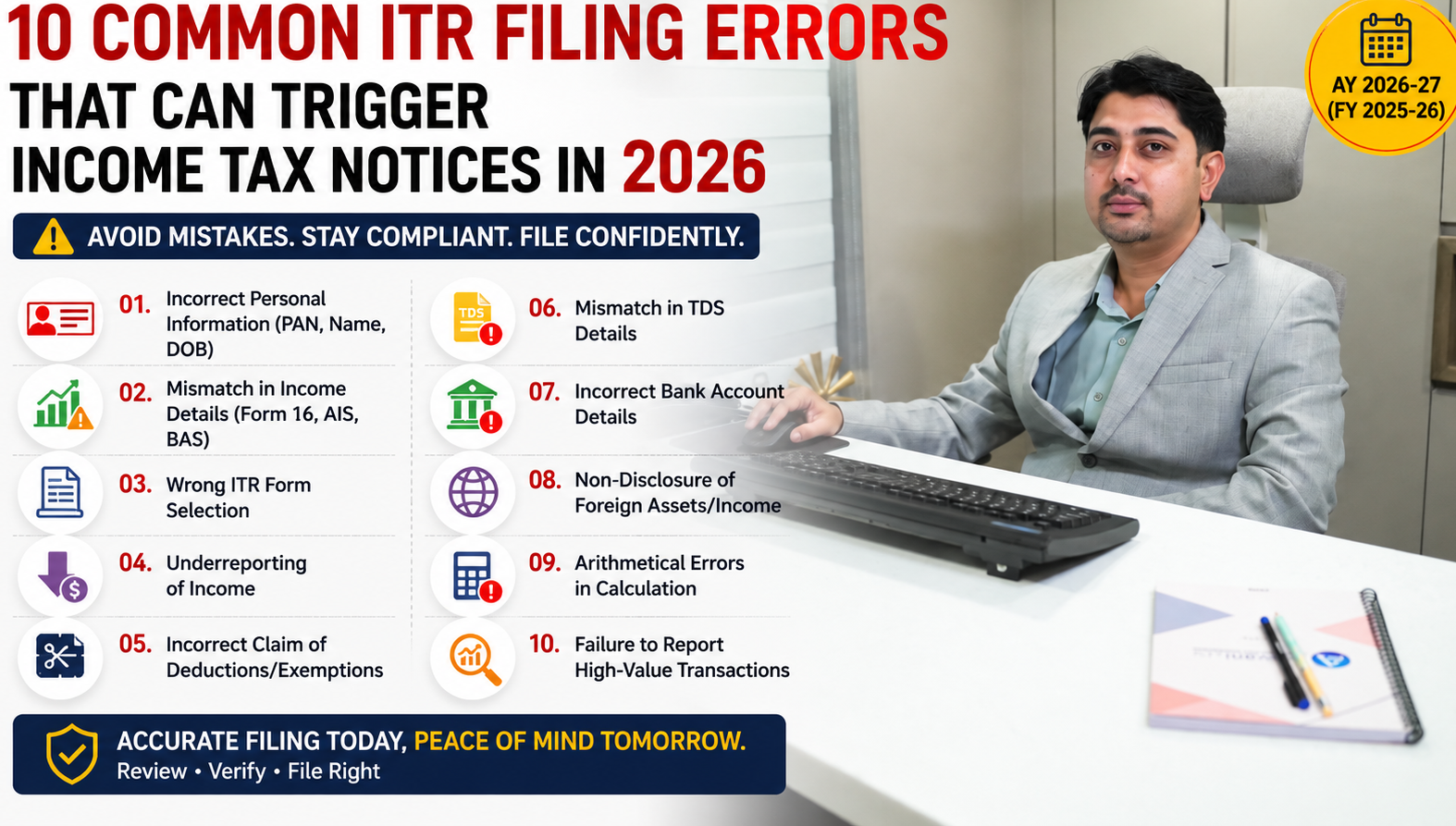
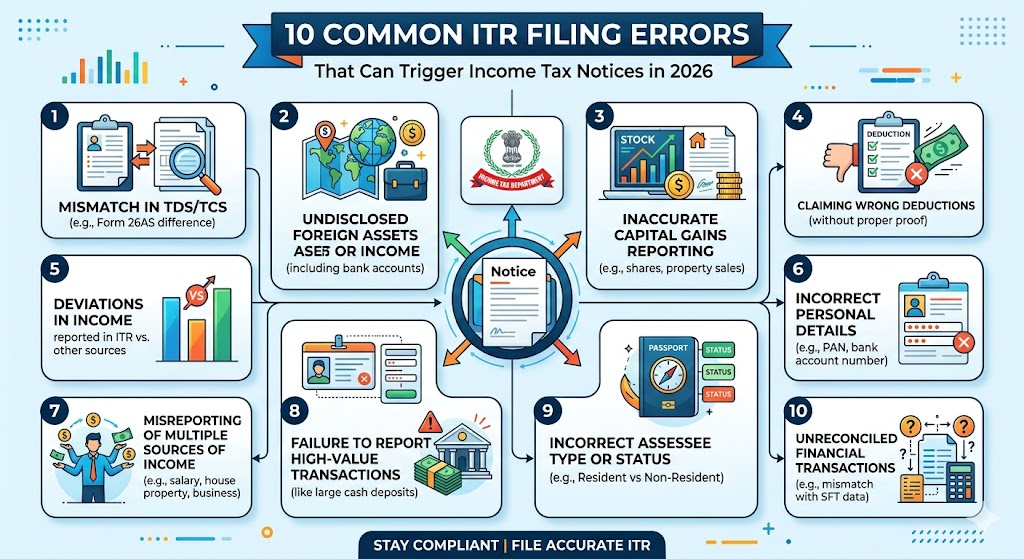
    10 Common ITR Filing Errors That Can Trigger Income Tax Notices in 2026

    08 June 2026• Prafull Nile

    10 Common ITR Filing Errors

    Filing your Income Tax Return (ITR) may appear simple, especially with pre-filled data available on the Income Tax Portal. However, thousands of taxpayers receive notices every year due to avoidable mistakes while filing their returns.

    Many taxpayers believe that if tax has been deducted or Form 16 has been issued, there is no possibility of receiving a notice. Unfortunately, this is not always true.

    The Income Tax Department now uses data from:

    • Annual Information Statement (AIS)
    • Form 26AS
    • Banks
    • Mutual Funds
    • Stock Brokers
    • Property Registrars
    • Credit Card Companies

    As a result, even small filing errors can result in tax demands, refund delays, scrutiny, or notices.

    Let’s look at the most common ITR filing mistakes and how to avoid them.

    1. Not Checking AIS Before Filing

    This is currently one of the biggest mistakes taxpayers make.

    Many individuals file their returns using only Form 16 without reviewing the Annual Information Statement (AIS).

    AIS may contain:

    • FD interest
    • Dividend income
    • Share transactions
    • Mutual fund redemptions
    • Property transactions
    • Foreign remittances

    If income reflected in AIS is not reported in the ITR, the department may issue a notice.

    Example

    A salaried employee reported salary income based on Form 16 but forgot to include ₹38,000 FD interest reflected in AIS.

    The mismatch was later identified during return processing.

    Also Read our detailed guide on: Salary vs AIS Mismatch in Your ITR : Dangerous, Common & Completely Fixable

    1. Incorrect Selection of ITR Form

    Using the wrong ITR form is a common mistake.

    Examples:

    • Using ITR 1 despite having capital gains
    • Using ITR 1 despite owning foreign assets
    • Using ITR 4 despite being ineligible

    An incorrect form can make the return defective.

    1. Not Reporting Interest Income

    Many taxpayers assume that because TDS has been deducted, interest income need not be reported.

    This is incorrect.

    Commonly missed income includes:

    • Savings account interest
    • Fixed Deposit interest
    • Recurring Deposit interest

    The income must generally be disclosed in the return.

    1. Ignoring Dividend Income

    Dividend income received from shares and mutual funds is often forgotten during filing.

    Since this information is generally available to the department, non-reporting can create mismatches.

    1. Incorrect Capital Gains Reporting

    This is one of the most frequent reasons for notices.

    Taxpayers often:

    • Forget to report share transactions
    • Ignore mutual fund redemptions
    • Miscalculate capital gains
    • Fail to report property sales

    Example

    A taxpayer sold mutual funds worth ₹12 lakh and assumed there was no taxable gain because the amount was reinvested.

    The transaction appeared in AIS but was omitted from the ITR.

    A notice was later received seeking clarification.

    1. Claiming Deductions Without Proper Documentation

    Many taxpayers claim deductions under:

    • Section 80C
    • Section 80D
    • Section 80G

    without maintaining supporting records.

    If questioned by the department, documentary evidence may be required.

    1. Not Reporting Foreign Assets

    This mistake is particularly common among NRIs returning to India.

    Foreign bank accounts, investments, and other reportable assets may require disclosure depending on residential status and applicable provisions.

    Failure to disclose can have serious consequences.

    1. Not Reconciling Form 26AS

    Before filing, taxpayers should compare:

    • Form 16
    • Form 26AS
    • AIS
    • Bank records

    Differences should be investigated before submission.

    1. Incorrect Bank Account Details

    A simple mistake in bank account information can result in:

    • Refund failure
    • Delayed processing
    • Additional compliance issues

    Always verify account details carefully.

    1. Filing in a Hurry Before the Deadline

    Many taxpayers wait until the last few days before the due date.

    As a result, important items are overlooked, including:

    • AIS mismatches
    • Capital gains
    • Interest income
    • Foreign assets
    • TDS discrepancies

    Rushed filing often leads to mistakes that could have been avoided.


    Real-Life Example: Notice Due to AIS Mismatch

    Mr. Sharma filed his Income Tax Return based solely on Form 16 provided by his employer.

    A few months later, he received a communication from the Income Tax Department.

    Upon review, it was found that:

    • FD interest of ₹62,000 reflected in AIS was not reported.
    • Dividend income of ₹14,000 was omitted.
    • Mutual fund redemption transactions were not disclosed.

    Although the omissions were unintentional, additional compliance was required to resolve the matter.

    This situation is becoming increasingly common as the department relies heavily on AIS data.


    Can I Correct an ITR Filing Mistake?

    In many situations, taxpayers may be able to rectify mistakes by filing a revised return within the applicable timelines.

    However, early identification of errors is important.

    The longer a mistake remains uncorrected, the greater the risk of notices, demands, or penalties.


    How to Avoid ITR Filing Errors:

    Before filing your return:

    ✔️ Verify Form 16

    ✔️ Check AIS thoroughly

    ✔️ Review Form 26AS

    ✔️ Reconcile bank interest

    ✔️ Verify dividend income

    ✔️ Check capital gains statements

    ✔️ Confirm bank account details

    ✔️ Select the correct ITR form

    ✔️ Review foreign asset disclosures

    ✔️ Seek professional advice for complex transactions

    Frequently Asked Questions

    1.Can a small mistake in ITR trigger a notice?

    Yes. Even small mismatches between the ITR and AIS can result in communications from the Income Tax Department.

    2.Can I revise my ITR after filing?

    In many cases, taxpayers can file a revised return within the prescribed timelines.

    3.Is AIS more important than Form 16?

    Both are important. However, AIS often contains additional information that may not appear in Form 16.

    What is the most common ITR filing mistake

    Currently, failure to reconcile AIS before filing is among the most common errors.

    Final Thoughts

    Most Income Tax notices are not issued because taxpayers intentionally hide income. They are often the result of simple mistakes, omissions, or mismatches.

    A careful review of AIS, Form 26AS, interest income, capital gains, and deductions before filing can significantly reduce the risk of future notices and tax disputes.

    Taking a few extra minutes before filing can save months of stress later.

    Many taxpayers file their returns themselves and later discover mistakes that result in notices, refund delays, or additional tax demands.

    About the Author : Prafull Nile

    Prafull Nile is a senior taxation and accounting professional associated with Adwani & Co LLP, bringing over 19 years of extensive experience in direct taxation, tax audits, income tax assessments, GST audits, and financial statement finalization. He has successfully managed diverse client engagements across industries, providing strategic guidance on tax compliance, assessments, and regulatory matters. In addition to his technical expertise, Prafull leads and mentors teams, ensuring high standards of service delivery and operational excellence. His practical approach, deep understanding of tax laws, and commitment to client success make him a trusted advisor for businesses and professionals navigating complex financial and compliance requirements.

    At ITRAdvisor.in, we help taxpayers with:

    ✔️ ITR Filing Review

    ✔️ AIS Reconciliation

    ✔️ Capital Gains Reporting

    ✔️ NRI Taxation

    ✔️ Tax Notice Response

    ✔️ Revised Returns

    ✔️ Income Tax Planning

    ✔️ Refund and Compliance Issues

    If you are unsure whether your return has been filed correctly or want a professional review before submission, consulting an experienced tax professional can help avoid costly mistakes.

    Visit ITRAdvisor.in for expert assistance with your Income Tax Return and tax compliance requirements.

    Disclaimer: ITRAdvisor.in is an educational and informational platform focused on tax awareness and compliance updates. Nothing contained herein should be construed as solicitation or advertisement of professional services. Professional services, where applicable, are rendered in accordance with ICAI guidelines. This article is published on ITRAdvisor.in, a tax and compliance knowledge platform. The content has been reviewed for technical accuracy by professionals associated with Adwani & Co LLP.

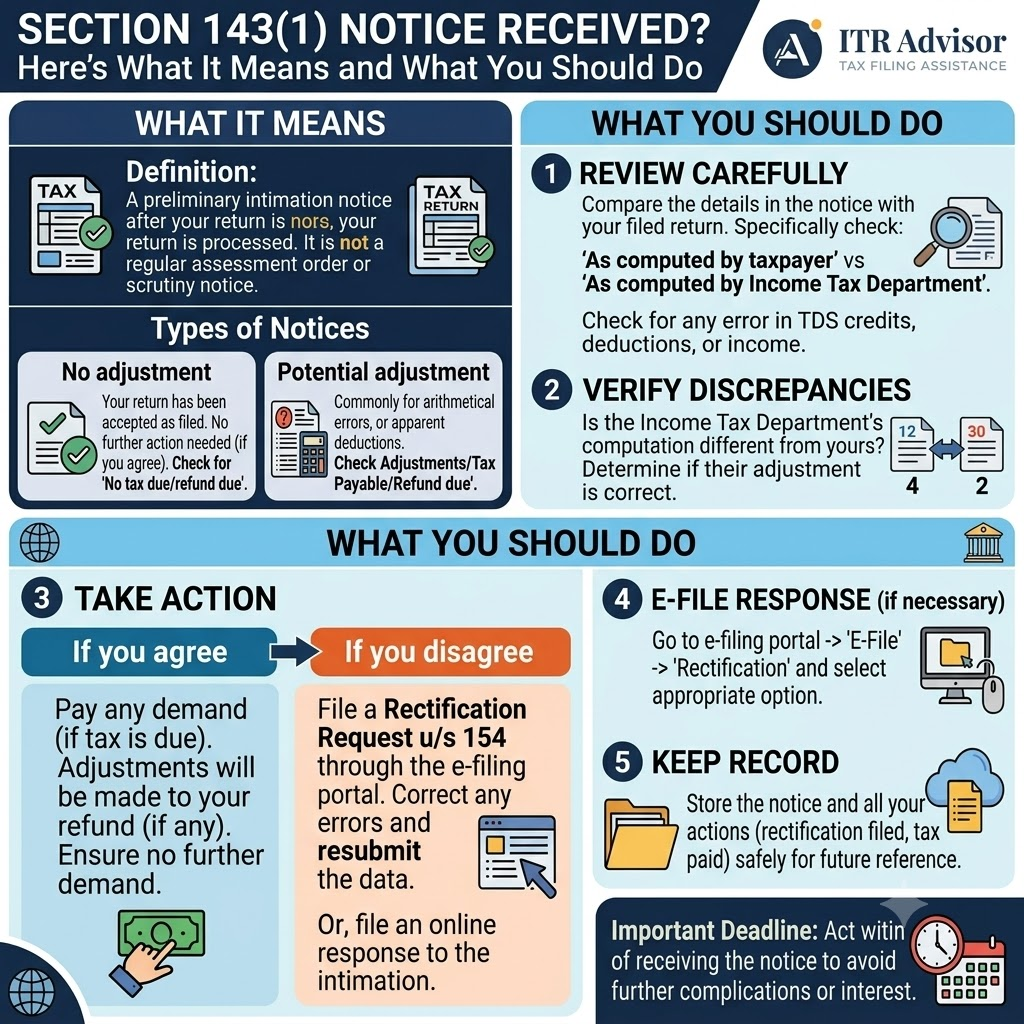
  • Section 143(1) Notice Received? Here’s What It Means and What You Should Do

    Section 143(1) Notice Received? Here’s What It Means and What You Should Do

    8 June 2026•Dr. Haresh Adwan

    A Section 143(1) Notice

    Receiving an Income Tax Notice can be stressful, especially when you see “Section 143(1)” mentioned in the communication from the Income Tax Department. Many taxpayers panic, assuming they are under scrutiny or facing a tax investigation.

    The good news is that a Section 143(1) Notice is usually not a tax raid, assessment, or investigation. In most cases, it is simply an intimation sent after the Income Tax Department processes your Income Tax Return (ITR).

    In this article, we explain what a Section 143(1) Notice means, why you received it, and what actions you should take.


    What is a Section 143(1) Notice?

    A Section 143(1) Notice, commonly known as an Intimation under Section 143(1), is issued after the Income Tax Department processes your Income Tax Return.

    The department compares:

    • Income reported in your ITR
    • Information available in Form 26AS
    • Annual Information Statement (AIS)
    • Tax Deducted at Source (TDS) records
    • Other financial information available with the department

    After processing, the department may:

    • Accept your return as filed
    • Determine additional tax payable
    • Grant a refund
    • Adjust the refund against existing tax demand

    The result is communicated through an Intimation under Section 143(1).


    Is Section 143(1) Notice a Serious Notice?

    In most cases, .

    NO

    A Section 143(1) Notice is generally a routine communication and does not necessarily indicate any wrongdoing.

    However, taxpayers should carefully review the notice because it may contain:

    • Tax demand
    • Reduction in refund
    • Disallowance of deductions
    • Mismatch in income reporting

    Ignoring the notice can create future complication

    Why Did I Receive a Section 143(1) Notice?

    Some common reasons include:

    1. Mismatch in TDS

    The TDS claimed in your ITR may not match the TDS reported by deductors.

    1. Interest Income Not Reported

    Banks report FD interest to the Income Tax Department.

    If the interest reflected in AIS is not reported in the ITR, the department may make adjustments.

    1. Incorrect Deduction Claims

    Deductions claimed under sections such as:

    • 80C
    • 80D
    • 80G

    may be disallowed if discrepancies are identified.

    1. Mathematical Errors

    Simple calculation mistakes can also result in adjustments during processing.

    1. Income Mismatch with AIS

    The department increasingly relies on AIS data.

    Differences between AIS and the ITR can trigger adjustments under Section 143(1).


    Types of Intimations Under Section 143(1)

    Return Accepted

    The department accepts the return without any changes.

    No further action is generally required.

    Refund Determined

    The department confirms that a refund is due and initiates the refund process.

    Tax Demand Raised

    The department determines that additional tax is payable.

    Taxpayers should verify the reasons before making payment.


    How to Check Section 143(1) Notice Online

    You can check the notice by logging into the Income Tax e-Filing Portal.

    Steps:

    1. Login to your account.
    2. Go to “e-Proceedings” or “View Filed Returns.”
    3. Download the Intimation under Section 143(1).
    4. Review the comparison between the filed return and processed return.

    What Should You Do After Receiving a Section 143(1) Notice?

    Step 1: Read the Notice Carefully

    Identify whether:

    • No demand exists
    • Refund is granted
    • Additional tax demand is raised

    Step 2: Compare with Your ITR

    Review:

    • Form 26AS
    • AIS
    • Form 16
    • Bank interest records
    • Capital gains statements

    Step 3: Verify the Adjustment

    Determine whether the department’s adjustment is correct.

    Step 4: Respond Appropriately

    If you agree with the demand:

    • Pay the tax
    • Update records

    If you disagree:

    • File a rectification request under Section 154 if applicable
    • Seek professional advice

    Can You Ignore a Section 143(1) Notice?

    Ignoring the notice is not advisable.

    Failure to address a valid demand may result in:

    • Interest liability
    • Future refund adjustments
    • Recovery proceedings in certain cases

    Always review and understand the notice before deciding on the next step.

    Section 143(1) Notice vs Section 143(2) Notice

    Many taxpayers confuse these notices.

    Section 143(1)

    • Automated processing
    • Routine communication
    • No detailed scrutiny

    Section 143(2)

    • Scrutiny assessment
    • Detailed examination of income and deductions
    • Additional documents may be requested

    A Section 143(2) notice is generally more significant than a Section 143(1) intimation.

    Also Read: Income Tax Notice India 2026: Every Section Explained What It Means and How to Respond

    Frequently Asked Questions (FAQs)

    1.Is Section 143(1) Notice a scrutiny notice

    No. It is generally an intimation issued after processing the return.

    2.Can I receive a refund after a Section 143(1) Notice?

    Yes. Many taxpayers receive refunds through the Section 143(1) intimation process.

    3.What if the demand raised is incorrect?

    You should review the notice and consider filing a rectification request if the adjustment is incorrect.

    4.How long does it take to receive a Section 143(1) Intimation?

    The timeline varies depending on return processing by the Income Tax Department.

    Conclusion

    Receiving a Section 143(1) Notice is common and should not automatically cause concern. However, taxpayers should carefully review the notice to ensure that income, deductions, TDS credits, and other information have been correctly considered.

    If you have received a Section 143(1) Notice and are unsure how to interpret the tax demand, refund adjustment, or income mismatch, professional guidance can help avoid future disputes and unnecessary tax liabilities.

    About the Author
    Dr. Haresh Adwani
    Ph.D. in Commerce | Law Graduate | Managing Partner, Adwani & Co LLP Dr. Haresh Adwani holds a Ph.D. in Commerce and is a qualified Law graduate with over two decades of hands-on experience in GST advisory, direct taxation, and statutory compliance for businesses across

    Disclaimer: ITRAdvisor.in is an educational and informational platform focused on tax awareness and compliance updates. Nothing contained herein should be construed as solicitation or advertisement of professional services. Professional services, where applicable, are rendered in accordance with ICAI guidelines. This article is published on ITRAdvisor.in, a tax and compliance knowledge platform. The content has been reviewed for technical accuracy by professionals associated with Adwani & Co LLP.

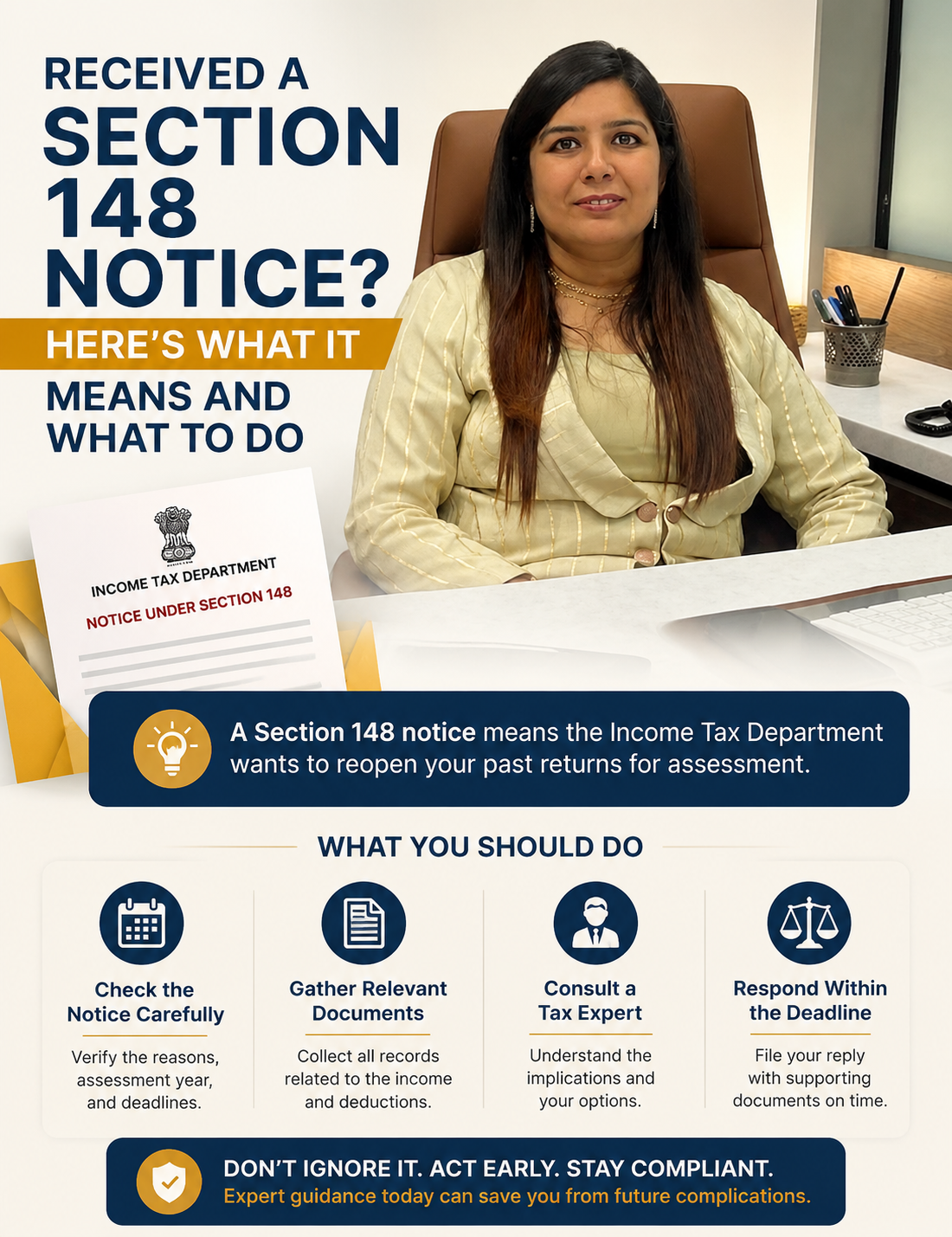
  • Received a Section 148 Notice? Here’s What It Means and What to do

    Received a Section 148 Notice? Here’s What It Means and What to do

    June 2026• Nidhi Adwani

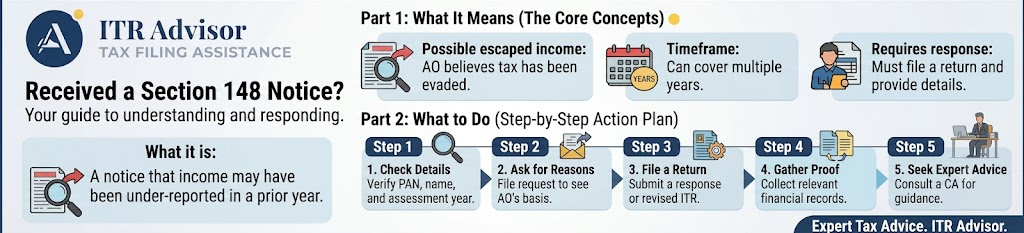
    A Section 148 Notice is one of the most serious notices that a taxpayer can receive from the Income Tax Department.

    Many taxpayers panic when they receive such a notice because it relates to income that the department believes may have escaped assessment in an earlier year.

    However, receiving a Section 148 Notice does not automatically mean that you have committed tax evasion or concealed income. In many cases, notices are issued due to information mismatches, non reporting of transactions, or incomplete disclosures in the Income Tax Return (ITR).

    Understanding the reason for the notice and responding correctly is critical.


    What is a Section 148 Notice?

    A Section 148 Notice is issued when the Income Tax Department has information suggesting that taxable income may have escaped assessment.

    In simple words, the department believes that:

    • Certain income was not disclosed in the ITR, or
    • Certain transactions were not properly reported, or
    • Additional tax may be payable.

    The notice gives the taxpayer an opportunity to explain the transaction before reassessment proceedings are completed.

    Why is a Section 148 Notice Issued?

    Today, the Income Tax Department receives information from multiple sources, including:

    • Banks
    • Property Registration Offices
    • Stock Brokers
    • Mutual Fund Companies
    • Credit Card Companies
    • GST Authorities
    • Foreign Tax Authorities
    • Annual Information Statement (AIS)

    If the information available with the department does not match the details disclosed in the ITR, a Section 148 Notice may be issued.

    Common Reasons for Receiving a Section 148 Notice

    1. Property Sale Not Reported

    The taxpayer sold a property but failed to report capital gains in the return.

    1. High-Value Credit Card Spending

    Large spending patterns not matching declared income.

    1. Share Market Transactions Not Disclosed

    Capital gains or trading profits omitted from the ITR.

    1. Foreign Income Not Reported

    Income earned outside India not disclosed where required.

    1. Cash Deposits in Bank Accounts

    Large cash deposits that do not match reported income.

    1. Business Receipts Under-Reported

    Turnover reflected in GST records differs from income declared in the ITR.


    Real-Life Example: Section 148 Notice for Property Sale

    Mr. Rajesh, a salaried employee from Pune, sold a residential plot in 2022 for ₹72 lakh.

    Since tax was deducted by the buyer and the sale proceeds were credited to his bank account, Mr. Rajesh assumed that no further reporting was required.

    While filing his Income Tax Return, he disclosed his salary income but failed to report the capital gains arising from the property sale.

    The property transaction was reported to the Income Tax Department through the registrar’s office and reflected in its database.

    Two years later, Mr. Rajesh received a Section 148 Notice stating that income chargeable to tax appeared to have escaped assessment.

    After consulting a tax professional, he:

    • Obtained the purchase documents.
    • Calculated the indexed cost of acquisition.
    • Computed long-term capital gains.
    • Submitted proof of investment made in another residential property.
    • Claimed exemption under the applicable provisions.

    After reviewing the documents, the Income Tax Department accepted the explanation and completed the reassessment proceedings.

    This is one of the most common reasons for Section 148 Notices in India.


    Real-Life Example: Section 148 Notice for Credit Card Spending

    A taxpayer declared annual income of ₹9 lakh in his Income Tax Return.

    However, information available with the Income Tax Department showed credit card spending exceeding ₹24 lakh during the same financial year.

    The department sought an explanation regarding the source of funds used for such expenditure.

    Upon examination, it was found that a significant portion of the spending was incurred for family members and reimbursed by relatives.

    Supporting documents were submitted and the matter was explained during reassessment proceedings.

    This example highlights how high-value transactions can attract scrutiny even when there is no tax evasion.

    Read our detailed guide on:Got an Income Tax Notice for High Credit Card Spending?


    What Should You Do After Receiving a Section 148 Notice?

    Step 1: Do Not Ignore the Notice

    Ignoring the notice can result in reassessment being completed based on available information.

    Step 2: Understand the Issue

    Identify:

    • Assessment Year involved
    • Transaction questioned by the department
    • Deadline for response

    Step 3: Gather Documents

    Depending on the issue involved, collect:

    • Bank statements
    • Property documents
    • Capital gains calculations
    • Loan documents
    • Investment records
    • Business books of accounts

    Step 4: Verify the Facts

    Many notices arise because the department’s information is incomplete or because a transaction has been misunderstood.

    Step 5: Submit a Proper Response

    A well-documented response supported by evidence can significantly improve the outcome of reassessment proceedings.


    Is Section 148 Notice Serious?

    Yes.

    A Section 148 Notice should always be taken seriously because it involves reopening an earlier assessment.

    However, seriousness does not mean guilt.

    Many genuine taxpayers successfully resolve reassessment proceedings by providing proper explanations and supporting documents.


    What Happens if You Ignore a Section 148 Notice?

    Failure to respond may result in:

    • Reassessment based on available records
    • Additional tax demand
    • Interest liability
    • Penalty proceedings in certain cases

    Therefore, timely action is essential.

    Frequently Asked Questions (FAQs)

    1.Does a Section 148 Notice mean I have concealed income?

    No. The notice only indicates that the department believes income may have escaped assessment and seeks an explanation.

    2.Can salaried employees receive a Section 148 Notice?

    Yes. Property transactions, share trading, foreign assets, and high-value transactions can trigger notices even for salaried taxpayers.

    3.Can a Section 148 Notice be issued years after filing the return?

    Yes. Subject to statutory conditions and timelines prescribed under the Income Tax Act.

    4.Should I seek professional assistance?

    Where the notice involves property transactions, capital gains, business income, foreign assets, or substantial tax demands, professional guidance is strongly advisable.

    About the Author Nidhi Adwani

    Nidhi Adwani is the Human Resources Manager at Adwani & Co., where she plays a key role in people management, team development, organizational culture, and business communications. With a background in Law and MBA (Human Resources), she combines legal understanding with modern HR practices to support a productive and growth-oriented workplace.

    Beyond HR management, Nidhi actively oversees staff engagement initiatives, recruitment, employee development, and internal operations. She also manages the firm’s social media presence and contributes to content strategy, helping communicate valuable insights to clients and professionals through informative articles and digital engagement.

    As a regular contributor to the blogs of ITRAdvisor and Adwani & Co., she writes on topics related to human resources, workplace culture, leadership, employee engagement, professional development, and organizational effectiveness. Her articles aim to simplify practical HR concepts, share industry perspectives, and encourage continuous learning among professionals and business owners.

    Through her writing, Nidhi seeks to bridge the gap between people, processes, and professional growth, helping organizations build stronger teams and healthier work environments.


    Need Help with a Section 148 Notice?

    Receiving a reassessment notice can be stressful, but the right response at the right time can make a significant difference.

    If you have received a Section 148 Notice and need assistance in understanding the notice, preparing a response, calculating capital gains, explaining high-value transactions, or representing your case before the Income Tax Department, professional support can help protect your interests.

    For assistance and consultation, contact ITRAdvisor.in. Our team helps taxpayers across India with ncome Tax Notices, Reassessment Proceedings, AIS Mismatches, Capital Gains Issues, NRI Taxation, and ITR Compliance matters.

    Visit: https://itradvisor.in

    Early action can often prevent unnecessary tax disputes and penalties.

  • Received an Income Tax Notice for Cash Deposits? Here’s What to Do in AY 2026-27

    Received an Income Tax Notice for Cash Deposits? Here’s What to Do in AY 2026-27

    CA Dipesh Gurubakshani June 2026 8 min read

    Received an Income Tax Notice for Cash Deposits? Don’t Panic

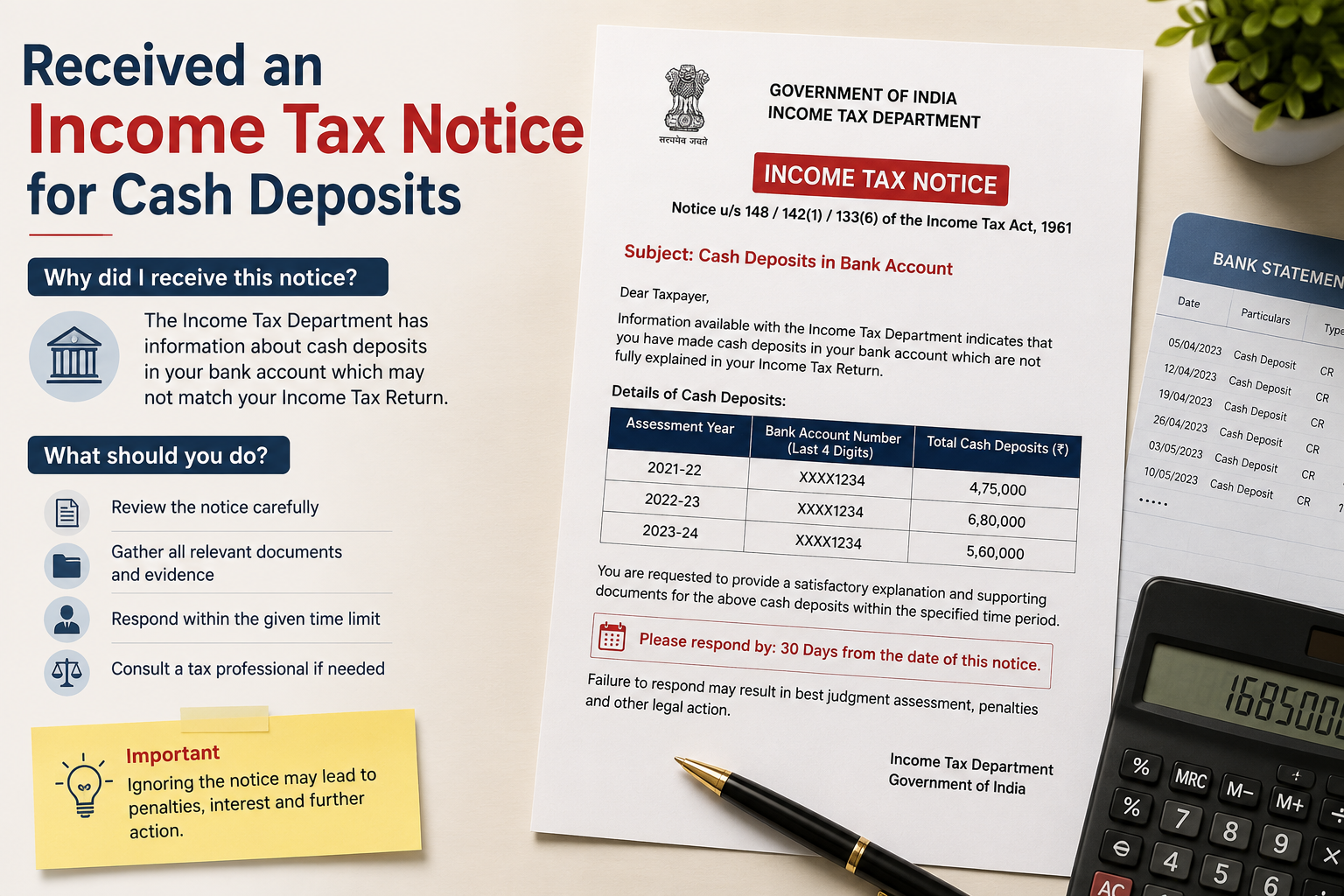
    Have you recently received an Income Tax notice for cash deposits in your bank account?

    You’re not alone

    Every year, thousands of taxpayers receive notices from the Income Tax Department after depositing substantial amounts of cash in savings accounts, current accounts, or other bank accounts.

    In many cases, the deposits are genuine and fully explainable. However, ignoring the notice or providing an incomplete response can lead to scrutiny, reassessment proceedings, additional tax demands, penalties, and prolonged litigation.

    This guide explains why you may have received an Income Tax notice for cash deposits, what documents you should collect, how to respond, and how to protect yourself from unnecessary tax disputes in AY 2026-27.


    Why Did You Receive an Income Tax Notice for Cash Deposits?

    Banks and financial institutions report certain high-value transactions to the Income Tax Department.

    The Department uses data analytics, PAN-based reporting, AIS (Annual Information Statement), and other information sources to identify cases where cash deposits appear inconsistent with the income reported in the Income Tax Return (ITR).

    Common situations that trigger notices include:

    • Large cash deposits in savings accounts
    • Significant cash deposits in current accounts
    • Cash deposits not matching declared income
    • Cash deposits during specific monitoring periods
    • High-value transactions reflected in AIS
    • Cash deposits where no ITR has been filed

    The notice does not automatically mean tax evasion. It simply means the Department requires an explanation.


    Common Reasons for Large Cash Deposits

    Before responding, identify the actual source of funds.

    Legitimate sources may include:

    1. Cash Sales from Business

    Businesses dealing in cash may deposit daily collections into bank accounts.

    Supporting records should be maintained.

    1. Agricultural Income

    Agricultural income may generate substantial cash receipts in certain cases.

    Proper evidence should be available.

    1. Withdrawal and Redeployment of Cash

    Taxpayers sometimes redeposit cash previously withdrawn from bank accounts.

    A clear cash flow trail is important.

    1. Sale of Assets

    Cash received from the sale of certain assets may be deposited into a bank account.

    Documentation must support the transaction.

    1. Gifts or Family Contributions

    In some situations, cash may have been received from family members or relatives.

    Proper documentation becomes critical.

    1. Past Savings

    Taxpayers may deposit accumulated cash savings.

    However, the source and accumulation history should be capable of explanation.


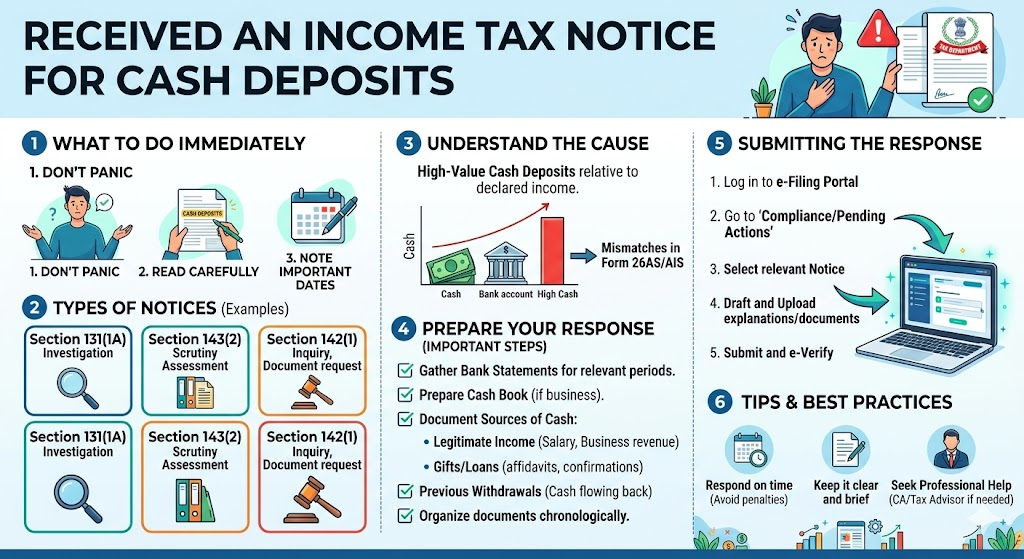
    What Types of Notices May Be Issued?

    The Income Tax Department may issue different notices depending upon the facts of the case.

    Common notices include:

    Notice Seeking Information

    The Department may ask you to explain the source of cash deposits and provide supporting evidence.

    Scrutiny Proceedings

    Your return may be selected for detailed examination.

    Reassessment Proceedings

    In certain circumstances, reassessment proceedings may be initiated if income is believed to have escaped assessment.

    Section 148 Notice

    A notice under Section 148 may be issued in cases where the Department believes taxable income may not have been properly reported.

    A Section 148 notice should never be ignored and requires careful professional review.


    What Should You Do Immediately After Receiving the Notice?

    Step 1: Read the Notice Carefully

    Identify:

    • Notice section
    • Assessment year involved
    • Response deadline
    • Information requested

    Different notices require different responses.

    Step 2: Download AIS and Form 26AS

    Review:

    • Reported cash transactions
    • Bank information
    • TDS records
    • Other financial transactions
    • TDS records
    • Other financial transactions
    • Many notices originate from information reflected in AIS.

    Step 3: Gather Supporting Documents

    • Collect documents relevant to the source of cash deposits.
    • Examples include:
    • Bank statements
    • Cash books
    • Sale agreements
    • Agricultural records
    • Income records
    • Gift documentation
    • Business books of accounts
    • The stronger the documentation, the stronger the response.

    Step 4: Prepare a Cash Flow Explanation

    • The Income Tax Department generally expects a logical explanation supported by evidence.
    • A proper cash flow statement should explain:
    • Opening cash balance
    • Cash receipts
    • Cash utilization
    • Cash deposits made
    • This often becomes the most important document in cash deposit cases.

    What Happens If You Ignore the Notice?

    Ignoring a notice can create serious problems.

    Possible consequences include:

    • Best judgment assessment
    • Addition of unexplained income
    • Additional tax liability
    • Interest charges
    • Penalty proceedings
    • Further notices and litigation

    Even when the cash deposits are genuine, failure to respond can result in adverse outcomes.


    Can Cash Deposits Be Treated as Unexplained Income?

    Yes.

    If a taxpayer fails to satisfactorily explain the source of cash deposits, the Department may treat the amount as unexplained income under applicable provisions of the Income Tax Act.

    This can lead to:

    • High tax liability
    • Interest
    • Penalties
    • Extended scrutiny

    Therefore, documentation and professional representation are extremely important.


    Example:

    Cash Deposit Notice Successfully Explained

    Mr. Sharma received a notice regarding cash deposits of ₹18 lakh in his savings account.

    Initially, he was concerned that the Department would treat the entire amount as unexplained income.

    Upon review, it was found that:

    • Part of the deposits represented business receipts
    • Part represented redeposit of earlier withdrawals
    • Supporting records were available

    A detailed explanation with documentary evidence was submitted.

    As a result, the matter was resolved without adverse additions.

    This demonstrates the importance of proper representation and documentation.


    Common Mistakes Taxpayers Make

    Ignoring the Notice

    Many taxpayers assume the issue will disappear automatically.

    It will not.

    Responding Without Reviewing Documents

    Incorrect explanations can weaken the case.

    Providing Incomplete Information

    Half-complete responses often generate additional queries.

    Missing Response Deadlines

    Delays can adversely affect the outcome.

    Not Seeking Professional Advice

    Complex cash deposit cases often require technical tax analysis and structured submissions.

    Read our detailed guide on: Income Tax Notice After Filing ITR? Here’s What Every Taxpayer Must Know


    How to Avoid Cash Deposit Notices in Future To reduce future risks:

    ✅ File your ITR on time

    ✅ Maintain proper books and records

    ✅ Reconcile cash transactions regularly

    ✅ Review AIS before filing returns

    ✅ Maintain supporting evidence for large cash transactions

    ✅ Ensure reported income matches actual financial activity

    Frequently Asked Questions (FAQs)

    1. Why did I receive an income tax notice for cash deposits

    The notice is generally issued when cash deposits reported by banks appear inconsistent with the income disclosed in your tax records.

    2.Does receiving a notice mean I have done something wrong?

    No. A notice simply means the Department wants clarification regarding the transaction.

    3.Can cash deposits from past savings be explained?

    Yes, provided sufficient evidence and a credible explanation are available.

    4.What if I received a Section 148 notice for cash deposits?

    A Section 148 notice should be reviewed carefully and responded to within the prescribed time limits after evaluating the facts and supporting records.

    5.Should I handle the notice myself?

    Simple cases may be manageable. However, substantial cash deposits or reassessment proceedings often require professional assistance.

    Author

    CA Dipesh Gurubakshani is a Chartered Accountant with Adwani & Co LLP, Pune, specialising in income tax audit, direct taxation, and accounting advisory. He supports clients across statutory compliance, financial reporting, and income tax matters with a focus on accuracy, regulatory adherence, and disciplined execution.Received an Income Tax Notice for Cash Deposits? We Can Help.

    If you have received:

    • An income tax notice for cash deposits
    • A cash transaction notice
    • A scrutiny notice
    • A Section 148 notice
    • A reassessment notice

    our experienced tax professionals can help you prepare a strong response supported by proper documentation and legal analysis.

    Contact ITR Advisor Today

    Don’t ignore the notice. The right response at the right time can make all the difference.

    Disclaimer: ITRAdvisor.in is an educational and informational platform focused on tax awareness and compliance updates. Nothing contained herein should be construed as solicitation or advertisement of professional services. Professional services, where applicable, are rendered in accordance with ICAI guidelines. This article is published on ITRAdvisor.in, a tax and compliance knowledge platform. The content has been reviewed for technical accuracy by professionals associated with Adwani & Co LLP.

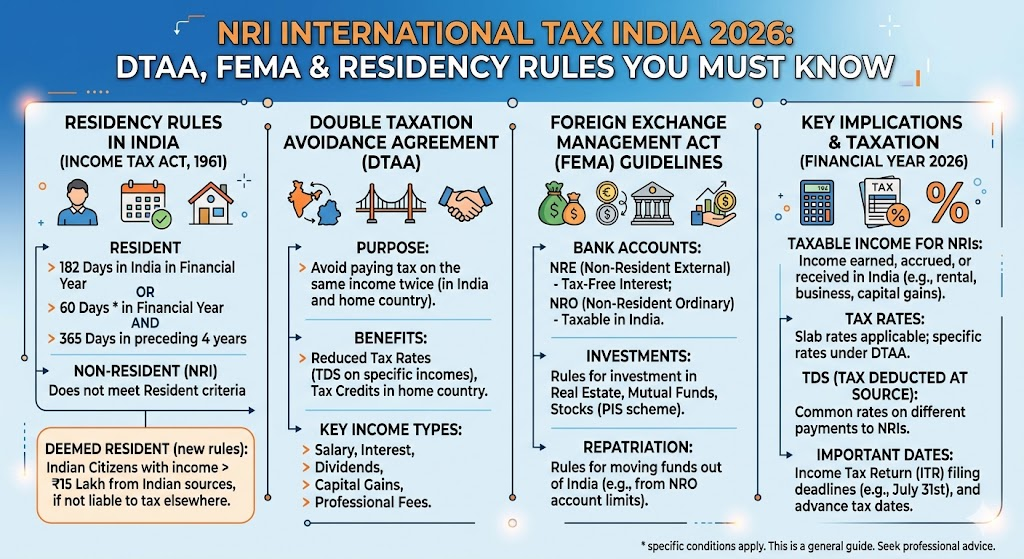
  • NRI Returning to India ? Tax Rules You Must Know Before Filing ITR for AY 2026-27

    NRI Returning to India ? Tax Rules You Must Know Before Filing ITR for AY 2026-27

    CA Dipesh Gurubakshani June 2026 7 min read

    NRI Returning to India After Working Abroad? Understand Your Tax Status Before Filing ITR

    Thousands of Non-Resident Indians (NRIs) return to India every year after working in countries such as the USA, UK, UAE, Canada, Australia, Singapore, and other parts of the world.

    One of the biggest mistakes returning NRIs make is assuming that all their foreign income automatically becomes taxable in India.


    The reality is different.

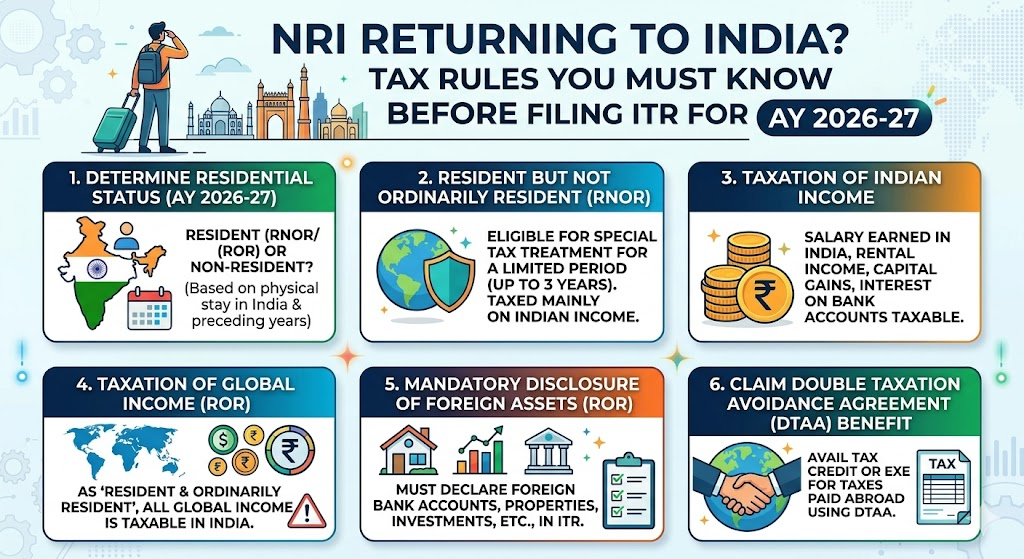
    Your tax liability depends on your residential status under the Income Tax Act, which may be classified as:

    • Non-Resident (NRI)
    • Resident but Not Ordinarily Resident (RNOR)
    • Resident and Ordinarily Resident (ROR)

    Understanding these categories can help you save tax legally and avoid costly mistakes while filing your Income Tax Return (ITR) for AY 2026-27.


    Why Determining Residential Status Is Important

    Your residential status determines:

    • Whether foreign income is taxable in India
    • Whether foreign bank accounts need disclosure
    • Whether foreign assets need reporting
    • Eligibility for tax benefits
    • Applicable ITR forms

    Even a small mistake in determining residential status can result in notices, penalties, or double taxation issues.


    Resident vs NRI vs RNOR – Understanding the Difference

    1. Non-Resident Indian (NRI)

    You are generally treated as an NRI if your stay in India during the relevant financial year does not exceed the prescribed limits under the Income Tax Act.

    For NRIs:

    Taxable in India

    ✔️ Salary received in India

    ✔️ Rental income from Indian property

    ✔️ Capital gains from Indian assets

    ✔️ Interest on Indian bank deposits (subject to applicable provisions)

    Not Taxable in India

    ✔️ Salary earned abroad

    ✔️ Foreign business income

    ✔️ Foreign investment income

    ✔️ Foreign rental income

    2.Resident but Not Ordinarily Resident (RNOR)

    RNOR is a special transitional status available to many NRIs returning to India.

    This status can provide significant tax benefits.

    A returning NRI may qualify as RNOR depending upon past residential history and conditions prescribed under the Income Tax Act.

    Read our Detailed guide on:The 120-Day Rule That Is Silently Taxing Thousands of NRIs in India :Are You at Risk?

    Major Benefit of RNOR Status

    During the RNOR period:

    ✔️ Foreign income generally remains outside Indian taxation, provided it is not derived from a business controlled from India or a profession set up in India.

    ✔️ Global income disclosure requirements are comparatively relaxed compared to Resident and Ordinarily Resident taxpayers.

    For many returning NRIs, RNOR status can result in substantial tax savings.

    3. Resident and Ordinarily Resident (ROR)

    Once RNOR benefits expire, an individual may become Resident and Ordinarily Resident.

    This is the most comprehensive tax category.

    Taxable in India

    ✔️ Indian income

    ✔️ Foreign salary

    ✔️ Foreign interest income

    ✔️ Foreign rental income

    ✔️ Foreign dividends

    ✔️ Foreign capital gains

    ✔️ Global income from all sources

    In other words, worldwide income generally becomes taxable in India.

    Taxability of Foreign Income After Returning to India

    One of the most frequently asked questions is:

    Do I need to pay tax in India on my foreign income after returning?”

    The answer depends on your residential status.

    Type of Income NRI RNOR ROR
    Foreign Salary Not Taxable Generally Not Taxable Taxable
    Foreign Bank Interest Not Taxable Generally Not Taxable Taxable
    Foreign Rental Income Not Taxable Generally Not Taxable Taxable
    Foreign Capital Gains Not Taxable Generally Not Taxable Taxable
    Indian Rental Income Taxable Taxable Taxable

    Therefore, determining RNOR eligibility can have a major impact on tax planning.


    Foreign Bank Accounts : Disclosure Requirements

    Many NRIs maintain

    • Savings accounts abroad
    • Salary accounts
    • Investment accounts
    • Retirement accounts
    • Brokerage accounts

    Once you become Resident and Ordinarily Resident, disclosure of foreign assets and accounts becomes extremely important.

    Failure to disclose foreign assets may attract severe consequences under applicable laws.

    Before filing your ITR, review:

    • Foreign bank accounts
    • Foreign shares
    • Mutual funds
    • Retirement accounts
    • Real estate holdings
    • Foreign insurance policies

    Proper disclosure is essential for compliance.


    Common Mistakes Returning NRIs Make

    1. Assuming RNOR Benefits Automatically Apply

    Many taxpayers assume they are RNOR without verifying eligibility.

    Always calculate residential status carefully.

    1. Ignoring Foreign Income

    Some returning NRIs continue receiving:

    • Foreign salary arrears
    • Overseas pension
    • Interest income
    • Dividends

    The tax treatment depends on residential status.

    1. Not Reviewing Double Taxation Relief

    India has tax treaties with many countries.

    Failure to claim treaty benefits may result in paying more tax than necessary.

    1. Incorrect ITR Form Selection

    Using the wrong ITR form can lead to defective return notices and processing delays.

    1. Non-Disclosure of Foreign Assets

    Many returning NRIs are unaware of disclosure requirements applicable after becoming Resident and Ordinarily Resident.

    This is one of the most serious compliance errors.

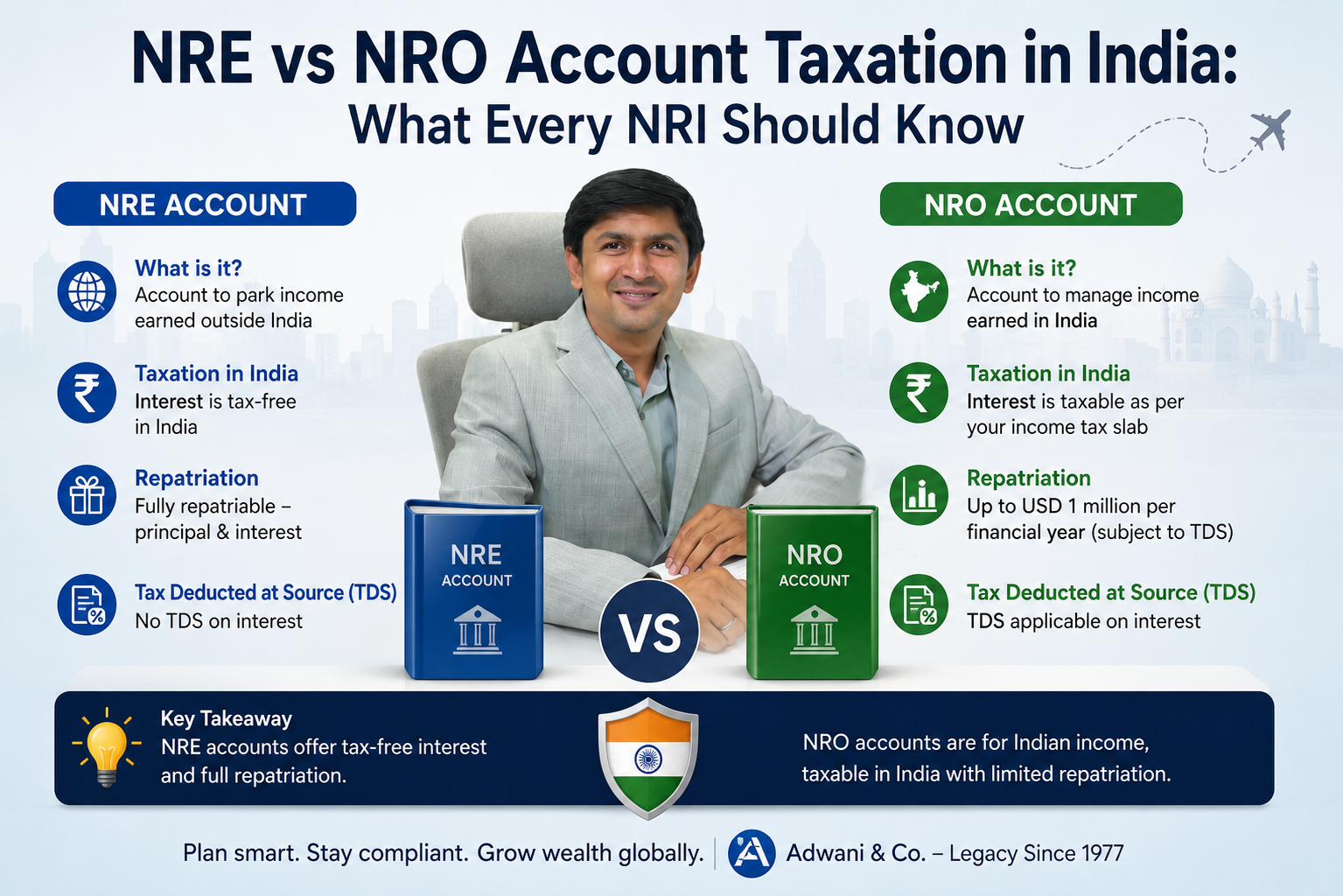
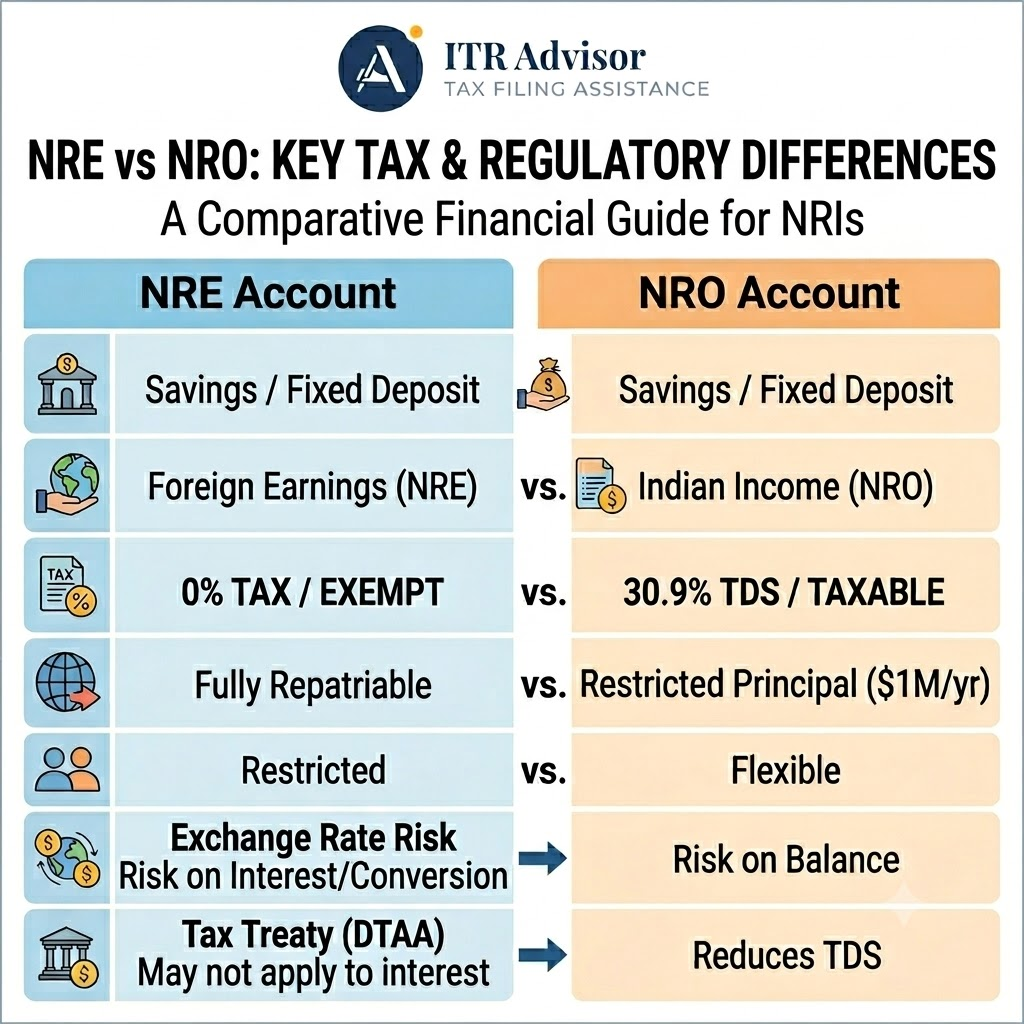
    1. Continuing NRO/NRE Accounts Without Review

    Returning NRIs should review banking arrangements and ensure compliance with RBI and income tax regulations.


    Example

    Returning NRI from UAE

    Mr. Shah worked in Dubai for 12 years and permanently returned to India during FY 2025-26.

    He continues to hold:

    • UAE bank deposits
    • Foreign mutual funds
    • Rental property in Dubai

    If he qualifies as RNOR, foreign income may continue to enjoy favourable tax treatment during the RNOR period, subject to applicable provisions.

    However, once he becomes Resident and Ordinarily Resident, worldwide income may become taxable in India.

    Understanding this transition can help avoid unnecessary tax liability.


    Checklist Before Filing ITR for AY 2026-27:

    ✅ Determine residential status correctly

    ✅ Evaluate RNOR eligibility

    ✅ Review foreign income sources

    ✅ Check tax treaty benefits

    ✅ Verify foreign asset disclosures

    ✅ Select the correct ITR form

    ✅ Reconcile foreign tax credits

    ✅ Review NRE and NRO accounts

    ✅ Maintain supporting documentation


    Frequently Asked Questions (FAQs)

    1.Can a returning NRI claim RNOR status?

    Yes, subject to satisfying the conditions prescribed under the Income Tax Act.

    2.Is foreign salary taxable after returning to India?

    It depends on your residential status and the period to which the salary relates.

    3.Are foreign bank accounts required to be disclosed?

    Disclosure requirements depend on residential status and applicable reporting provisions.

    4.Can I claim credit for foreign taxes paid?

    Yes, relief may be available under Double Taxation Avoidance Agreements (DTAAs) and other provisions, subject to conditions.

    5.Is foreign rental income taxable in India?

    It depends on whether you are NRI, RNOR, or Resident and Ordinarily Resident.

    Author

    CA Dipesh Gurubakshani is a Chartered Accountant with Adwani & Co LLP, Pune, specialising in income tax audit, direct taxation, and accounting advisory. He supports clients across statutory compliance, financial reporting, and income tax matters with a focus on accuracy, regulatory adherence, and disciplined execution.

    Need Professional Assistance With NRI Tax Filing?

    Returning to India can create complex tax issues involving:

    • RNOR status determination
    • Foreign income taxation
    • DTAA benefits
    • Foreign tax credit claims
    • Foreign asset disclosures
    • NRI and returning resident tax planning

    At ITR Advisor, we assist NRIs and returning Indians worldwide with accurate tax compliance and strategic tax planning.

    If you have recently returned to India or plan to return soon, consult our NRI tax experts before filing your Income Tax Return for AY 2026-27.

    Disclaimer: ITRAdvisor.in is an educational and informational platform focused on tax awareness and compliance updates. Nothing contained herein should be construed as solicitation or advertisement of professional services. Professional services, where applicable, are rendered in accordance with ICAI guidelines. This article is published on ITRAdvisor.in, a tax and compliance knowledge platform. The content has been reviewed for technical accuracy by professionals associated with Adwani & Co LLP.

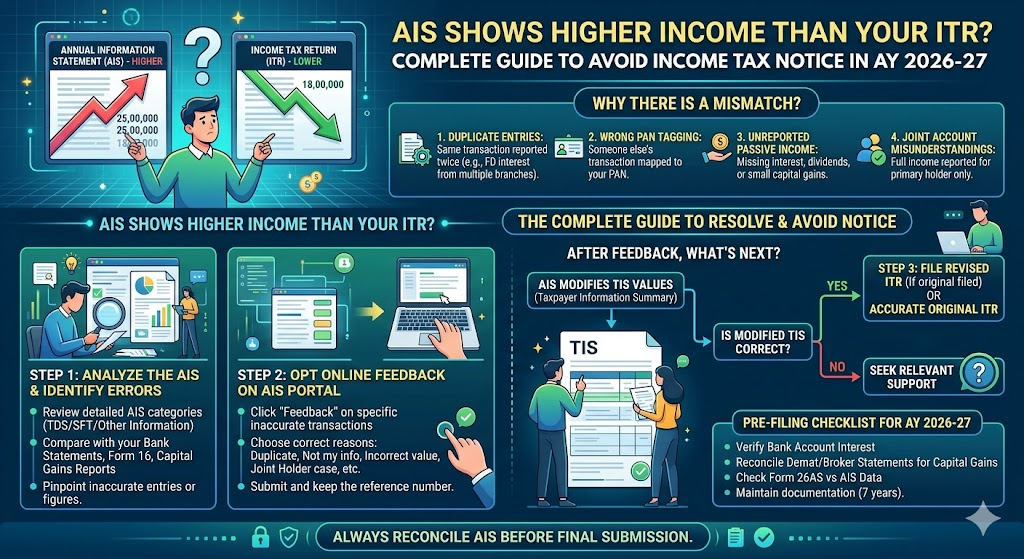
  • AIS Shows Higher Income Than Your ITR? Complete Guide to Avoid Income Tax Notice in AY 2026-27

    AIS Shows Higher Income Than Your ITR? Complete Guide to Avoid Income Tax Notice in AY 2026-27

    CA Dipesh Gurubakshani June 2026 9 min read

    AIS Shows More Income Than Your ITR? Don’t Ignore It

    Have you checked your Annual Information Statement (AIS) before filing your Income Tax Return (ITR)?

    Many taxpayers receive Income Tax notices because the income reported in their ITR does not match the information available with the Income Tax Department through AIS.

    If your AIS shows higher income than what you have reported in your ITR, it could trigger scrutiny, notices, or demands from the Income Tax Department.

    In this guide, we explain what AIS is, common AIS mismatches, how to correct errors, and what steps you should take before filing your ITR for AY 2026-27.


    What is AIS (Annual Information Statement)?

    The Annual Information Statement (AIS) is a comprehensive statement available on the Income Tax Portal that contains details of various financial transactions reported to the Income Tax Department.

    AIS includes information such as:

    • Savings bank interest
    • Fixed deposit interest
    • Dividend income
    • Purchase and sale of shares and mutual funds
    • Salary income
    • Rent received
    • Foreign remittances
    • Credit card payments
    • High-value transactions
    • Tax Deducted at Source (TDS)
    • Tax Collected at Source (TCS)

    The Income Tax Department uses AIS to verify whether taxpayers have correctly reported their income in the ITR.


    Why AIS is Important Before Filing ITR

    Many taxpayers rely only on Form 16, bank statements, or investment records while filing their returns.

    However, the Income Tax Department compares your ITR with the data available in AIS.

    Even if you unintentionally omit income, the mismatch may result in:

    • Defective return notices
    • Scrutiny notices
    • Tax demands
    • Penalties
    • Interest liability

    Therefore, checking AIS before filing your return has become essential.

    Read our detailed guide on :How to Download AIS from the Income Tax Portal : The Ultimate Step by Step Guide for AY 2026-27


    Common AIS Errors and Mismatches

    1. Fixed Deposit Interest Not Reported

    Banks report FD interest to the Income Tax Department even if the interest is not credited to your account.

    Many taxpayers miss reporting FD interest, leading to an AIS mismatch.

    2. Savings Bank Interest Missing

    Interest earned from savings accounts is often overlooked while filing returns.

    However, banks report this information in AIS.

    3. Dividend Income Not Included

    Companies and mutual funds report dividend payments.

    Failure to report dividend income may create discrepancies.

    4. Capital Gains Not Reported Correctly

    Share and mutual fund transactions are reported by brokers and RTAs.

    Many taxpayers report only sale proceeds or forget to calculate capital gains accurately.

    5.Duplicate Reporting in AIS

    Sometimes AIS may show duplicate transactions due to reporting by multiple entities.

    Such cases require verification before filing.

    6. Incorrect Salary Information

    Employers may revise TDS returns, causing differences between Form 16 and AIS.

    7. High-Value Transactions

    Property purchases, foreign remittances, credit card payments, and other specified financial transactions may appear in AIS.

    Ignoring them can invite questions from the tax department.


    What Happens If You Ignore AIS Mismatches?

    Ignoring AIS discrepancies can lead to serious consequences.

    The Income Tax Department may:

    • Issue notices seeking clarification
    • Add omitted income during assessment
    • Levy additional tax
    • Charge interest under applicable provisions
    • Impose penalties in certain cases

    Many taxpayers receive notices simply because they failed to reconcile AIS before filing their return.


    How to Check AIS Online

    Follow these steps:

    1. Login to the Income Tax e-Filing Portal.

    2. Go to “Services”.

    3. Click on “Annual Information Statement (AIS)”.

    4. Open AIS and review all reported transactions.

    5. Compare AIS data with:

    • Form 16
    • Form 26AS
    • Bank statementsBank statements
    • Broker statements
    • Mutual fund statements
    • Books of accounts

    How to Submit Feedback in AIS

    If you find incorrect information in AIS, you can submit feedback directly through the portal.

    Common feedback options include:

    • Information is correct
    • Information is not fully correct
    • Information relates to another PAN
    • Duplicate information
    • Information is denied

    Providing feedback helps the Income Tax Department understand discrepancies and may prevent future issues.


    Example of an AIS Mismatch


    Mr. Sharma filed his ITR showing interest income of ₹12,000.

    However, AIS reflected:

    • Savings account interest: ₹12,000
    • FD interest: ₹45,000
    • Total interest as per AIS: ₹57,000

    Since FD interest was omitted from the return, the Income Tax Department may issue a notice seeking clarification.

    This is one of the most common AIS-related mistakes observed every year.


    Best Practices to Avoid AIS-Related Notices

    Before filing your ITR:

    • ✅ Download and review AIS
    • ✅ Compare AIS with Form 26AS
    • ✅ Verify bank interest income
    • ✅ Check dividend income
    • ✅ Review share and mutual fund transactions
    • ✅ Verify salary details
    • ✅ Reconcile TDS entries
    • ✅ Submit feedback wherever required
    • ✅ Seek professional assistance for complex transactions

    Frequently Asked Questions (FAQs)

    1. Is AIS mandatory for filing ITR?

    While AIS is not mandatory, checking it before filing your return is strongly recommended to avoid mismatches.

    2.Can AIS contain incorrect information?

    Yes. AIS may occasionally contain duplicate or incorrect entries. Such errors can be addressed through the feedback mechanism.

    3.Can I revise my ITR if AIS shows additional income?

    Yes, taxpayers can file a revised return within the prescribed time limit if any income was omitted.

    4. Will I definitely receive a notice if AIS and ITR do not match?

    Not necessarily. However, significant mismatches increase the likelihood of scrutiny or notices.

    Author

    CA Dipesh Gurubakshani is a Chartered Accountant with Adwani & Co LLP, Pune, specialising in income tax audit, direct taxation, and accounting advisory. He supports clients across statutory compliance, financial reporting, and income tax matters with a focus on accuracy, regulatory adherence, and disciplined execution.

    Disclaimer: ITRAdvisor.in is an educational and informational platform focused on tax awareness and compliance updates. Nothing contained herein should be construed as solicitation or advertisement of professional services. Professional services, where applicable, are rendered in accordance with ICAI guidelines. This article is published on ITRAdvisor.in, a tax and compliance knowledge platform. The content has been reviewed for technical accuracy by professionals associated with Adwani & Co LLP.

    Need Help With AIS Mismatch or Income Tax Notice?

    If your AIS shows higher income than your ITR, do not ignore it. Our team at ITR Advisor assists taxpayers across India and NRIs worldwide with:

    • AIS reconciliation
    • Income Tax Return filing
    • Revised Return filing
    • Income Tax Notice replies
    • Scrutiny and assessment support
    • Contact us today for professional assistance and ensure your return is filed accurately and compliantly.

  • Urgent & Powerful Tax Saving Tips Before July 31 for AY 2026-27 : Don’t Miss the Deadline!

    Urgent & Powerful Tax Saving Tips Before July 31 for AY 2026-27 : Don’t Miss the Deadline!

    •Dr. Haresh Adwani June 2026

    Tax Saving Tips Before July 31 for AY 2026-27

    The clock is ticking. July 31, 2026, is the ITR filing last date for AY 2026-27, and if you haven’t already taken stock of your tax saving opportunities, you are leaving real money on the table. Whether you’re a salaried professional, freelancer, or a small business owner, the weeks leading up to this deadline are your last genuine window to legally reduce your tax liability for FY 2025-26.

    This isn’t just a filing reminder it’s your strategic playbook. Let’s walk through the most impactful tax saving moves you can still make before the deadline hits.


    Why the July 31 Deadline for AY 2026-27 Is Critical

    Under the Income Tax Act, 1961, the due date for filing an ITR for individuals, HUFs, and non-audit cases is July 31st of the assessment year. For AY 2026-27, this translates to the last date being 31st July 2026. Missing this deadline doesn’t just attract a late filing fee of up to ₹5,000 under Section 234F it also locks you out of several beneficial provisions, including carrying forward certain losses.

    The Income Tax Department has made it clear through CBDT guidelines that filing on time is the foundation of good tax compliance. Don’t wait for an extension that may never come.


    Step 1 : Choose the Right Tax Regime Before Filing Your ITR

    One of the most consequential decisions you’ll make this filing season is: Old Tax Regime or New Tax Regime for FY 2026-27?

    The new tax regime for FY 2026-27 offers zero income tax on income up to ₹12 lakh (after rebate under Section 87A), with a simplified slab structure. It also now includes a standard deduction of ₹75,000 for salaried individuals a significant upgrade.

    However, if you have substantial deductions particularly Section 80C investments (up to ₹1.5 lakh), HRA, home loan interest (Section 24b), and NPS contributions (Section 80CCD(1B)) the old tax regime may still work out cheaper for you. Read our detailed guide on Old vs New Tax Regime 2026 to run your numbers before you file.

    Pro Tip: Use the ITR filing portal’s built-in regime comparison calculator or get a professional assessment before locking in your choice. Once the ITR is filed, switching is not possible for that year.

    Step 2 : Maximize Your Deductions Before July 31 (Checklist)

    Even if most investments had to be made by March 31, 2026, here’s what you can still do before filing:

    Deductions You Must Claim While Filing

    • Section 80C (up to ₹1.5 lakh): ELSS, PPF, LIC premium, home loan principal, NSC, tuition fees ensure all investments made in FY 2025-26 are accurately declared.
    • Section 80D Health Insurance Premium: Up to ₹25,000 for self/family; ₹50,000 for senior citizen parents. This deduction is often underclaimed.
    • Section 80CCD(1B) NPS Contribution: An additional ₹50,000 over and above the 80C limit available only under the old tax regime.
    • Section 24(b) Home Loan Interest: Up to ₹2 lakh for a self-occupied property. If you have a home loan, this is a powerful deduction to claim.
    • HRA Exemption: Cross-verify your actual rent paid vs. employer-declared HRA. Discrepancies can trigger notices.
    • Standard Deduction of ₹75,000 (new regime) or ₹50,000 (old regime for salaried): Automatically available ensure it reflects correctly in your ITR.

    Learn more about our ITR Filing Service to ensure every deduction is captured accurately

    Step 3 : Verify Form 26AS, AIS & TIS Before Filing

    One of the most overlooked yet critical pre filing steps is reconciling your Form 26AS, AIS (Annual Information Statement), and TIS (Taxpayer Information Summary). These documents reflect what banks, employers, and other third parties have reported to the Income Tax Department against your PAN.

    A mismatch between your income and what’s reported in AIS can trigger income tax scrutiny notices something you definitely want to avoid.


    Step 4 : Don’t Forget Advance Tax Compliance for FY 2026-27

    If you are a freelancer, consultant, business owner, or have capital gains income, advance tax is your responsibility. The advance tax due dates for FY 2026-27 are:

    InstallmentDue Date% of Total Tax
    1stJune 15, 202615%
    2ndSeptember 15, 202645%
    3rdDecember 15, 202675%
    4thMarch 15, 2027100%

    Failing to pay advance tax leads to interest under Sections 234B and 234C. This year, with capital gains from shares and mutual funds being taxable, many salaried individuals with F&O or equity portfolios fall into the advance tax net without realising it.


    Step 5 : File the Correct ITR Form

    This may sound basic, but filing the wrong ITR form is a common mistake that results in defective return notices. Here’s a quick guide:

    • ITR(1) (Sahaj): Salaried income, one house property, other sources income up to ₹50 lakh
    • ITR(2): Capital gains, multiple properties, foreign income/assets
    • ITR(4) (Sugam): Presumptive income under Section 44AD, 44ADA, 44AE

    Read our ITR-1 vs ITR-2 vs ITR-4 selection guide to pick the right form for your income type in AY 2026-27.


    Expert Insight : What Tax Professionals Recommend

    According to Dr. Haresh Adwani, a trusted voice in Indian taxation and compliance, many taxpayers lose significant amounts not because of high tax rates, but due to poor documentation, wrong regime selection, and failure to claim legitimate deductions. “Filing early, filing correctly, and filing with complete documentation is the single most powerful tax strategy available to the Indian taxpayer,” he notes.

    This view aligns with the Income Tax Department’s consistent push toward voluntary and timely compliance and for good reason. Early filers get faster refunds, fewer notices, and a cleaner compliance record.

    Key Takeaways

    • July 31, 2026 is the last date to file ITR for AY 2026-27 late filing attracts ₹5,000 penalty under Section 234F
    • Compare old vs new tax regime before filing don’t assume one is better without calculating
    • Standard deduction of ₹75,000 is available under the new regime for salaried individuals
    • Always verify Form 26AS, AIS, and TIS for mismatches before filing
    • Freelancers and business owners must track advance tax due dates for FY 2026-27
    • Choose the correct ITR form wrong form = defective return notice
    • Every deduction saved is money back in your pocket claim 80C, 80D, 80CCD(1B), and 24(b) diligently

    Fequently Asked Questions (FAQs)

    Q1. What is the last date to file ITR for AY 2026-27?

    The ITR filing last date for AY 2026-27 is July 31, 2026 for individuals and non audit cases. Filing after this date attracts a late fee of up to ₹5,000 under Section 234F.

    Q2. Which tax regime is better for salaried employees in FY 2026-27?

    It depends on your total deductions. The new tax regime benefits those with fewer deductions, while the old regime suits those with significant 80C, HRA, and home loan interest claims. Use a regime comparison calculator before deciding.

    Q3. What is the standard deduction under the new tax regime in 2026?

    The standard deduction under the new tax regime for FY 2025-26 (AY 2026-27) is ₹75,000 for salaried employees and pensioners a significant benefit introduced in the Union Budget

    Q4. Can I still save tax if I missed the March 31 investment deadline?

    Most investment-based deductions (like 80C) require investments before March 31. However, you can still maximize deductions by claiming HRA, home loan interest, health insurance premiums, and ensuring accurate reporting of all eligible expenses in your ITR.

    Q5. What happens if I file the wrong ITR form for AY 2026-27?

    Filing an incorrect ITR form results in a defective return notice under Section 139(9). You’ll be given 15 days to rectify it. However, repeated errors can delay refunds and invite scrutiny always verify which form applies to your income profile.

    Conclusion

    The ITR filing deadline for AY 2026-27 is not just a compliance formality it’s your last call to lock in every tax benefit legally available to you. From choosing the right regime and maximizing deductions to verifying AIS data and filing the correct form, every step matters.

    Don’t let procrastination cost you thousands of rupees in avoidable penalties, missed refunds, or compliance complications down the road.

    Ready to file smart this July 31? Connect with the experts at itradvisor.in today — because the right guidance now saves far more than the time it takes.

    Learn more about our ITR Filing Service | Explore our complete guide on Income Tax Slabs FY 2026-27

    About the Author
    Dr. Haresh Adwani
    Ph.D. in Commerce | Law Graduate | Managing Partner, Adwani & Co LLP Dr. Haresh Adwani holds a Ph.D. in Commerce and is a qualified Law graduate with over two decades of hands-on experience in GST advisory, direct taxation, and statutory compliance for businesses across

    Disclaimer: ITRAdvisor.in is an educational and informational platform focused on tax awareness and compliance updates. Nothing contained herein should be construed as solicitation or advertisement of professional services. Professional services, where applicable, are rendered in accordance with ICAI guidelines. This article is published on ITRAdvisor.in, a tax and compliance knowledge platform. The content has been reviewed for technical accuracy by professionals associated with Adwani & Co LLP.

  • Salary vs AIS Mismatch in Your ITR : Dangerous, Common & Completely Fixable

    Salary vs AIS Mismatch in Your ITR : Dangerous, Common & Completely Fixable

    Here’s Why It Happens and Exactly How to Fix It Before the Tax Department Comes Knocking (2026)

    Salary vs AIS Mismatch in ITR 2026: Reasons, Risks & Step-by-Step Solutions

    You filed your Income Tax Return confidently and then the refund just didn’t come. Or worse, a notice arrived asking you to explain why the salary reported in your ITR does not match the figures in your Annual Information Statement (AIS). If you are a salaried taxpayer in India, a salary vs AIS mismatch is one of the most common and most avoidable reasons your ITR gets flagged, your refund gets delayed, or a formal income tax scrutiny notice lands in your inbox.

    The AIS, introduced by the Income Tax Department under Section 285BB, consolidates data from multiple sources: your employer’s TDS returns (Form 24Q), banks, mutual funds, and even foreign remittances. When the income you declare in your ITR doesn’t align with what the AIS shows, the system triggers an alert automatically. In AY 2026-27, with AI-driven matching now deeply integrated into the income tax portal at incometax.gov.in, even minor salary vs AIS mismatches are getting picked up faster than ever before.

    The good news: every mismatch has a reason, and every reason has a fix. This guide breaks it all down.

    What Is the AIS and Why Does Salary vs AIS Mismatch Occur?

    The Annual Information Statement (AIS) is a comprehensive financial snapshot that the Income Tax Department generates for every taxpayer. Unlike the older Form 26AS which primarily captured TDS and TCS data the AIS captures a far wider range of transactions, including salary, interest income, dividends, mutual fund transactions, foreign remittances, and more.

    A salary vs AIS mismatch in ITR typically occurs when there is a gap between:

    • The salary figure reported by your employer in their TDS returns (Form 24Q) which flows into your AIS
    • The salary income you declare in your ITR based on your Form 16 or salary slips
    • Or when multiple employers in the same year report salary figures that do not reconcile with each other or with what you have declared

    Understanding the exact cause of the mismatch is the first and most critical step. Read our detailed guide on Form 26AS vs AIS vs TIS: Key Differences & How to Match Them Before Filing ITR for a complete primer on how these three documents interact.


    The 7 Most Common Reasons for Salary vs AIS Mismatch : and How to Fix Each

    Common Mismatch ReasonLikely Root CauseQuick Fix
    Employer filed incorrect TDS return (Form 24Q)Wrong salary or TDS figure submitted by employer to TRACESRequest employer to file a TDS correction statement immediately
    Job change mid-year: two Form 16s not reconciledBoth employers report salary separately; taxpayer adds them incorrectlyAdd both salary components; verify AIS reflects both TDS credits
    Perquisites/allowances excluded from ITREmployer includes all taxable perks in Form 24Q; taxpayer omits themInclude all taxable components per Form 16 Part B in your ITR
    AIS shows salary but Form 16 figure is lowerEmployer may not have updated revised TDS return after increments/bonusesReconcile with salary slips; raise feedback on AIS portal if data is wrong
    TDS deducted but not deposited by employerEmployer deducted TDS but failed to deposit to government it appears in salary but not in TDS creditFile ITR; follow up with employer; raise grievance on TRACES if needed
    AIS shows excess salary due to data duplicationTRACES data entry error or duplicate reporting by employerSubmit feedback on incometax.gov.in AIS portal mark as ‘Duplicate / Incorrect’
    Previous year arrears included in AISEmployer included arrears received in FY 2025-26 but attributable to earlier yearsClaim relief under Section 89(1); file Form 10E before filing ITR

    How to Use the AIS Feedback Feature to Dispute a Salary Mismatch

    One of the most powerful and underused tools available to taxpayers is the AIS Feedback mechanism on the income tax portal. If the salary figure in your AIS is incorrect, you do not have to simply accept it and file a potentially wrong ITR.

    Here’s how to submit an AIS mismatch correction:

    1. Log in to incometax.gov.in : Navigate to the AIS/TIS section under ‘Services’. Download your AIS for FY 2025-26.
    2. Identify the specific entry with the mismatch: Under the ‘Salary’ section of AIS, locate the entry that does not match your Form 16 or salary records.
    3. Click ‘Feedback’ against the incorrect entry: Select the appropriate reason: ‘Income is not as per source’, ‘Income is for a different year’, ‘Duplicate information’, or ‘Denied — not my income’.
    4. Submit with supporting details: Briefly explain the discrepancy. The portal records your feedback and updates your Taxpayer Information Summary (TIS), which is the adjusted figure used as a reference for your ITR.
    5. File your ITR based on the correct TIS figure: Once you’ve submitted feedback, the TIS gets updated. File your ITR aligned with the correct, verified figures not the original incorrect AIS entry.

    Important: Submitting AIS feedback does not automatically change the underlying data the original AIS still shows the employer’s reported figure. What changes is the TIS, which is your curated, taxpayer-revised view of income. The Income Tax Department uses both when assessing your return.


    What Happens If You File ITR Without Fixing a Salary vs AIS Mismatch?

    This is where many salaried taxpayers make a costly mistake. Filing your ITR with figures that differ from the AIS without submitting feedback explaining the discrepancy places your return in a high-risk zone for the following consequences:

    • Defective return notice under Section 139(9) : requiring you to resubmit the ITR within 15 days
    • Income tax scrutiny notice under Section 143(2) where the Assessing Officer formally examines your return
    • ITR refund delay : your refund gets held pending AIS reconciliation by the CPC (Centralised Processing Centre)
    • Demand notice under Section 156 : if the department independently computes a higher income and raises a tax demand
    • Penalty under Section 270A : for under-reporting or misreporting income, ranging from 50% to 200% of the tax on the under-reported amount

    Read our detailed guide on ITR Refund Delay 2026: Why It’s Late, How to Check Status & Escalate It to understand why AIS mismatches are among the top causes of refund delays.

    Read our detailed guide on Income Tax Notice Time Limit 2026 to understand how long the department can pursue a mismatch case.

    Expert Insight

    Dr. Haresh Adwani, senior chartered accountant and co-founder of Adwani & Co LLP, advises every salaried client to treat AIS reconciliation as a mandatory pre-filing step — not an afterthought. In his experience, over 60% of ITR refund delays handled by the firm each year trace back to unresolved AIS discrepancies that could have been corrected in under 30 minutes before filing.“Your AIS is the Income Tax Department’s version of your financial year. Before you file your ITR, make sure your version and theirs are telling the same story.”


    Pre-Filing AIS Checklist: How Smart Taxpayers Avoid Salary Mismatch Issues

    Adopting a structured pre-filing review process is the single most effective way to prevent salary vs AIS mismatch in ITR. Here is the checklist used by tax professionals before filing returns for their clients:

    • Download Form 16 (Part A and Part B) from your employer this is your authoritative salary document
    • Download your AIS and TIS from incometax.gov.in under the ‘Services’ tab
    • Cross-check: Salary in Form 16 Part B ↔ Salary in AIS ↔ What you plan to declare in ITR
    • Cross-check: TDS deducted per Form 16 Part A ↔ TDS credit shown in Form 26AS ↔ TDS in AIS
    • For job-changers: ensure both Form 16s are in hand; check that both employers’ TDS is reflected in your AIS
    • For arrears recipients: verify if Section 89(1) relief applies and file Form 10E before filing ITR
    • Submit AIS feedback for any incorrect entries before filing do not file first and fix later
    • Use the ITR pre-fill feature on the portal carefully pre-filled data comes from AIS, which may itself have errors

    Read our detailed guide on How to File ITR Online 2026: Step-by-Step Guide for Salaried & Freelancers for a complete walkthrough with the AIS reconciliation step built in.

    Learn more about our ITR Filing & Notice Response Service for expert-assisted, AIS-verified ITR filing.


    Key TakeawayS

    What Every Salaried Taxpayer Must Know About Salary vs AIS Mismatch

    • The AIS on incometax.gov.in captures salary data directly from your employer’s TDS returns it may differ from your Form 16 if the employer filed incorrect TDS returns.
    • A salary vs AIS mismatch in ITR is one of the top causes of income tax notices, refund delays, and defective return flags in AY 2026-27.
    • The AIS Feedback feature allows you to dispute incorrect entries online always submit feedback before filing your ITR, not after.
    • Job changers and arrears recipients face the highest mismatch risk reconcile both Form 16s and consider Section 89(1) relief where applicable.
    • Filing your ITR with the correct, reconciled figures even if they differ from an incorrect AIS entry is legally sound, provided you have documented evidence and submitted AIS feedback.

    The Taxpayer Information Summary (TIS) is the adjusted AIS figure after your feedback always cross-check TIS before final ITR submission.


    Frequently Asked Questions

    Q1. What should I do if my salary in AIS is higher than my Form 16?

    First, verify whether the difference relates to unreported perquisites, allowances, or arrears that your employer included in their TDS return. If the AIS figure is genuinely incorrect, submit an ‘Income is not as per source’ feedback on the AIS portal before filing your ITR.

    Q2. Can I file my ITR with the Form 16 figure even if AIS shows a different salary amount?

    Yes you should always file based on the correct, documented figure from your Form 16 and salary records. However, you must also submit AIS feedback explaining the discrepancy; otherwise, the mismatch may trigger a notice or refund delay.

    Q3. Will a salary vs AIS mismatch automatically delay my income tax refund?

    Yes, it often does. The CPC (Centralised Processing Centre) puts AIS-unmatched returns on hold for reconciliation before processing refunds. Resolving the mismatch before filing is the only reliable way to prevent this.

    Q4. What if my employer has deducted TDS but it’s not showing in my AIS or Form 26AS?

    This typically means your employer deducted TDS but either filed an incorrect TDS return or failed to deposit the tax. Raise the issue with your employer’s payroll/finance team to file a TDS correction statement; you can also raise a grievance on the TRACES portal.

    Q5. How does the Income Tax Department detect salary vs AIS mismatch automatically?

    The Income Tax Department’s AI-powered Centralised Processing Centre cross-checks the income declared in your ITR against the AIS data sourced from your employer’s Form 24Q filings. Any variance beyond an internal threshold triggers an alert which may result in a defective return notice or scrutiny.

    Conclusion:

    A salary vs AIS mismatch in ITR is not an insurmountable problem it is a solvable one, provided you address it before hitting the ‘Submit’ button on your return. The Income Tax Department’s AIS portal gives you the tools to verify, dispute, and correct your data. What it cannot do for you is the 30-minute reconciliation exercise that separates a smooth ITR filing from a notice-driven nightmare.

    In AY 2026-27, with AI-backed matching and a strengthened faceless assessment framework, the margin for unaddressed mismatches has all but disappeared. Treat AIS reconciliation as Step Zero of your ITR filing process not an optional extra.

    About the Author
    Dr. Haresh Adwani
    Ph.D. in Commerce | Law Graduate | Managing Partner, Adwani & Co LLP Dr. Haresh Adwani holds a Ph.D. in Commerce and is a qualified Law graduate with over two decades of hands-on experience in GST advisory, direct taxation, and statutory compliance for businesses across